
Generative AI In HR Talent Acquisition and Workforce Planning Market Size and Share
Market Overview
| Study Period | 2020 - 2031 |
|---|---|
| Market Size (2026) | USD 6.27 Billion |
| Market Size (2031) | USD 21.84 Billion |
| Growth Rate (2026 - 2031) | 28.35 % |
| Fastest Growing Market | Asia-Pacific |
| Largest Market | North America |
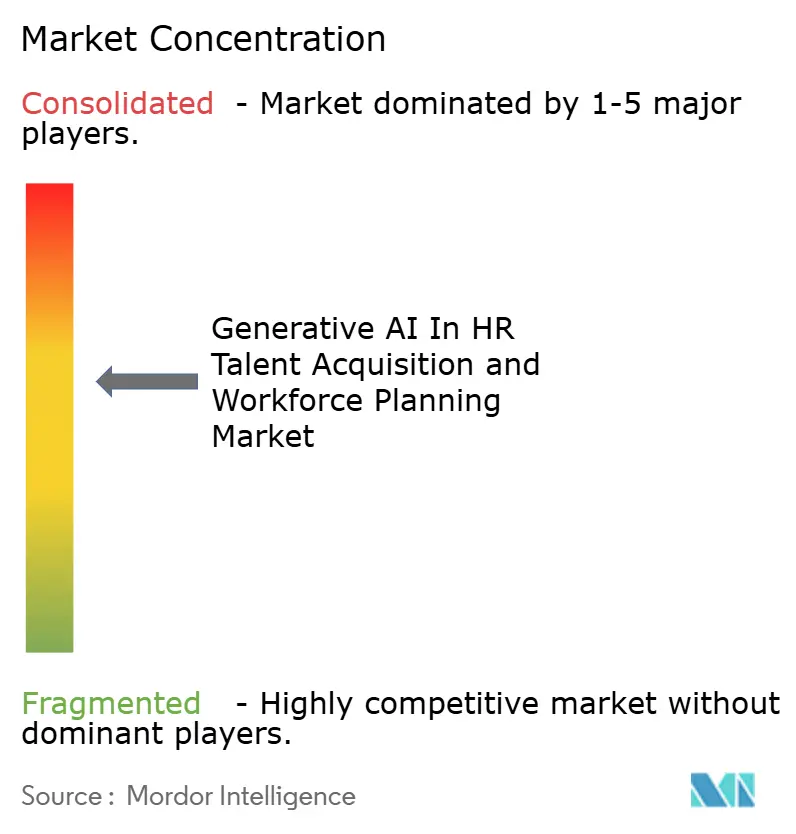
| Market Concentration | Medium |
Major Players *Disclaimer: Major Players sorted in no particular order Image © Mordor Intelligence. Reuse requires attribution under CC BY 4.0. | |
Generative AI In HR Talent Acquisition and Workforce Planning Market Analysis by Mordor Intelligence
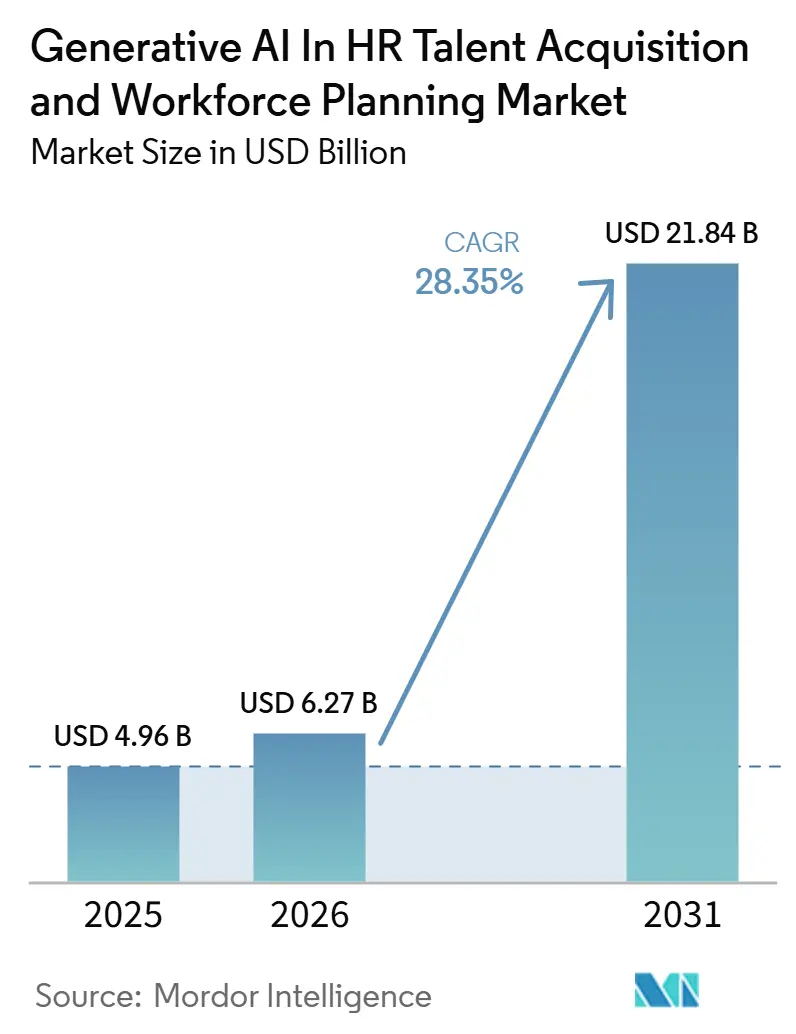
The Generative AI in HR Talent Acquisition and Workforce Planning market size was valued at USD 4.96 billion in 2025 and estimated to grow from USD 6.27 billion in 2026 to reach USD 21.84 billion by 2031, at a CAGR of 28.35% during the forecast period (2026-2031). Growth reflects the broader adoption of large language models across human capital management platforms and recruiting systems. Employers are using these tools to shorten hiring workflows, reduce routine administration, and support workforce decisions. Established HCM suppliers are building agent-based functions into existing platforms, while specialized vendors focus on recruiting, skills intelligence, and candidate engagement. Demand also reflects the need to identify skills faster and plan workforces more flexibly. Privacy, bias testing, and compliance requirements remain important factors in buying decisions and product design.
Key Report Takeaways
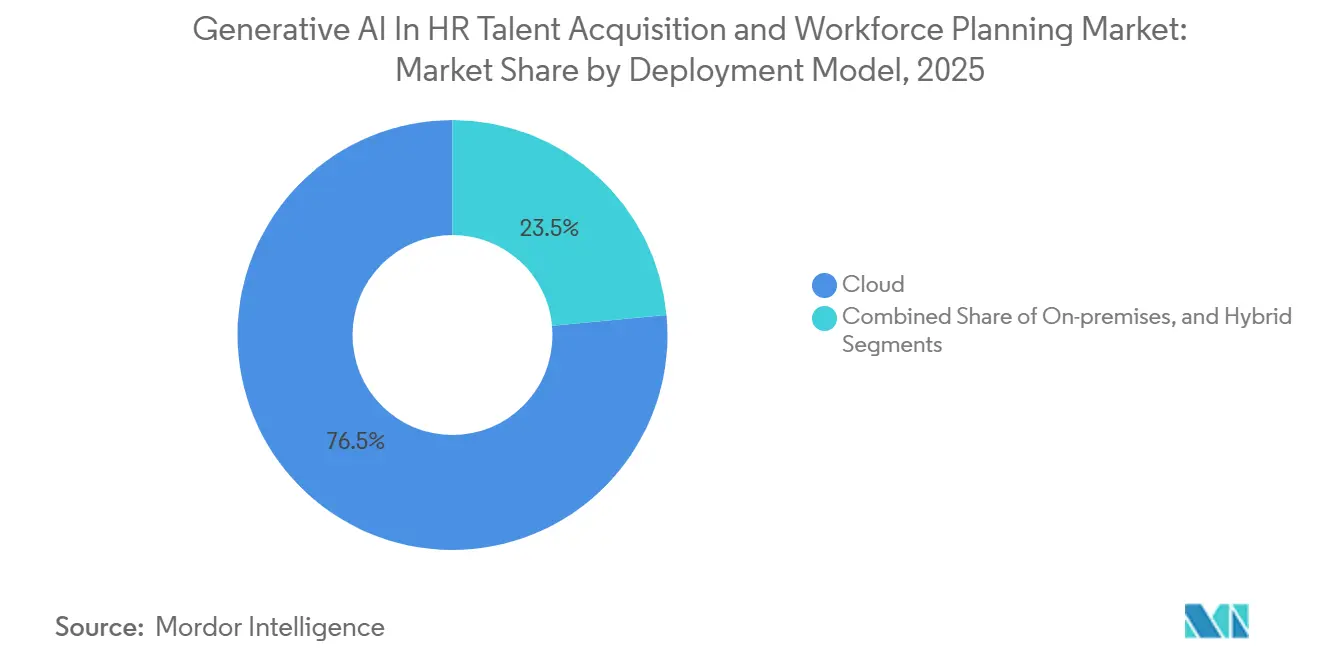
- By deployment model, cloud held 76.48% of the generative AI in HR talent acquisition and workforce planning market share in 2025, while hybrid deployment is projected to expand at a 29.47% CAGR through 2031.
- By HR function, recruitment and talent acquisition held 35.82% of the generative AI in HR talent acquisition and workforce planning market in 2025, while HR analytics and workforce planning are projected to grow at a 30.82% CAGR through 2031.
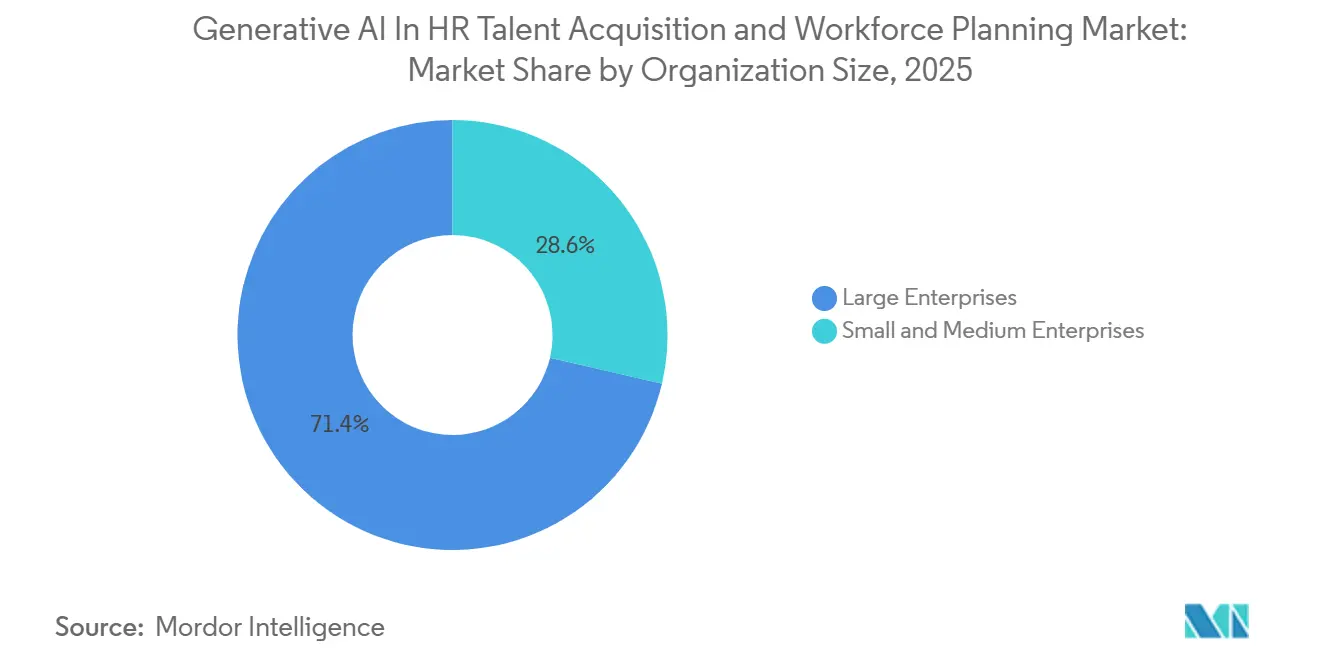
- By organization size, large enterprises accounted for 71.36% of the generative AI in HR talent acquisition and workforce planning market in 2025, while small and medium enterprises are projected to expand at a 29.95% CAGR through 2031.
- By end-use industry, IT and telecom held 24.91% of the generative AI in HR talent acquisition and workforce planning market in 2025, while healthcare and life sciences are projected to grow at a 30.21% CAGR through 2031.
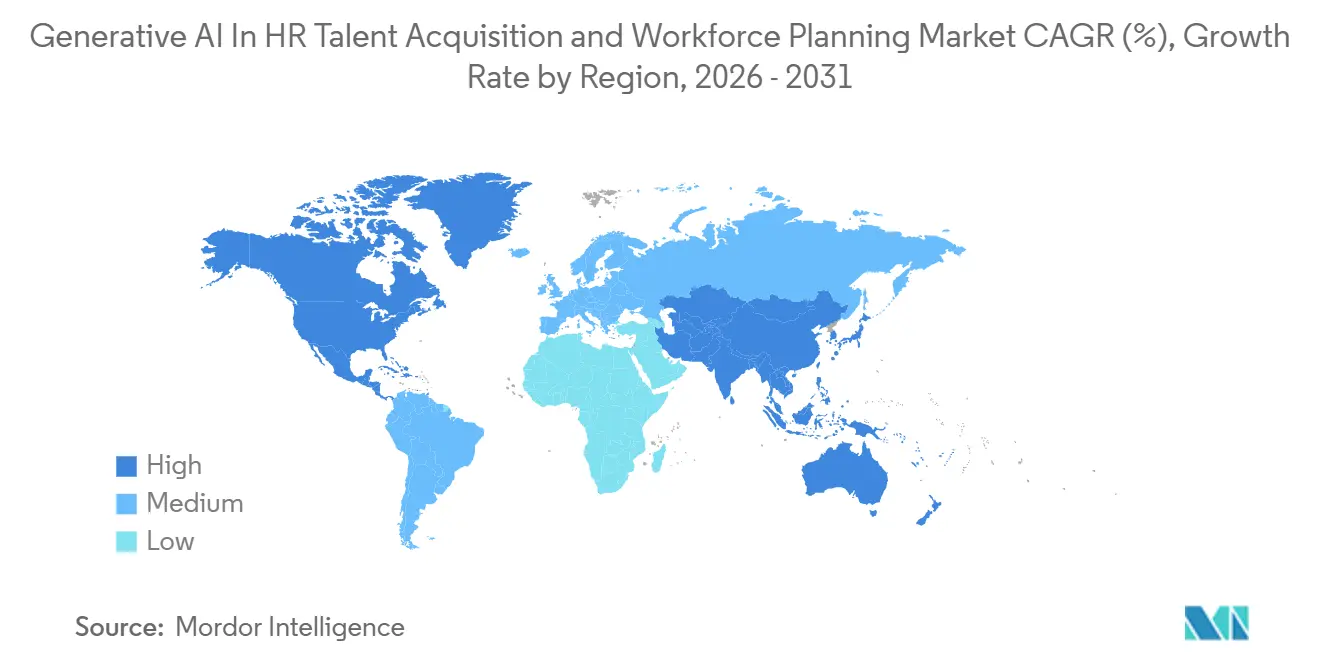
- By geography, North America held 40.27% of the generative AI in HR talent acquisition and workforce planning market in 2025, while Asia-Pacific is projected to expand at a 30.71% CAGR through 2031.
Note: Market size and forecast figures in this report are generated using Mordor Intelligence’s proprietary estimation framework, updated with the latest available data and insights as of January 2026.
Market Trends and Insights
Drivers Impact Analysis of Generative AI In HR Talent Acquisition and Workforce Planning Market*
| Driver | (~) % Impact on CAGR Forecast | Geographic Relevance | Impact Timeline |
|---|---|---|---|
| Large Language Model Adoption in Enterprise HR SaaS | +8.2% | Global, concentrated in North America and Western Europe with fast follow-on in Asia-Pacific | Short term (≤ 2 years) |
| Automation of High-Volume Hiring Workflows | +6.5% | Global, with strongest uptake in North America, India, and Southeast Asia high-volume hiring markets | Short term (≤ 2 years) |
| Conversational AI for Employee and Candidate Self-Service | +4.8% | Global, with spillover concentrated in Asia-Pacific and Middle East mobile-first markets | Medium term (2-4 years) |
| Skills-Based Workforce Planning and Internal Mobility | +3.5% | North America and Europe core, with early gains in Singapore, Australia, and India's GCC clusters | Medium term (2-4 years) |
| Integration With Low-Code HR Tech Stacks | +2.8% | Global, with acceleration in North America and Asia-Pacific enterprise mid-market | Medium term (2-4 years) |
| Personalized Candidate and Employee Content Generation | +2% | Global, with early deployment in North America and Northern Europe | Long term (≥ 4 years) |
| Source: Mordor Intelligence | |||
Large Language Model Adoption in Enterprise HR SaaS
Large language models are moving from trials into core HR software workflows. Workday launched Sana from Workday in March 2026 with more than 300 agentic skills for HR and finance work. Berner Group reported 90% adoption within 40 days and retired 400 ChatGPT licenses after the rollout.[1]Workday, Inc., “Introducing Sana From Workday: Superintelligence for Work That Finds Answers, Takes Action, and Automates Workflows,” Workday Newsroom Oracle introduced 8 Fusion Agentic Applications for HR in April 2026, designed to support actions within Oracle Fusion Cloud HCM workflows. These releases integrate AI functions into the main HR system rather than treating them as separate tools. Procurement teams are also giving more weight to governance controls and AI management practices.
Automation of High-Volume Hiring Workflows
High-volume recruiting provides employers with a clear framework for assessing the operational value of AI. In July 2026, Eightfold stated that early users of its AI Interviewer reduced hiring cycles from 42 days to under 1 week. The company also reported time-to-interview reductions of up to 90% and automation of 80% of manual recruiter tasks.[2]Eightfold AI, Inc., “Eightfold AI Grows Talent Agents to 2.0 With Candidate Agent,” Eightfold AI Press Release Structured screening can improve consistency in early candidate evaluation when organizations closely monitor outcomes. SAP is implementing SmartRecruiters for SAP SuccessFactors across its global operations, with a worldwide go-live scheduled for September 2026. The generative AI in HR talent acquisition and workforce planning market benefits where employers can link faster screening with transparent evaluation controls.
Conversational AI for Employee and Candidate Self-Service
Conversational interfaces are becoming a common route for candidates and employees to use HR services. Paradox's Candidate Experience Agent supports discovery, applications, status questions, and interview scheduling across SMS, WhatsApp, and Messenger. Workday made its Sana Self-Service Agent available through Microsoft 365 Copilot in May 2026. The service lets employees and managers complete HR and finance tasks within the Microsoft environment.[3]Paradox.ai, “Candidate Experience Agent,” Paradox.ai This approach reduces the need to move users to separate HR portals. It also raises the importance of accurate answers, clear escalation paths, and language support.
Skills-Based Workforce Planning and Internal Mobility
Skills-based planning is increasing the need for HR systems that can organize and refresh workforce data. The World Economic Forum reported in 2025 that skills-based hiring is developing into a broader workforce approach.[4]World Economic Forum, “Skills-Based Hiring Can Help Us Recruit for Jobs That Don't Exist Yet,” World Economic Forum Generative AI can help HR teams connect job descriptions, employee records, learning activities, and talent demand. This supports internal mobility by matching people to roles based on demonstrated skills rather than job titles alone. It also gives employers a way to compare internal movement with external recruitment. The generative AI in HR talent acquisition and workforce planning market is therefore moving toward linked talent acquisition, development, and workforce planning functions.
Restraints Impact Analysis of Generative AI In HR Talent Acquisition and Workforce Planning Market*
| Restraint | (~) % Impact on CAGR Forecast | Geographic Relevance | Impact Timeline |
|---|---|---|---|
| Data Privacy, Bias, and Fairness Concerns | -3.5% | Global, most acute in the EU, North America, and Asia-Pacific regulatory environments | Short term (≤ 2 years) |
| Limited HR-Specific Training Data Quality | -2.8% | Global, with the strongest constraints in South America, Africa, and emerging Asia-Pacific markets | Medium term (2-4 years) |
| High Fine-Tuning and Governance Costs | -2.2% | North America and Europe, where enterprise fine-tuning and audit infrastructure require capital allocation | Medium term (2-4 years) |
| Intellectual Property and Content Ownership Ambiguity | -1.5% | Global, with early regulatory clarity emerging in the United States and the United Kingdom | Long term (≥ 4 years) |
| Source: Mordor Intelligence | |||
Data Privacy, Bias, and Fairness Concerns
Bias and fairness concerns create legal and reputational risks for employers using AI in hiring. A 2026 study in Scientific Reports found that intersectional bias can manifest across race, gender, and age in AI recruitment systems. This makes simple, single-category reviews insufficient for many hiring models. Employers need documented testing, oversight, and a process for reviewing model outcomes. These requirements may be harder for smaller suppliers to meet consistently. They also make governance capability a central part of the generative AI in HR talent acquisition and workforce planning market offering.
Limited HR-Specific Training Data Quality
HR models depend on complete, representative, and well-managed workforce data. A 2025 systematic review found that dataset bias was the most common source of discriminatory outcomes in AI-supported HR tools. Fragmented applicant tracking systems and incomplete outcome records can limit the reliability of testing. Organizations must often improve data definitions and record quality before deploying AI across major HR processes. This work can delay returns from new software investments. It can also widen the gap between organizations with mature HR data and those still using disconnected systems.
*Our forecasts treat driver/restraint impacts as directional, not additive. The impact forecasts reflect baseline growth, mix effects, and variable interactions.
Generative AI In HR Talent Acquisition and Workforce Planning Market Segment Analysis
By Deployment Model:
Hybrid Deployments Gain Importance in Regulated SettingsCloud held 76.48% of the generative AI in HR talent acquisition and workforce planning market share in 2025. The position reflects the long-running migration of core human capital systems to software-as-a-service platforms. Major suppliers use cloud architectures to deliver AI functions across their HR suites. This keeps cloud deployment central for organizations that can meet cloud data governance requirements.
Hybrid deployment is projected to grow at a 29.47% CAGR through 2031. Financial services, healthcare, and government organizations may retain payroll or candidate data in controlled environments. They can still use cloud services for selected analytics and inference workloads. Oracle introduced an AI-native builder experience for Fusion Applications in July 2026, including no-code, low-code, and pro-code options. On-premises systems remain relevant where legacy integration requirements or strict data sovereignty rules are in place. Hybrid capability is becoming important for suppliers serving regulated enterprise accounts.



By HR Function:
Talent Acquisition Leads While Workforce Planning ExpandsRecruitment and talent acquisition accounted for 35.82% of the generative AI in HR talent acquisition and workforce planning market size in 2025. Recruiting produces recurring workflows that can be measured through time-to-fill, interview completion, and offer outcomes. These data points make the use case easier to explain to HR and finance leaders. High hiring volumes also give organizations repeated opportunities to refine their processes.
HR analytics and workforce planning are projected to expand at a 30.82% CAGR through 2031. The function is shifting from static reporting toward scenario planning, skills mapping, and internal mobility support. Employers can use AI to identify likely skills gaps before a hiring requirement becomes urgent. Learning and development, engagement, and performance management also add demand for connected people data. The result is a closer relationship between recruiting, development, and retention. Suppliers that integrate these functions into a single experience may be better positioned to serve enterprise buyers.
By Organization Size:
Large Enterprises Retain Scale AdvantagesLarge enterprises captured 71.36% of the generative AI in HR talent acquisition and workforce planning market in 2025. These organizations usually have larger HR data sets, integration resources, and budgets for governance work. They are also more likely to operate complex, global HR processes. SHRM reported in 2026 that 60% of extra-large organizations had implemented AI tools in HR, compared with 33% of small and 35% of midsize organizations.
Small and medium enterprises are projected to expand at a 29.95% CAGR through 2031. Modular software and application programming interfaces can lower the entry cost for these buyers. The OECD reported in 2025 that nearly 1-third of surveyed SMEs across 7 countries used generative AI in some form. Smaller organizations may adopt useful functions before building full governance processes. This can support near-term use but create problems when deployments become broader. Vendors need simple controls and clear implementation support for this customer group.
By End-Use Industry:
IT and Telecom Leads as Healthcare Builds MomentumIT and telecom accounted for 24.91% of the generative AI in HR talent acquisition and workforce planning market size in 2025. The sector has digitized HR records and cloud infrastructure that can support AI deployment. It also faces continuing demand for technical skills, which strengthens the value of sourcing and skills analysis tools. These conditions make the sector an early user of AI-supported recruiting and workforce planning.
Healthcare and life sciences are projected to grow at a 30.21% CAGR through 2031. Persistent clinical talent shortages encourage providers to improve sourcing and retention processes. ManpowerGroup reported in 2026 that 60% of life sciences executives planned to increase investment in generative AI across their value chains. The sector still needs careful handling of sensitive workforce information and role-specific requirements. BFSI also contributes to demand because it requires stringent data controls and costly, specialized hiring. Manufacturing, retail, and e-commerce use these tools for frontline hiring and seasonal workforce planning.
Geography Analysis
North America Generative AI in HR Talent Acquisition and Workforce Planning Market
North America held 40.27% of the generative AI in HR talent acquisition and workforce planning market share in 2025. The region has a concentrated base of enterprise HR software suppliers and cloud HCM users. The United States drives most regional demand, while Canada and Mexico benefit from cross-border platform deployments. Workday brought Sana Self-Service Agent to Microsoft 365 Copilot in May 2026. Placing HR functions within established productivity software can reduce user adoption barriers.
APAC Generative AI in HR Talent Acquisition and Workforce Planning Market
Asia-Pacific is projected to grow at a 30.71% CAGR through 2031. Employers across India, China, and Southeast Asia are digitizing recruiting and employee services. India and China are developing products that reflect local languages and labor market conditions. Mobile-first candidate interactions support demand for multilingual conversational AI and efficient recruiting workflows.
EMEA and South America Generative AI in HR Talent Acquisition and Workforce Planning Market
Europe remains an important but compliance-shaped demand center. The EU AI Act treats many employment AI uses as high-risk, which increases the need for assessment, documentation, and human oversight. Leapsome introduced an AI recruiting and people management suite in 2026 that emphasizes GDPR-compliant and explainable AI agents. South America is developing from a smaller base, with Brazil and Argentina showing active demand. The Middle East has targeted potential through workforce nationalization programs, especially in Saudi Arabia and the UAE. Africa remains at an early stage, with South Africa and Egypt leading initial adoption.

Competitive Landscape
The generative AI in HR talent acquisition and workforce planning market is moderately consolidated among enterprise platform providers and fragmented among specialists and smaller-business suppliers. Workday, Oracle, SAP, and Microsoft compete through broad platform coverage and installed customer relationships. They can embed AI features into existing HR contracts, reducing the need for separate procurement. This creates switching costs for customers already using their HCM platforms. Specialized suppliers compete by recruiting, interviewing, gathering skills intelligence, and using targeted workflow tools.
Workday launched Sana from Workday in March 2026 with more than 300 agentic skills for HR and finance. Oracle introduced 8 Fusion Agentic Applications for HR in April 2026. SAP has integrated SmartRecruiters into SAP SuccessFactors following its 2025 acquisition. The integration brings connected hiring data, AI-based candidate matching, and Joule and Winston agents into its HCM environment. These moves show that established vendors are extending core platforms rather than treating AI as a separate feature.
Eightfold AI, Phenom People, Paradox, HireVue, and Gloat compete on specialized models and deployment speed. Eightfold stated that it received ISO 42001 certification and conducts third-party bias audits, including audits under New York City Local Law 144. Governance functions are becoming part of the product proposition for suppliers selling into regulated employers. Data depth remains an important differentiator for suppliers with large proprietary talent data sets.
Generative AI In HR Talent Acquisition and Workforce Planning Industry Leaders
Workday, Inc.
Oracle Corporation
SAP SE
Microsoft Corporation
Eightfold AI, Inc.
- *Disclaimer: Major Players sorted in no particular order
Generative AI In HR Talent Acquisition and Workforce Planning Market Companies Covered in this Report
- Workday, Inc.
- Oracle Corporation
- SAP SE
- Microsoft Corporation
- Eightfold AI, Inc.
- Phenom People, Inc.
- iCIMS, Inc.
- Beamery Ltd.
- Gloat, Inc.
- HireVue, Inc.
- Paradox.ai, Inc.
- Greenhouse Software, Inc.
- Lever, Inc.
- Textio, Inc.
- SeekOut Inc.
- Retain.ai Ltd.
- Lattice, Inc.
- ADP, Inc.
- IBM Corporation
- ServiceNow, Inc.

Recent Industry Developments in Generative AI In HR Talent Acquisition and Workforce Planning Market
- July 2026: Eightfold AI, Inc. launched Talent Agents 2.0, including Candidate Agent, a conversational AI covering job discovery, application, scheduling, and handoff to AI Interviewer in 24+ languages across SMS, WhatsApp, and web. Early adopters reported hiring cycles compressed from 42 days to under 1 week and time-to-interview reduced by up to 90%.
- July 2026: Oracle Corporation introduced an AI-native builder experience for Oracle AI Agent Studio for Fusion Applications, enabling no-code, low-code, and pro-code development of agentic HR applications within Oracle Fusion Cloud.
- June 2026: SAP SE published the Future of Hiring case study confirming that SAP is implementing SmartRecruiters for SAP SuccessFactors across its global operations, with a worldwide go-live scheduled for September 2026.
- June 2026: PageUp launched Paige, a multifunctional agentic assistant embedded in its talent acquisition suite for candidate pipeline review, applicant information analysis, workflow guidance, and citation-backed responses.


Global Generative AI In HR Talent Acquisition and Workforce Planning Market Report Scope
The Generative AI in HR Talent Acquisition and Workforce Planning Market Report is Segmented by Deployment Model (Cloud, On-Premises, and Hybrid), HR Function (Recruitment and Talent Acquisition, Learning and Development, Performance Management, Employee Engagement and Experience, HR Analytics and Workforce Planning, and Other HR Functions), Organization Size (Large Enterprises and Small and Medium Enterprises), End-Use (IT and Telecom, BFSI, Healthcare and Life Sciences, Manufacturing, Retail and E-commerce, and Other End-Use Industries), and Geography (North America, South America, Europe, Asia-Pacific, Middle East, and Africa). The Market Forecasts are Provided in Terms of Value (USD).
| Cloud |
| On-Premises |
| Hybrid |
| Recruitment and Talent Acquisition |
| Learning and Development |
| Employee Engagement and Experience |
| Performance Management |
| HR Analytics and Workforce Planning |
| Other HR Functions |
| Large Enterprises |
| Small and Medium Enterprises |
| IT and Telecom |
| BFSI |
| Healthcare and Life Sciences |
| Manufacturing |
| Retail and E-commerce |
| Other End-Use Industries |
| North America | United States |
| Canada | |
| Mexico | |
| South America | Brazil |
| Argentina | |
| Rest of South America | |
| Europe | Germany |
| United Kingdom | |
| France | |
| Italy | |
| Spain | |
| Russia | |
| Rest of Europe | |
| Asia-Pacific | China |
| Japan | |
| India | |
| South Korea | |
| Australia | |
| Rest of Asia-Pacific | |
| Middle East | Saudi Arabia |
| United Arab Emirates | |
| Turkey | |
| Rest of Middle East | |
| Africa | South Africa |
| Egypt | |
| Rest of Africa |
| By Deployment Model | Cloud | |
| On-Premises | ||
| Hybrid | ||
| By HR Function | Recruitment and Talent Acquisition | |
| Learning and Development | ||
| Employee Engagement and Experience | ||
| Performance Management | ||
| HR Analytics and Workforce Planning | ||
| Other HR Functions | ||
| By Organization Size | Large Enterprises | |
| Small and Medium Enterprises | ||
| By End-Use Industry | IT and Telecom | |
| BFSI | ||
| Healthcare and Life Sciences | ||
| Manufacturing | ||
| Retail and E-commerce | ||
| Other End-Use Industries | ||
| By Geography | North America | United States |
| Canada | ||
| Mexico | ||
| South America | Brazil | |
| Argentina | ||
| Rest of South America | ||
| Europe | Germany | |
| United Kingdom | ||
| France | ||
| Italy | ||
| Spain | ||
| Russia | ||
| Rest of Europe | ||
| Asia-Pacific | China | |
| Japan | ||
| India | ||
| South Korea | ||
| Australia | ||
| Rest of Asia-Pacific | ||
| Middle East | Saudi Arabia | |
| United Arab Emirates | ||
| Turkey | ||
| Rest of Middle East | ||
| Africa | South Africa | |
| Egypt | ||
| Rest of Africa | ||


Key Questions Answered in the Report
What is the size of the generative AI in HR talent acquisition and workforce planning market?
The generative AI in HR talent acquisition and workforce planning market was valued at USD 4.96 billion in 2025 and is estimated at USD 6.27 billion in 2026. It is projected to reach USD 21.84 billion by 2031 at a 28.35% CAGR.
What is driving adoption of generative AI in HR talent acquisition and workforce planning market?
Adoption is supported by large language model integration, high-volume recruiting automation, conversational self-service, and skills-based workforce planning. Employers also use these functions to reduce administrative work and improve the speed of talent decisions.
Which deployment model leads the generative AI in HR talent acquisition and workforce planning market?
Cloud led with 76.48% share in 2025 because HR software has increasingly moved to software-as-a-service environments. Hybrid deployment is projected to record the highest growth, at a 29.47% CAGR through 2031, as regulated organizations balance security requirements and cloud capabilities.
Which HR function has the largest share in the generative AI in HR talent acquisition and workforce planning market?
Recruitment and talent acquisition held 35.82% in 2025, reflecting frequent and measurable workflows. HR analytics and workforce planning is projected to grow fastest, at a 30.82% CAGR through 2031, as employers use skills data to support scenario planning and internal mobility.
Which region is expected to grow fastest in the generative AI in HR talent acquisition and workforce planning market?
Asia-Pacific is projected to grow at a 30.71% CAGR through 2031. The region combines rapid HR digitization, mobile-first hiring practices, and growing need for local-language candidate interactions.
What challenges affect AI use in hiring?
Key challenges include privacy, bias, fairness, limited HR data quality, governance costs, and uncertainty around content ownership. These issues require organizations to improve controls, testing processes, oversight, and the quality of workforce records before scaling deployment.
Page last updated on:





