
Generative AI In Enterprise Knowledge Management and Search Market Size and Share
Market Overview
| Study Period | 2020 - 2031 |
|---|---|
| Market Size (2026) | USD 7.81 Billion |
| Market Size (2031) | USD 27.43 Billion |
| Growth Rate (2026 - 2031) | 28.56 % |
| Fastest Growing Market | Asia-Pacific |
| Largest Market | North America |
| Market Concentration | Medium |
Major Players *Disclaimer: Major Players sorted in no particular order Image © Mordor Intelligence. Reuse requires attribution under CC BY 4.0. | |
Generative AI In Enterprise Knowledge Management and Search Market Analysis by Mordor Intelligence
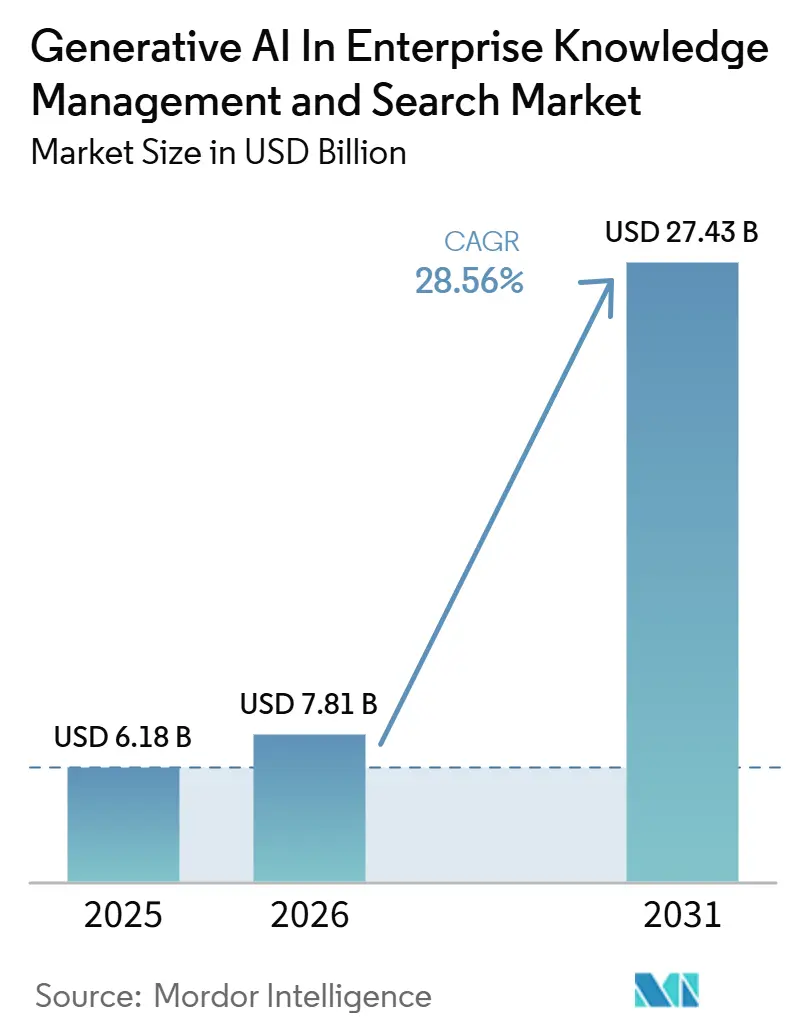
The generative AI in enterprise knowledge management and search market size is expected to increase from USD 6.18 billion in 2025 to USD 7.81 billion in 2026 and reach USD 27.43 billion by 2031, growing at a CAGR of 28.56% over 2026-2031. Organizations are seeking reliable value from knowledge held across disconnected SaaS repositories. Context-aware systems that provide grounded answers are replacing keyword-only retrieval for many enterprise use cases. Large platform providers are embedding retrieval-augmented generation pipelines and agentic knowledge functions in established enterprise suites. This reduces deployment barriers but raises the standard for specialized providers. Trust, auditability, and real-time permission enforcement remain central conditions for broader workforce adoption of the generative AI in enterprise knowledge management and search market.
Key Report Takeaways
- By offering, software platforms held 73.64%share of the generative AI in enterprise knowledge management and search market in 2025, while services are projected to expand at a CAGR of 29.47% through 2031.
- By deployment mode, cloud accounted for 78.21% share in 2025, while hybrid deployment is projected to expand at a CAGR of 29.92% through 2031.
- By enterprise size, large enterprises held 72.88% share of the generative AI in enterprise knowledge management and search market in 2025, while small and medium enterprises are projected to expand at a CAGR of 29.84% through 2031.
- By end user, information technology and telecom accounted for 26.84% share of the generative AI in enterprise knowledge management and search market in 2025, while healthcare and life sciences are projected to expand at a CAGR of 30.36% through 2031.
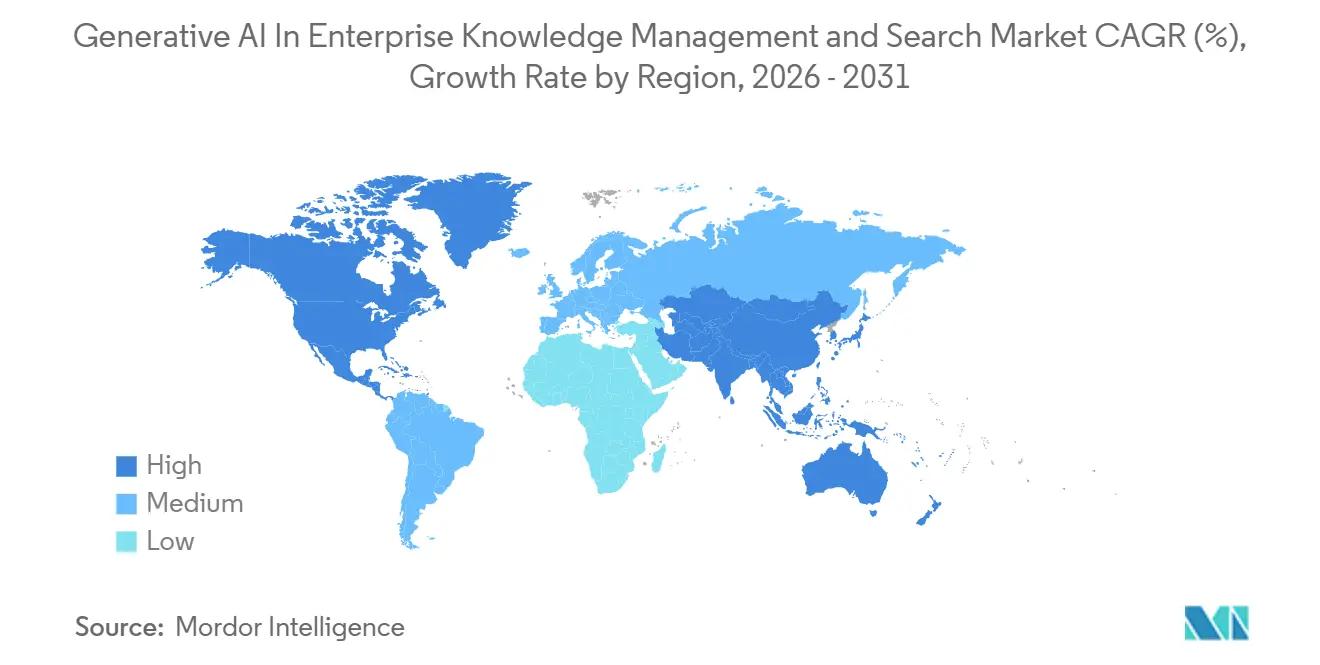
- By geography, North America held 40.86% share of the generative AI in enterprise knowledge management and search market in 2025, while the Asia-Pacific is projected to expand at a CAGR of 30.74% through 2031.
Note: Market size and forecast figures in this report are generated using Mordor Intelligence’s proprietary estimation framework, updated with the latest available data and insights as of January 2026.
Market Trends and Insights
Drivers Impact Analysis of Generative AI In Enterprise Knowledge Management and Search Market*
| Driver | (~) % Impact on CAGR Forecast | Geographic Relevance | Impact Timeline |
|---|---|---|---|
| Enterprise Knowledge Fragmentation Across SaaS Stacks | +6.8% | Global | Short term (≤ 2 years) |
| Permission-Aware Semantic Search and Grounded Answers | +5.9% | Global | Medium term (2-4 years) |
| Copilot-Led Knowledge Workflows | +4.8% | North America and Europe | Medium term (2-4 years) |
| Retrieval of Tribal Knowledge for Distributed Teams | +3.4% | Global | Short term (≤ 2 years) |
| Model Governance, Auditability, and Citation-Backed Answers | +2.6% | Europe and North America | Medium term (2-4 years) |
| Domain-Specific Context Graphs and Agentic Retrieval | +1.8% | North America and Asia-Pacific | Long term (≥ 4 years) |
| Source: Mordor Intelligence | |||
Rising Enterprise Knowledge Fragmentation Across SaaS Stacks
Enterprises often operate more than 125 SaaS applications with separate data models, access controls, and indexes. This structure makes cross-system retrieval difficult without a shared intelligence layer. Disconnected data from Salesforce, Confluence, Slack, and ServiceNow can degrade answer quality as AI programs expand. Knowledge workers can spend substantial time locating information or identifying colleagues who can help. A governed knowledge graph can provide a common foundation instead of linking each AI agent to isolated repositories. The generative AI in enterprise knowledge management and search market therefore benefits when organizations treat knowledge unification as an architectural priority.
Demand for Permission-Aware Semantic Search and Grounded Answers
Semantic search is gaining attention because incorrect access to privileged information creates legal and reputational exposure. Older keyword systems can rely on static permission caches that do not reflect current employee roles. This weakness may remain hidden until an audit identifies unauthorized access. Amazon Web Services made Amazon Bedrock Managed Knowledge Base generally available in June 2026 with real-time access-control-list enforcement in a managed retrieval-augmented generation service.[1]Amazon Web Services, “Amazon Bedrock Managed Knowledge Base Now Generally Available,” Amazon Web Services Permission enforcement is becoming an infrastructure capability rather than an application setting. Financial services, healthcare, and government buyers are making retrieval-time permission accuracy a vendor selection requirement in the generative AI in enterprise knowledge management and search market.
Shift From Static Search to Copilot-Led Knowledge Workflows
Knowledge retrieval is moving from a user-initiated search to a function embedded in work completion. Copilots can surface relevant material while employees draft documents, resolve incidents, or respond to customers. This broadens the use case beyond activity in a search box. ServiceNow launched Otto at Knowledge 2026 in May 2026, combining conversational AI, autonomous workflows, and enterprise search in one experience.[2]ServiceNow, “ServiceNow Moves Beyond the Sidecar AI Era,” ServiceNow Workflow-embedded systems can be assessed through case-resolution time, ticket deflection, and draft-quality measures. Those measures can make investment cases easier to evaluate within the generative AI in enterprise knowledge management and search market.
Faster Retrieval of Tribal Knowledge for Hybrid and Distributed Teams
Distributed teams can lose access to informal expertise once shared through direct workplace interaction. That knowledge becomes harder to find when specialists work across time zones or leave the organization. Systems that index meeting transcripts, collaboration channels, and code discussions can make this material more accessible under suitable permissions. OECD data showed that generative AI adoption among small and medium enterprises rose to 26% in 2025 from 18% in 2024.[3]OECD, “SME Digitalisation for Competitiveness,” Organisation for Economic Co-operation and Development These users sought productivity gains and wider access to institutional knowledge. Multimodal indexing, current ingestion, and confidence-scored synthesis distinguish purpose-built platforms in the generative AI in enterprise knowledge management and search market.
Restraints Impact Analysis of Generative AI In Enterprise Knowledge Management and Search Market*
| Restraint | (~) % Impact on CAGR Forecast | Geographic Relevance | Impact Timeline |
|---|---|---|---|
| Hallucination Risk and Limited Trust in AI Answers | -2.6% | Global | Short term (≤ 2 years) |
| Integration With Legacy Repositories, Applications, and Identity Systems | -2.1% | Global | Medium term (2-4 years) |
| Data Privacy, Access Control, Data Residency, and Compliance Challenges | -1.4% | Europe and North America | Medium term (2-4 years) |
| Poor Content Quality, Outdated Knowledge, and Inconsistent Taxonomies | -0.8% | Global | Long term (≥ 4 years) |
| Source: Mordor Intelligence | |||
Hallucination Risk and Limited Enterprise Trust in Incorrect or Unverifiable AI-Generated Answers
Hallucinated answers remain a significant concern for legal research, compliance reporting, and clinical decision support. Foundation models are probabilistic, and their reasoning can be difficult to inspect when errors occur. MIT CISR identified this opacity as a structural issue that organizations must manage rather than eliminate.[4]MIT Center for Information Systems Research, “Mapping the Generative AI Risk Space,” MIT CISR Procurement teams in regulated fields can delay deployment when answers cannot be verified. Citation-backed outputs allow employees to trace statements to a retrievable document. Vendors that provide source attribution are better placed to address a core trust barrier in the generative AI in enterprise knowledge management and search market.
Complex Integration With Legacy Repositories, Enterprise Applications, and Identity Systems
A significant portion of enterprise knowledge remains in legacy content platforms, on-premises stores, and proprietary databases. These systems may use outdated authentication structures that complicate comprehensive indexing. Role changes can also fail to reach SaaS knowledge tools in real time, leaving stale permission caches. IBM introduced its OpenRAG framework on watsonx.data for governed retrieval across hybrid environments, with governance applied during inference. Integration requirements can lengthen sales cycles and limit the transition from pilot projects to production. Manufacturing, government, and financial services can offer substantial contract value, but they also require the most demanding deployments in the generative AI in enterprise knowledge management and search market.
*Our forecasts treat driver/restraint impacts as directional, not additive. The impact forecasts reflect baseline growth, mix effects, and variable interactions.
Generative AI In Enterprise Knowledge Management and Search Market Segment Analysis
By Offering:
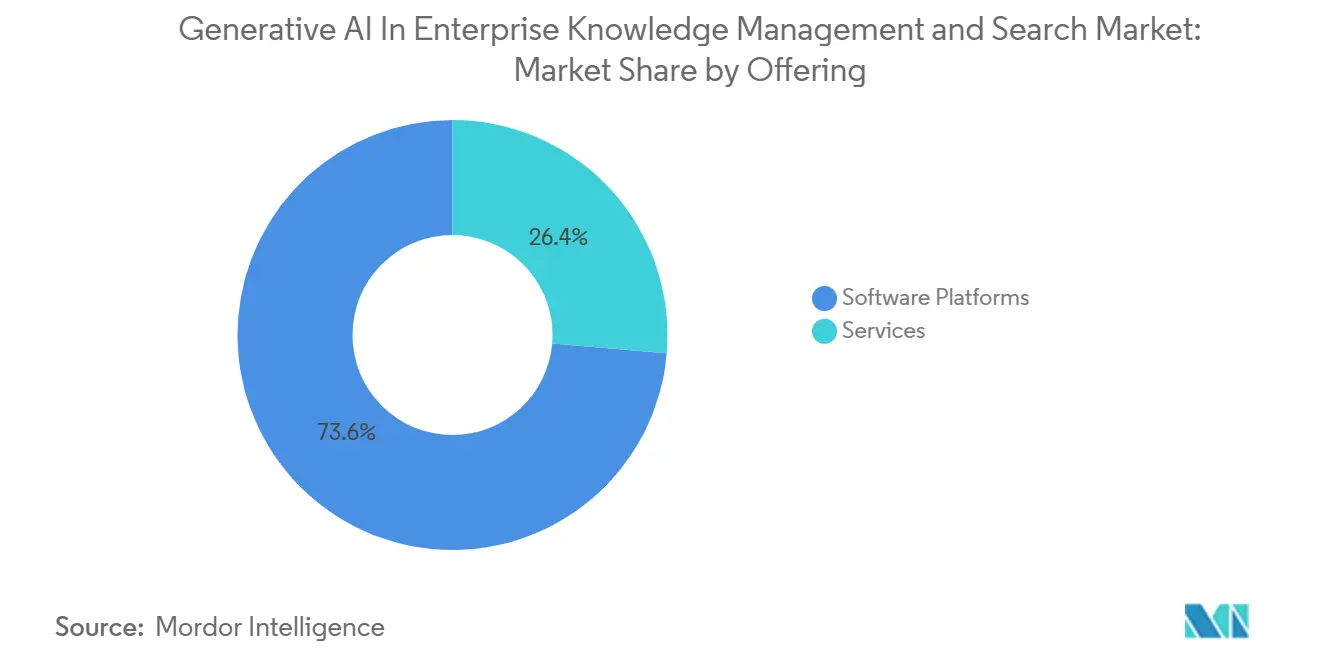
Software Platforms Lead Deployments While Services ExpandSoftware platforms held 73.64% of the generative AI in enterprise knowledge management and search market share in 2025. Indexing engines, orchestration layers, and permission graphs form the foundation of knowledge retrieval systems. Buyers generally need this infrastructure before they can deploy a broader use case. Microsoft, Google, and Amazon Web Services can embed platform functions in existing enterprise agreements. This can make platform procurement an extension of wider infrastructure commitments. Platform demand also reflects the need to connect many repositories under a common set of controls.
Services are projected to grow at a CAGR of 29.47% from 2026 to 2031. Organizations need support for domain-specific tuning, retrieval-pipeline optimization, and governance design after initial implementation. These requirements often extend beyond a single deployment project. Agentic workflows also require continuing changes as systems move beyond single-turn queries. Service revenue can therefore shift toward recurring work rather than one-time configuration. Salesforce introduced Agentic Enterprise Search in its Spring 2026 release, using context from more than 200 external sources and coordinating multiple AI agents. This product direction shows how service requirements are becoming part of platform architecture in the generative AI in enterprise knowledge management and search market.


By Deployment Mode:
Cloud Leads While Hybrid Use ExpandsCloud deployment held 78.21% of the generative AI in enterprise knowledge management and search market in 2025. Managed ingestion pipelines, elastic indexing, and SaaS connectors support this deployment preference. Cloud services can make it easier to connect common enterprise applications. They also reduce the need for organizations to manage core retrieval infrastructure internally. These benefits are especially relevant when data sources change frequently. The cloud model remains the main route for organizations seeking faster deployment.
Hybrid deployment is projected to grow at a CAGR of 29.92% through 2031. Regulated documents, legacy stores, and high-security repositories can require local indexing alongside cloud orchestration. On-premises systems remain relevant in defense, financial services, and healthcare due to strict data-residency requirements. IBM's watsonx.data Context capabilities support retrieval across hybrid environments with governance applied to the process. Hybrid deployments can preserve access to sensitive data while still supporting modern orchestration tools. This makes them relevant to organizations with mixed technology estates in the generative AI in enterprise knowledge management and search market.
By Enterprise Size:
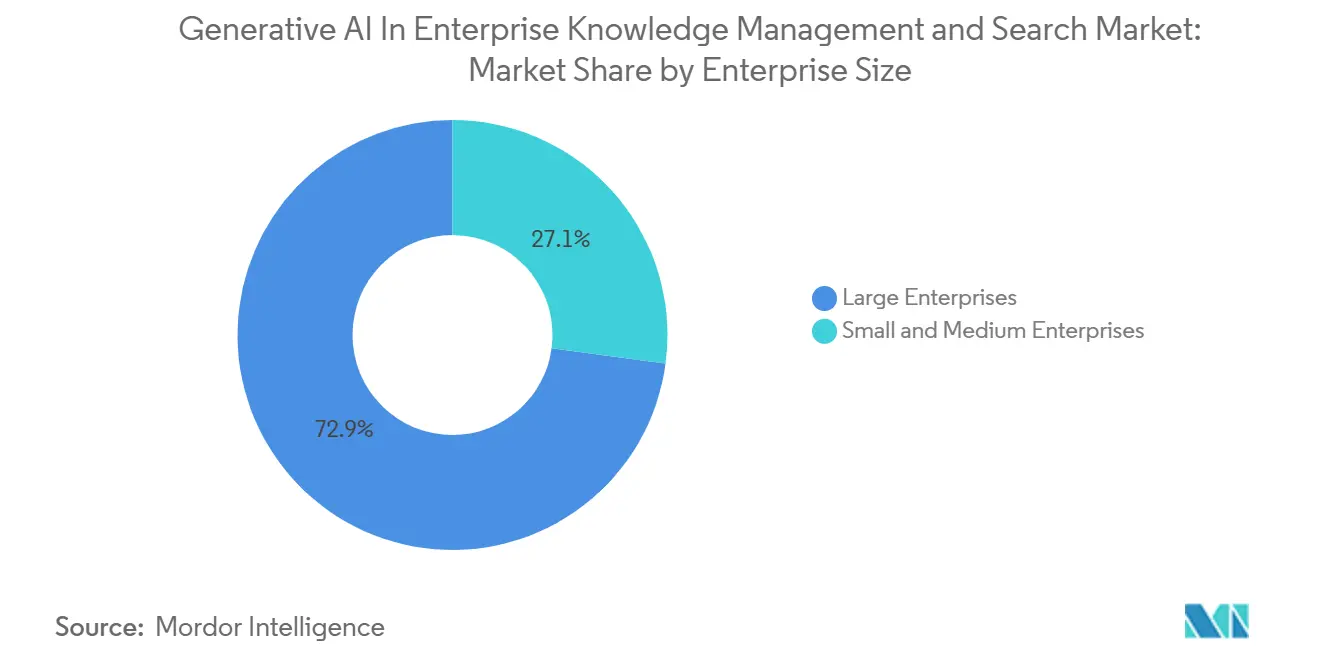
Large Enterprises Lead While SMEs Grow FasterLarge enterprises commanded 72.88% of the generative AI in enterprise knowledge management and search market share in 2025. These organizations hold large volumes of fragmented knowledge and face substantial regulatory exposure. They also have wider information technology budgets for integration and governance. Large SaaS portfolios across business units can create retrieval gaps that become more serious as organizations grow. The need to connect many systems supports early adoption among complex enterprises. Their requirements often include detailed role controls and audit trails.
Small and medium enterprises are projected to expand at a CAGR of 29.84% from 2026 to 2031. Cloud-native and API-first products can reduce deployment costs and technical burden. The OECD reported that 91% of small- and medium-sized enterprise users of generative AI cited productivity gains as their primary benefit in 2025. ServiceNow launched its Enterprise Service Management Foundation product for midsize companies in 2026. More focused packaging can improve access for buyers without large implementation teams. This creates a broader buyer base for the generative AI in enterprise knowledge management and search market.
By End User:
IT and Telecom Leads While Healthcare AcceleratesInformation technology and telecom accounted for 26.84% of the generative AI in enterprise knowledge management and search market share in 2025. The sector contains extensive technical knowledge, including runbooks and incident reports. Service-desk applications can use this material for ticket deflection and incident knowledge synthesis. These uses offer operational measures that can support procurement decisions. BFSI organizations focus on retrieving compliance documents and creating audit trails. Manufacturing, retail and e-commerce, government, and public-sector users use related systems for supplier records, onboarding, and administrative functions.
Healthcare and life sciences are projected to expand at a 30.36% CAGR through 2031. Clinicians need evidence-backed answers at the point of care, which increases the value of grounded retrieval. IQVIA introduced IQVIA.ai in March 2026 for clinical, commercial, and real-world intelligence applications. Healthcare systems must meet HIPAA and comparable national health data requirements. This shapes selection toward products with data lineage, output logging, and access audit trails. The specialized compliance needs can support demand in the generative AI in enterprise knowledge management and search market.
Geography Analysis
North America Generative AI in Enterprise Knowledge Management and Search Market
North America held 40.86% of the generative AI in enterprise knowledge management and search market share in 2025. The region benefits from a high concentration of SaaS-native enterprises and cloud infrastructure. The United States leads demand across the product stack. Fortune 500 buyers, technology companies, and a developed vendor base support this position. Dedicated knowledge platforms have gained traction as organizations consolidate AI spending. Canada contributes growing demand, while Mexico benefits from shared-service centers that are building AI-enabled knowledge operations.
APAC Generative AI in Enterprise Knowledge Management and Search Market
Asia-Pacific is projected to grow at a CAGR of 30.74% through 2031. China, India, South Korea, and Australia are increasing enterprise digitalization activity. India's technology services sector supports demand from domestic enterprises and multinational clients. Multilingual retrieval is relevant for its varied regional workforce. South Korean manufacturing groups and telecom companies use domain-specific retrieval for engineering documentation. Japan and Australia are advancing more gradually, taking privacy and compliance considerations into account. The OECD reported that the gap in AI adoption between larger firms and SMEs remained pronounced across Asia-Pacific economies in 2025.
EMEA and South America Generative AI in Enterprise Knowledge Management and Search Market
Europe is the second-largest regional area for the generative AI in enterprise knowledge management and search market. Germany, the United Kingdom, and France generate much of the region's enterprise spending. The EU AI Act creates transparency and oversight requirements for relevant AI applications. This favors platforms that provide citation provenance and access logs. South America is emerging, with early adoption in Brazilian and Argentine financial services and retail. Saudi Arabia and the United Arab Emirates are supporting demand through government digitalization programs. Africa remains at an earlier stage, with South Africa and Egypt among the initial commercial locations for financial services and telecommunications deployments.

Competitive Landscape
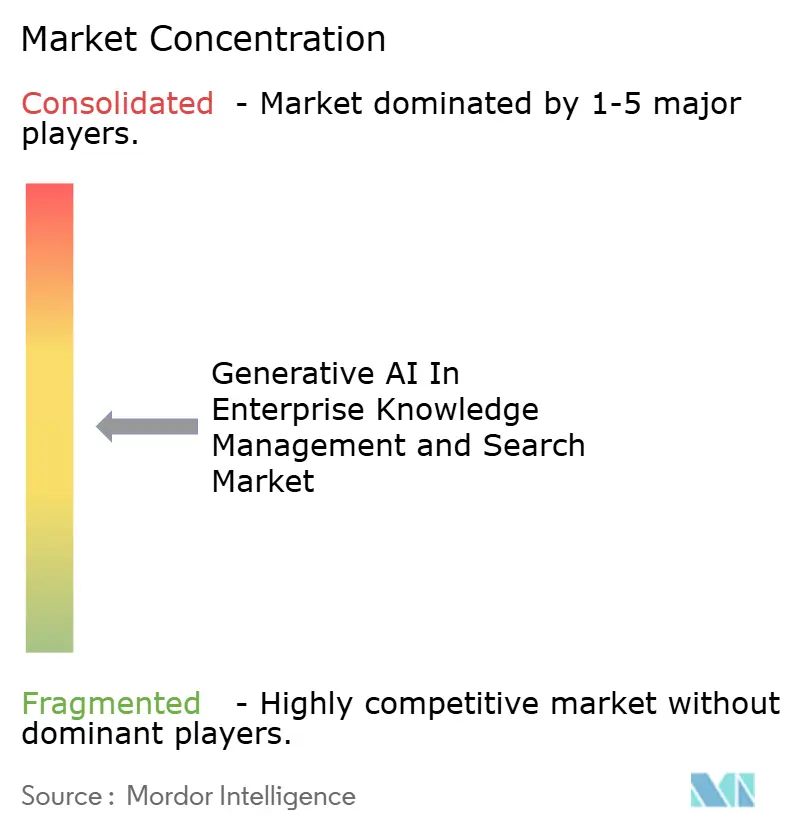
The generative AI in enterprise knowledge management and search market has concentration at the infrastructure layer and a more fragmented specialist layer. Microsoft, Google, and Amazon Web Services use suite integration to retain procurement within existing enterprise agreements. This approach can convert enterprise search into a bundled capability. Microsoft Copilot Search supported more than 100 prebuilt connectors in March 2026, including Salesforce, ServiceNow, Confluence, and Google Drive. These connectors support unified discovery across established enterprise systems. Large infrastructure providers, therefore, compete through integration, security, and existing account relationships.
ServiceNow completed its USD 2.85 billion acquisition of Moveworks in December 2025. The transaction combined enterprise search and an AI assistant with ServiceNow workflow automation. ServiceNow also launched Otto in May 2026 to combine conversational AI, autonomous workflows, and search. Salesforce added Agentic Enterprise Search in February 2026, extending its search and action capabilities across external sources. IBM is differentiating through OpenRAG on watsonx.data for governed retrieval across hybrid settings. These moves show that retrieval, governance, and workflow automation are increasingly offered together.
Glean, Coveo, Elastic, and Vectara compete through retrieval quality, connector coverage, and governance features. Their products can be relevant where multi-source data and domain-specific ranking affect answer quality. Industry-specific knowledge graphs remain a gap for horizontal systems in pharmaceutical, engineering, and legal settings. Provenance-first designs can also help organizations verify each answer against its source. Smaller specialists using neural re-ranking and hybrid retrieval seek to improve outcomes in dense technical documentation. Consumption-based pricing can support conversion from small and medium enterprise trials to longer-term subscriptions. The generative AI in enterprise knowledge management and search market continues to offer room for providers that resolve trust barriers in regulated verticals.
Generative AI In Enterprise Knowledge Management and Search Industry Leaders
Microsoft Corporation
Google LLC
Salesforce, Inc.
Glean Technologies, Inc.
Amazon Web Services, Inc.
- *Disclaimer: Major Players sorted in no particular order
Generative AI In Enterprise Knowledge Management and Search Market Companies Covered in this Report
- Microsoft Corporation
- Google LLC
- Amazon Web Services, Inc.
- Salesforce, Inc.
- Glean Technologies, Inc.
- ServiceNow, Inc.
- International Business Machines Corporation
- Elastic N.V.
- Coveo Solutions Inc.
- Lucidworks, Inc.
- Sinequa SAS
- Algolia SAS
- Open Text Corporation
- Guru Technologies, Inc.
- Atlassian Corporation Plc
- Notion Labs, Inc.
- Moveworks, Inc.
- Kore.ai, Inc.
- Vectara, Inc.
- SAP SE

Recent Industry Developments in Generative AI In Enterprise Knowledge Management and Search Market
- July 2026: Amazon Web Services launched Amazon Bedrock Managed Knowledge Base in general availability, offering a fully managed RAG service with ingestion, vector storage, real-time ACL enforcement, and native MCP integration, enabling production-ready AI agents grounded in enterprise data without custom retrieval infrastructure.
- May 2026: Glean crossed USD 300 million in annual recurring revenue, a 3x increase from USD 100 million in 15 months, with Fortune 500 customers nearly doubling year-over-year, as AI budget-cutting consolidation became its primary commercial selling point and over 85% of customers expanded usage across 5 or more departments.
- May 2026: ServiceNow launched Otto at Knowledge 2026, unifying conversational AI, autonomous workflows, and enterprise search into a single cross-departmental experience, and expanded AI Control Tower with end-to-end governance, covering discovery, observability, security, and measurement, for any AI system regardless of vendor origin.
- February 2026: Salesforce released Spring 2026 introducing Agentic Enterprise Search, a unified search and action interface powered by Data 360 that draws on context from over 200 external sources and coordinates across multiple AI agents to find, synthesize, and act on enterprise information.


Global Generative AI In Enterprise Knowledge Management and Search Market Report Scope
The Generative AI in Enterprise Knowledge Management and Search Market Report is Segmented by Offering (Software Platforms and Services), Deployment Mode (Cloud, On-Premises, and Hybrid), Enterprise Size (Large Enterprises and SMEs), End User (IT and Telecom, BFSI, Healthcare and Life Sciences, Manufacturing, Retail and E-Commerce, Government and Public Sector, and Other End Users), and Geography (North America, South America, Europe, Asia-Pacific, Middle East, and Africa). The Market Forecasts are Provided in Terms of Value (USD).
| Software Platforms |
| Services |
| Cloud |
| On-Premises |
| Hybrid |
| Large Enterprises |
| Small and Medium Enterprises |
| IT and Telecom |
| BFSI |
| Healthcare and Life Sciences |
| Manufacturing |
| Retail and E-Commerce |
| Government and Public Sector |
| Other End Users |
| North America | United States |
| Canada | |
| Mexico | |
| South America | Brazil |
| Argentina | |
| Rest of South America | |
| Europe | Germany |
| United Kingdom | |
| France | |
| Italy | |
| Spain | |
| Russia | |
| Rest of Europe | |
| Asia-Pacific | China |
| Japan | |
| India | |
| South Korea | |
| Australia | |
| Rest of Asia-Pacific | |
| Middle East | Saudi Arabia |
| United Arab Emirates | |
| Turkey | |
| Rest of Middle East | |
| Africa | South Africa |
| Egypt | |
| Rest of Africa |
| By Offering | Software Platforms | |
| Services | ||
| By Deployment Mode | Cloud | |
| On-Premises | ||
| Hybrid | ||
| By Enterprise Size | Large Enterprises | |
| Small and Medium Enterprises | ||
| By End User | IT and Telecom | |
| BFSI | ||
| Healthcare and Life Sciences | ||
| Manufacturing | ||
| Retail and E-Commerce | ||
| Government and Public Sector | ||
| Other End Users | ||
| By Geography | North America | United States |
| Canada | ||
| Mexico | ||
| South America | Brazil | |
| Argentina | ||
| Rest of South America | ||
| Europe | Germany | |
| United Kingdom | ||
| France | ||
| Italy | ||
| Spain | ||
| Russia | ||
| Rest of Europe | ||
| Asia-Pacific | China | |
| Japan | ||
| India | ||
| South Korea | ||
| Australia | ||
| Rest of Asia-Pacific | ||
| Middle East | Saudi Arabia | |
| United Arab Emirates | ||
| Turkey | ||
| Rest of Middle East | ||
| Africa | South Africa | |
| Egypt | ||
| Rest of Africa | ||


Key Questions Answered in the Report
What is the size of the generative AI in enterprise knowledge management and search market?
The market is expected to increase from USD 7.81 billion in 2026 to USD 27.43 billion by 2031, at a CAGR of 28.56%.
What is driving enterprise adoption of generative AI in enterprise knowledge management and search market?
Fragmented SaaS data, the need for permission-aware answers, and embedded copilot workflows are supporting adoption.
Which deployment mode leads generative AI in enterprise knowledge management and search market?
Cloud led with a 78.21% share in 2025, supported by managed ingestion, elastic indexing, and connector ecosystems.
Which end use group is expected to grow fastest through 2031?
Healthcare and life sciences is projected to grow at a CAGR of 30.36%, supported by the need for grounded evidence at the point of care.
Which region is growing fastest for generative AI in enterprise knowledge management and search market?
Asia-Pacific is projected to grow at a CAGR of 30.74% through 2031, driven by digitalization in China, India, South Korea, and Australia.
Why are source attribution and access controls important for enterprise deployments?
They help organizations verify answers and prevent unauthorized retrieval, especially in regulated fields.
Page last updated on:





