
Generative AI In Education Curriculum Design and Adaptive Learning Systems Market Size and Share
Market Overview
| Study Period | 2020 - 2031 |
|---|---|
| Market Size (2026) | USD 6.48 Billion |
| Market Size (2031) | USD 22.63 Billion |
| Growth Rate (2026 - 2031) | 28.42 % |
| Fastest Growing Market | Asia-Pacific |
| Largest Market | North America |
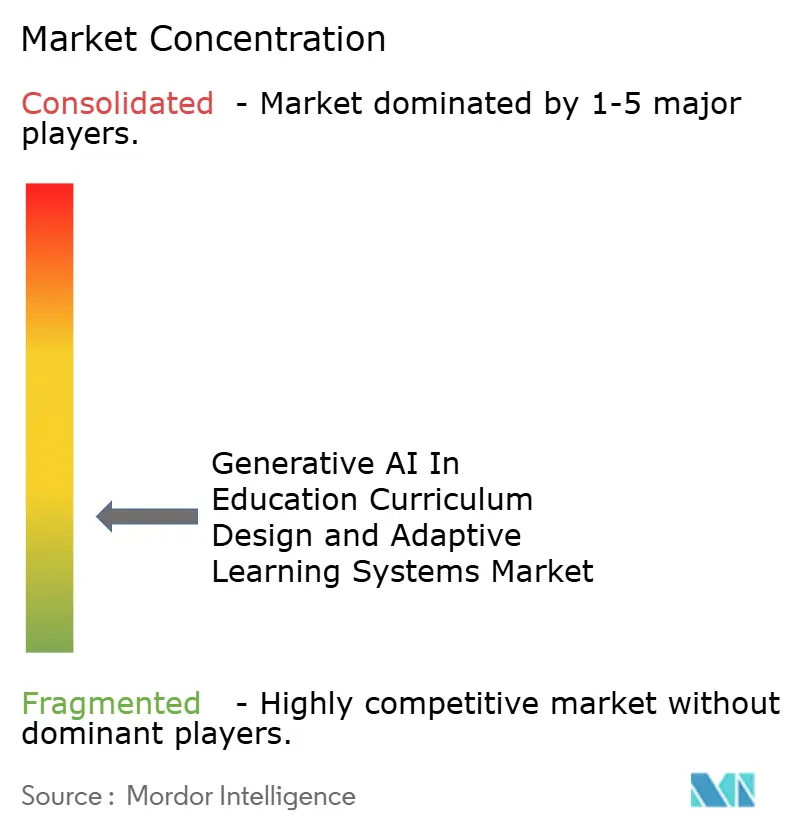
| Market Concentration | Low |
Major Players *Disclaimer: Major Players sorted in no particular order Image © Mordor Intelligence. Reuse requires attribution under CC BY 4.0. | |
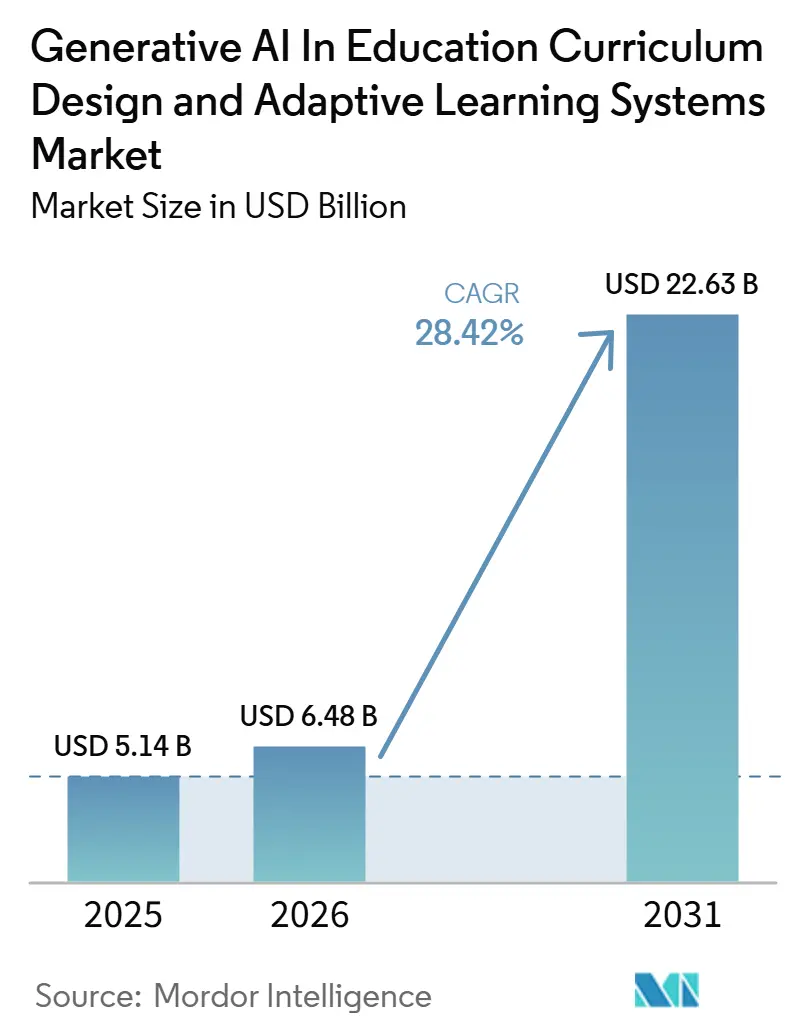
Generative AI In Education Curriculum Design and Adaptive Learning Systems Market Analysis by Mordor Intelligence
The Generative AI in Education Curriculum Design and Adaptive Learning Systems Market size is expected to increase from USD 5.14 billion in 2025 to USD 6.48 billion in 2026 and reach USD 22.63 billion by 2031, growing at a CAGR of 28.42% over 2026-2031. The Generative AI in Education Curriculum Design and Adaptive Learning Systems Market is moving from selective experimentation to broader institutional adoption, as schools, universities, employers, and publishers now treat generative AI as a core component of digital learning systems rather than an add-on feature. Public policy is also reinforcing this direction, since governments and multilateral organizations increasingly frame generative AI as part of long-term education modernization, research investment, and workforce readiness. Competitive conditions are tightening because large technology vendors already have distribution advantages through learning platforms, productivity suites, and educator training programs, while specialized providers are competing through stronger pedagogy, better workflow fit, and clearer learning outcome claims. Demand is also expanding beyond academic settings, with corporate learning, reskilling, curriculum refresh, and adaptive content delivery creating new growth paths for the Generative AI in Education Curriculum Design and Adaptive Learning Systems Market. At the same time, privacy controls, model accuracy, and system integration remain important limits on deployment speed, especially where institutions need clear governance before scaling adoption across large learner populations.
Key Report Takeaways
- By component, software platforms led with 69.83% revenue share in 2025, while services are projected to expand at a 29.21% CAGR through 2031.
- By deployment mode, cloud held 74.26% of revenue in 2025, while hybrid is projected to grow at a 29.74% CAGR through 2031.
- By AI technology, large language models accounted for 42.74% of revenue in 2025, while multimodal generative AI is projected to advance at a 31.46% CAGR through 2031.
- By application, personalized and adaptive learning pathways held 31.58% of the Generative AI in Education Curriculum Design and Adaptive Learning Systems Market in 2025, while intelligent tutoring systems are projected to expand at a 30.18% CAGR through 2031.
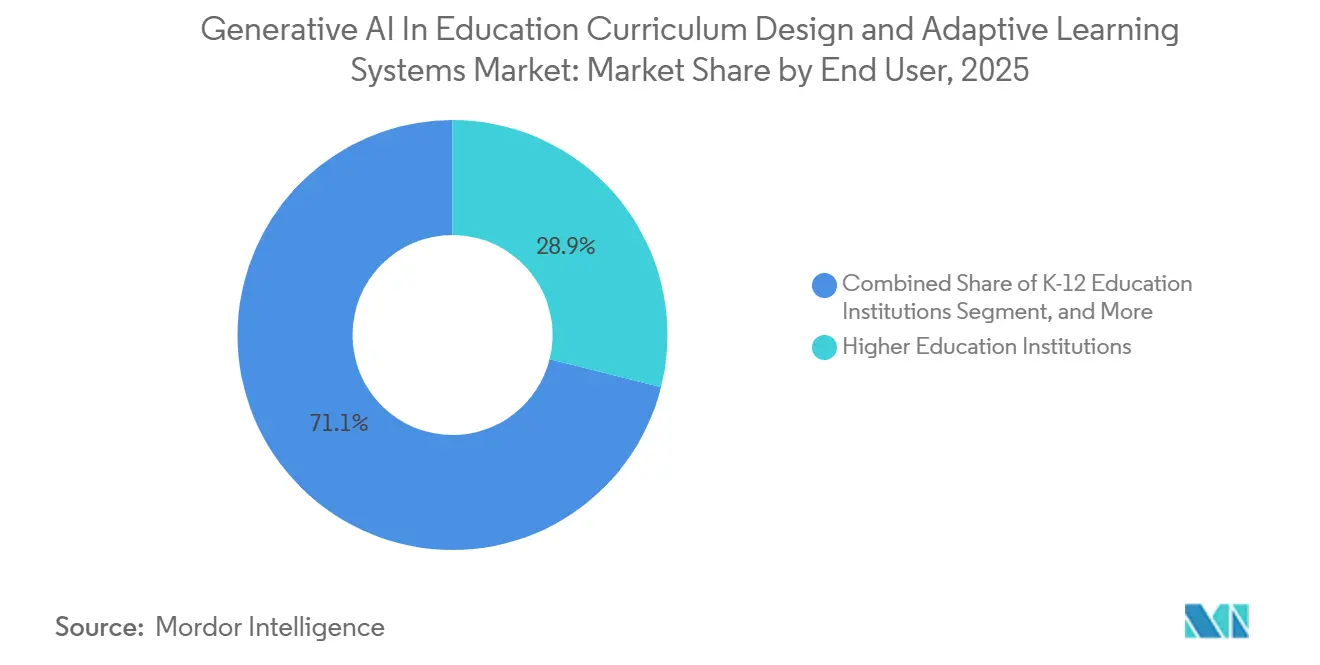
- By end user, higher education accounted for 28.91% of revenue share in 2025, while corporate learning and development is projected to grow at a 30.62% CAGR through 2031.
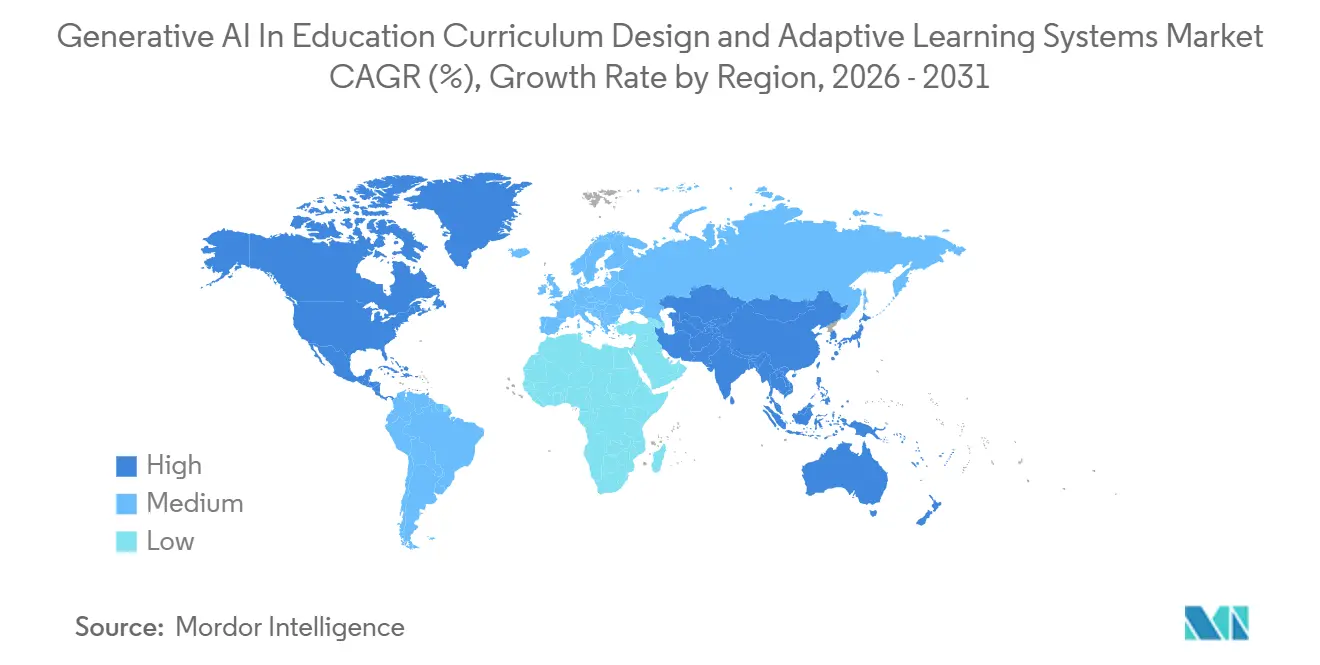
- By geography, North America accounted for 39.12% share in 2025, while Asia-Pacific is projected to record the highest CAGR of 30.37% through 2031.
Note: Market size and forecast figures in this report are generated using Mordor Intelligence’s proprietary estimation framework, updated with the latest available data and insights as of January 2026.
Market Trends and Insights
Drivers Impact Analysis of Generative AI In Education Curriculum Design and Adaptive Learning Systems Market*
| Driver | (~) % Impact on CAGR Forecast | Geographic Relevance | Impact Timeline |
|---|---|---|---|
| Growing Demand for AI-Powered Personalized Education Solutions | +5.2% | Global | Medium term (2-4 years) |
| Growing Adoption of Generative AI in Content Creation and Curriculum Design | +4.8% | Global, with early gains in North America and Asia-Pacific | Short term (≤ 2 years) |
| Increasing Demand for Workforce Upskilling and Reskilling | +4.3% | Global, especially North America, Europe, and Asia-Pacific | Medium term (2-4 years) |
| Growing Institutional Investments in Educational Technology | +3.9% | North America and Europe | Medium term (2-4 years) |
| Growing Demand for Mobile and Microlearning Content | +2.8% | APAC core, spill-over to MEA | Short term (≤ 2 years) |
| Rising Adoption of Corporate Training Platforms | +2.4% | Global, especially North America | Medium term (2-4 years) |
| Source: Mordor Intelligence | |||
Growing Demand for AI-Powered Personalized Education Solutions
Personalized delivery is becoming a baseline expectation across the Generative AI in Education Curriculum Design and Adaptive Learning Systems Market, not a premium feature reserved for a small group of advanced adopters. A 2025 randomized controlled trial published in Scientific Reports found that AI tutoring outperformed in-class active learning, with measurable gains in knowledge retention and learner engagement.[1]Greg Kestin, Kelly Miller, Anna Klales, Timothy Milbourne, and Gregorio Ponti, “AI Tutoring Outperforms In-Class Active Learning: An RCT Introducing a Novel Research-Based AI Tutor,” Scientific Reports The OECD also stated in its 2026 digital education outlook that generative AI tutoring systems can produce sustained learning gains when they are built around clear pedagogical principles rather than used as generic chat tools.[2]OECD, “OECD Digital Education Outlook 2026,” OECD, oecd.org This is changing how institutions evaluate products, because procurement teams are placing more weight on learner outcomes, instructional structure, and explainable personalization than on model novelty alone. It also raises the bar for vendors in the Generative AI in Education Curriculum Design and Adaptive Learning Systems Market, since platforms that can connect personalization to validated classroom or workplace performance are more likely to retain long-term contracts. The result is a shift toward systems that combine adaptive sequencing, learner modeling, and curriculum alignment within a single environment rather than making broad but weak personalization claims.
Growing Adoption of Generative AI in Content Creation and Curriculum Design
Generative AI is changing the cost, speed, and workflow of curriculum creation across the Generative AI in Education Curriculum Design and Adaptive Learning Systems Market. Google and Khan Academy announced in January 2026 that they were building new AI learning tools using Gemini models, including writing and reading support that more closely ties content generation to guided educational use rather than open-ended drafting. Google expanded in this direction in July 2026 with Gemini study notebooks, diagnostic quizzes, auto-updating bite-sized lessons, and course-grounded student learning experiences, which show how content generation is increasingly linked to a structured curriculum flow. McGraw-Hill also launched Sharpen Advantage in September 2025, adding custom content creation and AI-supported academic tools to a broader enterprise learning offer for higher education.[3]McGraw Hill, “McGraw Hill Introduces Sharpen Advantage, Expanding Its Popular Sharpen Study App into a Responsible, AI-Powered Enterprise Solution for Higher Ed,” McGraw Hill Investor Relations As creation becomes faster, value in the Generative AI in Education Curriculum Design and Adaptive Learning Systems Market is moving away from raw output volume and toward alignment, review, evidence quality, and learning design discipline. This means the strongest providers are the ones that can help institutions generate, organize, validate, and continuously refresh content without weakening instructional quality.
Increasing Demand for Workforce Upskilling and Reskilling
Workforce reskilling is a major growth engine for the Generative AI in Education Curriculum Design and Adaptive Learning Systems Market because employers now need faster ways to update skills as job requirements change. Coursera reported in 2025 that enrollments in GenAI courses reached 12 per minute, with 680 or more GenAI courses active across its platform, which shows how quickly demand for role-relevant AI learning has scaled. In 2026, Coursera launched a learning agent within Microsoft 365 Copilot, which embeds learning discovery and skill support directly into the daily workflow rather than requiring a separate training session.[4]Coursera, “Coursera Launches the First Learning Agent in Microsoft 365 Copilot Enabled by Apps SDK,” Coursera Blog That shift matters because learning in the flow of work tends to reduce friction, increase visibility into skill gaps, and support higher completion rates and repeat use in corporate settings. It also helps explain why corporate learning and development is the fastest-growing end user segment in the Generative AI in Education Curriculum Design and Adaptive Learning Systems Market. Over time, vendors that connect adaptive content, role mapping, and workflow delivery are likely to benefit most as learning becomes a continuous part of knowledge work.
Growing Institutional Investments in Educational Technology
Institutional investment is expanding the Generative AI in Education Curriculum Design and Adaptive Learning Systems Market by moving adoption from pilot programs to wider operational deployment. Google stated in 2025 that its AI for Education Accelerator reached 400+ higher education institutions across all 50 U.S. states, offering no-cost AI professional certificates that strengthened early exposure and platform familiarity at scale. Microsoft reported in June 2026 that adoption momentum in education remained broad and that it was introducing a new wave of AI-powered teaching and learning tools through Microsoft 365 Education and partner learning management systems at no additional cost. China also raised the institutional commitment level in April 2026 through its national AI-plus-education action plan, which called for AI-driven adaptive learning paths, intelligent student portfolios, and generative AI content tools across all education tiers. These moves matter because they create early workflow habits, staff familiarity, and infrastructure lock-in before a full procurement cycle is completed. They also favor vendors with scale, compliance readiness, and platform reach, which is shaping the competitive structure of the Generative AI in Education Curriculum Design and Adaptive Learning Systems Market.
Restraints Impact Analysis of Generative AI In Education Curriculum Design and Adaptive Learning Systems Market*
| Restraint | (~) % Impact on CAGR Forecast | Geographic Relevance | Impact Timeline |
|---|---|---|---|
| Student Data Privacy, Security, and Compliance Challenges | -3.2% | North America and Europe (FERPA, GDPR, and COPPA jurisdictions) | Short term (≤ 2 years) |
| Hallucination, Bias, and Accuracy Issues in AI Models | -2.8% | Global | Medium term (2-4 years) |
| Integration Challenges With Existing Educational Infrastructure | -2.1% | Emerging markets in MEA and South America | Medium term (2-4 years) |
| High Implementation, Maintenance, and Operational Costs | -1.6% | South America, MEA, and Tier-2 markets globally | Long term (≥ 4 years) |
| Source: Mordor Intelligence | |||
Student Data Privacy, Security, and Compliance Challenges
Privacy and compliance remain among the clearest adoption barriers in the Generative AI in Education Curriculum Design and Adaptive Learning Systems Market, especially when products handle learner records, assessment content, or behavioral data. The OECD noted in 2026 that generative AI in education raises governance concerns that extend beyond teaching practice and require stronger policy attention, public oversight, and sustained institutional capacity. In practice, this means many institutions now treat privacy review, data use terms, and model governance as procurement conditions rather than post-purchase compliance work. The effect is especially strong in regulated school systems and cross-border settings where data residency, student protection, and vendor accountability are closely examined. This environment tends to favor larger providers that already have legal, technical, and contractual resources to support compliance by design. It also slows smaller entrants in the Generative AI in Education Curriculum Design and Adaptive Learning Systems Market, even when their products are strong on instructional value.
Hallucination, Bias, and Accuracy Issues in AI Models
Accuracy problems remain a major restraint because the highest-value use cases in the Generative AI in Education Curriculum Design and Adaptive Learning Systems Market often involve feedback, tutoring, assessment, and credential-linked learning support. A 2025 classroom RCT published on arXiv found that generative AI tutoring systems can harm learning outcomes when they are deployed without proper pedagogical safeguards, rather than merely failing to help. The OECD made a related point in 2026, distinguishing between well-designed instructional systems and generic chatbot use, which again shows that raw model fluency does not guarantee educational value. This challenge is pushing vendors toward tighter curriculum boundaries, stronger retrieval layers, and clearer verification workflows before outputs reach learners or educators. It also creates a quality divide inside the Generative AI in Education Curriculum Design and Adaptive Learning Systems Market, where platforms with domain constraints and review controls are better positioned than broad-purpose tools. Until accuracy risks are managed more consistently, some institutions will continue to limit use in high-stakes teaching and assessment settings.
*Our forecasts treat driver/restraint impacts as directional, not additive. The impact forecasts reflect baseline growth, mix effects, and variable interactions.
Generative AI In Education Curriculum Design and Adaptive Learning Systems Market Segment Analysis
By Component:
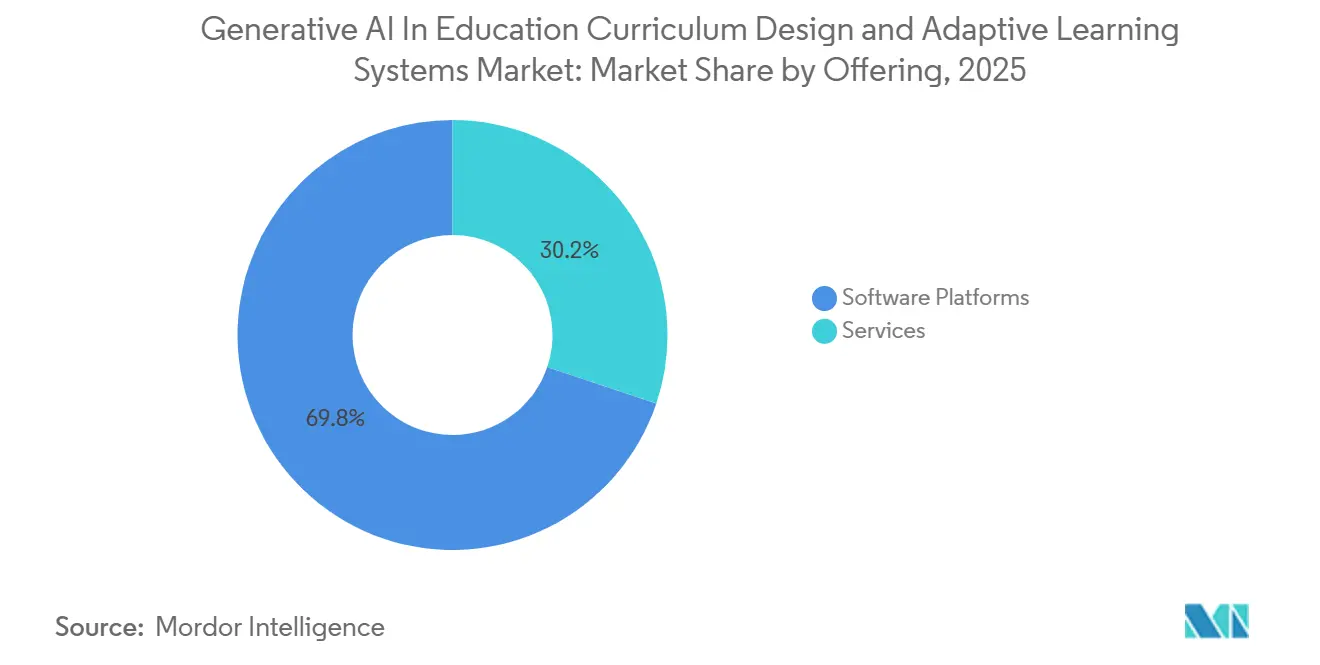
Platform Dominance Sustained, but Services Drive Recurring RevenueSoftware platforms accounted for 69.83% of revenue in 2025, keeping this segment at the center of the Generative AI in Education Curriculum Design and Adaptive Learning Systems Market. That lead reflects the fact that institutions usually purchase AI capability through learning management systems, adaptive platforms, and curriculum authoring tools that sit inside everyday teaching and learning workflows. In the early deployment stage, buyers often focus first on the platform layer because that is where user access, content orchestration, data visibility, and system integration come together. This has helped platform vendors secure a large installed base while also shaping feature expectations across the broader Generative AI in Education Curriculum Design and Adaptive Learning Systems Market. It also means software providers influence how quickly new AI capabilities move from trial use into institution-wide deployment.
Services are projected to expand at a 29.21% CAGR through 2031, indicating that growth is shifting toward deeper implementation as the market matures. The Generative AI in Education Curriculum Design and Adaptive Learning Systems Market for services is rising because institutions now need training, integration support, instructional design guidance, and ongoing performance review after the initial software purchase. McGraw Hill’s September 2025 launch of Sharpen Advantage, which combined enterprise analytics, custom content creation, and AI academic support, illustrates how established vendors are widening revenue beyond software licenses alone. As AI adoption scales, service intensity becomes more important because institutions need stronger change management and clearer outcome tracking. Vendors that built consulting, support, and educator enablement capacity early are therefore in a better position to increase account value and reduce switching risk over time.


By Deployment Mode:
Cloud Anchors Scale, Hybrid Architecture Addresses GovernanceCloud accounted for 74.26% of revenue in 2025, giving it the largest share in the Generative AI in Education Curriculum Design and Adaptive Learning Systems Market by deployment mode. This reflects the practical reality that most schools, colleges, and workplace learning teams lack the internal infrastructure needed for broad on-premises AI inference or rapid feature updates. Cloud also aligns with the operating model of many learning platforms, as it simplifies rollout, content synchronization, and access across distributed learner groups. The strong position of cloud deployment supports faster expansion in the Generative AI in Education Curriculum Design and Adaptive Learning Systems Market, especially where institutions want low upfront infrastructure burden and quicker product release cycles. It also aligns with the way large technology vendors bundle AI learning features into broader software ecosystems.
Hybrid deployment is projected to grow at a 29.74% CAGR through 2031, making it the fastest-growing mode as governance needs become more complex. In July 2025, Instructure and OpenAI announced a global partnership to embed AI learning experiences into Canvas, reinforcing the cloud-first direction of institutional AI deployment. Even so, many institutions want sensitive student information to remain under tighter local control while still using external AI services for generation and inference. That is why hybrid architectures are gaining traction across university systems, large districts, and public institutions that must balance scalability with data governance. On-premises deployment remains a smaller but durable part of the Generative AI in Education Curriculum Design and Adaptive Learning Systems Market where sovereignty rules, security needs, or specialized training programs make full cloud reliance less suitable.
By AI Technology:
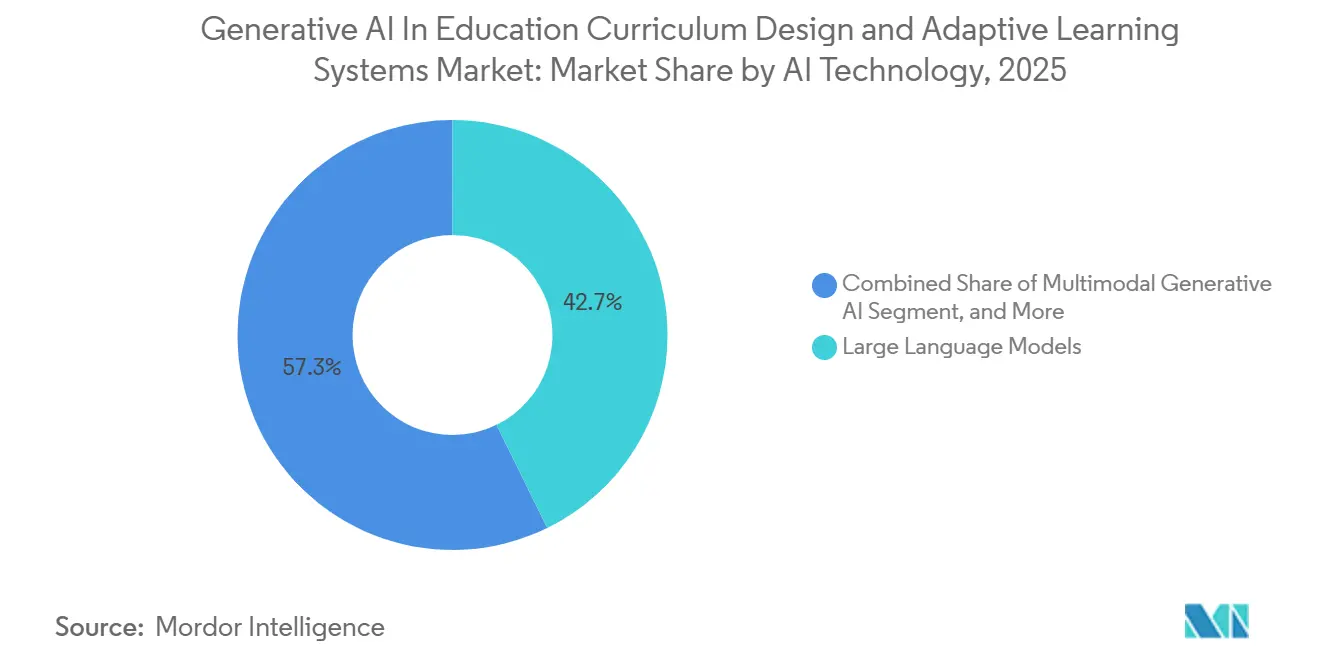
LLMs Set the Baseline, Multimodal Architectures Define the CeilingLarge language models held 42.74% of revenue in 2025, which made them the core technology base of the Generative AI in Education Curriculum Design and Adaptive Learning Systems Market. Their lead comes from strong fit with lesson drafting, dialogue-based tutoring, curriculum ideation, assessment support, and teacher productivity tasks that depend heavily on text generation and language understanding. In many institutions, LLMs have become the first layer through which users encounter educational AI because they are easy to test and quick to integrate into existing interfaces. This installed role gives LLM-driven systems a powerful starting position across the Generative AI in Education Curriculum Design and Adaptive Learning Systems Market. It also creates a baseline expectation that every major platform should offer some form of conversational or text-based assistance.
Multimodal generative AI is projected to grow at a 31.46% CAGR through 2031, which makes it the strongest forward signal within this technology split. Research published in Frontiers in Computer Science in 2026 found that intelligent tutoring systems combining multimodal knowledge graph construction with retrieval-augmented generation outperformed single-modality systems on pedagogical accuracy metrics, especially in complex STEM learning contexts. Google’s July 2026 rollout of Gemini study notebooks also showed how text, quizzes, lesson updates, and connected study tools are converging into one student-facing environment. Natural language processing remains critical for essay feedback and live dialogue, while knowledge graphs are gaining importance for curriculum mapping and learning structure. The direction of the Generative AI in Education Curriculum Design and Adaptive Learning Systems Market suggests that text-only capability will remain important, but richer learning experiences will increasingly depend on systems that combine multiple formats in a coordinated way.

By Application:
Adaptive Pathways Lead Adoption, Intelligent Tutoring Scales FastestPersonalized and adaptive learning pathways accounted for 31.58% of revenue in 2025, making them the leading application area. This leadership reflects long-standing demand for systems that track mastery, identify gaps, and guide learners through content sequences with more precision than static course structures allow. Once these systems are embedded in teaching or training workflows, they tend to create durable usage habits and data continuity that make replacement more difficult. That helps explain why this application remains central to the Generative AI in Education Curriculum Design and Adaptive Learning Systems Market, even as new AI use cases appear. It also shows that buyers continue to view learner-level adaptation as one of the clearest sources of return from education AI spending.
Intelligent tutoring systems are projected to expand at a 30.18% CAGR through 2031, indicating rising demand for guided, responsive learner support. The OECD stated that generative AI tutoring systems can produce sustained learning gains when designed with a clear pedagogical structure, supporting the growth outlook for tutoring-led deployments. The 2025 Scientific Reports RCT also reinforced that well-designed AI tutoring can outperform traditional active learning formats under controlled conditions. At the same time, curriculum design, lesson planning, and assessment support continue to expand because lower generation costs make ongoing content refresh more practical for institutions. The Generative AI in Education Curriculum Design and Adaptive Learning Systems Market therefore remains application-diverse, but tutoring and adaptive pathways stand out because they connect AI capability directly to learner progression and instructional effectiveness.
By End User:
Higher Education Anchors Revenue, Corporate Learning Defines GrowthHigher education accounted for 28.91% of revenue in 2025, giving universities and colleges the largest share of the Generative AI in Education Curriculum Design and Adaptive Learning Systems Market by end user. This position reflects large digital learning budgets, strong experimentation capacity, and a high concentration of institutions that can test and scale AI across teaching, assessment, support services, and research-linked education programs. Higher education environments also generate broad use cases, from curriculum support to tutoring and faculty productivity, which makes them attractive entry points for vendors. That breadth has helped anchor demand in the Generative AI in Education Curriculum Design and Adaptive Learning Systems Market, even as adoption expands into other customer groups. It also explains why many platform partnerships and product launches continue to focus on campus deployment models.
Corporate learning and development is projected to grow at a 30.62% CAGR through 2031, making it the fastest-growing end user group. Coursera’s 2026 launch of a learning agent inside Microsoft 365 Copilot shows how workplace learning is being embedded directly into daily productivity environments rather than treated as a separate training event. K-12 systems remain a large volume opportunity, while tutoring, test preparation, publishers, and public sector programs are all expanding their use of adaptive and generative tools through different delivery models. China’s April 2026 national action plan and Tokyo’s June 2026 school AI lab rollout both indicate that public education systems are becoming more active in structured deployment. The result is a wide customer base for the Generative AI in Education Curriculum Design and Adaptive Learning Systems Market, with revenue leadership still in higher education but growth momentum shifting more strongly toward workforce learning and government-backed scale programs.
Geography Analysis
North America Generative AI in Education Curriculum Design and Adaptive Learning Systems Market
North America accounted for 39.12% of revenue in 2025, making it the largest regional contributor to the Generative AI in Education Curriculum Design and Adaptive Learning Systems Market. The region benefits from a high concentration of major technology vendors, strong demand for enterprise learning, and research-intensive universities that often serve as early adopters and implementation partners. Google reported in 2025 that its AI for Education Accelerator reached 400 or more higher education institutions across all 50 U.S. states, which highlights the scale of institutional exposure already in place. Microsoft also stated in June 2026 that schools and colleges were showing widespread adoption momentum, supported by new AI-powered tools across Microsoft 365 Education and partner learning management systems. These factors make North America the most mature regional environment for commercial deployment, recurring usage, and institutional scaling.
APAC Generative AI in Education Curriculum Design and Adaptive Learning Systems Market
Asia-Pacific is projected to grow at a 30.37% CAGR through 2031, which makes it the fastest-growing geography in the Generative AI in Education Curriculum Design and Adaptive Learning Systems Market. China strengthened this position in April 2026, when the Ministry of Education and other ministries issued the AI-plus-education action plan, covering adaptive learning, digital student portfolios, and generative content tools across all education levels. Japan also added momentum through policy and deployment, with the Tokyo Metropolitan Board of Education launching its school AI lab across metropolitan high schools in June 2026. India remains an important expansion zone because higher education AI adoption is rising quickly and supports broader regional demand even where deployment maturity varies. South Korea and Australia also contribute to the region’s early adoption profile through active use of digital education tools and institutional openness to AI-supported learning models.
EMEA and South America Generative AI in Education Curriculum Design and Adaptive Learning Systems Market
Europe continues to hold a meaningful position in the Generative AI in Education Curriculum Design and Adaptive Learning Systems Market, with Germany, the United Kingdom, and France acting as key spending centers. DFKI and Deutsche Telekom Stiftung reported in 2025 that AI application supply for German schools had tripled since 2021, with generative tools emerging as the most widely adopted category and with clear interest in European-developed alternatives tied to data sovereignty needs. In 2026, IÉSEG Business School took an equity stake of EUR 500,000 (USD 545,000) in Compleducation, which shows that some European institutions are moving beyond procurement and into direct strategic participation in adaptive learning platforms. South America, the Middle East, and Africa remain earlier-stage regions, but mobile-first delivery, public digital education programs, and local modernization agendas are supporting longer-term adoption potential.

Competitive Landscape
The competitive structure of the Generative AI in Education Curriculum Design and Adaptive Learning Systems Market combines concentration at the platform layer with fragmentation across specialist applications. Large technology companies Microsoft, Pearson, Google, Anthropic, and Coursera benefit from broad distribution because they already control major productivity tools, learning environments, and educator enablement channels. This creates a faster route to institutional adoption than smaller vendors typically have, especially when AI features are introduced into products customers already use. At the same time, specialist providers continue to compete through tighter curriculum fit, stronger learner models, and use cases built for specific instructional workflows. That combination produces a market where scale matters, but differentiation still depends heavily on pedagogy, deployment discipline, and evidence of learning value.
A clear example of a scale strategy came in July 2025, when Instructure and OpenAI announced a global partnership to embed AI learning experiences into Canvas, shortening the path from experimentation to classroom use for institutions already on the platform. Google took a parallel route through no-cost institutional exposure programs, then extended student-facing functionality with Gemini study notebooks and connected classroom features in 2026. McGraw Hill used another model in September 2025 by expanding from study support into enterprise analytics, custom content creation, and AI-backed academic services through Sharpen Advantage. These moves show that leading companies are not competing on a single feature set, but on how deeply they can integrate generation, support, workflow, and institutional service within one offer.
The next stage of competition is likely to center on evidence quality, compliance strength, and multimodal learning performance. The OECD has already made clear that generative AI in education needs strong pedagogical design to deliver real gains, which supports a more outcome-focused buying process over time. Research in Frontiers in Computer Science also supports the view that richer architectures can improve tutoring accuracy in demanding instructional settings, which may strengthen the case for multimodal providers. As a result, the Generative AI in Education Curriculum Design and Adaptive Learning Systems Market is likely to reward vendors that can combine institutional trust, flexible deployment, and verified educational performance rather than relying on general AI branding alone.
Generative AI In Education Curriculum Design and Adaptive Learning Systems Industry Leaders
Microsoft Corporation
Google LLC
Pearson plc
Anthropic
Coursera, Inc.
- *Disclaimer: Major Players sorted in no particular order
Generative AI In Education Curriculum Design and Adaptive Learning Systems Market Companies Covered in this Report
- Microsoft Corporation
- Google LLC
- Pearson plc
- Anthropic
- Coursera, Inc.
- Duolingo, Inc.
- Khan Academy
- D2L Corporation
- Instructure Holdings, Inc.
- DreamBox Learning, Inc.
- Curriculum Associates LLC
- McGraw Hill LLC
- Quizlet, Inc.
- Sana Labs AB
- Squirrel AI Learning, Inc.
- MagicSchool, Inc.
- Area9 Lyceum ApS
- OpenAI
- IXL Learning, Inc

Recent Industry Developments in Generative AI In Education Curriculum Design and Adaptive Learning Systems Market
- July 2026: Google announced Gemini study notebooks at ISTE Live 2026, deploying an adaptive learning platform with diagnostic quizzes, auto-updating bite-sized lessons, and NotebookLM sync for students on personal and school accounts globally. The announcement included no-cost practice GRE and ACT tests in partnership with The Princeton Review, and the extension of Gemini in Classroom to students of all ages with teacher-assigned, course-grounded learning experiences, one of the most comprehensive single-event expansions of a technology company’s educational AI footprint to date.
- June 2026: Microsoft published its third annual AI in Education Report on June 24, 2026, documenting widespread adoption momentum, and simultaneously announced a new wave of AI-powered teaching and learning tools integrated into Microsoft 365 Education and partner LMS platforms at no additional cost, reinforcing Microsoft’s strategy of embedding AI at the infrastructure level across K-12 and higher education ecosystems.
- April 2026: China’s Ministry of Education and 4 co-ministries jointly issued the AI + Education Action Plan, mandating national deployment of AI-driven adaptive learning paths, intelligent digital student portfolios, and generative AI content tools across all education tiers, with explicit equity targets for rural schools and central and western region institutions, a policy framework that positions China as the world’s most systematically coordinated national market for generative AI in education.
- January 2026: Google and Khan Academy announced a partnership at BETT 2026 to build new AI learning tools using Gemini models, integrating Gemini into Khan Academy’s Writing Coach for grades 7-12 and Reading Coach, while Schoolhouse.world deployed Gemini to provide feedback and practice simulations for tutors, extending the adaptive learning infrastructure to Khan Academy’s global learner base.


Global Generative AI In Education Curriculum Design and Adaptive Learning Systems Market Report Scope
The Generative AI in Education Curriculum Design and Adaptive Learning Systems Market is Segmented by Component (Software Platforms, and Services), Deployment (Cloud, On-Premises, and Hybrid), AI Technology (LLMs, Multimodal AI, Natural Language Processing and Conversational AI, Knowledge Graphs, and Other AI Technologies), Application (Curriculum Design, Lesson Planning and Instructional Content Generation, Personalized and Adaptive Learning Pathways, Intelligent Tutoring and Conversational Learning, and Other Applications), End User (K-12, Higher Education, Corporate, Tutoring, Publishers, Government), and Geography (North America, South America, Europe, Asia-Pacific, Middle East, and Africa). The Market Forecasts are Provided in Terms of Value (USD).
| Software Platforms |
| Services |
| Cloud |
| On-Premises |
| Hybrid |
| Large Language Models |
| Multimodal Generative AI |
| Natural Language Processing and Conversational AI |
| Knowledge Graphs and Retrieval-Augmented Generation |
| Other AI Technologies |
| Curriculum Design and Course Authoring |
| Lesson Planning and Instructional Content Generation |
| Personalized and Adaptive Learning Pathways |
| Intelligent Tutoring and Conversational Learning |
| Other Applications |
| K-12 Education Institutions |
| Higher Education Institutions |
| Corporate Learning and Workforce Development |
| Tutoring and Test Preparation Providers |
| Education Publishers and Content Providers |
| Government and Public Education Authorities |
| North America | United States |
| Canada | |
| Mexico | |
| South America | Brazil |
| Argentina | |
| Rest of South America | |
| Europe | Germany |
| United Kingdom | |
| France | |
| Italy | |
| Spain | |
| Russia | |
| Rest of Europe | |
| Asia-Pacific | China |
| Japan | |
| India | |
| South Korea | |
| Australia | |
| Rest of Asia-Pacific | |
| Middle East | Saudi Arabia |
| United Arab Emirates | |
| Turkey | |
| Rest of Middle East | |
| Africa | South Africa |
| Egypt | |
| Rest of Africa |
| By Offering | Software Platforms | |
| Services | ||
| By Deployment Mode | Cloud | |
| On-Premises | ||
| Hybrid | ||
| By AI Technology | Large Language Models | |
| Multimodal Generative AI | ||
| Natural Language Processing and Conversational AI | ||
| Knowledge Graphs and Retrieval-Augmented Generation | ||
| Other AI Technologies | ||
| By Application | Curriculum Design and Course Authoring | |
| Lesson Planning and Instructional Content Generation | ||
| Personalized and Adaptive Learning Pathways | ||
| Intelligent Tutoring and Conversational Learning | ||
| Other Applications | ||
| By End User | K-12 Education Institutions | |
| Higher Education Institutions | ||
| Corporate Learning and Workforce Development | ||
| Tutoring and Test Preparation Providers | ||
| Education Publishers and Content Providers | ||
| Government and Public Education Authorities | ||
| By Geography | North America | United States |
| Canada | ||
| Mexico | ||
| South America | Brazil | |
| Argentina | ||
| Rest of South America | ||
| Europe | Germany | |
| United Kingdom | ||
| France | ||
| Italy | ||
| Spain | ||
| Russia | ||
| Rest of Europe | ||
| Asia-Pacific | China | |
| Japan | ||
| India | ||
| South Korea | ||
| Australia | ||
| Rest of Asia-Pacific | ||
| Middle East | Saudi Arabia | |
| United Arab Emirates | ||
| Turkey | ||
| Rest of Middle East | ||
| Africa | South Africa | |
| Egypt | ||
| Rest of Africa | ||


Key Questions Answered in the Report
What is the 2026 size of the Generative AI in Education Curriculum Design and Adaptive Learning Systems Market?
The Generative AI in Education Curriculum Design and Adaptive Learning Systems Market stands at USD 6.48 billion in 2026 and is forecast to reach USD 22.63 billion by 2031 at a 28.42% CAGR.
What is driving adoption of generative AI in curriculum design and adaptive learning systems?
The main growth factors are stronger demand for personalized learning, faster content creation, rising workforce reskilling needs, and broader institutional investment in education technology.
Which application area leads current demand?
Personalized and adaptive learning pathways led with 31.58% share in 2025, showing that institutions continue to prioritize learner-level customization and progression tracking.
Which technology category is expanding the fastest?
Multimodal generative AI is projected to grow at a 31.46% CAGR through 2031, ahead of other AI technology categories in this space.
Which end user group offers the strongest growth opportunity?
Corporate learning and development is projected to record the fastest CAGR at 30.62% through 2031 as employers embed learning into daily work tools and reskilling programs.
Which region is currently largest and which one is growing fastest?
North America held the largest share at 39.12% in 2025, while Asia-Pacific is projected to expand the fastest at a 30.37% CAGR through 2031.
Page last updated on:





