
Generative AI In Autonomous Vehicle Training Data Generation Market Size and Share
Market Overview
| Study Period | 2020 - 2031 |
|---|---|
| Market Size (2026) | USD 2.17 Billion |
| Market Size (2031) | USD 9.56 Billion |
| Growth Rate (2026 - 2031) | 34.52 % |
| Fastest Growing Market | Asia-Pacific |
| Largest Market | North America |
| Market Concentration | Medium |
Major Players *Disclaimer: Major Players sorted in no particular order Image © Mordor Intelligence. Reuse requires attribution under CC BY 4.0. | |
Generative AI In Autonomous Vehicle Training Data Generation Market Analysis by Mordor Intelligence
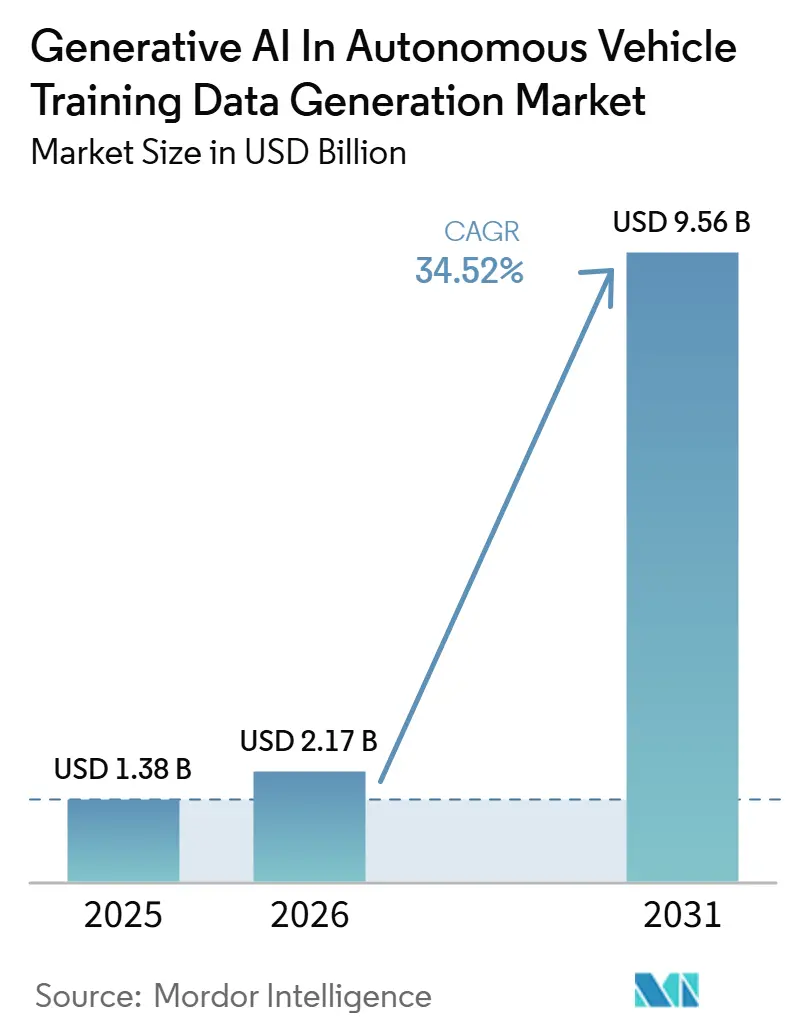
The generative AI in autonomous vehicle training data generation market size is expected to increase from USD 1.38 billion in 2025 to USD 2.17 billion in 2026 and reach USD 9.56 billion by 2031, growing at a CAGR of 34.52% over 2026-2031. The generative AI in autonomous vehicle training data generation market is expanding because autonomous driving teams need more rare and safety critical scenarios than physical fleets can capture in normal operations. The shift from real-world collection to synthetic pipelines is becoming increasingly central as developers seek to shorten validation cycles and improve coverage across weather, lighting, traffic behavior, and sensor combinations. The generative AI in autonomous vehicle training data generation market is also being shaped by stricter expectations around traceability, data quality governance, and safety validation for Level 3 and Level 4 systems. Competition is strengthening as infrastructure leaders, simulation vendors, and specialized synthetic data providers deepen their integration with OEM engineering workflows and cloud environments. Verification gaps, compute cost volatility, and uneven regulatory frameworks still create friction, but they also expand room for vendors that can deliver scalable, auditable, and high-fidelity data generation systems.
Key Report Takeaways
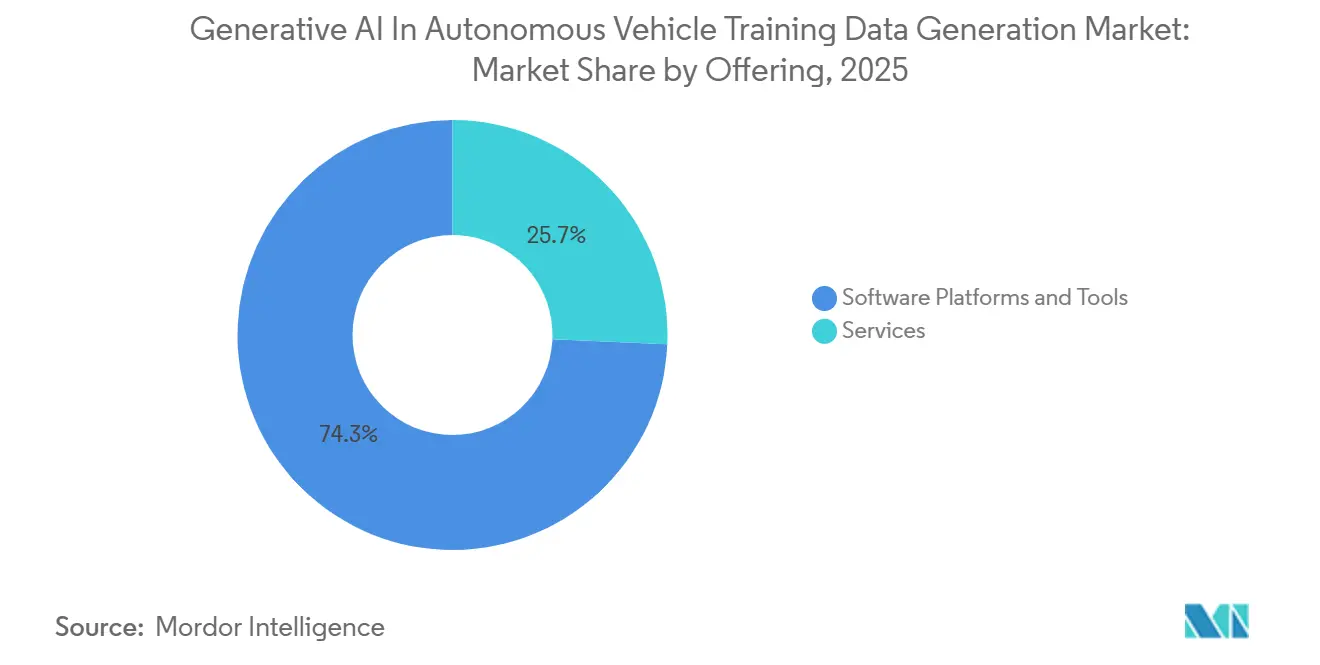
- By offering, software platforms and tools held 74.32% of the generative AI in autonomous vehicle training data generation market share in 2025, while services are projected to expand at 34.67% CAGR through 2031.
- By data modality, multimodal sensor data held 45.67% share in 2025, while LiDAR point cloud generation is projected to grow at 34.53% CAGR through 2031.
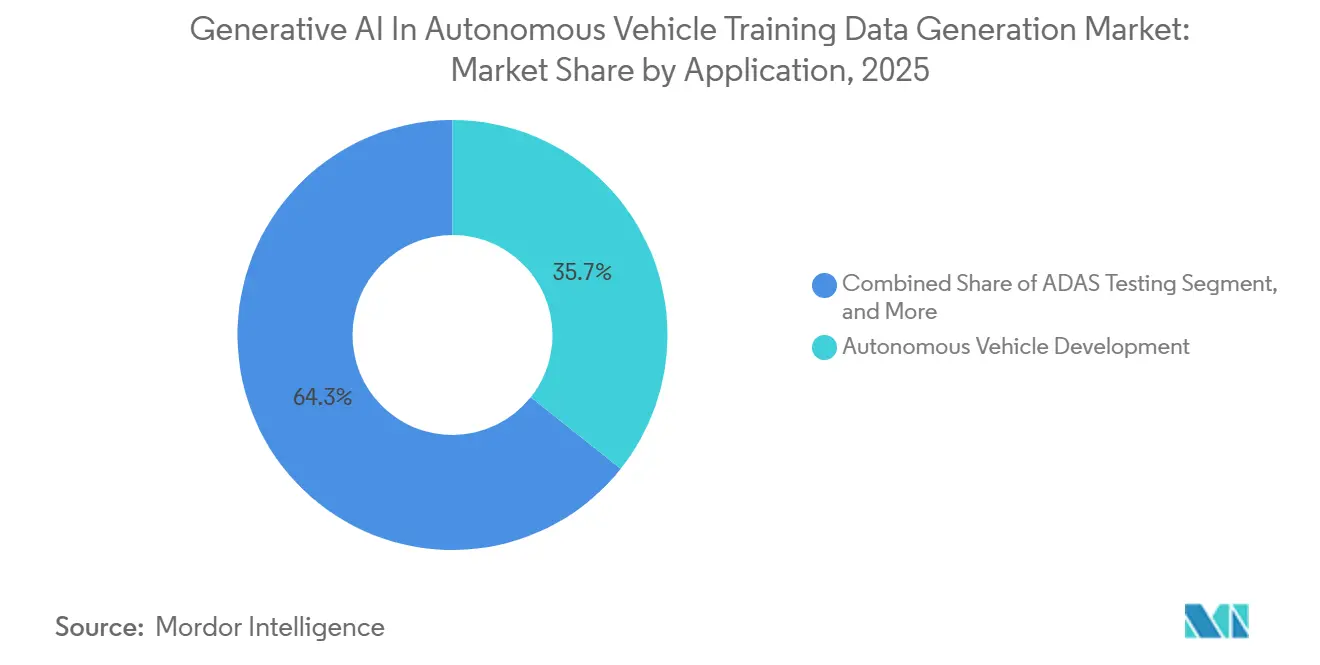
- By application, autonomous vehicle development accounted for 35.69% share of the generative AI in autonomous vehicle training data generation market size in 2025, while safety and compliance is projected to expand at 35.67% CAGR through 2031.
- By end use, automotive OEMs held 43.23% share in 2025, while technology companies are projected to grow at 34.98% CAGR through 2031.
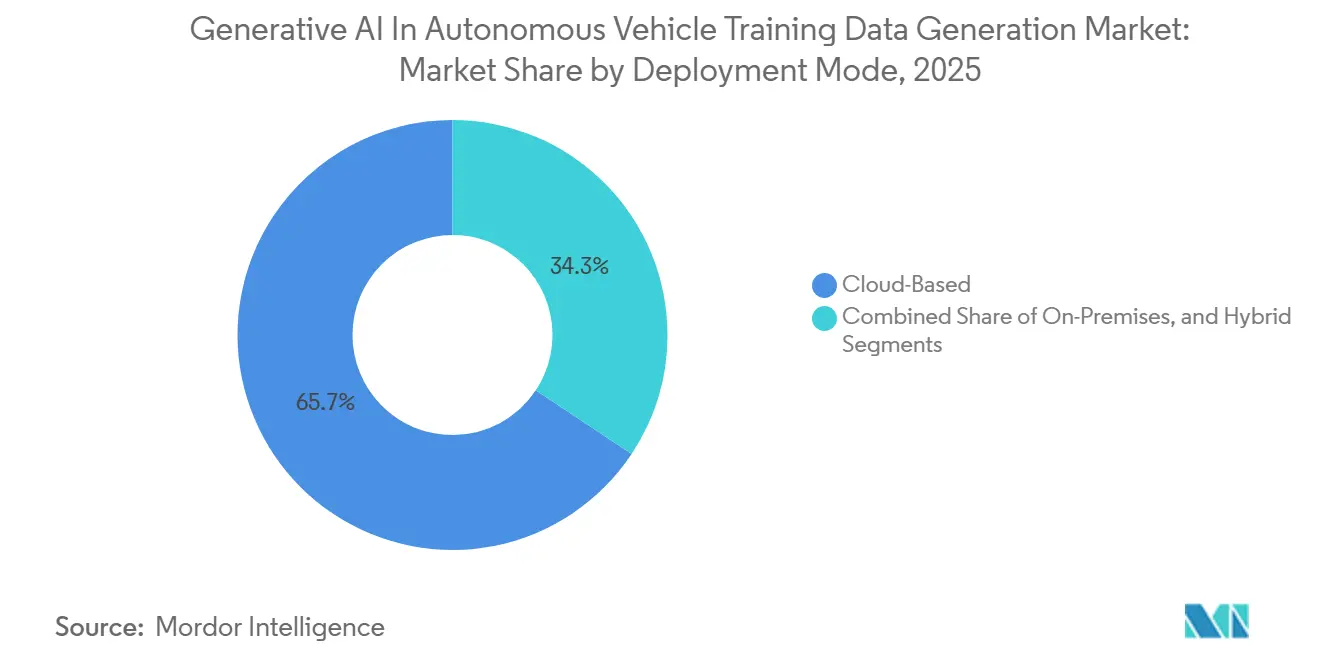
- By deployment mode, cloud-based deployment held 65.67% share in 2025, while hybrid deployment is projected to grow at 35.67% CAGR through 2031.
- By geography, North America held 32.12% share in 2025, while Asia-Pacific is projected to expand at 36.32% CAGR through 2031.
Note: Market size and forecast figures in this report are generated using Mordor Intelligence’s proprietary estimation framework, updated with the latest available data and insights as of January 2026.
Market Trends and Insights
Drivers Impact Analysis of Generative AI In Autonomous Vehicle Training Data Generation Market*
| Driver | (~) % Impact on CAGR Forecast | Geographic Relevance | Impact Timeline |
|---|---|---|---|
| Growing Need for Safe Synthetic Training Scenarios | +8.5% | Global, concentrated in North America and Europe | Short term (≤ 2 years) |
| Rising Cost and Scalability Constraints of Real-World Data Collection | +7.2% | Global, highest in North America, China, and Germany | Short term (≤ 2 years) |
| Expansion of ADAS and Autonomous Driving Programs | +6.8% | North America, Asia-Pacific core, and Europe | Medium term (2-4 years) |
| Shortage of Real-World Edge Case Training Data | +5.9% | Global, acute in Asia-Pacific and South America due to road-type diversity | Medium term (2-4 years) |
| Foundation Model Ecosystem for Large-Scale AI Training | +4.3% | North America and Asia-Pacific core, with spillover to Europe | Long term (≥ 4 years) |
| Growing Demand for Diverse and High-Fidelity Synthetic Datasets | +3.8% | Global | Long term (≥ 4 years) |
| Source: Mordor Intelligence | |||
Growing Need for Safe Synthetic Training Scenarios
The generative AI in autonomous vehicle training data generation market is being pushed first by the simple fact that rare driving events do not appear often enough in physical fleet data to support broad and safe model training. Emergency vehicle interactions, sudden pedestrian movement, heavy weather, and unusual road conflicts all matter for deployment readiness, but they appear too infrequently in natural driving to build balanced training libraries from road collection alone. NVIDIA released Cosmos world foundation models and a related physical AI dataset in 2025 to let developers generate varied driving clips from map, depth, and weather inputs, directly addressing this long-tail coverage problem.[1]NVIDIA, “Simplify End-to-End Autonomous Vehicle Development With New NVIDIA Cosmos World Foundation Models,” NVIDIA CARLA also integrated Cosmos Transfer into its open-source simulation platform in 2025, which widened access to generative synthetic workflows across a large developer base. Safety validation pressure adds more urgency because ISO/TS 5083:2025 sets clearer expectations for scenario coverage and traceable testing before deployment of higher-level autonomous systems.
Rising Cost and Scalability Constraints of Real-World Data Collection
The generative AI in autonomous vehicle training data generation market is also benefiting from the rising cost of collecting, cleaning, labeling, and validating real-world sensor streams at a production scale. Modern fleets can generate up to 4 TB of raw sensor data per vehicle per day, yet usable ground truth for rare edge cases and cross-sensor context remains much harder to secure than raw volume.[2]Kognic, “Pre-Production Validation Challenges in Autonomy Systems,” Kognic Synthetic generation changes the cost structure by enabling pre-annotated outputs and reducing the manual labeling needed for new scenario libraries. Applied Intuition said it processed hundreds of petabytes of training data and supported 50 million simulations in 2025, which shows how expensive and operationally demanding large-scale data infrastructure has become for autonomy programs. That makes managed synthetic data pipelines more attractive for Tier 1 suppliers and mid-sized developers that cannot build fleet-scale data operations on their own.
Expansion of ADAS and Autonomous Driving Programs
The expansion of ADAS and autonomous driving programs is widening the customer base for the generative AI in autonomous vehicle training data generation market across passenger cars, trucks, robotaxis, and defense-related applications. Every new operating domain needs its own scenario library, sensor calibration logic, and testing conditions, so data requirements multiply as programs move from controlled pilots to broader deployment. Applied Intuition deepened this trend in 2025 through work with TRATON Group across Scania, MAN, International, and Volkswagen Truck and Bus, where simulation and virtual validation became part of larger industrial programs.[3]Applied Intuition, “2025 in Review, Autonomy at Scale,” Applied Intuition The same source also showed expansion with partners in mining, commercial vehicles, and passenger vehicle autonomy, suggesting broader program demand beyond a single vehicle class. As more ADAS and AV teams scale their efforts, the generative AI in autonomous vehicle training data generation market gains from the recurring need for new synthetic scenarios, faster iteration, and evidence packages that support validation.
Shortage of Real-World Edge Case Training Data
A persistent shortage of real-world edge case coverage continues to strengthen the generative AI in autonomous vehicle training data generation market because critical failures often arise from low-frequency situations that fleets do not capture in enough volume. Research published in Automated Software Engineering in 2025 showed that synthetic critical scenario sets differ statistically from California collision reports, confirming both the need for synthetic augmentation and for realism calibration. A separate study in the MDPI AI journal in 2026 showed that diffusion-based inpainting can generate annotated training data from unlabeled traffic camera footage, reducing manual effort while filling scenario gaps. NVIDIA also released the Cosmos-Drive-Dreams dataset in 2025 with 81,802 synthetic video samples derived from 5,843 real-world clips, including rain, snow, and fog conditions that are harder to collect consistently on the road. These developments are turning synthetic generation into a core data infrastructure layer instead of a side tool for limited augmentation.
Restraints Impact Analysis of Generative AI In Autonomous Vehicle Training Data Generation Market*
| Restraint | (~) % Impact on CAGR Forecast | Geographic Relevance | Impact Timeline |
|---|---|---|---|
| Verification Gap Between Synthetic and Real-World Sensor Data | -4.2% | Global | Medium term (2-4 years) |
| High Cost of Physics-Based Simulation Infrastructure | -3.1% | Global, acute for mid-size Tier 1 suppliers in South America, the Middle East, and Africa | Long term (≥ 4 years) |
| Fragmented Scenario Coverage Across Geographies and ODD Types | -2.4% | Asia-Pacific, South America, and Africa | Long term (≥ 4 years) |
| GPU and Cloud Compute Constraints | -1.8% | Global, acute in regions with limited cloud infrastructure | Medium term (2-4 years) |
| Source: Mordor Intelligence | |||
Verification Gap Between Synthetic and Real-World Sensor Data
The main restraint on the generative AI in autonomous vehicle training data generation market remains the gap between synthetic outputs and real sensor behavior in deployment conditions. Models trained on generated scenarios can still underperform when they meet subtle noise patterns, reflectance effects, and atmospheric conditions that the simulation does not fully reproduce. Research on dataset safety in autonomous driving published in 2025 also stressed that data lineage and model impact must remain traceable under emerging safety assurance frameworks, which raises the documentation burden for synthetic pipelines.[4]arXiv, “Dataset Safety in Autonomous Driving, Requirements, Risks, and Assurance NVIDIA’s NuRec APIs help close part of that gap by reconstructing high-fidelity 3D environments from real fleet data, but validation still depends on specialized engineering workflows. Until standardized transfer benchmarks become more common across sensor modalities, adoption will continue to move more slowly than the underlying demand suggests.
High Cost of Physics-Based Simulation Infrastructure
The generative AI in autonomous vehicle training data generation market also faces a cost barrier when customers need physics-accurate radar and LiDAR simulation under difficult weather and lighting conditions. High-fidelity rendering needs significant GPU resources because each interaction must model propagation, material response, and scene dynamics with enough detail to support engineering decisions. Ansys showed this direction in its AVxcelerate Sensors 2026 R1 release, which integrated NVIDIA Omniverse NuRec and Cosmos into a more advanced sensor simulation environment. That level of realism improves utility, but it also raises the infrastructure and expertise threshold for regional OEMs and mid-sized suppliers. Cloud adoption helps with part of the burden, yet the remaining on-premise and hybrid workloads often belong to the same cost-constrained programs that struggle most with premium simulation spending.
*Our forecasts treat driver/restraint impacts as directional, not additive. The impact forecasts reflect baseline growth, mix effects, and variable interactions.
Generative AI In Autonomous Vehicle Training Data Generation Market Segment Analysis
By Offering:
Software Platforms Anchor the Pipeline, Services Narrow the GapSoftware platforms and tools held 74.32% share in 2025, which shows that the generative AI in autonomous vehicle training data generation market still rests first on platform ownership rather than outsourced execution. Early buyers have focused on scenario generation, annotation control, and data curation systems because these tools sit closest to internal engineering workflows and give teams greater control over operational design domains, sensor configurations, and corner-case logic. This pattern favors vendors that can provide extensible APIs, configurable environments, and integration with downstream model training pipelines. It also reflects a preference among OEMs and Tier 1 suppliers to keep the core logic of scenario design and validation inside their own organizations.
Services are projected to expand at a 34.67% CAGR through 2031, making it the fastest-growing part of this segment as more customers lack the internal teams needed to run synthetic data programs at scale. The generative AI in autonomous vehicle training data generation market is therefore shifting from pure software procurement toward blended models where platform access and managed execution move together. Applied Intuition’s Data Engine, which curates petabyte-scale datasets from raw fleet logs for foundation model training, shows how platform vendors are already building recurring service layers around software licenses. As post-training, calibration, and evaluation work grows more specialized, service demand is likely to rise because many customers need delivery speed and quality assurance more than they need ownership of every workflow component.


By Data Modality:
Multimodal Data Leads, LiDAR Moves FastestMultimodal sensor data commanded 45.67% share in 2025, which confirms that buyers in the generative AI in autonomous vehicle training data generation market value cross-sensor consistency more than single-modality output. Autonomous perception systems do not operate on camera, radar, or LiDAR in isolation, so synthetic data is more useful when geometry, timing, and object behavior remain aligned across all streams. This explains why multimodal stacks have become central to platform positioning and scenario design. It also explains why images and videos remain important but no longer define the highest-value part of the workflow on their own.
LiDAR point cloud generation is projected to grow at a 34.53% CAGR through 2031, as dynamic scene understanding relies heavily on precise spatial representation. Research presented at ICRA 2025 on LidarDM showed how generated worlds can support more realistic LiDAR simulation workflows. NVIDIA’s Cosmos Predict-2 extended multimodal world modeling in 2025 by generating future-world-state videos with stronger motion and object control, enabling richer synchronization across synthetic sensor outputs. ISO/TS 21934-2:2024 also supports this direction because virtual environments for pre-crash technology simulation require broader modality coverage for testing and evidence generation.
By Application:
AV Development Holds the Lead, Safety and Compliance AcceleratesAutonomous vehicle development held 35.69% share in 2025, which kept it as the largest application in the generative AI in autonomous vehicle training data generation market. The reason is straightforward: large L3 and L4 programs need broad, repeatable, and edge-case-rich scenario sets long before commercial-scale deployment. Applied Intuition said customers completed more than 50 million simulations and billions of virtual driving miles in 2025, demonstrating that synthetic generation now supports core development activities rather than side testing. ADAS testing also remains important because Tier 1 suppliers and OEMs use synthetic scenarios to cover defined regulatory matrices at a lower cost than physical testing alone.
Safety and compliance are projected to grow at a 35.67% CAGR through 2031, making it the fastest-expanding application area in this segment. The generative AI in autonomous vehicle training data generation market size for this use case is rising because auditable training datasets are becoming more important as governance expectations tighten across automated driving systems. The EU AI Act and related quality governance requirements strengthen that shift by pushing developers toward repeatable and documented data workflows. Design validation is smaller in current share, but digital twins are giving engineering teams more room to test sensor placement and architecture choices before prototype commitments are made. AI and ML model training also keeps gaining weight as end-to-end systems need more diverse synthetic inputs than physical fleets can deliver in practical time frames.

By End Use:
OEMs Drive Current Demand, Technology Companies Raise Growth RatesAutomotive OEMs accounted for 43.23% share in 2025, which made them the largest end use group in the generative AI in autonomous vehicle training data generation market. OEM demand is anchored in the scale of their validation burden, because fleets can generate multi-terabyte data streams every day without addressing the shortage of usable edge-case coverage. That makes synthetic workflows valuable not because raw data is scarce, but because targeted and verified training content is scarce. OEM-led programs, therefore, continue to set revenue volume for the current market.
Technology companies are projected to grow at a 34.98% CAGR through 2031, the fastest pace among end users. The generative AI in autonomous vehicle training data generation market is attracting these companies because physical AI developers increasingly want shared training pipelines that can serve robotics, logistics, and autonomous driving from a common stack. Applied Intuition’s 2025 work with TRATON and other partners shows how platform ecosystems are already crossing vehicle classes and adjacent autonomy domains. Research institutions remain smaller in revenue terms, but their role in tooling and benchmark development still matters, including work such as SynthDrive’s real2sim2real pipeline presented at IROS 2025.
By Deployment Mode:
Cloud Leads on Scale, Hybrid Gains from Data Control NeedsCloud-based deployment held 65.67% share in 2025, which left it as the leading deployment mode in the generative AI in autonomous vehicle training data generation market. Cloud environments fit this workload well because synthetic generation, inference, and repeated scenario execution can require large bursts of GPU capacity that many customers do not want to finance on fixed local infrastructure. The cloud model also supports easier access to managed services, shared development tools, and shorter setup times for new programs. This combination has made cloud deployment the default path for many teams entering synthetic data workflows.
Hybrid deployment is projected to expand at a 35.67% CAGR through 2031 as buyers seek to balance elastic compute with greater control over proprietary fleet data and regional data-handling requirements. NVIDIA’s Cosmos Transfer NIM microservice, introduced as a containerized service in 2025, supports this trend by lowering access barriers while still aligning with broader enterprise deployment choices. On-premises environments remain relevant when defense-linked programs, sensitive fleet records, or local compliance requirements limit the external movement of data. Hybrid architectures are therefore gaining ground because they let customers keep data and scenario libraries closer to internal systems while still using external compute where it adds the most value.
Geography Analysis
North America Generative AI in Autonomous Vehicle Training Data Generation Market
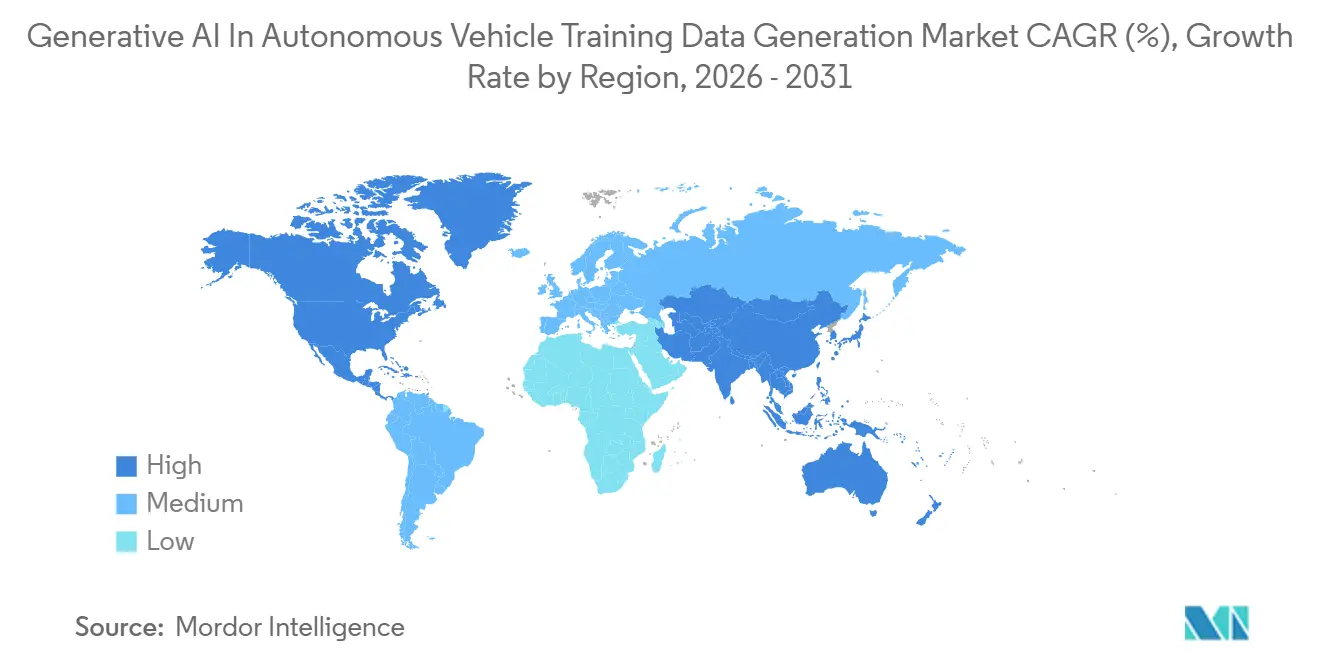
North America held 32.12% of the generative AI in autonomous vehicle training data generation market share in 2025, which made it the largest regional contributor. The region benefits from a dense mix of AV developers, simulation platform vendors, and GPU infrastructure suppliers, with the United States serving as the main center for commercialization. Applied Intuition, NVIDIA, Parallel Domain, and Foretellix all support that ecosystem depth, and Applied Intuition reported 50 million simulations in 2025 while expanding to six new global offices. The United States also remains the largest base for active autonomous-driving programs that require high volumes of synthetic validation data across multiple use cases. Mexico adds a smaller but relevant role as cross-border commercial autonomy programs widen the operating corridor for testing and logistics use cases.
APAC Generative AI in Autonomous Vehicle Training Data Generation Market
Asia-Pacific is projected to expand at 36.32% CAGR through 2031, giving it the fastest regional pace in the generative AI in autonomous vehicle training data generation market. Growth in the region is being supported by China’s industrial push into autonomous driving, Japan’s efforts in commercial vehicles, and South Korea’s expanding ADAS supply base. South Korea’s SUM launched the Abyss data operating platform in 2025 to convert real-world driving data into AI-ready assets aligned with national autonomous-driving data standards, indicating that local capability-building is moving beyond pilot work. Japan and India also add momentum as corridor programs and logistics autonomy efforts create more structured demand for synthetic testing and training content.
EMEA and South America Generative AI in Autonomous Vehicle Training Data Generation Market
Europe remains the second-largest regional market in value terms because it combines a deep OEM and Tier 1 supplier base with a stricter regulatory setting. The United Kingdom strengthens regional depth through Wayve, which secured a USD 1.2 billion Series D round in February 2026 and is using its GAIA world model as the base for commercial robotaxi trials in London. Germany continues to anchor much of the region’s industrial activity through its OEM ecosystem and vendors such as dSPACE, while France adds simulation capability through AVSimulation. South America, the Middle East, and Africa still represent smaller positions in the generative AI in autonomous vehicle training data generation market because local AV fleet scale and infrastructure remain limited, though cloud-based workflows are lowering entry barriers for research and logistics programs.

Competitive Landscape
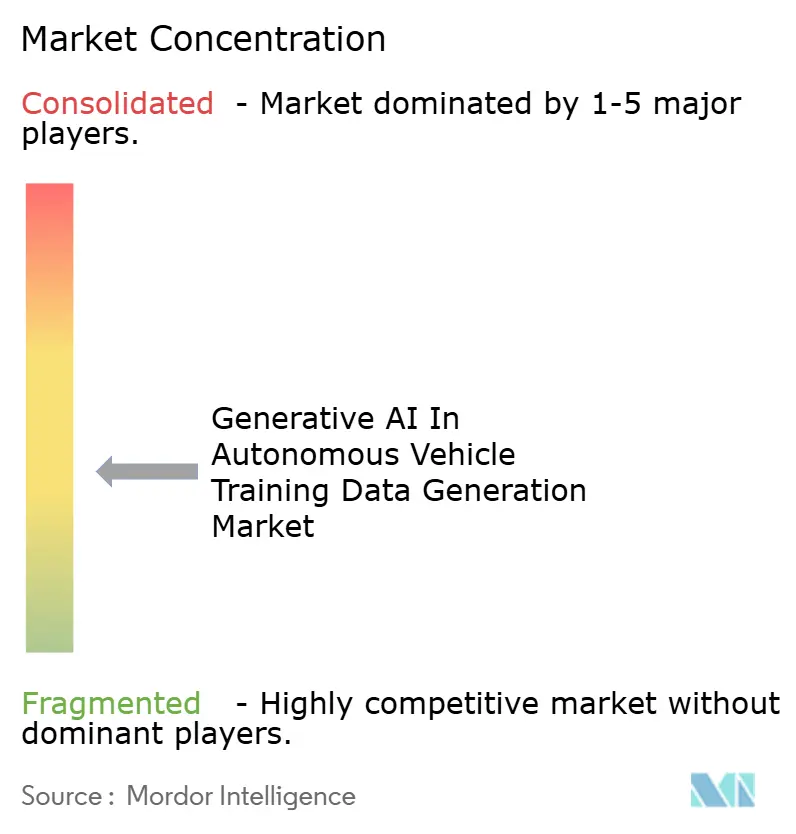
The generative AI in autonomous vehicle training data generation market shows moderate concentration at the infrastructure layer, but it remains fragmented across scenario depth, sensor modality coverage, and geographic operating design domain coverage. NVIDIA holds an influential position because its Cosmos world foundation model family shapes how many developers think about generation, transfer, and future-state modeling across AV workflows. That influence does not make the market highly consolidated because application-layer competition remains active among simulation platforms and synthetic data specialists. Applied Intuition, Cognata, Parallel Domain, dSPACE, Foretellix, Ansys, and The MathWorks still compete on engineering workflow fit, sensor fidelity, and the breadth of scenario libraries. In practice, the generative AI in autonomous vehicle training data generation market rewards vendors that can combine technical realism with easier integration into OEM validation systems.
A clear competitive pattern is that established vendors are adding generative AI capabilities into existing simulation stacks instead of replacing their full platforms. Ansys did this in 2026 by integrating NVIDIA Omniverse NuRec and Cosmos into AVxcelerate Sensors, which strengthened its physics-based simulation position with new AI-driven scenario generation functions. dSPACE also expanded Aurelion with Hesai LiDAR integration in 2025, which improved sensor coverage for developers working across camera, radar, and LiDAR testing environments. Foretellix and Parallel Domain moved in a similar direction through a joint solution that connected coverage-driven scenario testing with photorealistic digital twin environments.[5]Foretellix, “Foretellix and Parallel Domain Partner to Bring Hyper-Realistic Simulation for AV Testing,” Foretellix
Newer entrants are targeting narrower bottlenecks instead of trying to match full-stack incumbents from the start. Nomadic focused on turning unstructured AV fleet footage into structured and searchable training datasets, while DiffuseDrive positioned itself around photorealistic generative content for automotive and adjacent robotics uses. This leaves room for specialists even as larger vendors expand platform scope, because the market still has open gaps in regional scenario coverage and automated measurement of synthetic-to-real transfer quality. Compliance also favors better-established vendors because standards such as ISO 22133:2026 are raising the bar for tools that want to support OEM-grade validation programs.
Generative AI In Autonomous Vehicle Training Data Generation Industry Leaders
NVIDIA Corporation
Applied Intuition Inc.
Cognata Ltd.
Parallel Domain Inc.
Foretellix Ltd.
- *Disclaimer: Major Players sorted in no particular order
Generative AI In Autonomous Vehicle Training Data Generation Market Companies Covered in this Report
- NVIDIA Corporation
- Applied Intuition Inc.
- Cognata Ltd.
- Parallel Domain Inc.
- Foretellix Ltd.
- Ansys Inc.
- The MathWorks, Inc.
- dSPACE GmbH
- Siemens Digital Industries Software
- Dassault Systemes SE
- Altair Engineering Inc.
- Autodesk, Inc.
- Unity Software Inc.
- IPG Automotive GmbH
- AVSimulation SAS
- rFpro Limited
- aiMotive
- Elektrobit Automotive GmbH
- Scale AI, Inc.

Recent Industry Developments in Generative AI In Autonomous Vehicle Training Data Generation Market
- June 2026: Stellantis, Wayve, and Uber announced a strategic partnership to jointly develop and deploy Level 4 driverless robotaxi services globally, integrating Wayve's GAIA generative AI world model into the full L4 autonomy stack and creating program-level demand for Wayve's synthetic training data capabilities across multiple markets.
- May 2026: Wayve and Stellantis announced integration of the Wayve AI Driver into the STLA AutoDrive platform for L2+ supervised automated driving, extending Wayve's embodied AI approach, trained on data from over 70 countries, to mass-market consumer vehicles scheduled for deployment from 2027.
- February 2026: Wayve closed a USD 1.2 billion Series D funding round at a USD 8.6 billion post-money valuation, with investors including NVIDIA, Microsoft, Uber, Mercedes-Benz, Nissan, and Stellantis. The funding supports the commercial deployment of its generative AI end-to-end autonomous driving platform, with London robotaxi trials launching in 2026.
- January 2026: Waabi raised USD 1 billion in a Series C co-led by Khosla Ventures and G2 Venture Partners, including USD 250 million in milestone-based capital from Uber tied to deploying 25,000 or more Waabi Driver-powered autonomous vehicles exclusively on Uber's platform, bringing Waabi's total funding to USD 1.28 billion.


Global Generative AI In Autonomous Vehicle Training Data Generation Market Report Scope
The Generative AI in Autonomous Vehicle Training Data Generation Market is Segmented by Offering (Software Platforms and Tools, and Services), Data Modality (Image, Video, LiDAR Point Cloud, Radar, and Multimodal Sensor Data), Application (ADAS Testing, Autonomous Vehicle Development, AI and ML Model Training, Safety and Compliance Validation, and Design Validation), End Use (Automotive OEMs, Tier 1 Suppliers, Technology Companies, and Research Institutions), Deployment Mode (On-Premises, Cloud-Based, and Hybrid), and Geography (North America, South America, Europe, Asia-Pacific, Middle East, and Africa). The Market Forecasts are Provided in Terms of Value (USD).
| Software Platforms and Tools |
| Services |
| Image |
| Video |
| LiDAR Point Cloud |
| Radar |
| Multimodal Sensor Data |
| ADAS Testing |
| Autonomous Vehicle Development |
| AI and ML Model Training |
| Safety and Compliance Validation |
| Design Validation |
| Automotive OEMs |
| Tier 1 Suppliers |
| Technology Companies |
| Research Institutions |
| On-Premises |
| Cloud-Based |
| Hybrid |
| North America | United States |
| Canada | |
| Mexico | |
| South America | Brazil |
| Argentina | |
| Rest of South America | |
| Europe | Germany |
| United Kingdom | |
| France | |
| Italy | |
| Spain | |
| Russia | |
| Rest of Europe | |
| Asia-Pacific | China |
| Japan | |
| India | |
| South Korea | |
| Australia | |
| Rest of Asia-Pacific | |
| Middle East | Saudi Arabia |
| United Arab Emirates | |
| Turkey | |
| Rest of Middle East | |
| Africa | South Africa |
| Egypt | |
| Rest of Africa |
| By Offering | Software Platforms and Tools | |
| Services | ||
| By Data Modality | Image | |
| Video | ||
| LiDAR Point Cloud | ||
| Radar | ||
| Multimodal Sensor Data | ||
| By Application | ADAS Testing | |
| Autonomous Vehicle Development | ||
| AI and ML Model Training | ||
| Safety and Compliance Validation | ||
| Design Validation | ||
| By End Use | Automotive OEMs | |
| Tier 1 Suppliers | ||
| Technology Companies | ||
| Research Institutions | ||
| By Deployment Mode | On-Premises | |
| Cloud-Based | ||
| Hybrid | ||
| By Geography | North America | United States |
| Canada | ||
| Mexico | ||
| South America | Brazil | |
| Argentina | ||
| Rest of South America | ||
| Europe | Germany | |
| United Kingdom | ||
| France | ||
| Italy | ||
| Spain | ||
| Russia | ||
| Rest of Europe | ||
| Asia-Pacific | China | |
| Japan | ||
| India | ||
| South Korea | ||
| Australia | ||
| Rest of Asia-Pacific | ||
| Middle East | Saudi Arabia | |
| United Arab Emirates | ||
| Turkey | ||
| Rest of Middle East | ||
| Africa | South Africa | |
| Egypt | ||
| Rest of Africa | ||


Key Questions Answered in the Report
What is the current and forecast size of generative AI in autonomous vehicle training data generation market?
The generative AI in autonomous vehicle training data generation market stood at USD 2.17 billion in 2026 and is projected to reach USD 9.56 billion by 2031, growing at a 34.52% CAGR over 2026-2031.
What is driving adoption of synthetic training data for autonomous driving programs?
The main driver is the need for safe coverage of rare edge cases that physical fleets cannot capture often enough, along with lower labeling costs and faster scenario generation.
Which offering segment currently leads revenue generation?
Software platforms and tools led with 74.32% share in 2025 because OEMs and Tier 1 suppliers prioritized internal control of scenario generation, curation, and validation workflows.
Which data modality is expanding the fastest for synthetic AV training workflows?
LiDAR point cloud generation is projected to grow at 34.53% CAGR through 2031, while multimodal sensor data held the largest share at 45.67% in 2025.
Why is hybrid deployment gaining traction despite cloud dominance?
Cloud held 65.67% share in 2025, but hybrid is growing faster at 35.67% CAGR because many developers want cloud scale for compute while keeping sensitive fleet data and scenario libraries under tighter control.
Which region offers the strongest growth outlook through 2031?
Asia-Pacific is projected to grow at 36.32% CAGR through 2031, supported by expanding autonomous driving programs, local data platforms, and broader industrial investment in AV development.
Page last updated on:





