
Generative AI In Architectural Design and Urban Planning Market Size and Share
Market Overview
| Study Period | 2020 - 2031 |
|---|---|
| Market Size (2026) | USD 3.58 Billion |
| Market Size (2031) | USD 12.52 Billion |
| Growth Rate (2026 - 2031) | 28.45 % |
| Fastest Growing Market | Asia-Pacific |
| Largest Market | North America |
| Market Concentration | Medium |
Major Players *Disclaimer: Major Players sorted in no particular order Image © Mordor Intelligence. Reuse requires attribution under CC BY 4.0. | |
Generative AI In Architectural Design and Urban Planning Market Analysis by Mordor Intelligence
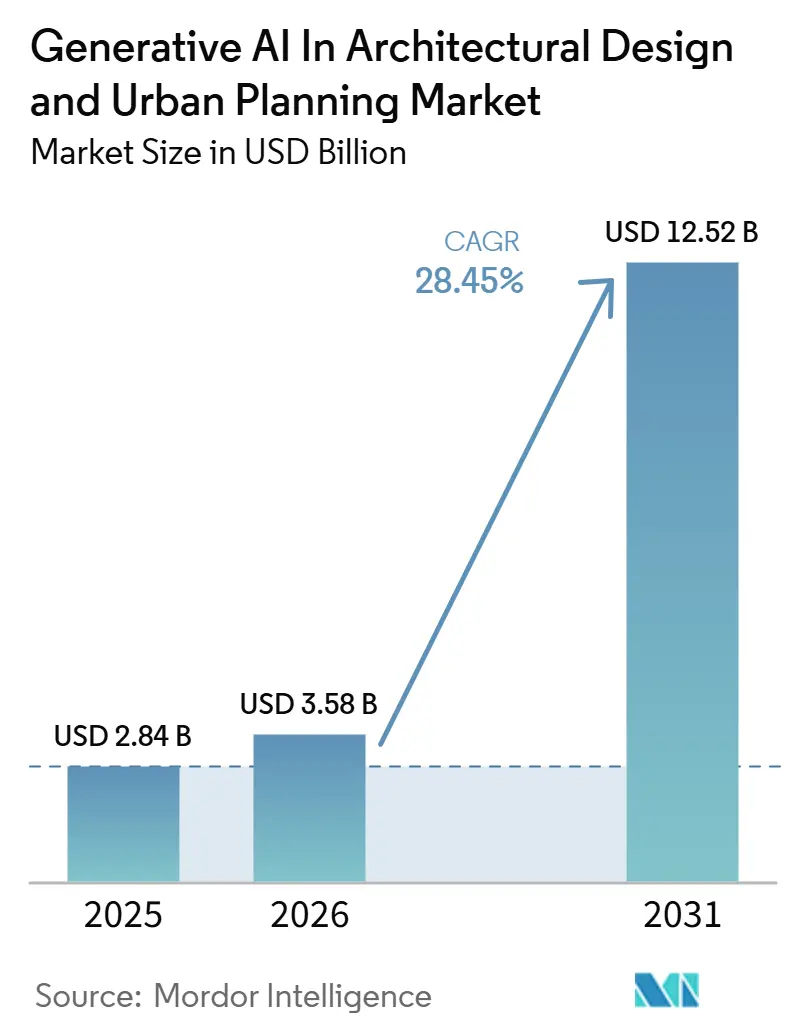
The generative AI in architectural design and urban planning market size is expected to increase from USD 2.84 billion in 2025 to USD 3.58 billion in 2026 and reach USD 12.52 billion by 2031, growing at a CAGR of 28.45% over 2026-2031. The 2026 step-up reflected a clear shift in buyer behavior, as major AEC software vendors moved generative AI from optional features into core design workflows. Geometry-native model development also broadened the practical use of AI, enabling firms to apply it to schematic design, floor planning, and feasibility work rather than using it only for image-led ideation. At the same time, high GPU costs kept cloud delivery central to adoption, pushing customers away from purely on-premises licensing toward flexible consumption models. Competition widened as incumbents defended installed software bases while AI-native vendors targeted early-stage design tasks that shape long-term platform retention. The main constraint on the growth path was not lack of interest, but the pace at which firms, regulators, and insurers could settle questions around verification, accountability, and privacy in production design environments.
Key Report Takeaways
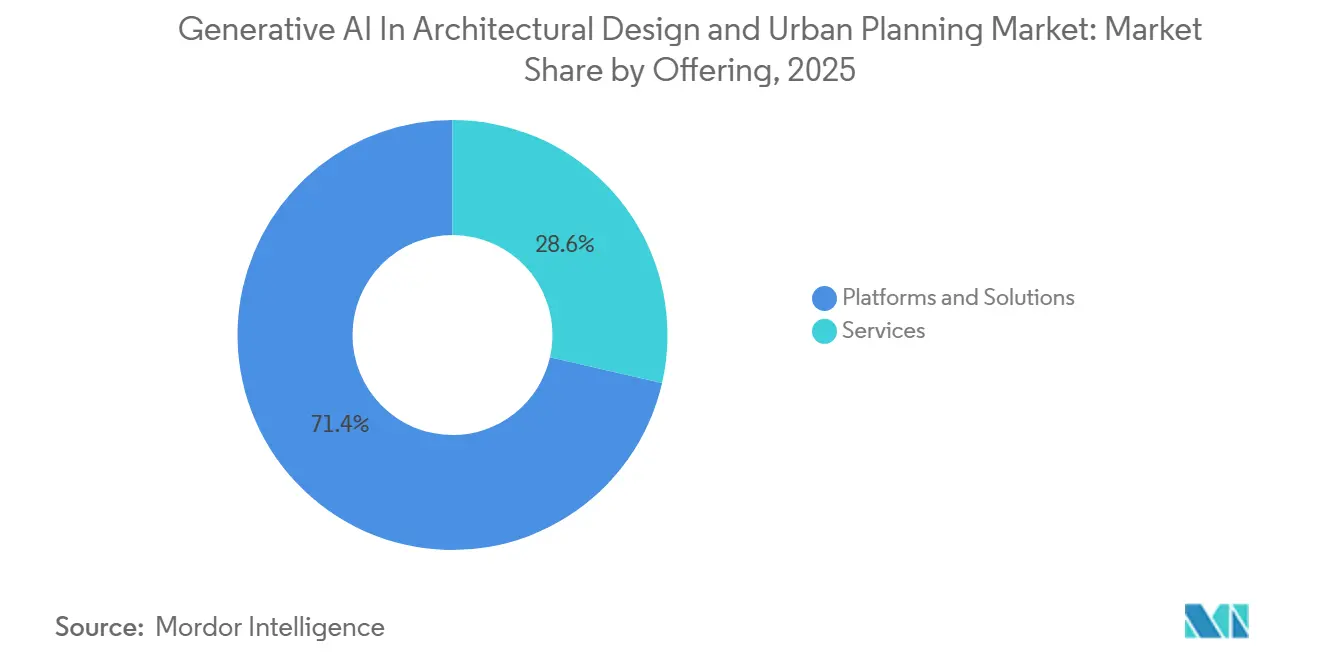
- By offering, platforms and solutions held 71.42% of revenue in 2025, while services are projected to expand at a 29.18% CAGR through 2031.
- By deployment, cloud-based models accounted for 69.15% of revenue in 2025, while hybrid cloud is projected to record the fastest growth at a 29.63% CAGR through 2031.
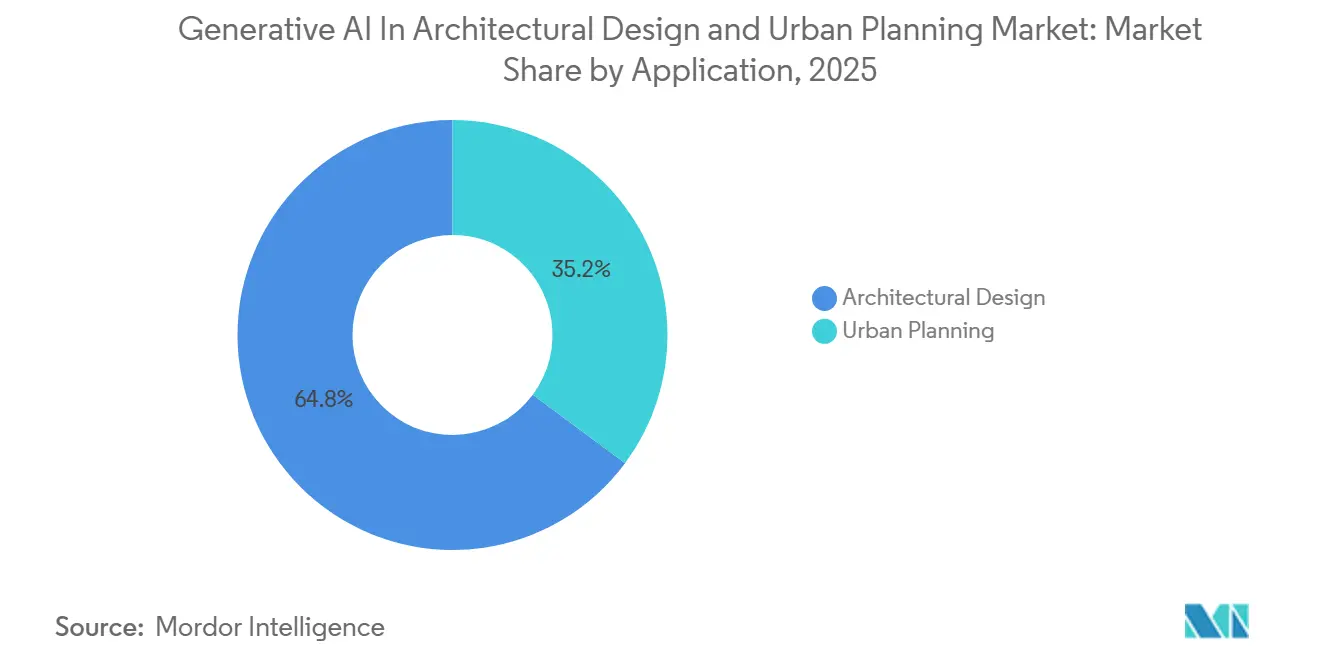
- By application, architectural design represented 64.83% of the generative AI in architectural design and urban planning market size in 2025, while urban planning is expected to grow at a 29.05% CAGR through 2031.
- By end-user, architectural and design firms held 36.72% of revenue in 2025, while government and municipal agencies are projected to expand at a 29.71% CAGR through 2031.
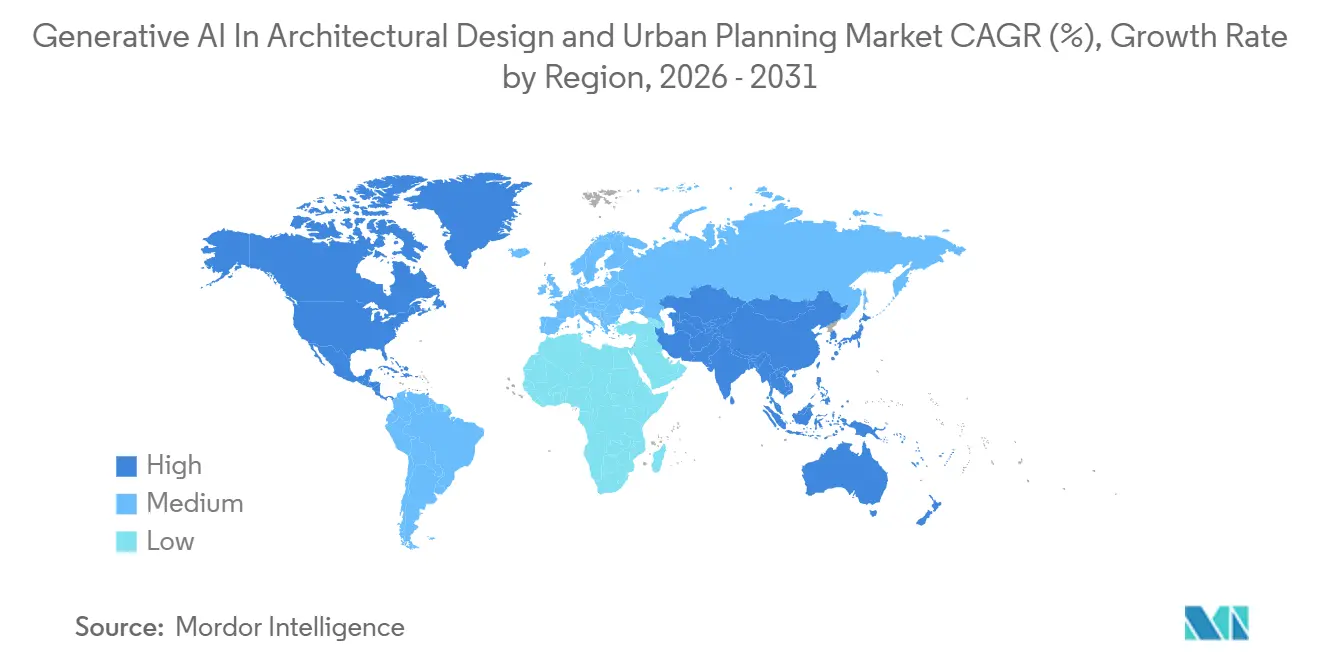
- By geography, North America captured 38.26% of revenue in 2025, while Asia-Pacific is projected to grow at a 30.18% CAGR through 2031.
Note: Market size and forecast figures in this report are generated using Mordor Intelligence’s proprietary estimation framework, updated with the latest available data and insights as of January 2026.
Market Trends and Insights
Drivers Impact Analysis of Generative AI In Architectural Design and Urban Planning Market*
| Driver | (~) % Impact on CAGR Forecast | Geographic Relevance | Impact Timeline |
|---|---|---|---|
| Rapid Prototyping And Real-Time Computational Design Demand | +6.8% | Global, concentration in North America and Europe | Short term (≤ 2 years) |
| Urban Planning Complexity And Infrastructure Challenges | +4.5% | APAC core, spill-over to Middle East and Africa | Medium term (2-4 years) |
| Low-Carbon And Energy-Efficient Design Compliance Needs | +4.0% | EU, North America, with early gains in Australia and South Korea | Medium term (2-4 years) |
| BIM And Cloud-Native Platform Integration | +3.5% | Global | Short term (≤ 2 years) |
| AI-Powered Visualization And Real-Time Rendering Demand | +2.8% | North America and Asia-Pacific | Short term (≤ 2 years) |
| Automation In AEC Design Workflows | +2.2% | Global | Long term (≥ 4 years) |
| Source: Mordor Intelligence | |||
Growing Demand for Rapid Prototyping and Real-Time Computational Design
The move from sequential design work to concurrent iteration remained one of the strongest demand drivers in the generative AI in architectural design and urban planning market. Autodesk Research stated in June 2026 that Neural CAD was built to reason directly over precise 2D and 3D geometry, which moved AI closer to production-grade design tasks instead of visual experimentation alone. Research published in Automation in Construction in 2025 found that machine learning pipelines now extend across floor plan generation, performance simulation, and construction detailing, which showed that AI utility was spreading across the full design continuum.[1]X. Zhuang, P. Zhu, A.Y. Yang, and L. Caldas, “Machine Learning for Generative Architectural Design: Advancements, Opportunities, and Challenges,” Automation in Construction Snaptrude also positioned its 2026 release around LOD 300 and LOD 350 delivery from early massing through coordinated AI workflows, which supported faster movement from concept work to coordinated design output. As iteration cycles shortened, the cost advantage long held by large studios started to narrow because smaller practices could test more options with fewer manual hours. That shift mattered because early concept work often shaped client retention, pricing power, and downstream subscription value across the generative AI in architectural design and urban planning market.
Increasing Complexity of Urban Planning Projects and Infrastructure Challenges
Urban planning authorities faced rising pressure to speed housing delivery while managing land use constraints, infrastructure gaps, and climate-related risk, which increased the relevance of the generative AI in architectural design and urban planning market. The UK government announced in June 2026 that its Augmented Planning Decisions prototype aimed to reduce the time for processing householder planning applications from 8 weeks to 4 weeks across local authorities in England.[2]UK Government, Ministry of Housing, Communities and Local Government, “AI Tool to Slash Planning Decision Times as Government Accelerates Push to Build 1.5 Million Homes,” GOV.UK Germany’s SPARK initiative was released as open source in April 2026 to support complex planning and approval procedures while keeping final decisions in the hands of qualified staff, demonstrating that public agencies were treating AI as an operational tool rather than a trial technology. These programs also had broader commercial value because they created procurement templates that other cities and national agencies could adopt without relying on a single proprietary vendor stack. That pattern supported the fastest-growth outlook for government-linked demand in the generative AI in architectural design and urban planning market, especially where planning backlogs had become politically sensitive. It also widened the addressable market beyond private design firms, which gave vendors a new path into long-cycle public budgets.
Growing Need for Low-Carbon, Energy-Efficient Building Design and Sustainability Compliance
Sustainability compliance became a more direct growth lever for the generative AI in architectural design and urban planning market because energy and carbon performance moved earlier in the design process. The International Energy Agency reported that building operations accounted for 30% of global final energy consumption, underscoring the importance of performance modeling in project planning and regulatory review. Snaptrude stated that its integration with cove.tool allowed architects to run energy and daylighting analysis continuously during BIM-based design iteration, which reduced the stop-start pattern between design teams and sustainability specialists.[3]Snaptrude, “Announcing Snaptrude AI, An AI That Designs With You,” Snaptrude This mattered commercially because firms increasingly needed design tools that could test cost, climate, and spatial trade-offs within a single workflow rather than across separate handoffs. The Czech Republic’s Act No. 330/2025 Coll. also signaled tighter digital information management requirements for public construction, reinforcing the role of software platforms that embed verification and traceability into project workflows. As a result, vendors in the generative AI in architectural design and urban planning market gained a clearer route to differentiation when compliance functions were integrated directly into design generation.
Growing Integration of Generative AI With BIM and Cloud-Native Design Platforms
The growing integration of generative AI with BIM and cloud-native tools helped lower deployment friction across the generative AI in architectural design and urban planning market. Autodesk said in March 2026 that it rebranded Autodesk Construction Cloud as Autodesk Forma and extended Forma Site Design, Forma Building Design, and Forma Data Management Essentials to all Revit subscribers, which reduced the barrier to trial and adoption across its installed base. Esri also released new GeoAI foundation models in 2026, including geospatial vision-language models and remote-sensing models, indicating that urban planning and building design intelligence were moving toward a more unified spatial stack. Published research on BIM and AI integration in early-stage design described a shift from isolated tool pairing toward closed-loop design and validation pipelines, with digital twins emerging as a preferred output for complex civic and mixed-use projects. This reduced the need for specialist scripting teams, which had previously limited advanced computational design methods to larger firms with niche technical staff. It also made the generative AI in architectural design and urban planning market more scalable because broader user groups could access AI functions inside familiar production environments.
Restraints Impact Analysis of Generative AI In Architectural Design and Urban Planning Market*
| Restraint | (~) % Impact on CAGR Forecast | Geographic Relevance | Impact Timeline |
|---|---|---|---|
| AI Accuracy, Reliability, And Design Hallucinations | -1.9% | Global | Short term (≤ 2 years) |
| Professional Liability, Legal Accountability, And Ethical Concerns | -1.4% | EU, North America, Australia | Medium term (2-4 years) |
| Legacy AEC Software And Workflow Integration Complexity | -1.1% | Global | Long term (≥ 4 years) |
| Data Privacy, Intellectual Property, And Copyright Concerns | -0.8% | EU, North America | Medium term (2-4 years) |
| Source: Mordor Intelligence | |||
Challenges Around AI Accuracy, Reliability, and Design Hallucinations
Accuracy limits remained a real brake on the generative AI in architectural design and urban planning market because design output had to comply with structural, spatial, and code requirements. A 2026 liability framework published in Buildings identified 2 major harm pathways: autonomous hallucination in safety-relevant design information and erroneous or adversarial data entering digital-twin feedback loops.[4]“Research Progress and Frontier Trends in Generative AI in Architectural Design and Urban Planning (2005-2025),” Buildings The same study noted that existing tort doctrine and emerging AI regulation did not fully allocate responsibility across distributed AEC workflows, leaving verification burdens on project teams. A separate 2025 study on generative AI in architectural design and urban planning market found that machine learning performed more reliably in standardized building types than in complex civic or heritage structures. That mismatch carried a commercial problem because some of the strongest incentives to adopt AI sat in the same high-value projects where error tolerance was lowest. Until tools prove consistent performance in less regular typologies, parts of the generative AI in architectural design and urban planning market will continue to face slower deployment in high-liability use cases.
Professional Liability, Legal Accountability, and Ethical Concerns
Professional liability remained another structural restraint for the generative AI in architectural design and urban planning market because licensed sign-off still sat with human professionals in most regulated jurisdictions. The UK government made this point explicit in 2026 by requiring AI-assisted planning assessments to be reviewed and approved by qualified planning officers before decisions could move forward. Research published in Buildings in 2025 also noted that copyright ownership for AI-generated design outputs remained unsettled, especially when tools moved beyond support functions and more directly shaped the design result. This legal uncertainty mattered because institutional clients, insurers, and public agencies usually require clear lines of accountability before adopting new design processes at scale. It also favored vendors that positioned AI as a supervised co-design system rather than a fully autonomous authoring layer. In that sense, legal clarity was not a side issue, because it directly shaped adoption speed across the generative AI in architectural design and urban planning market.
*Our forecasts treat driver/restraint impacts as directional, not additive. The impact forecasts reflect baseline growth, mix effects, and variable interactions.
Generative AI In Architectural Design and Urban Planning Market Segment Analysis
By Offering:
Platforms Anchor Revenue While Services Expand With Workflow EmbeddingPlatforms and solutions held 71.42% of revenue in 2025, while services are projected to grow at a 29.18% CAGR through 2031. This split showed that the generative AI in architectural design and urban planning market was still led by software acquisition, with firms first securing tools before redesigning internal delivery models. Subscription-led platforms remained the main revenue engine because buyers usually entered through production software that could support massing studies, floor planning, documentation flow, and project coordination. Autodesk’s Forma rollout strengthened this pattern by expanding access to AI-enabled design capabilities across a large Revit-linked user base. Bentley also kept the platform case strong by extending AI-enabled digital twin capabilities across infrastructure workflows, which reinforced the position of established software ecosystems.
Services, however, grew faster because firms needed implementation support, workflow redesign, compliance review, and project-specific model tuning after the initial software purchase. This part of the generative AI in architectural design and urban planning market reflected a shift from buying access to buying usable outcomes inside real delivery environments. The services layer also absorbed work around verification and change management, which became important as firms moved AI from pilot use into billable project workflows. Over time, this meant value capture could move beyond licenses toward recurring advisory and managed delivery revenue, especially where design teams lacked in-house computational depth.


By Deployment:
Cloud Leads the Installed Base While Hybrid Cloud Gains on Control NeedsCloud-based deployment accounted for 69.15% of revenue in 2025, while hybrid cloud is projected to expand at a 29.63% CAGR through 2031. Cloud remained the default architecture in the generative AI in architectural design and urban planning market because large 3D generative models required elastic compute that was difficult to replicate through standard in-house hardware. This position was reinforced by the product design of major vendors, as Autodesk Forma, Snaptrude, and ArcGIS planning tools were built around connected, continuously updated delivery environments. Cloud also supported rapid model updates, collaborative access, and easier scaling across distributed project teams, all of which improved the commercial fit of the generative AI in architectural design and urban planning market. For newer adopters, the cloud model reduced the need for large upfront hardware spending and shortened onboarding timelines.
Hybrid cloud grew faster because some buyers needed the design speed of remote compute while keeping sensitive project data and regulated information under tighter internal control. This was especially relevant in public infrastructure, large owner-operator environments, and European design firms working through strict data residency rules. The Czech Republic’s Act No. 330/2025 Coll. reinforced the importance of controlled information environments in construction data management, which supported a more mixed deployment pattern over time. On-premises deployments therefore did not disappear, but they increasingly served narrow use cases where confidentiality and sovereignty carried more weight than flexibility. In practical terms, the generative AI in architectural design and urban planning market moved toward a layered deployment model rather than a simple cloud-only outcome.
By Application:
Architectural Design Holds Revenue Leadership While Urban Planning Rises on Public DemandArchitectural design captured 64.83% of application revenue in 2025, while urban planning is projected to grow at a 29.05% CAGR through 2031. Architectural design led because the generative AI in architectural design and urban planning market had a broad installed base of firms already using digital tools for floor plans, site analysis, massing studies, and early coordination. Research published in Buildings described 3 phases of generative AI development in architectural design from 2013 to 2025, with the most recent phase focused on safety, automation, and multimodal integration, supporting the maturity of current commercial products. That maturity mattered because it moved AI from concept support toward more repeatable design tasks where time savings could be measured and priced. As a result, private firms remained the largest day-to-day users in this application area, especially in high-volume building types that enabled stronger standardization.
Urban planning grew faster because its budgeting logic differed from that of core design software spending and drew more directly from public-sector modernization programs. The UK APD program and Germany’s SPARK initiative demonstrated how planning agencies were beginning to use AI to accelerate review times, support land-use analysis, and streamline approval workflows. Esri’s 2025 and 2026 updates to ArcGIS planning tools also pointed to sustained product investment in scenario analysis, parcel suitability, and 3D urban model integration. This gave the generative AI in architectural design and urban planning market a second growth channel that was less tied to private design firm software budgets. It also widened the user base to planners, permitting teams, and public agencies that had not previously been central software buyers in the AEC stack.
By End-User:
Design Firms Supply Volume While Government Agencies Post the Fastest GrowthArchitectural and design firms accounted for 36.72% of revenue in 2025, while government and municipal agencies are projected to grow at a 29.71% CAGR through 2031. This pattern showed that the generative AI in architectural design and urban planning market still depended on the installed buying power of firms that make design software decisions every year. These firms adopted AI to speed concept studies, increase option testing, and reduce repetitive drafting effort in the schematic phase. Real estate developers formed another important buyer group because AI-assisted feasibility analysis could test zoning constraints, density trade-offs, and financial assumptions before making large commitments. The segment, therefore, combined production design users with investment-oriented users, which gave the generative AI in architectural design and urban planning market broader demand support than a pure drafting tool category would have had.
Government and municipal agencies grew faster because planning backlogs, housing delivery pressure, and smart city programs created a stronger case for automation in public workflows. The UK government’s deployment of AI-assisted planning review and Germany’s open-source SPARK platform both signaled rising public-sector demand for decision support systems. Construction and engineering firms also expanded their role through digital twin and infrastructure workflows, as shown by Bentley’s partnership with EARTHBRAIN in Japan. Other end-users, including academic institutions, standards bodies, and sustainability-focused organizations, helped support experimentation and validation around the generative AI in architectural design and urban planning market. Taken together, the end-user mix showed a category moving from private design software into a wider operational system for the built environment.
Geography Analysis
North America Generative AI in Architectural Design and Urban Planning Market
North America held 38.26% of revenue in 2025, which kept it the largest regional contributor in the generative AI in architectural design and urban planning market. The region benefited from the concentration of major platform vendors, including Autodesk, Esri, and several AI-focused design software providers, which gave buyers earlier access to commercial tools and ecosystem support. Autodesk’s 2026 Forma moves and Esri’s 2026 GeoAI releases showed how much product leadership still sat inside North American software stacks. This vendor density supported faster experimentation across private firms and public agencies, especially where digital delivery was already common in design workflows. It also helped North America defend its lead even as other regions posted faster growth rates in the generative AI in architectural design and urban planning market.
APAC Generative AI in Architectural Design and Urban Planning Market
Asia-Pacific is projected to grow at a 30.18% CAGR through 2031, making it the fastest-growing regional block in the generative AI in architectural design and urban planning market size. The region combined urbanization pressure, large infrastructure programs, and a policy environment that was increasingly favorable to digital planning and BIM-led delivery. China’s BIM-related requirements in major municipalities, India’s smart infrastructure push, and broader Southeast Asian urban investment created a large future pipeline for AI-assisted design and planning tools. The region also included markets such as South Korea and Australia, where digital planning and feasibility tools were already gaining practical relevance in housing and property workflows. This meant Asia-Pacific was not growing from one source alone, but from a mix of public investment, private construction demand, and digital planning modernization.
EMEA and South America Generative AI in Architectural Design and Urban Planning Market
Europe held a strong strategic position in the generative AI in architectural design and urban planning market even without matching North America’s 2025 share lead, because it combined regulatory pressure with advanced public-sector pilots. The UK’s APD initiative and Germany’s SPARK platform became visible reference points for how governments could adopt AI in planning while preserving human oversight. South America, the Middle East, and Africa remained earlier-stage markets, but each offered longer-term room for adoption as digital planning infrastructure and smart city programs matured. The Middle East stood out for city-scale digital twin ambitions, while parts of South America and Africa represented more gradual expansion opportunities tied to public modernization and urban development needs.

Competitive Landscape
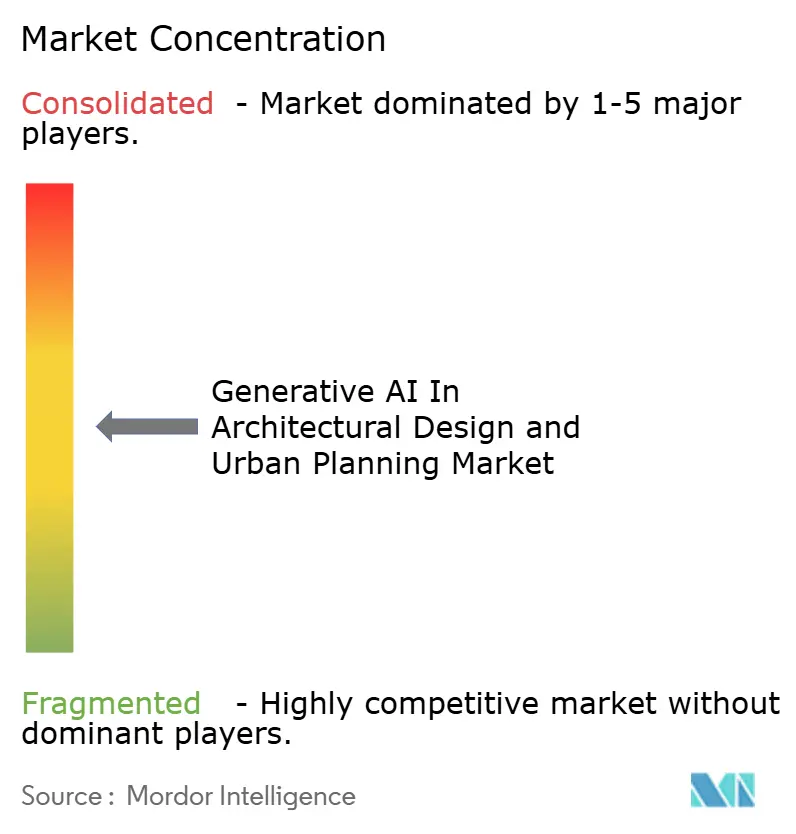
The generative AI in architectural design and urban planning market was moderately consolidated at the platform layer and fragmented in the AI-native application tier. Established AEC software providers such as Autodesk, Bentley Systems, Esri, Dassault Systèmes, and Trimble still carried major installed bases, but workflow control in generative design remained contested because no single vendor had locked in the full design cycle. Autodesk strengthened its position in March 2026 by rebranding Autodesk Construction Cloud as Autodesk Forma and expanding bundled access for Revit subscribers, giving it a broader route to embed AI into daily design practice. It followed that move in April 2026 with Forma Building Design and its Neural CAD direction, which pushed the company deeper into geometry-native generative design. These steps mattered because they aimed to keep enterprise users within a single expanding workflow rather than leaving early-stage design tasks open to outside specialists.
Bentley Systems pursued a different path by extending AI deeper into infrastructure and asset workflows rather than focusing only on architectural authoring. Its January 2026 acquisitions of Talon Aerolytics and Pointivo technology strengthened asset analytics and digital twin capability, which supported a wider infrastructure lifecycle play. Bentley also partnered with EARTHBRAIN in late 2025 to connect AI-powered digital twin technology with smart construction workflows, first in Japan and later with broader expansion potential. This strategy gave Bentley a stronger position where construction execution, earthworks, and infrastructure operations mattered as much as the original design model.
AI-native challengers still mattered because they targeted narrow but high-engagement workflow points such as concept massing, floor plan generation, site feasibility, and rapid scenario testing. Snaptrude’s 2026 AI release showed how smaller vendors could compete by compressing the path from early concept to coordinated output rather than replicating the full enterprise stack. NVIDIA also widened competitive pressure in 2025 through its Omniverse Blueprint for Smart City AI, which connected urban simulation, digital twins, and hardware-backed AI workflows across public-sector use cases. White space remained in code compliance automation, multilingual regulatory support, and data-governed hybrid deployment, which meant the generative AI in architectural design and urban planning market still had room for specialist entrants. That is why competition centered less on broad brand awareness and more on who could secure the earliest workflow step, the cleanest data loop, and the most trusted verification layer.
Generative AI In Architectural Design and Urban Planning Industry Leaders
Autodesk Inc.
Bentley Systems, Incorporated
Esri
Dassault Systemes SE
Trimble Inc.
- *Disclaimer: Major Players sorted in no particular order
Generative AI In Architectural Design and Urban Planning Market Companies Covered in this Report
- Autodesk Inc.
- Bentley Systems, Incorporated
- Esri
- Dassault Systemes SE
- Trimble Inc.
- Microsoft Corporation
- NVIDIA Corporation
- Archistar Pty Ltd.
- TestFit, Inc.
- Digital Blue Foam Pte Ltd.
- UrbanFootprint, Inc.
- Hypar, Inc.
- Graphisoft SE
- Hexagon AB
- Finch
- Maket Technologies Inc.
- Snaptrude Inc.
- cove.tool

Recent Industry Developments in Generative AI In Architectural Design and Urban Planning Market
- June 2026: The UK Ministry of Housing, Communities and Local Government announced alpha deployment of its Augmented Planning Decisions (APD) prototype, developed under a GBP 8.2 million (USD 10.4 million) contract with Google DeepMind, Google Cloud, and Faculty, in Barnet, Camden, and Dorset councils, targeting a halving of householder planning application processing time from 8 to 4 weeks, with national rollout to 300-plus local authorities planned from 2027.
- May 2026: Esri released ArcGIS CityEngine 2026.0 with full Python 3 integration, enabling generative AI-driven urban scene automation, custom metric publishing to ArcGIS Urban, and import of Overture Maps data, substantially expanding the range of AI use cases for municipal and regional planners.
- April 2026: Autodesk launched Forma Building Design in tech preview, embedding Neural CAD capabilities for schematic-phase exploration including LOD 200 and LOD 300 outputs, AI-automated floor plan generation, and deep integration with Revit as the platform’s first Forma Connected Client.
- January 2026: Bentley Systems announced the acquisitions of Talon Aerolytics and Pointivo’s technology and IP, both closed in December 2025, bringing its Asset Analytics annual revenue run rate to USD 50 million, with applications in AI-powered infrastructure digital twins for utilities, telecommunications, and road networks.


Global Generative AI In Architectural Design and Urban Planning Market Report Scope
The Generative AI in Architectural Design and Urban Planning Market Report is Segmented by Offering (Platforms and Solutions, and Services), Deployment (Cloud-Based, On-Premises, and Hybrid Cloud), Application (Architectural Design, and Urban Planning), End-User (Architectural and Design Firms, Real Estate Developers, Government and Municipal Authorities, Construction and Engineering Companies, Urban Planning and Infrastructure Consulting Firms, and Other End-Users), and Geography (North America, South America, Europe, Asia-Pacific, Middle East, and Africa). The Market Forecasts are Provided in Terms of Value (USD).
| Platforms and Solutions |
| Services |
| Cloud-Based |
| On-Premises |
| Hybrid Cloud |
| Architectural Design |
| Urban Planning |
| Architectural and Design Firms |
| Real Estate Developers |
| Government and Municipal Authorities |
| Construction and Engineering Companies |
| Urban Planning and Infrastructure Consulting Firms |
| Other End-Users |
| North America | United States |
| Canada | |
| Mexico | |
| South America | Brazil |
| Argentina | |
| Rest of South America | |
| Europe | Germany |
| United Kingdom | |
| France | |
| Italy | |
| Spain | |
| Russia | |
| Rest of Europe | |
| Asia-Pacific | China |
| Japan | |
| India | |
| South Korea | |
| Australia | |
| Rest of Asia-Pacific | |
| Middle East | Saudi Arabia |
| United Arab Emirates | |
| Turkey | |
| Rest of Middle East | |
| Africa | South Africa |
| Egypt | |
| Rest of Africa |
| By Offering | Platforms and Solutions | |
| Services | ||
| By Deployment | Cloud-Based | |
| On-Premises | ||
| Hybrid Cloud | ||
| By Application | Architectural Design | |
| Urban Planning | ||
| By End-User | Architectural and Design Firms | |
| Real Estate Developers | ||
| Government and Municipal Authorities | ||
| Construction and Engineering Companies | ||
| Urban Planning and Infrastructure Consulting Firms | ||
| Other End-Users | ||
| By Geography | North America | United States |
| Canada | ||
| Mexico | ||
| South America | Brazil | |
| Argentina | ||
| Rest of South America | ||
| Europe | Germany | |
| United Kingdom | ||
| France | ||
| Italy | ||
| Spain | ||
| Russia | ||
| Rest of Europe | ||
| Asia-Pacific | China | |
| Japan | ||
| India | ||
| South Korea | ||
| Australia | ||
| Rest of Asia-Pacific | ||
| Middle East | Saudi Arabia | |
| United Arab Emirates | ||
| Turkey | ||
| Rest of Middle East | ||
| Africa | South Africa | |
| Egypt | ||
| Rest of Africa | ||


Key Questions Answered in the Report
What is the size outlook for the generative AI in architectural design and urban planning market space?
The generative AI in architectural design and urban planning market size was USD 2.84 billion in 2025, reached USD 3.58 billion in 2026, and is forecast to reach USD 12.52 billion by 2031 at a 28.45% CAGR.
Which region is growing the fastest through 2031?
Asia-Pacific is projected to expand at a 30.18% CAGR through 2031, supported by urbanization, smart infrastructure programs, and rising digital planning adoption.
Which application area currently leads revenue?
Architectural design led with 64.83% of application revenue in 2025 because design firms already had a large digital workflow base for floor planning, massing, and site analysis.
Why is hybrid cloud growing faster than standard on-premises deployment?
Hybrid cloud is projected to grow at a 29.63% CAGR because buyers want elastic compute for AI workloads while keeping sensitive BIM and project data under tighter internal control.
Which end-user group is expanding most quickly?
Government and municipal agencies are expected to record the fastest growth at a 29.71% CAGR through 2031 as planning authorities adopt AI to address approval backlogs and housing delivery pressure.
What are the main risks slowing adoption?
The main constraints are design hallucinations, unresolved liability, copyright uncertainty, and data privacy concerns, especially in regulated projects where human sign-off remains mandatory.
Page last updated on:





