
GDDR7 Graphics Memory Market Size and Share
Market Overview
| Study Period | 2020 - 2031 |
|---|---|
| Market Size (2026) | USD 2.55 Billion |
| Market Size (2031) | USD 13.58 Billion |
| Growth Rate (2026 - 2031) | 39.70 % |
| Fastest Growing Market | North America |
| Largest Market | Asia-Pacific |
| Market Concentration | High |
Major Players *Disclaimer: Major Players sorted in no particular order Image © Mordor Intelligence. Reuse requires attribution under CC BY 4.0. | |
GDDR7 Graphics Memory Market Analysis by Mordor Intelligence
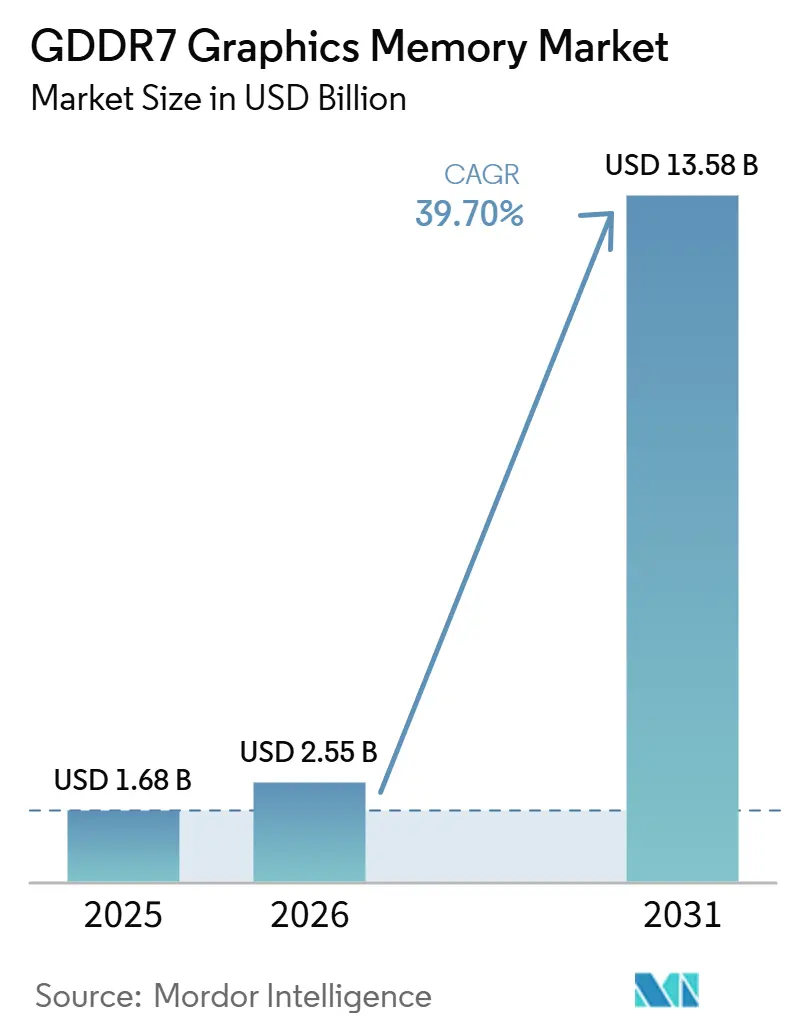
The GDDR7 graphics memory market size is expected to increase from USD 1.7 billion in 2025 to USD 2.6 billion in 2026 and reach USD 13.6 billion by 2031, growing at a CAGR of 39.7% over 2026-2031. The GDDR7 graphics memory market is expanding rapidly as both gaming GPUs and AI inference hardware move toward higher-bandwidth memory. The March 2024 JEDEC standard gave vendors a common technical path, and commercial rollouts accelerated in 2025 as leading memory suppliers and GPU platforms moved into production. The GDDR7 graphics memory market is also moving beyond premium gaming cards into workstation, inference, and edge-oriented systems where power efficiency, latency, and board simplicity matter. Supply conditions remain tight because advanced DRAM capacity must support multiple high-performance memory categories, which keeps pricing firm during the early ramp. The concentrated supplier base, fast platform qualification cycles, and broader use across consumer and enterprise systems create clear room for sustained expansion in the GDDR7 graphics memory market through 2031.
Key Report Takeaways
- By bandwidth per pin, up to 32 Gbps held 75.2% share of the GDDR7 graphics memory market in 2025, while above 40 Gbps is projected to expand at 41.2% CAGR through 2031.
- By memory capacity, 16 GB accounted for 68.4% of the market share of the GDDR7 graphics memory market in 2025, while capacities above 24 GB are forecast to grow at a 42.4% CAGR through 2031.
- By packaging type, standalone packages captured 78.4% share in 2025, while advanced package integration is projected to grow at 40.9% CAGR through 2031.
- By application, gaming GPUs accounted for 72.8% of the GDDR7 graphics memory market in 2025, while AI accelerators and data center GPUs are set to grow at a 41.1% CAGR through 2031.
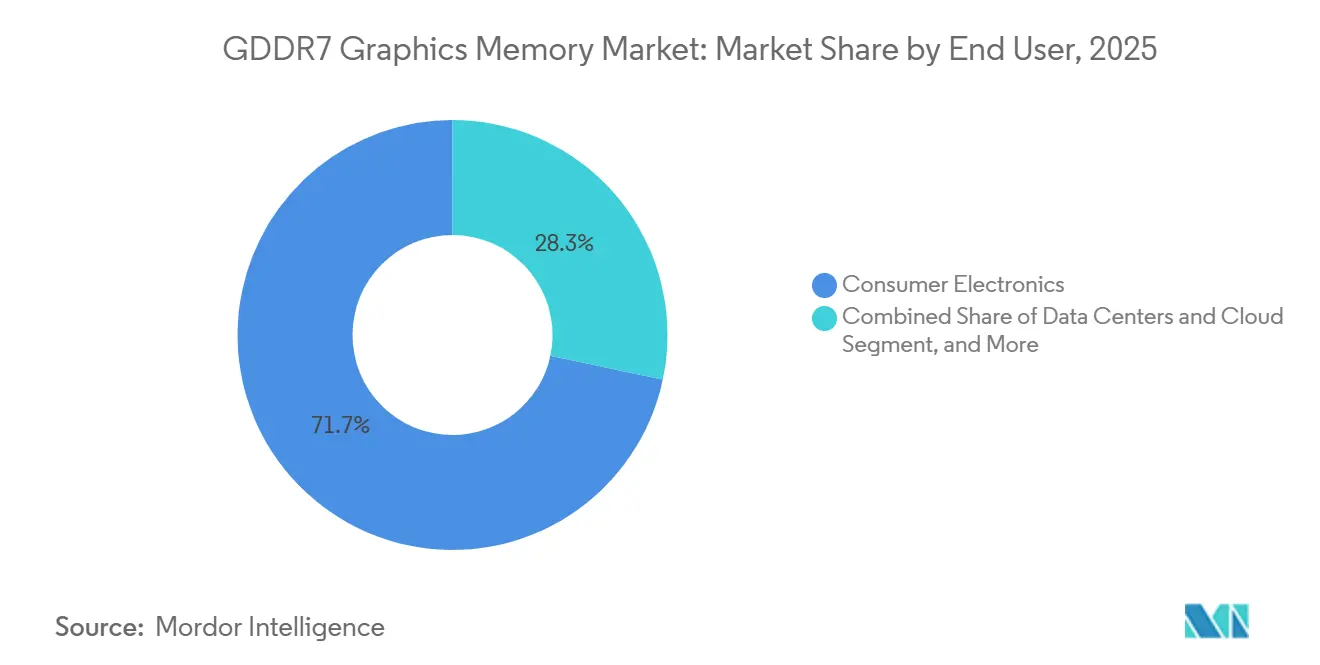
- By end user, consumer electronics held 71.7% share in 2025, while data centers and cloud are projected to expand at 40.7% CAGR through 2031.
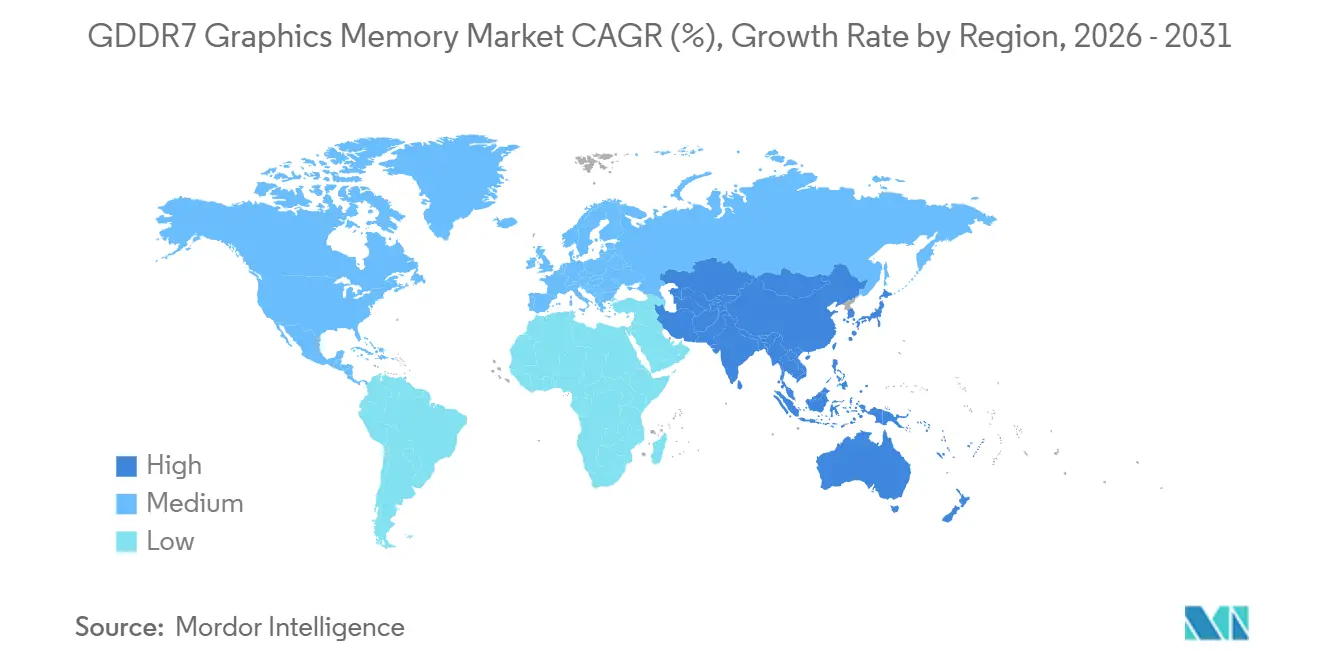
- By geography, Asia-Pacific led with 64.7% share in 2025, while North America is forecast to record the fastest growth at 41.6% CAGR through 2031.
Note: Market size and forecast figures in this report are generated using Mordor Intelligence’s proprietary estimation framework, updated with the latest available data and insights as of January 2026.
Market Trends and Insights
Drivers Impact Analysis of GDDR7 Graphics Memory Market*
| Driver | (~) % Impact on CAGR Forecast | Geographic Relevance | Impact Timeline |
|---|---|---|---|
| Rising AI And Gaming Bandwidth Requirements | +7.5% | Global | Short term (≤ 2 years) |
| Transition From GDDR6 To GDDR7 In Flagship GPUs | +6.8% | Global, led by North America and Asia-Pacific | Short term (≤ 2 years) |
| Faster Adoption In AI Workstation And Inference Cards | +5.9% | North America and Europe, emerging in Asia-Pacific | Medium term (2-4 years) |
| Higher Energy Efficiency At 1.2V Operation | +4.8% | Global | Medium term (2-4 years) |
| Advanced Packaging And Signal Integrity Improvements | +3.6% | Asia-Pacific core, with design spillover to North America | Long term (≥ 4 years) |
| Strategic OEM And Memory Vendor Qualification Cycles | +2.1% | Global | Short term (≤ 2 years) |
| Source: Mordor Intelligence | |||
Rising AI And Gaming Bandwidth Requirements
The GDDR7 graphics memory market is being pushed by a rare overlap between gaming refresh demand and rising AI inference memory needs. JEDEC set the base for this shift with a standard that starts at 32 Gbps per pin and extends to a 48 Gbps roadmap, while PAM3 signaling improves transfer efficiency over GDDR6.[1]JEDEC Solid State Technology Association, “Graphics Double Data Rate 7 SGRAM Standard, JESD239,” JEDEC, jedec.org That technical step matters because long-context inference workloads move large amounts of data through memory and place steady pressure on throughput and responsiveness.[2]NVIDIA Developer Blog, “NVIDIA Rubin CPX Accelerates Inference Performance and Efficiency for 1M+ Token Context Workloads,” NVIDIA, developer.nvidia.com NVIDIA’s Rubin CPX design, which carries 128 GB of GDDR7, shows that the memory type is now part of AI inference platform planning rather than only a gaming upgrade path. As a result, the GDDR7 graphics memory market is benefiting from two end markets that are both rewarding faster memory adoption in the same window.
Transition From GDDR6 To GDDR7 In Flagship GPUs
The January 2025 launch of NVIDIA’s GeForce RTX 50 series marked the first broad platform migration from GDDR6 to GDDR7 in high-volume consumer graphics cards. Rambus noted that GDDR7 adds PAM3 signaling, four independent channels per chip, and finer access granularity, which together raise controller parallelism and improve how bandwidth is used at the board level. That combination gives flagship products a clearer performance step than a simple frequency increase would provide, which supports early premium positioning in the GDDR7 graphics memory market. It also gives board partners and OEMs a direct validation path, because once flagship designs are qualified, the broader ecosystem can adapt around a stable memory architecture. The result is that the GDDR7 graphics memory market is seeing its first major wave of adoption start at the top of the product stack and then spread outward into adjacent GPU classes.
Faster Adoption In AI Workstation And Inference Cards
The GDDR7 graphics memory market is also gaining from workstation and inference products that sit outside the usual gaming replacement cycle. Micron’s product brief places GDDR7 at 4.5 picojoules per bit, compared with 6.5 picojoules per bit for GDDR6 at reference speeds, which gives system designers a clearer power case for professional accelerators. Micron also reported over 30% higher frame rates in ray tracing and more than 33% higher generative AI throughput in comparisons against GDDR6-based equivalents, which strengthens the premium value case in workstation deployments.[3]Micron Technology, “The New Performance Bottleneck, How More GPU Memory Unlocks Next-Gen Gaming and AI PCs,” Micron Technology, micron.com Higher-density GDDR7 devices allow larger memory pools without moving to stacked HBM designs, which keeps board design more straightforward while lifting usable capacity.[4]Samsung Semiconductor Global Newsroom, “Samsung Develops Industry’s First 24Gb GDDR7 DRAM for Next-Generation AI Computing,” Samsung Semiconductor, news.samsungsemiconductor.com This makes the GDDR7 graphics memory market more relevant in professional systems where power, latency, board complexity, and total memory footprint all matter at the same time.
Higher Energy Efficiency At 1.2V Operation
The shift from 1.35V in GDDR6 to 1.2V in GDDR7 improves the power profile of new designs and widens the thermal margin available to GPU board teams. Samsung stated that its 24 Gb GDDR7 achieved more than 30% higher power efficiency through clock control management and dual-voltage domain design, which shows that the gain comes from both voltage scaling and internal architecture choices. Better efficiency matters in the GDDR7 graphics memory market because future workstation, embedded, and automotive uses need higher bandwidth without taking large steps up in board power. It also gives vendors more flexibility to raise capacity or speed grades without losing all thermal headroom at the product level. That balance makes the GDDR7 graphics memory market more viable beyond top-end gaming cards and supports a wider long-run adoption base.
Restraints Impact Analysis of GDDR7 Graphics Memory Market*
| Restraint | (~) % Impact on CAGR Forecast | Geographic Relevance | Impact Timeline |
|---|---|---|---|
| Higher Cost Of Next-Generation DRAM Manufacturing | -5.2% | Global, most acute in North America and Europe OEM procurement | Short term (≤ 2 years) |
| HBM Substitution Pressure In Premium AI Accelerators | -4.1% | North America and Asia-Pacific data centers | Medium term (2-4 years) |
| Supply Chain Concentration In Advanced Memory Fabrication | -3.3% | Asia-Pacific core, with exposure extending globally | Long term (≥ 4 years) |
| Board-Level Thermal And Power Delivery Complexity | -2.0% | Global, with highest impact in automotive and embedded segments | Medium term (2-4 years) |
| Source: Mordor Intelligence | |||
Higher Cost Of Next-Generation DRAM Manufacturing
The GDDR7 graphics memory market still faces a cost barrier because leading devices rely on advanced DRAM nodes and a more demanding interface design. Samsung’s 24 GB GDDR7 used a 5th-generation 10 nm-class process and 50% higher cell density than its predecessor, which shows how much process advancement is being built into current products. Those technical gains raise the cost of memory content in premium graphics cards and make it harder for lower-priced platforms to migrate at the same speed. The GDDR7 graphics memory market also competes for advanced manufacturing attention with other high-performance memory categories, which can tighten supply when demand rises quickly. Until yields improve and capacity broadens, this cost structure will continue to slow adoption in more price-sensitive parts of the GDDR7 graphics memory market.
HBM Substitution Pressure In Premium AI Accelerators
The GDDR7 graphics memory market is advancing in AI, but it still sits below HBM in the most bandwidth-intensive accelerator designs. JEDEC’s GDDR7 roadmap raises per-pin speed materially, yet the architecture remains a board-level memory approach rather than a stacked memory model built for the highest aggregate bandwidth tiers. NVIDIA’s Rubin CPX shows that GDDR7 can be important in inference-oriented AI systems, but it does not remove HBM’s advantage in the largest training and high-context platforms. That means vendors in the GDDR7 graphics memory market must position products where total system cost, deployability, and practical memory capacity matter more than peak stacked-memory bandwidth. This creates a ceiling on how far the GDDR7 graphics memory market can penetrate the most expensive AI accelerator tier even as adoption broadens elsewhere.
*Our forecasts treat driver/restraint impacts as directional, not additive. The impact forecasts reflect baseline growth, mix effects, and variable interactions.
GDDR7 Graphics Memory Market Segment Analysis
By Bandwidth Per Pin:
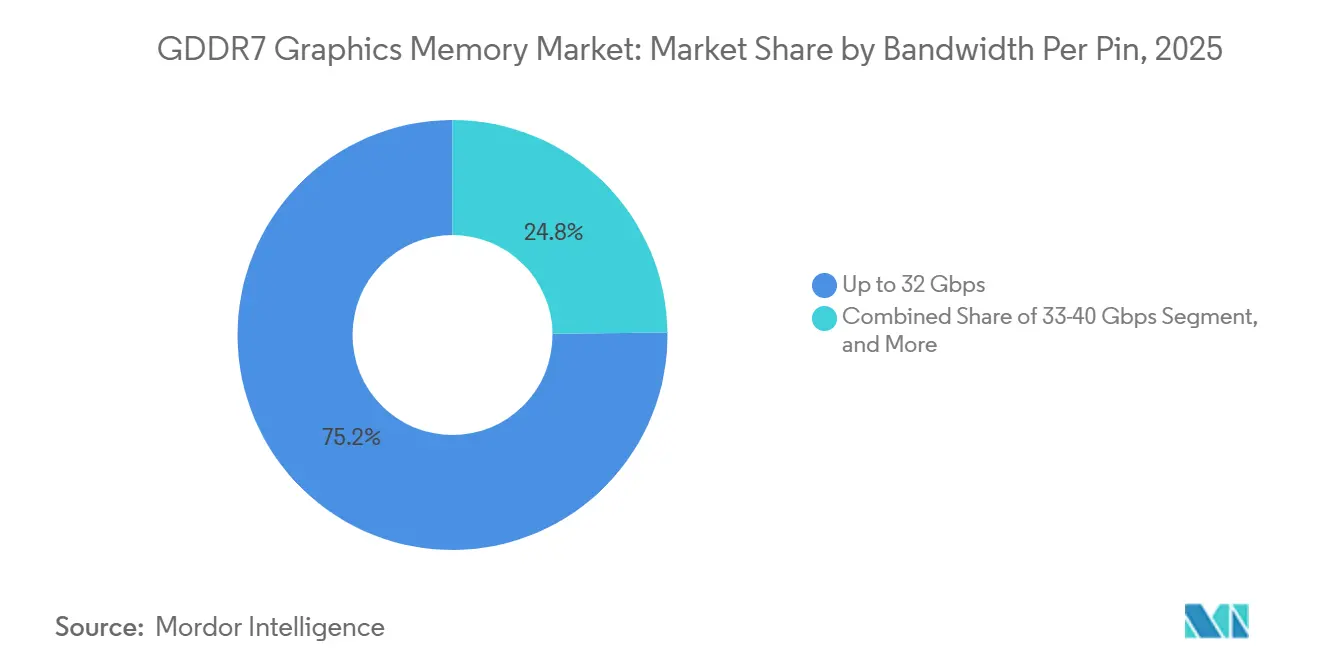
Low-Speed Installed Base Supports Volume While Premium Tiers Lift RevenueUp to 32 Gbps held 75.2% of the GDDR7 graphics memory market share in 2025, which reflected the first large production ramp of GDDR7 in consumer graphics cards. Most early gaming products prioritized stable operating points rather than maximum speed grades, which made this tier the natural entry point for the GDDR7 graphics memory market. That approach gave board partners room to manage thermals, power delivery, and validation risk while still delivering a clear step up from GDDR6-era memory behavior. It also aligned with a launch phase in which platform reliability and retail availability mattered as much as absolute bandwidth. In practical terms, the up to 32 Gbps segment acted as the base that allowed the GDDR7 graphics memory market to scale in volume before higher-grade devices widened their presence.
The above 40 Gbps segment is projected to grow at 41.2% CAGR through 2031, which makes it the revenue-driving frontier inside the GDDR7 graphics memory market. Samsung announced the industry’s first 24 Gb GDDR7 device with validated speeds above 40 Gbps, while JEDEC’s standard already provides a path to 48 Gbps per pin, reducing the need for another standardization cycle before faster products move forward. SK hynix then presented a 48 Gbps 24 Gb GDDR7 at ISSCC 2026, which pushed the top commercial performance tier even further and reinforced the long runway for premium speed grades. The 33-40 Gbps range sits between these two ends and gives vendors an intermediate step for premium gaming cards and professional systems that want more headroom without moving to the highest validation threshold. Over time, this mix should keep the GDDR7 graphics memory market balanced between broad entry volume and a smaller but more lucrative high-speed layer.



By Memory Capacity:
Mainstream 16 GB Volume Leads While High-Density Designs Shape Future GrowthThe 16 GB tier captured 68.4% of the GDDR7 graphics memory market in 2025, which made it the core volume configuration during the first year of wider platform adoption. This tier aligned with the dominant shipping mix in gaming cards and several professional GPU designs, where capacity targets had to stay within strict board cost limits. It also benefited from the most mature die and bus configurations, which reduced integration risk for board partners. Because of that balance between cost, capacity, and qualification ease, 16 GB became the anchor point for the GDDR7 graphics memory market in its early expansion phase. The 24 GB layer grew alongside it, supported by demand for higher-end systems that needed more VRAM without moving to more complex memory architectures.
Above 24 GB configurations are forecast to grow at a 42.4% CAGR through 2031, making this the fastest-growing capacity segment in the GDDR7 graphics memory market. Samsung’s 24 GB GDDR7 announcement was the enabling step because it raised cell density sharply and opened a clearer path to larger memory pools on conventional GPU boards. Micron stated that its 24 GB GDDR7 supports GPU memory configurations of up to 96 GB, which is material for workstation and inference designs that need larger context windows and heavier visual workloads. SK hynix extended that high-density case at ISSCC 2026 with a 24 GB device optimized for symmetric 2-channel operation, which shows that the density race is now tied closely to AI-oriented use cases as well. As a result, the GDDR7 graphics memory market is shifting from a gaming-led VRAM story toward a broader memory-capacity story that includes professional AI deployment needs.
By Packaging Type:
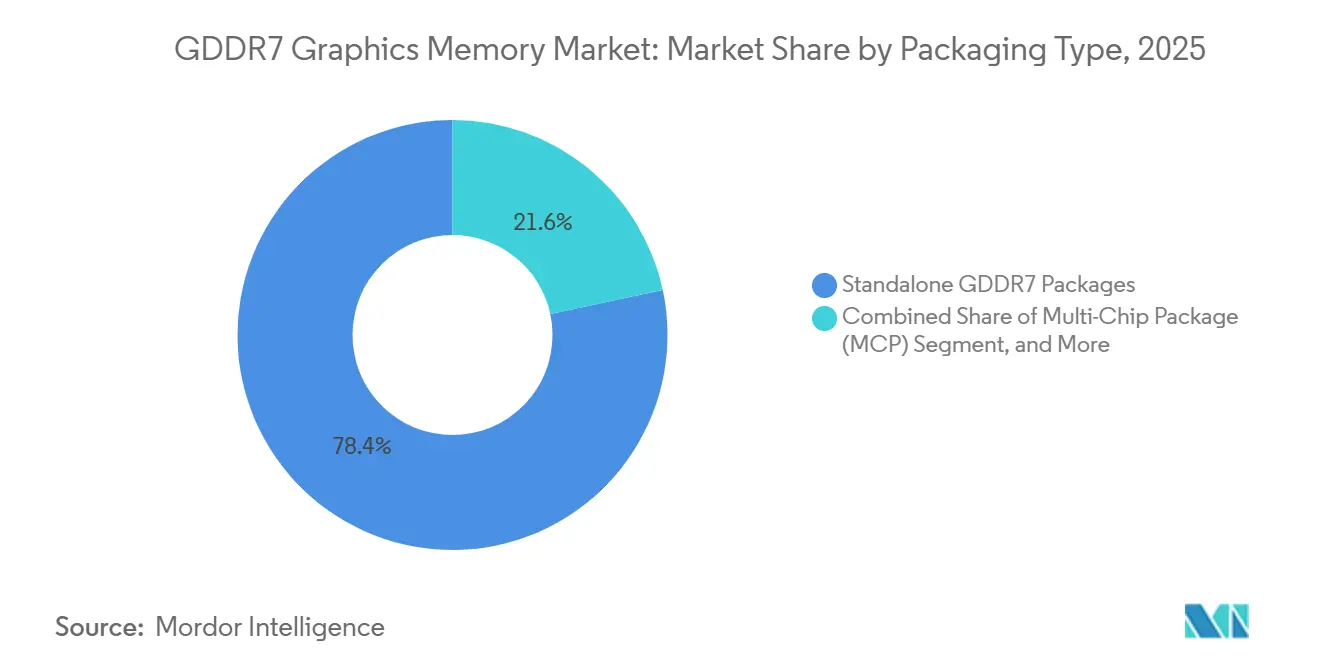
Standalone Packaging Dominates Today While Advanced Integration Builds Future MomentumStandalone GDDR7 packages held 78.4% share in 2025, which kept conventional PCB-based GPU assembly at the center of the GDDR7 graphics memory market. This format benefited from the broadest board partner ecosystem, the most established substrate supply chains, and the lowest disruption to current manufacturing workflows. It also matched the needs of first-generation GDDR7 rollouts, where platform teams preferred known assembly methods while validating a new memory standard. Multi-chip package formats remained more limited because their use cases were narrower and tied to space-constrained designs rather than mainstream discrete graphics cards. In effect, the current shape of the GDDR7 graphics memory market still reflects the established GPU board model more than a packaging reset.
Advanced package integration is projected to grow at 40.9% CAGR through 2031, making it the fastest-growing packaging path in the GDDR7 graphics memory market. This reflects the broader move toward 2.5D and chiplet-style GPU design, where shorter connections can help preserve signal quality as memory speeds rise. JEDEC’s speed roadmap makes that transition more relevant because higher per-pin rates increase the value of tighter electrical paths and cleaner board-level implementation. The May 2026 start of volume production at the Suzhou chiplet advanced packaging base showed that commercial capacity for this kind of integration is moving beyond pilot scale and into real manufacturing programs. As chiplet architectures mature, the GDDR7 graphics memory market is likely to see advanced integration move from a fast-growing niche into a more standard option for premium and specialized platforms.
By Application:
Gaming Provides Current Scale While AI Accelerators Reset the Growth ProfileGaming GPUs accounted for 72.8% of application revenue in 2025, which made them the clear foundation of the GDDR7 graphics memory market. NVIDIA’s GeForce RTX 50 series was the first volume consumer family to standardize on GDDR7, and that rollout gave the new memory type immediate scale across a wide retail channel. The installed gaming base also helped justify capacity commitments across packages, boards, and supporting components, which strengthened the supply chain behind the GDDR7 graphics memory market. High-performance computing and professional visualization remained smaller in revenue terms, but they were structurally important because these buyers value memory throughput, usable capacity, and board simplicity in different ways than mainstream gamers do. Automotive AI and infotainment also represent an emerging application track, though adoption in those systems will follow longer qualification timelines than consumer platforms.
AI accelerators and data center GPUs are projected to expand at 41.1% CAGR through 2031, which makes them the fastest-growing application in the GDDR7 graphics memory market. NVIDIA’s Rubin CPX announcement signaled that GDDR7 is being designed into large-context inference hardware rather than only borrowed from gaming GPU roadmaps. This matters because the application mix in the GDDR7 graphics memory market is broadening from entertainment-focused demand toward enterprise workloads that care about throughput, power, and deployable memory capacity. AR and VR systems remain smaller in current volume, but they also benefit from fast frame-buffer behavior and higher graphics memory bandwidth. Taken together, these shifts show that the GDDR7 graphics memory market is no longer defined by one application alone, even though gaming still supplies most current revenue.
By End User:
Consumer Electronics Lead Revenue While Cloud Deployment Broadens the Demand BaseConsumer electronics accounted for 71.7% of revenue in 2025, which kept this segment at the center of the GDDR7 graphics memory market. Discrete graphics cards for PC gaming, desktops, workstations, and consumer notebooks accounted for the largest share of shipments, and board partner product calendars remained closely tied to major GPU launches. That structure provides the GDDR7 graphics memory market with a clear volume channel, as memory devices move through a broad retail and OEM network once a new GPU family is qualified. Automotive demand is still emerging and will likely move on a slower cycle, as graphics-class memory in vehicle systems has longer design and validation windows. Industrial and embedded buyers add another layer of interest, especially when reliability features and long-life operating requirements matter more than pure gaming performance.
Data centers and cloud are forecast to grow at a 40.7% CAGR through 2031, making this the fastest-growing end-user segment in the GDDR7 graphics memory market. The segment is expanding because hyperscalers are building more tiered compute environments in which inference hardware does not always need HBM-class memory to be effective. IEEE ISSCC 2026 highlighted GDDR7 devices with reliability, availability, and serviceability features such as symmetric channel operation and memory-oriented protection features, which makes the technology more relevant for enterprise-class deployment than older gaming-only assumptions would suggest. This allows the GDDR7 graphics memory market to serve as a complement to HBM-based infrastructure rather than a direct replacement for it. That coexistence model broadens the addressable demand base for the GDDR7 graphics memory market and reduces the risk that growth depends only on consumer GPU cycles.
Geography Analysis
APAC GDDR7 Graphics Memory Market
Asia-Pacific accounted for 64.7% of the GDDR7 graphics memory market share in 2025, maintaining the region's clear lead over all other geographies. The region’s lead rests on its concentration of memory fabrication and GPU board manufacturing, with South Korea central to GDDR7 die production and Taiwan central to board assembly. Samsung’s and SK Hynix’s positions in advanced graphics DRAM give the Asia-Pacific region a strong hold over the supply side of the GDDR7 graphics memory market. The region also benefits from a dense supplier network that supports substrates, packaging, testing, and downstream board integration. Because of that industrial depth, Asia-Pacific remains the operational center of the GDDR7 graphics memory market even as demand grows globally.
North America GDDR7 Graphics Memory Market
North America is forecast to record the fastest CAGR of 41.6% through 2031, making it the key demand-side growth engine in the GDDR7 graphics memory market. This growth is being driven more by hyperscaler and AI infrastructure spending than by retail gaming alone. NVIDIA’s Rubin CPX program is important in this regional picture because it shows how GDDR7 is being tied to large-context inference hardware with enterprise relevance. The region also benefits from a strong ecosystem of GPU platform design, cloud deployment, and workstation procurement that can absorb new memory standards quickly. As a result, North America is likely to shape the next phase of the GDDR7 graphics memory market through early AI deployment patterns and premium system demand.
Europe and Global Markets
Europe and the rest of the world accounted for the remaining share of the GDDR7 graphics memory market in 2025. Europe’s demand is centered more on professional workstation use, automotive design, scientific computing, and specialized industrial workloads than on raw consumer scale. Those use cases support steady relevance for the GDDR7 graphics memory market, even if the region does not control the supply chain in the same way as Asia-Pacific. Rest of the world markets remain smaller today and are still driven largely by imported finished GPU systems, though data center build-outs and enterprise IT upgrades should gradually widen demand over the forecast period.

Competitive Landscape
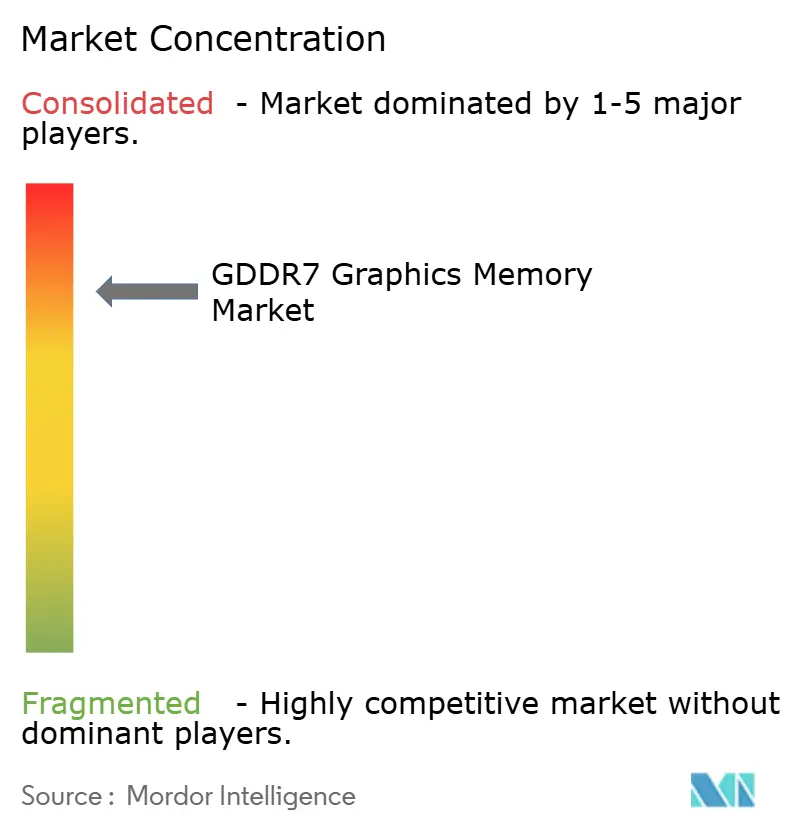
The GDDR7 graphics memory market is structurally concentrated at the chip level, with Samsung Electronics, SK hynix, and Micron Technology representing the meaningful supplier set. Samsung established an early advantage by bringing GDDR7 into production for the first wave of NVIDIA’s GeForce RTX 50 platform and then extending its position with the industry’s first 24 GB GDDR7 device validated above 40 Gbps. SK hynix moved quickly to strengthen its standing, first by showing a 35.4 Gb/s per pin 16 Gb GDDR7 at ISSCC 2024 and then by presenting a 48 Gbps 24 Gb device at ISSCC 2026. Micron entered the supply picture with a clear product case around efficiency, higher density, and AI-oriented performance improvements, which gave the GDDR7 graphics memory market a stronger three-supplier structure. This means competition is no longer only about proving the standard works, but also about who can qualify for more speed grades, densities, and platform variants with reliable supply.
At the board partner level, competition is broader and less concentrated because companies such as ASUSTeK Computer, Micro-Star International, GIGA-BYTE Technology, ZOTAC, Colorful Technology, and Galax compete on cooling, power delivery, factory tuning, and brand positioning. These companies do not control the core memory supply, but they influence how quickly GDDR7 devices move into market-visible products. The GDDR7 graphics memory market therefore has two different competitive layers, one highly concentrated upstream and one more differentiated downstream. White-space opportunities are strongest in automotive-grade graphics memory use and in advanced package integration where long qualification cycles can still reshape supplier positions. That mix keeps barriers high for new memory entrants, even though it leaves room for board-level and packaging specialists to build advantage around the GDDR7 graphics memory market.
Recent strategic moves show that the leading suppliers are competing through technology timing as much as through pricing. Samsung used an early commercialization push and a high-density 24 Gb announcement to define the first premium roadmap in the GDDR7 graphics memory market. SK hynix responded by lifting the top disclosed speed tier and reinforcing its credibility in advanced graphics DRAM through IEEE-backed technical disclosure. Micron focused on efficiency and performance claims that connect directly to gaming and generative AI use cases, which helps it compete on system value rather than only on raw speed. With only a few meaningful die suppliers and a broad set of downstream board partners, the GDDR7 graphics memory market should remain concentrated, technology-led, and qualification-driven through the forecast period.
GDDR7 Graphics Memory Industry Leaders
Samsung Electronics Co., Ltd.
Micron Technology, Inc.
SK hynix Inc.
NVIDIA Corporation
Advanced Micro Devices, Inc.
- *Disclaimer: Major Players sorted in no particular order
GDDR7 Graphics Memory Market Companies Covered in this Report
- Micron Technology, Inc.
- Samsung Electronics Co., Ltd.
- SK hynix Inc.
- NVIDIA Corporation
- Advanced Micro Devices, Inc.
- ASUSTeK Computer Inc.
- Micro-Star International Co., Ltd.
- GIGA-BYTE Technology Co., Ltd.
- ZOTAC Technology Limited
- PNY Technologies, Inc.
- Palit Microsystems Ltd.
- Sapphire Technology Limited
- Kingston Technology Company, Inc.
- Corsair Gaming, Inc.
- G.SKILL International Enterprise Co., Ltd.
- ADATA Technology Co., Ltd.
- Team Group Inc.
- Transcend Information, Inc.
- Colorful Technology Company Limited
- Galax Microsystems Ltd.

Recent Industry Developments in GDDR7 Graphics Memory Market
- June 2026: Micron Technology confirmed production readiness of its 24 Gb (3 GB) GDDR7 memory modules at 36 Gbps, joining Samsung and SK hynix in the highest-density GDDR7 tier and qualifying as the third supplier for NVIDIA's GeForce RTX 50 series GPU ecosystem.
- May 2026: The Suzhou Chiplet Advanced Packaging Base, operated jointly by JCET and AMD, entered volume production focused on 2.5D chiplet integration for AI and automotive applications, with an average delivery lead time of eight weeks, three to four weeks faster than comparable international production lines. Initial customers include major GPU platform and ADAS chip vendors.
- April 2026: Samsung Electronics expanded its commercial GDDR7 portfolio by listing multiple 24 Gb GDDR7 production and sample devices on its official product catalog, strengthening its position in next-generation graphics memory for AI and gaming applications.
- February 2026: SK hynix presented the industry's fastest GDDR7 memory device at 48 Gbps per pin at the IEEE International Solid-State Circuits Conference, targeting mid-range AI inference deployments with a symmetric 2-channel mode that optimizes capacity utilization without increasing die count.


Global GDDR7 Graphics Memory Market Report Scope
The GDDR7 Graphics Memory Market Report is Segmented by Bandwidth Per Pin (Up To 32 Gbps, 33-40 Gbps, and Above 40 Gbps), Memory Capacity (16 GB, 24 GB, and Above 24 GB), Packaging Type (Standalone GDDR7 Packages, Multi-Chip Package (MCP), and Advanced Package Integration (2.5D / Chiplet-based), Application (Gaming GPUs, AR/VR Systems, AI Accelerators and Data Center GPUs, High-Performance Computing, Professional Visualization, and Automotive AI and Infotainment), End-User (Consumer Electronics, Data Centers and Cloud, Automotive, Industrial and Embedded, and More), and Geography (North America, Europe, Asia-Pacific, and Rest of the World). The Market Forecasts are Provided in Terms of Value (USD).
| Up to 32 Gbps |
| 33-40 Gbps |
| Above 40 Gbps |
| 16 GB |
| 24 GB |
| Above 24 Gb |
| Standalone GDDR7 Packages |
| Multi-Chip Package (MCP) |
| Advanced Package Integration (2.5D / Chiplet-based) |
| Gaming GPUs |
| AI Accelerators and Data Center GPUs |
| High-Performance Computing |
| Professional Visualization |
| AR/VR Systems |
| Automotive AI and Infotainment |
| Consumer Electronics |
| Data Centers and Cloud |
| Automotive |
| Industrial and Embedded |
| Other End-Users |
| North America | |
| Europe | |
| Asia Pacific | China |
| Japan | |
| South Korea | |
| Taiwan | |
| Rest of Asia Pacific | |
| Rest of the World |
| By Bandwidth Per Pin | Up to 32 Gbps | |
| 33-40 Gbps | ||
| Above 40 Gbps | ||
| By Memory Capacity | 16 GB | |
| 24 GB | ||
| Above 24 Gb | ||
| By Packaging Type | Standalone GDDR7 Packages | |
| Multi-Chip Package (MCP) | ||
| Advanced Package Integration (2.5D / Chiplet-based) | ||
| By Application | Gaming GPUs | |
| AI Accelerators and Data Center GPUs | ||
| High-Performance Computing | ||
| Professional Visualization | ||
| AR/VR Systems | ||
| Automotive AI and Infotainment | ||
| By End-User | Consumer Electronics | |
| Data Centers and Cloud | ||
| Automotive | ||
| Industrial and Embedded | ||
| Other End-Users | ||
| By Geography | North America | |
| Europe | ||
| Asia Pacific | China | |
| Japan | ||
| South Korea | ||
| Taiwan | ||
| Rest of Asia Pacific | ||
| Rest of the World | ||


Key Questions Answered in the Report
What is driving growth in GDDR7 graphics memory through 2031?
Growth is being driven by the overlap between gaming GPU refresh cycles and rising AI inference demand. The market is projected to grow from USD 2.6 billion in 2026 to USD 13.6 billion by 2031 at a 39.7% CAGR.
Which application contributes the most revenue today?
Gaming GPUs lead current demand with 72.8% of application revenue in 2025. They remain the scale base for broader adoption across the GDDR7 graphics memory market.
Which application is growing the fastest?
AI accelerators and data center GPUs are the fastest-growing application, with a projected 41.1% CAGR through 2031. This reflects stronger use of GDDR7 in inference-oriented compute systems.
Why is Asia-Pacific the leading region?
Asia-Pacific held 64.7% share in 2025 because the region combines memory fabrication strength with deep GPU board manufacturing capacity. South Korea and Taiwan are central to that position.
How does GDDR7 compare with HBM in AI hardware?
GDDR7 is gaining ground in inference and cost-sensitive accelerator designs, while HBM still holds an advantage in the most bandwidth-intensive training systems. That is why both memory types are likely to coexist rather than fully replace each other.
Which part of the product mix is growing the fastest?
Above 24 GB capacity configurations are projected to grow at 42.4% CAGR, and above 40 Gbps bandwidth products are projected to grow at 41.2% CAGR. This shows that higher density and higher speed tiers are shaping the premium end of the market.
Page last updated on:





