
GCC Telecom Tower Lease Benchmarking Market Size and Share
Market Overview
| Study Period | 2020 - 2031 |
|---|---|
| Forecast Data Period | 2026 - 2031 |
| Base Year Market Size (2025) | USD 0.72 Billion |
| Market Size (2026) | USD 0.76 Billion |
| Market Size (2031) | USD 1.01 Billion |
| Growth Rate (2026 - 2031) | 5.82 % |
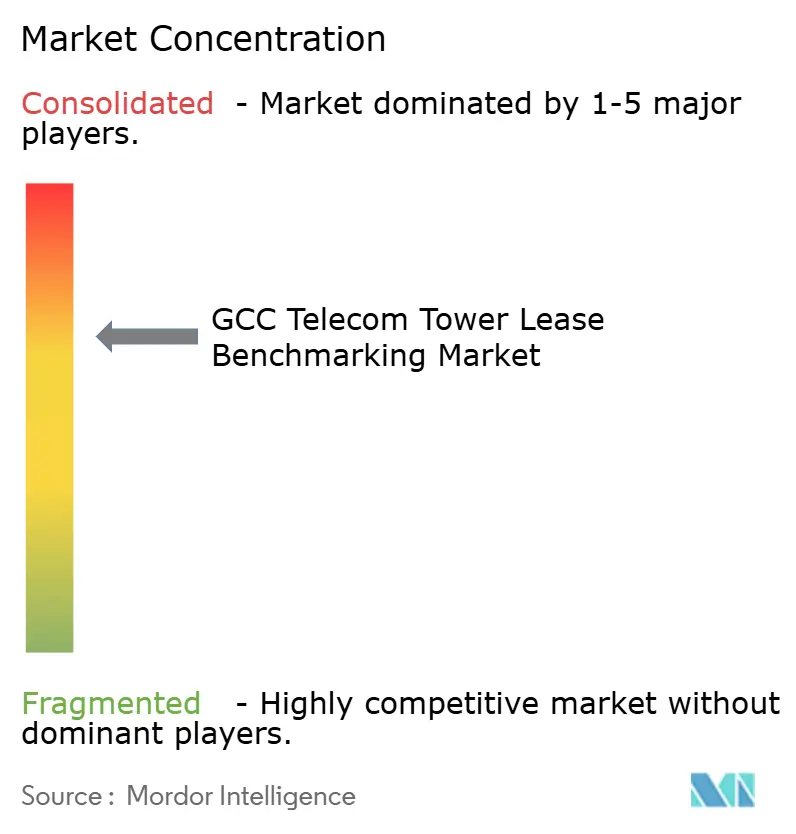
| Market Concentration | Medium |
Major Players *Disclaimer: Major Players sorted in no particular order Image © Mordor Intelligence. Reuse requires attribution under CC BY 4.0. | |
GCC Telecom Tower Lease Benchmarking Market Analysis by Mordor Intelligence
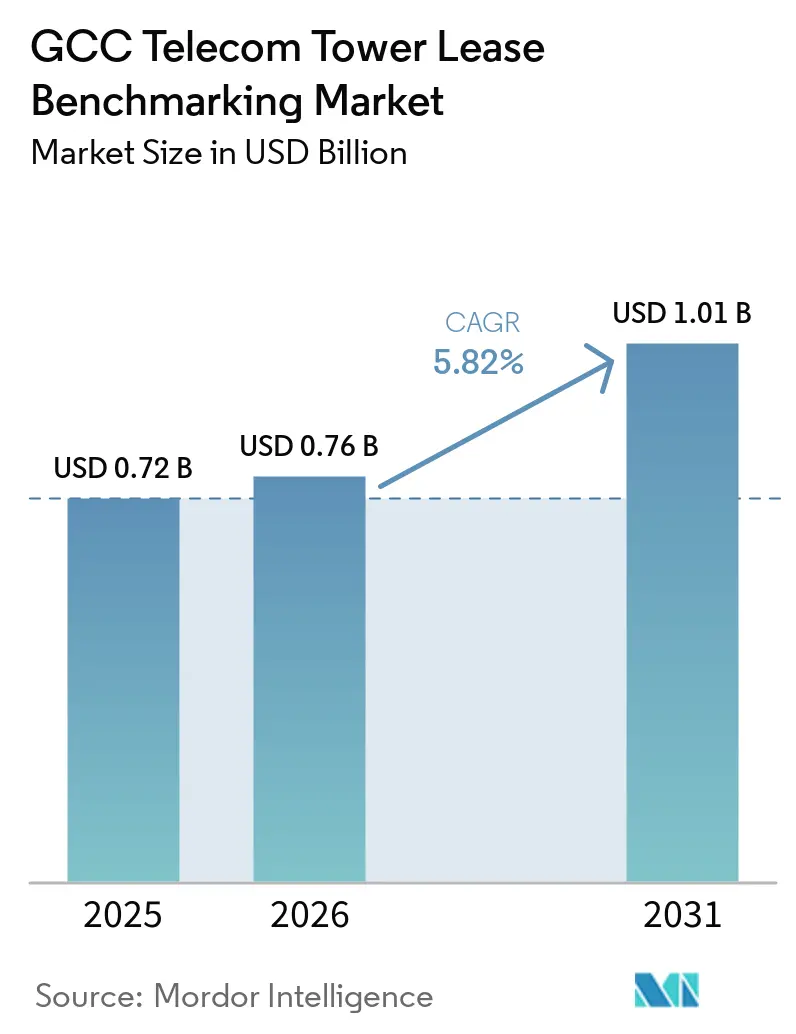
The GCC telecom tower lease benchmarking market size is projected to expand from USD 0.72 billion in 2025 and USD 0.76 billion in 2026 to USD 1.01 billion by 2031, registering a CAGR of 5.82% between 2026 to 2031. The GCC telecom tower lease market is moving from operator-owned assets toward more formal third-party lease arrangements, especially in Saudi Arabia and Oman. Sale-leaseback activity is making lease terms, annual escalators, and colocation conditions more visible to landlords and tenants. Rising mobile traffic requires capacity upgrades at established sites, which creates recurring demand for lease amendments rather than only new tower construction. Giga-projects, private wireless networks, and neutral-host models are broadening the set of organizations that may lease tower, rooftop, and indoor infrastructure.
Key Report Takeaways
- By land access type, ground leases held 55.24% of the GCC telecom tower lease benchmarking market share in 2025, while rooftop leases are projected to expand at a 6.22% CAGR through 2031.
- By site configuration, macro tower sites accounted for 58.66% of the GCC telecom tower lease benchmarking market share in 2025, while small-cell sites are projected to expand at a 6.14% CAGR through 2031.
- By customer and counterparty, MNO captive infrastructure held 37.61% of the GCC telecom tower lease benchmarking market share in 2025, while private wireless and enterprise networks are projected to expand at a 6.36% CAGR through 2031.
- By lease economics, fixed annual escalator leases accounted for 42.33% of the GCC telecom tower lease benchmarking market share in 2025, while revenue-share and colocation-linked rent structures are projected to expand at a 6.52% CAGR through 2031.
- By geography, Saudi Arabia held 59.22% of the GCC telecom tower lease benchmarking market share in 2025, while the UAE is projected to expand at a 6.27% CAGR through 2031.
Note: Market size and forecast figures in this report are generated using Mordor Intelligence’s proprietary estimation framework, updated with the latest available data and insights as of January 2026.
GCC Telecom Tower Lease Benchmarking Market Trends and Insights
Drivers Impact Analysis*
| Driver | (~) % Impact on CAGR Forecast | Geographic Relevance | Impact Timeline |
|---|---|---|---|
| 5G-Advanced Densification and Network Capacity Upgrades | +1.8% | Saudi Arabia and UAE primary, Qatar and Kuwait secondary | Short term (≤ 2 years) |
| Tower Asset Monetization and Sale-Leaseback Activity | +1.4% | Saudi Arabia primary, Oman and Kuwait secondary | Medium term (2-4 years) |
| Smart-City, Giga-Project and Industrial-Corridor Buildouts | +1% | Saudi Arabia, including NEOM, Red Sea Global, and Qiddiya, and UAE | Medium term (2-4 years) |
| Mobile Data, IoT and Private 5G Traffic Growth | +0.8% | GCC-wide, strongest in Saudi Arabia, UAE, and Qatar | Medium term (2-4 years) |
| Energy-Efficient Tower Upgrades and Renewable-Powered Sites | +0.5% | GCC-wide, particularly Bahrain, UAE, and Saudi Arabia | Long term (≥ 4 years) |
| GCC Cross-Border TowerCo Consolidation and Neutral-Host Expansion | +0.4% | Saudi Arabia, Oman, and Kuwait | Medium term (2-4 years) |
| Source: Mordor Intelligence | |||
5G-Advanced Densification and Network Capacity Upgrades
5G-Advanced deployments are changing the capacity needs of existing sites across the GCC telecom tower lease benchmarking market. Rising 5G subscription penetration is supporting a continuing need for macro-site amendments and small-cell infill. Mobile traffic in the region is also expected to increase substantially over the forecast period.[1] This demand can raise lease amendment volumes because operators need added radios, power equipment, and indoor coverage systems at established locations. The UAE initiative by du and Huawei targeted 10 Gbps peak speeds through indoor digitalization and upper 6 GHz capabilities, showing why malls, airports, and exhibition centers need more site capacity. Spectrum trials in Saudi Arabia also indicate that future bands may require physical changes to existing tower infrastructure.
Tower Asset Monetization and Sale-Leaseback Activity
Tower monetization remains a major driver of the GCC telecom tower lease benchmarking market because each sale-leaseback agreement formalizes previously captive site access. Public Investment Fund acquired a majority stake in TAWAL from stc Group, in a transaction that established a significant enterprise value for the Saudi tower platform. Such transactions set observable reference points for lease durations, site rents, and escalation terms. Brookfield acquired a majority stake in Oman Tower Company SAOC, covering a substantial site portfolio and bringing institutional ownership into Oman’s tower sector. The transaction can strengthen pricing discipline in lease negotiations as landlords and operators use more comparable portfolio information. Zain Group also acquired IHS Towers’ stake in IHS Kuwait Limited, covering an extensive portfolio of active sites, showing that ownership can return to an operator when local economics favor a captive model.
Smart-City, Giga-Project and Industrial-Corridor Buildouts
Saudi Arabia’s large development projects provide concentrated demand for new tower and rooftop lease agreements in the GCC telecom tower lease benchmarking market. Saudi Telecom Company received a major contract to design, build, and operate national telecommunications infrastructure. The build and operating terms support a multiyear requirement for ground leases, easements, and shared sites. NEOM plans extensive telecom street-box infrastructure across multiple nodes, combining rooftop radios with smart-city sensor networks. Its DataVolt partnership involves a net-zero hyperscale data center at Oxagon and requires resilient enterprise coverage before the end of the decade. These projects can make building owners, industrial authorities, and public entities direct parties to long-term infrastructure agreements.
Mobile Data, IoT and Private 5G Traffic Growth
Mobile data, Internet of Things applications, and private 5G networks are widening the tenant base for the GCC telecom tower lease benchmarking market. Average monthly data traffic per active smartphone reached 30 GB in 2025 and is forecast to reach 49 GB by 2031. Higher traffic requires ongoing capacity additions, which can produce separately contracted amendments on active sites. Qatar ranks among the leading markets for enterprise private 5G adoption, while Saudi Arabia recorded an expected digital investment return period of 3.3 years. Global enterprise private-network deployments reached 1,953 in February 2026, according to GSA.[2] Oil and gas, ports, logistics, and industrial sites can require dedicated rooftop or tower access with service terms that differ from standard mobile operator leases.
Restraints Impact Analysis*
| Restraint | (~) % Impact on CAGR Forecast | Geographic Relevance | Impact Timeline |
|---|---|---|---|
| High Captive Ownership and Slow Portfolio Release | -1.2% | GCC-wide, particularly Kuwait and Qatar | Long term (≥ 4 years) |
| Limited Addressable Scale in Smaller GCC Markets | -0.8% | Bahrain, Oman, and Kuwait | Medium term (2-4 years) |
| Site-Acquisition, Zoning and Aesthetic Approval Delays | -0.6% | UAE urban zones, Saudi Arabia giga-project corridors, and Qatar | Short term (≤ 2 years) |
| Heat, Sandstorm and Off-Grid Power O and M Cost Volatility | -0.5% | Saudi Arabia central and northern regions, Oman, and UAE interior | Long term (≥ 4 years) |
| Source: Mordor Intelligence | |||
High Captive Ownership and Slow Portfolio Release
Captive ownership limits the number of independently priced agreements entering the GCC telecom tower lease benchmarking market. Many operators built their 4G and 5G networks before regional tower companies reached significant scale. This left a large base of sites under operator control and reduced the immediate need for asset sales. Qatar, Kuwait, and Bahrain have small geographic footprints and limited tower counts, which can further weaken the case for portfolio separation. Zain Group’s 2024 acquisition of the former IHS Kuwait portfolio demonstrates that a tower portfolio can move back into an operator’s balance sheet. This pattern limits transparent data for rent reviews, annual escalator negotiations, and colocation-rate discussions.
Limited Addressable Scale in Smaller GCC Markets
Bahrain and Kuwait together operate fewer than 5,000 active tower sites, limiting the scale available for dedicated tower operations. Smaller portfolios may not support the fixed cost of a country-specific platform. A regional master lease may be more practical across Kuwait, Bahrain, and Qatar, but it can blend different regulatory, power-cost, and property conditions. This makes site-specific rent benchmarking more difficult for the GCC telecom tower lease benchmarking market. Ooredoo Oman’s separate tower sale-leaseback process also shows that smaller-market transactions can take longer to complete. The absence of a common regional transaction registry means that some local benchmark rates must be inferred from comparable agreements rather than directly observed.
*Our forecasts treat driver/restraint impacts as directional, not additive. The impact forecasts reflect baseline growth, mix effects, and variable interactions.
Segment Analysis
By Land Access Type: Ground Leases Anchor the Revenue Base
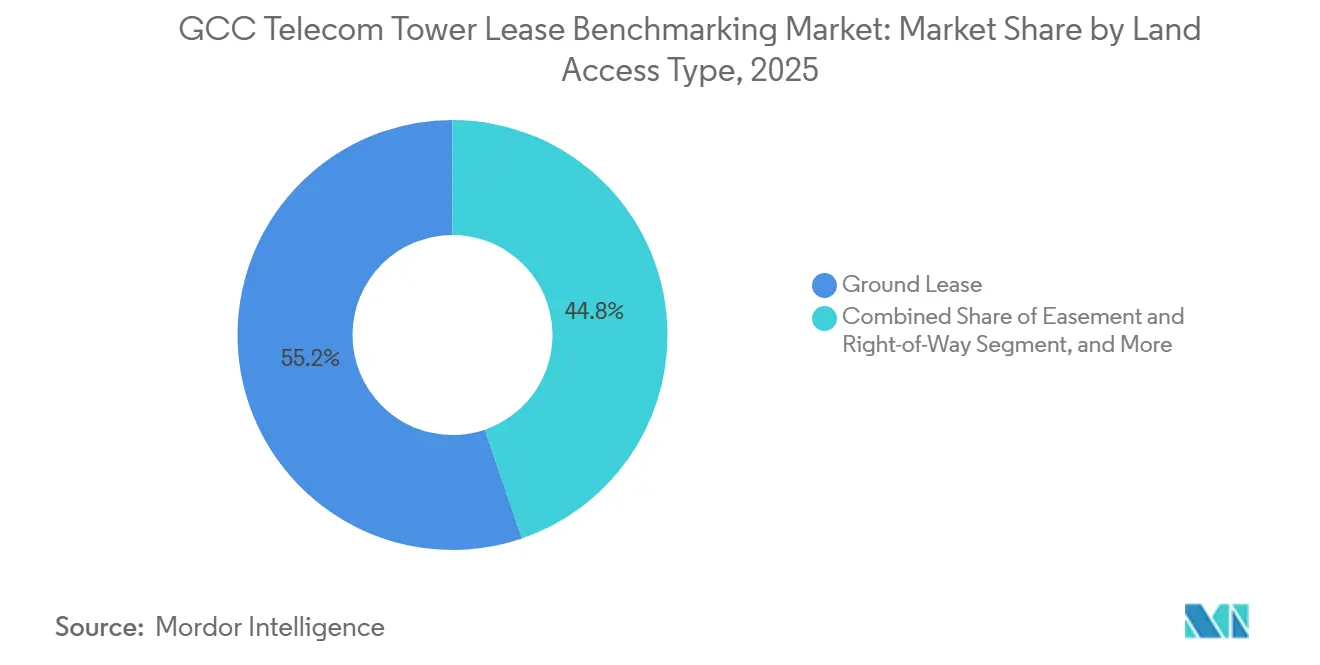
Ground leases held 55.24% of the GCC telecom tower lease benchmarking market share in 2025, reflecting the need for macro coverage across all 6 GCC countries. These agreements generally secure long-term rights from private landowners or government bodies. Fixed annual escalators are common because they support predictable cash flows for infrastructure finance. Ground sites remain important where operators need wide-area coverage before adding localized capacity. Easements and rights-of-way are gaining use along industrial corridors and planned rail extensions in Saudi Arabia. UAE industrial authorities and energy operators can also grant access for private 5G ground infrastructure.
Rooftop leases are projected to expand at a 6.22% CAGR through 2031, making them the fastest-growing land-access category in the GCC telecom tower lease benchmarking market. They are useful in high-rise commercial areas and dense project zones where acquiring a new ground site takes longer. Rooftop access can reduce permitting cycles by 30% compared with new ground-site acquisition. Small-cell and indoor systems can use the same rooftop connection point, allowing a landlord to combine passive rent with equipment access charges. Saudi Arabia’s CST and the UAE’s TDRA set site-sharing and access-pricing conditions that support more consistent master lease discussions. A mixed portfolio of ground and rooftop sites gives tower companies broad coverage capacity and denser urban tenancy opportunities.

By Site Configuration: Small Cells Reshape the Tenancy Curve
Macro tower sites accounted for 58.66% of the GCC telecom tower lease benchmarking market share in 2025. Their position reflects the requirement to establish wide-area 5G coverage before capacity densification occurs. A macro-site amendment can create a separately billable change to a lease when it involves new antennas, radios, or power upgrades. TAWAL manages more than 30,000 sites across Saudi Arabia and international markets, illustrating the scale of the macro infrastructure base. Macro sites continue to form the core of coverage obligations across Saudi Arabia, the UAE, Kuwait, Qatar, Bahrain, and Oman. They also provide the initial platform for later sharing arrangements.
Small-cell sites are projected to expand at a 6.14% CAGR through 2031. Enterprise indoor locations represent an important deployment area because traffic demand is concentrated in commercial and public venues. Nokia, CST, ACES NH, Mobily, and Zain launched a mid-band indoor spectrum-sharing deployment using a neutral-host model in Saudi Arabia. The deployment substantially reduced costs and demonstrated how operators can share a single indoor system. Rooftop, in-building, and distributed antenna system locations address capacity constraints at airports, malls, stadiums, and campuses. ACES also deployed a neutral-host indoor 4G and 5G small-cell site at King Abdullah Financial District in Riyadh.[3]
By Customer and Counterparty: MNO Captive Infrastructure Coexists with Rising Enterprise Demand
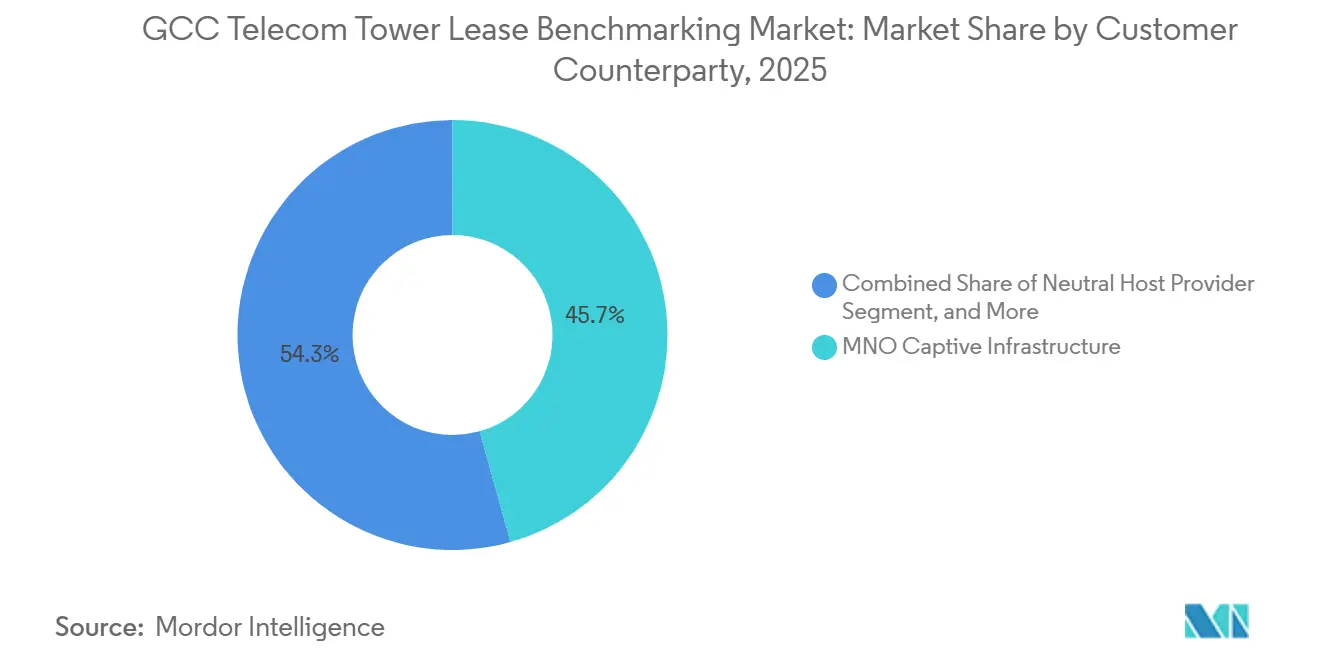
MNO captive infrastructure held 37.61% of the GCC telecom tower lease benchmarking market share in 2025. This category includes portfolios transferred to internal tower vehicles or third parties while the operator remains the anchor tenant under a long-term lease. Independent tower companies also play an important role as sale-leaseback activity turns carrier-owned assets into third-party portfolios. Ooredoo, Zain, and TASC Towers formed a regional tower company across multiple MENA markets. The arrangement supports wider use of standardized master lease agreements and common operating practices. Neutral-host providers form another category because they allow multiple operators to use shared active and passive assets.
Private wireless and enterprise networks are projected to expand at a 6.36% CAGR through 2031. These users need tailored service conditions that are not always covered by conventional MNO master leases. ADNOC’s private 5G work with e& and Aramco Digital’s Industry 4.0 programs illustrate the potential for multi-site enterprise network requirements. Public-sector network operators may also become more visible as NEOM, Red Sea Global, and Qiddiya move from early deployment to formal connectivity agreements. TAWAL and Nokia demonstrated a multi-tenant Open RAN edge-cloud platform at LEAP 2025 in Riyadh. The model lets operators and enterprises use shared active infrastructure under pay-as-you-grow terms.
By Lease Economics: Revenue-Share Structures Challenge Fixed Escalator Dominance
Fixed annual escalator leases accounted for 42.33% of the GCC telecom tower lease benchmarking market share in 2025. These agreements give tower companies predictable revenue that can support project bonds and infrastructure financing. CPI-linked escalators provide inflation protection where fixed annual increases do not reflect changes in operating costs. Hybrid arrangements combine a minimum uplift with a CPI-linked addition above a specified threshold. These terms are becoming more relevant in Oman and Bahrain, where pure revenue-share structures may be less practical. The IEA Middle East diesel price tracker provides a public cost reference that can be used in power-related adjustment clauses.
Revenue-share and colocation-linked rent structures are projected to expand at a 6.52% CAGR through 2031. They link tower company income to tenant additions and use of active infrastructure. This shifts a portion of lease income away from fixed land-access pricing toward site utilization. TAWAL’s shared Open RAN platform offers a practical example because users can pay according to their infrastructure needs. The GCC telecom tower lease benchmarking market can therefore develop more tenancy-ratio-based reference points for rent reviews. Energy-cost pass-through clauses can also make remote and off-grid locations more viable by allocating some power-cost volatility through the contract.
Geography Analysis
Saudi Arabia accounted for 59.22% of the GCC telecom tower lease benchmarking market share in 2025. The country combines the largest tower base with giga-project requirements and a regulatory framework overseen by CST. Saudi Telecom Company’s SAR 32.64 billion (USD 8.7 billion) infrastructure contract provides a multiyear pipeline for ground leases and easements. NEOM, Red Sea Global, and the Riyadh-Jeddah industrial axis require coverage grids that can use both passive and active shared infrastructure. Saudi Arabia’s 7 GHz spectrum trial with stc Group and Nokia indicates that future spectrum bands may require site modifications. Saudi Arabia also remains the principal location for tower asset monetization and neutral-host deployment.
The UAE is projected to expand at a 6.27% CAGR through 2031. The country had an extensive number of 5G sites and near-universal population coverage, creating a dense base for capacity amendments. TDRA established a 6G Committee comprising public bodies, operators, universities, research centers, and technology providers. Future site contracts may therefore need to accommodate subsequent 6G configurations. du’s 5G-Advanced program with Huawei and Ericsson’s 5G-Advanced work with e& UAE support demand for indoor and macro-site changes. A recent ownership change returned the former IHS Kuwait portfolio to Zain Group, reducing the availability of independently observable lease data.
Qatar, Bahrain, and Oman are smaller markets with different demand conditions. Qatar’s private 5G adoption supports enterprise network leases beyond conventional MNO arrangements. Bahrain launched a fully off-grid renewable mobile site powered by solar and wind energy. The site reduces emissions and generates significant annual energy savings, creating a basis for energy-performance terms in selected lease agreements. Oman’s extensive tower portfolio and a pending Ooredoo Oman sale-leaseback can increase the availability of observable lease terms.
Competitive Landscape
The GCC telecom tower lease benchmarking market has moderate concentration, with TAWAL and the TASC Towers, Zain, and Ooredoo platforms serving as the main scaled groups. TAWAL has a large Saudi and international estate, while TASC emphasizes a multi-country portfolio model. Together, their leases and operating methods influence regional expectations for site access and master contract terms. TAWAL’s work with Nokia on a multi-tenant Open RAN edge-cloud platform shows its focus on active-infrastructure sharing. The platform was demonstrated live at LEAP 2025 and supports shared 5G services. This strategy expands its role from passive site rental toward shared digital infrastructure.
TASC Towers focuses on portfolio aggregation across the GCC and wider MENA region. The Ooredoo, Zain, and TASC transaction created a large regional platform with an extensive tower asset base across the combined portfolios. Standardized master leases can create customer consistency across multiple countries. Brookfield’s majority acquisition of Oman Tower Company introduced an international asset manager to a smaller national platform. This can make global valuation and lease-rate comparisons more relevant in Omani negotiations. The GCC telecom tower lease benchmarking market also contains opportunities in revenue-share structures, in-building distributed antenna systems, and enterprise private network sites.
Government-linked coverage, sustainability, and digital-economy requirements shape competitive positioning. Companies that offer neutral-host access and energy-efficient site designs can be better placed for public-sector and giga-project contracts. Bahrain’s renewable site example shows that energy-performance provisions can become a factor in lease discussions. Helios Towers reported improved tenancy levels and set a longer-term target for further tenancy growth, providing a public reference for lease-up expectations. Its revenue increased as tenancy improved. Competitive success will depend on adding tenants while maintaining lease terms that remain workable for operators, enterprises, and site owners.
GCC Telecom Tower Lease Benchmarking Industry Leaders
-
TAWAL Company
-
TASC Towers Holding B.V.
-
Emirates Telecommunications Group Company PJSC
-
Emirates Integrated Telecommunications Company PJSC
-
Helios Towers plc
- *Disclaimer: Major Players sorted in no particular order
Recent Industry Developments
- July 2026: TAWAL Company, the Saudi Public Investment Fund-backed tower operator with over 30,000 sites across Saudi Arabia and international markets, entered reported negotiations to acquire more than 10,000 Etihad Etisalat Company tower sites in a multibillion-dollar transaction. If completed, the deal would make TAWAL the dominant tower landlord across Saudi Arabia and is expected to precede a TAWAL IPO in 2027 or 2028, according to sources familiar with the matter.
- June 2026: Ooredoo launched Al Abraj, a standalone company to independently operate and manage its passive tower infrastructure in Qatar, following regulatory approvals.
- June 2026: e& UAE announced a commercial deployment of U6GHz 256TRX Giga-MIMO, planned for the second half of 2026, supporting higher-capacity 5G-Advanced and future 6G network requirements.
- March 2026: du, Emirates Integrated Telecommunications Company PJSC, and Huawei launched a joint 5G-Advanced upgrade initiative in the UAE targeting peak speeds of 10 Gbps through indoor digitalization systems integrating existing TDD 3CC capabilities with upper 6 GHz radio solutions. The initiative covers high-traffic venues including malls, hotels, airports, and exhibition centers, generating new small-cell and in-building lease amendment obligations across du's tower counterparty network.
GCC Telecom Tower Lease Benchmarking Market Report Scope
GCC Telecom Tower Lease Benchmarking Market refers to data, advisory, and valuation services that analyze and compare lease rates, contract terms, and commercial conditions for telecom tower sites across the Gulf Cooperation Council countries. It covers macro towers, rooftops, monopoles, small cells, in-building systems, land leases, and shared passive infrastructure used by mobile network operators and other wireless service providers.
The GCC Telecom Tower Lease Benchmarking Market Report is Segmented by Land Access Type (Ground, Rooftop, and Easement), Site Configuration (Macro Tower, Small-Cell, Rooftop, and In-Building/DAS), Customer/Counterparty (Independent Towerco, MNO Captive Infrastructure, Neutral Host Provider, Public-Sector Network Operator, and Private Wireless and Enterprise Network), Lease Economics (Fixed, CPI-Linked, Hybrid, and Revenue-Share), and Geography (Saudi Arabia, UAE, Kuwait, Qatar, Bahrain, and Oman). The Market Forecasts are Provided in Terms of Value (USD).
| Ground Lease |
| Rooftop Lease |
| Easement and Right-of-Way |
| Other Land Access Types |
| Macro Tower Site |
| Small-Cell Site |
| Rooftop Site |
| In-Building and Distributed Antenna Site |
| Independent Towerco |
| MNO Captive Infrastructure |
| Neutral Host Provider |
| Public-Sector Network Operator |
| Private Wireless and Enterprise Network |
| Fixed Annual Escalator |
| CPI-Linked Escalator |
| Hybrid Index and Fixed Escalator |
| Revenue-Share and Colocation-Linked Rent |
| Saudi Arabia |
| United Arab Emirates |
| Kuwait |
| Qatar |
| Bahrain |
| Oman |
| By Land Access Type | Ground Lease |
| Rooftop Lease | |
| Easement and Right-of-Way | |
| Other Land Access Types | |
| By Site Configuration | Macro Tower Site |
| Small-Cell Site | |
| Rooftop Site | |
| In-Building and Distributed Antenna Site | |
| By Customer / Counterparty | Independent Towerco |
| MNO Captive Infrastructure | |
| Neutral Host Provider | |
| Public-Sector Network Operator | |
| Private Wireless and Enterprise Network | |
| By Lease Economics | Fixed Annual Escalator |
| CPI-Linked Escalator | |
| Hybrid Index and Fixed Escalator | |
| Revenue-Share and Colocation-Linked Rent | |
| By Geography | Saudi Arabia |
| United Arab Emirates | |
| Kuwait | |
| Qatar | |
| Bahrain | |
| Oman |
Key Questions Answered in the Report
What is the size of the GCC telecom tower lease benchmarking market?
The GCC telecom tower lease benchmarking market size is USD 0.76 billion in 2026 and is forecast to reach USD 1.01 billion by 2031 at a 5.82% CAGR. The estimate reflects lease income from ground, rooftop, small-cell, and indoor infrastructure arrangements across Saudi Arabia, the UAE, Kuwait, Qatar, Bahrain, and Oman.
Which land access type led GCC telecom tower leasing?
Ground leases led with a 55.24% share in 2025 because macro coverage remains essential across the 6 GCC countries. These contracts usually provide long-term occupation rights and predictable annual rent adjustments that support broad network coverage requirements.
Why are rooftop leases expanding faster than other land-access types?
Rooftop leases are projected to expand at a 6.22% CAGR through 2031 as dense urban sites and high-rise developments need faster access to capacity infrastructure. They can avoid part of the acquisition process required for new ground sites and accommodate converging small-cell and indoor equipment needs.
Which country holds the largest share of telecom tower leasing in the GCC?
Saudi Arabia held 59.22% of the GCC telecom tower lease benchmarking market share in 2025, supported by its tower base, giga-projects, and infrastructure contracts. Its national infrastructure program supports demand for ground access, easements, and shared sites over a multiyear operating period.
What is driving private wireless demand across the GCC?
Enterprise activity in oil and gas, ports, logistics, and industrial facilities is driving dedicated private 5G site agreements with tailored service conditions. These requirements widen the customer base beyond mobile network operators and can require specific rooftop, tower, power, and service-level provisions.
Which lease economics model is expanding fastest?
Revenue-share and colocation-linked rent structures are projected to expand at a 6.52% CAGR through 2031 because they link income to tenancy and infrastructure use. The approach allows owners and lessors to participate more directly in tenant additions and shared active-infrastructure demand at a site.