
GCC Event Planning Services Market Size and Share
Market Overview
| Study Period | 2022 - 2032 |
|---|---|
| Forecast Data Period | 2027 - 2032 |
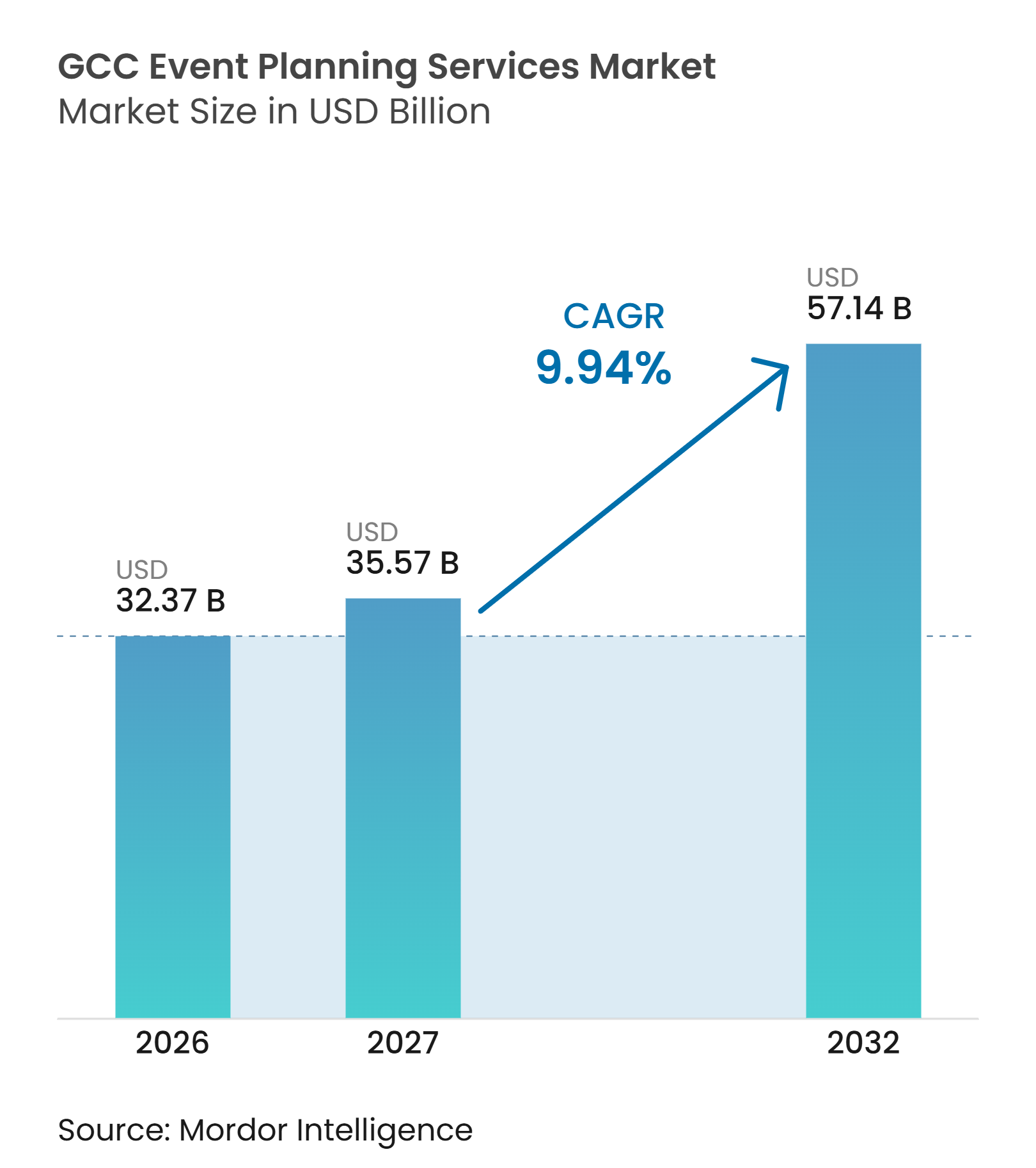
| Base Year Market Size (2026) | USD 32.37 Billion |
| Market Size (2027) | USD 35.57 Billion |
| Market Size (2032) | USD 57.14 Billion |
| Growth Rate (2027 - 2032) | 9.94 % |
| Market Concentration | Low |
Major Players *Disclaimer: Major Players sorted in no particular order Image © Mordor Intelligence. Reuse requires attribution under CC BY 4.0. | |
GCC Event Planning Services Market Analysis by Mordor Intelligence
The GCC event planning services market size was valued at USD 32.37 billion in 2026 and is estimated to grow from USD 35.57 billion in 2027 to reach USD 57.14 billion by 2032, at a CAGR of 9.94% during the forecast period (2027-2032). Saudi Arabia’s event economy is expanding under the Vision 2030 program, which reported 923 accredited venues and more than 300,000 m² of exhibition space in 2025[1]. The UAE offers an established base for international exhibitions and business events, supported by Dubai World Trade Centre’s venue activity in 2025. The GCC event planning services market also benefits from investments in new venues, entertainment assets, and business tourism across Saudi Arabia and the UAE. Digital event tools are becoming a standard part of service delivery, while heat exposure, skilled labor shortages, permitting complexities, and high production costs continue to constrain execution capacity.
Key Report Takeaways
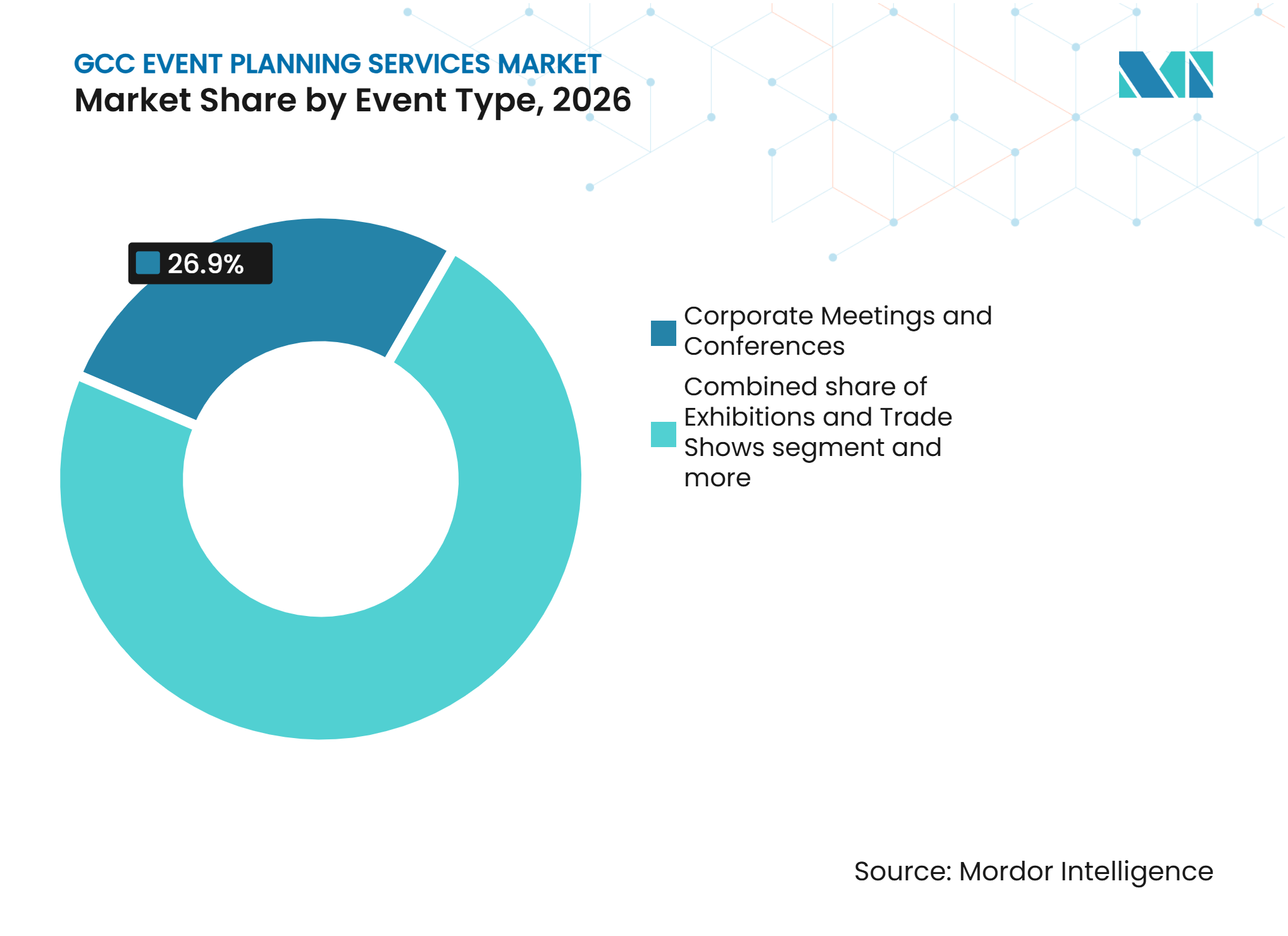
- By event type, Corporate Meetings and Conferences accounted for 26.90% of the GCC event planning services market share in 2026, and Sports, Music and Entertainment Events are projected to grow at an 11.20% CAGR through 2032.
- By service type, Venue and Logistics Management accounted for 38.20% of the GCC event planning services market share in 2026, and Registration and Attendee Management are projected to grow at an 11.70% CAGR through 2032.
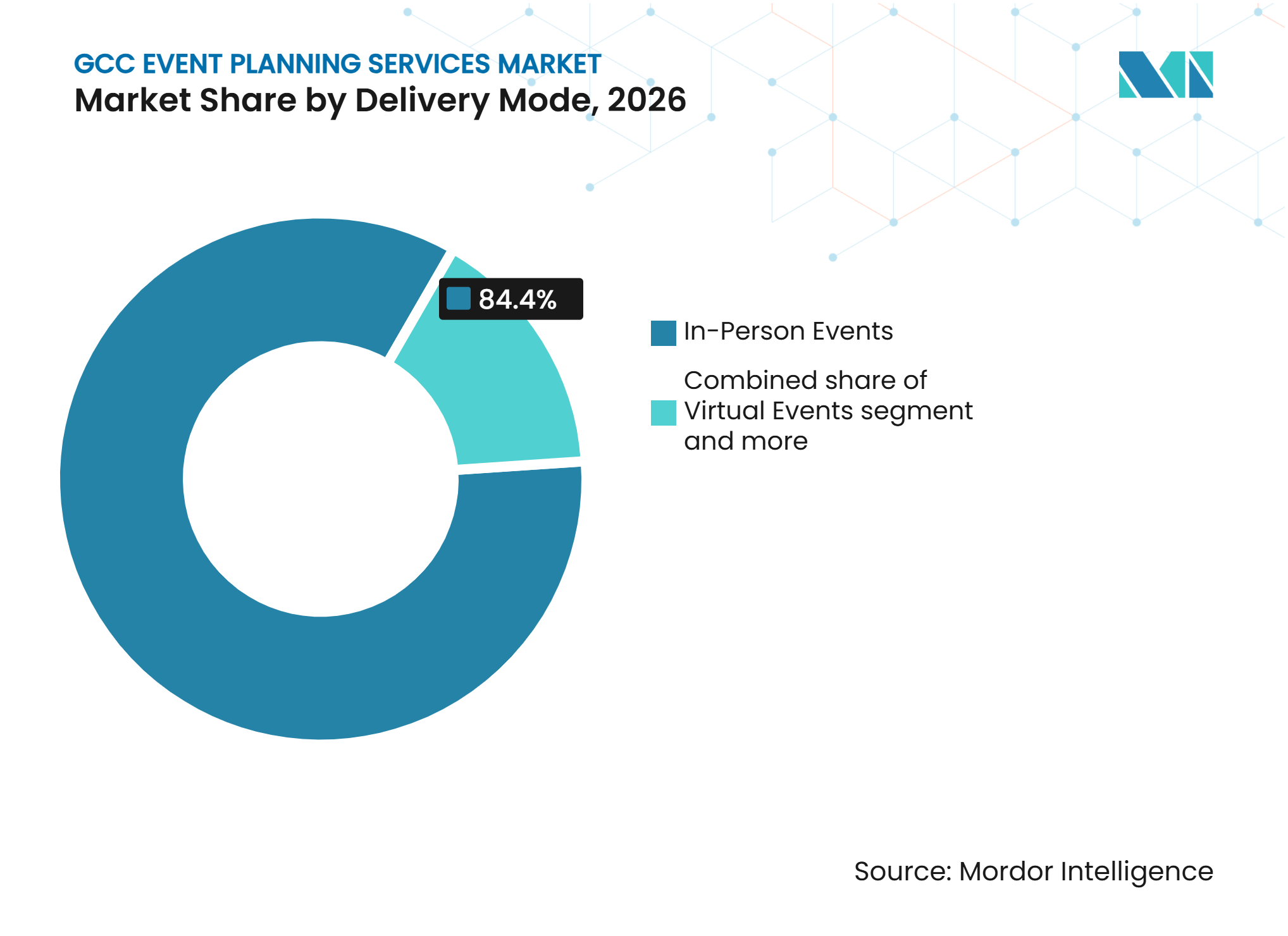
- By delivery mode, In-Person Events accounted for 84.40% of the GCC event planning services market share in 2026, and Hybrid Events are projected to grow at a 12.15% CAGR through 2032.
- By end user, Corporates and Businesses accounted for 48.10% of the GCC event planning services market share in 2026, and Educational Institutions are projected to grow at an 11.90% CAGR through 2032.
- By geography, Saudi Arabia accounted for 43.10% of the GCC event planning services market share in 2026, and is projected to grow at a 10.60% CAGR through 2032.
Note: Market numbers in this report are based on Mordor Intelligence's proprietary estimation framework, which combines nine months of actuals with Q4 projections for base year 2026.
Market Trends and Insights
Drivers Impact Analysis of GCC Event Planning Services Market*
| Driver | (~) % Impact on CAGR Forecast | Geographic Relevance | Impact Timeline |
|---|---|---|---|
| Vision 2030-Led Expansion of Business Events and Entertainment | +3.2% | Saudi Arabia, with spillover to the UAE and Qatar | Long term (≥ 4 years) |
| Growth of International Conferences, Exhibitions, and Incentive Travel | +2.4% | UAE, Saudi Arabia, and Qatar | Medium term (2-4 years) |
| Mega-Project Venue Development and Destination Diversification | +1.6% | Saudi Arabia, Dubai, and Abu Dhabi | Long term (≥ 4 years) |
| Arabic-First Digital Engagement and AI-Powered Event Operations | +0.8% | GCC-wide, especially Riyadh and Dubai | Short term (≤ 2 years) |
| Cross-Border GCC Event Circuits and Unified Visitor Access | +0.6% | GCC-wide | Medium term (2-4 years) |
| Rising Demand for Premium Private Celebrations and Destination Weddings | +0.5% | UAE, Saudi Arabia, Qatar, and Kuwait | Medium term (2-4 years) |
| Source: Mordor Intelligence | |||
Vision 2030-Led Expansion of Business Events and Entertainment
Saudi Arabia’s Vision 2030 program positions exhibitions, conferences and entertainment as contributors to economic diversification. The Vision 2030 Annual Report 2025 reported that the exhibitions and conferences sector contributed USD 2.67 billion to GDP[2], with more than 17,000 companies compared with 400 in 2018. Separately, the General Entertainment Authority reported more than 89 million visitors across 1,690 entertainment events in 2025. This expansion supports demand for event planning, production, logistics and venue-management services across the GCC. Major events, including Riyadh Season, LEAP and the Future Investment Initiative, also create potential recurring opportunities for suppliers that meet organizer, government and sponsor requirements.
Growth of International Conferences, Exhibitions, and Incentive Travel
International business events are expanding the addressable client base for the GCC event planning services market. In the first half of 2025, Dubai Business Events secured 249 successful bids, expected to bring 127,087 delegates to the city over the following years[3]. Dubai World Trade Centre hosted 2.97 million attendees in 2025, including 2.19 million Meetings, Incentives, Conferences, and Exhibitions (MICE) participants across 134 events. Qatar Tourism also reported securing 14 international event bids for events scheduled in 2026 and 2027. Large international events require planners to coordinate delegates, suppliers, transportation, accommodation and regulatory approvals. This trend favors service providers with strong logistics capabilities and sector-specific expertise in healthcare, technology, education and energy.
Mega-Project Venue Development and Destination Diversification
New venues are expanding the operating capacity of the GCC event planning services market. The Dubai Exhibition Centre completed Phase 1 of its expansion in 2026, adding 64,000 m² of permanent exhibition space and 30,000 m² of flexible pavilion space, supporting up to 50,000 daily visitors. In Abu Dhabi, the Department of Culture and Tourism – Abu Dhabi entered agreements for Sphere Abu Dhabi, a planned immersive venue on Yas Island. Saudi Arabia is also expanding its event infrastructure ahead of Expo 2030 and the FIFA World Cup 2034. These developments create opportunities for event planning firms to provide venue programming, supplier coordination and operational support before and after facilities open.
Arabic-First Digital Engagement and AI-Powered Event Operations
Arabic-language digital tools are increasingly important in the GCC event planning services market, as service delivery must align with local audience preferences and permitting requirements. In Saudi Arabia, event technology providers have used AI-enabled capabilities for crowd analytics, smart navigation, and attendee support at large-scale events. The National Events Center’s 2025 Event Tech Meetup in Riyadh examined the use of AI and data in event operations. At GITEX Global 2025, WebCastle Technologies and EventHex.ai announced an event technology partnership covering matchmaking, ticketing, and attendee engagement tools. These capabilities reduce registration friction and strengthen the data organizers can present to sponsors and government buyers. Event companies that integrate local-language support and regulatory workflows can compete more effectively than platforms designed solely for international use.
Restraints Impact Analysis of GCC Event Planning Services Market*
| Restraint | (~) % Impact on CAGR Forecast | Geographic Relevance | Impact Timeline |
|---|---|---|---|
| Extreme-Heat Compression of Outdoor Event Calendars | -0.6% | GCC-wide, especially Kuwait, Qatar, and inland Saudi Arabia | Long term (≥ 4 years) |
| Shortage of Senior Event Production and Strategic-Planning Talent | -0.8% | Saudi Arabia, UAE, and the wider GCC | Medium term (2-4 years) |
| Fragmented Permitting, Protocol, and Venue-Access Requirements | -0.4% | GCC-wide, with multiple regulators in the UAE | Short term (≤ 2 years) |
| High Fixed Costs and Margin Pressure in Mega-Event Delivery | -0.5% | Saudi Arabia and the UAE | Medium term (2-4 years) |
| Source: Mordor Intelligence | |||
Extreme-Heat Compression of Outdoor Event Calendars
Extreme heat limits the period available for outdoor events in the GCC event planning services market. In the UAE, outdoor activity providers commonly reduce or suspend operations during the hottest summer months. Global Village closes from May to October, demonstrating the seasonal constraints affecting open-air visitor attractions. These conditions concentrate demand between November and April, increasing competition for indoor venues and production teams. ADNEC Group and the Abu Dhabi Sports Council operated Abu Dhabi Summer Sports in an air-conditioned venue from June to August 2025. Although indoor formats can reduce seasonal constraints, their capacity and cost structure cannot fully replace large outdoor festivals and public events.
Shortage of Senior Event Production and Strategic-Planning Talent
The expansion of event calendars continues to outpace the supply of senior production and strategic-planning talent. UFI – The Global Association of the Exhibition Industry's 2025 Global Exhibition Barometer found that 80% of surveyed exhibition companies in Saudi Arabia planned to increase staffing, the highest share among the countries covered. Demand for technical directors, bilingual project managers, crowd management specialists, and senior producers increases staffing costs and may extend project timelines. Saudi Arabia launched the Event Pioneers program in 2025 to develop graduates in event management, protocol, crowd management, and health and safety. Although the program strengthens the domestic talent pipeline, training capacity may take time to match growth in large-scale events. Companies with structured training programs can reduce dependence on the limited pool of experienced external personnel.
*Our forecasts treat driver/restraint impacts as directional, not additive. The impact forecasts reflect baseline growth, mix effects, and variable interactions.
Consumer Preferences & Spending Patterns
Saudi Arabia recorded more than 89 million entertainment-sector visitors, 1,690 events, and 75,661 event-days in 2025, reflecting the growing scale of organized entertainment. This growth supports demand for event production, venue coordination, ticketing, crowd management, and culturally tailored programming, creating opportunities for recurring contracts. Dubai World Trade Centre attracted 2.65 million participants across 378 events in 2024. MICE attendance rose 30% year on year to 2.03 million, including more than 942,000 international participants, supporting demand for multilingual registration, exhibitor coordination, delegate transportation, and sponsor servicing. Saudi Arabia recorded approximately 123 million domestic and inbound tourists and SAR 304 billion (USD 81 billion) in tourism spending in 2025, creating opportunities to bundle event planning with accommodation, transportation, hospitality, and destination experiences. However, corporate and government procurement contracts better indicate addressable event demand. Qatar welcomed 5.1 million international visitors in 2025, while accommodation room nights exceeded 10.8 million, up 8.6% year-on-year. Growth supports demand for delegate logistics, hospitality coordination, cultural programming, and event management services, although seasonal accommodation constraints and supplier costs remain key considerations.
Service Market Performance Intelligence
Pricing in the GCC event planning services market reflects venue costs, technical production, specialized labor, logistics, and event complexity, although comparable public agency rate cards remain limited. Dubai World Trade Centre (DWTC)'s 100 large-scale events generated an estimated AED 2.9 billion (USD 0.79 billion) in direct MICE-sector sales in 2024, including venue space, exhibition stands, logistics, and business support services. Total economic output reached AED 22.35 billion (USD 6.08 billion). International attendees spent an average of AED 9,833 (USD 2,676.81) per event, versus AED 1,673 (USD 455.44) for local attendees, according to the DWTC Economic Impact Assessment. This gap supports international conferences and complex business events requiring accommodation, transportation, technical production, and attendee services. Providers can differentiate through bundled pricing, supplier agreements, and cost controls.
Client acquisition relies on international bidding, destination partnerships, and delivery capacity. Dubai Business Events submitted 391 bids in H1 2025, winning 249 (64%), compared with 58% in H1 2024; these bids were expected to attract 127,087 delegates. DXB LIVE served 127 events in H1 2025, up 40% year on year, and was prime contractor for 38 events. DWTC hosted 401 events and attracted 2.97 million attendees in 2025, up 12%. New entrants need local networks, qualified teams, and tender credentials. Repeating contracts and successful delivery records can reduce one-time acquisition costs.
GCC Event Planning Services Market Segment Analysis
By Event Type:
Corporate Meetings Lead, Entertainment Sets the PaceCorporate Meetings and Conferences accounted for 26.90% of the GCC event planning services market in 2026. The segment benefits from the GCC’s role in regional headquarters activity, investment forums, association meetings, and professional events. Dubai World Trade Centre hosted 134 MICE events with 2.19 million participants in 2025. Corporate clients require venue management, delegate support, technical production, and compliance coordination. Recurring annual meetings and trade events provide planners with predictable demand. Consulting, technology, education, healthcare, and energy clients also require specialized content support and supplier networks.
Sports, Music, and Entertainment Events are forecast to grow at an 11.20% CAGR through 2032. Soundstorm 2025 hosted 500,000 attendees during a three-day festival in Riyadh[4]. Saudi Arabia’s accredited venue network and Dubai’s expanding exhibition capacity support exhibition and trade show activity. Weddings, private social events, government ceremonies, esports events, and sports fixtures also generate demand. Providers that manage programming, staging, security, artists, sponsors, and attendee flows can serve multiple event types.



By Service Type:
Venue Dominance Masks Registration Technology GrowthVenue and Logistics Management accounted for 38.20% of the GCC event planning services market share in 2026. High-specification hotels, convention centers, arenas, and outdoor venues require operational planning that clients typically cannot manage in-house. Dubai World Trade Centre Hospitality served 1.28 million guests across 2,578 events in 2025. Venue services include supplier coordination, catering, transportation, floor planning, guest flow management, safety, and regulatory documentation. The concentration of large events during cooler months increases the value of established venue relationships. This service area remains the largest revenue pool for many integrated service providers.
Registration and Attendee Management is forecast to grow at a CAGR of 11.70% through 2032. Organizers increasingly use registration platforms for check-in, badge printing, session tracking, attendee engagement, and sponsor reporting. UAE technology suppliers have demonstrated contactless check-in and AI-supported attendee recommendations at major regional events. Event Planning and Coordination remains the core client-facing service, particularly for organizations outsourcing end-to-end delivery. Event Production and Technical Services face cost pressures from specialized crew and equipment need. Event Marketing and Sponsorship services benefit from demand for measurable audience engagement and partner returns.
By Delivery Mode:
In-Person Events Anchor Regional DemandIn-person events accounted for 84.40% of the GCC event planning services market in 2026. This share reflects the importance of hospitality, relationship building, and live entertainment in GCC business and social events. New physical infrastructure, including the Dubai Exhibition Centre expansion, supports face-to-face formats. These events generate demand for catering, guest management, transportation, security, stage production, and venue operations, which digital formats cannot easily replicate. Public-sector forums, exhibitions, private celebrations, and major entertainment events remain primarily physical experiences.
Hybrid events are projected to grow at a CAGR of 12.15% through 2032 in the GCC event planning services market. They enable international associations and multinational employers to engage remote participants while maintaining in-person programs. In 2025, WebCastle Technologies and EventHex.ai announced tools integrating ticketing, matchmaking, engagement, and event website functions. Virtual formats complement rather than replace physical events. Hybrid delivery increases demand for camera work, broadcast direction, remote moderation, platform administration, and digital content management. It also highlights technical talent shortages, as production teams need expertise in live event execution and online audience engagement.

By End User:
Corporate Spending Leads, Education AcceleratesCorporates and businesses accounted for 48.10% of the GCC event planning services market share in 2026. Demand included conferences, product launches, investor meetings, employee programs, exhibitions, and client hospitality events. Dubai’s business event bidding activity indicated continued demand from international organizations seeking regional meeting destinations. Government and public-sector organizations funded high-profile forums and national celebrations, while associations and professional bodies required specialized delegate and content management for recurring conferences. Long-term client relationships enabled planners to secure annual calendars and repeat business.
The educational institutions segment is projected to grow at a CAGR of 11.90% through 2032. Universities, research centers, and schools require support for commencement ceremonies, academic conferences, research summits, and alumni events. Khalifa University held its 2025 graduation ceremony at ADNEC Centre, Abu Dhabi for 1,112 graduates over two days. These events require guest management, student coordination, stage production, transportation, and venue logistics. Nonprofit organizations and private clients also drive demand for galas, philanthropy events, and family celebrations, enabling providers to balance corporate contracts with specialized projects.
Geography Analysis
Saudi Arabia accounted for 43.10% of the GCC event planning services market in 2026 and is forecast to grow at a 10.60% CAGR through 2032. The Vision 2030 Annual Report documented 923 accredited venues, over 300,000 m² of exhibition space, more than 17,000 business events, and a USD 2.67 billion GDP contribution from exhibitions and conferences in 2025. Expo 2030 and the 2034 FIFA World Cup are driving long-term investment. SCEGA licensing and accreditation influence operators.
The UAE has an established ecosystem for international exhibitions and business events. Dubai World Trade Centre recorded 2.97 million visitors and 2.19 million MICE participants in 2025. Dubai Business Events secured 249 bids in the first half of 2025, representing 127,087 expected delegates. Venue and emirate requirements require familiarity with local authorities. Qatar, Kuwait, Bahrain, and Oman offer growth opportunities. Qatar Tourism secured 14 international event bids for 2026 and 2027. Kuwait is expanding trade fairs, Bahrain is developing Information and Communications Technology (ICT) and convention offerings, and Oman’s Khareef season supports events during hotter months elsewhere.
Service Provider Network & Expansion Intelligence
The GCC event planning services market comprises integrated venue operators, international exhibition organizers, full-service agencies, and specialist production firms. ADNEC Group managed more than 1,000 events and attracted 5.4 million visitors in 2024. DXB LIVE delivered services for 127 events across 13 cities in the first half of 2025. SELA and MDLBEAST specialize in sports, entertainment, and festival production, while MCI Middle East and international organizers support corporate meetings, exhibitions, and association events. This specialization allows clients to select integrated partners or targeted suppliers based on event complexity, technical requirements, and budget.
Geographic expansion and international partnerships are broadening the regional supplier network. In January 2026, DWTC and Informa launched inD, combining more than 40 B2B event brands with projected revenue exceeding USD 650 million. ADNEC Group and Informa planned four exhibitions in Al Ain for 2026-2027, while dmg events and Messe München partnered to bring IFAT to Saudi Arabia in 2026. These developments create opportunities in exhibition production, logistics, registration, and technical services while increasing competition and the need to meet international operating standards.
Competitive Landscape
Market Concentration
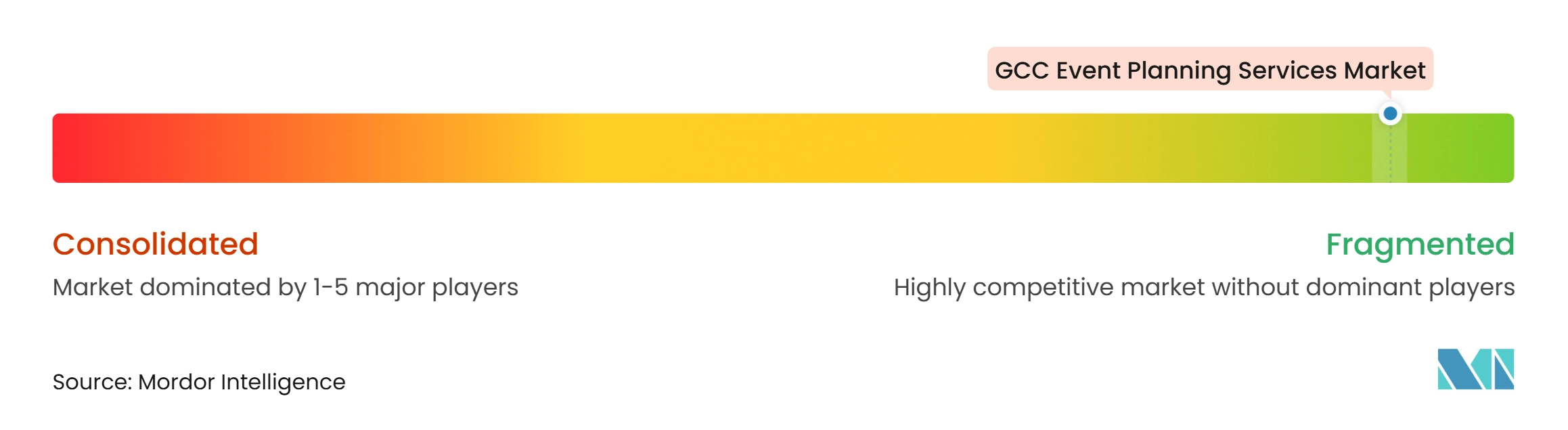
The GCC event planning services market is highly fragmented. The market includes exhibitions, MICE, concerts, sports events, weddings, government events, and private celebrations. Venue operators hold stronger positions within their local assets, particularly ADNEC Group in Abu Dhabi and DWTC in Dubai. DWTC and Informa announced their partnership in 2025 and launched inD in January 2026, combining more than 40 B2B event brands. Global groups compete through established brands and exhibitor networks, while regional specialists leverage local relationships and operational knowledge. This structure limits pricing control by any single provider. Competition centers on geographic reach, venue access, digital capabilities, and regulatory expertise.
Messe München and dmg events plan to launch bauma Saudi Arabia in 2027, reflecting long-term positioning in Saudi Arabia. Cross-border teams and compliance systems support complex regional contracts. Arabic-first platforms, modular packages, and touring services remain competitive areas. Crowd analytics, integrated ticketing, sponsor reporting, and attendee data add value. Saudi Commission for Exhibitions & Global Accreditation (SCEGA), the Department of Culture and Tourism (DCT) Abu Dhabi, and venue requirements create compliance barriers. Smaller agencies compete through specialization, supplier networks, or high-value client segments. Global firms require local partnerships to meet GCC cultural and regulatory requirements.
GCC Event Planning Services Industry Leaders
-
Abu Dhabi National Exhibitions Company (ADNEC Group)
-
Dubai World Trade Centre (DWTC)
-
SELA
-
MDLBEAST
-
dmg events
- *Disclaimer: Major Players sorted in no particular order
GCC Event Planning Services Market Companies Covered in this Report
- Abu Dhabi National Exhibitions Company (ADNEC Group)
- Dubai World Trade Centre (DWTC)
- SELA
- MDLBEAST
- dmg events
- Benchmark
- Riyadh Exhibitions Company
- Ethara
- Live Nation Middle East
- MCI Middle East
- RX Global
- Messe Frankfurt Middle East
- GL events
- GES
- Done Events
- entourage
- HQ Worldwide Shows (HQWS)
- Evolution Events
- INFYA
- ER Event
Recent Industry Developments in GCC Event Planning Services Market
- January 2026: DWTC and Informa announced inD, combining their B2B event businesses and more than 40 event brands across multiple sectors, with projected 2026 revenue exceeding USD 650 million.
- January 2026: dmg events and Messe München launched Saudi Arabia’s inaugural IFAT exhibition alongside Global Water Expo at Riyadh Front Exhibition & Conference Center. The event attracted more than 450 exhibitors from over 35 countries and nearly 20,000 trade visitors, highlighting opportunities for specialized B2B exhibition planning.
- October 2025: Messe München and dmg events signed an agreement to launch bauma Saudi Arabia in 2027, bringing the international construction machinery exhibition to the Saudi market for the first time.
- October 2025: Abu Dhabi National Exhibitions Company (ADNEC) Group and Informa signed an agreement to introduce four exhibitions at ADNEC Centre Al Ain during 2026-2027, expanding the UAE’s regional exhibition portfolio and creating opportunities for B2B event planning and delivery.
GCC Event Planning Services Market Report Scope
The GCC Event Planning Services Market Report examines services supporting the planning, coordination, production, marketing, and management of corporate, public, entertainment, and private events across GCC countries. The market is segmented by event type (Corporate Meetings and Conferences, Exhibitions and Trade Shows, Weddings and Private Social Events, Sports, Music and Entertainment Events, and Others), service type (Event Planning and Coordination, Event Production and Technical Services, Event Marketing and Sponsorship, Venue and Logistics Management, and Registration and Attendee Management), delivery mode (In-Person, Virtual, and Hybrid Events), end user (Corporates and Businesses, Government and Public-Sector Organizations, Associations and Professional Bodies, Educational Institutions, and Nonprofit Organizations and Private Clients), and geography (Saudi Arabia, UAE, Qatar, Kuwait, and Rest of GCC). The study analyzes key drivers, including economic diversification, business-event expansion, venue development, international conferences, digital event management, and demand for premium celebrations. It assesses restraints such as extreme heat, talent shortages, fragmented permitting, and high operating costs. The report evaluates regulatory requirements, technological developments, competitive forces, provider networks, pricing, client acquisition, consumer preferences, and event spending. It provides market forecasts, country-level analysis, market concentration, market share, strategic developments, and company profiles. Opportunities in Arabic-first event platforms, compliance-ready solutions, and modular packages for SMEs are also examined. Market estimates and forecasts are presented in USD across all covered segments.
Segmentation Overview
Key Questions Answered in the Report
What is the value of the GCC event planning services market?
The GCC event planning services market is valued at USD 32.37 billion in 2026 and is forecast to reach USD 57.14 billion by 2032, at a 9.94% CAGR.
Which country leads GCC event planning services?
Saudi Arabia leads with a 43.10% share in 2026 and is forecast to grow at a 10.60% CAGR through 2032.
Which event type is growing fastest in the GCC?
Sports, Music and Entertainment Events are forecast to grow at an 11.20% CAGR through 2032.
What service is used most in GCC event planning?
Venue and Logistics Management leads service spending with a 38.20% share in 2026.
Why are hybrid events expanding in the GCC?
Hybrid Events are projected to grow at a 12.15% CAGR because they combine physical delegate experiences with access for remote audiences.
What are the main challenges for event organizers in the GCC?
Key challenges include extreme heat, shortages of senior production talent, fragmented permitting requirements, and high fixed delivery costs.