
Market Overview
| Study Period | 2020 - 2031 |
|---|---|
| Forecast Data Period | 2026 - 2031 |
| Base Year Market Size (2025) | USD 2.21 Billion |
| Market Size (2026) | USD 2.31 Billion |
| Market Size (2031) | USD 2.86 Billion |
| Growth Rate (2026 - 2031) | 4.42 % |
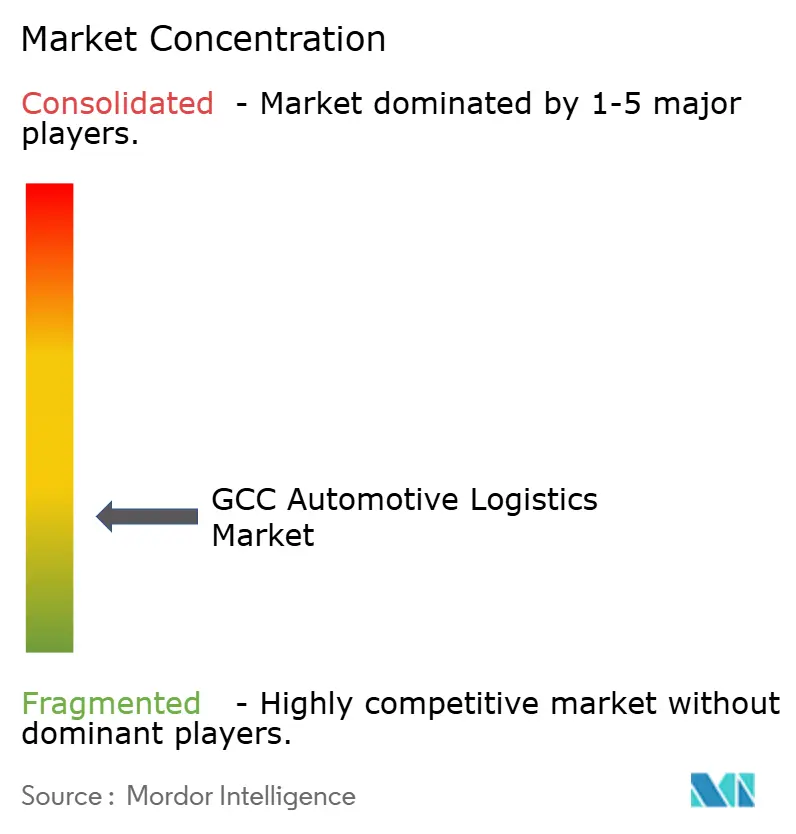
| Market Concentration | Low |
Major Players *Disclaimer: Major Players sorted in no particular order Image © Mordor Intelligence. Reuse requires attribution under CC BY 4.0. | |
GCC Automotive Logistics Market Analysis by Mordor Intelligence
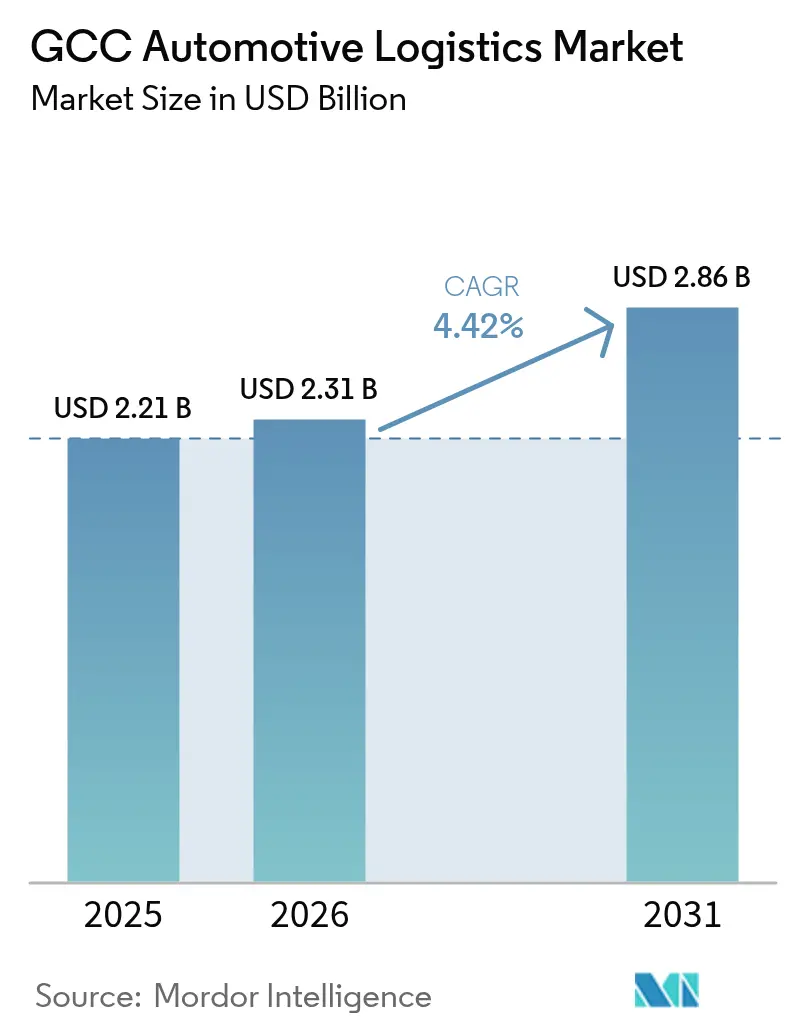
The GCC Automotive Logistics Market size is expected to grow from USD 2.21 billion in 2025 to USD 2.31 billion in 2026 and is forecast to reach USD 2.86 billion by 2031 at 4.42% CAGR over 2026-2031.
The growth reflects the bloc’s position as a tri-continental trade bridge, rising sovereign investment in multimodal corridors, and a decisive rebound in vehicle imports after the pandemic. Chinese vehicle makers are funneling larger volumes through Gulf ports, realigning historical flows that once centered on Japanese and European brands. Early adoption of digital customs platforms under the new Integrated Customs Tariff is trimming border dwell times, while a wave of cold-chain warehouse projects is preparing the network for electric-vehicle battery traffic. Intensifying cross-border commerce, combined with new truck and fuel regulations in Saudi Arabia, continues to test freight margins even as it unlocks demand for higher-margin value-added services.
Key Report Takeaways
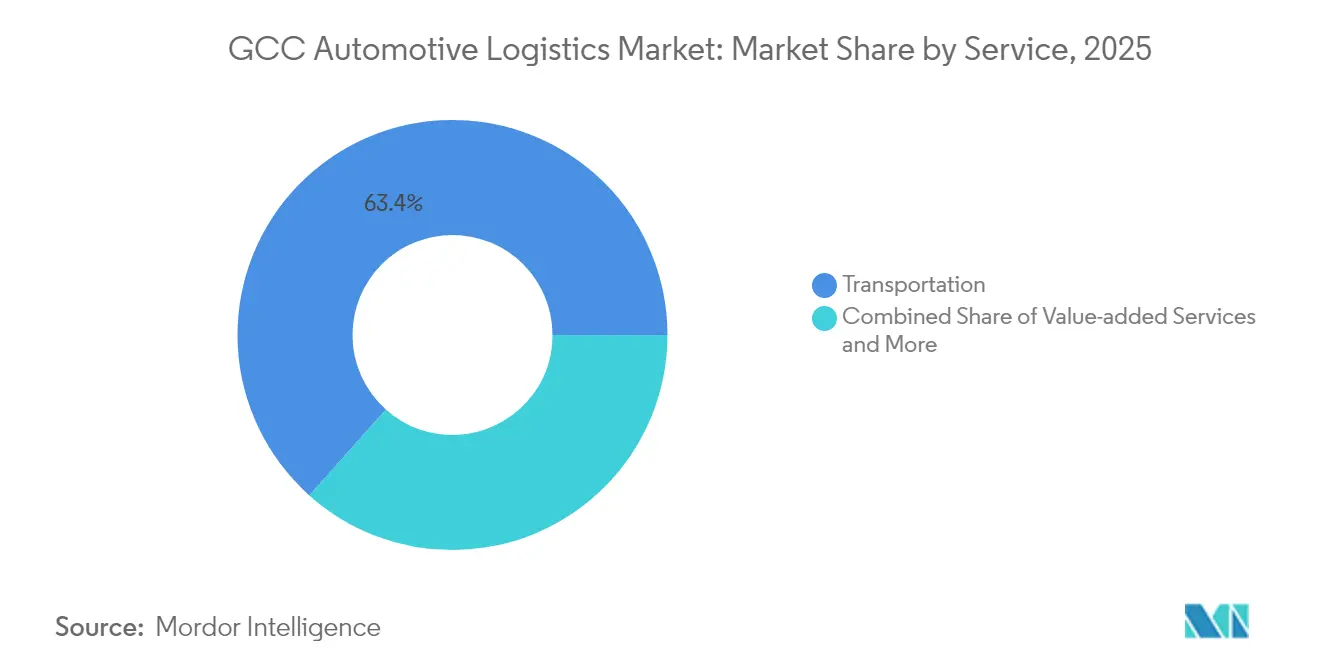
- By service, transportation held 63.40% of GCC automotive logistics market share in 2025; value-added services are poised for the quickest advance at a 3.62% CAGR through 2031.
- By type, OEM flows accounted for 67.30% of GCC automotive logistics market share in 2025, whereas aftermarket logistics is expected to record the fastest rise at a 4.08% CAGR to 2031.
- By cargo, finished vehicles represented 62.30% of the GCC automotive logistics market size in 2025, yet EV batteries and power electronics are forecast to grow at a 4.64% CAGR.
- By country, Saudi Arabia led with 40.55% revenue share in 2025; the United Arab Emirates is projected to log the highest 4.28% CAGR during 2026-2031.
Note: Market size and forecast figures in this report are generated using Mordor Intelligence’s proprietary estimation framework, updated with the latest available data and insights as of 2026.
Market Trends and Insights
Drivers Impact Analysis of GCC Automotive Logistics Market*
| Driver | (~) % Impact on CAGR Forecast | Geographic Relevance | Impact Timeline |
|---|---|---|---|
| Robust vehicle-sales rebound post-COVID | +1.2% | Saudi Arabia, UAE, wider GCC | Short term (≤ 2 years) |
| Mega-projects under Saudi Vision 2030 & UAE NLS 2030 | +1.8% | Saudi Arabia, UAE, spillover to neighbors | Long term (≥ 4 years) |
| E-commerce surge boosting last-mile LCV demand | +0.9% | UAE, Qatar, expanding to Saudi Arabia | Medium term (2-4 years) |
| EV and battery import boom | +0.7% | Saudi Arabia, UAE | Medium term (2-4 years) |
| Sovereign capex for logistics automation | +0.6% | Saudi Arabia, UAE | Long term (≥ 4 years) |
| Rising Chinese OEM penetration | +0.8% | GCC-wide, especially Saudi Arabia and UAE | Medium term (2-4 years) |
| Source: Mordor Intelligence | |||
Robust Vehicle-Sales Rebound Post-COVID Drives Infrastructure Utilization
Sales volumes surpassed pre-pandemic levels in 2024, crowding RoRo berths and inland yards across the bloc. Saudi dealerships reordered aggressively as consumer sentiment strengthened, while Chinese marques such as MG and Geely seized shelf space once dominated by Japanese sedans. Gulf ports responded by re-striping yards to accommodate different vehicle dimensions and revising parts-picking logic inside distribution centers. Bahrain’s Ministry of Transportation reported that Khalifa bin Salman Port handled 4,357 vehicles in September 2024, up from 2,618 units a month earlier[1].
Mega-Projects Under Saudi Vision 2030 & UAE NLS 2030 Transform Regional Connectivity
Saudi Arabia’s SAR 4 billion (USD 1.06 billion) SAL Logistics Zone clusters processing, storage, and cold-chain facilities near Jeddah Islamic Port, while the USD 10 billion NEOM–DSV partnership is embedding automated yards, drone inventories, and green-hydrogen truck docks within the futuristic city[2]. Parallel UAE investments include Dubai’s AED 90 million (USD 24.5 million) JAFZA Logistics Park extension and Abu Dhabi’s AED 10 billion (USD 2.72 billion) industrial strategy that fast-tracks temperature-controlled units for battery warehousing. Coordinated rail spurs will eventually knit these mega-nodes into a seamless corridor stretching from the Red Sea to the Gulf of Oman.
E-Commerce Surge Accelerates Last-Mile LCV Demand and Urban Distribution Networks
Online retail volumes doubled in key Gulf capitals in the past two years, pivoting logistics priorities toward light commercial vehicles. Fulfillment providers are rolling out micro-hubs within 20 kilometers of dense neighborhoods to shorten delivery cycles. Technology start-ups, backed by USD 9 million in venture capital, are integrating auto-parts stocking with same-day consumer parcel flows, allowing warehouses to toggle between B2B and B2C pick paths.
EV & Battery Import Boom Requires Specialized Temperature-Controlled Logistics Infrastructure
Electric-vehicle shipments surged in 2024, introducing UN 3480 and UN 3481 battery classes into Gulf freight portfolios. Each lithium-ion pack now travels in fire-retardant packaging equipped with temperature sensors and data loggers. RSA Global, in collaboration with Americold, commissioned a 15,000-pallet cold box in Dubai dedicated to 15-25 °C battery staging. Compliance with Gulf fire codes and International Maritime Organization rules is filtering out smaller haulers and concentrating flows among certified 3PLs[3].
Restraints Impact Analysis of GCC Automotive Logistics Market*
| Restraint | (~) % Impact on CAGR Forecast | Geographic Relevance | Impact Timeline |
|---|---|---|---|
| Fragmented customs across GCC borders | −0.8% | All member states | Short term (≤ 2 years) |
| Skilled warehouse & truck-driver shortage | −1.1% | Saudi Arabia, UAE, wider GCC | Medium term (2-4 years) |
| Limited rail haulage capacity | −0.5% | Saudi Arabia, UAE | Long term (≥ 4 years) |
| High capex for automation & cold-chain | −0.7% | GCC-wide | Medium term (2-4 years) |
| Source: Mordor Intelligence | |||
Fragmented, Non-Harmonized Customs Across GCC Borders Creates Operational Inefficiencies
While the unified tariff aligns duty rates, physical inspection rules still diverge. Trucks entering Oman via the Al Buraimi post clear in under four hours, yet similar loads can wait 12–18 hours at the Al Batha gate into Saudi Arabia. Documentation redundancies inflate demurrage bills and complicate just-in-time parts programs for regional assembly lines. A common digital window remains under pilot testing, with full certification reciprocity still at least two years away as per Gulf Cooperation Council secretariat updates[4].
Shortage of Skilled Warehouse & Truck-Driver Labor Constrains Operational Capacity
The International Road Transport Union projects that global truck driver shortages will double by 2028, with the GCC region experiencing particularly severe constraints. Gulf wage inflation has made driver recruitment competitive with construction and oil-field jobs, pushing some fleets to park idle tractors. Warehouses confront a parallel gap in technicians capable of maintaining automated sortation or operating hazardous-goods zones for batteries. Bahri Logistics signed a two-year program with the Saudi Logistics Academy to upskill local talent in 2024, yet the cadence of graduates lags demand.
*Our forecasts treat driver/restraint impacts as directional, not additive. The impact forecasts reflect baseline growth, mix effects, and variable interactions.
GCC Automotive Logistics Market Segment Analysis
By Service:
Transportation Dominance Faces Value-Added DisruptionTransportation services controlled 63.40% of GCC automotive logistics market share in 2025, anchored by road freight corridors that knit together port cities and desert hinterlands. RoRo berths at Jebel Ali, Dammam, and Sohar funnel full shiploads into convoys bound for dealer yards, while sea-to-rail transload remains nascent outside the Etihad Rail Phase 2 stub. The GCC automotive logistics market size tied to transportation is forecast to grow in lockstep with finished-vehicle imports yet cede relative weight as higher-margin services proliferate.
Value-added modules - pre-delivery inspection, battery conditioning, and software flashing - are on course for a 3.62% CAGR. Logistics providers are converting ambient sheds into temperature-managed zones with 24-hour flame-suppression and ISO17025 testing booths. The resulting bundled propositions fetch premiums of 15-25% over standard cross-dock moves and form a key entry barrier for asset-light start-ups.

By Type:
OEM Networks Drive Volume While Aftermarket AcceleratesOriginal-equipment manufacturer flows represented 67.30% of GCC automotive logistics market share in 2025, mirroring the region’s reliance on imported finished cars and CKD kits. Routinely scheduled block-trains and chartered car carriers allow tier-one 3PLs to leverage density economics.
Aftermarket lanes, growing at a 4.08% CAGR (2026-2031), favor agile operators that can execute high-frequency, low-volume deliveries to 2,000-plus service outlets. E-commerce portals specializing in brake pads and lubricants now demand next-day fulfilment, tightening cut-off windows for parts hubs in Dubai South and Riyadh’s Sudair City. The shift compels OEM-centric forwarders to invest in piece-picking automation and reverse-logistics workflows for remanufactured components.

By Cargo Type:
Finished Vehicles Lead Despite EV Battery SurgeFinished vehicles retained 62.30% of cargo share in 2025 thanks to large-lot imports from China and Korea. A single vessel call can discharge 5,000 sedans, necessitating purpose-built marshalling yards with vehicle-tracking RFID gates. This concentration allows the GCC automotive logistics market size associated with vehicle moves to remain the revenue spine of many 3PL contracts.
EV batteries and power electronics are scaling from a lower base yet advancing at a 4.64% CAGR (2026-2031). Each GCC country now enforces Class 9 labeling, shock sensors, and thermal stripping before inbound clearance. The capital intensity - special racks, foam insulation, and fire blankets - spurs alliances between shipping lines and cold-chain specialists. As battery volumes mount, total landed cost per unit is expected to dip by 2030, making electric cars more price-competitive across dealer showrooms.
Geography Analysis
Saudi Arabia Automotive Logistics Market
Saudi Arabia dominated the GCC automotive logistics market in 2025 with a 40.55% slice, propelled by Vision 2030 capital programs and its role as the Gulf’s biggest car buyer. The SAR 4 billion (USD 1.06 billion) SAL Logistics Zone near Jeddah Islamic Port integrates battery chambers, bonded yards, and an air-freight feeder, enabling two-hour truck transfers to inland distributors. Planned NEOM freight villages will plug into a 6,000-kilometer rail network, promising modal shifts from diesel trucks to electric locomotives once operational.
United Arab Emirates Automotive Logistics Market
The United Arab Emirates is on track for the fastest 4.28% CAGR (2026-2031) thanks to Dubai’s trade-first infrastructure and Abu Dhabi’s diversification into advanced manufacturing. Jebel Ali’s newly unveiled 13,000-CEU yard gives the port a total 75,000-CEU footprint, letting shipping lines stage peak-season overflow without costly diversions. Meanwhile, the Einride-DP World autonomous-truck pilot aims to slash 14,600 t of annual emissions across 100 battery-electric tractors, underscoring the UAE’s sustainability branding.
Regulatory Landscape
The GCC automotive logistics operating environment is shaped by customs-union rules and increasingly formalized road-transport governance. Under the GCC Common Customs Law and the Unified Customs Tariff, most goods entering from outside the customs union are subject to a 5% import duty on CIF value, while member states continue to run national digital customs portals for declarations and clearance (for example, Dubai Customs and Abu Dhabi Customs in the UAE). Cross-border road movements are further framed by the Unified Law of International Land Transport, approved by the GCC Supreme Council in December 2022, which sets common principles on international land transport operations and safety.
Saudi Arabia has been tightening licensing and technical compliance requirements that affect automotive logistics providers and fleet operators. The Transport General Authority (TGA) regulates road-transport operations through licensing and technical specifications under Saudi Arabia's Road Transport Law (published by the Ministry of Investment in July 2025). Product-side compliance for imported vehicles and components is anchored in SASO technical regulations and conformity assessment. In March 2026, the Saudi Ministry of Transport and Logistics Services announced a GCC logistics initiative that included extending truck age limits to 22 years and introducing storage measures at King Abdulaziz Port in Dammam, including up to 60-day fee exemptions for GCC-destined cargo. This provides a near-term operational lever for port and inland distribution planning.
Value Chain Analysis
GCC automotive logistics remains predominantly import and re-export led, with port-centric nodes feeding inland distribution to dealer networks, service outlets, and free zones. Upstream flows start with global OEMs and tier suppliers shipping finished vehicles, CKD kits, and components into major gateways such as Jebel Ali (UAE), King Abdulaziz Port in Dammam and Jeddah Islamic Port (Saudi Arabia), followed by movements into marshalling yards, bonded storage, and vehicle processing areas (PDI, accessorization, software flashing). Downstream, operators allocate inventory to dealership yards and parts hubs, with aftermarket distribution increasingly relying on multi-drop road routes and e-commerce compatible pick-pack operations.
The chain is becoming more specialized around battery and electronics handling. Certified hazardous-goods processes (packaging, labeling, temperature monitoring, and fire-code compliant storage) are pushing work toward larger 3PLs and integrated port zones. Joint ventures and ecosystem partnerships are increasingly used to coordinate across the chain, linking port operators, national champions, and global specialists to provide end-to-end services from port handling through technical services and final delivery (for example, the Bahri, TASARU, and MOSOLF joint venture announced in 2025). Capacity additions at ports and free zones, together with inland nodes such as Dubai South and Saudi industrial cities, are reinforcing a hub-and-spoke model that supports both high-volume finished vehicles and high-frequency spare parts distribution.
Competitive Landscape
The field is moderately fragmented, with regional stalwarts mixing with multinational heavyweights. Almajdouie Logistics pairs local ground assets with deep-sea alliances, whereas DHL and DSV inject end-to-end visibility platforms spanning origin factories in China to Gulf showrooms. The CEVA–Almajdouie joint venture finalized in 2024 illustrates the trend toward hybrid models that blend regional access with global control towers.
Technology is the prime battleground. Kuehne + Nagel’s AI-driven ETA engine trims yard dwell by 9%, while DP World’s port community system automates tendering for last-mile drayage slots. Certified battery cells move only through facilities sporting FM-approved sprinklers and 24/7 thermal cameras, narrowing the field of compliant operators. The rising bar for ESG reporting further advantages scale players able to finance solar rooftops and hydrogen truck pilots.
M&A momentum is set to continue as asset-heavy regional firms seek partners for digital upgrades and network reach. DSV’s acquisition of Schenker in 2025, raising combined revenues above EUR 39 billion (USD 40.6 billion), signals a capital-powered push into high-service niches such as finished-vehicle remarketing. Smaller fleets face succession issues and may opt to fold into larger groups to access telematics platforms, driver academies, and bonded-warehouse licenses.
GCC Automotive Logistics Industry Leaders
-
Almajdouie Logistics
-
Gulf Agency Company Ltd.
-
Al-Futtaim Logistics
-
Bahri Logistics
-
RSA Global
- *Disclaimer: Major Players sorted in no particular order
GCC Automotive Logistics Market Companies Covered in this Report
- Almajdouie Logistics
- Gulf Agency Company Ltd.
- Al-Futtaim Logistics
- Bahri Logistics
- RSA Global
- Gallega Global Logistics
- Globwin Logistics
- Total Freight International
- DHL
- DSV A/S
- CEVA Logistics
- Kuehne + Nagel
- GEODIS
- Nippon Express
- Yusen Logistics
- Hellmann Worldwide Logistics
- Noatum Logistics
- Clarion Shipping
- Starlinks
- Al Talib Shipping Co. LLC
Market Opportunities and Future Outlook
A whitespace is emerging around multi-modal finished-vehicle distribution and route resilience, supported by executed pilots and corridor investments. In April 2026, Etihad Rail Freight and Al Masaood Automobiles completed a first rail movement of finished Nissan passenger vehicles from Fujairah ports to the ICAD dry port, creating a repeatable template for shifting selected dealer replenishment from long-haul trucking to rail-linked inland nodes. Alongside this, contingency routing that bypasses maritime chokepoints is being formalized through initiatives such as the Mawani and Gulftainer corridor connecting Khorfakkan Commercial Terminal, Sajaa Dry Port, and Dammam. This structure aligns with OEM and 3PL demand for predictable lead times during regional shipping disruptions.
Spare-parts availability and EV ecosystem enablement are also generating investable opportunities in dedicated automotive logistics real estate and value-added services. In June 2026, Hellmann Worldwide Logistics and INDU Group broke ground on a 300,000 sq ft automotive logistics hub in JAFZA for spare parts distribution, reflecting the premium placed on free-zone scale, customs processing capability, and proximity to re-export channels. On the road-freight side, DP World's July 2026 purchase of 700 trucks to expand its Gulf road network highlights the focus on capacity control and service reliability, which benefits providers offering integrated transport plus yard, PDI, battery-compliant handling, and returns management for aftermarket flows.
Recent Industry Developments in GCC Automotive Logistics Market
- July 2026: DP World acquired 700 trucks to expand its Gulf road freight network, adding capacity that supports logistics during Strait of Hormuz-related disruptions. The move increases control over regional drayage and inland distribution, which are critical for finished-vehicle flows and time-sensitive spare parts replenishment. Larger captive fleets also help with tighter slotting with port vehicle yards and dealer delivery windows.
- June 2026: Hellmann Worldwide Logistics and INDU Group broke ground on a 300,000 sq ft automotive logistics hub in JAFZA for spare parts distribution, reflecting the premium placed on free-zone scale, customs processing capability, and proximity to re-export channels. The project expands regional capacity for automotive warehousing, value-added services, and returns management, complementing ongoing port-edge processing.
- April 2026: Etihad Rail Freight and Al Masaood Automobiles completed a first rail movement of finished Nissan passenger vehicles from Fujairah ports to the ICAD dry port, creating a repeatable template for shifting dealer replenishment from long-haul trucking to rail-linked inland nodes. The success supports more predictable lead times and diversifies modal mix for regional finished-vehicle distribution.
GCC Automotive Logistics Market Report Scope and Research Methodology
Market Definition and Coverage
For this study, the market covers logistics services used to move, store, and handle automotive cargo across GCC countries, from import entry points to inland distribution and dealer delivery. It includes transport, warehousing, distribution and inventory handling, and value-added logistics tied to automotive flows.
Scope exclusions: Excludes pure passenger transport, vehicle retail financing, and non-logistics automotive services that do not involve physical handling, storage, or movement of cargo.
Segments Covered in This Report
- By Service
- Transportation
- Road
- Rail
- Air
- Sea / Ro-Ro / Short-Sea
- Warehousing, Distribution & Inventory Management
- Value-added Services
- Transportation
- By Type
- OEM
- Aftermarket
- By Cargo Type
- Finished Vehicles
- Auto Components
- EV Batteries and Power-Electronics
- Other Cargo
- By Country
- Saudi Arabia
- United Arab Emirates
- Qatar
- Kuwait
- Oman
- Bahrain
Data Sources, Market Sizing, and Validation
Desk Research
Desk research started with public trade and transport indicators to map the demand pool for automotive cargo moving in and out of GCC ports and land borders, then expanded into domestic distribution networks. Sources included national statistics portals in GCC countries, UN Comtrade style trade series for vehicle and parts flows, and OPEC and IMF macro indicators for vehicle demand context. We also used port authority publications that show throughput and capacity expansions.
To tighten assumptions, we reviewed company annual reports and investor presentations of logistics operators and auto distributors, along with reputable press coverage on port and corridor projects. We also checked customs and transport regulator updates that can change clearance time and cost. When needed, paid subscriptions were used for company financials and news screening, and for import and export shipment-level checks to validate direction on volumes and lanes. These desk sources are not exhaustive, and many other public documents were also referenced to collect, verify, and clarify data points.
Primary Interviews and Surveys
Primary work focused on interviews and short surveys with logistics service providers, freight forwarders, warehouse operators, port-linked handlers, and automotive OEM and aftermarket supply chain teams. Coverage was kept across the GCC so differences in import reliance, dealer networks, and re-export activity could be reflected. We then checked key assumptions like typical service mix, utilization, and pricing bands until they aligned with the model totals.
Distribution of primary research fieldwork respondents
| Company type | Respondent position |
|---|---|
| Top tier: 34% | CXOs: 13% |
| Mid tier: 46% | Functional/Unit leaders: 27% |
| Smaller Players: 20% | Managers: 60% |
Market-Sizing & Forecasting
Sizing begins with a top-down demand reconstruction where vehicle and parts trade flows, local distribution intensity, and logistics activity per unit are used to build the addressable logistics spend across GCC. To keep the calculation transparent, we map cargo movement into service buckets (transport, warehousing, distribution and inventory handling, and value-added work). We then apply pricing logic that reflects the local lane mix and handling complexity.
The model is guided by a small set of practical inputs, such as new vehicle sales and parc direction, import and re-export volumes for finished vehicles and components, port throughput and inland corridor capacity additions, typical storage dwell time, and service pricing progression for road haulage and storage. Once a market total is obtained, we corroborate it with selective bottom-up approximations, including sampled provider revenue splits, channel checks on warehouse space utilization, and volume times average price checks for common lanes. Where bottom-up visibility is incomplete, we use conservative penetration ranges and then narrow them using primary feedback on service attach rates.
For forecasting, we run scenario analysis around a base case that links demand to vehicle imports, domestic distribution needs, and aftermarket replacement activity. We then adjust for expected infrastructure and policy shifts. Pricing assumptions are reviewed with practitioners so ASP movement reflects fuel and labor cost pressures, capacity tightness, and contract reset timing rather than a flat inflation add-on.
Data Validation & Update Cycle
Outputs are validated through multiple checks, starting with internal consistency tests across service buckets and countries. We then compare results against independent signals such as trade volume direction, port expansion timing, and reported logistics utilization commentary. When a variance looks large, we revisit the drivers, re-check unit conversions and currency handling, and re-contact selected interviewees if the change is tied to a real market event rather than a modeling artifact.
Before sign-off, the model and assumptions go through a multi-step analyst review so outliers and step changes are explained and documented. Reports are refreshed annually, and interim updates are made when material events occur, such as major policy changes, large port capacity additions, or sharp freight rate resets. A final review pass is completed right before delivery to ensure the latest updated view is reflected.
Mordor Intelligence's Gcc Automtoive Logistics Market Size Compared With Other Published Estimates
Published market values for GCC automotive logistics do not always match because the service boundary and the timing of price assumptions can vary, which changes what gets counted as logistics spend. We also see differences in how firms treat re-export activity, whether EV-related cargo handling is included, and how they convert local currency figures into USD for a single-year snapshot.
A practical gap driver is refresh cadence, since freight rates, storage pricing, and fuel-linked surcharges can move within the year. Older models can carry last-year price levels into the current view. By updating pricing logic at the lane and service level with recent contract reset signals and cross-checking against trade and throughput direction, the 2025 estimate of Mordor Intelligence stays aligned with what logistics buyers in the GCC are typically paying in that year.
Benchmark comparison
| Source | Market Size | Gaps in Research Methodology |
|---|---|---|
| Mordor Intelligence | USD 2.21 B (2025) | |
| Trade Journal A | USD 6.40 B (2024) | Uses a broader GCC automotive logistics spend definition that likely rolls in wider 3PL and supply chain services beyond cargo handling and movement, and it anchors results to a 2024 snapshot where price and currency timing can differ from a 2025 base. |
| Regional Consultancy B | USD 6.40 B (2024) | Appears to apply a higher average pricing per vehicle and parts flow and may count adjacent activities like end-to-end supply chain management as logistics, which lifts totals versus a tighter service-only scope and updated service-bucket pricing. |
The spread in the table is mainly explained by scope width and the year chosen for pricing and USD conversion, which can shift totals even when the same countries are covered. Our approach keeps the number traceable to observable cargo flows, service mix, and pricing checks, so users can see exactly what is included and repeat the logic when assumptions change.
Key Questions Answered in the Report
What is the current value of the GCC automotive logistics market?
The market is valued at USD 2.31 billion in 2026 and is forecast to reach USD 2.86 billion by 2031.
Which service segment leads revenue in Gulf automotive logistics?
Transportation accounts for 63.40% of 2025 revenue, reflecting heavy reliance on road and RoRo links.
Which Gulf country is the fastest-growing logistics hub for vehicles?
The United Arab Emirates shows the highest 4.28% CAGR between 2026 and 2031, buoyed by port and free-zone expansions.
How quickly are EV batteries becoming a logistics opportunity in the region?
Battery and power-electronics flows are rising at a 4.64% CAGR, faster than any other cargo category.
What is the biggest operational constraint faced by logistics firms today?
A shortage of qualified truck drivers and warehouse technicians is suppressing capacity and raising labor costs.
How fragmented is competition among Gulf automotive logistics providers?
The market scores 5/10 on concentration, with the top five firms holding just over half of total revenue.