
GCC Government Super App Platforms Market Size and Share
Market Overview
| Study Period | 2020 - 2031 |
|---|---|
| Forecast Data Period | 2026 - 2031 |
| Base Year Market Size (2025) | USD 0.68 Billion |
| Market Size (2026) | USD 0.85 Billion |
| Market Size (2031) | USD 2.19 Billion |
| Growth Rate (2026 - 2031) | 20.84 % |
| Market Concentration | Medium |
Major Players *Disclaimer: Major Players sorted in no particular order Image © Mordor Intelligence. Reuse requires attribution under CC BY 4.0. | |
GCC Government Super App Platforms Market Analysis by Mordor Intelligence
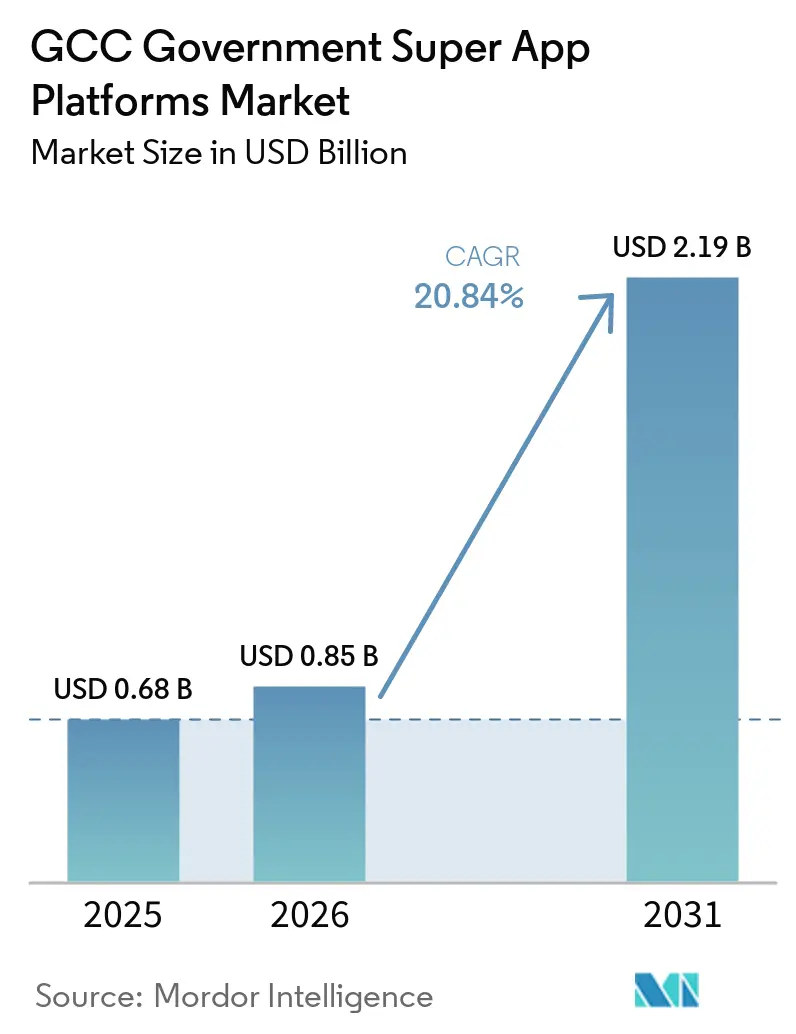
The GCC government super app platforms market size is expected to increase from USD 0.68 billion in 2025 to USD 0.85 billion in 2026 and reach USD 2.19 billion by 2031, expanding at a CAGR of 20.84% over 2026-2031. National digital programs treat unified public services as long-term public infrastructure, supporting ongoing platform investment across the GCC government super-app platforms market. Government agencies are combining identity, payments, and service workflows to reduce the need for residents to use separate portals. Sovereign cloud and Arabic-language AI capabilities are becoming important selection factors for platform suppliers. Back-end modernization, consent controls, and multi-agency coordination can slow the addition of services, even where front-end platforms are well established. Saudi Arabia and the UAE remain the principal deployment centers, while Qatar, Kuwait, Bahrain, and Oman are widening their nationally governed digital service platforms.
Key Report Takeaways
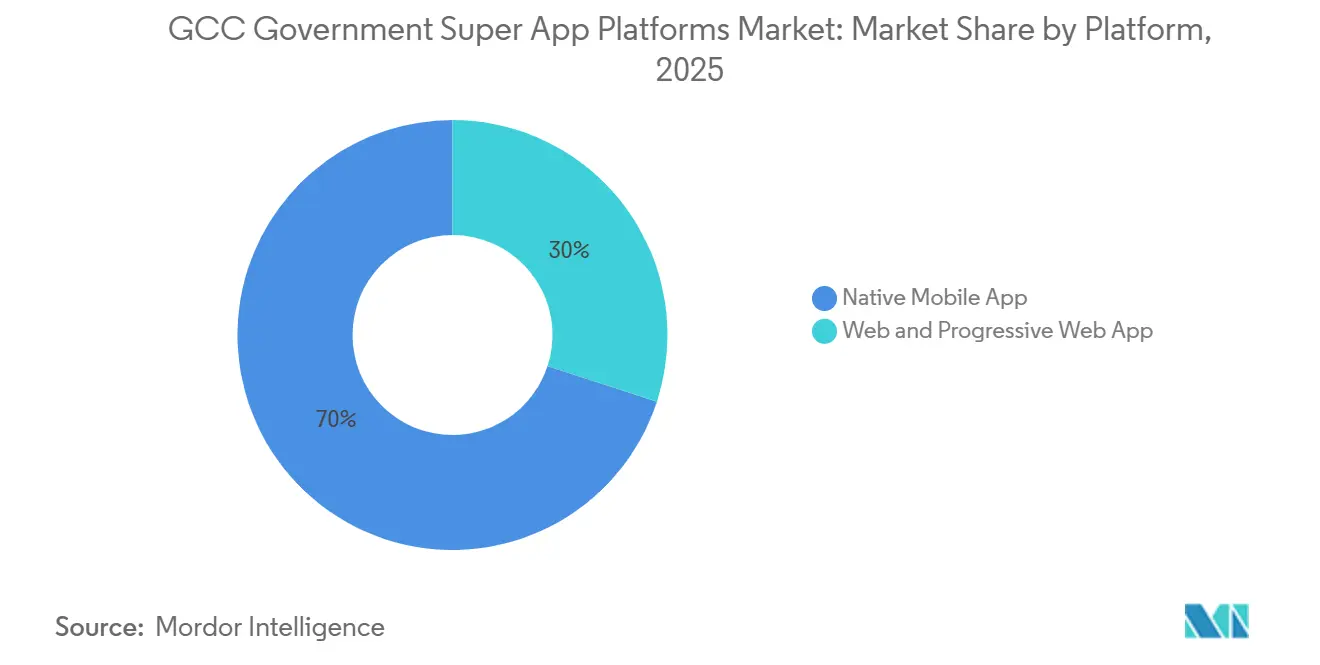
- By platform, Native Mobile App held 69.98% of the GCC government super app platforms market share in 2025, while Web and Progressive Web App are projected to expand at a CAGR of 21.43% through 2031.
- By deployment type, Cloud held 52.11% of the GCC government super app platforms market share in 2025, while Hybrid is projected to expand at a CAGR of 21.33% through 2031.
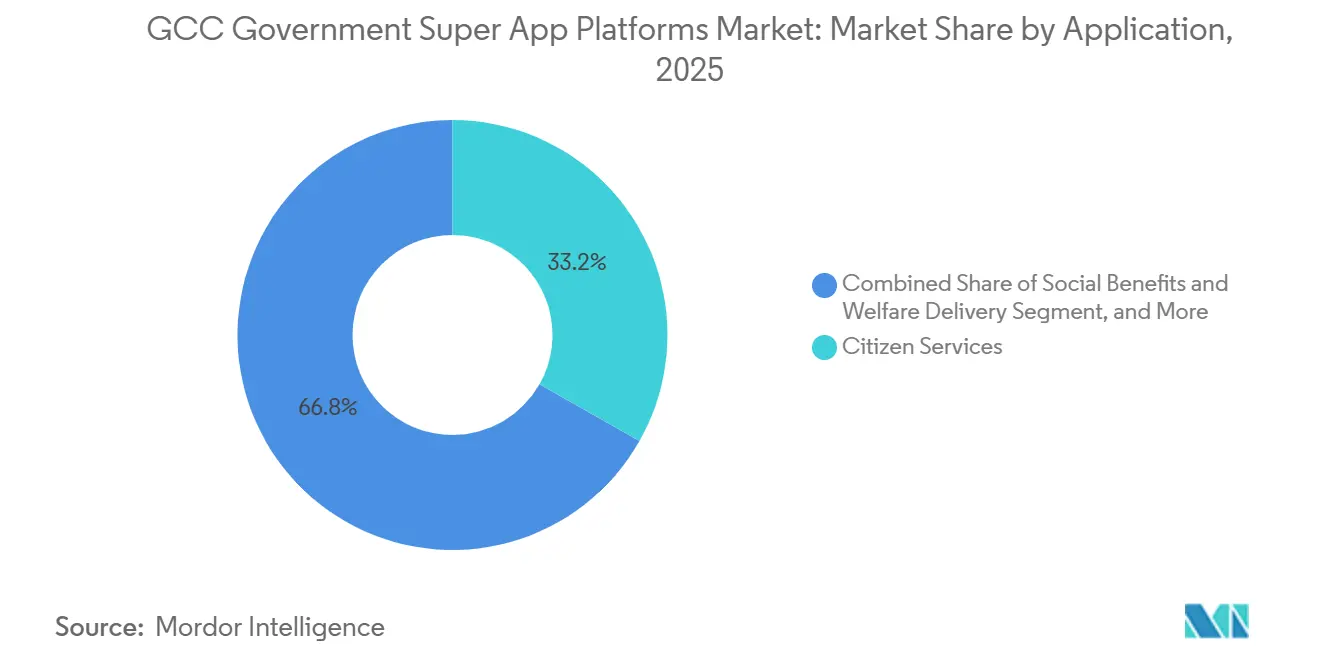
- By application, Citizen Services accounted for 33.21% of the GCC government super app platforms market size in 2025, while Identity, Credentials, and Wallet Services are projected to expand at a CAGR of 22.21% through 2031.
- By end user, the Central Government accounted for 64.32% of the GCC government super app platforms market size in 2025, while the State or Provincial Government is projected to expand at a CAGR of 22.76% through 2031.
Note: Market size and forecast figures in this report are generated using Mordor Intelligence’s proprietary estimation framework, updated with the latest available data and insights as of January 2026.
GCC Government Super App Platforms Market Trends and Insights
Drivers Impact Analysis*
| DRIVER | (~) % IMPACT ON CAGR FORECAST | GEOGRAPHIC RELEVANCE | IMPACT TIMELINE |
|---|---|---|---|
| National Digital Transformation Agendas Accelerating Super App Adoption | +5.5% | GCC-wide, led by Saudi Arabia, the UAE, and Qatar | Short term (≤2 years) |
| High Smartphone and Mobile Internet Penetration Enabling One-Stop Citizen Services | +3.8% | GCC-wide, led by the UAE and Qatar | Short term (≤2 years) |
| Digital Identity, Payments, and Data Sharing as Foundational Infrastructure | +3.2% | GCC-wide, with early gains in the UAE and Saudi Arabia | Medium term (2–4 years) |
| AI-Enabled Proactive Services and Case Routing Under National AI Strategies | +3.0% | UAE and Saudi Arabia, with spillover to Qatar and Oman | Medium term (2–4 years) |
| Cross-Agency Cost Compression and Oil Revenue Diversification Mandates | +2.0% | GCC-wide, led by Saudi Arabia | Medium term (2–4 years) |
| National Digital Sovereignty and Public-Control Requirements | +1.5% | GCC-wide, with early gains in the UAE and Saudi Arabia | Long term (≥4 years) |
| Source: Mordor Intelligence | |||
National Digital Transformation Agendas Accelerate Super App Adoption Across the GCC
National policy programs are a central source of demand in the GCC government super-app platforms market because they link service-delivery targets to national competitiveness and public administration reform. Saudi Vision 2030 aims to reach a top-5 position in the UN E-Government Development Index by 2030, after Saudi Arabia ranked 31st in 2022.[1] This objective requires public agencies to move beyond separate departmental portals toward connected service journeys that reflect a resident’s complete interaction with government. The UAE has committed to the complete digitalization of government services, and UAE PASS provides a common identity layer for many public and private services. Shared identity and workflow capabilities allow agencies to add services without building separate authentication systems or requiring people to maintain multiple accounts. These national targets also make integration into common platforms an important part of agency digital-maturity performance and put sustained pressure on ministries to simplify fragmented processes.
Mobile Infrastructure Enables One-Stop Citizen-Service Delivery at Scale
Mobile access supports the reach and usability of the GCC government super app platforms market, particularly because public transactions often need to be completed away from an office or service center. Mobile internet penetration among high-income populations in the region reached 71% in 2024, while 5G adoption across GCC states is expected to reach 95% by 2030.[2] Saudi Arabia reported that 98.4% of internet users accessed the internet via mobile phones in 2025. The same survey recorded 98% 4G population coverage, exceeding the country’s 2025 target of 96%.[3] This connectivity makes mobile applications practical for recurring public transactions, real-time service updates, document access, and follow-up messages delivered directly to users. It also raises the expected performance standard for platforms that offer voice, notification, or assisted digital services.
Digital Identity and Payment Infrastructure Anchors the GCC Super App Ecosystem
Digital identity, payments, and data sharing provide the core infrastructure for the GCC government super app platforms market by linking services that would otherwise remain separate agency transactions. UAE PASS supports common access to government services and reduces the need for agencies to maintain separate login systems. In Saudi Arabia, government digital platforms combine identity with high-frequency services such as residency, licensing, and public records. This structure enables users to complete a sequence of related transactions through a single account, rather than repeatedly proving their identity at individual service points. It also gives agencies a practical basis for real-time fee collection, service status updates, and more consistent records across related public functions. As identity becomes a common access layer, the security and governance of that layer become more consequential for public confidence.
National AI Strategies Drive Proactive and Case-Routed Government Service Delivery
National AI programs are changing product requirements within the GCC government super app platforms market by moving public platforms beyond a simple request-and-response model. In October 2025, Abu Dhabi introduced TAMM 4.0 and its AutoGov capability, designed to manage recurring public service tasks without requiring a new user request.[4] The platform supports more than 1,100 services for 3.6 million users. These features depend on timely information exchange across agencies that have often maintained separate operating systems and separate responsibilities for the same life event. They also require clear rules for data access, service accountability, exception handling, and the escalation of cases that cannot be resolved automatically. National AI strategies, therefore, increase the value of platforms that can combine automation with local data governance.
Restraints Impact Analysis*
| RESTRAINT | (~) % IMPACT ON CAGR FORECAST | GEOGRAPHIC RELEVANCE | IMPACT TIMELINE |
|---|---|---|---|
| Legacy System Lock-In and Slow Core Modernization | -1.5% | GCC-wide, particularly Oman and Kuwait | Short term (≤2 years) |
| Procurement Complexity and Multi-Agency Governance | -0.9% | GCC-wide, particularly Saudi Arabia and Qatar | Medium term (2–4 years) |
| Privacy, Consent, and Data Residency Constraints | -0.8% | Saudi Arabia and the UAE, with spillover to the GCC | Medium term (2–4 years) |
| Digital Exclusion Risk Among Low-Digital-Literacy Expatriate Workers | -0.5% | GCC-wide, particularly in the UAE, Qatar, and Kuwait | Long term (≥4 years) |
| Source: Mordor Intelligence | |||
Legacy System Lock-In Slows Back-End Integration Timelines
Legacy systems remain a material constraint on the GCC government super app platforms market, even where agencies have already launched a unified public-facing application. A public platform can present a unified front end while underlying ministry systems still require custom integration for each new service, document type, or eligibility decision. The IMF identifies digital skills and institutional capacity as continuing challenges in GCC digital transformation, despite strong ICT infrastructure. Older enterprise systems may not provide the interfaces needed for the timely exchange of identity, eligibility, payment, or case-status data across agencies. This can limit the range and depth of services offered through a single platform, despite strong demand for a one-stop experience. It can also extend deployment schedules, particularly for municipal and lower-frequency services that have not received the same modernization attention as federal functions.
Multi-Agency Procurement Complexity Extends Centralized Platform Deployment Cycles
Shared platforms require ministries and agencies to align service standards, data practices, procurement decisions, and accountability for the outcomes users see. This creates a governance challenge for the GCC government super-app platforms market because each participating body must integrate its own systems and operating procedures while relinquishing some control over individual service channels. The IMF notes that public-sector transformation requires complementary institutional capacity alongside technology investment. National interoperability requirements can provide a common direction for agencies and reduce some duplication in technical design. However, review processes and approval steps may slow the integration of new services where several bodies must agree on the workflow. Data residency, consent, and privacy rules can require additional design work before agencies can exchange personal data. Saudi Arabia’s Personal Data Protection Law has been in force since September 2024, imposing formal obligations on personal data processing.
*Our forecasts treat driver/restraint impacts as directional, not additive. The impact forecasts reflect baseline growth, mix effects, and variable interactions.
Segment Analysis
By Platform: Native Mobile Apps Lead While Web and Progressive Web Apps Gain Traction
Native mobile apps are expected to hold 69.98% of the GCC government super app platforms market share in 2025. This format aligns with the region’s high mobile internet usage and enables frequent citizen transactions through a familiar channel. Saudi Arabia’s official 2025 survey found that 98.4% of internet users accessed the internet via mobile phones. Native applications support notifications, device features, and persistent user sessions for services such as payments and renewals. Abu Dhabi’s TAMM follows a mobile-led service model for more than 1,100 services. Kuwait’s Sahel exceeded 3 million users and 120 million transactions by November 2025, demonstrating the operational scale that a mobile channel can support. These use cases help maintain the preference for native applications in high-volume public interactions.
Web and Progressive Web App platforms are expected to expand at a CAGR of 21.43% through 2031. Browser-based access can support users who do not want to install a dedicated application or who use devices with limited storage. It can also serve users who are less familiar with smartphone applications. UAE PASS supports common access across public and private services, reducing friction in browser-authenticated journeys. Wider adoption of newer mobile networks can improve browser performance for public service delivery. Web and Progressive Web App options, therefore, expand platform access without displacing the established mobile app channel.
By Deployment Type: Hybrid Models Become the Sovereignty-Compliant Default
Cloud is expected to hold 52.11% market share in the GCC government super app platforms market in 2025. Cloud services provide managed infrastructure, flexible capacity, and a practical way to consolidate public-sector technology workloads. These advantages are important as agencies integrate multiple public services into shared platforms. International enterprise suppliers are also adapting their offerings to local hosting requirements. In October 2025, SAP announced that Saudi Arabia was the first country to host the full SAP Business Network for the Public Sector, with local data residency and cybersecurity compliance. This deployment shows that large public-sector systems can operate through locally compliant cloud arrangements. It also highlights why the location of infrastructure has become a procurement consideration rather than a purely technical choice.
Hybrid deployment is projected to expand at a CAGR of 21.33% through 2031. This approach allows governments to retain sensitive identity, welfare, and records data in sovereign or on-premise environments. Lower-sensitivity workloads can use public cloud capacity where appropriate. Saudi data protection requirements and UAE federal data protection rules make the location and handling of personal data central design considerations. On-premise systems remain relevant for classified records, judicial proceedings, and other workloads that cannot leave controlled facilities. As a result, hybrid architecture is likely to remain a durable feature of the GCC government super app platforms market rather than a temporary transition.
By Application: Citizen Services Lead While Identity, Credentials, and Wallet Services Accelerate
Citizen services are expected to account for 33.21% of the GCC government super app platforms market share in 2025. This category includes recurring transactions such as traffic fine payments, residency renewals, health appointments, utility payments, and document attestations. These services drive everyday use of public platforms among residents and businesses. Saudi Arabia’s Digital Experience Maturity Index reported an Absher maturity score of 93.95% in 2025. The platform model links multiple public transactions to a common identity and service environment. High-frequency tasks make this application category central to user adoption. They also provide the transaction base that agencies can use to simplify related service journeys.
Identity, credentials, and wallet services are projected to expand at a CAGR of 22.21% through 2031. Governments are using digital identity to create a common access credential across public services and, in some cases, private services. This capability supports connected journeys in which a user can authenticate, submit evidence, make a payment, and receive a result through integrated systems. Saudi Arabia’s data protection law establishes formal requirements for the handling of personal data. The UAE’s federal framework also sets expectations for handling personal information. Payments, fees, welfare delivery, and licensing can build on these common identity capabilities as integration progresses.

By End User: Sub-National Bodies Drive the Next Wave of Platform Investment
The central government is expected to account for 64.32% of the GCC government super-app platforms' market share in 2025. Federal ministries have led early efforts to consolidate major citizen services into common platforms. National agencies control many high-volume services, including interior, health, labor, and identity functions. This role explains the central government’s lead in the initial deployment cycle. National policies also mandate that federal bodies set common standards for other public entities. The GCC government super app platforms market has consequently developed first around national digital identity and major public service workflows. As these systems mature, they provide a foundation for broader public-sector integration.
The state or provincial government is projected to expand at a CAGR of 22.76% through 2031. Municipal and provincial authorities manage many lower-frequency but important services, including building permits, local licensing, zoning records, and inspections. Oman’s Tahwul program completed 3,166 priority government service simplification targets by the end of 2025, reporting an overall performance rate of 94%. The program also reported 147 new digital systems, 33 mobile applications, and 37 redesigned government websites. This work demonstrates the scale of service redesign required outside the central government layer. It also creates opportunities for platforms that can connect local services with national identity and payment infrastructure.
Geography Analysis
The UAE and Saudi Arabia account for the largest share of the GCC government super-app platforms market, as both countries combine high digital service volumes with extensive public technology investments. In Abu Dhabi, TAMM supports more than 1,100 services for 3.6 million users. The Abu Dhabi Government Digital Strategy 2025-2027 allocates AED 13 billion (USD 3.54 billion) to support an AI-native government program. The UAE also uses UAE PASS as a shared digital identity capability across public-service journeys. Saudi Arabia operates federal digital services at a similar scale and recorded an Absher maturity score of 93.95% in the 2025 Digital Experience Maturity Index. Saudi Arabia’s Personal Data Protection Law also adds compliance requirements for platforms that process personal information.
Qatar and Kuwait are expanding mature government platforms by adding services and redesigning user journeys. Qatar is expected to relaunch the Metrash application in March 2025 as a rebuilt platform incorporating AI, blockchain-based KYC, biometric authentication, and Apple Pay. Qatar’s Ministry of Interior stated that the application consolidates access to more than 440 services. In June 2026, Qatar’s Ministry of Communications and Information Technology is expected to launch an upgraded Hukoomi platform designed around life events and proactive notifications. Kuwait’s Sahel is expected to have more than 3 million users and more than 120 million digital transactions by November 2025. These platforms indicate a shift from online directories toward integrated public-service experiences.
Bahrain and Oman present opportunities based on rapid service digitization and standardized service redesign. Bahrain ranked 15th globally in the World Bank’s 2025 GovTech Maturity Index, with an overall maturity rate of 93.6%. Bahrain also ranked fifth globally in the Digital Citizen Engagement Index, with a score of 98.3%. Oman is expected to complete its priority service simplification program by the end of 2025. Both countries are moving from basic online availability to more connected public service delivery. This transition can support sustained investment in the GCC government super-app platforms market over the forecast period.
Competitive Landscape
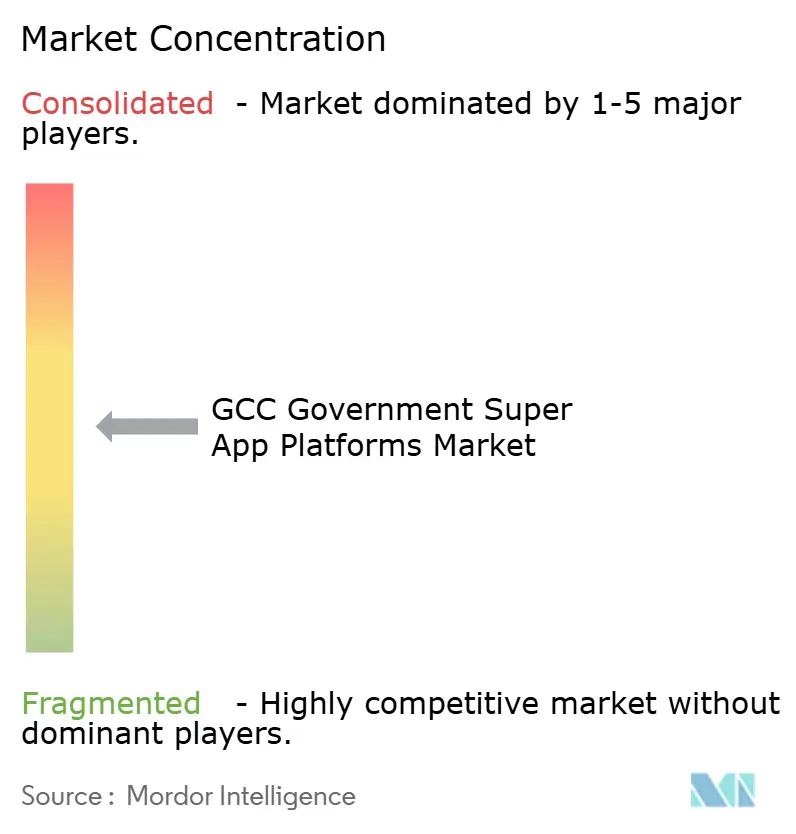
The GCC government super app platforms market has moderate concentration at the platform-ownership level, as governments operate their own national applications. However, the vendor ecosystem remains more distributed across cloud infrastructure, enterprise software, workflow tools, integration, and AI services. Global suppliers provide core technology layers, while regional providers hold an advantage when public buyers prioritize data control and local governance. Microsoft has supported TAMM through Azure OpenAI Service, while G42 has contributed Arabic AI capability to the platform. The UAE’s approach shows that international and regional vendors can operate within the same government platform architecture. Procurement decisions increasingly assess whether suppliers can meet sovereign-cloud and local AI requirements.
Suppliers are responding with locally hosted and sovereignty-compliant offerings. In October 2025, SAP is expected to introduce its locally hosted SAP Business Network for Public Sector deployment in Saudi Arabia. In January 2026, G42 is expected to introduce its Digital Embassies and Greenshield framework, designed to allow governments to retain legal authority over data and system policies. In February 2026, the Abu Dhabi Department of Government Enablement and Inception is expected to announce a partnership to support an AI-native government program, with more than 200 AI use cases under development. These initiatives place sovereign AI, local hosting, and operational controls at the center of vendor positioning. They also make Arabic-language capabilities more relevant to public service design and automation.
Competition among systems integrators increasingly depends on their ability to connect legacy systems, design accessible service journeys, and manage cross-agency deployment. Smaller regional integrators can benefit from local implementation experience and knowledge of public-sector processes. Larger international suppliers can leverage partnerships and local infrastructure to meet data residency requirements. The GCC government super app platforms market remains open because no single vendor owns the entire public-service stack. However, vendors without credible local data governance and AI credentials may face a narrower role in high-value government procurements. The competitive balance, therefore, reflects a combination of global software capabilities and regionally anchored sovereignty requirements.
GCC Government Super App Platforms Industry Leaders
-
Microsoft Corporation
-
Amazon Web Services, Inc.
-
SAP SE
-
IBM Corporation
-
Google LLC
- *Disclaimer: Major Players sorted in no particular order
Recent Industry Developments
- August 2026: Qatar's Ministry of Interior added a confidential security reporting channel to the Metrash app, enabling users to submit information to the Criminal Investigation Department without visiting a service center.
- July 2026: The World Economic Forum formally recognized UAE PASS as a global model for integrated government digital infrastructure, highlighting its shared-capability architecture, where agencies integrate a common identity layer rather than building separate authentication tools, as a benchmark for national digital governments.
- June 2026: Qatar's Ministry of Communications and Information Technology launched an upgraded Hukoomi platform, transforming the portal from a service directory into a proactive, Life Moments-based, integrated digital government experience, with plans to fully automate proactive notifications to replace user-initiated service searches.
- February 2026: Abu Dhabi's Department of Government Enablement and Inception announced a strategic partnership to accelerate Abu Dhabi's AI-native government ambition by 2027, with over 200 AI use cases under development and the Procurement and Human Capital pillars already operationalized.
GCC Government Super App Platforms Market Report Scope
The GCC Government Super App Platforms Report is Segmented by Platform (Native Mobile App, and Web and Progressive Web App), Deployment Type (Cloud, On-Premise, and Hybrid), Application (Citizen Services, Identity, Credentials, and Wallet Services, Payments, Fees, and Revenue Collection, Social Benefits and Welfare Delivery, Licensing, Permits, and Registrations, and Other Applications), and End User (Central Government, and State Or Provincial Government). The Market Forecasts are Provided in Terms of Value (USD).
| Native Mobile App |
| Web and Progressive Web App |
| Cloud |
| On-Premise |
| Hybrid |
| Citizen Services |
| Identity, Credentials, and Wallet Services |
| Payments, Fees, and Revenue Collection |
| Social Benefits and Welfare Delivery |
| Licensing, Permits, and Registrations |
| Other Applications |
| Central Government |
| State Or Provincial Government |
| By Platform | Native Mobile App |
| Web and Progressive Web App | |
| By Deployment Type | Cloud |
| On-Premise | |
| Hybrid | |
| By Application | Citizen Services |
| Identity, Credentials, and Wallet Services | |
| Payments, Fees, and Revenue Collection | |
| Social Benefits and Welfare Delivery | |
| Licensing, Permits, and Registrations | |
| Other Applications | |
| By End User | Central Government |
| State Or Provincial Government |
Key Questions Answered in the Report
What is the GCC government super app platforms market size?
The GCC government super app platforms market size is USD 0.85 billion in 2026 and is projected to reach USD 2.19 billion by 2031 at a CAGR of 20.84%. Demand is supported by national digital programs, shared identity infrastructure, and wider use of connected public-service journeys. Saudi Arabia and the UAE are the largest deployment centers, while Qatar, Kuwait, Bahrain, and Oman continue to expand nationally governed service platforms and improve the breadth of connected online public services.
Which platform type leads GCC government super app platforms?
Native Mobile App led with 69.98% share in 2025, supported by high mobile internet use across GCC countries. It is suited to recurring public transactions, notifications, device-based features, and persistent sign-in for frequent users.
Which deployment model is expanding fastest?
Hybrid deployment is projected to expand at a CAGR of 21.33% through 2031 because it combines scalable cloud capacity with sovereign data controls. Governments can retain sensitive identity and welfare records in controlled environments while using cloud resources for suitable workloads.
What application has the largest share in GCC government super app platforms?
Citizen Services held 33.21% share in 2025, covering high-frequency transactions such as payments, renewals, and appointments. These regular interactions build familiarity with the platform and make it easier to connect to related services over time.
Why are digital identity and wallet services important?
They are projected to expand at a CAGR of 22.21% through 2031 because they provide a common access layer for connected public-service journeys. The same identity layer can support authentication, evidence submission, payments, and service status updates.
Which end user is projected to expand fastest?
State or Provincial Government is projected to expand at a CAGR of 22.76% through 2031 as municipalities and provincial bodies digitize local services. Permits, inspections, local licensing, zoning, and municipal records create a substantial next stage of integration work, especially where local bodies still operate separate systems and procedures that must be aligned with national identity, payment, and data-sharing capabilities for residents and businesses.