
Gambier Market Size and Share
Gambier Market Analysis by Mordor Intelligence
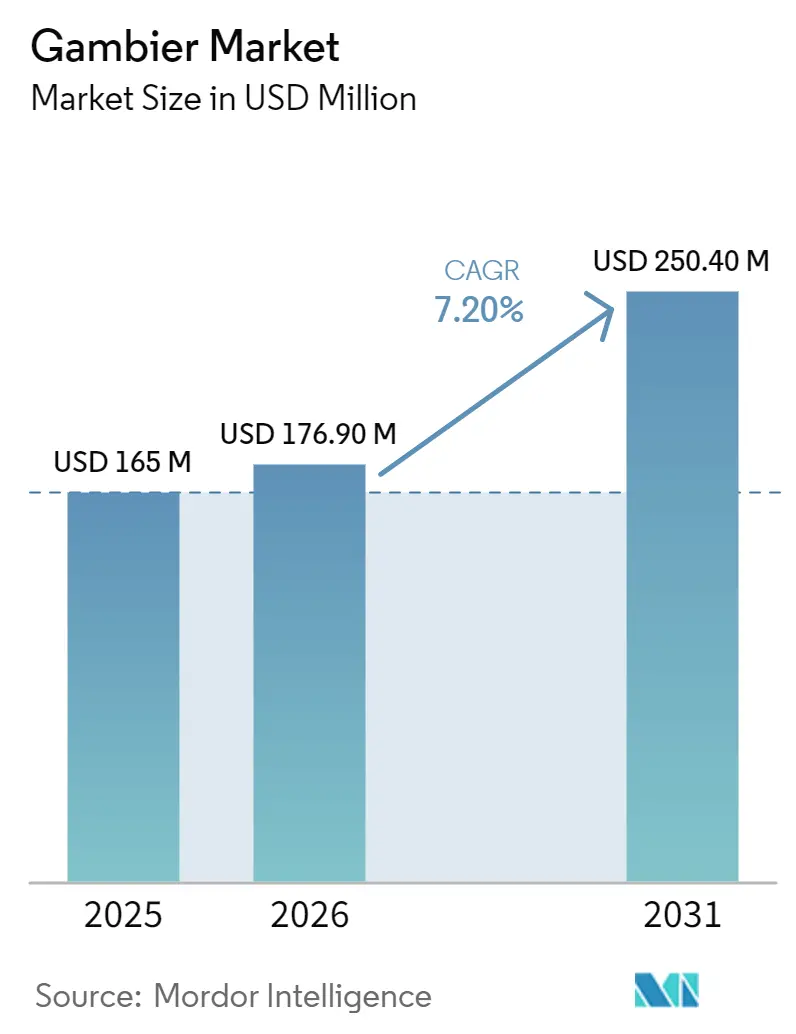
The gambier market was valued at USD 165.0 million in 2025 and is projected to grow from USD 176.90 million in 2026 to USD 250.4 million by 2031, registering a CAGR of 7.2% during 2026-2031. This growth is driven by the extract's versatile applications, as gambier contains both catechin and tannin, making it suitable for leather tanning, oral care, nutraceuticals, and textile processing within the same value chain. The supply of gambier is predominantly concentrated in West Sumatra, Indonesia, making the market highly sensitive to harvest conditions, local processing capacity, and export policies in the region. India remains a key driver of downstream demand, as raw gambier is extensively processed there into Katha and catechin, resulting in buyer concentration that significantly influences pricing and trade flows in the market. The future growth of the gambier market is projected to focus on improved standardization, higher-purity extraction, and increased local processing in Indonesia, enhancing value capture rather than relying solely on raw commodity exports. Additionally, advancements in clinical and formulation research in areas such as oral care, dermatology, metabolic health, and active packaging are expanding the commercial applications of gambier, reducing its reliance on traditional end uses and providing new growth opportunities.
Key Report Takeaways
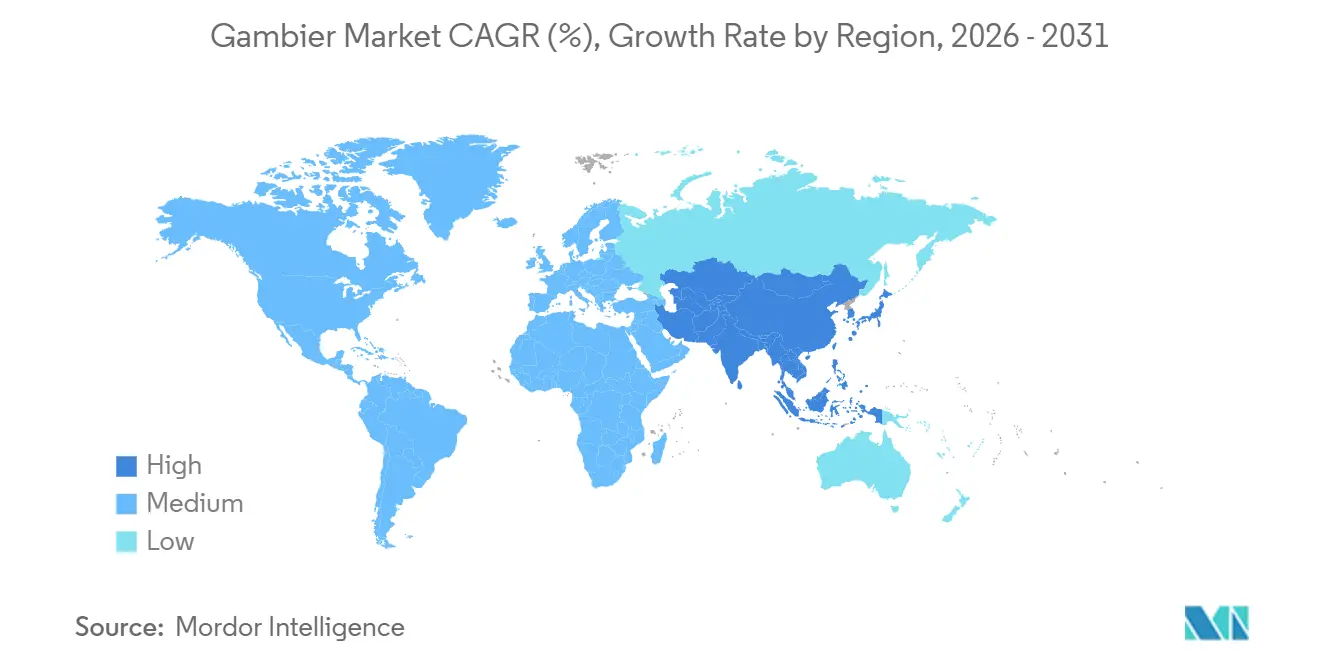
- By geography, Asia-Pacific accounted for the largest share of the gambier market at 46.0% in 2025, and the region is also projected to register the fastest growth at a CAGR of 8.9% from 2026 to 2031.
Note: Market size and forecast figures in this report are generated using Mordor Intelligence’s proprietary estimation framework, updated with the latest available data and insights as of January 2026.
Global Gambier Market Trends and Insights
Drivers Impact Analysis*
| Driver | (~) % Impact on CAGR Forecast | Geographic Relevance | Impact Timeline |
|---|---|---|---|
| Rising clean-label use in botanical formulations | +1.2% | Global, with concentration in North America and Europe | Medium term (2-4 years) |
| Expansion of oral health and astringent ingredient demand | +0.9% | Asia-Pacific, with growing uptake in Europe and North America | Medium term (2-4 years) |
| Growth of standardized catechin-rich extracts | +1.1% | Asia-Pacific, Europe, and North America | Long term (≥ 4 years) |
| Rising use in nutraceutical and functional health products | +1.3% | Asia-Pacific, North America, and the Middle East | Medium term (2-4 years) |
| Adoption in natural preservation and process aids | +0.8% | Asia-Pacific, Africa, and South America | Long term (≥ 4 years) |
| Traceable wildcrafted sourcing as a brand differentiator | +0.6% | Europe and North America | Short term (≤ 2 years) |
| Source: Mordor Intelligence | |||
Rising Use in Nutraceutical and Functional Health Products
The gambier market is experiencing growth due to increasing demand for nutraceutical and functional health ingredients with measurable bioactive properties and scientifically validated health benefits. Manufacturers are focusing on plant-derived extracts with standardized polyphenol content for applications in dietary supplements, oral health products, and functional formulations. This shift is driving interest in gambier-derived catechins as a value-added ingredient rather than a conventional raw material. A study by Novianty et al., published in the Journal of Research in Pharmacy (2025), reported that optimized gambier extraction achieved a total polyphenol content of 89.88%, underscoring its potential as a concentrated source of bioactive compounds for nutraceutical use[1]Source: Novianty et al., “Optimization and In Silico Evaluation of Gambier (Uncaria gambir Roxb.) Polyphenol Extract,” doi.org.. The availability of high-polyphenol extracts is enhancing gambier's role in the growing functional health market and contributing to the expansion of the gambier market.
Expansion of Oral Health and Astringent Ingredient Demand
The gambier market is experiencing growth due to increasing demand for natural oral health ingredients with proven antimicrobial and astringent properties. Manufacturers are focusing on botanical extracts that enhance dental hygiene, aid in plaque control, and support functional oral care formulations. Research into gambier catechin is bolstering its role as a value-added ingredient beyond its traditional uses. A study by Fadila et al. (2025), published in the AFDI FAL Journal, revealed that gambier gum formulations with 95% catechin achieved the highest reduction in Streptococcus mutans colonies and improved salivary pH compared to lower-concentration formulations and control groups[2]Source: Fadila et al., “Effect of Gambier Gum on Streptococcus mutans and Salivary pH,” afdifaljournal.com.. These findings highlight the ingredient's potential for use in advanced oral care products, driving growth opportunities in the gambier market.
Growth of Standardized Catechin-Rich Extracts
The gambier market is increasingly focusing on standardized catechin-rich extracts as manufacturers prioritize consistent quality, higher purity, and enhanced suitability for pharmaceutical, cosmetic, and nutraceutical applications. Standardization ensures batch uniformity and allows suppliers to market gambier as a premium functional ingredient rather than a basic raw material. This shift is driving investments in extraction technologies and quality-control systems throughout the value chain. According to Indonesia's Ministry of Industry (2025), the government has facilitated collaboration between gambier producers and Indian technical institutions to promote downstream processing and value-added catechin production. These initiatives are advancing the development of standardized extracts and supporting the transition to higher-value gambier products, contributing to the long-term growth of the gambier market.
Adoption in Natural Preservation and Process Aids
The gambier market is experiencing growth in natural preservation and process-aid applications as manufacturers increasingly prioritize plant-based ingredients that offer both functional and sustainable benefits. Gambier-derived catechins are being explored for use in active packaging, freshness-monitoring systems, and food-preservation technologies. These emerging applications extend the commercial scope of gambier beyond its traditional uses, opening new opportunities in value-added industrial markets. A study published in Trends in Sciences (2025) highlighted the effectiveness of a gambier catechin-based chitosan-cassava starch composite film in monitoring chicken breast freshness for 72 hours via visible color changes induced by pH changes[3]Source: Trends in Sciences, “Development of pH-Sensitive Film Based on Chitosan-Cassava Starch Incorporated with Gambier Catechin for Freshness Monitoring of Chicken Breast,” tis.wu.ac.th.. The proven functionality of gambier catechin in intelligent packaging systems supports its broader adoption in natural preservation technologies, contributing to the long-term growth prospects of the gambier market.
Restraints Impact Analysis*
| Restraint | (~) % Impact on CAGR Forecast | Geographic Relevance | Impact Timeline |
|---|---|---|---|
| Raw material seasonality and supply variability | -0.8% | Asia-Pacific as the primary production zone, and South Asia as an import-dependent region | Short term (≤ 2 years) |
| Limited regulatory standardization across end uses | -0.6% | Global, with stronger impact in Europe and North America | Medium term (2-4 years) |
| Low awareness outside Southeast Asia | -0.7% | The Middle East, Africa, and South America | Medium term (2-4 years) |
| Price pressure from substitute botanical extracts | -0.5% | Asia-Pacific and South Asia | Short term (≤ 2 years) |
| Source: Mordor Intelligence | |||
Raw Material Seasonality and Supply Variability
The gambier market is significantly affected by the seasonality of raw materials and supply variability due to its reliance on production within a limited geographic area and smallholder cultivation systems. Fluctuations in weather conditions, harvesting cycles, and farm management practices influence both production volumes and the consistency of raw materials, posing challenges for processors and exporters in securing stable supplies. The lack of geographic diversification further increases vulnerability to regional production disruptions. As reported by Antara News (2025), West Sumatra produced 25,818 metric tons of gambier from 28,760 hectares of cultivated land in 2024. The concentration of supply in a single region amplifies sourcing risks and limits the market's capacity to quickly scale production to meet growing demand, thereby constraining growth opportunities for the gambier market.
Limited Regulatory Standardization Across End Uses
The gambier market faces challenges due to the absence of harmonized regulatory standards across its applications in pharmaceuticals, nutraceuticals, food, and cosmetics. Suppliers must navigate varying documentation, safety assessments, and approval requirements across export markets, leading to higher compliance costs and longer product qualification timelines. Additionally, the lack of internationally recognized standards for gambier extracts restricts product differentiation and creates barriers to market entry, particularly for smaller processors. As noted by the United States Pharmacopeia (USP) Herbal Medicines Compendium and the European Pharmacopoeia (2025), Uncaria gambir extract lacks a dedicated monograph in these reference standards. This absence of standardized specifications increases validation requirements for buyers, limits broader commercialization opportunities, and hinders the growth of the gambier market.
*Our forecasts treat driver/restraint impacts as directional, not additive. The impact forecasts reflect baseline growth, mix effects, and variable interactions.
Geography Analysis
The Asia-Pacific region accounted for the largest gambier market share at 46.0% in 2025. This dominance is attributed to its role as the primary production hub and the largest center for downstream processing and consumption activities. Indonesia remains a key supplier, while India drives demand through applications in food ingredients, chewing products, and extract processing. Additionally, markets in Japan, South Korea, and China are expanding their participation in nutraceutical, cosmetic, and botanical ingredient sectors. These factors contribute to a robust ecosystem supporting both production and value-added processing activities in the region.
The gambier market size in Asia-Pacific is projected to grow at the fastest CAGR of 8.9% from 2026 to 2031. This growth is driven by efforts to enhance domestic processing capabilities and increase value capture from catechin- and tannin-based products. Governments, processors, and research institutions are promoting the commercialization of standardized extracts for pharmaceutical, nutraceutical, and industrial applications. The region also benefits from established cultivation expertise and proximity to major export markets. These factors are facilitating the shift from raw material supply to higher-value ingredient production, supporting long-term market development in the region.
North America, South America, the Middle East, and Africa are in the early stages of development within the gambier market, but play a critical role in diversification. In North America, the United States and Canada exhibit demand for gambier catechin as a botanical antioxidant and astringent in nutraceutical and cosmetic applications. South America presents a dual role, with countries such as Brazil, Argentina, and Chile competing in tannin supply while also showing emerging demand for health-focused formulations. The Middle East offers potential in halal-compatible nutraceutical and cosmetic products, while Africa provides opportunities through traditional medicine and ingredient distribution networks. Although these regions are not yet major volume contributors, their development is important for reducing the market's reliance on a limited buyer base over time.


Competitive Landscape
The gambier market is moderately consolidated, with competition primarily involving Indonesian processors, exporters, and ingredient suppliers. These players leverage access to raw material sourcing networks in key production regions. Competitive positioning is determined by factors such as processing expertise, extract quality, catechin concentration, and relationships with international buyers. Companies that consistently supply standardized products are better equipped to serve pharmaceutical, nutraceutical, cosmetic, and industrial applications. Additionally, the market includes numerous small and medium-sized processors that focus on sourcing capabilities and regional trade relationships rather than large-scale brand recognition.
Competitive differentiation in the gambier market is increasingly moving toward value-added processing and product standardization, rather than relying solely on raw material trading. Producers are investing in advanced extraction technologies, quality-control systems, and technical documentation to enhance product consistency and cater to higher-value applications. Strategic collaborations with research institutions and downstream users are fostering innovation in catechin-rich extracts and specialized formulations. As customer requirements grow more stringent, suppliers with robust technical capabilities and regulatory compliance are gaining a competitive edge in international markets and emerging application areas.
Competition is increasingly shaped by the ability to supply standardized, high-catechin extracts for nutraceutical, oral care, and specialty ingredient applications. Companies with advanced extraction and quality-control capabilities are strengthening their market position by targeting premium end-use markets rather than competing solely on raw material supply. For instance, JK Botanicals (2025) offers a commercially available Uncaria gambier extract standardized to 60%–90% catechin and 90% tannins. This reflects the growing emphasis on ingredient standardization and specification-driven sales. Suppliers that deliver consistent catechin concentrations and adhere to documented quality standards are gaining a competitive advantage in higher-value international markets.
Recent Industry Developments
- April 2026: The Indonesian Ministry of Agriculture, in collaboration with PT Perkebunan Nusantara IV, a state-owned plantation enterprise, has announced plans to develop a downstream gambier processing facility in Limapuluh Kota District, West Sumatra, which serves as the national hub for gambier production. The plant aims to process raw gambier into catechin and tannin derivatives, thereby decreasing Indonesia's reliance on raw commodity exports and enhancing its participation in the downstream value chain.
- January 2026: Universitas Negeri Padang developed a bioactive gambier chewing gum containing 95% catechin, which demonstrated a 100% reduction in Streptococcus mutans colonies during laboratory testing. This supports the commercialization of gambier-based oral care products and highlights the potential for expanding high-value applications in the gambier market.
- August 2024: IPB University have developed "C et Chic," an oral care product fortified with hydroxyapatite and incorporating black temu oil. The product has received a BPOM distribution permit, facilitating the commercialization of natural oral health solutions and broadening the potential use of gambier-derived catechin ingredients in dental care formulations.


Global Gambier Market Report Scope
Gambier is a plant-based extract derived from the leaves and twigs of Uncaria gambir. It contains high levels of catechins and tannins and is commonly utilized in nutraceuticals, oral care products, leather tanning, herbal formulations, food preservation, and botanical extracts. The Gambier market report is segmented by geography (North America, South America, Europe, Asia-Pacific, Middle East, and Africa). The report includes production analysis (area harvested, yield, and production), consumption analysis (value and volume), import analysis (value and volume), export analysis (value and volume), wholesale price trend analysis and forecast, regulatory framework, list of key players, logistics and infrastructure, and seasonality analysis. The market forecasts are provided in terms of value (USD) and volume (metric tons).
| North America | United States | Production Analysis (Area Harvested, Yield, and Production Volume) |
| Consumption Analysis (Consumption Value and Volume) | ||
| Import Market Analysis (Import Value, Volume, and Key Supplying Markets) | ||
| Export Market Analysis (Export Value, Volume, and Key Destination Markets) | ||
| Wholesale Price Trend Analysis and Forecast | ||
| Regulatory Framework | ||
| List of Key Players | ||
| Logistics and Infrastructure | ||
| Seasonality Analysis | ||
| Canada | Production Analysis (Area Harvested, Yield, and Production Volume) | |
| Consumption Analysis (Consumption Value and Volume) | ||
| Import Market Analysis (Import Value, Volume, and Key Supplying Markets) | ||
| Export Market Analysis (Export Value, Volume, and Key Destination Markets) | ||
| Wholesale Price Trend Analysis and Forecast | ||
| Regulatory Framework | ||
| List of Key Players | ||
| Logistics and Infrastructure | ||
| Seasonality Analysis | ||
| Mexico | Production Analysis (Area Harvested, Yield, and Production Volume) | |
| Consumption Analysis (Consumption Value and Volume) | ||
| Import Market Analysis (Import Value, Volume, and Key Supplying Markets) | ||
| Export Market Analysis (Export Value, Volume, and Key Destination Markets) | ||
| Wholesale Price Trend Analysis and Forecast | ||
| Regulatory Framework | ||
| List of Key Players | ||
| Logistics and Infrastructure | ||
| Seasonality Analysis | ||
| South America | Brazil | Production Analysis (Area Harvested, Yield, and Production Volume) |
| Consumption Analysis (Consumption Value and Volume) | ||
| Import Market Analysis (Import Value, Volume, and Key Supplying Markets) | ||
| Export Market Analysis (Export Value, Volume, and Key Destination Markets) | ||
| Wholesale Price Trend Analysis and Forecast | ||
| Regulatory Framework | ||
| List of Key Players | ||
| Logistics and Infrastructure | ||
| Seasonality Analysis | ||
| Argentina | Production Analysis (Area Harvested, Yield, and Production Volume) | |
| Consumption Analysis (Consumption Value and Volume) | ||
| Import Market Analysis (Import Value, Volume, and Key Supplying Markets) | ||
| Export Market Analysis (Export Value, Volume, and Key Destination Markets) | ||
| Wholesale Price Trend Analysis and Forecast | ||
| Regulatory Framework | ||
| List of Key Players | ||
| Logistics and Infrastructure | ||
| Seasonality Analysis | ||
| Europe | Germany | Production Analysis (Area Harvested, Yield, and Production Volume) |
| Consumption Analysis (Consumption Value and Volume) | ||
| Import Market Analysis (Import Value, Volume, and Key Supplying Markets) | ||
| Export Market Analysis (Export Value, Volume, and Key Destination Markets) | ||
| Wholesale Price Trend Analysis and Forecast | ||
| Regulatory Framework | ||
| List of Key Players | ||
| Logistics and Infrastructure | ||
| Seasonality Analysis | ||
| France | Production Analysis (Area Harvested, Yield, and Production Volume) | |
| Consumption Analysis (Consumption Value and Volume) | ||
| Import Market Analysis (Import Value, Volume, and Key Supplying Markets) | ||
| Export Market Analysis (Export Value, Volume, and Key Destination Markets) | ||
| Wholesale Price Trend Analysis and Forecast | ||
| Regulatory Framework | ||
| List of Key Players | ||
| Logistics and Infrastructure | ||
| Seasonality Analysis | ||
| United Kingdom | Production Analysis (Area Harvested, Yield, and Production Volume) | |
| Consumption Analysis (Consumption Value and Volume) | ||
| Import Market Analysis (Import Value, Volume, and Key Supplying Markets) | ||
| Export Market Analysis (Export Value, Volume, and Key Destination Markets) | ||
| Wholesale Price Trend Analysis and Forecast | ||
| Regulatory Framework | ||
| List of Key Players | ||
| Logistics and Infrastructure | ||
| Seasonality Analysis | ||
| Asia-Pacific | China | Production Analysis (Area Harvested, Yield, and Production Volume) |
| Consumption Analysis (Consumption Value and Volume) | ||
| Import Market Analysis (Import Value, Volume, and Key Supplying Markets) | ||
| Export Market Analysis (Export Value, Volume, and Key Destination Markets) | ||
| Wholesale Price Trend Analysis and Forecast | ||
| Regulatory Framework | ||
| List of Key Players | ||
| Logistics and Infrastructure | ||
| Seasonality Analysis | ||
| India | Production Analysis (Area Harvested, Yield, and Production Volume) | |
| Consumption Analysis (Consumption Value and Volume) | ||
| Import Market Analysis (Import Value, Volume, and Key Supplying Markets) | ||
| Export Market Analysis (Export Value, Volume, and Key Destination Markets) | ||
| Wholesale Price Trend Analysis and Forecast | ||
| Regulatory Framework | ||
| List of Key Players | ||
| Logistics and Infrastructure | ||
| Seasonality Analysis | ||
| Japan | Production Analysis (Area Harvested, Yield, and Production Volume) | |
| Consumption Analysis (Consumption Value and Volume) | ||
| Import Market Analysis (Import Value, Volume, and Key Supplying Markets) | ||
| Export Market Analysis (Export Value, Volume, and Key Destination Markets) | ||
| Wholesale Price Trend Analysis and Forecast | ||
| Regulatory Framework | ||
| List of Key Players | ||
| Logistics and Infrastructure | ||
| Seasonality Analysis | ||
| Indonesia | Production Analysis (Area Harvested, Yield, and Production Volume) | |
| Consumption Analysis (Consumption Value and Volume) | ||
| Import Market Analysis (Import Value, Volume, and Key Supplying Markets) | ||
| Export Market Analysis (Export Value, Volume, and Key Destination Markets) | ||
| Wholesale Price Trend Analysis and Forecast | ||
| Regulatory Framework | ||
| List of Key Players | ||
| Logistics and Infrastructure | ||
| Seasonality Analysis | ||
| Malaysia | Production Analysis (Area Harvested, Yield, and Production Volume) | |
| Consumption Analysis (Consumption Value and Volume) | ||
| Import Market Analysis (Import Value, Volume, and Key Supplying Markets) | ||
| Export Market Analysis (Export Value, Volume, and Key Destination Markets) | ||
| Wholesale Price Trend Analysis and Forecast | ||
| Regulatory Framework | ||
| List of Key Players | ||
| Logistics and Infrastructure | ||
| Seasonality Analysis | ||
| Middle East | Turkey | Production Analysis (Area Harvested, Yield, and Production Volume) |
| Consumption Analysis (Consumption Value and Volume) | ||
| Import Market Analysis (Import Value, Volume, and Key Supplying Markets) | ||
| Export Market Analysis (Export Value, Volume, and Key Destination Markets) | ||
| Wholesale Price Trend Analysis and Forecast | ||
| Regulatory Framework | ||
| List of Key Players | ||
| Logistics and Infrastructure | ||
| Seasonality Analysis | ||
| Saudi Arabia | Production Analysis (Area Harvested, Yield, and Production Volume) | |
| Consumption Analysis (Consumption Value and Volume) | ||
| Import Market Analysis (Import Value, Volume, and Key Supplying Markets) | ||
| Export Market Analysis (Export Value, Volume, and Key Destination Markets) | ||
| Wholesale Price Trend Analysis and Forecast | ||
| Regulatory Framework | ||
| List of Key Players | ||
| Logistics and Infrastructure | ||
| Seasonality Analysis | ||
| United Arab Emirates | Production Analysis (Area Harvested, Yield, and Production Volume) | |
| Consumption Analysis (Consumption Value and Volume) | ||
| Import Market Analysis (Import Value, Volume, and Key Supplying Markets) | ||
| Export Market Analysis (Export Value, Volume, and Key Destination Markets) | ||
| Wholesale Price Trend Analysis and Forecast | ||
| Regulatory Framework | ||
| List of Key Players | ||
| Logistics and Infrastructure | ||
| Seasonality Analysis | ||
| Africa | Egypt | Production Analysis (Area Harvested, Yield, and Production Volume) |
| Consumption Analysis (Consumption Value and Volume) | ||
| Import Market Analysis (Import Value, Volume, and Key Supplying Markets) | ||
| Export Market Analysis (Export Value, Volume, and Key Destination Markets) | ||
| Wholesale Price Trend Analysis and Forecast | ||
| Regulatory Framework | ||
| List of Key Players | ||
| Logistics and Infrastructure | ||
| Seasonality Analysis | ||
| South Africa | Production Analysis (Area Harvested, Yield, and Production Volume) | |
| Consumption Analysis (Consumption Value and Volume) | ||
| Import Market Analysis (Import Value, Volume, and Key Supplying Markets) | ||
| Export Market Analysis (Export Value, Volume, and Key Destination Markets) | ||
| Wholesale Price Trend Analysis and Forecast | ||
| Regulatory Framework | ||
| List of Key Players | ||
| Logistics and Infrastructure | ||
| Seasonality Analysis | ||
| By Geography | North America | United States | Production Analysis (Area Harvested, Yield, and Production Volume) |
| Consumption Analysis (Consumption Value and Volume) | |||
| Import Market Analysis (Import Value, Volume, and Key Supplying Markets) | |||
| Export Market Analysis (Export Value, Volume, and Key Destination Markets) | |||
| Wholesale Price Trend Analysis and Forecast | |||
| Regulatory Framework | |||
| List of Key Players | |||
| Logistics and Infrastructure | |||
| Seasonality Analysis | |||
| Canada | Production Analysis (Area Harvested, Yield, and Production Volume) | ||
| Consumption Analysis (Consumption Value and Volume) | |||
| Import Market Analysis (Import Value, Volume, and Key Supplying Markets) | |||
| Export Market Analysis (Export Value, Volume, and Key Destination Markets) | |||
| Wholesale Price Trend Analysis and Forecast | |||
| Regulatory Framework | |||
| List of Key Players | |||
| Logistics and Infrastructure | |||
| Seasonality Analysis | |||
| Mexico | Production Analysis (Area Harvested, Yield, and Production Volume) | ||
| Consumption Analysis (Consumption Value and Volume) | |||
| Import Market Analysis (Import Value, Volume, and Key Supplying Markets) | |||
| Export Market Analysis (Export Value, Volume, and Key Destination Markets) | |||
| Wholesale Price Trend Analysis and Forecast | |||
| Regulatory Framework | |||
| List of Key Players | |||
| Logistics and Infrastructure | |||
| Seasonality Analysis | |||
| South America | Brazil | Production Analysis (Area Harvested, Yield, and Production Volume) | |
| Consumption Analysis (Consumption Value and Volume) | |||
| Import Market Analysis (Import Value, Volume, and Key Supplying Markets) | |||
| Export Market Analysis (Export Value, Volume, and Key Destination Markets) | |||
| Wholesale Price Trend Analysis and Forecast | |||
| Regulatory Framework | |||
| List of Key Players | |||
| Logistics and Infrastructure | |||
| Seasonality Analysis | |||
| Argentina | Production Analysis (Area Harvested, Yield, and Production Volume) | ||
| Consumption Analysis (Consumption Value and Volume) | |||
| Import Market Analysis (Import Value, Volume, and Key Supplying Markets) | |||
| Export Market Analysis (Export Value, Volume, and Key Destination Markets) | |||
| Wholesale Price Trend Analysis and Forecast | |||
| Regulatory Framework | |||
| List of Key Players | |||
| Logistics and Infrastructure | |||
| Seasonality Analysis | |||
| Europe | Germany | Production Analysis (Area Harvested, Yield, and Production Volume) | |
| Consumption Analysis (Consumption Value and Volume) | |||
| Import Market Analysis (Import Value, Volume, and Key Supplying Markets) | |||
| Export Market Analysis (Export Value, Volume, and Key Destination Markets) | |||
| Wholesale Price Trend Analysis and Forecast | |||
| Regulatory Framework | |||
| List of Key Players | |||
| Logistics and Infrastructure | |||
| Seasonality Analysis | |||
| France | Production Analysis (Area Harvested, Yield, and Production Volume) | ||
| Consumption Analysis (Consumption Value and Volume) | |||
| Import Market Analysis (Import Value, Volume, and Key Supplying Markets) | |||
| Export Market Analysis (Export Value, Volume, and Key Destination Markets) | |||
| Wholesale Price Trend Analysis and Forecast | |||
| Regulatory Framework | |||
| List of Key Players | |||
| Logistics and Infrastructure | |||
| Seasonality Analysis | |||
| United Kingdom | Production Analysis (Area Harvested, Yield, and Production Volume) | ||
| Consumption Analysis (Consumption Value and Volume) | |||
| Import Market Analysis (Import Value, Volume, and Key Supplying Markets) | |||
| Export Market Analysis (Export Value, Volume, and Key Destination Markets) | |||
| Wholesale Price Trend Analysis and Forecast | |||
| Regulatory Framework | |||
| List of Key Players | |||
| Logistics and Infrastructure | |||
| Seasonality Analysis | |||
| Asia-Pacific | China | Production Analysis (Area Harvested, Yield, and Production Volume) | |
| Consumption Analysis (Consumption Value and Volume) | |||
| Import Market Analysis (Import Value, Volume, and Key Supplying Markets) | |||
| Export Market Analysis (Export Value, Volume, and Key Destination Markets) | |||
| Wholesale Price Trend Analysis and Forecast | |||
| Regulatory Framework | |||
| List of Key Players | |||
| Logistics and Infrastructure | |||
| Seasonality Analysis | |||
| India | Production Analysis (Area Harvested, Yield, and Production Volume) | ||
| Consumption Analysis (Consumption Value and Volume) | |||
| Import Market Analysis (Import Value, Volume, and Key Supplying Markets) | |||
| Export Market Analysis (Export Value, Volume, and Key Destination Markets) | |||
| Wholesale Price Trend Analysis and Forecast | |||
| Regulatory Framework | |||
| List of Key Players | |||
| Logistics and Infrastructure | |||
| Seasonality Analysis | |||
| Japan | Production Analysis (Area Harvested, Yield, and Production Volume) | ||
| Consumption Analysis (Consumption Value and Volume) | |||
| Import Market Analysis (Import Value, Volume, and Key Supplying Markets) | |||
| Export Market Analysis (Export Value, Volume, and Key Destination Markets) | |||
| Wholesale Price Trend Analysis and Forecast | |||
| Regulatory Framework | |||
| List of Key Players | |||
| Logistics and Infrastructure | |||
| Seasonality Analysis | |||
| Indonesia | Production Analysis (Area Harvested, Yield, and Production Volume) | ||
| Consumption Analysis (Consumption Value and Volume) | |||
| Import Market Analysis (Import Value, Volume, and Key Supplying Markets) | |||
| Export Market Analysis (Export Value, Volume, and Key Destination Markets) | |||
| Wholesale Price Trend Analysis and Forecast | |||
| Regulatory Framework | |||
| List of Key Players | |||
| Logistics and Infrastructure | |||
| Seasonality Analysis | |||
| Malaysia | Production Analysis (Area Harvested, Yield, and Production Volume) | ||
| Consumption Analysis (Consumption Value and Volume) | |||
| Import Market Analysis (Import Value, Volume, and Key Supplying Markets) | |||
| Export Market Analysis (Export Value, Volume, and Key Destination Markets) | |||
| Wholesale Price Trend Analysis and Forecast | |||
| Regulatory Framework | |||
| List of Key Players | |||
| Logistics and Infrastructure | |||
| Seasonality Analysis | |||
| Middle East | Turkey | Production Analysis (Area Harvested, Yield, and Production Volume) | |
| Consumption Analysis (Consumption Value and Volume) | |||
| Import Market Analysis (Import Value, Volume, and Key Supplying Markets) | |||
| Export Market Analysis (Export Value, Volume, and Key Destination Markets) | |||
| Wholesale Price Trend Analysis and Forecast | |||
| Regulatory Framework | |||
| List of Key Players | |||
| Logistics and Infrastructure | |||
| Seasonality Analysis | |||
| Saudi Arabia | Production Analysis (Area Harvested, Yield, and Production Volume) | ||
| Consumption Analysis (Consumption Value and Volume) | |||
| Import Market Analysis (Import Value, Volume, and Key Supplying Markets) | |||
| Export Market Analysis (Export Value, Volume, and Key Destination Markets) | |||
| Wholesale Price Trend Analysis and Forecast | |||
| Regulatory Framework | |||
| List of Key Players | |||
| Logistics and Infrastructure | |||
| Seasonality Analysis | |||
| United Arab Emirates | Production Analysis (Area Harvested, Yield, and Production Volume) | ||
| Consumption Analysis (Consumption Value and Volume) | |||
| Import Market Analysis (Import Value, Volume, and Key Supplying Markets) | |||
| Export Market Analysis (Export Value, Volume, and Key Destination Markets) | |||
| Wholesale Price Trend Analysis and Forecast | |||
| Regulatory Framework | |||
| List of Key Players | |||
| Logistics and Infrastructure | |||
| Seasonality Analysis | |||
| Africa | Egypt | Production Analysis (Area Harvested, Yield, and Production Volume) | |
| Consumption Analysis (Consumption Value and Volume) | |||
| Import Market Analysis (Import Value, Volume, and Key Supplying Markets) | |||
| Export Market Analysis (Export Value, Volume, and Key Destination Markets) | |||
| Wholesale Price Trend Analysis and Forecast | |||
| Regulatory Framework | |||
| List of Key Players | |||
| Logistics and Infrastructure | |||
| Seasonality Analysis | |||
| South Africa | Production Analysis (Area Harvested, Yield, and Production Volume) | ||
| Consumption Analysis (Consumption Value and Volume) | |||
| Import Market Analysis (Import Value, Volume, and Key Supplying Markets) | |||
| Export Market Analysis (Export Value, Volume, and Key Destination Markets) | |||
| Wholesale Price Trend Analysis and Forecast | |||
| Regulatory Framework | |||
| List of Key Players | |||
| Logistics and Infrastructure | |||
| Seasonality Analysis | |||


Key Questions Answered in the Report
What is the current outlook for gambier demand through 2031?
The gambier market stands at USD 176.90 million in 2026 and is forecast to reach USD 250.40 million by 2031.
Which region leads global consumption and growth for gambier?
Asia-Pacific led with 46.0% share in 2025 and is also the fastest-growing region, with an 8.9% CAGR from 2026 to 2031.
Why is India so important in the global gambier trade?
India remains the main downstream demand center because it imports steady volumes and converts raw gambier into Katha and catechin for industrial and pharmaceutical use.
What is holding wider adoption back in the near term?
The main constraints are raw material seasonality, limited regulatory standardization, low awareness outside Southeast Asia, and price pressure from substitute botanical extracts.
Page last updated on:





