
Furnace and Kiln Thermal Imaging Systems Market Size and Share
Market Overview
| Study Period | 2020 - 2031 |
|---|---|
| Market Size (2026) | USD 355.88 Million |
| Market Size (2031) | USD 526.11 Million |
| Growth Rate (2026 - 2031) | 8.13 % |
| Fastest Growing Market | Middle East and Africa |
| Largest Market | Asia-Pacific |
| Market Concentration | Medium |
Major Players *Disclaimer: Major Players sorted in no particular order Image © Mordor Intelligence. Reuse requires attribution under CC BY 4.0. | |
Furnace and Kiln Thermal Imaging Systems Market Analysis by Mordor Intelligence
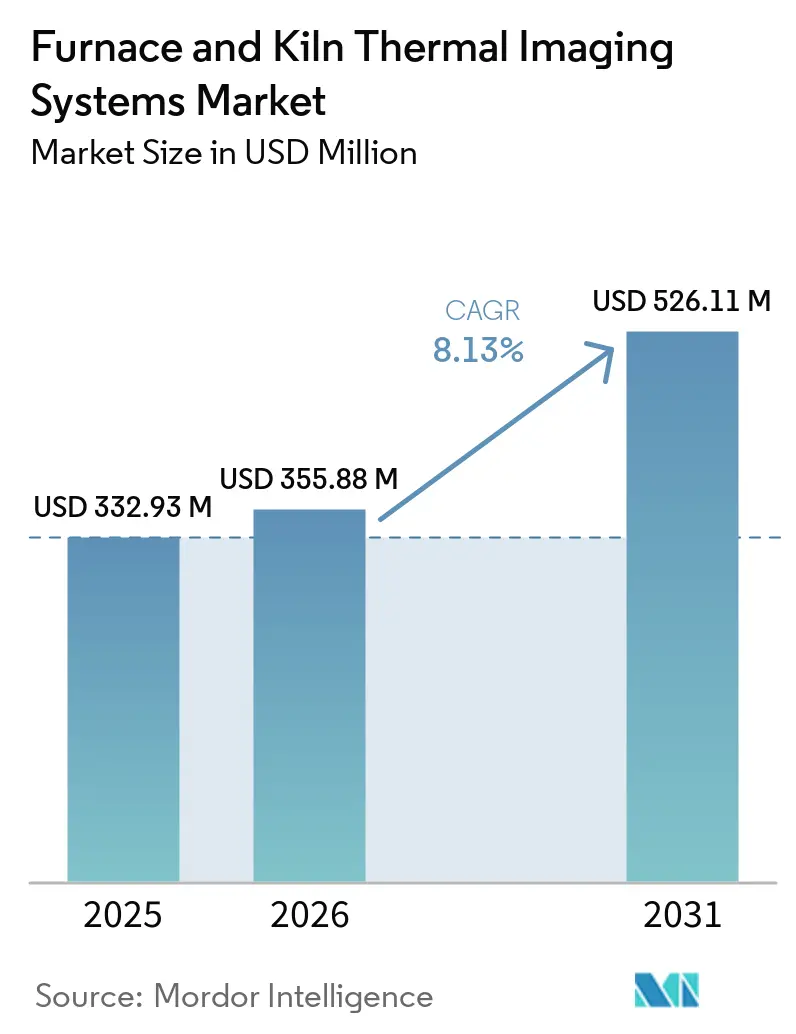
The Furnace and Kiln Thermal Imaging Systems Market size was valued at USD 332.93 million in 2025 and estimated to expand from USD 355.88 million in 2026 to reach USD 526.11 million by 2031, at a CAGR of 8.13% during the forecast period (2026-2031). Energy-intensive plants are replacing periodic manual inspections with continuous, camera-based monitoring that can connect to process-control systems. Blast furnaces, rotary cement kilns, and petrochemical reformers can use this information to identify operating changes before they lead to unplanned outages or refractory replacement. MWIR and multispectral cameras, together with industrial edge computing hardware, are widening the functional gap between continuous imaging and thermocouple arrays. The Furnace and Kiln Thermal Imaging Systems Market also benefits when new plants include thermal monitoring in their engineering budgets. Suppliers are pairing specialized camera hardware with software, cooling systems, and analytics, while high integration costs in older plants can delay purchases.
Key Report Takeaways
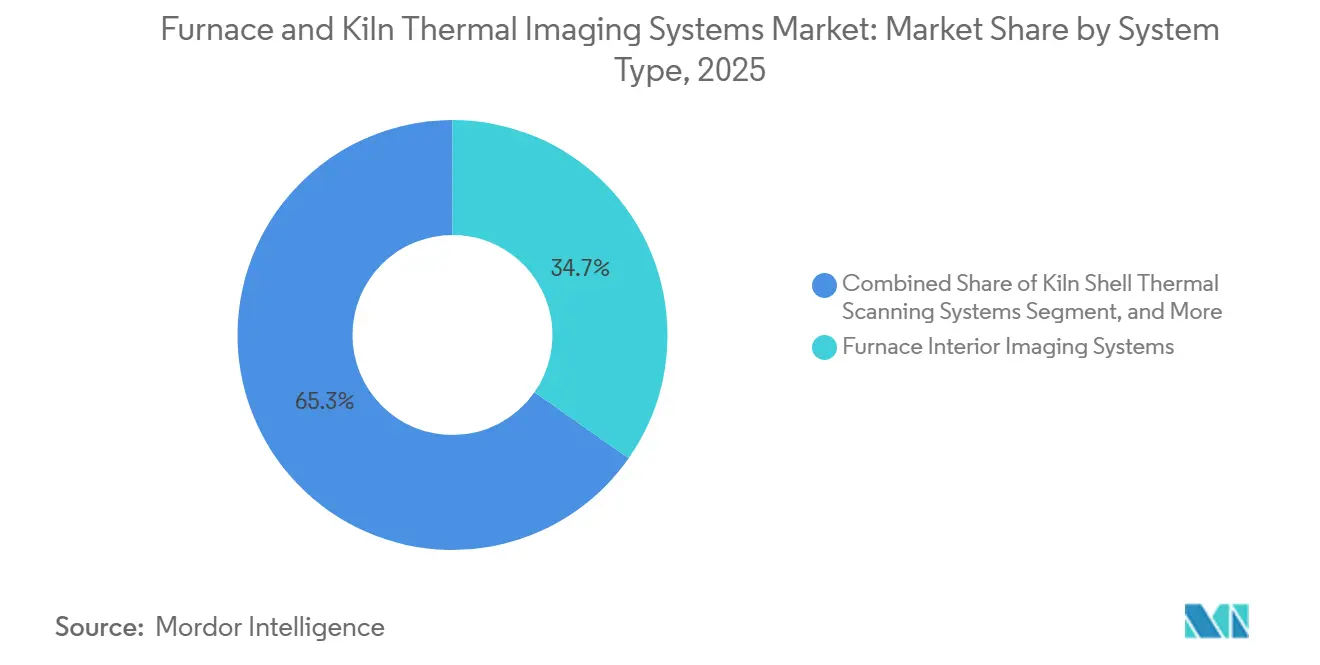
- By system type, Furnace Interior Imaging Systems held 34.71% of the Furnace and Kiln Thermal Imaging Systems Market share in 2025, while Furnace/Kiln Fixed Process Monitoring Systems are projected to expand at an 8.93% CAGR through 2031.
- By technology, infrared thermal imaging held 62.83% revenue share in 2025, while multispectral imaging is projected to expand at an 8.89% CAGR through 2031.
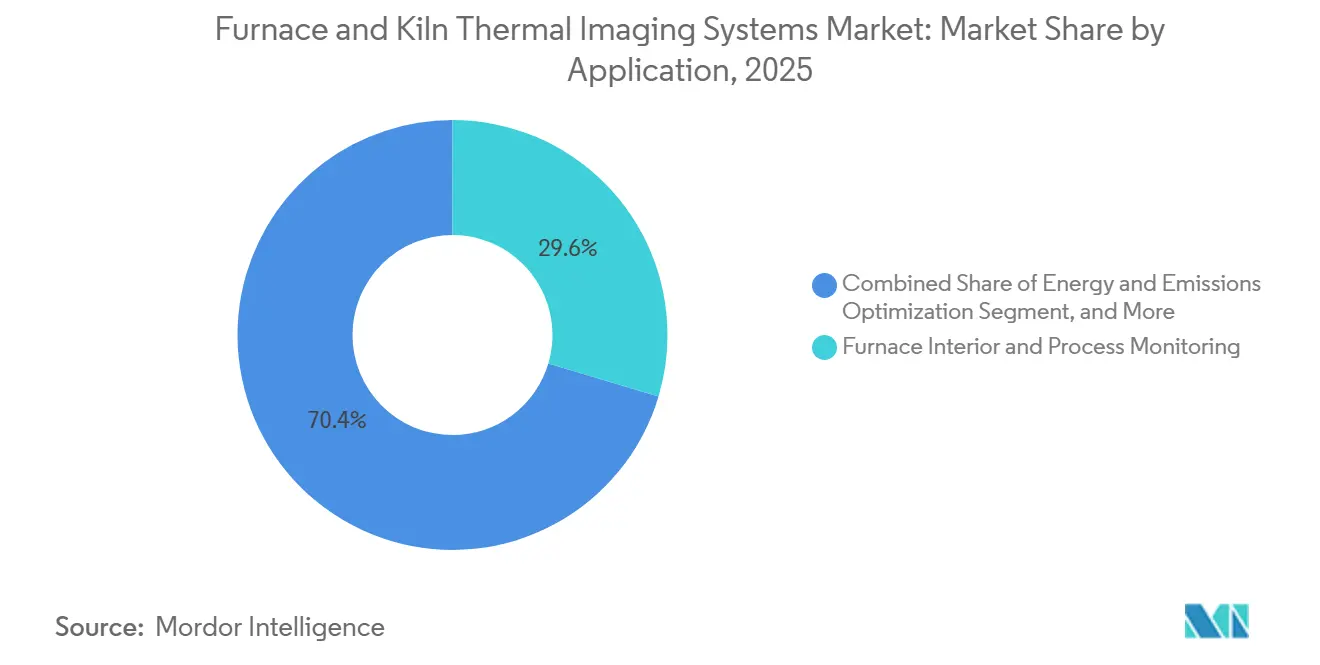
- By application, Furnace Interior and Process Monitoring accounted for 29.61% share in 2025, while Energy and Emissions Optimization is projected to expand at a 9.52% CAGR through 2031.
- By end-user industry, iron and steel accounted for 24.93% of revenue in 2025, while waste-to-energy and incineration are projected to expand at a 10.27% CAGR through 2031.
- By geography, Asia-Pacific held 43.71% revenue share in 2025, while the Middle East and Africa are projected to expand at a 9.14% CAGR through 2031.
Note: Market size and forecast figures in this report are generated using Mordor Intelligence’s proprietary estimation framework, updated with the latest available data and insights as of January 2026.
Global Furnace and Kiln Thermal Imaging Systems Market Trends and Insights
Drivers Impact Analysis*
| Driver | (~) % Impact on CAGR Forecast | Geographic Relevance | Impact Timeline |
|---|---|---|---|
| Replacement of Manual Inspections With Continuous Thermal Monitoring | +2.5% | Global | Short term (≤ 2 years) |
| Refractory Failure Detection and Predictive Maintenance Requirements | +2.0% | Global, North America and Europe as early adopters | Medium term (2-4 years) |
| Industrial Energy Efficiency and Emissions Reduction Mandates | +1.5% | Europe and Asia-Pacific core, spillover to Middle East and Africa | Medium term (2-4 years) |
| Expansion of Digital Kiln and Furnace Control Systems | +1.0% | Global | Medium term (2-4 years) |
| Thermal Imaging Integration With Plant Automation and Digital Twins | +0.8% | North America and Europe | Long term (≥ 4 years) |
| Demand for Through-Flame Imaging in Dusty and Opaque Combustion Environments | +0.5% | Global, Middle East and Africa, and Asia-Pacific | Medium term (2-4 years) |
| Source: Mordor Intelligence | |||
Replacement of Manual Furnace Inspections With Continuous Thermal Monitoring
Manual inspections during shutdowns use portable cameras or thermocouple probes and provide information only at a single point in time. Continuous thermal monitoring gives operators a live view of changing furnace conditions. The data can link temperature anomalies with burner faults, charge-distribution irregularities, and early refractory degradation. Tata Steel’s Thermal Hawk system showed that real-time monitoring of blast-furnace burden distribution, gas flow, and temperature events can operate at production scale. This capability enables more frequent calibration of process models and expands imaging's role beyond safety monitoring. ISO 18434-1 condition-monitoring expectations also provide plant safety teams with a formal basis for specifying continuous systems.
Refractory Failure Detection and Predictive Maintenance Requirements
Refractory linings are a major maintenance cost in rotary kilns and electric arc furnaces. A lining failure can create a multi-day outage and can damage the furnace shell. Thermal imaging can identify localized emissivity changes, hotspots, and shell-temperature gradients before a mechanical failure occurs. HGH Infrared Systems reported more than 1,300 KILNSCAN installations worldwide in 2025, with continuous 360-degree shell scanning used to identify tire slip, thermal warp, and coating loss. The June 2025 Tasek Cement case study described how hotspot data supported targeted refractory patching instead of a full lining replacement cycle. Long-term contracts that combine hardware and remote analytics can reduce adoption risk for plants with limited thermography expertise.
Industrial Energy Efficiency and Emissions Reduction Mandates
Combustion-intensive operations face increasing pressure to reduce emissions and document operating performance. The EU Carbon Border Adjustment Mechanism entered its definitive regime in 2026 and covers goods including cement, iron and steel, aluminum, fertilizers, hydrogen, and electricity.[1]European Commission, “Carbon Border Adjustment Mechanism,” European Commission, taxation-customs.ec.europa.eu Thermal imaging can provide spatial information on flame shape, temperature distribution, and unburned combustibles for internal optimization and reporting needs. India’s Perform, Achieve, and Trade program also supports the use of measurable energy-management tools at large industrial facilities. AMETEK Land introduced its MWIR-b-640 borescope in April 2025 for high-temperature imaging through smoke and hot atmospheres, using a 3.9 μm MWIR aperture and more than 300,000 pixels. The Furnace and Kiln Thermal Imaging Systems Market is relevant where plant owners need reliable combustion data for operating and reporting decisions.
Expansion of Digital Kiln and Furnace Control Systems
Digital control systems in cement, lime, and specialty chemical plants provide a direct interface for imaging data. Camera feeds can supplement or replace thermocouple feedback in older automation arrangements. Process software can use real-time thermal images to adjust combustion settings, feed rates, and fuel composition. This reduces the response delay that occurs when a point sensor captures only a limited area. Spatial alarm management can identify a specific furnace zone rather than issuing a broad alarm based on a single measurement. The Furnace and Kiln Thermal Imaging Systems Market can benefit as SCADA and distributed control systems become more capable of receiving camera data.
Restraints Impact Analysis*
| Restraint | (~) % Impact on CAGR Forecast | Geographic Relevance | Impact Timeline |
|---|---|---|---|
| High Installation and Integration Costs for Fixed Monitoring Systems | -1.8% | Global, particularly South America and Middle East and Africa | Short term (≤ 2 years) |
| Calibration Complexity in High-Temperature and Variable-Emissivity Environments | -1.2% | Global | Medium term (2-4 years) |
| Limited Availability of Skilled Industrial Thermography Personnel | -0.7% | Global, particularly Middle East and Africa and South America | Long term (≥ 4 years) |
| Optical Fouling and Cooling-System Reliability in Dust, Ash, and Combustion-Gas Environments | -0.5% | Global, particularly cement, mining, and waste-to-energy sectors | Medium term (2-4 years) |
| Source: Mordor Intelligence | |||
High Installation and Integration Costs for Fixed Monitoring Systems
A fixed system requires camera hardware, optical elements, water-cooling enclosures, purge assemblies, and control-system integration. Total spending can range from tens of thousands of USD to several hundred thousand USD for each furnace zone. Older facilities can require custom middleware when their PLC and DCS systems lack open communication protocols. Currency volatility and tighter project finance can raise the purchase hurdle in South America and sub-Saharan Africa. Environmental and functional-safety requirements can extend engineering validation and commissioning schedules. Optris introduced the Xi 1M Furnace Package in October 2025, featuring a water-cooled housing and a laminar air purge to simplify installation, although preconfigured packages offer fewer options than bespoke systems.[2]Optris, “Optris Launches New Infrared Application Packages,” Optris, optris.com
Calibration Complexity in High-Temperature and Variable-Emissivity Environments
Accurate radiometric measurement requires operators to account for emissivity changes caused by oxidation, material composition, slag, and scale. This challenge is acute in electric arc furnace steelmaking and non-ferrous smelting because melt chemistry changes through the heat cycle. An incorrect emissivity correction can produce readings that differ substantially from actual surface temperatures. Accurate control then depends on skilled setup, ongoing verification, and calibration support. The EN ISO 9712 pathway does not offer a dedicated module for high-temperature radiometric calibration in active combustion settings. The resulting reliance on equipment manufacturers can increase users' lifecycle costs in the Furnace and Kiln Thermal Imaging Systems Market.
*Our forecasts treat driver/restraint impacts as directional, not additive. The impact forecasts reflect baseline growth, mix effects, and variable interactions.
Segment Analysis
By System Type: Fixed Monitoring Gains Ground Across Process Industries
Furnace Interior Imaging Systems held 34.71% of the Furnace and Kiln Thermal Imaging Systems Market share in 2025. The systems are used in aluminum reheating furnaces, glass tank furnaces, and blast furnaces. Their value comes from giving operators a view of interior conditions during charge sequencing and combustion control. Kiln Shell Thermal Scanning Systems serve cement and lime producers that require continuous monitoring of the outer shell. Continuous 360-degree scanning is an established practice in modern kiln operations. Portable Thermal Inspection Systems support planned-outage surveys where permanent installation is not yet justified. Smaller cement plants and foundries in South and Southeast Asia have a broad use case for portable equipment. The Furnace and Kiln Thermal Imaging Systems Market includes these systems because they enable users to start with surveys and add permanent coverage once high-value zones are identified.
Furnace/Kiln Fixed Process Monitoring Systems are projected to expand at an 8.93% CAGR from 2026 to 2031. Lower sensor-to-DCS integration costs are improving the case for permanently installed cameras. Longer-life cooled detectors can also extend the maintenance intervals of these systems. Teledyne FLIR launched the A6450 cooled MWIR camera in February 2026 with a linear cooler rated for 27,000 operating hours. The camera supports GigE Vision and GenICam interfaces for automation applications. The 27,000-hour rating equals 3 years of continuous operation without major service. This improves fixed-system economics in cement and non-ferrous metals plants with infrequent access windows. In the Furnace and Kiln Thermal Imaging Systems Market, permanent systems also align with condition-monitoring requirements that favor continuous data over occasional surveys. The approach allows operators to relate thermal information to operating conditions during normal production. It can also reduce dependence on access during scheduled maintenance windows.



By Technology: Infrared Dominates, Multispectral Targets Combustion Gaps
Infrared thermal imaging held 62.83% of the Furnace and Kiln Thermal Imaging Systems Market share in 2025. Its large installed base reflects decades of use across steel, glass, and cement facilities. LWIR and MWIR products cover a broad range of operating temperatures. Radiometric software and thermal-analysis tools also support the established technology base. Visible-thermal hybrid systems are used when engineers must relate surface appearance to thermal anomalies. Thermoteknix’s ThermaScope HDT is positioned to meet this need in cement and ceramic applications. Infrared line and scanning imaging continue to play a stable role in kiln-shell monitoring. One-dimensional scanning may still be sufficient for shell-condition assessment along the full length of a kiln.
Multispectral imaging is projected to expand at an 8.89% CAGR through 2031. Standard LWIR cameras can be affected by CO₂ and H₂O absorption in combustion gases. Spectrally filtered MWIR systems at 3.9 μm are designed to address through-flame and high-gas-burden measurement conditions. Optris introduced the Xi 320 MT in September 2025 with a 3.9 μm wavelength, 320-by-240-pixel resolution, 30 Hz operation, and a 1,700 °C rating. It followed with the Xi 05M in October 2025, covering 950-2,450 °C with 396 by 300 pixel resolution and line-scan rates up to 500 Hz. These products address measurement limits in combustion environments. Multispectral imaging, therefore, complements infrared systems rather than replacing them across all plant locations. The Furnace and Kiln Thermal Imaging Systems Market can use both technologies within the same facility where process conditions differ. Operators can select the spectral approach that best matches the presence of gases and dust and the required temperature range. This preserves the role of established infrared equipment in applications where its measurements remain effective.
By Application: Process Monitoring Leads, Emissions Optimization Accelerates
Furnace Interior and Process Monitoring accounted for 29.61% of the Furnace and Kiln Thermal Imaging Systems Market share in 2025. The application combines interior visualization with combustion adjustment, charge scheduling, and quality control. It is important in aluminum reheating, glass tank, and cement rotary kiln operations. Refractory and shell monitoring is also widely used where asset integrity is a safety and production priority. Combustion, flame, and burner monitoring support furnace stoichiometry in cement, steel, and chemical facilities. Product and Material Temperature Monitoring is relevant in aluminum casting, glass forming, and ceramic firing. Exit-temperature uniformity can affect product quality and rejection rates. Predictive Maintenance and Safety Monitoring can connect thermal events to enterprise asset management systems and to automated work orders.
Energy and Emissions Optimization is projected to expand at a 9.52% CAGR from 2026 to 2031. The application reflects the increasing use of thermal imaging as a compliance-supporting infrastructure rather than only a process tool. CBAM and corporate reporting requirements place greater value on reliable combustion information. Spatial data can help operators understand performance across a furnace rather than at one measurement point. Other applications include specialty heat-treatment monitoring and waste-heat recovery optimization. These uses remain at an earlier stage but are supported by decarbonization investment in Europe and North America. Energy savings and emissions reduction are closely connected in combustion-heavy operations. New engineering scopes can therefore specify energy optimization alongside predictive maintenance. This supports a wider role for the Furnace and Kiln Thermal Imaging Systems Market in plant operations. It also puts combustion measurement alongside maintenance information during project planning. The same camera feed can serve multiple operational teams when integrated into the plant control environment.
By End-User Industry: Steel Leads, Waste-to-Energy Accelerates
Iron and steel held 24.93% of the Furnace and Kiln Thermal Imaging Systems Market share in 2025. The sector uses thermal monitoring at blast furnaces, basic oxygen furnaces, ladles, continuous casting lines, and heat-treatment units. These processes create several distinct monitoring opportunities within one production site. The capital intensity of steelmaking can support investment across multiple furnace zones. Cement and lime are major users of kiln-shell scanning systems. Non-ferrous metals, especially aluminum and copper smelting, require monitoring because a refractory breach can have significant financial consequences. Glass manufacturing, ceramics and refractories, and chemicals and petrochemicals add further demand. Glass tank campaigns and petrochemical reformer furnaces require particularly precise temperature control.
Waste-to-Energy and Incineration are projected to expand at a 10.27% CAGR through 2031. Municipal solid waste and refuse-derived fuel have variable calorific values. Operators, therefore, need real-time combustion feedback to maintain control of furnace conditions. Thermal imaging can help support the minimum combustion temperatures required under the EU Industrial Emissions Directive and national rules. Valmet’s Furnace Imaging System at E.ON’s Blackburn Meadows biomass boiler monitors combustion, flame conditions, heat-exchanger plugging, and fuel-moisture variation through dust and fly ash. The system operates in temperatures up to 1,600 °C. Mining and mineral processing also use thermal monitoring in ore roasting and pellet-induration kilns. These installations can support more consistent throughput during concentrate processing. Within the Furnace and Kiln Thermal Imaging Systems Market, variable-fuel operations require systems that can continue to provide information under dusty and unstable combustion conditions. This requirement differs from a periodic inspection need because operators use the information during active process control.
Geography Analysis
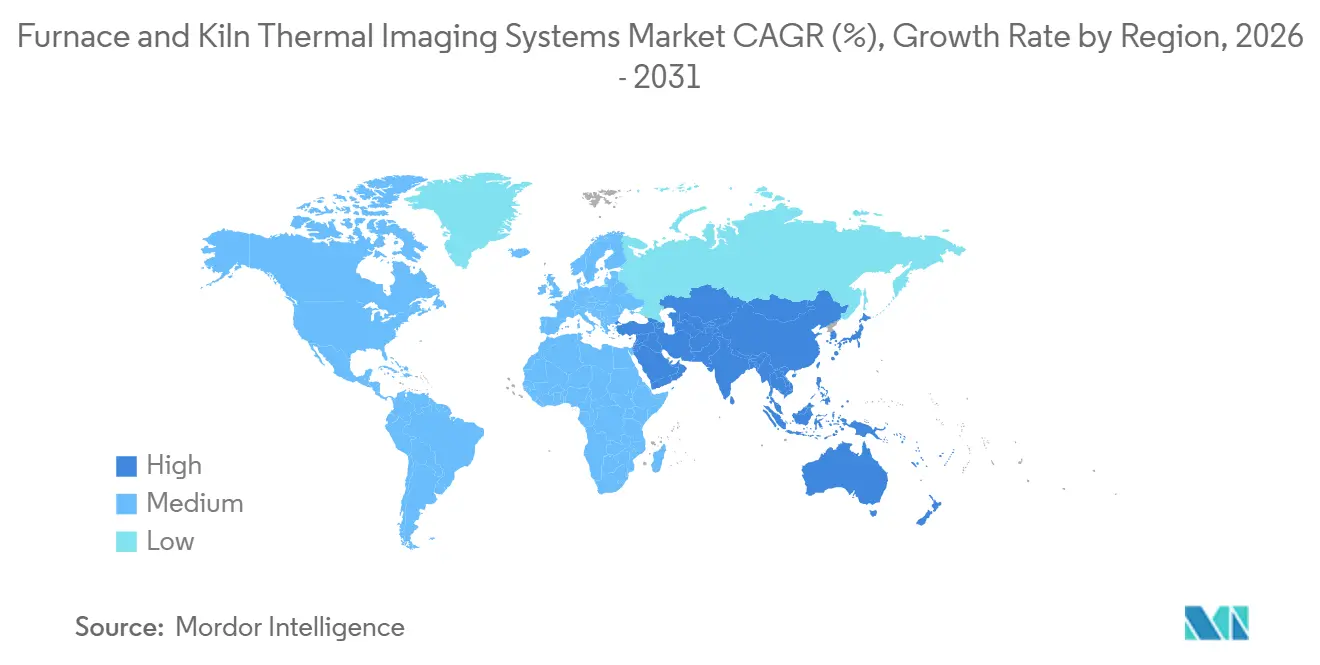
Asia-Pacific held 43.71% of the Furnace and Kiln Thermal Imaging Systems Market share in 2025. China, Japan, South Korea, and India have a concentration of vertically integrated steel producers. The region also includes major cement kiln fleets, particularly in China and India. China’s ultra-low-emission standards create demand for documented combustion-efficiency data in steel operations. India’s PAT program encourages auditable efficiency improvements at cement and aluminum facilities. These requirements place thermal monitoring within both plant operations and compliance records. Vietnam and Indonesia are emerging growth areas, with greenfield steel and glass capacity scheduled to come online through 2028.
North America has a demand for chemicals and petrochemicals, including steam methane reforming, fluid catalytic cracking, and coker furnaces. Mature iron and steel mini-mills and aluminum smelters also support demand in the region. US requirements for industrial boilers and process heaters add a compliance consideration to combustion monitoring. Europe has concentrated clusters of glass, ceramic tile, and specialty steel production in Germany, Italy, and Spain. Germany is also home to several technology developers, including Optris, InfraTec, and DIAS Infrared. The Corporate Sustainability Reporting Directive supports greater attention to Scope 1 and Scope 3 data collection across European heavy industry. South America centers on Brazil’s steel and mining sectors, although currency risk and limited local technical support can constrain uptake of fixed systems. Across these regions, the Furnace and Kiln Thermal Imaging Systems Market is shaped by different installed bases and plant investment priorities. Mature facilities can focus on integration with existing equipment, while new plants can include fixed thermal monitoring in the original design.
The Middle East and Africa are projected to expand at a 9.14% CAGR through 2031. GCC countries are commissioning integrated steel, aluminum, and petrochemical projects as part of industrialization programs. Greenfield facilities can install fixed camera systems that are fully integrated with distributed control systems from the start. These projects can require higher-specification systems than brownfield replacements in North America and Europe. Cement activity in South Africa, Nigeria, and East Africa is also supporting demand for kiln-shell monitoring. HGH INFRARED SYSTEMS has documented experience with KILNSCAN deployments in emerging-market cement operations.[3]HGH Infrared Systems, “KILNSCAN: 24/7 Kiln Shell Temperature Monitoring,” HGH Infrared Systems, hgh-infrared.com Turkey contributes through its active steel and glass sectors, where energy costs and export-quality requirements encourage adoption.

Competitive Landscape
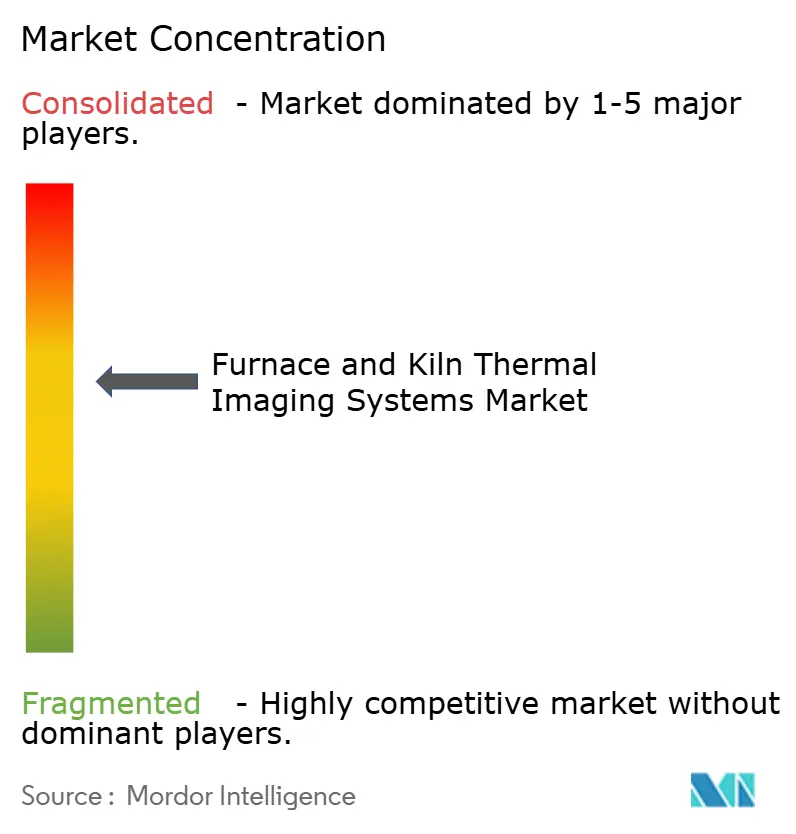
The Furnace and Kiln Thermal Imaging Systems Market is moderately concentrated at the premium end and fragmented across the mid-market. AMETEK Land, Teledyne FLIR, and Thermoteknix have established positions in high-temperature borescope optics, radiometric software, and certified camera housings. These capabilities are difficult to reproduce because they depend on sustained applications-engineering work. AMETEK Land released the MWIR-b-640 in April 2025 for high-temperature aluminum furnace imaging through smoke and flame.[4]AMETEK Land, “Next Generation of Thermal Imaging Technology for Aluminium,” AMETEK Land, ametek-land.com Teledyne FLIR launched the A6450 in February 2026 with a 27,000-hour linear cooler for continuous industrial process control. These product moves strengthen the premium offering for fixed process monitoring in the Furnace and Kiln Thermal Imaging Systems Market. ISO 18434-1 monitoring standards and EN ISO 9712 personnel certification are also appearing more often in procurement specifications.
Optris uses preconfigured packages to reduce engineering effort for smaller furnace operators. Its Xi 1M Furnace Package combines a camera with water cooling and laminar air purge for demanding applications. This approach can open projects that custom system integrators previously served. Zhejiang Dali Technology and Yantai IRay Technology compete in lower-specification and mid-temperature applications. Their position is relevant in China and Southeast Asia, where price sensitivity is higher. Software analytics is becoming an important area of competition alongside camera performance. Suppliers are also developing calibration algorithms and anomaly-detection functions for industrial settings. The Furnace and Kiln Thermal Imaging Systems Market still offers room for portable multispectral systems in waste-to-energy and mineral processing.
Premium suppliers operate in challenging conditions, including high temperatures, smoke, combustion gases, and limited access for maintenance. Mid-market suppliers compete where users can accept lower specifications in return for lower initial cost. The choice between these offerings depends on the plant process, the desired integration depth, and the need for certified performance. Fixed systems can provide more continuous information, but require more engineering work at installation. Portable systems can support a staged approach for users who need to validate the operating case before making a permanent investment. The Furnace and Kiln Thermal Imaging Systems Market, therefore, combines specialized hardware, integration capability, calibration support, and software services. No combined share data for the leading companies was provided, consistent with a moderately concentrated premium tier and a fragmented broader field.
Furnace and Kiln Thermal Imaging Systems Industry Leaders
AMETEK Land Instruments International Limited
Thermoteknix Systems Limited
Teledyne FLIR, LLC
HGH Infrared Systems SAS
CMV-Systems GmbH
- *Disclaimer: Major Players sorted in no particular order

Recent Industry Developments
- May 2026: DGC Africa deployed a Vision AI thermal surveillance platform across industrial sites in Africa, using existing camera infrastructure to provide 24/7 monitoring of furnaces, kilns, boilers, and refractory assets. The system detects abnormal heat signatures, refractory distress, and process instability in real time, extending AI-driven thermal analytics to multi-asset fleet-level management.
- May 2026: DGC Africa applied Vision AI analytics to existing camera infrastructure for centralized thermal surveillance across furnaces, kilns, and boilers. The deployment supported continuous asset-level monitoring rather than a separate camera installation for each monitored process area.
- February 2026: Teledyne FLIR launched the A6450 series of long-life cooled MWIR cameras for continuous industrial process control and automation. The cameras incorporate a linear cooler rated at 27,000 hours, operate at 125 Hz with high thermal sensitivity, and integrate through GigE Vision and GenICam protocols.
- February 2026: Teledyne FLIR positioned the A6450 series for fixed thermal monitoring in furnace and kiln environments. The 27,000-hour cooler rating and automation interfaces improved the total cost of ownership for continuous process monitoring systems.


Global Furnace and Kiln Thermal Imaging Systems Market Report Scope
The Furnace and Kiln Thermal Imaging Systems Market comprises the global market for thermal imaging hardware, sensing technologies, integrated monitoring systems, and associated solutions used to remotely visualize, measure, monitor, and analyze temperature distributions and thermal behavior in industrial furnaces and kilns. These systems use infrared, visible-light/thermal hybrid, multispectral, or infrared line-scanning technologies to provide real-time or periodic thermal information for process control, refractory and shell condition assessment, combustion and burner monitoring, product temperature measurement, predictive maintenance, safety management, and energy and emissions optimization.
The Furnace and Kiln Thermal Imaging Systems Market Report is Segmented by System Type (Furnace Interior Imaging Systems, Kiln Shell Thermal Scanning Systems, Furnace/Kiln Fixed Process Monitoring Systems, and Portable Thermal Inspection Systems), Technology (Infrared Thermal Imaging, Visible-Thermal Hybrid Imaging, Multispectral Imaging, and Infrared Line/Scanning Imaging), Application (Furnace Interior and Process Monitoring, Furnace/Kiln Refractory and Shell Monitoring, Combustion, Flame and Burner Monitoring, Product/Material Temperature Monitoring, Predictive Maintenance and Safety Monitoring, Energy and Emissions Optimization, and Other Applications), End-User Industry (Cement and Lime, Iron and Steel, Non-Ferrous Metals, Glass Manufacturing, Ceramics and Refractories, Chemicals and Petrochemicals, Pulp and Paper, Power Generation, Waste-to-Energy and Incineration, Mining and Mineral Processing, and Other End-User Industries), and Geography (North America, South America, Europe, Asia-Pacific, and Middle East and Africa). The Market Forecasts are Provided in Terms of Value (USD).
| Furnace Interior Imaging Systems |
| Kiln Shell Thermal Scanning Systems |
| Furnace/Kiln Fixed Process Monitoring Systems |
| Portable Thermal Inspection Systems |
| Infrared Thermal Imaging |
| Visible-Thermal Hybrid Imaging |
| Multispectral Imaging |
| Infrared Line/Scanning Imaging |
| Furnace Interior and Process Monitoring |
| Furnace/Kiln Refractory and Shell Monitoring |
| Combustion, Flame and Burner Monitoring |
| Product/Material Temperature Monitoring |
| Predictive Maintenance and Safety Monitoring |
| Energy and Emissions Optimization |
| Other Applications |
| Cement and Lime |
| Iron and Steel |
| Non-Ferrous Metals |
| Glass Manufacturing |
| Ceramics and Refractories |
| Chemicals and Petrochemicals |
| Pulp and Paper |
| Power Generation |
| Waste-to-Energy and Incineration |
| Mining and Mineral Processing |
| Other End-User Industries |
| North America | United States | |
| Canada | ||
| Mexico | ||
| South America | Brazil | |
| Argentina | ||
| Rest of South America | ||
| Europe | Germany | |
| United Kingdom | ||
| France | ||
| Italy | ||
| Spain | ||
| Rest of Europe | ||
| Asia-Pacific | China | |
| Japan | ||
| India | ||
| South Korea | ||
| ASEAN | ||
| Rest of Asia-Pacific | ||
| Middle East and Africa | Middle East | Saudi Arabia |
| United Arab Emirates | ||
| Turkey | ||
| Rest of the Middle East | ||
| Africa | South Africa | |
| Nigeria | ||
| Rest of Africa | ||
| By System Type | Furnace Interior Imaging Systems | ||
| Kiln Shell Thermal Scanning Systems | |||
| Furnace/Kiln Fixed Process Monitoring Systems | |||
| Portable Thermal Inspection Systems | |||
| By Technology | Infrared Thermal Imaging | ||
| Visible-Thermal Hybrid Imaging | |||
| Multispectral Imaging | |||
| Infrared Line/Scanning Imaging | |||
| By Application | Furnace Interior and Process Monitoring | ||
| Furnace/Kiln Refractory and Shell Monitoring | |||
| Combustion, Flame and Burner Monitoring | |||
| Product/Material Temperature Monitoring | |||
| Predictive Maintenance and Safety Monitoring | |||
| Energy and Emissions Optimization | |||
| Other Applications | |||
| By End-User Industry | Cement and Lime | ||
| Iron and Steel | |||
| Non-Ferrous Metals | |||
| Glass Manufacturing | |||
| Ceramics and Refractories | |||
| Chemicals and Petrochemicals | |||
| Pulp and Paper | |||
| Power Generation | |||
| Waste-to-Energy and Incineration | |||
| Mining and Mineral Processing | |||
| Other End-User Industries | |||
| By Geography | North America | United States | |
| Canada | |||
| Mexico | |||
| South America | Brazil | ||
| Argentina | |||
| Rest of South America | |||
| Europe | Germany | ||
| United Kingdom | |||
| France | |||
| Italy | |||
| Spain | |||
| Rest of Europe | |||
| Asia-Pacific | China | ||
| Japan | |||
| India | |||
| South Korea | |||
| ASEAN | |||
| Rest of Asia-Pacific | |||
| Middle East and Africa | Middle East | Saudi Arabia | |
| United Arab Emirates | |||
| Turkey | |||
| Rest of the Middle East | |||
| Africa | South Africa | ||
| Nigeria | |||
| Rest of Africa | |||


Key Questions Answered in the Report
What is the furnace and kiln thermal imaging systems market size?
The Furnace and Kiln Thermal Imaging Systems Market is estimated at USD 355.88 million in 2026 and is forecast to reach USD 526.11 million by 2031, at an 8.13% CAGR.
Why do furnace operators use thermal imaging systems?
Operators use continuous images to identify burner faults, temperature anomalies, and refractory deterioration before these issues cause unplanned outages.
Which system type is expected to expand fastest through 2031?
Furnace/Kiln Fixed Process Monitoring Systems are projected to expand at an 8.93% CAGR through 2031 as integration costs decline and cooled-detector life improves.
Which technology is best for through-flame furnace monitoring?
Multispectral systems using 3.9 μm filtered MWIR imaging address CO₂ and H₂O absorption that can limit standard LWIR cameras in combustion gases.
Which end-user sector has the highest forecast expansion rate?
Waste-to-energy and incineration is projected to expand at a 10.27% CAGR through 2031 because variable fuel quality requires real-time combustion feedback.
Which region leads demand for these systems?
Asia-Pacific held 43.71% share in 2025, supported by its large steel and cement production base and energy-efficiency programs.
Page last updated on:


 Your data is secure and never sold or shared.


