
Functional Apparel Market Size and Share
Market Overview
| Study Period | 2021 - 2031 |
|---|---|
| Market Size (2026) | USD 460.56 Billion |
| Market Size (2031) | USD 634.62 Billion |
| Growth Rate (2026 - 2031) | 6.62 % |
| Fastest Growing Market | Asia-Pacific |
| Largest Market | North America |
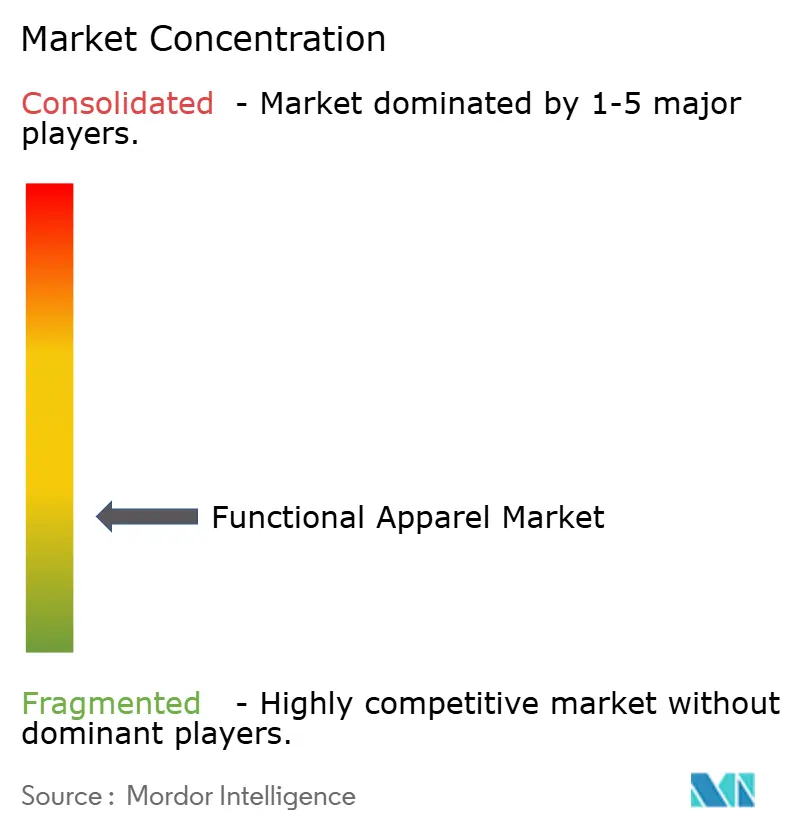
| Market Concentration | Low |
Major Players
*Disclaimer: Major Players sorted in no particular order Image © Mordor Intelligence. Reuse requires attribution under CC BY 4.0. |
|
Functional Apparel Market Analysis by Mordor Intelligence
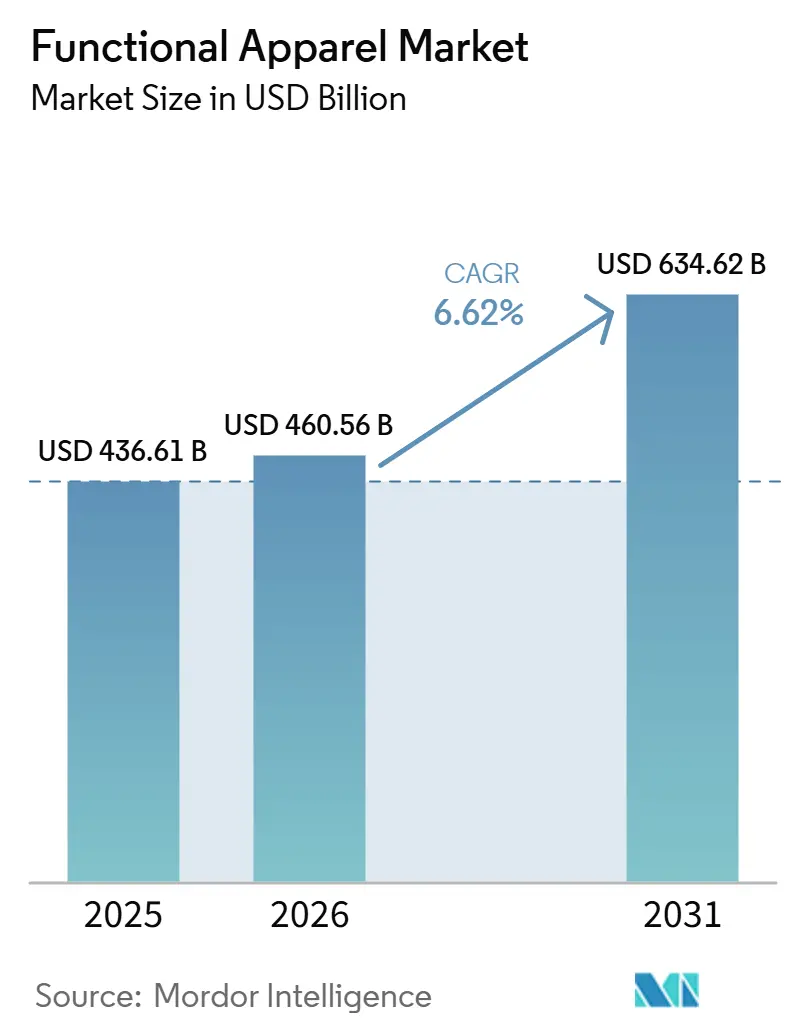
The functional apparel market size was valued at USD 436.61 billion in 2025 to USD 460.56 billion in 2026, and is forecast to reach USD 634.62 billion by 2031 at a 6.62% CAGR over 2026-2031. The market continues to expand steadily, supported by increasing participation in sports, fitness, and outdoor activities, as well as rising consumer demand for comfortable, performance-oriented apparel. Consumers increasingly prioritize apparel with functional attributes, including moisture management, temperature regulation, UV protection, stretchability, and water resistance. This shift is broadening the application of functional apparel beyond sports into everyday wear, workwear, and travel. Ongoing advancements in performance fabrics and sustainable materials are strengthening competitive intensity across the market. Leading brands are commercializing advanced technologies, including Nike Dri-FIT, Under Armour HeatGear, Columbia Omni-Heat Infinity, and The North Face FUTURELIGHT. In parallel, the growing adoption of athleisure continues to support demand for multifunctional apparel worldwide. Fashion brands are also integrating functional features into everyday apparel, reducing the distinction between performance wear and casual clothing.
Key Report Takeaways
- By product type, sportswear led the functional apparel market with a share of 38.89% in 2025, while protective workwear is anticipated to register the fastest CAGR of 7.72% during 2026-2031.
- By end user, men retained a 52.32% share in 2025, whereas women are forecast to expand at a 7.56% CAGR through 2031.
- By distribution channel, offline retail stores retained a 79.99% share in 2025, while online retail stores are anticipated to expand at a 7.84% CAGR through 2031.
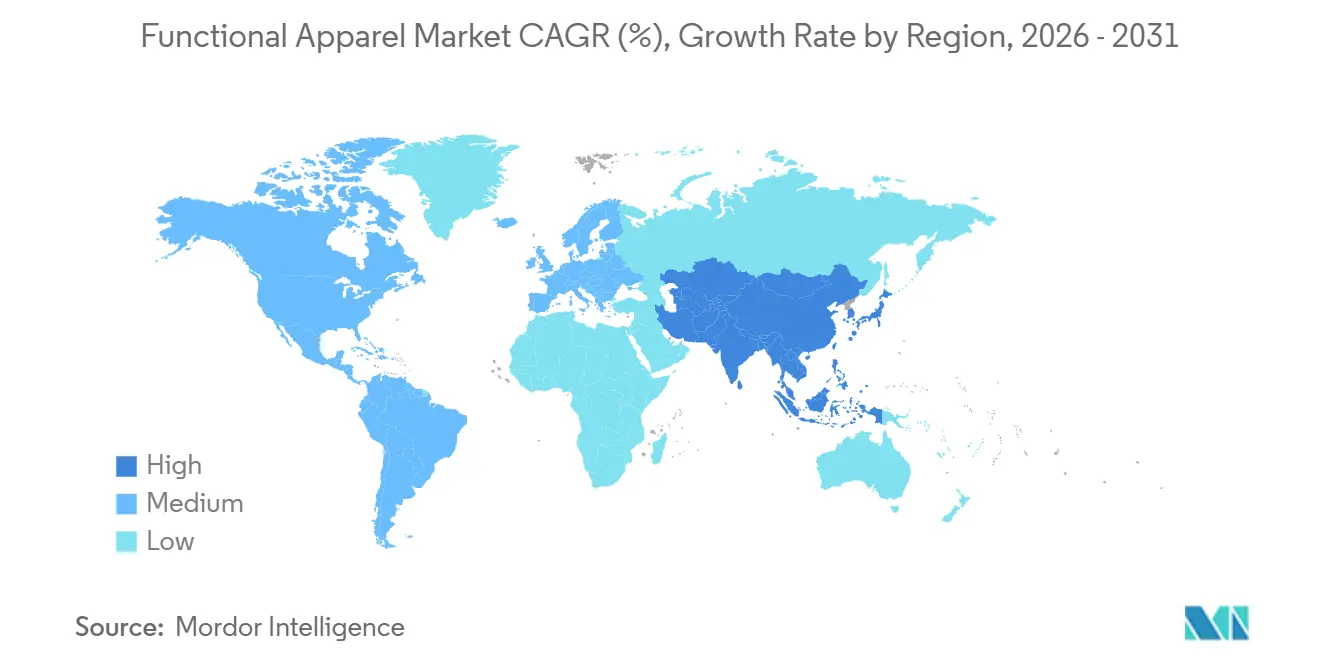
- By geography, North America led the global functional apparel market in 2025 with a 36.58% share, while Asia-Pacific is projected to advance at 8.43% CAGR through 2031.
Note: Market size and forecast figures in this report are generated using Mordor Intelligence’s proprietary estimation framework, updated with the latest available data and insights as of January 2026.
Market Trends and Insights
Drivers Impact Analysis of Functional Apparel Market*
| Drivers | (~) % Impact on CAGR Forecast | Geographic Relevance | Impact Timeline |
|---|---|---|---|
| Growing consumer focus on performance-oriented clothing | +1.8% | Global, strongest in North America and Asia-Pacific | Short term (≤ 2 years) |
| Advancements in high-performance textile technologies | +1.5% | Global, with early scaling in Europe and East Asia | Medium term (2-4 years) |
| Growing adoption of athleisure apparel across everyday lifestyles | +1.3% | North America and Europe, with rapid adoption in urban Asia-Pacific | Short term (≤ 2 years) |
| Expansion of sports sponsorship influencing consumer adoption | +0.8% | Global, concentrated in North America, Western Europe, and Asia-Pacific professional league markets | Medium term (2-4 years) |
| Customization and mass personalization enhancing consumer appeal | +0.5% | North America, Europe, and technology-led East Asian markets | Medium term (2-4 years) |
| Strengthening textile promotion policies supporting industry expansion | +0.6% | South Asia, led by India, with spillover to Southeast Asia and Sub-Saharan Africa | Long term (≥ 4 years) |
| Source: Mordor Intelligence | |||
Growing consumer focus on performance-oriented clothing
Rising health awareness and increasing participation in fitness and recreational activities are strengthening demand for functional apparel that delivers comfort, moisture management, stretchability, and breathability. According to Eventrac, a sports event management platform, global mass-participation sports events are projected to register 7.8% like-for-like growth in 2025, broadening the consumer base beyond professional athletes. In response, brands are introducing advanced performance collections, including adidas’ CLIMACOOL apparel for enhanced cooling and sweat management, ASICS’ ACTIBREEZE range for improved ventilation during training, and Decathlon’s Kalenji running apparel designed with lightweight, quick-drying fabrics. The continued adoption of athleisure and hybrid work lifestyles is also driving everyday use of performance apparel, encouraging manufacturers to expand multifunctional product portfolios that combine athletic performance with daily comfort.
Advancements in high-performance textile technologies
Continuous advancements in high-performance textile technologies are enabling manufacturers to develop functional apparel with improved moisture management, thermoregulation, antimicrobial protection, UV resistance, lightweight construction, and durability. Innovations in smart textiles, specialty fibers, nanotechnology, and performance finishes are expanding the use of functional apparel across sports, healthcare, industrial safety, and defense applications. Government-backed investments in technical textile Research and Development are further accelerating innovation. For instance, India’s Ministry of Textiles reported in December 2025 that the National Technical Textiles Mission (NTTM) had approved 168 projects, including 79 research projects worth INR 247 crore focused on specialty fibers, smart textiles, and advanced technical textile applications [4]Source: Textile Exchange, "Materials Market Report," textileexchange.org. These innovations are improving product performance, encouraging premium product development, and supporting sustained growth in the global functional apparel market.
Growing adoption of athleisure apparel across everyday lifestyles
The increasing adoption of athleisure is strengthening demand for functional apparel, as consumers prioritize products that deliver performance, comfort, and everyday versatility. Hybrid work models, relaxed workplace dress codes, and wellness-oriented lifestyles have broadened the application of functional apparel beyond sports to daily wear, travel, and social occasions. For example, in March 2025, UNIQLO is expected to expand its AIRism collection with lightweight, moisture-wicking apparel designed for both everyday wear and active use. In July 2026, Alo Yoga is expected to expand its lifestyle-focused retail presence in Germany, reflecting strong consumer demand for versatile athleisure products. This trend is prompting manufacturers to invest in multifunctional apparel that supports seamless use across fitness and daily routines, contributing to sustained market growth.
Strengthening textile promotion policies supporting industry expansion
Government policies supporting man-made fibers, technical textiles, and domestic manufacturing are driving growth in the functional apparel market by increasing production capacity and attracting investment in advanced textile technologies. For example, India's Union Budget 2026–27 is expected to introduce an Integrated Programme for the Textile Sector, focusing on man-made fibers and technical textiles. The Production Linked Incentive (PLI) Scheme for these segments also remains in effect through FY 2029–30, with an approved outlay of INR 10,683 crore[1]Source: Press Information Bureau, "Union Budget," pib.gov.in. These measures support the development of high-performance fabrics used in sportswear, outdoor apparel, compression wear, and protective clothing. They also help manufacturers expand local sourcing, improve supply chain resilience, and reduce production costs. As policy support continues to drive investment in specialized textile manufacturing, brands can strengthen product innovation and address rising global demand for functional apparel.
Restraints Impact Analysis of Functional Apparel Market*
| Restraint | (~) % Impact on CAGR Forecast | Geographic Relevance | Impact Timeline |
|---|---|---|---|
| Stringent multi regional regulatory compliance requirements | -0.4% | Global, most acute in the European Union and North America | Medium term (2-4 years) |
| Complex raw material sourcing and supply chain disruptions | -0.6% | Global, with highest exposure in Asia-Pacific manufacturing hubs | Short term (≤ 2 years) |
| Counterfit products eroding brand trust and revenue | -0.5% | Global, concentrated in South and Southeast Asia and online marketplaces | Medium term (2-4 years) |
| Volatile prices of high performance synthetic fibres | -0.7% | Global, with the largest immediate effect on manufacturers in India, Bangladesh, and China | Short term (≤ 2 years) |
| Source: Mordor Intelligence | |||
Counterfeit products eroding brand trust and revenue
The proliferation of counterfeit functional apparel undermines brand credibility, reduces revenue for legitimate manufacturers, and creates unfair market competition. Counterfeit products often imitate the appearance of premium functional apparel but fail to deliver essential performance features, such as moisture management, UV protection, flame resistance, compression, and antimicrobial properties. This gap can compromise consumer safety and satisfaction. For instance, in July 2026, a truck carrying counterfeit Croatia jerseys intended for the Fédération Internationale de Football Association (FIFA) World Cup arrived at the Bulgarian border but did not cross it. European authorities seized 41,280 counterfeit Nike-branded shirts valued at EUR 1.65 million. Authentication and traceability systems can help protect consumer trust, although their recurring costs are difficult for smaller regional brands to absorb. This widespread counterfeiting continues to erode consumer trust and restrain the growth of the global functional apparel market.
Complex raw material sourcing and supply chain disruptions
The functional apparel market’s reliance on synthetic fibers, including polyester, nylon, and elastane, exposes manufacturers to crude oil price volatility and global supply chain disruptions. According to Textile Exchange's Materials Market Report 2025, polyester represents 59% of global fiber production, with fossil fuels accounting for 88% of polyester feedstock [3]Source: Ministry of Textiles, "National Textile Mission," pib.gov.in. This underscores the industry’s continued dependence on petrochemical inputs. Geopolitical conflicts, freight disruptions, and feedstock shortages could increase the cost of polyester and other performance fibers, driving up production costs for functional apparel manufacturers. Geopolitical tensions in the Middle East in 2026, including potential disruptions to oil and petrochemical supply routes through the Strait of Hormuz, could further increase synthetic fiber costs. These cost pressures constrain manufacturers’ pricing flexibility and compress profit margins, particularly across premium sportswear, outdoor apparel, and protective clothing categories that depend on specialized technical fabrics.
*Our forecasts treat driver/restraint impacts as directional, not additive. The impact forecasts reflect baseline growth, mix effects, and variable interactions.
Functional Apparel Market Segment Analysis
By Product Type:
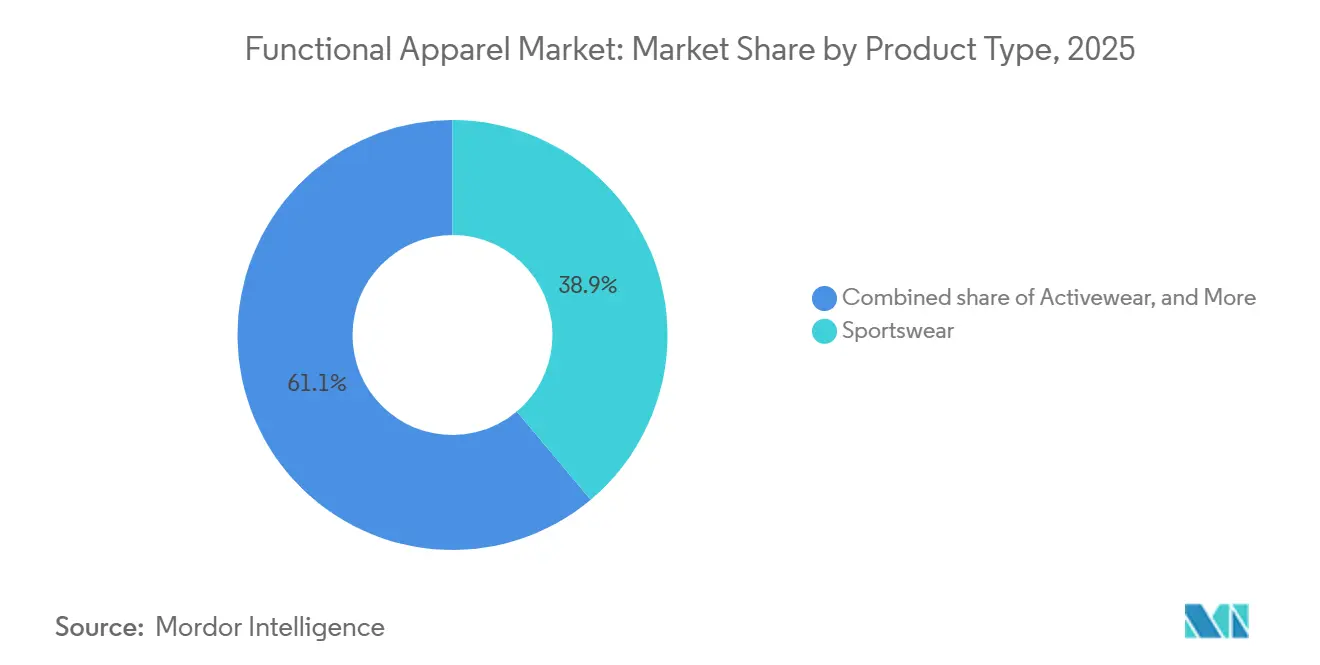
Protective Workwear Adds Faster Growth to a Sportswear-Led CategorySportswear accounted for 38.89% of global functional apparel market revenue in 2025, positioning it as the largest product category. This leadership is driven by increasing participation in sports and fitness activities, broader athleisure adoption, and stronger consumer demand for high-performance apparel that supports both active and everyday use. Ongoing advancements in moisture-wicking, temperature-regulating, and stretch fabrics continue to support demand among professional athletes and recreational users. The others category, which includes medical apparel and niche technical products, is expected to remain the smallest revenue contributor.
Protective workwear is projected to register a CAGR of 7.72% through 2031, making it the fastest-growing product type. Regulatory developments continue to support market demand, with the Occupational Safety and Health Administration (OSHA) updating personal protective equipment requirements under 29 CFR 1910 and the European Union Personal Protective Equipment (PPE) Regulation (EU 2016/425) mandating certification for high-risk workplaces. Manufacturers are expanding their portfolios with advanced protective garments that combine flame resistance, chemical protection, durability, and wearer comfort. For example, DuPont's Nomex and Kevlar fiber-based protective apparel continues to gain adoption across the oil and gas, utilities, and industrial sectors. Growing industrialization, stricter workplace safety regulations, and rising adoption of advanced technical textiles are expected to sustain strong demand for protective workwear throughout the forecast period.



By End User:
Women Gain Momentum While Men Retain the Largest Revenue BaseMen accounted for 52.32% of revenue in 2025, maintaining their position as the largest end-user group in the functional apparel market. Higher participation in gym training, running, outdoor recreation, and team sports continues to drive demand for sportswear, compression wear, and performance outerwear across this segment. Premiumization and shorter replacement cycles for performance apparel used in fitness and outdoor activities further reinforce the segment’s revenue leadership.
The women’s segment is projected to register a CAGR of 7.56% through 2031, making it the fastest-growing end-user segment. Brands continue to expand women-focused performance apparel portfolios. For example, adidas is broadening its women’s running and training apparel offerings with AEROREADY moisture-management technology, while Under Armour has enhanced its women’s performance portfolio with Infinity sports bras and training apparel designed to provide improved support and comfort. Rising female participation in fitness, running, and organized sports, combined with higher investment in women-specific product innovation, is expected to support sustained segment growth.
By Distribution Channel:
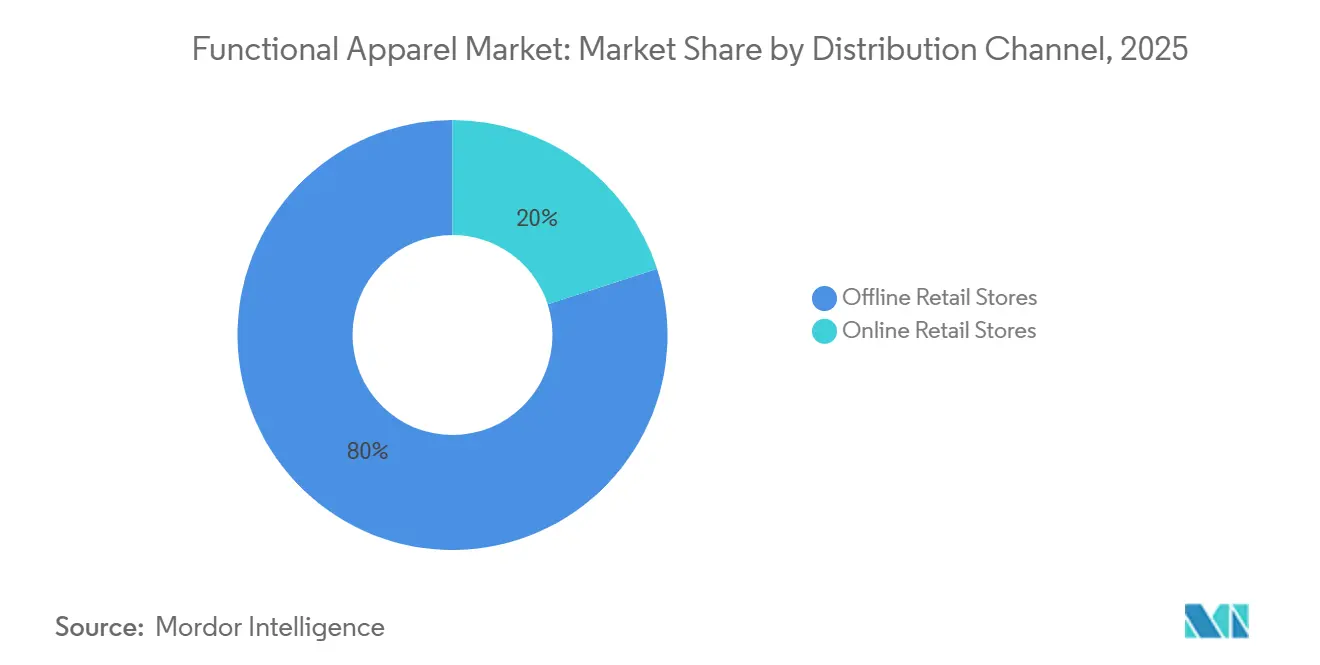
Digital Discovery Supports Online Growth While Stores Remain CentralOffline retail stores accounted for 79.99% of revenue in 2025, supported by consumers’ preference to evaluate the fit, comfort, durability, and performance attributes of compression wear, protective workwear, and technical sportswear before purchase. Specialty sports retailers and brand-exclusive stores further enhance purchase confidence by offering product demonstrations and expert guidance, particularly for premium functional apparel. Despite the continued expansion of e-commerce, physical stores are expected to remain the leading sales channel for technically advanced apparel.
Online retail stores are projected to record a CAGR of 7.84% through 2031, representing the fastest growth among distribution channels. Rising smartphone penetration, digital product discovery, and direct-to-consumer (DTC) strategies are driving online sales. For instance, Nike and adidas continue to scale their DTC e-commerce platforms through personalized recommendations, loyalty programs, and integrated omnichannel shopping experiences. The wider availability of detailed product information, customer reviews, and virtual shopping tools is further supporting online adoption, particularly among younger consumers.
Geography Analysis
North America Functional Apparel Market
North America is projected to account for 36.58% of revenue in 2025 and remain the largest regional contributor to the functional apparel market. High consumer spending on fitness, mature sponsorship networks, and wide availability of mass and premium products support the region’s leadership. The region also benefits from a well-established athlete-endorsement ecosystem and a college-sports outfitting model that connects institutional demand with consumer brand visibility. Strong adoption of athleisure and outdoor recreation continues to broaden demand for performance apparel beyond core sports applications. Leading brands such as Nike, Under Armour, and lululemon continue to invest in product innovation and direct-to-consumer channels to strengthen market penetration.
APAC Functional Apparel Market
Asia-Pacific is forecast to grow at a CAGR of 8.43% through 2031, making it the fastest-growing region in the functional apparel market. China remains the region’s largest national market, with Li-Ning and Anta competing on fabric technology and pricing. India is expanding its fitness infrastructure and supporting domestic manufacturing through incentives for man-made fibers and technical textiles. In January 2026, Anta is expected to announce the acquisition of a 29.1% stake in PUMA for EUR 1.5 billion. Rapid urbanization, rising disposable incomes, and increasing participation in fitness activities are accelerating demand for functional apparel across emerging Asian markets. The expansion of domestic brands and local manufacturing capabilities is further improving the region’s competitive position in the global market.
EMEA and South America Functional Apparel Market
Europe benefits from demand for technical quality and sustainability credentials across Germany, the United Kingdom, France, Italy, and Spain. Adidas and PUMA provide established distribution infrastructure and invest in material development from their European bases. The Ecodesign for Sustainable Products Regulation is raising expectations for textile durability and repairability in institutional workwear procurement. In South America, Brazil leads the market, supported by e-commerce growth, a young population, and strong football and running cultures, despite currency and tariff pressures. The Middle East and Africa remain at an earlier stage of development, with Saudi Arabia and the United Arab Emirates offering the most concentrated opportunities through premium demand and regional distribution activity.

Competitive Landscape
The functional apparel market remains fragmented, with global leaders, regional challengers, and specialist producers operating across sportswear, activewear, and protective workwear. Competition is particularly strong in sportswear and activewear, where brand recognition, material innovation, and digital engagement influence pricing power. Manufacturers continue to invest in research and development to introduce apparel with enhanced moisture management, thermoregulation, antimicrobial properties, UV protection, compression, and smart textile capabilities.
Competition is intensifying as brands expand their functional apparel portfolios through premium collections and technology-driven product launches. NikeSKIMS plans to expand their Spring 2026 collection with new gym-essential apparel featuring quick-dry fabrics, compression materials, and performance silhouettes, reflecting the growing emphasis on combining technical performance with everyday wearability.
The market continues to offer significant opportunities in women's performance apparel, smart functional clothing, medical compression garments, industrial protective apparel, and sustainable technical textiles. Companies are increasingly integrating AI-enabled product design, digital fitting technologies, recycled performance fibers, and certified sustainable materials to strengthen their market positioning. Certifications such as OEKO-TEX STANDARD 100, bluesign, and other performance and sustainability standards are becoming important differentiators, particularly in premium retail, institutional procurement, and industrial applications.
Functional Apparel Industry Leaders
-
Nike, Inc
-
Under Armour
-
Adidas
-
Asics Corporation
-
Columbia Sportswear Company
- *Disclaimer: Major Players sorted in no particular order
Functional Apparel Market Companies Covered in this Report
- Nike, Inc
- Under Armour
- Adidas
- Reebook
- Puma
- Asics Corporation
- Russell Brands LLC
- Hugo Boss
- Lakeland Industries
- Decathlon
- Ralph Lauren
- Amer Sports
- PVH Corp.
- Misto Luxembourg, SARL
- Jockey International
- Umbro
- Columbia Sportswear Company
- North Face
- New Balance
- Athleta LLC

Recent Industry Developments in Functional Apparel Market
- June 2026: Balenciaga expanded its design philosophy with the launch of the TechWear Wellness Collection, a new apparel line that combines high-performance athletic functionality with the brand’s distinctive approach to luxury fashion. The collection moves beyond traditional sportswear by integrating advanced material technologies directly into garments designed for both physical activity and everyday use.
- May 2026: The North Face introduced its Ski and Snowboard Lifestyle Collection for Fall 2026, integrating Futurelight, Futurefleece, DotKnit, DryVent, and Gore-Tex technologies into high-performance apparel.
- January 2026: London-based label NAMED COLLECTIVE launched its first activewear line, Nth ACTIVE, bridging the gap between streetwear and gym wear for fashion-focused consumers. The debut collection introduces Nth ACTIVE’s direction, integrating the brand’s mainline design signatures into a carefully crafted activewear capsule. The initial drop includes gym staples such as sports bras, leggings, shorts, and a matching shrug for added warmth.
- June 2025: Under Armour expanded its wholesale partnership with BSN SPORTS and designated the distributor as an official manufacturer of UA-sublimated uniforms, effective January 2026. The partnership will expand Under Armour’s reach across high school, collegiate, and youth league team sports outfitting channels.


Global Functional Apparel Market Report Scope
Functional apparel includes specialized clothing designed to deliver performance, comfort, protection, and durability beyond basic apparel. Manufacturers use advanced materials and textile technologies to provide features such as moisture management, thermal regulation, stretchability, UV protection, and enhanced safety for sports, outdoor, workwear, and everyday applications.
The functional apparel market is segmented by product type, end user, distribution channel, and geography. By product type, the market is segmented into sportswear, activewear, protective workwear, and others. By end user, the market is segmented into men, women, and kids. By distribution channel, the market is segmented into online retail stores and offline retail stores. Based on geography, the market is classified into North America, Europe, South America, Asia-Pacific, and the Middle East and Africa. The Market Forecasts are Provided in Terms of Value (USD).
| Sportswear |
| Activewear |
| Protective Workwear |
| Others |
| Men |
| Women |
| Kids |
| Online Retail Stores |
| Offline Retail Stores |
| North America | United States |
| Canada | |
| Mexico | |
| Rest of North America | |
| Europe | Germany |
| United Kingdom | |
| Italy | |
| France | |
| Spain | |
| Netherlands | |
| Poland | |
| Belgium | |
| Sweden | |
| Rest of Europe | |
| Asia-Pacific | China |
| India | |
| Japan | |
| Australia | |
| Indonesia | |
| South Korea | |
| Thailand | |
| Singapore | |
| Rest of Asia-Pacific | |
| South America | Brazil |
| Argentina | |
| Colombia | |
| Chile | |
| Peru | |
| Rest of South America | |
| Middle East and Africa | South Africa |
| Saudi Arabia | |
| United Arab Emirates | |
| Nigeria | |
| Egypt | |
| Morocco | |
| Turkey | |
| Rest of Middle East and Africa |
| By Product Type | Sportswear | |
| Activewear | ||
| Protective Workwear | ||
| Others | ||
| By End User | Men | |
| Women | ||
| Kids | ||
| By Distribution Channel | Online Retail Stores | |
| Offline Retail Stores | ||
| By Geography | North America | United States |
| Canada | ||
| Mexico | ||
| Rest of North America | ||
| Europe | Germany | |
| United Kingdom | ||
| Italy | ||
| France | ||
| Spain | ||
| Netherlands | ||
| Poland | ||
| Belgium | ||
| Sweden | ||
| Rest of Europe | ||
| Asia-Pacific | China | |
| India | ||
| Japan | ||
| Australia | ||
| Indonesia | ||
| South Korea | ||
| Thailand | ||
| Singapore | ||
| Rest of Asia-Pacific | ||
| South America | Brazil | |
| Argentina | ||
| Colombia | ||
| Chile | ||
| Peru | ||
| Rest of South America | ||
| Middle East and Africa | South Africa | |
| Saudi Arabia | ||
| United Arab Emirates | ||
| Nigeria | ||
| Egypt | ||
| Morocco | ||
| Turkey | ||
| Rest of Middle East and Africa | ||


Key Questions Answered in the Report
What is the current size and future outlook of the global functional apparel market?
The global functional apparel market was valued at USD 436.61 billion in 2025 and is estimated to reach USD 460.56 billion in 2026. The market is further projected to grow to USD 634.62 billion by 2031, registering a CAGR of 6.62% during 2026–2031.
Which product type held the largest share of the functional apparel market in 2025?
Sportswear leads the product type segment, accounted for 38.89% of the global market in 2025.
Which end-user segment dominated the functional apparel market in 2025?
The men segment dominated the market with a 52.32% share in 2025.
Which distribution channel accounted for the largest market share in 2025?
Offline retail stores held the largest share of the functional apparel market, representing 79.99% of total sales in 2025.
Which region led the global functional apparel market in 2025?
North America held the largest regional share, accounting for 36.58% of global revenue in 2025.
Which region is projected to experience the fastest growth through 2031?
Asia-Pacific region is projected to be the fastest-growing market, with a CAGR of 8.43% from 2026 to 2031.
Page last updated on:





