
Fruit and Vegetable Optical Sorting Systems Market Size and Share
Market Overview
| Study Period | 2020 - 2031 |
|---|---|
| Market Size (2026) | USD 0.58 Billion |
| Market Size (2031) | USD 1.36 Billion |
| Growth Rate (2026 - 2031) | 18.58 % |
| Fastest Growing Market | Asia-Pacific |
| Largest Market | Europe |
| Market Concentration | Medium |
Major Players *Disclaimer: Major Players sorted in no particular order Image © Mordor Intelligence. Reuse requires attribution under CC BY 4.0. | |
Fruit and Vegetable Optical Sorting Systems Market Analysis by Mordor Intelligence
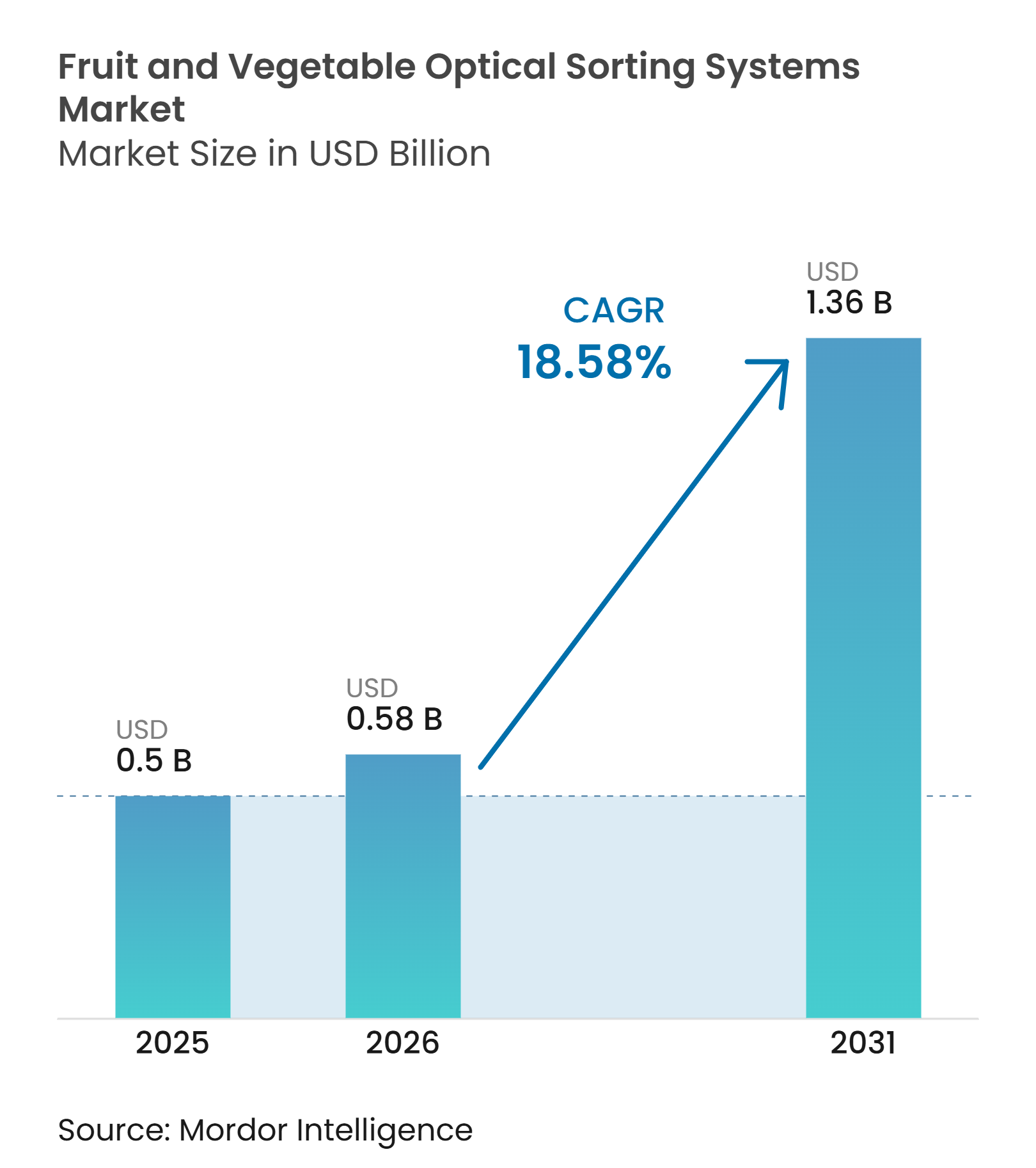
The Fruit and Vegetable Optical Sorting Systems Market Size is expected to increase from USD 0.50 billion in 2025 to USD 0.58 billion in 2026 and reach USD 1.36 billion by 2031, registering a CAGR of 18.58% over 2026-2031. The Fruit and Vegetable Optical Sorting Systems Market is moving from manual visual checks toward automated detection in post-harvest operations. Labor constraints and inspection costs make automated sorting more relevant for processors that need dependable line performance. Export requirements in emerging supply corridors are also raising the value of systems that assess more than surface color. This supports demand for multispectral and near-infrared capabilities that can identify quality attributes within the product. Competition centers on software, sensor capabilities, service coverage, and equipment designs that can be adapted to different production lines.
Key Report Takeaways
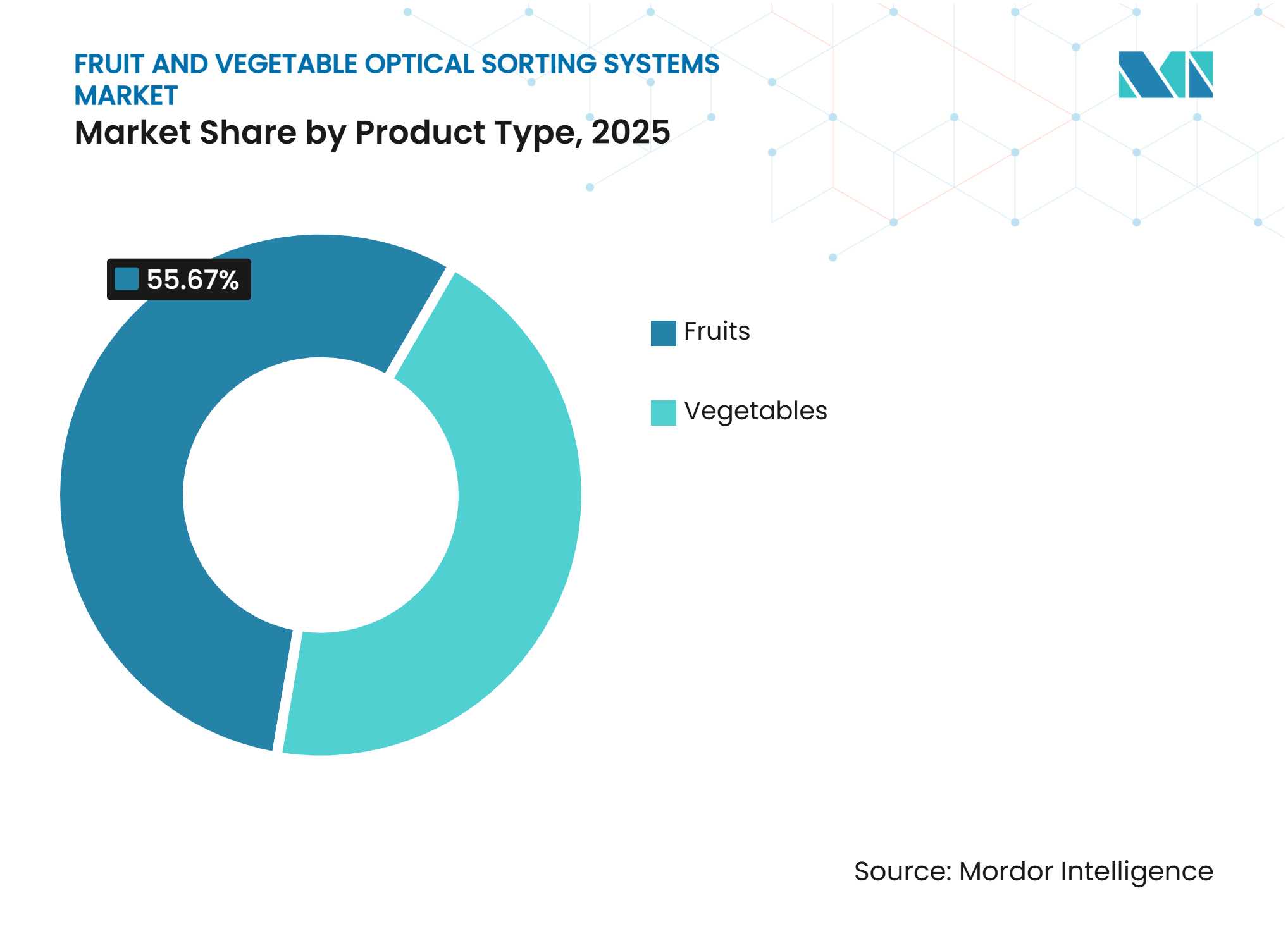
- By product type, fruits held 55.67% of demand in the Fruit and Vegetable Optical Sorting Systems Market 2025, while vegetables are projected to expand at a 19.34% CAGR through 2031.
- By sorting technology, RGB and color-vision systems held 41.23% of demand in 2025, while hyperspectral systems are projected to expand at a 22.29% CAGR through 2031.
- By sorting function, color and appearance accounted for 31.22% of demand in the Fruit and Vegetable Optical Sorting Systems Market 2025, while internal quality sorting is projected to expand at a 21.56% CAGR through 2031.
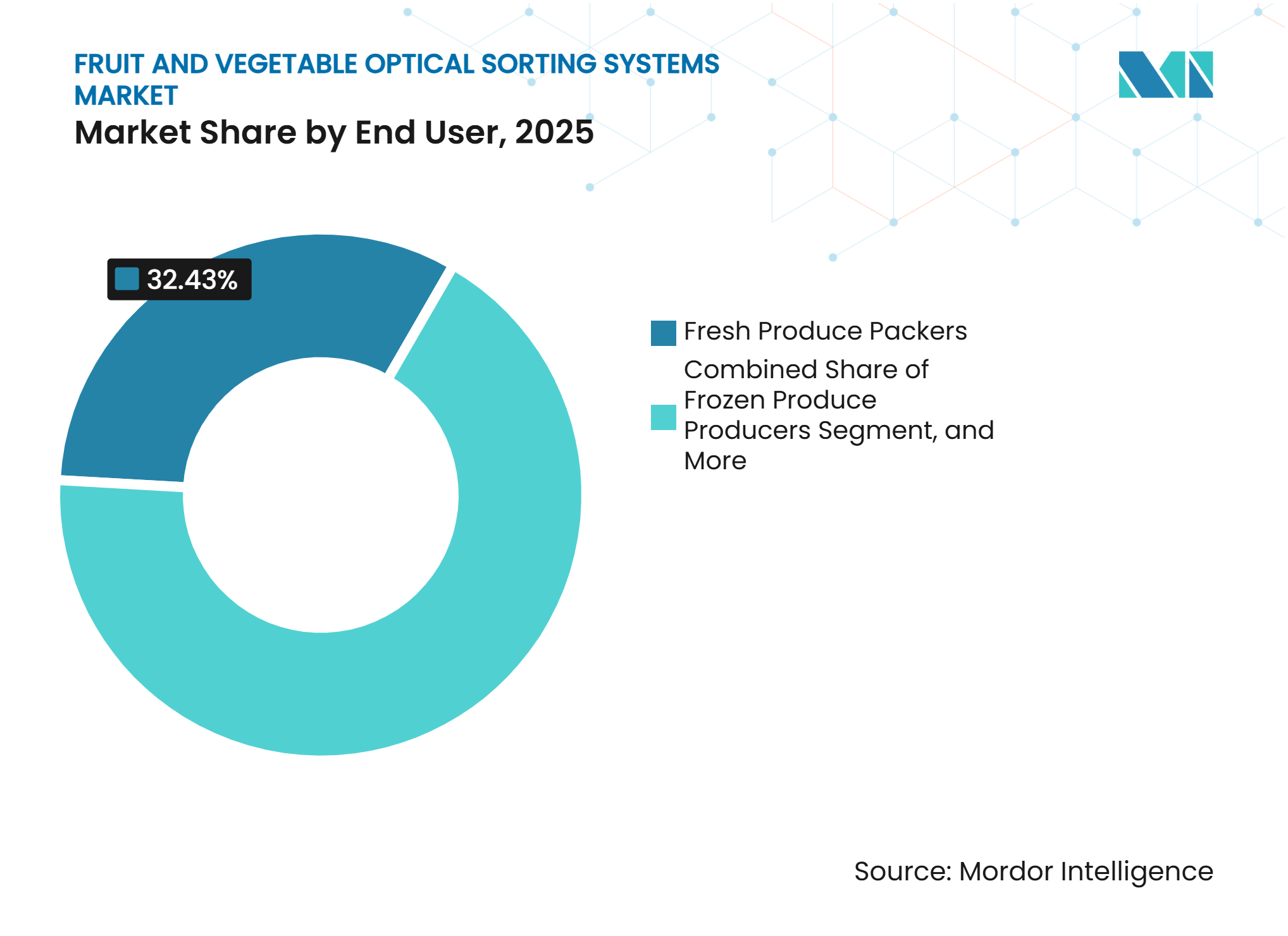
- By end user, fresh produce packers accounted for 32.43% of demand in 2025, while frozen produce producers are projected to expand at an 18.67% CAGR through 2031.
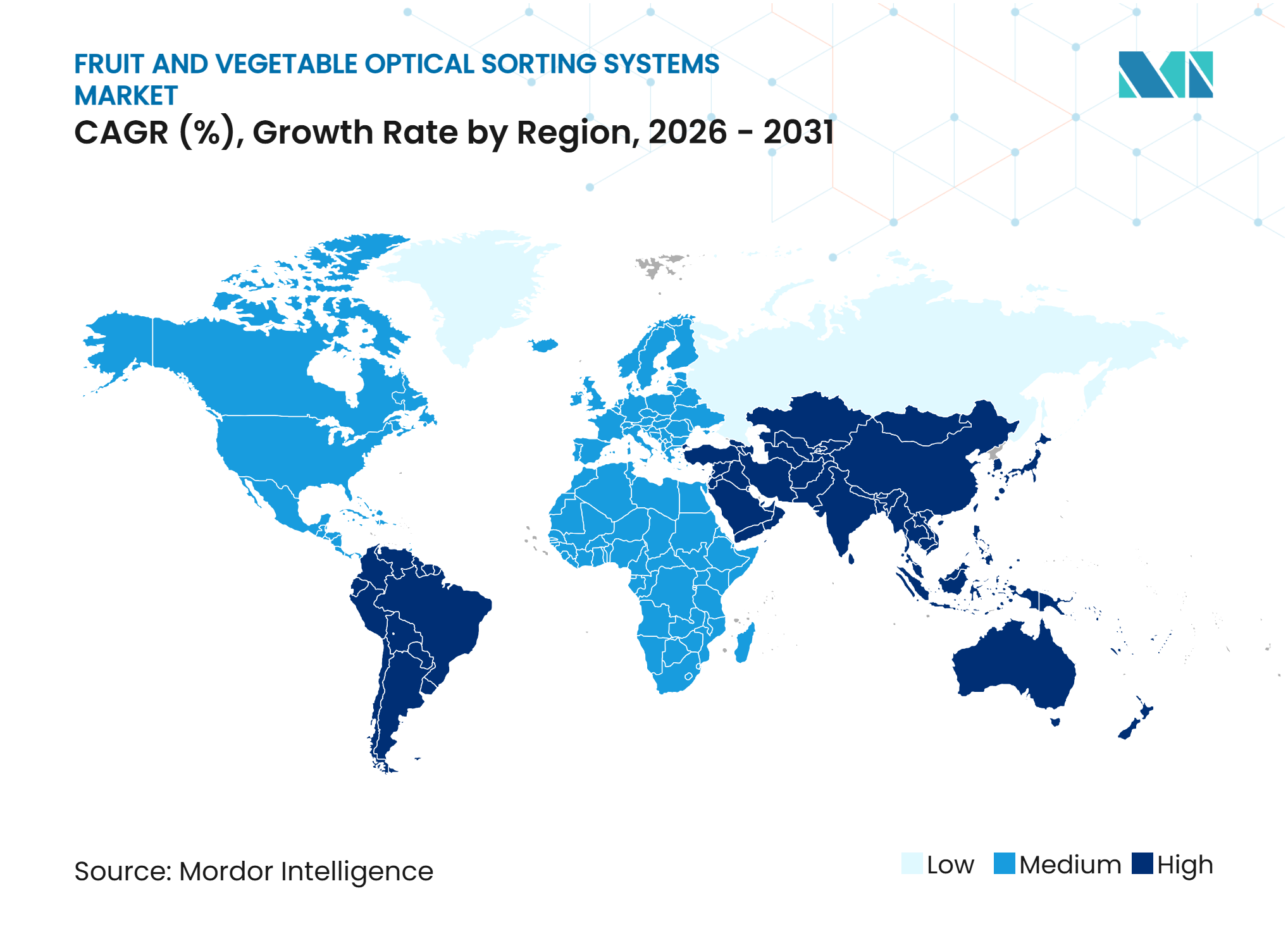
- By geography, North America accounted for 32.34% of demand in the Fruit and Vegetable Optical Sorting Systems Market 2025, while Asia-Pacific is projected to expand at a 20.34% CAGR through 2031.
Note: Market size and forecast figures in this report are generated using Mordor Intelligence’s proprietary estimation framework, updated with the latest available data and insights as of January 2026.
Market Trends and Insights
Drivers Impact Analysis of Fruit and Vegetable Optical Sorting Systems Market*
| Driver | (~) % Impact on CAGR Forecast | Geographic Relevance | Impact Timeline |
|---|---|---|---|
| Labor Shortages and Inspection Costs | +2.5% | Global, with highest intensity in North America and Western Europe | Short term (≤ 2 years) |
| Processed, Frozen, and Fresh-Cut Produce Demand | +2.0% | Global, concentrated in North America, Europe, and Asia-Pacific | Medium term (2-4 years) |
| Food Safety and Retailer Quality Specifications | +1.8% | North America and Europe, with rising influence in Asia-Pacific and Middle East and Africa export hubs | Medium term (2-4 years) |
| AI, Hyperspectral Imaging, and Sensor Fusion | +1.5% | Global, with adoption led by North America and Europe | Long term (≥ 4 years) |
| Export-Grade Consistency Requirements | +0.8% | Asia-Pacific, with spillover to Middle East and Africa, East Africa, and Southeast Asia | Medium term (2-4 years) |
| Digitized Waste-Stream Data and Yield Monetization | +0.5% | North America and Europe, with emerging use in Asia-Pacific | Long term (≥ 4 years) |
| Source: Mordor Intelligence | |||
Labor Shortages and Rising Inspection Costs
Labor scarcity is making optical equipment a more direct operating requirement for produce processors. The Fruit and Vegetable Optical Sorting Systems Market benefits when packers need to maintain grading consistency despite limited access to manual inspectors. An analysis by North Carolina State University found that automation economics in specialty crops favor larger operations first, while smaller producers may rely on manual or shared-service approaches for longer periods. This difference makes scalable equipment and flexible financing important in the Fruit and Vegetable Optical Sorting Systems Market. Automated inspection can reduce dependence on repetitive manual sorting tasks and make output more consistent over long shifts. It also raises the need for technicians who can calibrate equipment and manage changing product conditions.
Growth in Processed, Frozen, and Fresh-Cut Produce
Processed, frozen, and fresh-cut lines require reliable inspection before products move into later production stages. The Fruit and Vegetable Optical Sorting Systems Market gains from the wider range of product formats, color profiles, defect limits, and size specifications that these lines must manage. Key Technology stated that its COMPASS platform lets operators switch settings across corn, peas, and green beans without application-engineer support. This capability matters where frequent recipe changes can interrupt output and complicate quality control. The U.S. Food and Drug Administration finalized fresh-cut produce guidance in August 2026 that strengthened preventive-control expectations for sanitation, antimicrobial wash programs, and supply-chain traceability. Inline detection can therefore support both production requirements and documented control procedures.[1]
Stricter Food Safety and Retailer Quality Specifications
Food safety requirements increasingly rely on documented controls across handling and processing steps. The U.S. Food and Drug Administration guidance issued in August 2026 superseded the 2008 fresh-cut produce guidance and strengthened expectations under FSMA Part 117.[2] EFSA also published a 2025 opinion on microbiological hazards associated with water used in the post-harvest handling of fresh and frozen produce. These requirements increase the value of systems that record rejection data by batch and provide a traceable operating record. European retail specifications can also exceed baseline regulatory requirements for export-oriented packers. The Fruit and Vegetable Optical Sorting Systems Market, therefore, has a role in both physical inspection and quality documentation.[3]
AI, Hyperspectral Imaging, and Sensor-Fusion Improvements
AI software is extending the role of sorting equipment beyond simple pass-or-reject decisions. The Fruit and Vegetable Optical Sorting Systems Market is adopting systems that combine optical images with data on yield composition and rejection rates. A 2025 study reported energy savings of 15-20% and detection accuracy above 98% for AI-integrated food manufacturing systems. This supports the use of image-based data to identify recurring raw-material issues and improve purchasing decisions. Hyperspectral and sensor fusion tools also help distinguish internal defects that conventional color cameras may miss. TOMRA Food reported that its LUCAi platform had surpassed 3,500 installed lines by late 2025, demonstrating commercial use across a range of food applications.[4]
Restraints Impact Analysis of Fruit and Vegetable Optical Sorting Systems Market*
| Restraint | (~) % Impact on CAGR Forecast | Geographic Relevance | Impact Timeline |
|---|---|---|---|
| Initial Investment and Integration Costs | -1.8% | Global, most acute in Asia-Pacific emerging markets and smallholder-dominated regions | Short term (≤ 2 years) |
| Technical Complexity and Maintenance Requirements | -1.2% | Global, with highest friction in Middle East and Africa and parts of South America with limited OEM service networks | Medium term (2-4 years) |
| Sensor Fouling and Model Drift | -0.9% | Global, concentrated in fresh-cut vegetables, leafy greens, and tropical fruit processing | Medium term (2-4 years) |
| Interoperability and Data Ownership Concerns | -0.6% | North America and Europe, where data governance frameworks are more developed | Long term (≥ 4 y |
| Source: Mordor Intelligence | |||
High Initial Investment and Integration Costs
High capital costs limit adoption by cooperatives and mid-tier processors, even when automated inspection would improve their operations. The Fruit and Vegetable Optical Sorting Systems Market includes lower-cost belt-fed RGB systems, but these systems may not meet premium export requirements. Hyperspectral configurations with multiple sensors require larger up-front commitments and more complex line integration. North Carolina State University noted that the cost per unit declines more favorably for larger specialty-crop operations than for smaller growers. Lease programs and performance-based pricing can reduce the initial barrier, but seasonal operations still face uncertain payback periods. Crop-yield risk can further discourage capital commitments when utilization is limited to short harvesting windows.
Technical Complexity and Maintenance Requirements
Optical sorting equipment requires calibrated operation and specialized support for maintenance and troubleshooting. The Fruit and Vegetable Optical Sorting Systems Market is becoming harder to access, as operators cannot obtain timely technical support. Seasonal changes in produce appearance and defect profiles can require updated samples and model retraining. A 2026 review found that AI use in food processing remains context-dependent and can yield weaker results in dynamic or data-poor environments. High-moisture fresh-cut and vegetable lines also create sensor-fouling risks that may reduce sorting accuracy without immediate alerts. Limited data interoperability and concerns over ownership of production data add another barrier for facilities connecting sorters to plant systems.
*Our forecasts treat driver/restraint impacts as directional, not additive. The impact forecasts reflect baseline growth, mix effects, and variable interactions.
Fruit and Vegetable Optical Sorting Systems Market Segment Analysis
By Product Type:
Fruits Lead While Vegetables Gain GroundFruits held 55.67% of the Fruit and Vegetable Optical Sorting Systems Market Share in 2025. Retail-ready fruit has strict appearance requirements, especially within export supply chains and established packing-house networks. Blueberries, stone fruits, citrus, and avocados need several checks in one pass, including dehydration, bloom retention, and defect grading. TOMRA Food launched the 5S Blueberry, powered by Spectrim with LUCAi, in February 2026, featuring redesigned transfer points intended to reduce abrasion and drop height. These crop characteristics keep fruit important to equipment demand, as sorting errors can directly affect pack-out quality.
Vegetables are projected to expand at a 19.34% CAGR through 2031 within the Fruit and Vegetable Optical Sorting Systems Market. Fresh-cut and individually quick-frozen applications account for much of the additional requirement because vegetable lines often operate at high throughput. Wet product surfaces, debris, and foreign material create operating conditions that differ from those found in fresh-fruit packing. Key Technology designed its leafy greens COMPASS sorter with intelligent belt control and a washdown-ready cantilevered open-sanitary frame for raw receiving areas. Canned, preserved, juice, and beverage producers need sorting for ripeness and checks for foreign material.


By Sorting Technology:
RGB Remains Established While Hyperspectral Adoption AcceleratesRGB and color-vision systems retained 41.23% of sorter demand in 2025. Their position reflects competitive camera costs and replacement cycles that can extend for a decade or more. These systems remain suitable for many surface-color and appearance decisions across commodity lines. Near-infrared platforms provide accessible indicators of sugar content and moisture, while multispectral systems fall between RGB and hyperspectral equipment. Satake launched the SLASH β PLUS in June 2026 with four-color LED and multi-wavelength infrared detection, plus dual configurable ejection patterns.
Hyperspectral systems are projected to expand at a 22.29% CAGR through 2031. Their value comes from an internal quality assessment that RGB and conventional near-infrared platforms cannot consistently provide. A 2024 study found that Support Vector Machine-based hyperspectral sorting of apples achieved Adjusted Rand Index scores of up to 0.854 for rot detection. Frontiers in Plant Science reported in 2026 that HyperVision-HSI frameworks achieved prediction errors in soluble solids content as low as 0.62°Brix for grapes and tomatoes in real-time operation. This supports use in retail and export channels that require internal differentiation, although higher system cost limits wider adoption.
By Sorting Function:
Color Grading Provides the Base While Internal Quality ExpandsColor and appearance held 31.22% of demand in 2025. This function remains the basic inspection layer for many integrated lines and for produce sold into domestic channels. Size and shape sorting commonly complements color grading in potato, apple, citrus, and onion operations. It helps packers align output with pack-size requirements, while ripeness sorting is gaining use for avocados, mangoes, and stone fruits. These functions allow the fruit and vegetable optical sorting systems industry to serve both basic grading and more detailed product differentiation.
Internal quality sorting is projected to expand at a 21.56% CAGR through 2031. The Fruit and Vegetable Optical Sorting Systems Market Size for this function is supported by hyperspectral hardware that can assess attributes beyond visible appearance. Retail specifications that define soluble-solids thresholds by grade also encourage investment in this capability. Foreign-material detection is expanding alongside internal quality checks, and the U.S. Food and Drug Administration guidance from August 2026 sets preventive-control expectations where the risk of extraneous material is significant. This encourages optical inspection near pre-cut receiving points and at later processing stages.
By End User:
Fresh Produce Packers Lead While Frozen Produce Producers AccelerateFresh produce packers accounted for 32.43% of end-user demand in 2025. Their equipment decisions are closely tied to grading outcomes, pack yield, and retailer acceptance. Many packers are adding AI inference capabilities to existing hardware rather than replacing entire lines. This can reduce disruption, while food processors need uniform raw materials before blanching, drying, or canning. These use cases keep the Fruit and Vegetable Optical Sorting Systems Market focused on practical throughput and reliable defect removal.
Frozen produce producers are projected to expand at an 18.67% CAGR through 2031. Individually quick frozen lines combine high volumes with difficult sorting conditions, including the need to identify ice agglomerates and dense contaminants. Key Technology offers a COMPASS chute-fed configuration with high-powered ejectors for fresh and individually quick frozen vegetables. Accurate ejection matters because excess rejection reduces yield, while juice and beverage producers need ripeness and foreign-material detection. Growers and cooperatives form an early-stage user group as export certification requirements extend sorting expectations farther upstream.


Geography Analysis
North America held 32.34% of the Fruit and Vegetable Optical Sorting Systems Market Share in 2025. California's Central Valley and Midwest vegetable-processing corridors provide a large installed base and active compliance investment. The U.S. Food and Drug Administration's Produce Safety Rule established compliance obligations that also apply to certain small businesses. This regulatory environment supports upgrades where processors need more consistent quality control and traceability. Bühler and West-Link opened a SORTEX application and training center in Stockton, California, in March 2025 to provide demonstrations, mobile testing, and parts support for western U.S. processors.
Canada contributes demand through berry, potato, and tree-fruit processing, while Mexican export packing houses are upgrading systems to meet U.S. retail buyer specifications. Europe is the second-largest regional cluster, with Italy, Spain, the Netherlands, Germany, and France serving the stone fruit, citrus, potato, onion, and tomato processing sectors. GLOBALG.A.P. certification and private-label requirements can make detailed rejection records relevant for European and export-oriented packers. The Netherlands remains a cooperative packhouse center, while South America is modernizing export infrastructure for citrus, avocado, and grapes.
Asia-Pacific is projected to expand at a 20.34% CAGR through 2031. China's cold-chain development, India's processing formalization, and export requirements in Southeast Asia support the regional opportunity. China is both a large deployment market and a source of domestic sorting equipment, which places pressure on commodity-tier prices. Satake launched its modular SLASH series in April 2026 with full-color cameras, near-infrared and short-wave infrared detectors, and a shape-sorting function. The Middle East and Africa remain at an earlier stage, although Saudi agricultural modernization efforts and Kenya's farm-to-port traceability requirements create demand for specification-grade sorting.
Competitive Landscape
Market Concentration
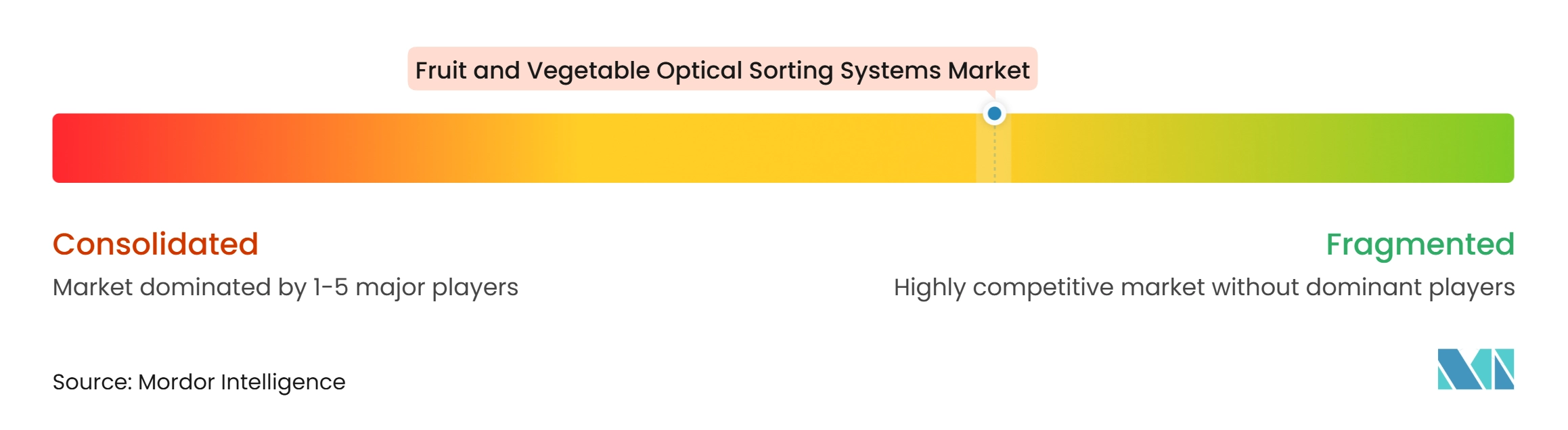
The Fruit and Vegetable Optical Sorting Systems Market has several global equipment suppliers and a wider group of regional specialists. TOMRA Systems ASA, Bühler AG, Key Technology, and Satake Corporation are established in the premium tier through software capabilities and service coverage. GREEFA BV, Unitec SpA, MAF RODA Agrobotic, Aweta GGP BV, and Ellips BV retain regional positions in specific produce categories and packing-house formats. Within the Fruit and Vegetable Optical Sorting Systems Market, service availability and application knowledge are important factors when selecting equipment.
TOMRA Food reported that LUCAi had surpassed 3,500 installed lines by late 2025. Bühler launched the SORTEX AI700 in May 2025, using neural-network inference to deliver defect-concentration performance beyond classical machine-learning approaches. The company also expanded its U.S. application support through the Stockton center in 2025. Satake's SLASH β PLUS launch in June 2026 added faster ejector valves, longer-life four-color LEDs, and configurable ejection patterns to a compact sorter. These developments show that suppliers are competing through detection accuracy, flexibility, and line-level operating performance.
Chinese manufacturers, including Jiangxi Reemoon Technology Holdings, Hefei Meyer Optoelectronic Technology, and Anhui Zhongke Optic-electronic Sorting Machines, are progressing beyond color-based commodity equipment. A 2025 Chinese patent filing, CN122499989A, described a spatial-spectral fusion convolutional architecture for vegetable sorting. This activity indicates interest in the same AI-enabled detection areas, while modular and performance-priced models remain relevant for capital-constrained cooperatives. Audit trails linked to ISO 22000 and GLOBALG.A.P. documentation can be important in procurement decisions for export-facing processors. The Fruit and Vegetable Optical Sorting Systems Market, therefore, includes both premium technology competition and price-sensitive opportunities.
Fruit and Vegetable Optical Sorting Systems Industry Leaders
-
TOMRA Systems ASA
-
Bühler AG
-
Key Technology, Inc.
-
Satake Corporation
-
GREEFA BV
- *Disclaimer: Major Players sorted in no particular order
Fruit and Vegetable Optical Sorting Systems Market Companies Covered in this Report
- TOMRA Systems ASA
- Bühler AG
- Key Technology, Inc.
- Satake Corporation
- GREEFA BV
- Raytec Vision SpA
- MAF RODA Agrobotic
- Aweta GGP BV
- Unitec SpA
- Ellips BV
- Newtec Sorting AS
- Sesotec GmbH
- Sorma Group Srl
- Pellenc ST
- Odenberg Engineering
- Marcelissen BV
- CFT SpA
- Compac Sorting Equipment
- KRONEN GmbH
- Futura Srl
- Quadra Machinery
- Protec Srl
- Jiangxi Reemoon Technology Holdings Co., Ltd.
- Anhui Zhongke Optic-electronic Sorting Machines Machinery Co., Ltd.
- Hefei Meyer Optoelectronic Technology Inc.
- Eshet Eilon Industries Ltd.
- BIOMETiC
Recent Industry Developments in Fruit and Vegetable Optical Sorting Systems Market
- September 2026: Vinci Energies acquired Bühler Group's CDD Automation Solutions, a UK-based food and feed industry systems integrator established in 1981, reflecting Bühler's strategic refocus on core optical-sorting technology. Existing customer relationships continue under Vinci Energies, reshaping competitive dynamics in UK food automation integration.
- August 2026: The U.S. FDA finalized the "Guide to Minimize Biological Hazards in Ready-to-Eat Fresh-Cut Produce" under FSMA 21 CFR Part 117, superseding 2008 guidance and strengthening preventive-control expectations for sanitation, antimicrobial wash programs, and supply-chain traceability across fresh-cut operations.
- June 2026: Satake Corporation globally launched the SLASH β PLUS (Model EMS-01B) compact optical sorter, successor to the PikaSen α series. Ejector valves operate 1.7× faster than predecessor models, the four-color LED system provides 1.5× longer service life, and dual configurable ejection patterns improve lightweight foreign-material capture.
- May 2026: Key Technology's COMPASS belt-fed optical sorter made its European debut at Interpack 2026, generating up to 8 inspection-data channels via multi-wavelength strobing, delivering defect detection comparable to laser-based systems without mechanical scanning components, lowering long-term operating costs for wet and delicate produce lines.
Global Fruit and Vegetable Optical Sorting Systems Market Report Scope
Fruit and Vegetable Optical Sorting Systems are advanced automated solutions that utilize high-resolution imaging and spectral analysis technologies to evaluate produce based on external appearance, internal quality, size, and ripeness, enabling high-speed, non-destructive sorting and grading to maximize yield and ensure consistent quality for fresh and processed food markets.
The Fruit and Vegetable Optical Sorting Systems Market Report is Segmented by Product Type (Fruits and Vegetables), Sorting Technology (RGB and Color Vision, NIR, Multispectral, Hyperspectral, Laser, and Other Sorting Technologies), Sorting Function (Color and Appearance, Size and Shape, Ripeness and Maturity, Internal Quality, Foreign Material, and Other Sorting Functions), End-User (Fresh Produce Packers, Food Processors, Frozen Produce Producers, Canned and Preserved Food Producers, Juice and Beverage Producers, Growers and Cooperatives, and Other End-Users), and Geography (North America, South America, Europe, Asia-Pacific, Middle East and Africa). The Market Forecasts are Provided in Terms of Value (USD).
Segmentation Overview
| Fruits |
| Vegetables |
| RGB and Color Vision |
| NIR |
| Multispectral |
| Hyperspectral |
| Laser |
| Other Sorting Technologies |
| Color and Appearance |
| Size and Shape |
| Ripeness and Maturity |
| Internal Quality |
| Foreign Material |
| Other Sorting Functions |
| Fresh Produce Packers |
| Food Processors |
| Frozen Produce Producers |
| Canned and Preserved Food Producers |
| Juice and Beverage Producers |
| Growers and Cooperatives |
| Other End-Users |
| Automated Sorting and Grading Systems |
| Meat and Seafood Processors |
| Dairy Processors |
| Bakery and Confectionery Manufacturers |
| Fruit and Vegetable Processors |
| Processed Food Manufacturers |
| Beverage Manufacturers |
| Other End-Users |
| North America | United States | |
| Canada | ||
| Mexico | ||
| South America | Brazil | |
| Argentina | ||
| Rest of South America | ||
| Europe | Germany | |
| United Kingdom | ||
| France | ||
| Italy | ||
| Spain | ||
| Rest of Europe | ||
| Asia-Pacific | China | |
| Japan | ||
| India | ||
| South Korea | ||
| Rest of Asia-Pacific | ||
| Middle East and Africa | Middle East | Saudi Arabia |
| United Arab Emirates | ||
| Turkey | ||
| Rest of the Middle East | ||
| Africa | South Africa | |
| Nigeria | ||
| Rest of Africa | ||
| By Product Type | Fruits | ||
| Vegetables | |||
| By Sorting Technology | RGB and Color Vision | ||
| NIR | |||
| Multispectral | |||
| Hyperspectral | |||
| Laser | |||
| Other Sorting Technologies | |||
| By Sorting Function | Color and Appearance | ||
| Size and Shape | |||
| Ripeness and Maturity | |||
| Internal Quality | |||
| Foreign Material | |||
| Other Sorting Functions | |||
| By End-User | Fresh Produce Packers | ||
| Food Processors | |||
| Frozen Produce Producers | |||
| Canned and Preserved Food Producers | |||
| Juice and Beverage Producers | |||
| Growers and Cooperatives | |||
| Other End-Users | |||
| Automated Sorting and Grading Systems | |||
| Meat and Seafood Processors | |||
| Dairy Processors | |||
| Bakery and Confectionery Manufacturers | |||
| Fruit and Vegetable Processors | |||
| Processed Food Manufacturers | |||
| Beverage Manufacturers | |||
| Other End-Users | |||
| By Geography | North America | United States | |
| Canada | |||
| Mexico | |||
| South America | Brazil | ||
| Argentina | |||
| Rest of South America | |||
| Europe | Germany | ||
| United Kingdom | |||
| France | |||
| Italy | |||
| Spain | |||
| Rest of Europe | |||
| Asia-Pacific | China | ||
| Japan | |||
| India | |||
| South Korea | |||
| Rest of Asia-Pacific | |||
| Middle East and Africa | Middle East | Saudi Arabia | |
| United Arab Emirates | |||
| Turkey | |||
| Rest of the Middle East | |||
| Africa | South Africa | ||
| Nigeria | |||
| Rest of Africa | |||
Key Questions Answered in the Report
What is the Fruit and Vegetable Optical Sorting Systems Market Size?
The Fruit and Vegetable Optical Sorting Systems Market Size is USD 0.58 billion in 2026 and is forecast to reach USD 1.36 billion by 2031 at an 18.58% CAGR.
What is driving adoption of optical sorting systems for fruit and vegetables?
Labor constraints, food safety controls, retailer specifications, and the need for consistent quality in processed and fresh produce support adoption. These factors increase the need for repeatable grading, foreign-material removal, and documented operating controls.
Which product type leads demand for fruit and vegetable optical sorting systems?
Fruits led demand with a 55.67% share in 2025 because export and retail channels require detailed appearance and defect grading. Blueberries, citrus, avocados, and stone fruits require handling that protects product quality.
Which sorting technology is expanding fastest in this field?
Hyperspectral systems are projected to expand at a 22.29% CAGR through 2031 because they assess internal product quality. The technology can help separate products by attributes that are not visible through conventional color inspection.
Which end users are increasing their use of optical sorters?
Frozen produce producers are projected to expand at an 18.67% CAGR through 2031, while fresh produce packers held 32.43% of demand in 2025. Both groups require accurate detection at production speeds that protect usable product yield.
Which region has the strongest projected demand?
Asia-Pacific is projected to expand at a 20.34% CAGR through 2031, supported by cold-chain development, processing formalization, and export requirements. China, India, and Southeast Asian export corridors are central to this regional demand.