
Fried Onion Market Size and Share
Market Overview
| Study Period | 2022 - 2032 |
|---|---|
| Market Size (2027) | USD 4.51 Billion |
| Market Size (2032) | USD 5.72 Billion |
| Growth Rate (2027 - 2032) | 4.87 % |
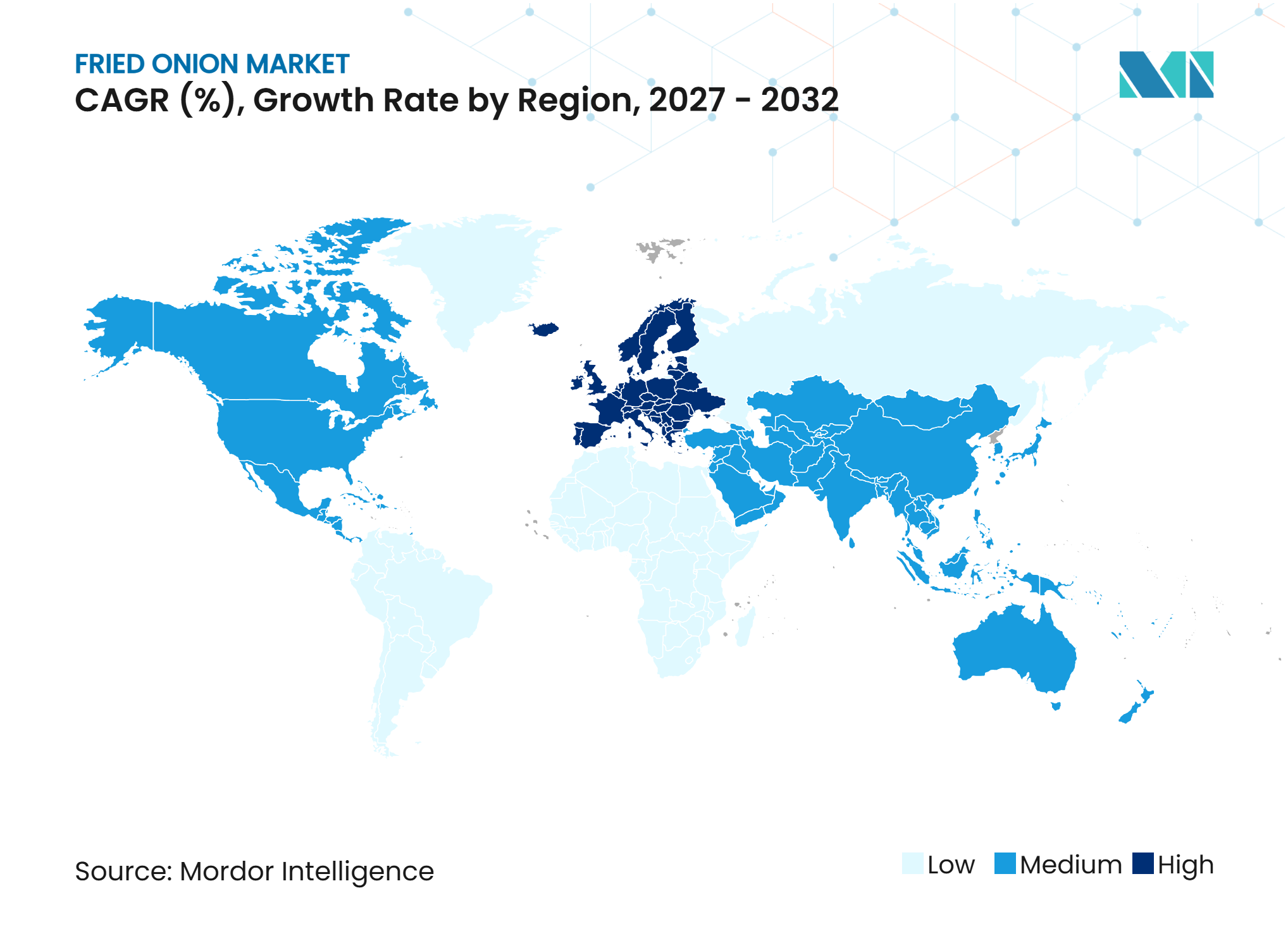
| Fastest Growing Market | Europe |
| Largest Market | Asia-Pacific |
| Market Concentration | Medium |
Major Players *Disclaimer: Major Players sorted in no particular order Image © Mordor Intelligence. Reuse requires attribution under CC BY 4.0. | |
Fried Onion Market Analysis by Mordor Intelligence
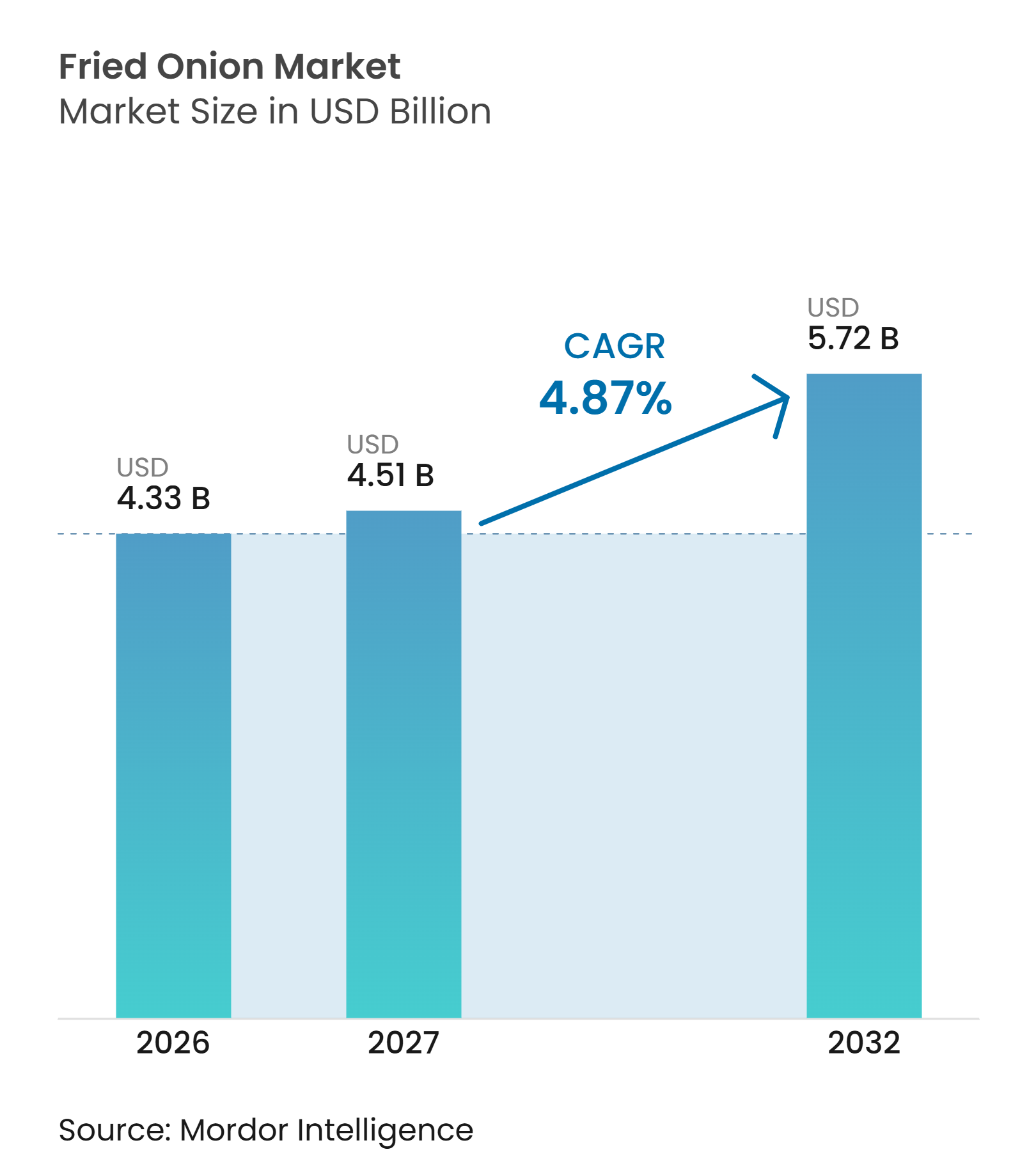
The fried onion market size is expected to grow from USD 4.33 billion in 2026 to USD 4.51 billion in 2027 and is forecast to reach USD 5.72 billion by 2032 at 4.87% CAGR over 2027-2032. Commercial kitchens are replacing fresh-onion preparation with standardized, shelf-stable products because they reduce preparation time, kitchen waste, and variation in finished dishes. Quick-service restaurants, cloud kitchens, and institutional caterers can use these products to manage larger order volumes with more consistent flavor and texture. This demand pattern gives the fried onion market support beyond grocery retail, especially where foodservice operators are formalizing procurement. Asia-Pacific remains central to demand because onion-based dishes are widely used across India, Southeast Asia, and East Asia. Producers that can offer consistent quality, documented sourcing, and dependable supply are positioned to serve both bulk foodservice and higher-value retail channels.
Key Report Takeaways
-
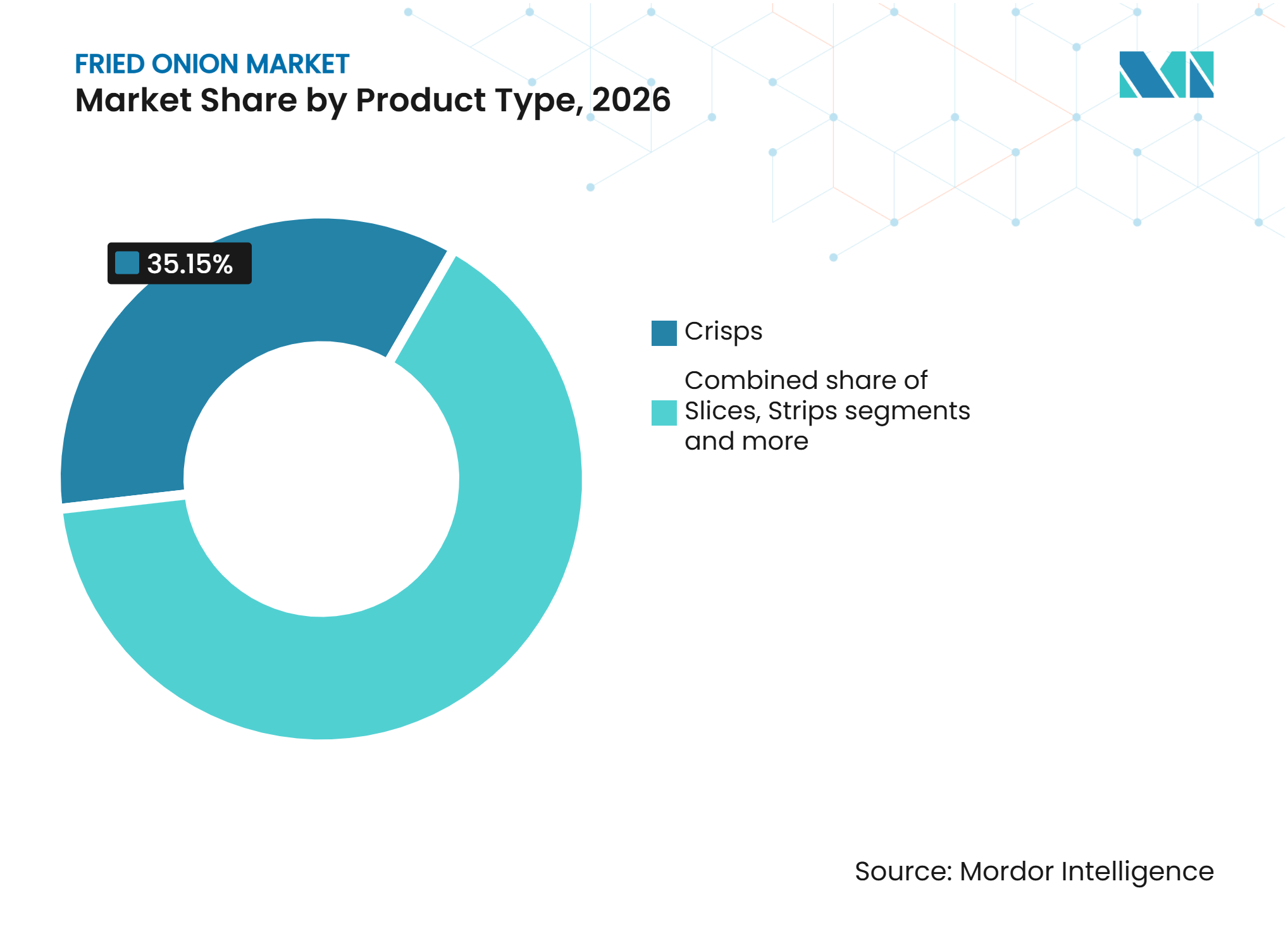
By product type, crisps held 35.15% of the fried onion market share in 2026, while slices are forecast to grow at a 5.85% CAGR through 2032.
-
By form, ready-to-use fried onions held 89.34% of the fried onion market share in 2026, while frozen fried onions are forecast to grow at a 6.01% CAGR through 2032.
-
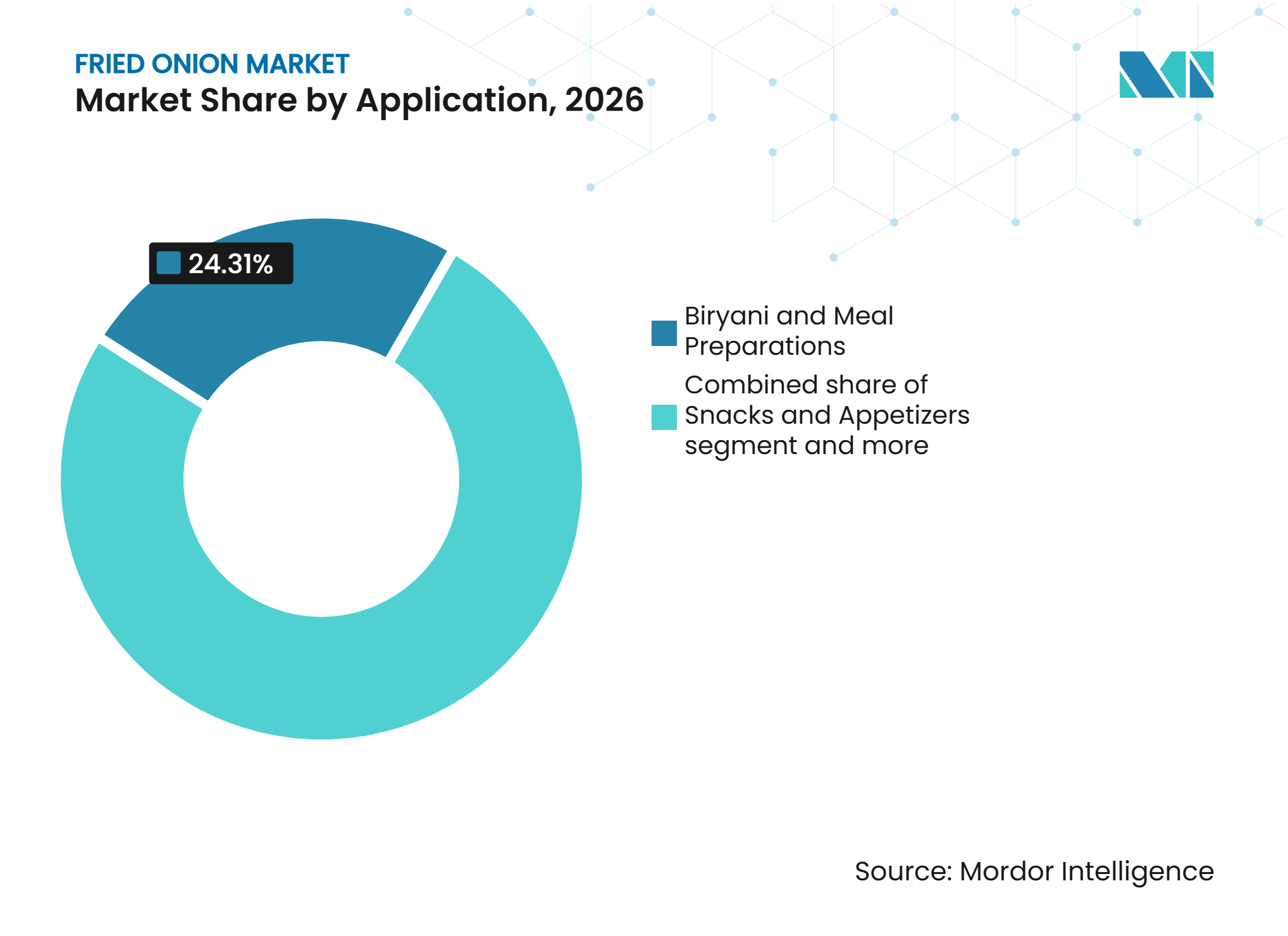
By application, biryani and rice preparations accounted for 24.31% of the fried onion market size in 2026, while snacks and appetizers are forecast to grow at a 6.24% CAGR through 2032.
-
By geography, Asia-Pacific held 38.31% of the fried onion market size in 2026, while Europe is forecast to grow at a 5.71% CAGR through 2032.
Note: Market numbers in this report are based on Mordor Intelligence's proprietary estimation framework, which combines nine months of actuals with Q4 projections for base year 2026.
Market Trends and Insights
Drivers Impact Analysis of Fried Onion Market*
| Driver | (~) % Impact on CAGR Forecast | Geographic Relevance | Impact Timeline |
|---|---|---|---|
| Rising demand for time-saving and ready-to-use ingredients in foodservice operations | +1.4% | Global | Medium term (2–4 years) |
| Growing use of fried onions in biryani, curries, burgers, and other commercial food preparations | +1.1% | Asia-Pacific, Middle East and Africa, Global | Long term (≥ 4 years) |
| Expansion of quick-service restaurants and cloud kitchens | +0.9% | Asia-Pacific, Middle East and Africa, Global | Short term (≤ 2 years) |
| Increasing demand for standardized taste and consistency across foodservice outlets | +0.5% | North America, European Union, Asia-Pacific | Medium term (2–4 years) |
| Growing adoption of pre-processed ingredients to reduce kitchen labour and preparation time | +0.4% | Global | Short term (≤ 2 years) |
| Increasing popularity of ethnic cuisines and onion-based food preparations | +0.3% | Europe, North America | Long term (≥ 4 years) |
| Source: Mordor Intelligence | |||
Rising Demand for Time-Saving, Ready-to-Use Foodservice Ingredients
Foodservice operators are increasingly adopting ready-to-use ingredients to simplify kitchen operations, reduce preparation time, and manage labour requirements. The preparation of fresh onions involves peeling, slicing, frying, and de-oiling, which can increase kitchen workload, particularly during peak service hours. Ready-to-use fried onions eliminate these preparation steps while ensuring consistent flavour, colour, and texture across food preparations. According to the National Restaurant Association's 2025 report, 77% of restaurant operators continued to identify employee recruitment and retention as significant challenges, highlighting the importance of operational efficiency[1]. This is encouraging restaurants, catering businesses, and institutional kitchens to incorporate pre-processed ingredients into their menus. Fried onions are particularly suitable for biryanis, curries, gravies, snacks, and other high-volume preparations where consistent ingredient quality and faster service are important.
Growing Use of Fried Onions in Biryani, Curries, Burgers, and Commercial Food Preparations
Fried onions are used in biryani as a flavor and texture component, rather than only as a garnish. Swiggy recorded 93 million biryani orders in 2025, compared with 83 million orders in 2024, which shows the scale of demand linked to this dish in organized delivery channels. Unilever Food Solutions identified stronger global interest in Asian flavors, including Indian curry and rice dishes, in its 2025 Future Menus report[2]. The company also reported that 65% of Gen Z consumers seek value in street-food formats that use bold garnishes. Demand also comes from curries, burger toppings, sauces, and snack formats, which reduces dependence on any single food category. This wider use supports the Fried onion market across both Asian and Western foodservice menus.
Expansion of Quick-Service Restaurants and Cloud Kitchens
Cloud kitchens are reorganising how fried onion ingredients are sourced and consumed. talabat Kitchens, the region's largest multi-market cloud kitchen network, reached 30+ hubs across the UAE, Kuwait, Qatar, Bahrain, and Jordan in 2025, supporting over 1,000 restaurant brands, with plans to reach 50 hubs over the next three years[3]. Cloud kitchens generated an additional USD 200 million in HRI revenue in Saudi Arabia in 2024 and are projected to contribute another USD 500 million by 2030. Unlike traditional restaurants, cloud kitchens source ingredients in bulk with strict consistency requirements—a procurement model that particularly favours standardised fried onion formats over fresh-onion preparation and positions ready-to-use and frozen product types as the preferred supply choices in this fastest-growing foodservice segment.
Increasing Demand for Standardized Taste and Consistency Across Foodservice Outlets
Foodservice operators are increasingly prioritizing standardized taste, flavor, and presentation across their outlets to maintain consistent customer experiences. The use of fresh onions can result in variations in sweetness, moisture content, colour, and texture depending on the onion variety, storage conditions, and preparation methods. Commercially processed fried onions offer greater consistency in frying quality, colour, crispness, and flavour across different batches. Their use also helps restaurant chains, cloud kitchens, catering businesses, and institutional foodservice operators maintain uniform food quality across multiple locations. Additionally, pre-processed fried onions reduce variations associated with manual slicing, frying temperatures, cooking durations, and oil absorption.
Restraints Impact Analysis of Fried Onion Market*
| Restraint | (~) % Impact on CAGR Forecast | Geographic Relevance | Impact Timeline |
|---|---|---|---|
| Fluctuations in raw onion prices and seasonal availability | -1.3% | Global; peak exposure in European Union, India, Philippines | Medium term (2–4 years) |
| High frying and processing costs | -0.9% | Asia, Europe | Medium term (2–4 years) |
| Short shelf life and susceptibility to moisture absorption | -0.5% | Global | Long term (≥ 4 years) |
| Concerns regarding high fat and calorie content | -0.3% | Western Europe, North America | Long term (≥ 4 years) |
| Source: Mordor Intelligence | |||
Fluctuations in Raw Onion Prices and Seasonal Availability
The fried onion market is exposed to fluctuations in raw onion prices and seasonal variations in agricultural supply, which can affect manufacturers' procurement costs and production planning. Onion production is influenced by weather conditions, crop yields, regional harvesting cycles, and disruptions in transportation and storage. Unfavourable weather events, crop diseases, and supply shortages can reduce the availability of suitable onions and increase procurement expenses for processors. Since raw onions represent a key input in fried onion manufacturing, sudden price increases can raise overall production costs and compress manufacturers' profit margins. Seasonal supply variations also create challenges in maintaining consistent production volumes, product pricing, and supply commitments to foodservice customers.
High Frying and Processing Costs
The production of fried onions involves multiple processing stages, including peeling, washing, slicing, frying, de-oiling, cooling, and packaging, which contribute to overall manufacturing expenses. Frying operations require substantial quantities of cooking oil and continuous energy consumption to maintain controlled processing temperatures and consistent product quality. Additionally, manufacturers must invest in specialized equipment, automated processing lines, oil filtration systems, and quality control infrastructure to ensure uniform colour, texture, and crispness. Rising costs of edible oils, electricity, fuel, packaging materials, and equipment maintenance can further increase production expenses. Maintaining product shelf life and preventing moisture absorption also require appropriate packaging materials and storage conditions, adding to operational costs.
*Our forecasts treat driver/restraint impacts as directional, not additive. The impact forecasts reflect baseline growth, mix effects, and variable interactions.
Fried Onion Market Segment Analysis
By Product Type:
Slices Gain Ground Alongside Crisp LeadershipBy product type, crisps accounted for the largest share of the fried onion market, representing 35.15% in 2026. Their leading position is supported by their widespread use as ready-to-use toppings and garnishes across various food applications. Crispy fried onions are commonly incorporated into biryanis, curries, soups, salads, sandwiches, burgers, and snack preparations to enhance flavour and texture. Their crunchy consistency and concentrated savoury taste make them suitable for both commercial foodservice operations and packaged food manufacturing. Additionally, their convenience eliminates the need for time-consuming onion slicing and frying during food preparation.
The slices segment is projected to register the fastest growth in the fried onion market, with a CAGR of 5.85% through 2032. Growth is driven by the increasing use of fried onion slices as flavour-enhancing ingredients in traditional and convenience food preparations. Their distinct shape, texture, and uniform appearance make them suitable for applications such as biryanis, pulao, curries, gravies, and ready-to-eat meals. Foodservice operators increasingly incorporate pre-fried onion slices to reduce preparation time, maintain consistency, and streamline kitchen operations.



By Form:
Frozen Products Build on Cloud Kitchen RequirementsReady-to-use fried onions accounted for the largest share of the fried onion market, representing 89.34% in 2026. Their dominance is primarily supported by the convenience they offer to foodservice operators, restaurants, catering businesses, and food manufacturers. These products are available in pre-fried formats that can be directly incorporated into food preparations without requiring additional slicing, frying, or processing. Their widespread use in biryanis, curries, gravies, soups, salads, and other prepared meals further supports segment demand.
The frozen fried onions segment is projected to register the fastest growth in the fried onion market, with a CAGR of 6.01% through 2032. Growth is supported by increasing demand for convenient food ingredients that offer extended storage potential and ease of handling. Freezing helps preserve the product's sensory characteristics and reduces dependence on frequent fresh product procurement when supported by appropriate cold-chain conditions. These products are suitable for restaurants, institutional kitchens, catering businesses, and food manufacturers requiring consistent ingredient availability.
By Application:
Snack Formats Extend Demand Beyond Meal PreparationBiryani and rice preparations accounted for the largest share of the fried onion market, representing 24.31% in 2026. The segment's leading position is supported by the extensive use of fried onions as a key ingredient and garnish in traditional rice-based dishes. Fried onions contribute characteristic sweetness, aroma, colour, and texture to preparations such as biryani, pulao, and other flavoured rice dishes. Their incorporation during cooking and final garnishing makes them an important ingredient across household, restaurant, catering, and institutional foodservice applications. The growing presence of biryani-focused restaurants, cloud kitchens, and takeaway foodservice establishments further supports commercial demand.
The snacks and appetizers segment is projected to register the fastest growth in the fried onion market, with a CAGR of 6.24% through 2032. Growth is supported by the increasing incorporation of fried onions as flavour-enhancing ingredients and crunchy toppings across diverse snack preparations. Their savoury taste and crispy texture make them suitable for applications such as savoury mixtures, savoury pastries, fritters, sandwiches, burgers, and other quick-service food offerings. The expansion of packaged snacks and convenience food categories is also creating opportunities for fried onion ingredients in commercial food manufacturing.

Geography Analysis
Asia-Pacific
Asia-Pacific accounted for the largest share of the fried onion market, representing 38.31% in 2026. The region's dominance is supported by the widespread use of fried onions in traditional cuisines, particularly across India, Indonesia, Malaysia, Thailand, and other Southeast Asian markets. Fried onions are extensively incorporated into biryanis, rice preparations, curries, noodles, snacks, and various ready-to-eat food products. The strong presence of restaurants, catering businesses, street food vendors, and organized foodservice chains further supports regional consumption. Additionally, the availability of onion processing facilities and established agricultural supply chains in countries such as India supports the production of fried onions for domestic consumption and exports.
Europe
Europe is projected to register the fastest growth in the fried onion market, with a CAGR of 5.71% through 2032. Growth is supported by the increasing incorporation of fried onions into convenience foods, prepared meals, snacks, and foodservice offerings. The expanding popularity of international cuisines, including Indian, Middle Eastern, and Asian dishes, is creating opportunities for fried onion ingredients across European foodservice establishments. Additionally, demand from food manufacturers for ready-to-use ingredients that enhance flavour and texture is supporting product adoption. The region's established packaged food industry and expanding ready-meal segment further contribute to demand for processed onion products.
North America, South America, and Middle East and Africa
North America represents an established market for fried onions, supported by their use in burgers, salads, casseroles, sandwiches, and convenience food preparations. Demand from quick-service restaurants, food manufacturers, and institutional foodservice operators supports the adoption of crispy fried onion toppings and ready-to-use formats. In South America, consumption is supported by the incorporation of fried onions into traditional dishes, meat preparations, rice-based meals, and snacks, particularly in Brazil and Argentina. The expansion of restaurants and packaged food manufacturing is creating additional opportunities for commercial fried onion suppliers. Meanwhile, the Middle East and Africa market benefits from the use of fried onions in rice dishes, biryanis, meat preparations, and traditional meals.
Competitive Landscape
Market Concentration
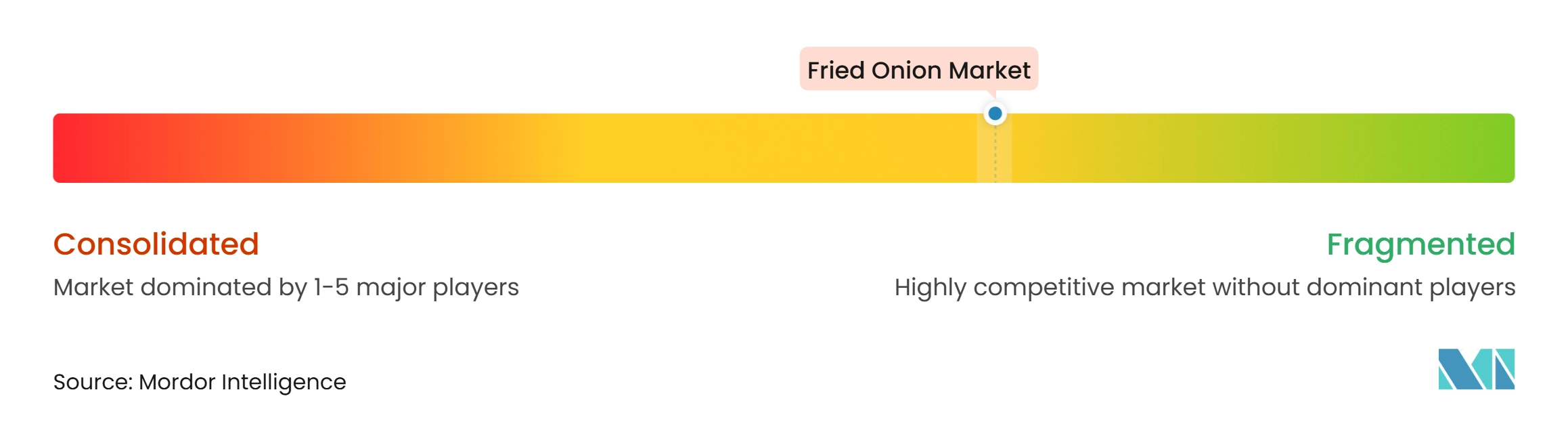
The fried onion market is fragmented, with the presence of several established ingredient manufacturers and specialized onion processing companies competing across product quality, pricing, processing capabilities, and distribution networks. Olam Group Limited (ofi) participates in the market through its processed food ingredient portfolio, leveraging its global sourcing network and established food ingredient supply capabilities. McCormick & Company, Incorporated strengthens its position through its expertise in seasonings, flavor solutions, and food ingredient applications, supporting demand from food manufacturers and foodservice customers.
Natural Dehydrated Vegetables Private Limited and Lion Foods B.V. represent specialized participants in the processed onion and vegetable ingredient industry. Natural Dehydrated Vegetables Private Limited focuses on processed vegetable ingredients, supported by its expertise in onion processing and ingredient manufacturing. Lion Foods B.V. participates through its range of processed onion products, including fried onion ingredients, catering to food manufacturers and international customers.
The Onion Group (TOP Taste B.V.) further contributes to the competitive landscape through its specialization in processed onion products and value-added onion ingredients. The company serves industrial food manufacturers and foodservice customers requiring processed onion solutions for different culinary applications. Competition among these players is influenced by product formats, frying quality, colour consistency, flavour retention, shelf life, and pricing. Manufacturing efficiency, raw onion sourcing, food safety certifications, and international distribution capabilities also influence supplier selection.
Fried Onion Industry Leaders
-
Olam Group Limited (ofi)
-
McCormick & Company, Incorporated
-
Lion Foods B.V.
-
The Onion Group (TOP Taste B.V.)
-
Natural Dehydrated Vegetables Private Limited
- *Disclaimer: Major Players sorted in no particular order
Fried Onion Market Companies Covered in this Report
- Olam Group Limited (ofi)
- McCormick & Company, Incorporated
- Natural Dehydrated Vegetables Private Limited
- Lion Foods B.V.
- The Onion Group (TOP Taste B.V.)
- Shimla Hills Offerings Private Limited
- Fresh Gourmet Company
- Roland Foods, LLC
- Kissan International
- Farmvilla Food Industries Private Limited
- Chhatariya Foods
- Doel Onions (Van Den Doel B.V.)
- Beevis Foods
- Kings Crispy Onions
- Poldar Fried Onion Manufacturer
- Bagora Dehydrates
- SKY Agri Export
- TO Foods Co., Ltd.
- Megahwan Food Sdn. Bhd.
- Maharaja Dehydration Pvt. Ltd.
Recent Industry Developments in Fried Onion Market
- September 2026: Lalsai Global Limited showcased its Crispy Fried Onion range, targeting applications such as biryani, pulao, soups, salads, burgers, sandwiches, and snacks. Its product credentials included BRCGS food safety, FDA registration, Halal, and Kosher certifications, supporting its positioning across international food ingredient markets.
- August 2026: Sky Agri Export introduced its Vaidic-branded Fresh Fried Onion range, targeting commercial food applications. The product highlighted the convenience of pre-fried onions for restaurants and quick-service kitchens, where ready-to-use ingredients help reduce preparation time.
- January 2026: Lalsai Global Limited showcased its fried onion portfolio at Gulfood 2026, highlighting multiple product cuts, including flakes, kibbled, sliced, and customized sizes. The company emphasized controlled frying technology, consistent crispness, low moisture content, and shelf stability for food processing and foodservice applications.
Global Fried Onion Market Report Scope
Fried onions refer to onions that are sliced or chopped and cooked in edible oil or fat through frying until they develop a golden-brown colour, crispy texture, and characteristic savory flavor. The fried onion market is segmented by product type, form, application and geography. Based on product type, the market is segmented into slices, strips, flakes, crisps, and minced. By form, the market is segmented into ready-to-use fried onions, and frozen fried onions. By application, the market is segmented into burger and sandwich toppings, biryani and rice preparations, curries, gravies and sauces, soups and stews, salads and meat toppings, snacks and appetizers, and other applications. By geography, the market is segmented into North America, Europe, Asia-Pacific, South America, and Middle-East and Africa. For each segment, the market sizing and forecasting have been done in value terms (USD billion).
Segmentation Overview
| Slices |
| Strips |
| Flakes |
| Crisps |
| Minced |
| Ready-to-Use Fried Onions |
| Frozen Fried Onions |
| Burger and Sandwich Toppings |
| Biryani and Rice Preparations |
| Curries, Gravies and Sauces |
| Soups and Stews |
| Salads and Meal Toppings |
| Snacks and Appetizers |
| Other Foodservice Applications |
| North America | United States |
| Canada | |
| Mexico | |
| Rest of North America | |
| Europe | United Kingdom |
| Germany | |
| France | |
| Italy | |
| Spain | |
| Netherlands | |
| Poland | |
| Belgium | |
| Sweden | |
| Rest of Europe | |
| Asia-Pacific | China |
| Japan | |
| India | |
| Australia | |
| Indonesia | |
| South Korea | |
| Thailand | |
| Singapore | |
| Rest of Asia-Pacific | |
| South America | Brazil |
| Argentina | |
| Colombia | |
| Chile | |
| Peru | |
| Rest of South America | |
| Middle East and Africa | South Africa |
| Saudi Arabia | |
| United Arab Emirates | |
| Nigeria | |
| Egypt | |
| Morocco | |
| Turkey | |
| Rest of Middle East and Africa |
| Product Type | Slices | |
| Strips | ||
| Flakes | ||
| Crisps | ||
| Minced | ||
| By Form | Ready-to-Use Fried Onions | |
| Frozen Fried Onions | ||
| By Application | Burger and Sandwich Toppings | |
| Biryani and Rice Preparations | ||
| Curries, Gravies and Sauces | ||
| Soups and Stews | ||
| Salads and Meal Toppings | ||
| Snacks and Appetizers | ||
| Other Foodservice Applications | ||
| By Geography | North America | United States |
| Canada | ||
| Mexico | ||
| Rest of North America | ||
| Europe | United Kingdom | |
| Germany | ||
| France | ||
| Italy | ||
| Spain | ||
| Netherlands | ||
| Poland | ||
| Belgium | ||
| Sweden | ||
| Rest of Europe | ||
| Asia-Pacific | China | |
| Japan | ||
| India | ||
| Australia | ||
| Indonesia | ||
| South Korea | ||
| Thailand | ||
| Singapore | ||
| Rest of Asia-Pacific | ||
| South America | Brazil | |
| Argentina | ||
| Colombia | ||
| Chile | ||
| Peru | ||
| Rest of South America | ||
| Middle East and Africa | South Africa | |
| Saudi Arabia | ||
| United Arab Emirates | ||
| Nigeria | ||
| Egypt | ||
| Morocco | ||
| Turkey | ||
| Rest of Middle East and Africa | ||
Key Questions Answered in the Report
What is the projected value of the fried onion sector by 2032?
The fried onion market is projected to reach USD 5.72 billion by 2032 from USD 4.33 billion in 2026. The projected 4.87% CAGR reflects recurring foodservice demand for standardized, ready-to-use ingredients.
Which fried onion product format has the largest share?
Ready-to-Use Fried Onions held 89.34% share by form in 2026. The Fried onion market relies on this ambient format because it is shelf-stable, easy to transport, and does not require cold-chain distribution.
Which fried onion product type is growing fastest?
Slices are projected to grow at a 5.85% CAGR through 2032. In the Fried onion market, the format serves operators that want a visible garnish with texture for plated and higher-value foodservice presentations.
Which application is expected to grow fastest for fried onions?
Snacks and Appetizers are forecast to grow at a 6.24% CAGR through 2032. The Fried onion market is reaching more direct snack and premium retail formats while retaining its role in meal preparation.
Which region leads fried onion consumption?
Asia-Pacific held 38.31% share in 2026, supported by wide use in Indian, Southeast Asian, and East Asian food preparations. Organized foodservice growth and regional export activity give the region a central role in demand.