
France Hydroponics Market Size and Share
Market Overview
| Study Period | 2021 - 2031 |
|---|---|
| Forecast Data Period | 2026 - 2031 |
| Base Year Market Size (2025) | USD 190.12 Million |
| Market Size (2026) | USD 200.32 Million |
| Market Size (2031) | USD 290.64 Million |
| Growth Rate (2026 - 2031) | 7.73 % |
| Market Concentration | Low |
Major Players *Disclaimer: Major Players sorted in no particular order Image © Mordor Intelligence. Reuse requires attribution under CC BY 4.0. | |
France Hydroponics Market Analysis by Mordor Intelligence
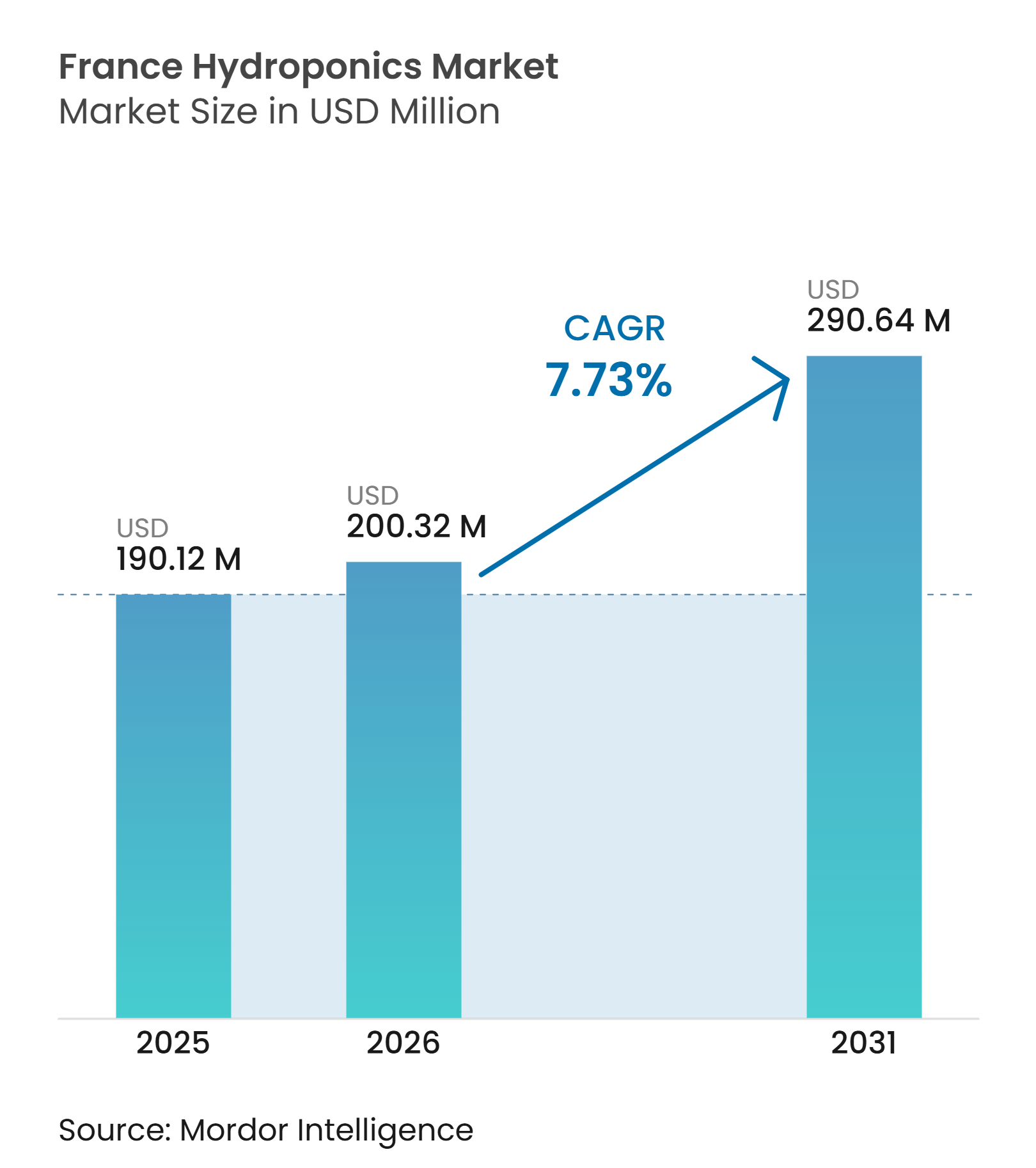
The France hydroponics market is projected to grow from USD 190.12 million in 2025 and USD 200.32 million in 2026 to USD 290.64 million by 2031, registering a CAGR of 7.73% between 2026 and 2031. France is a mature Western European market where controlled-environment production is increasingly becoming a regular supply option for retailers and foodservice operators. The Écophyto 2030 strategy supports this transition by targeting a 50% reduction in phytopharmaceutical use and risk by 2030[1]. Retailers are increasingly seeking pesticide-free produce year-round, favoring hydroponic growers that can closely manage production conditions. Rising energy costs remain a significant constraint for farms that depend on artificial lighting[2]. Public support for pilot projects and production technologies can help producers manage this transition and support long-term market development.
Key Report Takeaways
- By system type, aggregate systems accounted for the largest 55.3% of the France hydroponics market share in 2025, while aeroponics is forecast to grow fastest at a 10.5% CAGR through 2026 to 2031.
- By farming type, commercial greenhouses accounted for the laregest 58.1% of the France hydroponics market size in 2025, while vertical farms are forecast to grow at a 10.0% CAGR through 2026 to 2031.
- By crop type, leafy vegetables accounted for the largest share, at 45.2%, of the French hydroponics market in 2025, while strawberries are forecast to grow at a 9.5% CAGR through 2026 to 2031.
Note: Market size and forecast figures in this report are generated using Mordor Intelligence’s proprietary estimation framework, updated with the latest available data and insights as of January 2026.
Market Trends and Insights
Drivers Impact Analysis of France Hydroponics Market*
| Driver | (~) % Impact on CAGR Forecast | Geographic Relevance | Impact Timeline |
|---|---|---|---|
| Pesticide-free and year-round produce demand | +2.0% | National, strongest retail demand in Paris, Lyon, and Bordeaux | Short term (≤ 2 years) |
| Water scarcity and closed-loop efficiency | +1.5% | National, especially PACA and Occitanie | Medium term (2-4 years) |
| Urban agriculture and short supply chains | +1.2% | Île-de-France and major urban areas | Short term (≤ 2 years) |
| Climate volatility and protected cultivation | +1.0% | National, including southern and inland regions | Medium term (2-4 years) |
| Waste-heat integration for farms | +0.8% | Industrial zones and data-center hubs, with early activity in Grand Est and Occitanie | Long term (≥ 4 years) |
| Retailer-specified cultivars and quality control | +0.6% | National, linked to major grocery networks | Short term (≤ 2 years) |
| Source: Mordor Intelligence | |||
Pesticide-free and year-round produce demand
France's retail sector increasingly treats pesticide-free sourcing as a baseline requirement rather than a premium feature. The France hydroponics market benefits from the Écophyto 2030 strategy, which encourages production systems that reduce dependence on conventional crop protection products. Soilless cultivation enables growers to maintain tighter control over crop environments and limit exposure to soil-borne pest and disease pressures. Retailers can also request specific lettuce and herb varieties when growers can supply consistent volumes under controlled conditions. The combination of traceability, production consistency, and dependable delivery supports stronger long-term relationships between growers and retail buyers.
Water Scarcity and Closed-Loop Resource Efficiency
Repeated drought restrictions in southern France during 2025 strengthened the operational case for recirculating production systems. Hydroponic recirculating systems, which, according to the Food and Agriculture Organization of the United Nations, can use up to 90% less water than soil-based cultivation, offer a direct benefit to the France hydroponics market[3]. This advantage is particularly relevant for producers in Mediterranean regions and Occitanie. Closed-loop fertigation systems can also reduce nutrient discharge into local water bodies. Farms that monitor water quality in real time are better positioned to demonstrate compliance with water management standards. As a result, water efficiency is becoming an increasingly important component of routine farm planning, rather than a measure adopted only when formal restrictions take effect.
Urban Agriculture and Short Supply Chains
Dense metropolitan areas concentrate demand for fresh produce and place greater value on shelf life. The France hydroponics market can address this demand by supporting farms located within or near major urban centers. Shorter delivery routes can reduce the time between harvest and retail sale from days to hours. Les Fermes Ionaka reports water savings of up to 90% compared with conventional production through its aeroponic tower systems, highlighting the resource-efficiency advantages of urban cultivation. Its deployments at data-center sites in Bordeaux, Toulouse, and Strasbourg demonstrate how urban farms can integrate production with existing infrastructure. This approach enables operators to connect food production with local energy and property assets rather than relying on separate agricultural sites.
Climate Volatility and Protected Cultivation
Heat and irregular rainfall are reducing the reliability of outdoor production for soft fruits and herbs across France, strengthening the role of the hydroponics market as growers seek production systems less exposed to weather-related disruptions. Summer heat in southern France in 2025 led to blossom loss, fruit deformity, and plant health issues in outdoor strawberry production, highlighting the vulnerability of field-grown crops to extreme weather. Controlled-environment systems can maintain production when adverse weather affects outdoor cultivation. The reduced availability of approved active substances also limits corrective options for conventional growers facing pest and disease pressure. As a result, retail buyers seeking stable volumes are placing greater importance on suppliers that can protect production from weather-related disruptions.
Restraints Impact Analysis of France Hydroponics Market*
| Restraint | (~) % Impact on CAGR Forecast | Geographic Relevance | Impact Timeline |
|---|---|---|---|
| High initial capital requirements | -1.8% | National, particularly for smaller operators outside metropolitan areas | Long term (≥ 4 years) |
| Energy intensity of artificial lighting | -1.5% | National, concentrated in fully lit vertical facilities | Medium term (2-4 years) |
| Grid connections and permitting delays | -0.7% | Île-de-France and periurban areas with limited grid capacity | Medium term (2-4 years) |
| Biological control, biosecurity, and traceability complexity | -0.6% | National, especially in multicrop container and vertical farms | Long term (≥ 4 years) |
| Source: Mordor Intelligence | |||
Energy Intensity of Artificial Lighting
Supplemental lighting and full climate control remain major operating costs in the France hydroponics market, particularly for indoor and vertical farming operations. France's 2025 average wholesale spot electricity price was (EUR 61/MWh) USD 71.4/MWh. Farms relying on artificial lighting year-round can incur energy expenses that account for a substantial share of production costs, especially for commodity leafy vegetables. This cost pressure is encouraging operators to focus on herbs, edible flowers, and specialty crops with stronger value realization. Energy-efficiency requirements and performance monitoring also add operational considerations for intensive cultivation systems. As a result, producers must carefully balance crop selection, yield targets, lighting strategies, and local energy conditions to maintain commercial viability.
Grid Connections and Permitting Delays
Large indoor farming projects often require power connections that exceed standard agricultural grid capacity. In some peri-urban areas around Paris, limited distribution capacity and aging infrastructure can constrain new development. Grid upgrades may delay project commissioning by 12 to 24 months, affecting investment timelines and project economics. Planning authorities also apply varying criteria for change-of-use permits in former industrial and logistics buildings. These challenges can favor established greenhouse operators that expand on already permitted agricultural sites. As a result, developers in the France hydroponics market must evaluate electrical capacity and local planning requirements at an early stage, as both can significantly influence project costs and implementation schedules.
*Our forecasts treat driver/restraint impacts as directional, not additive. The impact forecasts reflect baseline growth, mix effects, and variable interactions.
France Hydroponics Market Segment Analysis
By System Type:
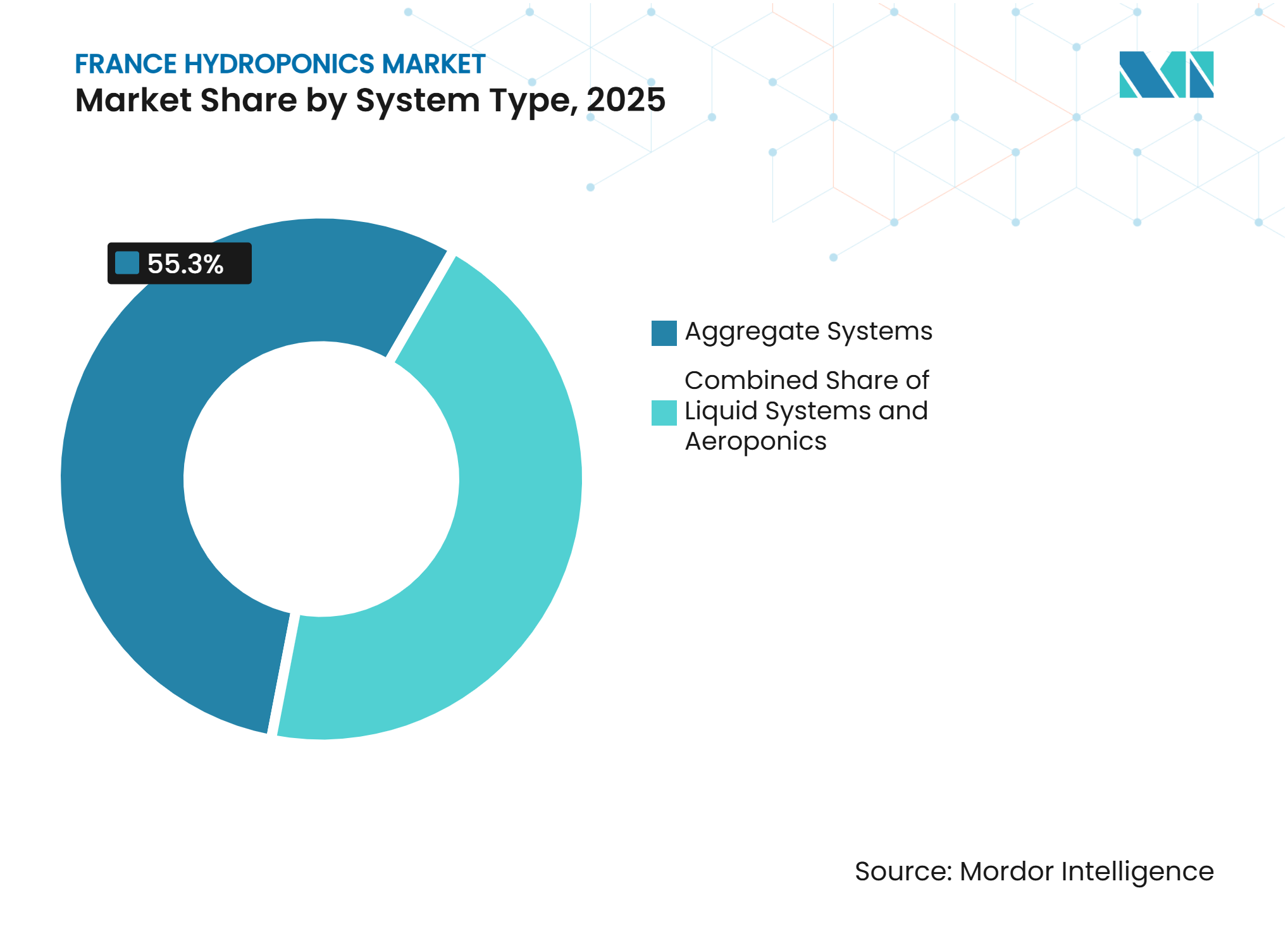
Aggregate Systems Support Established Greenhouse ProductionAggregate systems accounted for about 55.3% of the France hydroponics market share in 2025. Their strong position is supported by the long-standing use of rockwool, perlite, and coconut-fiber substrates in commercial tomato and cucumber greenhouses. These systems benefit from established supply chains, proven production methods, and compatibility with precision drip irrigation. Growers expanding capacity while maintaining familiar cultivation and crop-management practices continue to rely on aggregate systems. Grodan, a division of ROCKWOOL A/S, supports this segment through its extensive substrate distribution network across Western Europe.
Liquid systems occupy a middle position within the installed base, particularly in lettuce and herb production. Their suitability for 21- to 35-day crop cycles supports continuous planting schedules and frequent harvests throughout the year. Aeroponics is the fastest-growing system type and is projected to expand at a CAGR of 10.5% through 2031. Interest in aeroponic systems is increasing for urban and infrastructure-linked production where land availability is limited and water efficiency is a priority. Ionaka's aeroponic tower installations at data-center sites demonstrate this approach, with the company reporting up to 90% lower water use than conventional production.



By Farming Type:
Commercial Greenhouses Remain the Main Production FormatCommercial greenhouses accounted for 58.1% of the France hydroponics market share in 2025. Their dominance is supported by established protected-cultivation infrastructure across Brittany, the Loire Valley, and the Mediterranean coast. According to the research, more than 85% of French tomatoes were produced in controlled-environment greenhouses in 2024. This extensive installed base reinforces the role of commercial greenhouses in high-volume soilless production. Greenhouses also allow operators to leverage established production practices, labor availability, and distribution networks.
Vertical farms are forecast to grow at a 10.0% CAGR through 2026 to 2031. These facilities commonly focus on microgreens, specialty herbs, and edible flowers, where higher retail values can better offset operating costs. The France hydroponics market is also expanding through warehouse-conversion projects that serve nearby supermarkets and institutional food channels. A Lyon facility, housed in a former 3,000 m² logistics hall and producing leafy vegetables in a controlled environment, illustrates this trend. Such facilities demonstrate how hydroponic production can achieve high output density while significantly reducing water consumption compared with conventional cultivation.
By Crop Type:
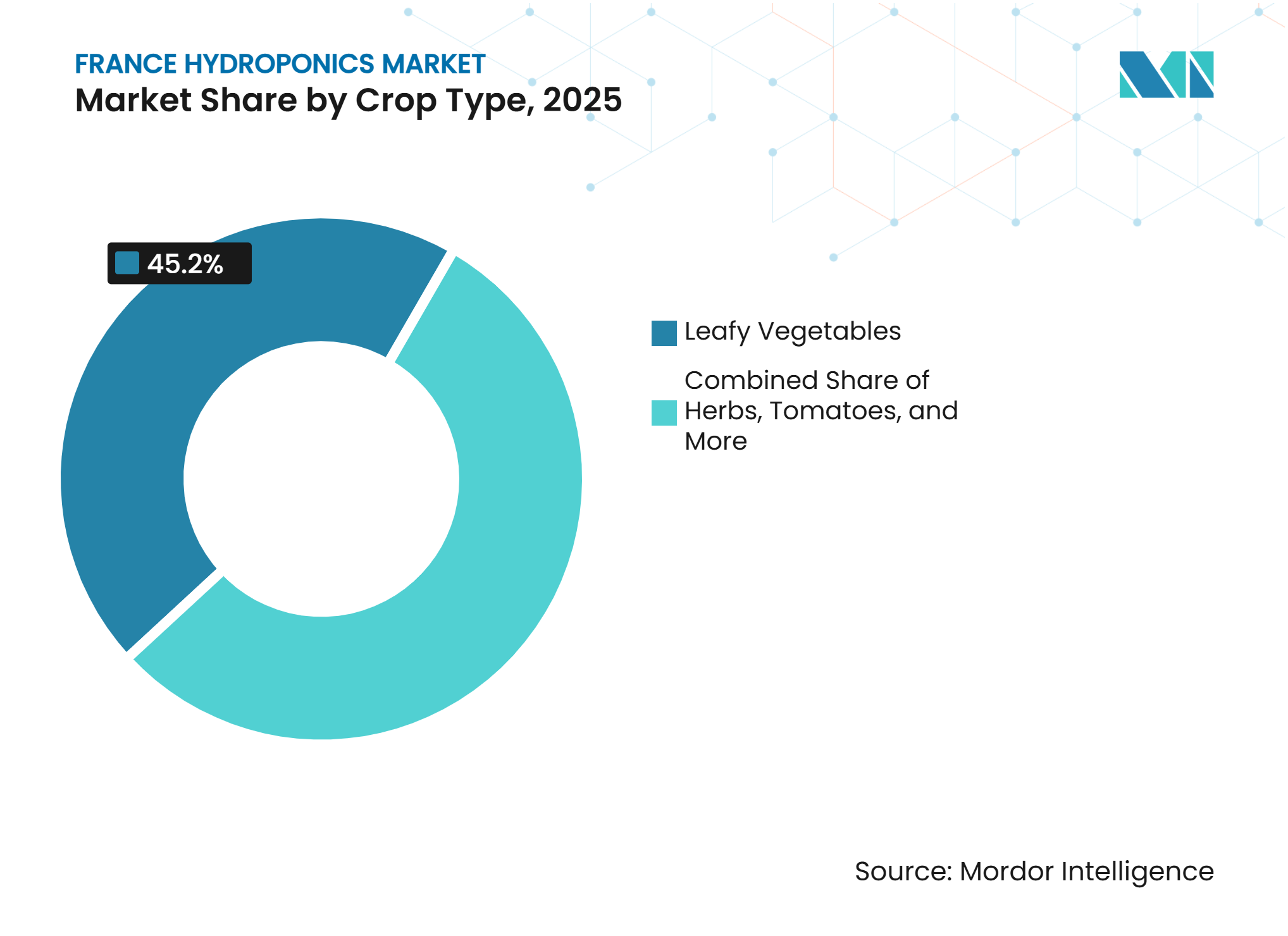
Leafy Vegetables Lead Revenue While Strawberries Grow FastestLeafy vegetables held 45.2% of the France hydroponics market share in 2025. This position reflects steady year-round demand, short crop cycles, and the value placed on fresh local supply. Leafy crops are well-suited to the controlled conditions of hydroponic systems. Herbs are an important adjacent category for growers that require continuous supply schedules. Les Crudettes and CleanGreens operate an aeroponic greenhouse that produces pesticide-free herbs year-round, demonstrating the commercial viability of controlled-environment herb production.
Tomatoes and cucumbers are primarily grown in substrate-based greenhouse systems that support consistent quality and predictable yields. France's cooperative marketing structure allows mid-sized growers to participate in national retail programs and maintain reliable supply relationships. Strawberries are forecast to grow at a 9.5% CAGR through 2026 to 2031. Protected strawberry cultivation continues to expand as growers seek greater protection from weather variability and stronger control over production conditions. Controlled-environment systems are increasingly supporting a stable strawberry supply for retail channels.

Geography Analysis
Île-de-France and the Greater Paris basin remain the primary investment center within the France hydroponics market. The region benefits from a large consumer base, extensive retail networks, redevelopment opportunities in former logistics facilities, and strong access to investment capital. In 2025, Les Nouvelles Fermes advanced the development of a large aquaponics project in Carrières-sous-Poissy, supported by external financing and designed to combine vegetable and fish production within a recirculating system. The project reflects growing interest in resource-efficient food production close to major urban consumption centers, where reliable local supply and shorter distribution routes are increasingly valued.
Southern France, including Occitanie, Provence-Alpes-Côte d'Azur (PACA), and the Atlantic Southwest, represents another important growth area for the France hydroponics market. Recurring drought conditions and irrigation restrictions continue to strengthen the case for recirculating cultivation systems across these regions. Richel Group S.A.S. developed Project Phoenix in Mauguio as an example of climate-resilient greenhouse production. The facility combines soilless cultivation, photovoltaic panels, and inflatable double-wall insulation to improve growing conditions during periods of high temperatures. The project also demonstrates how protected cultivation can support consistent supply programs while reducing dependence on conventional crop-protection practices.
Grand Est, Auvergne-Rhône-Alpes, and Essonne are emerging as additional investment locations within the France hydroponics market. Ionaka expanded its aeroponic production model through an installation at an UltraEdge data center site in Strasbourg, demonstrating how controlled-environment agriculture can be integrated with existing infrastructure. The Drôme region continues to attract interest in aquaponic greenhouse development, while Auvergne-Rhône-Alpes also hosts indoor farming projects supplying supermarkets and institutional food channels. Essonne is attracting attention through plans for large-scale automated farming projects that combine controlled-environment greenhouse production with advanced cultivation technologies, further broadening the geographic footprint of hydroponic investment across France.
Competitive Landscape
Market Concentration
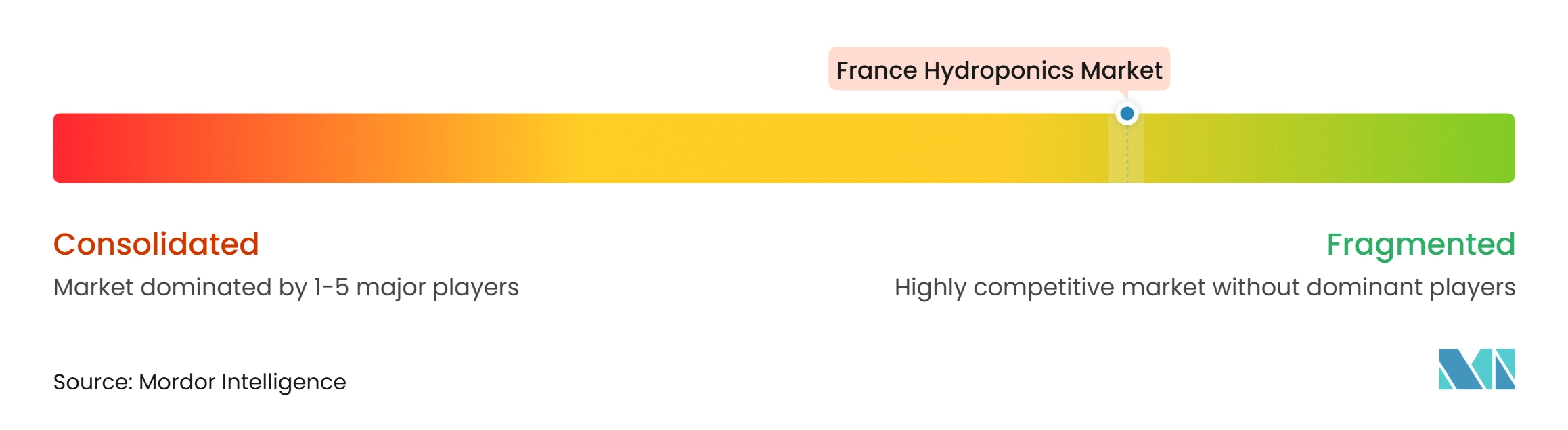
The France hydroponics market was fragmented in 2025, with competition spread across technology providers, greenhouse specialists, and commercial farm operators. Signify Holding B.V. supplies horticultural lighting solutions, while ROCKWOOL A/S serves growers through its Grodan substrate portfolio. Netafim Ltd. competes in precision irrigation and fertigation systems, while Priva Holding B.V. and Hoogendoorn Growth Management B.V. provide climate-control and greenhouse management technologies. These companies increasingly compete through integrated cultivation platforms that combine irrigation, climate management, lighting, and operational intelligence.
Signify Holding B.V. continued expanding its smart-lighting capabilities through advanced spectrum-management solutions integrated with systems from Ridder Holding Harderwijk B.V. At the same time, Netafim Ltd. introduced irrigation technologies designed to improve application consistency and simplify installation. These developments reflect the market's emphasis on efficient resource utilization, improved crop performance, and lower operating costs across controlled-environment production systems.
Farm operators are also broadening their activities beyond crop production into engineering, facility design, commissioning, and technical support services. Organic hydroponics under EU regulatory frameworks and modular production systems for hospitals, campuses, and logistics hubs remain emerging areas of development. Dosatron International S.A.S. and Richel Group S.A.S. continue to support domestic growers while serving international markets. The France hydroponics market therefore combines established greenhouse technology suppliers with emerging urban farming and infrastructure-linked production models.
France Hydroponics Industry Leaders
-
Signify Holding B.V.
-
ROCKWOOL A/S
-
Netafim Ltd.
-
Priva Holding B.V.
-
Ridder Holding Harderwijk B.V.
- *Disclaimer: Major Players sorted in no particular order
France Hydroponics Market Companies Covered in this Report
- Signify Holding B.V.
- ROCKWOOL A/S
- Netafim Ltd.
- Priva Holding B.V.
- Ridder Holding Harderwijk B.V.
- Hoogendoorn Growth Management B.V.
- Urban Crop Solutions BV
- Argus Control Systems Limited
- Dosatron International S.A.S.
- Richel Group S.A.S.
- WEENAT S.A.S.
- Blue Radix B.V.
- Pyrène Automation
- DelleD SAS
- Bosman Van Zaal B.V.
Recent Industry Developments in France Hydroponics Market
- July 2026: Les Fermes Ionaka deployed an aeroponic farm at an UltraEdge data-center site in Strasbourg, highlighting growing adoption of energy-efficient urban hydroponic production models within the France hydroponics market.
- February 2026: La Ferme Intégrale inaugurated a commercial aquaponics greenhouse in the Drôme, strengthening investment in resource-efficient controlled-environment agriculture and expanding France’s hydroponic production capacity.
- July 2025: Richel Group S.A.S. opened Project Phoenix in Mauguio, a semi-closed, soilless greenhouse designed to improve climate resilience and support the wider adoption of advanced hydroponic greenhouse systems in France.
France Hydroponics Market Report Scope
Hydroponics is a soilless cultivation method that grows plants using nutrient-rich water solutions, often supported by inert growing media. It enables efficient use of water and nutrients, supports year-round production, increases crop yields, and is widely used to cultivate vegetables, herbs, and fruits in controlled environments.
The France hydroponics market report is segmented by system type (aggregate systems, liquid systems, and drip systems), by farming type (commercial greenhouses, vertical farms, indoor farms, and container farms), and by crop type (leafy vegetables, herbs, tomatoes, cucumbers, strawberries, and other crop types). The market forecasts are provided in terms of value (USD).
Segmentation Overview
| Aggregate Systems |
| Liquid Systems |
| Aeroponics |
| Commercial Greenhouses |
| Vertical Farms |
| Indoor Farms |
| Container Farms |
| Leafy Vegetables |
| Herbs |
| Tomatoes |
| Cucumbers |
| Strawberries |
| Other Crop Types |
| By System Type | Aggregate Systems |
| Liquid Systems | |
| Aeroponics | |
| By Farming Type | Commercial Greenhouses |
| Vertical Farms | |
| Indoor Farms | |
| Container Farms | |
| By Crop Type | Leafy Vegetables |
| Herbs | |
| Tomatoes | |
| Cucumbers | |
| Strawberries | |
| Other Crop Types |
Key Questions Answered in the Report
What is the forecast for hydroponics in France?
The France hydroponics market is projected to reach USD 290.64 million by 2031, growing at a 7.73% CAGR from 2026 to 2031.
Which hydroponic system is growing fastest in France?
Aeroponics is forecast to grow at a 10.5% CAGR through 2031, supported by urban sites and data-center-linked projects.
Which farming format has the largest position in France?
Commercial greenhouses held 58.1% of revenue in 2025, supported by established protected-cultivation infrastructure.
Why are growers adopting recirculating systems?
Water restrictions, lower water use, and stronger expectations for year-round pesticide-free supply support recirculating production.