
France Educational Tourism Market Size and Share
Market Overview
| Study Period | 2021 - 2031 |
|---|---|
| Forecast Data Period | 2026 - 2031 |
| Base Year Market Size (2025) | USD 14.03 Billion |
| Market Size (2026) | USD 14.34 Billion |
| Market Size (2031) | USD 19.41 Billion |
| Growth Rate (2026 - 2031) | 6.23 % |
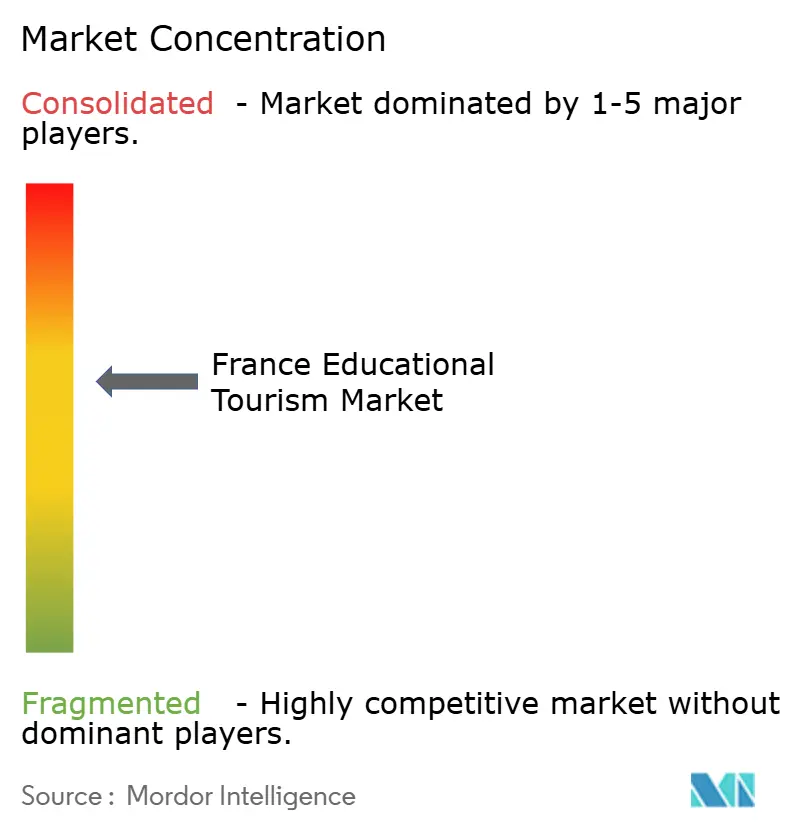
| Market Concentration | Medium |
Major Players *Disclaimer: Major Players sorted in no particular order Image © Mordor Intelligence. Reuse requires attribution under CC BY 4.0. | |
France Educational Tourism Market Analysis by Mordor Intelligence
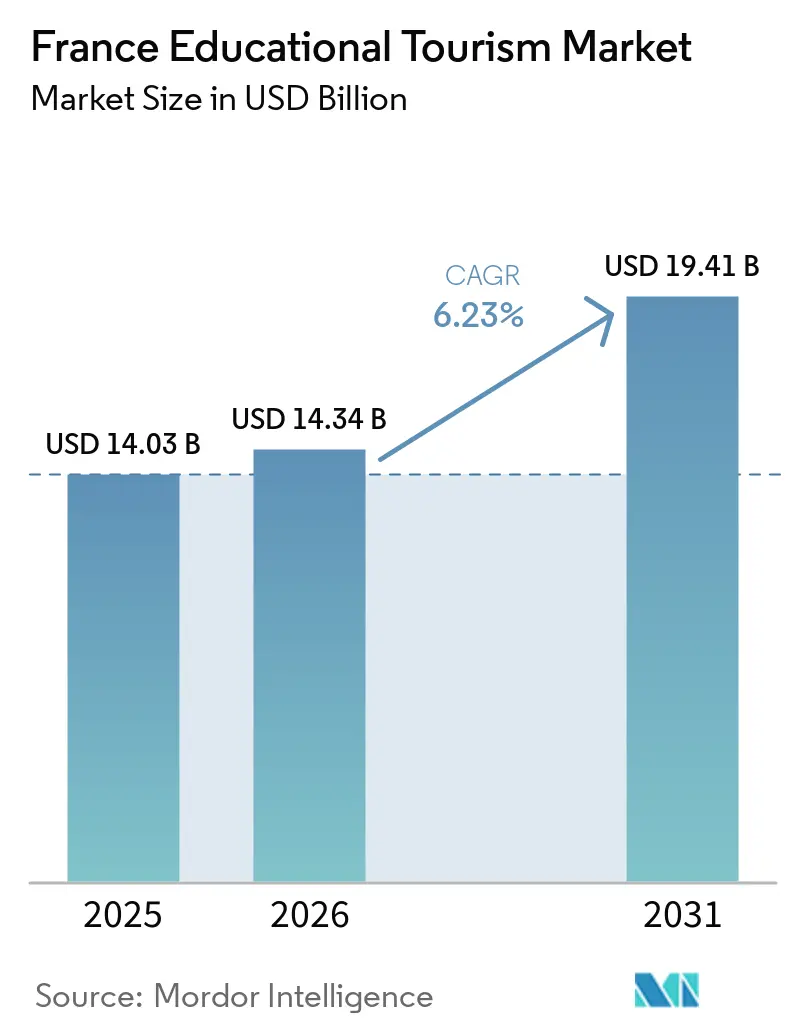
The France educational tourism market was valued at USD 14.03 billion in 2025 and estimated to grow from USD 14.34 billion in 2026 to reach USD 19.41 billion by 2031, at a CAGR of 6.23% during the forecast period (2026–2031). France hosted 443,500 international students in 2024-2025, a 17% increase compared to five years earlier, with foreign students accounting for 15% of higher education enrollment. The "Bienvenue en France" initiative aims to attract 500,000 international students by 2027 through enhanced reception capacities, accreditations, and scholarships, driving market growth[1]. France’s cultural assets, including 43 UNESCO World Heritage Sites, 8,000 museums, and EUR 170.1 million (USD 200.1 million) in Erasmus+ funding for 2024, support its appeal by integrating language learning, academic travel, and cultural immersion. International student enrollment in business schools rose by 70% over five years through 2024. A decline in United States inbound student numbers between March 2024 and March 2025 has redirected global demand toward European destinations, benefiting France. However, visa challenges, high housing costs in Paris, and reduced student flows from North Africa and the Middle East limit growth, particularly for budget-conscious students and short-term programs.
Key Report Takeaways
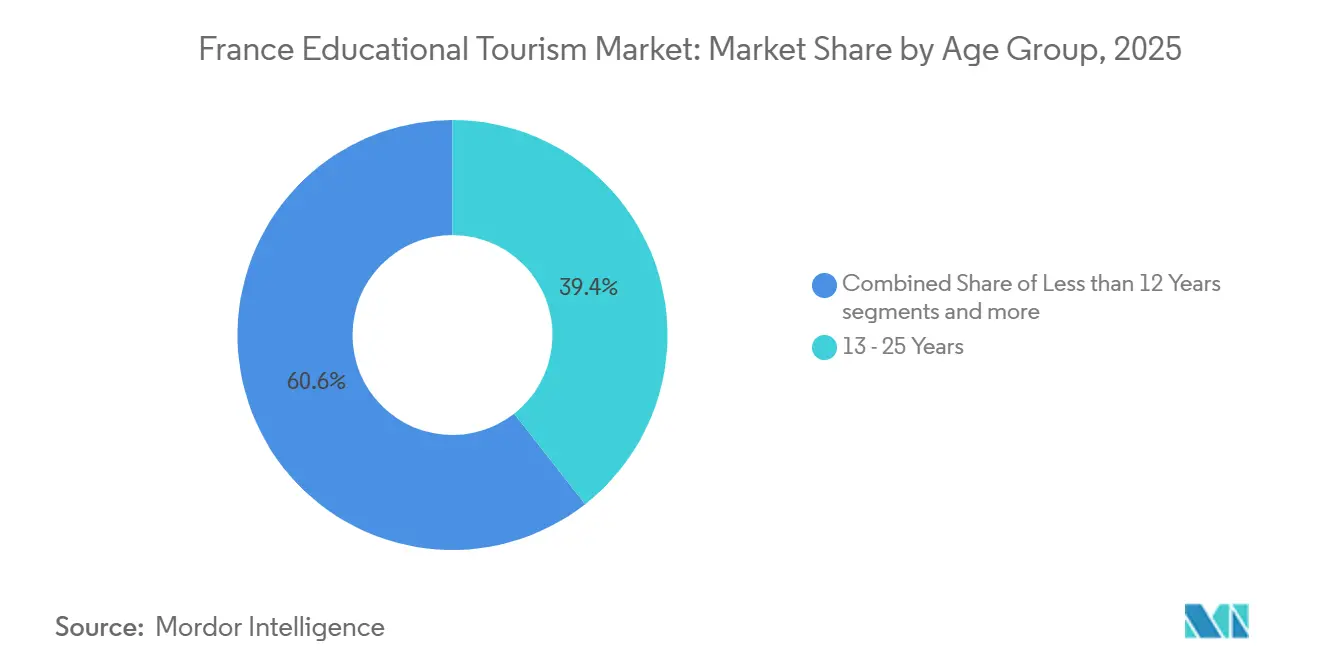
- By age group, the 13 - 25 years cohort held 39.42% share in 2025 in the France educational tourism market, while the same segment is forecast to expand at 7.17% CAGR through 2031.
- By education type, graduation programs held 37.64% share in 2025 in the France educational tourism market, while post-graduation recorded the highest projected CAGR at 6.92% through 2031.
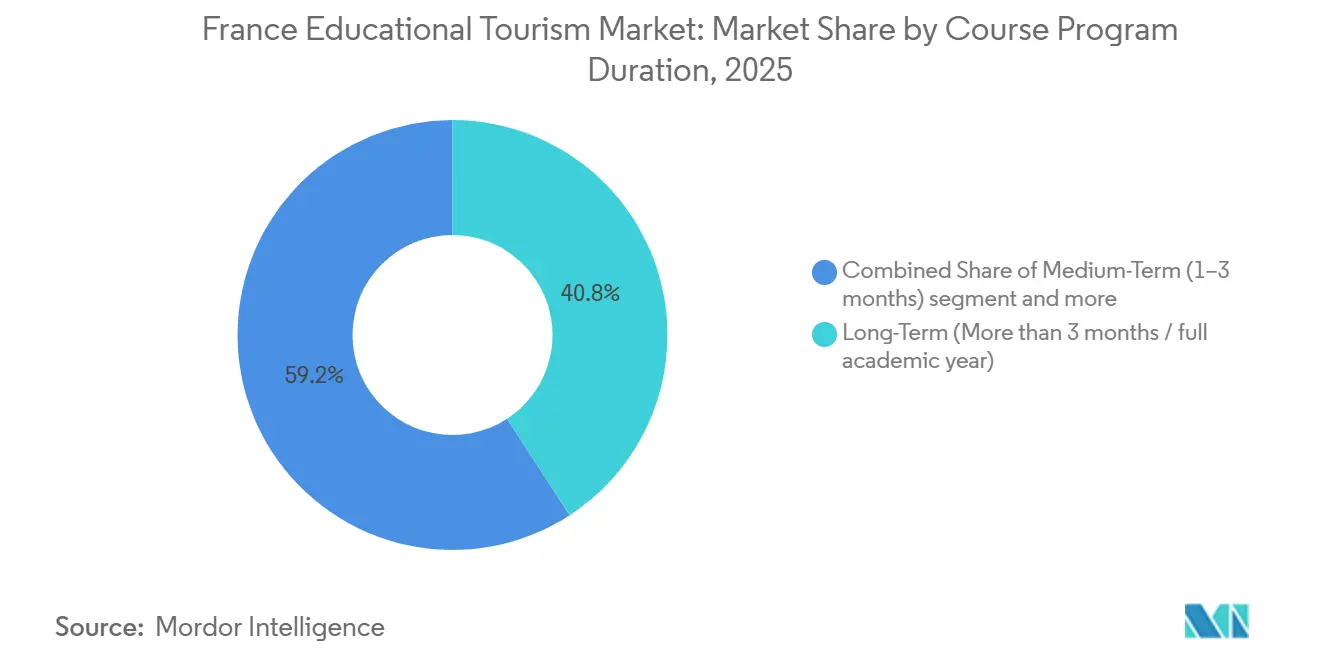
- By course duration, long-term programs accounted for 40.81% share in 2025 in the France educational tourism market, while medium-term programs are advancing at 6.88% CAGR through 2031.
- By booking channel, education agents and counselors held 45.91% share in 2025 in the France educational tourism market, while online and digital platforms are forecast to grow at 7.53% CAGR through 2031.
- By tourism type, international tourism held 67.24% share in 2025 in the France educational tourism market, while domestic tourism is projected to expand at 7.04% CAGR through 2031.
Note: Market size and forecast figures in this report are generated using Mordor Intelligence’s proprietary estimation framework, updated with the latest available data and insights as of January 2026.
France Educational Tourism Market Trends and Insights
Drivers Impact Analysis*
| Drivers | (~) % Impact on CAGR Forecast | Geographic Relevance | Impact Timeline |
|---|---|---|---|
| Growing emphasis on French language proficiency for global employability | +1.8% | Strong demand from Sub-Saharan Africa, Middle East and North Africa, and Asia-Oceania | Long term (≥ 4 years) |
| Post-COVID demand for experiential learning and cultural immersion trips | +1.3% | Asia-Pacific core, with spillover to Middle East and North Africa and the Americas | Medium term (2-4 years) |
| French government scholarships attracting non-European Union students (e.g., Eiffel, Erasmus+) | +0.9% | Multi-regional, with Eiffel attracting 81 nationalities and Erasmus+ focused on European Union mobility | Medium term (2-4 years) |
| Integration of EdTech-enabled hybrid study-tour packages | +0.7% | Multi-regional, with faster adoption in Europe and Asia-Oceania | Short term (≤ 2 years) |
| Paris 2024 Olympic legacy marketing driving short-term study tours | +0.5% | North America and the United Kingdom, with Asia-Pacific spillover | Medium term (2-4 years) |
| Corporate upskilling retreats combining language and leadership modules | +0.6% | France, especially Paris and Lyon, with inbound European Union and Gulf Cooperation Council demand | Medium term (2-4 years) |
| Source: Mordor Intelligence | |||
Growing emphasis on French language proficiency for global employability
The global prominence of the French language continues to drive demand for France's educational tourism market, supported by rising student flows from Sub-Saharan Africa. French institutions gain from strong global rankings, enhancing the labor-market value of their credentials. Student mobility from India has also grown significantly, aligned with a bilateral roadmap aiming to increase Indian student enrollment in France. This trend is expanding demand beyond traditional francophone regions, fostering interest in bilingual and dual-credential programs that integrate French with engineering and technology. The market is shifting as the French language becomes increasingly tied to career opportunities, postgraduate mobility, and international professional value. Longer student stays are encouraged as learners seek programs with robust institutional connections and formal qualifications, aligning academic and professional goals.
Post-COVID demand for experiential learning and cultural immersion trips
France has transitioned from a brief post-pandemic recovery to a sustained focus on experiential learning in travel. The number of Erasmus+ participants visiting the country increased significantly in recent years, with learners forming the majority. Campus France revamped its French+ program family, introducing French+Sciences, French+Gastronomy, and French+Hospitality to meet demand for practical, sector-focused courses. Providers that developed online learning pipelines during the pandemic are now converting more of these learners into in-person visits compared to earlier levels[2]. France’s UNESCO World Heritage Sites and annual festivals enhance academic travel by offering a broader tourism base beyond classroom study. This environment supports the commercial relevance of short and medium-duration programs, which integrate thematic excursions, culinary training, hospitality exposure, and cultural programming led by cities.
French government scholarships attracting non-European Union students (e.g., Eiffel, Erasmus+)
The France Excellence Eiffel Scholarship Program awarded scholarships to 81 nationalities in 2025, with most recipients at the master’s level and a smaller portion at the Doctoral level. Monthly stipends increased in January 2026, enhancing France’s competitiveness in student funding. French government scholarships under the MEAE and AEFE frameworks rose significantly in 2023-2024, alongside a notable growth in internship-focused scholarships, supporting professional mobility. Most Eiffel recipients pursued master’s programs, strengthening higher-value segments of France's educational tourism market. This focus benefits institutions, as postgraduate students typically stay longer, spend more on housing and services, and often combine language studies with academic or research activities. This approach has led to a stronger influx of non-European Union students into programs that generate higher revenue per student and improve academic retention.
Integration of EdTech-enabled hybrid study-tour packages
Digital language delivery complements physical travel in the French educational tourism market. Alliance Française Paris offers hybrid evening courses via Glowbl and Apolearn, while Alliance Française Lyon provides the fully online "Français 360" format, enabling global learners to transition to in-person classes[3]. Erasmus+ has streamlined administrative processes by digitalizing learning agreements, increasing student mobility. EF Education First’s EF Efekta system tracks learners digitally before and during their stay, fostering longer customer relationships and structured progression planning. Online and digital platforms have become the fastest-growing booking channels, allowing providers to assess demand before travel decisions. The market is shifting toward a blended model, integrating digital discovery, onboarding, and physical immersion into a unified purchase journey.
Restraints Impact Analysis*
| Restraints | (~) % Impact on CAGR Forecast | Geographic Relevance | Impact Timeline |
|---|---|---|---|
| Stringent French visa bureaucracy & appointment backlogs | -0.8% | North Africa and the Middle East are the most affected, with Sub-Saharan Africa as a secondary area | Medium term (2-4 years) |
| High cost of living in key academic hubs (Paris, Lyon) deterring budget travellers | -0.7% | National, with Paris as the main pressure point and Lyon and Bordeaux as secondary areas | Medium term (2-4 years) |
| Volatile geopolitical sentiment affecting international student mobility | -0.6% | Multi-regional, with stronger exposure in Middle East and North Africa and the Americas | Medium term (2-4 years) |
| Competition from lower-cost European Union destinations (Spain, Portugal) | -0.5% | South America, North Africa, and European source markets | Long term (≥ 4 years) |
| Source: Mordor Intelligence | |||
Stringent French visa bureaucracy & appointment backlogs
Study visa issuances for France declined, with the North Africa and Middle East corridor experiencing the sharpest contraction. The transition to TLScontact in the United States introduced additional costs, including fees for long-stay student visa applications and expedited services. The mandatory Etudes en France platform in several countries adds an extra administrative step before the consular process. While features such as real-time tracking, dedicated centers, and off-hours biometric appointments improve convenience, they do not fully address cost and timing challenges for budget-conscious applicants. This issue significantly impacts France's educational tourism market, as many prospects come from non-European Union regions where decisions depend on agents, financing, and extended timelines. Short and medium-duration programs face greater pressure, as students are less inclined to handle extra paperwork and higher upfront costs.
High cost of living in key academic hubs (Paris, Lyon) deterring budget travellers
International students in Paris face high annual living costs, with housing being a significant expense. This has created a divide in demand, as scholarship recipients and postgraduate students manage these costs better than short-term language tourists and school groups[4]. Campus France identifies housing as a structural challenge for international students. Consequently, demand is gradually shifting to cities like Lyon, Normandy, Nice, and Bordeaux, where comparable educational experiences are available at lower costs. This redistribution is altering value capture within France's educational tourism market, with spending increasingly directed toward regional programs. Over time, Paris’s dominance in inbound educational travel may decline if regional operators continue enhancing their offerings and gaining accreditation.
*Our forecasts treat driver/restraint impacts as directional, not additive. The impact forecasts reflect baseline growth, mix effects, and variable interactions.
Segment Analysis
By Age Group: Youth Mobility Anchors Market Volume with Cross-Generational Broadening
The 13–25 Years segment represented the largest share of the France educational tourism market at 39.42% in 2025 and is further expected to grow at a 7.17% CAGR from 2026 to 2031, reinforcing its dominance in overall demand. Campus France reported that universities enrolled 63% of all foreign students in France during 2023 - 2024, with Bachelor-level students accounting for 52% of this group, reflecting a 14% increase over five years. This highlights the importance of university-age mobility, where degree progression, language learning, and cultural exposure are often combined. The 13 - 25 age group benefits from France’s strong academic reputation, Erasmus+ visibility, and its role as a gateway to European mobility. This focus keeps youth mobility central to program design, housing, visa support, and institutional marketing.
France is strengthening the younger pipeline earlier in the student journey. The Génération 2024 program, through Paris Olympic legacy education initiatives, reached 3 million students and labeled over 11,000 schools, introducing educational travel themes to under-12 and lower secondary students. The group of over 40 years, though underdeveloped, is gaining visibility. EF Education First offers language stays of 2 to 52 weeks for 50+ learners, while Erasmus+ adult education recorded a 175% increase in adult learner mobilities from France in 2024. These developments indicate generational diversification in the France educational tourism market, though offerings remain more developed for university-age travelers. Providers targeting adult learners, school groups, and family-supported youth travel can capture broader demand while maintaining the market’s core age structure.

By Education Type: Graduation Programs Lead as Post-Graduate Segment Accelerates Fastest
Graduation programs accounted for 37.64% of France's educational tourism market size in 2025, highlighting their central role in the education mix. France’s strong university network attracts foreign students at the bachelor’s level in fields such as law, languages, health, and economics. This public higher education framework supports graduation-level study travel, which connects long stays with potential postgraduate enrollment. Degree-linked travel remains a key revenue driver, surpassing the impact of short language stays.
Post-Graduation is the fastest-growing segment, with a 6.92% CAGR projected through 2031. France ranks among the leading hosts for international doctoral students, supported by scholarships favoring Master’s and Doctoral candidates. The Eiffel scholarship reflects this trend, with most recipients pursuing master’s degrees and a smaller share pursuing doctorates. Primary and Secondary education markets are smaller but growing, driven by camps, exchange programs, and early academic exposure. Rising international enrollment in French lycée higher education sections indicates increasing pre-university activity. Institutions such as Institut Catholique de Paris, Sorbonne University, and France Éducation International focus on Graduation and Post-Graduation tiers, adhering to formal quality and accreditation standards. This focus ensures higher spending per learner and sustained institutional value within the France educational tourism market.
By Course & Program Duration: Long-Term Stays Define the Revenue Base as Medium-Term Accelerates
Long-Term programs held a 40.81% share in 2025, making them the primary revenue driver in the France educational tourism market. These programs, including full academic year formats, pathway programs, and language stays, support direct university entry over short cultural experiences. Kaplan’s academic year programs in Lyon and Nice run for 6 to 11 months with 25 to 30 lessons per week. The University Pathway option allows DALF-qualified students to gain direct admission to French universities. Long-duration offerings remain crucial for value capture, as tuition, housing, and local spending accumulate over extended periods. While shorter formats expand access, long stays continue to anchor the market’s core economics.
Medium-Term programs are expected to grow at a 6.88% CAGR through 2031, making them the fastest-growing segment. Demand for 1 to 3 month language intensives aligns with the European academic calendar and corporate training schedules supported by OPCO funding rules. Short-Term programs remain significant for youth camps and adult trial courses. EF’s France offerings range from 2-week starts to multi-week summer sessions for ages 12 to 50+. A new short-stay category has emerged from the Paris 2024 legacy, combining Olympic heritage visits with sports science, physical education, and sustainability content for school groups from the United Kingdom and North America. These shorter stays diversify the market’s duration mix and often serve as entry points for longer academic commitments, complementing rather than replacing long-term study programs.
By Booking Channel: Agent Networks Hold Majority Share as Digital Platforms Outpace the Field
Education agents and counselors held a 45.91% market share in 2025, highlighting their critical role in managing visas, housing, and institutional coordination. Campus France, with 275 Espaces Campus France across 134 countries, acts as a quasi-institutional agency, screening and channeling applicants into formal enrollment pipelines. This structure is vital for non-European Union students, who often rely on support for documentation, destination selection, and accommodation planning. Agent-led bookings remain strong despite institutions expanding direct digital capabilities.
Online and digital platforms are the fastest-growing booking channel, with a 7.53% CAGR projected through 2031. Growth is driven by platform-based comparison tools and the digitalization of enrollment workflows. Erasmus+ achieved 55% digitalization of learning agreements in French higher education during 2024-2025, reducing friction in mobility processing. The "Direct Enrollment and Others" channel, including institutional agreements and corporate HR procurement, is becoming more formalized through CPF eligibility and OPCO-backed training purchases. The French educational tourism market is not moving away from intermediaries but is incorporating digital layers into the decision-making process. Digital discovery, agent validation, and direct institutional confirmation are increasingly integrated into the booking journey.
By Tourism Type: International Flows Define Market Scale as Domestic Tourism Grows Fastest
International tourism represented 67.24% of France's educational tourism market share in 2025, highlighting the sector's dependence on cross-border demand. In the 2023-2024 academic year, France hosted 430,466 foreign higher education students, accounting for 14% of its total student population. This growth aligns with a 3% overall increase in international enrollment for the 2024-2025 academic year, bringing total numbers to roughly 443,500 students. Long-term regional influxes are heavily anchored by a five-year 34% volume increase from Sub-Saharan Africa and a 21% rise from Europe, particularly led by nations like Italy.
Domestic tourism is projected to grow at a 7.04% CAGR through 2031, making it the fastest-growing segment. Growth is driven by formalized internal professional mobility under CPF and OPCO frameworks and increased domestic relocation for language-based corporate upskilling. The Paris 2024 legacy is strongly boosting long-term interest; post-Games evaluation surveys revealed that an overwhelming 84% of Olympic spectators expressed a desire to return to France. This momentum supports Atout France's strategic roadmap to decentralize visitor traffic toward regional cultural assets and regional infrastructure. The conversion of the Paris Athletes’ Village into student residences and community infrastructure from 2025 will further support domestic learners. While international flows remain the primary source of value and scale, the market is gradually achieving a more balanced structure.
Geography Analysis
Paris and the Île-de-France region dominate France's educational tourism market, hosting the highest share of international students among academic regions. The University of Paris-Saclay's inclusion in the global Top 15 of the 2025 Shanghai Ranking highlights the region's appeal for research-focused and postgraduate studies. Rising housing costs in Paris are prompting institutions to promote regional campuses as cost-effective alternatives. Event-led branding remains effective, with EF Education First's partnership with the Tour de France linking French language studies at the Paris campus to broader cultural experiences.
Lyon and the Auvergne-Rhône-Alpes region rank as the second-largest academic hub for international students. Kaplan International operates French language schools in Lyon and Nice, while Inflexyon Lyon specializes in French as a Foreign Language and professional certifications. The Grand Est region benefits from cross-border Erasmus+ traffic due to its proximity to neighboring countries. Germany, Italy, and Spain were the top sources of Erasmus+ arrivals into France in 2023. Normandy is building its profile with an Erasmus+-accredited program by French in Normandy, combining intensive French lessons with ICT tools for educators.
Nice and the Côte d’Azur offer a distinct value proposition, focusing on lifestyle, certification quality, and shorter immersion courses. Kaplan Languages Group's acquisition of Azurlingua expanded the Nice campus, which serves students from over 100 nationalities and maintains high certification success rates. The southern corridor, including Nice, Bordeaux, and Montpellier, is gaining popularity for short and medium-term courses, driven by budget-conscious markets in South America and North Africa. Bordeaux’s Alliance Française integrates language studies with local tourism, showcasing how regional providers align cost-sensitive demand with accredited, culturally rich offerings.
Competitive Landscape
The French educational tourism market was moderately consolidated, with EF Education First holding the largest share. Its success stemmed from a global network of campuses, the EF Efekta learning system, and a partnership with the Tour de France, linking language education to a cultural event. Other key players included Campus France, Alliance Française Network, Kaplan International Languages, and ESL Education. The remaining market share was fragmented among operators like ACCORD, France Langue, Eurocentres, and university short-program departments. These smaller players focused on local specialization, FLE expertise, academic pathways, and competitive pricing, allowing both global brands and regional schools to coexist while addressing different buyer needs.
Consolidation and platform building have been significant trends. Inspirit Capital’s acquisition of Kaplan Languages Group brought multiple brands under one platform, enhancing cross-destination selling for long-stay and multi-country bookings. This move increased competition for independent operators in cities like Lyon and Nice. Alliance Française adopted a different approach, leveraging its extensive global network to pre-qualify learners locally and convert them into France-bound enrollments. This strategy created a broad pre-travel funnel, making it difficult for competitors to replicate.
Blended and corporate-focused specialists have gained traction. Providers like Language Teams and BTL reported high student satisfaction and significant training hours, highlighting the growing role of smaller, Qualiopi-certified operators in professional language training. These providers focused on customization, corporate billing, and compliance with OPCO and CPF frameworks to attract clients needing tailored solutions. However, a gap remains in AI-driven pedagogy, as no French operator has matched the visibility of EF’s digital learning system. Compliance, platform diversity, and hybrid delivery are becoming as critical as brand recognition and city presence in the market.
France Educational Tourism Industry Leaders
-
EF Education First
-
Campus France
-
Alliance Française Network
-
Kaplan International Languages
-
Study Group
- *Disclaimer: Major Players sorted in no particular order
Recent Industry Developments
- April 2026: Inspirit Capital has acquired Kaplan Languages Group (KLG) from Kaplan Inc. KLG operates language schools across several countries, serving students from various nationalities. The acquisition strengthens its position in France's language education market, increasing competition for independent schools. KLG will temporarily retain the Kaplan name while rebranding.
- February 2026: Campus France has revised its "French+" programs -French+Sciences, French+Gastronomy, and French+Hospitality - in collaboration with FLE-accredited centers and French diplomatic posts. These programs combine sector-specific themes with French language training, providing international learners with professional immersion beyond standard academic curricula.
- September 2025: French EdTech company Wefit acquired Globe Speaker, a Montpellier-based language e-learning platform publisher. The acquisition allows Wefit to combine gamified self-learning with live videoconference instruction, enhancing its hybrid B2B language offerings for corporate study-tour programs. Wefit serves over 500 corporate clients, including Institut Pasteur and Pernod Ricard.
- August 2025: The Alliance Française Bordeaux Nouvelle-Aquitaine has enhanced its curriculum by introducing digital DELF/DALF preparation packages and hybrid general French courses. Supported by France Éducation International and Campus France, these updates simplify certifications for international students while local tourism partnerships strengthen language immersion and cultural integration programs.
France Educational Tourism Market Report Scope
| Less than 12 Years |
| 13 - 25 Years |
| 26 - 40 Years |
| Over 40 Years |
| Primary |
| Secondary |
| Graduation |
| Post-Graduation |
| Short-Term (Less than or equal to 4 weeks) |
| Medium-Term (1-3 months) |
| Long-Term (More than 3 months / full academic year) |
| Direct Enrolment |
| Education Agents & Counselors |
| Online & Digital Platforms |
| Others |
| Domestic |
| International |
| By Age Group | Less than 12 Years |
| 13 - 25 Years | |
| 26 - 40 Years | |
| Over 40 Years | |
| By Education Type | Primary |
| Secondary | |
| Graduation | |
| Post-Graduation | |
| By Course and Program Duration | Short-Term (Less than or equal to 4 weeks) |
| Medium-Term (1-3 months) | |
| Long-Term (More than 3 months / full academic year) | |
| By Booking Channel | Direct Enrolment |
| Education Agents & Counselors | |
| Online & Digital Platforms | |
| Others | |
| By Tourism Type | Domestic |
| International |
Key Questions Answered in the Report
What is the 2031 value of educational travel in France?
The France educational tourism market is projected to reach USD 19.41 billion by 2031 from USD 14.34 billion in 2026, with a 6.23% CAGR over 2026-2031.
Which student group is growing the fastest in France?
The 13-25 Years cohort is the fastest-growing age group, with a projected CAGR of 7.17% through 2031, supported by university mobility and degree-linked travel demand.
Which program type leads demand in France?
Graduation programs led the education type mix with 37.64% share in 2025, while post-graduation is growing faster at 6.92% CAGR through 2031.
Why do international students still prefer France despite cost pressure?
France combines a strong academic brand, 43 UNESCO World Heritage Sites, 8,000 museums, scholarship support, and large international student flows, which together sustain demand even as Paris living costs stay high.
Which booking route is becoming more important for study travel in France?
Online and digital platforms are the fastest-growing booking channel at 7.53% CAGR, although agents still held the largest 45.91% share in 2025 because many students still need support with visas and housing.
Which tourism type contributes the most to educational travel demand in France?
International tourism contributed the most, with a 67.24% share in 2025, showing that cross-border student mobility remains the main source of demand.