
Fortified Breakfast Spreads Market Size and Share
Market Overview
| Study Period | 2022 - 2032 |
|---|---|
| Market Size (2027) | USD 2.95 Billion |
| Market Size (2032) | USD 4.38 Billion |
| Growth Rate (2027 - 2032) | 8.21 % |
| Fastest Growing Market | Asia-Pacific |
| Largest Market | North America |
| Market Concentration | Medium |
Major Players *Disclaimer: Major Players sorted in no particular order Image © Mordor Intelligence. Reuse requires attribution under CC BY 4.0. | |
Fortified Breakfast Spreads Market Analysis by Mordor Intelligence
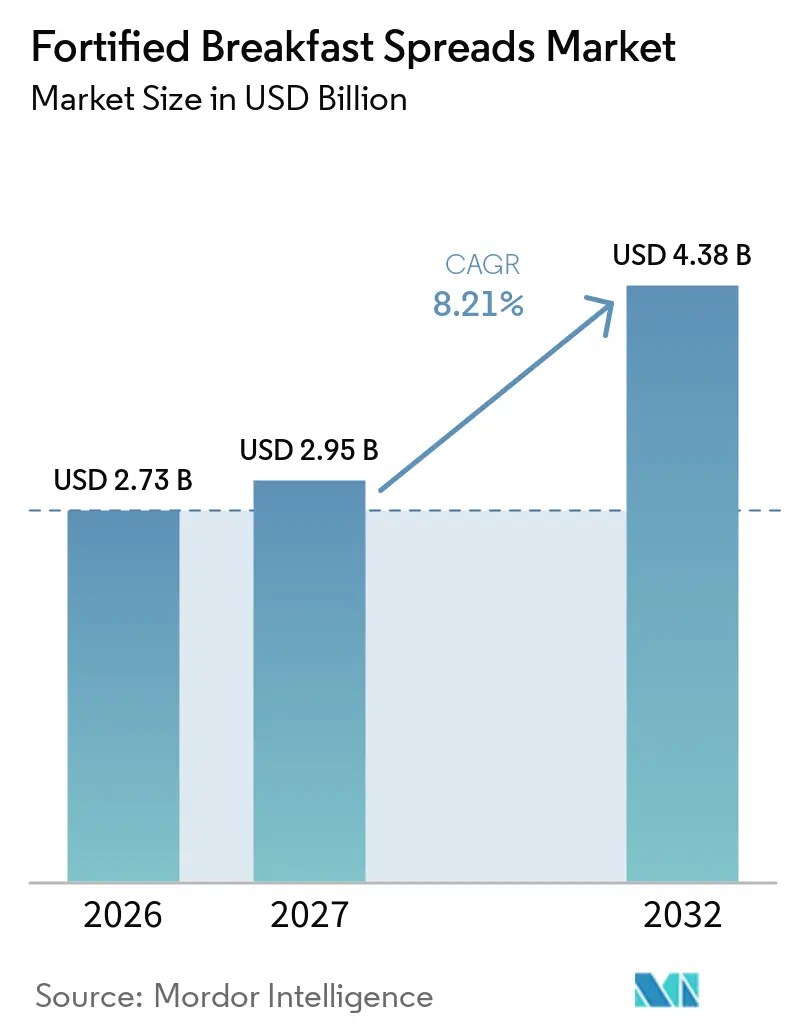
The fortified breakfast spreads market size is valued at USD 2.73 billion in 2026 to USD 2.95 billion in 2027, and is projected to reach USD 4.38 billion by 2032, growing at a CAGR of 8.21% during 2027-2032. The category benefits from demand for breakfast foods that combine taste, convenience, protein, and micronutrients in one product. Iron, vitamin D, and omega-3 fortification are relevant where consumers seek more nutrition from routine foods. Regulatory programs for food fortification also support familiarity with enriched foods in developing and developed economies. Product makers are responding through lower-sugar recipes, plant-based formulations, and formats that fit busy morning routines. The Fortified breakfast spreads market also faces a higher standard for nutrient retention, allergen controls, and accurate labeling as formulations become more complex.
Key Report Takeaways
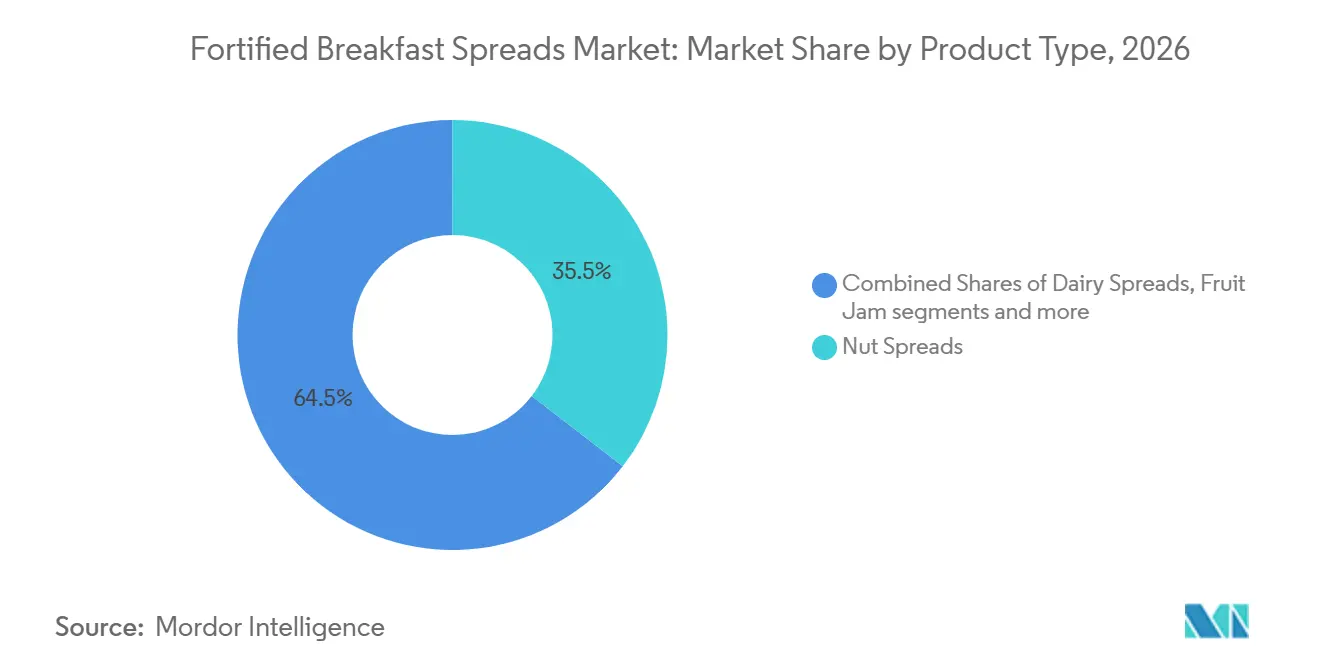
- By product type, nut spreads held 35.46% of the fortified breakfast spreads market share in 2026, while fruit jams and preserves are expected to grow at a 9.55% CAGR through 2032.
- By packaging type, jars accounted for 45.36% of the fortified breakfast spreads market share in 2026, while squeeze bottles are expected to grow at a 10.03% CAGR through 2032.
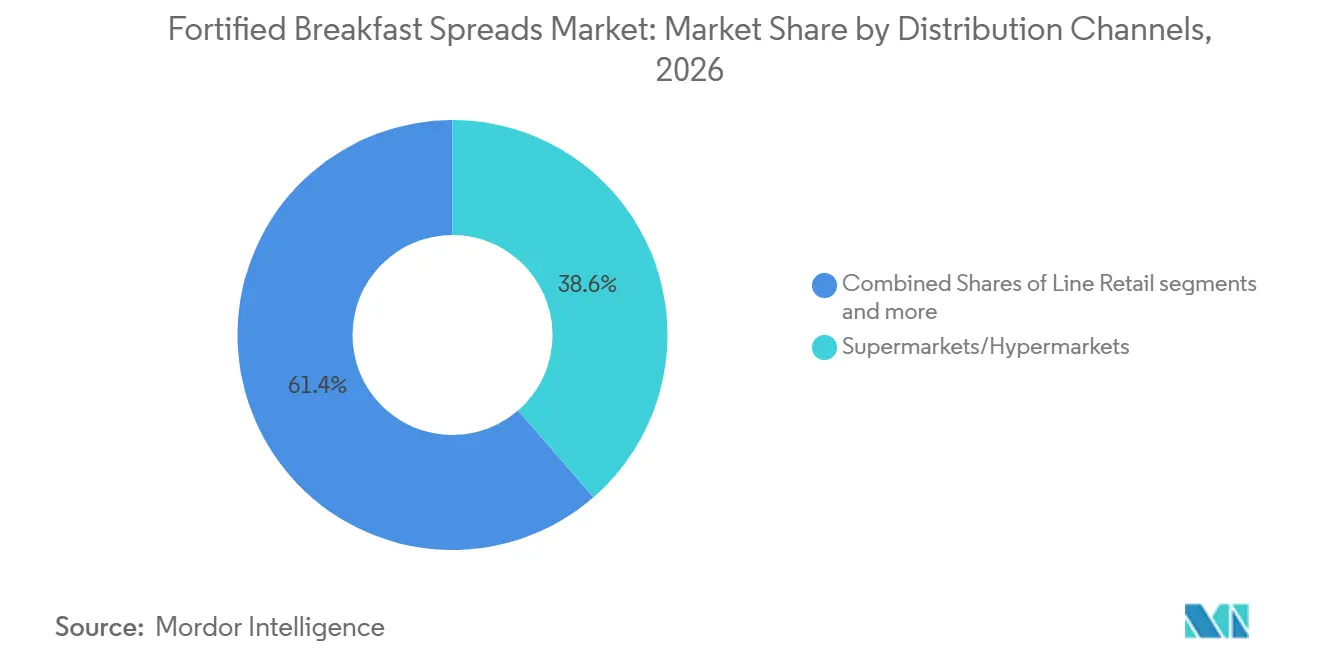
- By distribution channel, supermarkets and hypermarkets held 38.62% of the fortified breakfast spreads market share in 2026, while online retail is expected to grow at a 9.78% CAGR through 2032.
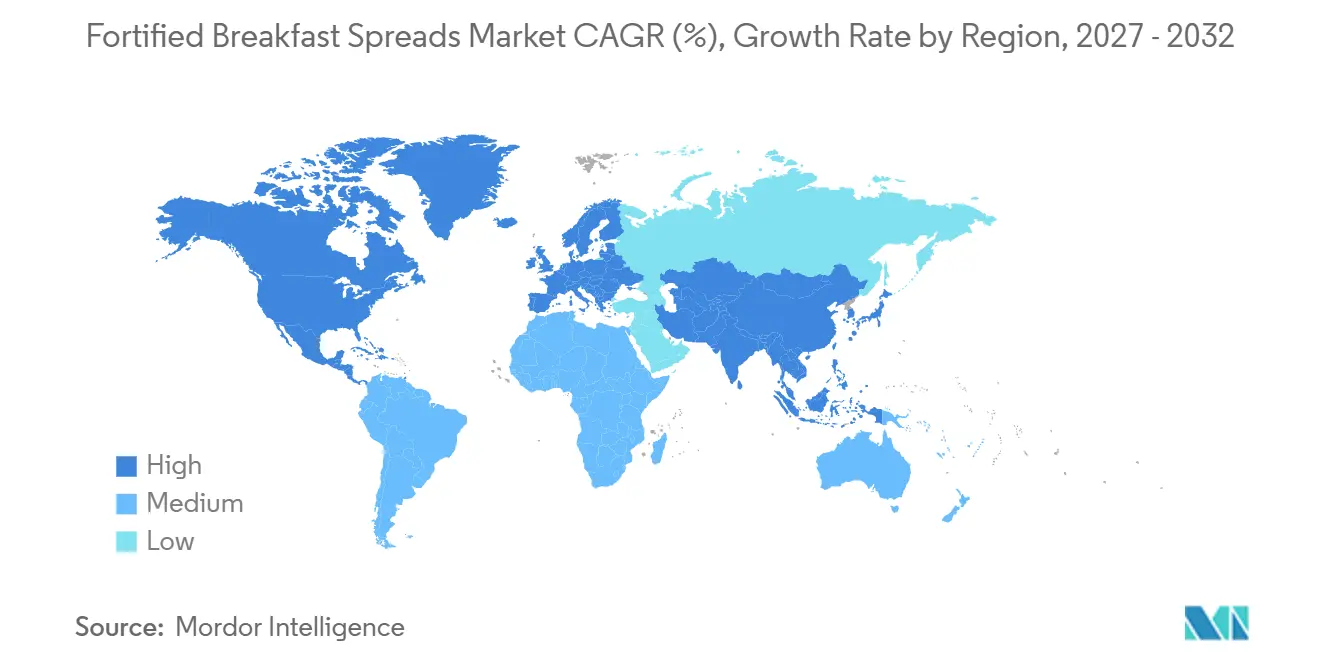
- By geography, North America held 32.42% of the fortified breakfast spreads market share in 2026, while Asia-Pacific is expected to grow at a 10.11% CAGR through 2032.
Note: Market numbers in this report are based on Mordor Intelligence's proprietary estimation framework, which combines nine months of actuals with Q4 projections for base year 2026.
Market Trends and Insights
Drivers Impact Analysis of Fortified Breakfast Spreads Market*
| Driver | (~) % Impact on CAGR Forecasts | Geographic Relevance | Impact Timeline |
|---|---|---|---|
| Rising demand for convenient and nutrient-dense breakfast options | +2.1% | Global, especially North America, Europe, and APAC urban centers | Medium term (2-4 years) |
| Government support for food fortification and nutrition programmes | +1.4% | Global, concentrated in APAC and MEA developing economies | Long term (≥ 4 years) |
| Rising plant-based protein and clean-label product innovation | +1.3% | North America and Europe, with growing APAC uptake | Medium term (2-4 years) |
| Increasing flavor innovations in spreads | +0.8% | Global, especially North America, Europe, and Japan | Short term (≤ 2 years) |
| Demand for allergen-conscious and alternative-ingredient formulations | +0.7% | North America and Europe | Medium term (2-4 years) |
| Increasing demand for low-sugar spreads | +0.6% | North America and Europe, with spillover to Australia and APAC | Short term (≤ 2 years) |
| Source: Mordor Intelligence | |||
Rising Demand for Convenient and Nutrient-Dense Breakfast Options
Busy schedules are reducing the time available for breakfast while increasing demand for foods with clear nutritional value. Consumers in North America, Europe, and Asian cities are seeking spreads that provide protein, micronutrients, and familiar flavors. This need places fortified spreads closer to snacks, supplements, and other functional food formats. Japan’s Consumer Affairs Agency system had received 6,703 functional food claims by March 2025, including 87 claims for spreads and edible oils. That record shows that functional positioning is moving into everyday food categories rather than remaining limited to tablets or powders.
Government Support for Food Fortification and Nutrition Programs
Government nutrition policies can increase the relevance of fortified everyday foods because they create common expectations around nutrient addition. The World Health Organization issued guidance in October 2025 on fortifying edible oils and fats with vitamins A and D for public health purposes. The guidance gives national authorities an evidence base for local standards and public programs. The World Food Programme reported in October 2025 that food fortification programs across Asia and the Pacific are gaining momentum[1]. India’s food rules and Cambodia’s 2025-2030 food fortification strategy show how policy can influence formulation requirements in packaged foods.
Rising Plant-Based Protein and Clean-Label Product Innovation
Plant-based reformulation is expanding ingredient options within the fortified breakfast spreads market. A 2025 peer-reviewed review found that nut and peanut spreads can provide plant proteins, unsaturated fatty acids, tocopherols, and phytosterols[2]. These attributes help manufacturers present a clearer nutrition case without relying only on added vitamins. A 2025 review of next-generation spreads reported that sodium reductions of up to 40% and fat reductions of 30-50% can be achieved without reducing sensory quality in certain formulations. Press cakes from oilseed processing may also provide fiber-rich ingredients and support circular production models.
Increasing Demand for Low-Sugar Spreads
Low-sugar product development is changing the role of fruit jams and preserves in the fortified breakfast spreads market. Manufacturers are combining reduced sugar with fruit content, fiber, and other functional ingredients. A 2025 study by the Indian Council of Agricultural Research found that low-sugar papaya and pineapple spreads made with honey substitution retained acceptable carotenoid levels and sensory quality over 3 months. This research supports the use of natural sweeteners in spread formulations. GOOD GOOD launched a no-added-sugar fruit spread line in the United States during May 2025 with 10 calories per serving and 1- 2 g of natural fruit-derived sugar.
Restraints Impact Analysis of Fortified Breakfast Spreads Market*
| Restraint | (~) % Impact on CAGR Forecasts | Geographic Relevance | Impact Timeline |
|---|---|---|---|
| Nutrient stability and degradation during storage | -0.5% | Global, especially tropical and high-temperature APAC and MEA regions | Long term (≥ 4 years) |
| Food safety risks and product recall exposure | -0.4% | Global, concentrated in North America and Europe | Short term (≤ 2 years) |
| Competition from alternative fortified food products | -0.7% | Global, especially Japan and health-focused urban markets | Medium term (2-4 years) |
| Price sensitivity among consumers | -0.6% | South America, MEA, and price-sensitive APAC markets | Medium term (2-4 years) |
| Source: Mordor Intelligence | |||
Nutrient Stability and Degradation During Storage
A nutrient claim in the fortified breakfast spreads market has value only when the stated nutrient remains present through distribution and shelf life. A 2025 Future Foods study on complex food matrices identified liquid format, temperature, and pH as important drivers of nutrient degradation, especially for vitamins A, C, B1, and D. The 2025 ICAR study on fruit spreads reported lower ascorbic acid after 3 months of storage. Manufacturers may add higher nutrient levels during production to account for expected losses. That practice raises formulation costs and can make fortified products more expensive than conventional alternatives.
Food Safety Risks and Product Recall Exposure
Plant-based recipes and multi-nutrient formulations in the fortified breakfast spreads market require careful allergen and label controls. In August 2025, the Canadian Food Inspection Agency recalled Boursin Dairy-Free Garlic & Fine Herbs Plant-Based Spread because it contained undeclared milk. The agency had also addressed Vegemite’s vitamin fortification labeling in Canada during April 2025[3]. These actions show that nutrition and allergen claims need strong internal verification. Different disclosure rules across North America and Europe add compliance work for brands selling in several countries.
*Our forecasts treat driver/restraint impacts as directional, not additive. The impact forecasts reflect baseline growth, mix effects, and variable interactions.
Fortified Breakfast Spreads Market Segment Analysis
By Product Type:
Nut Spreads Lead While Fruit Jams and Preserves Grow FasterNut spreads held 35.46% of the fortified breakfast spreads market share in 2026, making them the largest product type. Peanut and almond butter products support this position because they already carry familiar protein and healthy-fat associations. Manufacturers can add omega-3 fatty acids, vitamin E, and other nutrients without changing the core breakfast occasion. The fortified breakfast spreads market uses these familiar products as a practical entry point for consumers who may not otherwise seek a fortified food. Fruit jams and preserves are forecast to grow at a 9.55% CAGR through 2032. Their growth is linked to lower-sugar recipes, fruit-forward positioning, and added fiber or prebiotic ingredients.
Fruit formats can use nutrition messaging that combines added nutrients with naturally occurring fruit components. That approach can appeal to consumers who prefer recognizable ingredients and less added sugar. The 2025 review of functional nut spreads also indicates that bioactive compounds and natural antioxidant carriers can support innovation across related spread formats. Chocolate spreads and dairy-based spreads retain shelf presence, especially where established brands and dairy supply chains are strong. Honey spreads serve a more premium niche but compete with other natural sweetener options. Seed-based and legume spreads can attract consumers seeking peanut-free protein alternatives.

By Packaging Type:
Jars Lead While Squeeze Bottles Expand Usage OccasionsJars accounted for 45.36% of the fortified breakfast spreads market share in 2026. The format remains important because it offers broad label space and is familiar to shoppers buying nut butter, jams, and chocolate spreads. Glass jars can also support quality and recyclability messages in supermarket settings. Squeeze bottles are expected to grow at a 10.03% CAGR through 2032. Their appeal comes from easier portion control and reduced need for a knife. They can also reduce contact between users in shared kitchens and support on-the-go use.
The packaging shift matters because convenience can change when and where a spread is used. A squeeze format can support breakfast sandwiches, lunch boxes, and snack occasions as well as toast at home. The Specialty Food Association reported that O Olive Oil & Vinegar introduced a California organic extra virgin olive oil squeeze bottle in June 2025. This example from an adjacent food category shows that consumers are becoming more accustomed to controlled dispensing formats. Sachets and single-serve packs have a role in food service and institutional settings. They can limit waste and help manage allergen exposure.
By Distribution Channel:
Supermarkets Retain Volume While Online Retail Grows FasterSupermarkets and hypermarkets held 38.62% of the fortified breakfast spreads market share in 2026. These stores remain central because breakfast spreads are habitual pantry purchases that benefit from repeat shopping and broad assortment. Positioning near bread and cereal can support product discovery and encourage trial. Online retail is expected to grow at a 9.78% CAGR through 2032. Digital channels give brands more space to explain nutrition claims, ingredients, and usage ideas. They also support subscriptions and rapid replenishment for household staples.
Online retail can be particularly useful for products that need more explanation than standard spreads. A product page can present allergen information, certification details, and serving ideas without relying only on a small physical label. Convenience stores serve a different purpose because they address immediate replenishment needs in dense urban areas. Specialty health retailers can provide an early route to consumers looking specifically for functional or clean-label foods. Food service can test single-serve and portion-controlled products before wider rollout.
Geography Analysis
North America Fortified Breakfast Spreads Market
North America held 32.42% of the fortified breakfast spreads market share in 2026. The United States and Canada have established consumption of nut butters and wide retail distribution for breakfast foods. Protein-fortified, omega-3-enriched, and vitamin-added spreads fit consumer familiarity with functional foods. J.M. Smucker Company's higher-protein Uncrustables launch in September 2025 shows continued investment in nutrition-led breakfast formats. Kraft Heinz introduced Lunchables PB&J in May 2025 as a dippable, no-thaw crustless peanut butter and jelly product. Canada’s 2025 actions on Vegemite labeling and the Boursin recall show that compliance remains a clear part of category competition.
Europe Fortified Breakfast Spreads Market
Europe is the second-largest regional market in 2026. Germany, the United Kingdom, France, and the Benelux countries combine strong breakfast habits with developed premium grocery channels. Clean-label formulations, lower-sugar recipes, and plant-based products have a receptive consumer base in several European countries. Sweden and the Netherlands can serve as early markets for functional spread innovation because shoppers may be more willing to pay for transparent ingredients. Poland and Spain offer room for broader modern grocery distribution. Allergen disclosure and packaging compliance can favor manufacturers with established quality systems. Belgium and Italy maintain demand for chocolate and dairy-based spreads, providing a stable base while fortified products expand.
APAC, South America and MEA Fortified Breakfast Spreads Market
Asia-Pacific is expected to grow at a 10.11% CAGR through 2032, the fastest regional growth rate in the fortified breakfast spreads market. India is important because urbanization and formal retail are increasing exposure to packaged breakfast foods. Food fortification policy can also create familiarity with micronutrient-enriched products. The World Food Programme identified active food fortification activity across India, Cambodia, Bangladesh, Sri Lanka, and Nepal in its October 2025 update. Japan offers demand for premium and no-added-sugar spreads, while China requires careful planning around food safety and import controls. South America and the Middle East and Africa also offer selective opportunities, particularly where modern hypermarkets and imported premium foods have a strong presence.
Competitive Landscape
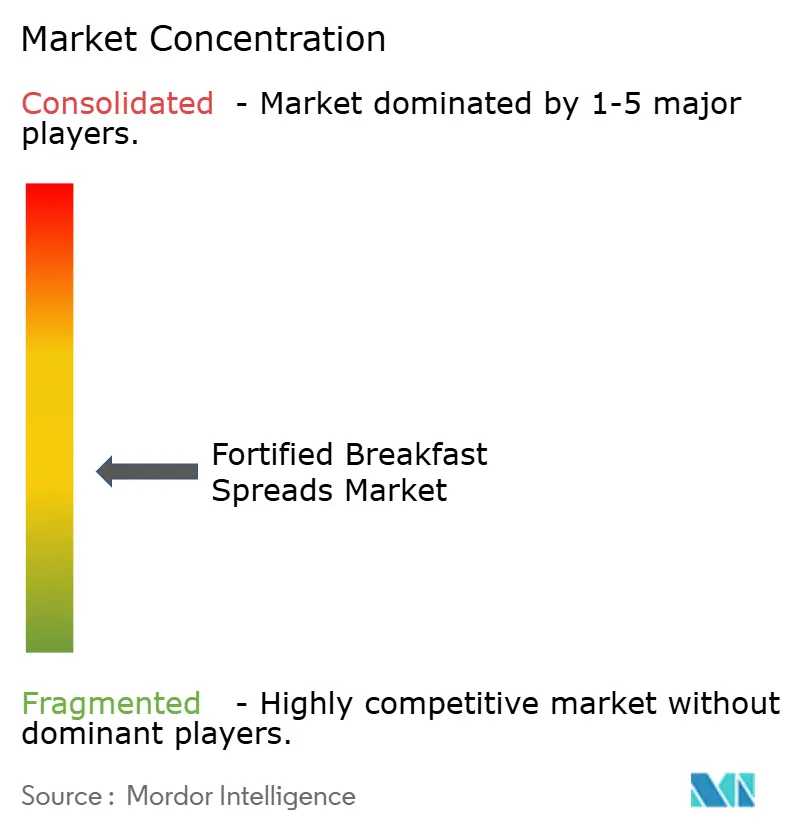
The fortified breakfast spreads market has a moderate concentration, reflecting a moderately fragmented structure in which large food companies compete with smaller premium brands. B&G Foods, J.M. Smucker Company, The Hershey Company, and others have established brands, distribution reach, and formulation resources. Smaller companies can still gain shelf space through protein-forward, clean-label, vegan, or allergen-conscious products. Competition depends on more than brand recognition because nutrient claims require evidence, stable formulations, and accurate labels. Codex guidance, national food rules, and allergen regulations raise the cost of entering highly regulated markets. This can favor companies with stronger quality assurance and regulatory teams.
Large companies use brand extensions to meet nutrition and convenience needs. Ferrero’s September 2025 Nutella Plant-Based launch in Israel used chickpeas and rice syrup in place of milk, extending the brand to vegan consumers. Kraft Heinz launched a dippable Lunchables PB&J product in May 2025 to combine a familiar peanut butter and jelly format with convenience. These moves show that companies are adapting established products instead of relying only on new brands. They also show that the fortified breakfast spreads market is connected to wider breakfast and snacking occasions.
Packaging and formulation remain areas where smaller companies can differentiate. Squeeze bottles have not been widely used for fortified nut butters and fruit spreads, leaving room for brands that can solve dispensing and product-stability needs. Research published in Future Foods reported consumer acceptance levels of 60-75% for spreads with novel or alternative ingredients. That finding supports continued experimentation with plant proteins, lower-sugar systems, and alternative fats. Companies such as Pip & Nut, Meridian Foods, Nuts ’N More, MYFITNESS, and Pintola compete through focused product positioning. Larger companies may respond by improving ingredient transparency and expanding premium product lines. The fortified breakfast spreads market remains open to new offerings, but durable growth depends on product quality, regulatory compliance, and repeat household demand.
Fortified Breakfast Spreads Industry Leaders
-
The J.M. Smucker Company
-
B & G Foods, Inc.
-
The Hain Celestial Group, Inc.
-
The Hershey Company
-
Conagra Brands, Inc.
- *Disclaimer: Major Players sorted in no particular order
Fortified Breakfast Spreads Market Companies Covered in this Report
- Ferrero International S.A.
- The J.M. Smucker Company
- Hormel Foods Corporation
- Conagra Brands, Inc.
- Unilever PLC
- The Kraft Heinz Company
- The Hershey Company
- Premier Foods PLC
- B & G Foods, Inc.
- Nestlé S.A.
- Upfield Holdings B.V.
- The Hain Celestial Group, Inc.
- Oskri Corporation
- Meridian Foods Limited
- Pip & Nut Limited
- Futura Foods Private Limited
- Modi Naturals Limited
- Marico Limited
- Once Again Nut Butter
- Nuts 'N More
Recent Industry Developments in Fortified Breakfast Spreads Market
- September 2026: Nutralite introduced its Choco Spread Calcium Enriched variant in India, expanding its chocolate spread portfolio with a product offering additional calcium. The company also highlighted its Choco Spread Crunchy Quinoa variant, which provides a crunchy texture for breakfast and snacking occasions.
- January 2026: Flora Food Group introduced a reformulated NutriRich range of I Can't Believe It's Not Butter! spreads in the United States. The updated formulations provide vitamins A, D, E, and B12, with the Original and Light variants also containing omega-3 alpha-linolenic acid (ALA).
- January 2026: Parayil Biofarm introduced collagen-enriched peanut butter in India as part of a range of innovative food products launched by startups associated with the ICAR-Central Institute of Fisheries Technology (ICAR-CIFT). The product combines peanut butter with collagen, targeting consumers seeking protein-containing spreads and nutritional alternatives for everyday consumption.
Global Fortified Breakfast Spreads Market Report Scope
The fortified breakfast spreads market is segmented by product type, packaging type, distribution channel, and geography. By product type, the market is segmented into nut spreads, dairy-based spreads, honey spreads, fruit jams and preserves, chocolate spreads, and others. By packaging type, the market is categorized into jars, sachets and single-serve packs, squeeze bottles, and others. By distribution channel, the market is divided into supermarkets and hypermarkets, convenience stores, online stores, and other distribution channels. By geography, the market is segmented into North America, Europe, Asia-Pacific, South America, and the Middle East and Africa. The market sizing has been done in value terms in USD for all the abovementioned segments.
Segmentation Overview
| Nut Spreads |
| Dairy-Based Spreads |
| Honey Spreads |
| Fruit Jams and Preserves |
| Chocolate Spreads |
| Others |
| Jars |
| Sachets and Single-Serve Packs |
| Squeeze Bottles |
| Others |
| Supermarkets and Hypermarkets |
| Convenience Stores |
| Online Stores |
| Other Distribution Channels |
| North America | United States |
| Canada | |
| Mexico | |
| Rest of North America | |
| Europe | Germany |
| United Kingdom | |
| France | |
| Italy | |
| Spain | |
| Netherlands | |
| Sweden | |
| Poland | |
| Belgium | |
| Rest of Europe | |
| Asia-Pacific | China |
| India | |
| Japan | |
| Australia | |
| South Korea | |
| Vietnam | |
| Indonesia | |
| Rest of Asia-Pacific | |
| South America | Brazil |
| Argentina | |
| Chile | |
| Peru | |
| Colombia | |
| Rest of South America | |
| Middle East and Africa | United Arab Emirates |
| Saudi Arabia | |
| South Africa | |
| Nigeria | |
| Rest of Middle East and Africa |
| Product Type | Nut Spreads | |
| Dairy-Based Spreads | ||
| Honey Spreads | ||
| Fruit Jams and Preserves | ||
| Chocolate Spreads | ||
| Others | ||
| Packaging Type | Jars | |
| Sachets and Single-Serve Packs | ||
| Squeeze Bottles | ||
| Others | ||
| Distribution Channels | Supermarkets and Hypermarkets | |
| Convenience Stores | ||
| Online Stores | ||
| Other Distribution Channels | ||
| Geography | North America | United States |
| Canada | ||
| Mexico | ||
| Rest of North America | ||
| Europe | Germany | |
| United Kingdom | ||
| France | ||
| Italy | ||
| Spain | ||
| Netherlands | ||
| Sweden | ||
| Poland | ||
| Belgium | ||
| Rest of Europe | ||
| Asia-Pacific | China | |
| India | ||
| Japan | ||
| Australia | ||
| South Korea | ||
| Vietnam | ||
| Indonesia | ||
| Rest of Asia-Pacific | ||
| South America | Brazil | |
| Argentina | ||
| Chile | ||
| Peru | ||
| Colombia | ||
| Rest of South America | ||
| Middle East and Africa | United Arab Emirates | |
| Saudi Arabia | ||
| South Africa | ||
| Nigeria | ||
| Rest of Middle East and Africa | ||
Key Questions Answered in the Report
What is the expected growth rate for fortified breakfast spreads?
The category is projected to grow at an 8.21% CAGR between 2027 and 2032, rising from USD 2.73 billion in 2026 to USD 4.38 billion by 2032.
Which product type has the largest revenue share?
Nut spreads lead with 35.46% share in 2026, supported by familiar peanut and almond butter formats.
Which product type is growing the fastest?
Fruit jams and preserves are projected to grow at a 9.55% CAGR through 2032.
Which sales channel leads fortified breakfast spread purchases?
Supermarkets and hypermarkets lead with 38.62% share in 2026, while online retail is the fastest-growing channel at a 9.78% CAGR.