
Forensic Swab Market Size and Share
Market Overview
| Study Period | 2020 - 2031 |
|---|---|
| Market Size (2026) | USD 2.89 Billion |
| Market Size (2031) | USD 4.38 Billion |
| Growth Rate (2026 - 2031) | 8.60 % |
| Fastest Growing Market | Asia-Pacific |
| Largest Market | North America |
| Market Concentration | Medium |
Major Players *Disclaimer: Major Players sorted in no particular order Image © Mordor Intelligence. Reuse requires attribution under CC BY 4.0. | |
Forensic Swab Market Analysis by Mordor Intelligence
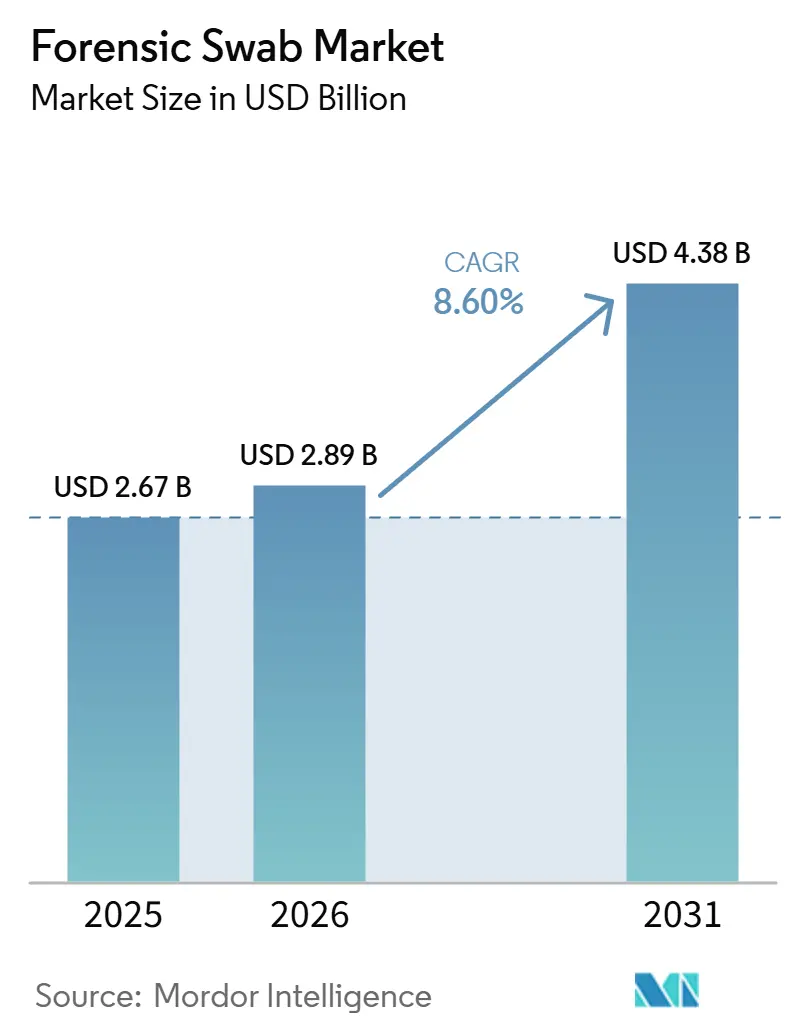
The Forensic Swab Market size is expected to grow from USD 2.67 billion in 2025 to USD 2.89 billion in 2026 and is forecast to reach USD 4.38 billion by 2031 at 8.60% CAGR over 2026-2031.
The forensic swabs market is supported by wider use of DNA evidence in criminal justice systems and by the continued expansion of national DNA repositories. The FBI’s CODIS network contained 19.27 million offender profiles, 6.14 million arrestee profiles, and 1.45 million forensic profiles in November 2025, supporting more than 758,449 investigations.[1]Federal Bureau of Investigation, “CODIS-NDIS Statistics,” Federal Bureau of Investigation, fbi.gov Rapid DNA workflows are also changing collection requirements because compatible, validated swabs are needed before a sample can enter a qualifying testing pathway. Procurement is increasingly shaped by contamination control, evidence tracking, and laboratory validation requirements. These conditions favor suppliers that can document material performance and forensic-grade production.
Key Report Takeaways
- By product material, foam swabs held 42.39% of the forensic swabs market share in 2025, while flocked swabs are projected to grow at a 9.81% CAGR through 2031.
- By swab tip design, standard tips accounted for 45.15% of the forensic swabs market size in 2025, while large-surface-area formats are forecast to advance at a 9.73% CAGR through 2031.
- By application, crime scene evidence collection held 39.35% of revenue in 2025, while touch DNA collection is projected to expand at a 9.89% CAGR through 2031.
- By end user, forensic science laboratories accounted for 47.18% of demand in 2025, while law enforcement agencies are forecast to grow at a 9.68% CAGR through 2031.
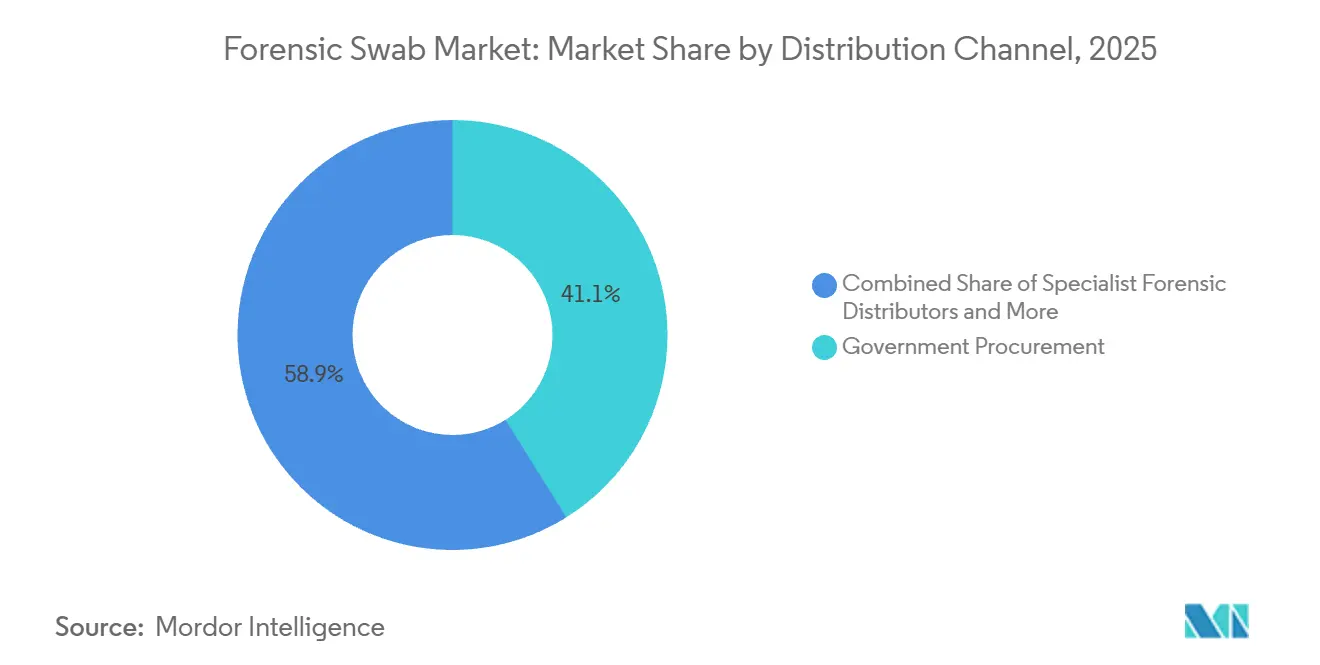
- By distribution channel, government procurement held 41.11% of revenue in 2025, while specialist forensic distributors are projected to grow at a 9.47% CAGR through 2031.
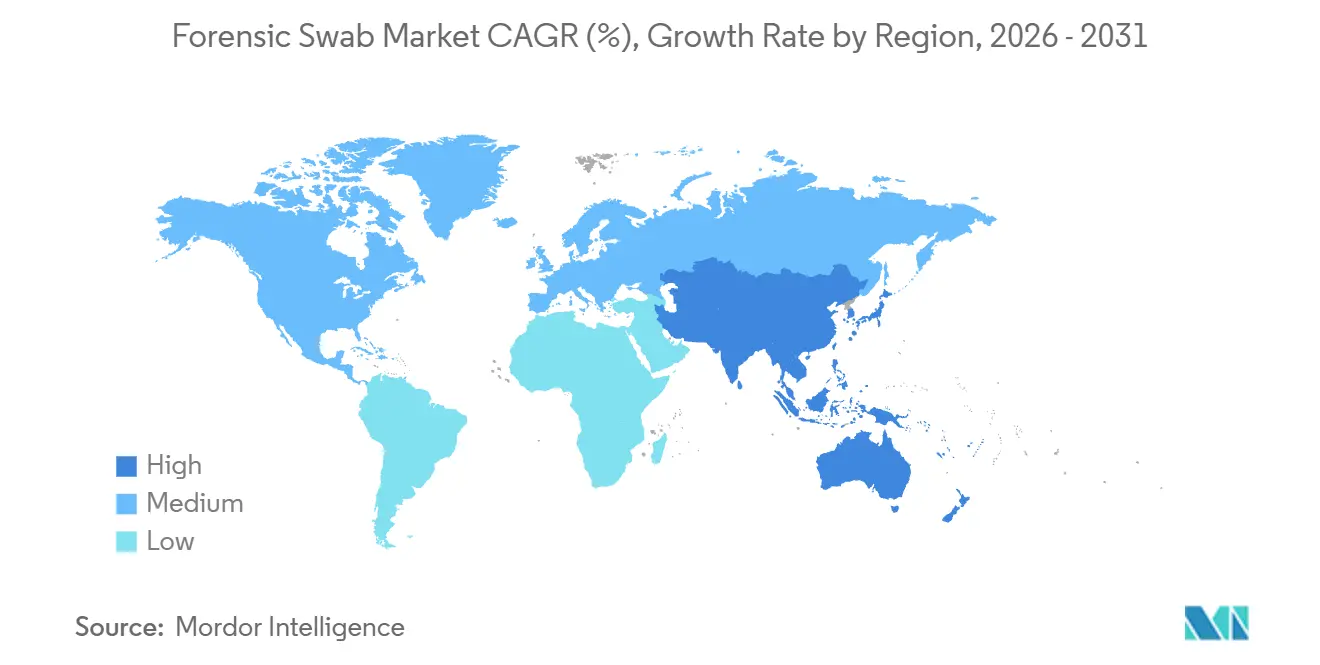
- By geography, North America held 38.19% of revenue in 2025, while Asia-Pacific is forecast to grow at a 9.88% CAGR through 2031.
Note: Market size and forecast figures in this report are generated using Mordor Intelligence’s proprietary estimation framework, updated with the latest available data and insights as of January 2026.
Global Forensic Swab Market Trends and Insights
Drivers Impact Analysis*
| Driver | (~) % Impact on CAGR Forecast | Geographic Relevance | Impact Timeline |
|---|---|---|---|
| Expansion of National DNA Databases | +1.6% | Global, strongest in North America, Asia-Pacific, and Europe | Medium term (2-4 years) |
| Growth in Crime Scene and Touch DNA Investigations | +1.3% | Global, led by North America and Europe | Short term (≤ 2 years) |
| Modernization of Forensic Laboratories | +1.1% | Asia-Pacific core, North America, Middle East and Africa spillover | Medium term (2-4 years) |
| Adoption of Rapid DNA Workflows | +1.0% | North America, with early gains in the United Kingdom and GCC | Short term (≤ 2 years) |
| Dual-Matrix Collection for Parallel Rapid and Conventional Testing | +0.6% | North America initially, with global expansion expected | Medium term (2-4 years) |
| Integrated Barcode and Evidence-Tracking Swabs | +0.4% | North America and Europe, with early adoption in Asia-Pacific | Long term (≥ 4 years) |
| Source: Mordor Intelligence | |||
Expansion of National DNA Databases Sustaining Baseline Swab Demand
Each profile added to a national repository requires a collection event, which provides recurring demand for single-use collection devices in the forensic swabs market. The United Kingdom National DNA Database held 7,404,888 subject profiles and 700,459 crime scene profiles in March 2025. It added 335,933 subject profiles during the 2024 to 2025 financial year.[2]Forensic Information Databases Strategy Board, “Annual Report 2024 to 2025,” GOV.UK, gov.uk The planned GBP 7 million expansion to support Y-STR markers in 2026 increases the need for reliable collection and profile generation. Database programs also place more scrutiny on the full pre-analytical chain, encouraging a shift from legacy cotton products toward certified foam and flocked alternatives. Dual-matrix devices can preserve material for conventional testing while providing a compatible sample for rapid workflows. Barcode-enabled collection devices can also support evidence handling requirements where agencies seek clearer chain-of-custody records.
Growth in Crime Scene and Touch DNA Investigations Reshaping Swab Specifications
Touch DNA extends evidence collection beyond visible bloodstains and saliva to biological material left through contact. A 2025 peer-reviewed assessment found 74% first-pass STR profiling success from fingertip contact using COPAN 4N6FLOQSwabs, compared with 54% using cotton swabs. The forensic swabs market therefore benefits when agencies need better recovery from low-deposit samples and difficult surfaces. A 2026 review reported that foam-tipped and nylon-flocked swabs improved trace DNA recovery compared with cotton alternatives, particularly for degraded and low-deposit samples. Faster and more dependable recovery can improve the practical value of a sample before it is compared with a repository. Laboratories also need to control low-level contamination because compromised collection can affect the confidence placed in a DNA result.
Modernization of Forensic Laboratories Creating Infrastructure-Linked Procurement
New laboratory capacity produces demand for validated consumables because equipment purchases are commonly paired with standardized workflows. Arkansas began construction of a USD 200 million crime laboratory in June 2025, with operations expected in 2027.[3]Arkansas Department of Public Safety, “DPS Breaks Ground on New State-of-the-Art Crime Lab in North Little Rock,” Arkansas Department of Public Safety, arkansas.gov The forensic swabs market gains from these projects when laboratories set approved material and handling specifications during commissioning. China’s GB/T 43635-2024 established a national specification for forensic DNA laboratory inspection and became effective in October 2024. New laboratories may initially use established cotton-based procedures, but later validation work can move purchasing toward materials that improve recovery and contamination control. Modern systems also give laboratories a reason to assess tip geometry, packaging, and swab-to-instrument fit as part of a single workflow decision.
Adoption of Rapid DNA Workflows Raising Compatibility Requirements
The FBI’s forensic quality assurance standards became effective on July 1, 2025 and set the national framework for qualifying crime scene Rapid DNA profiles for CODIS search and upload. In July 2026, Thermo Fisher Scientific received the first FBI National DNA Index System approval for the Applied Biosystems RapidINTEL Plus Cartridge used with qualifying forensic crime scene samples. The forensic swabs market is affected because laboratories need collection devices that fit validated cartridge workflows and preserve eligibility for downstream searching. This requirement narrows the range of products that can be used in qualifying workflows. It also makes technical compatibility a more important purchasing factor than unit price alone. It can also shift selection toward suppliers that provide documented collection and extraction performance.
Restraints Impact Analysis*
| Restraint | (~) % Impact on CAGR Forecast | Geographic Relevance | Impact Timeline |
|---|---|---|---|
| High Cost of DNA Testing and Evidence Processing | -1.4% | Global, most acute in developing economies and small United States municipalities | Medium term (2-4 years) |
| Shortage of Trained Forensic Personnel | -0.8% | Global, especially Asia-Pacific and Middle East and Africa | Long term (≥ 4 years) |
| Low-Level DNA Contamination and False Association Risk | -0.5% | Global, elevated in laboratories transitioning to touch DNA analysis | Short term (≤ 2 years) |
| Procurement Fragmentation Across Local Law Enforcement Agencies | -0.7% | North America, South America, and Middle East and Africa | Medium term (2-4 years) |
| Source: Mordor Intelligence | |||
High Cost of DNA Testing and Evidence Processing
DNA evidence costs extend from sample collection through profiling, review, and database upload. Agencies with limited budgets may constrain testing volumes even when they can procure basic collection products. Certified rapid instruments require capital investment, while manual extraction and capillary electrophoresis can limit throughput for agencies without those instruments. ISO 18385 and ISO/IEC 17025 requirements can also restrict buying to validated supplier pools, which may carry higher purchase costs than general medical swabs. Procurement fragmentation can add difficulty when local agencies purchase in small volumes through separate processes. The forensic swabs market is therefore exposed to public budget pressure, particularly where procurement must support both consumables and laboratory staffing.
Shortage of Trained Forensic Personnel Limiting Sample Processing
Forensic laboratories need qualified analysts to review, interpret, and release DNA results. The FBI’s 2025 quality standards require qualified laboratory DNA analyst review before eligible Rapid DNA data can be uploaded to CODIS. Automation can shorten steps in the process, but it does not remove this review requirement. When staff capacity is limited, collected samples can accumulate in backlogs rather than moving promptly into processing. This bottleneck is especially relevant where laboratories are adding touch DNA or other low-template testing that requires careful interpretation. This reduces the immediate volume effect that expanded collection programs might otherwise produce in the forensic swabs market.
*Our forecasts treat driver/restraint impacts as directional, not additive. The impact forecasts reflect baseline growth, mix effects, and variable interactions.
Segment Analysis
By Product Material: Foam Swabs Lead While Flocked Formats Gain Use
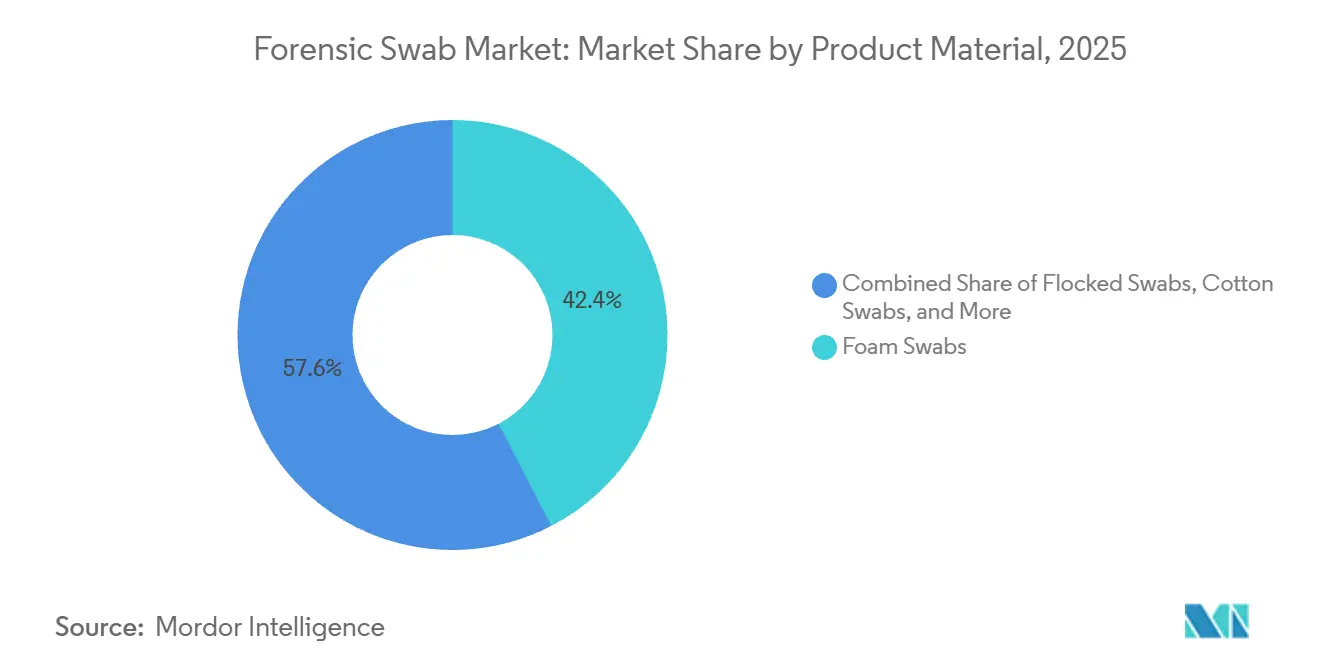
Foam swabs held 42.39% of the product material segment in 2025. Their position reflects strong DNA recovery from rough, porous, and serrated surfaces found at outdoor scenes. Their material structure can make them a practical option when evidence is located on textured objects rather than smooth and uniform surfaces. A 2025 study of wildlife-crime trace DNA recovery found that foam swabs delivered the highest average DNA quantity across varied surface types. Flocked swabs are projected to expand at a 9.81% CAGR through 2031, making them the fastest-growing product material in the forensic swabs market.
Flocked construction places nylon fibers perpendicular to the shaft, increasing contact with a surface and aiding release during extraction. This design is particularly relevant when a laboratory seeks to recover small deposits rather than a visible biological stain. The 2025 fingertip study found a 74% first-pass STR profiling success rate for flocked swabs and 54% for cotton. Cotton remains common where long-standing laboratory procedures were validated around it and where cost remains important. Nylon and polyester retain narrower uses, including buccal databasing and chemical trace collection, while a 2026 study found nylon and foam performed better than viscose and polyester across many polypropylene touch DNA deposits.[4]QIAGEN N.V., “QIAGEN Launches New Automated Sexual Assault Sample Processing Kit at ISHI 2025,” QIAGEN N.V., qiagen.com



By Swab Tip Design: Standard Tips Retain Scale as Larger Formats Expand
Standard tip swabs accounted for 45.15% of the tip design segment in 2025. They support routine collection of bloodstains, saliva, semen, and reference buccal samples. Their broad use reflects decades of validation across laboratories participating in national DNA programs. Their familiar format can also reduce changes to existing collection instructions and laboratory intake procedures. Large-surface-area formats are forecast to grow at a 9.73% CAGR through 2031 as the forensic swabs market serves wider surface collection needs.
These larger formats can help collect cellular material from broad surfaces during property crime and environmental investigations. They can also reduce repeat collection steps in high-throughput reference databasing programs. Tapered tips support collection from narrow grooves on firearms, cartridge casings, and threaded fasteners. Mini-tip, elongated, and sublingual designs remain relevant where surface access or anatomical access is restricted. Automated extraction systems encourage laboratories to specify compatible geometry during procurement.
By Application: Touch DNA Collection Grows Faster Than Conventional Categories
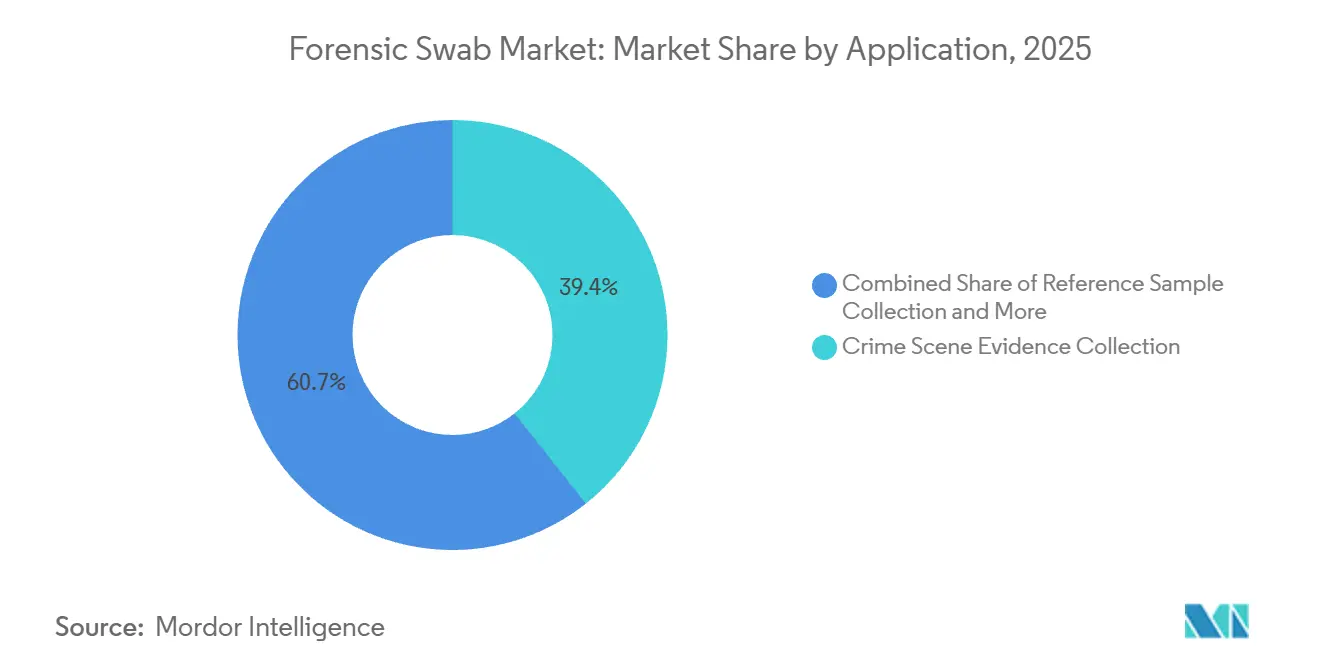
Crime scene evidence collection accounted for 39.35% of application revenue in 2025. It remains central to profile generation for database submission and casework. Routine casework uses collection devices across a wide range of biological evidence types and surface conditions. Touch DNA collection is projected to expand at a 9.89% CAGR through 2031, the fastest rate among applications in the forensic swabs market. The rate reflects both the wider investigative use of low-template DNA and the increasing availability of materials designed for trace recovery.
A 2026 review found that foam-tipped and nylon-flocked swabs improved trace DNA recovery over cotton alternatives for low-deposit and degraded samples. Reference sample collection and buccal and oral DNA collection remain high-volume uses tied to databasing programs. These applications require consistent specimen collection because they are used for comparison and identification workflows. Blood and body fluid collection remains established, though multi-surface devices can shift purchasing toward formats that handle several matrices. The forensic swabs market also benefits from the need to collect samples consistently when criminal justice systems broaden their databasing activity.
By End User: Forensic Laboratories Remain the Largest Buyers as Field Use Expands
Forensic science laboratories represented 47.18% of end-user demand in 2025. They serve as accredited processing hubs in centralized DNA evidence workflows. Their purchasing is shaped by ISO/IEC 17025 requirements, including validation of reagents and collection consumables within the laboratory’s accredited scope. These requirements make documented product performance important during supplier selection and method validation. Law enforcement agencies are forecast to grow at a 9.68% CAGR through 2031 as the forensic swabs market reaches field and booking-station workflows.
The FBI’s 2025 forensic standards allow eligible law enforcement agencies to work with accredited CODIS laboratories on crime scene Rapid DNA programs. Hospitals and medico-legal institutions form a steady demand base through sexual assault referral and evidence collection protocols. In October 2025, QIAGEN introduced the EZ2 DNA Investigator Sep&Prep Kit, which processes up to 24 sexual assault swab samples in parallel in under 2.5 hours.[5]China National Standards Administration, “GB/T 43635-2024 Forensic Science DNA Laboratory Inspection Specification,” China National Standards Administration, freebz.net. freebz.net This type of downstream automation makes upstream sample compatibility more important to laboratory workflows. Academic institutions, military and defense investigation units, and private forensic providers account for the remaining demand.
By Distribution Channel: Government Contracts Provide Scale While Specialist Support Matters
Government procurement accounted for 41.11% of distribution revenue in 2025. Centralized tenders supply public laboratories and law enforcement agencies with predictable contract volumes. Approved-vendor status can support multiyear placement when contracts require ISO 18385 certification. Tender requirements can also link purchasing to packaging, documentation, and evidence handling expectations. Specialist forensic distributors are projected to expand at a 9.47% CAGR through 2031, supported by the growing technical requirements of the forensic swabs market.
These distributors can advise on the fit between swabs, evidence kits, and downstream instruments. Direct sales and medical or laboratory distributors remain relevant for institutions that use established vendor relationships and consolidated billing. Online and catalog sales are more relevant for academic buyers and smaller private providers with decentralized purchasing. Swab bundling within sexual assault kits, crime scene kits, and Rapid DNA booking kits can shift purchasing from standalone orders toward specialist kit-level contracts. This arrangement can make kit specifications as important as the standalone swab choice.
Geography Analysis
North America held 38.19% of the forensic swabs market share in 2025. The region has extensive DNA evidence infrastructure and a large established profile database. The United States Department of Justice allocated USD 120 million to the Debbie Smith DNA Backlog Grant Program in both fiscal 2024 and fiscal 2025. The July 2026 NDIS approval for Thermo Fisher’s RapidINTEL Plus Cartridge supports early adoption of qualifying crime scene Rapid DNA workflows in the United States.
Europe is the second-largest regional area, with the United Kingdom, Germany, and France forming its core demand base. The United Kingdom National DNA Database contained 7,404,888 subject profiles and 700,459 crime scene profiles in March 2025. The United Kingdom committed GBP 7 million for a 2026 upgrade that includes Y-STR markers. European purchasing places weight on ISO 18385 and evidence quality, which makes certification an important factor in the forensic swabs market.
Asia-Pacific is projected to grow at a 9.88% CAGR through 2031, the fastest regional rate. China’s GB/T 43635-2024 and GB/T 43636-2024 standards took effect in October 2024 and support nationally standardized forensic DNA laboratory practice. South Korea, Japan, and Australia provide mature demand, while Vietnam and Indonesia offer developing opportunities.

Competitive Landscape
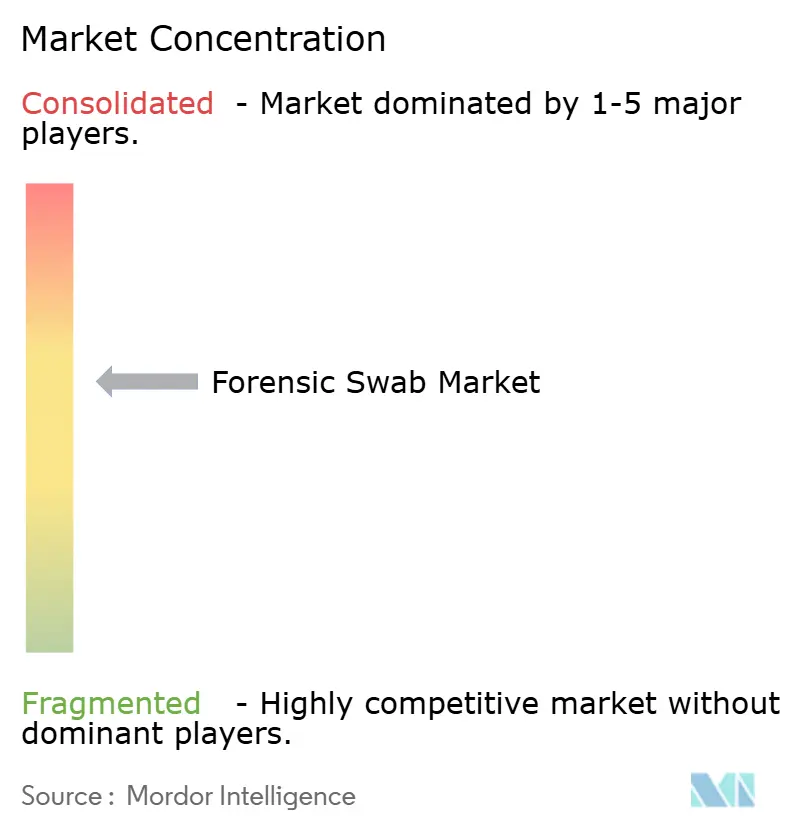
The forensic swabs market is moderately consolidated among specialist forensic consumable suppliers and larger life-science companies with forensic portfolios. COPAN Diagnostics, Puritan Medical Products, Arrowhead Forensics, Bode Technology, and Sirchie compete with Thermo Fisher Scientific, QIAGEN, Merck KGaA, SARSTEDT, and Becton Dickinson. Specialists compete through material innovation, forensic-grade certification, and chain-of-custody features. Larger companies can integrate collection devices with extraction instruments and human identification workflows.
COPAN’s 4N6 FLOQSwabs are made under ISO 18385:2016 and are co-marketed through Thermo Fisher Scientific human identification workflows. This arrangement connects swab purchasing to instrument-led sales and validated processing pathways. In February 2026, Bode Technology launched the patent-pending RapidSwab, a dual-matrix device that combines a flocked swab for Rapid DNA cartridge compatibility with a cotton swab for conventional testing. The product addresses the need to preserve a conventional testing option while supporting rapid processing from one collection event.
Barcode-enabled chain-of-custody swabs and certified kits for automated extraction platforms remain areas of product development. Chinese original equipment manufacturers are pursuing Asia-Pacific tenders with domestically produced DNA collection devices aligned with ISO 18385 requirements. QIAGEN’s October 2025 Sep&Prep launch illustrates how automated downstream processing can shape upstream compatibility needs. Competition in the forensic swabs market therefore depends on validation, compatibility, supply reliability, and the ability to meet public tender requirements. Suppliers that fit within a laboratory’s validated workflow can be less exposed to simple price comparisons.
Forensic Swab Industry Leaders
COPAN Diagnostics Inc.
Medical Wire & Equipment Co.
Puritan Medical Products
Sirchie
Thermo Fisher Scientific Inc.
- *Disclaimer: Major Players sorted in no particular order

Recent Industry Developments
- July 2026: Thermo Fisher Scientific received the first FBI National DNA Index System approval for its Applied Biosystems RapidINTEL Plus Cartridge for use with qualifying forensic crime scene samples, making the RapidHIT ID System the first Rapid DNA workflow eligible to generate profiles for CODIS network searches.
- February 2026: Bode Technology commercially launched the patent-pending Bode RapidSwab, a dual-matrix DNA evidence collection device combining a flocked swab for Rapid DNA cartridge compatibility and a cotton swab for conventional laboratory analysis in a single collection event.
- October 2025: QIAGEN launched the EZ2 DNA Investigator Sep&Prep Kit at the International Symposium on Human Identification 2025, an automated sexual assault sample processing workflow that processes up to 24 samples in parallel in under 2.5 hours using the EZ2 Connect Fx system, significantly reducing hands-on time and variability in sperm-fraction separation from cotton and flocked swabs.
- July 2025: The FBI formally operationalized the 2025 Forensic Quality Assurance Standards, establishing the first nationally recognized framework for forensic crime scene DNA profiles generated by Rapid DNA instruments to be eligible for CODIS upload and search, provided six specific criteria, including ISO 17025 accreditation and NDIS-approved cartridges, are met.


Global Forensic Swab Market Report Scope
The Forensic Swab market refers to the global industry focused on swabs used for collecting biological evidence such as DNA, saliva, or blood in criminal investigations and forensic testing. It includes specialized consumables designed to ensure contamination-free sample collection, preservation, and analysis. Growth in this market is driven by rising crime rates, advancements in forensic science, and increasing reliance on DNA profiling for law enforcement and judicial processes.
The forensic swab market is segmented by product material, swab tip design, application, end user, distribution channel, and geography. By product material, it is further divided into foam swabs, flocked swabs, cotton swabs, nylon swabs, polyester swabs, and other product materials. By swab tip design, it is segmented into standard tip swabs, tapered tip swabs, mini-tip swabs, elongated tip swabs, sublingual tip swabs, and large-surface-area swabs. By application, the market is segmented into crime scene evidence collection, reference sample collection, buccal and oral DNA collection, touch DNA collection, blood and body fluid collection, and other forensic applications. By end user, the market is segmented into forensic science laboratories, law enforcement agencies, hospitals and medico-legal institutions, academic and research institutes, military and defense investigation units, and private forensic service providers. By distribution channel, the market is segmented into direct sales, specialist forensic distributors, medical and laboratory distributors, government procurement, and online and catalog sales. The geography segment is further divided into North America, Europe, Asia-Pacific, the Middle East and Africa, and South America. The report also covers the estimated market sizes and trends for 17 countries across major regions globally. The report offers the market size and forecasts in value (USD) for the above segments.
| Foam Swabs |
| Flocked Swabs |
| Cotton Swabs |
| Nylon Swabs |
| Polyester Swabs |
| Other Product Materials |
| Standard Tip Swabs |
| Tapered Tip Swabs |
| Mini-Tip Swabs |
| Elongated Tip Swabs |
| Sublingual Tip Swabs |
| Large-Surface-Area Swabs |
| Crime Scene Evidence Collection |
| Reference Sample Collection |
| Buccal and Oral DNA Collection |
| Touch DNA Collection |
| Blood and Body Fluid Collection |
| Other Forensic Applications |
| Forensic Science Laboratories |
| Law Enforcement Agencies |
| Hospitals and Medico-Legal Institutions |
| Academic and Research Institutes |
| Military and Defense Investigation Units |
| Private Forensic Service Providers |
| Direct Sales |
| Specialist Forensic Distributors |
| Medical and Laboratory Distributors |
| Government Procurement |
| Online and Catalog Sales |
| North America | United States |
| Canada | |
| Mexico | |
| Europe | Germany |
| United Kingdom | |
| France | |
| Italy | |
| Spain | |
| Rest of Europe | |
| Asia-Pacific | China |
| Japan | |
| India | |
| Australia | |
| South Korea | |
| Rest of Asia-Pacific | |
| Middle East and Africa | GCC |
| South Africa | |
| Rest of Middle East and Africa | |
| South America | Brazil |
| Argentina | |
| Rest of South America |
| By Product Material | Foam Swabs | |
| Flocked Swabs | ||
| Cotton Swabs | ||
| Nylon Swabs | ||
| Polyester Swabs | ||
| Other Product Materials | ||
| By Swab Tip Design | Standard Tip Swabs | |
| Tapered Tip Swabs | ||
| Mini-Tip Swabs | ||
| Elongated Tip Swabs | ||
| Sublingual Tip Swabs | ||
| Large-Surface-Area Swabs | ||
| By Application | Crime Scene Evidence Collection | |
| Reference Sample Collection | ||
| Buccal and Oral DNA Collection | ||
| Touch DNA Collection | ||
| Blood and Body Fluid Collection | ||
| Other Forensic Applications | ||
| By End User | Forensic Science Laboratories | |
| Law Enforcement Agencies | ||
| Hospitals and Medico-Legal Institutions | ||
| Academic and Research Institutes | ||
| Military and Defense Investigation Units | ||
| Private Forensic Service Providers | ||
| By Distribution Channel | Direct Sales | |
| Specialist Forensic Distributors | ||
| Medical and Laboratory Distributors | ||
| Government Procurement | ||
| Online and Catalog Sales | ||
| By Geography | North America | United States |
| Canada | ||
| Mexico | ||
| Europe | Germany | |
| United Kingdom | ||
| France | ||
| Italy | ||
| Spain | ||
| Rest of Europe | ||
| Asia-Pacific | China | |
| Japan | ||
| India | ||
| Australia | ||
| South Korea | ||
| Rest of Asia-Pacific | ||
| Middle East and Africa | GCC | |
| South Africa | ||
| Rest of Middle East and Africa | ||
| South America | Brazil | |
| Argentina | ||
| Rest of South America | ||


Key Questions Answered in the Report
What is driving demand for forensic swabs?
National DNA database expansion, touch DNA collection, laboratory modernization, and qualifying Rapid DNA workflows support demand for validated collection devices. The forensic swabs market needs reliable, contamination-controlled products across these settings.
How large is the forensic swabs market in 2026?
The forensic swabs market size is USD 2.89 billion in 2026 and is projected to reach USD 4.38 billion by 2031 at an 8.60% CAGR.
Which forensic swab material is used most widely?
Foam swabs led product material demand with a 42.39% share in 2025, supported by recovery from rough and porous surfaces.
Which application is growing fastest for forensic swabs?
Touch DNA collection is forecast to grow at a 9.89% CAGR through 2031 as agencies increasingly collect low-template DNA evidence.
Which region is growing fastest?
Asia-Pacific is forecast to expand at a 9.88% CAGR through 2031, supported by national laboratory standards and forensic capacity investment.
Why is ISO 18385 important for collection devices?
ISO 18385 supports contamination-controlled forensic consumables, making it important where laboratories and government tenders require validated evidence collection.
Page last updated on:





