
Food Foreign-Object Detection Imaging Systems Market Size and Share
Market Overview
| Study Period | 2020 - 2031 |
|---|---|
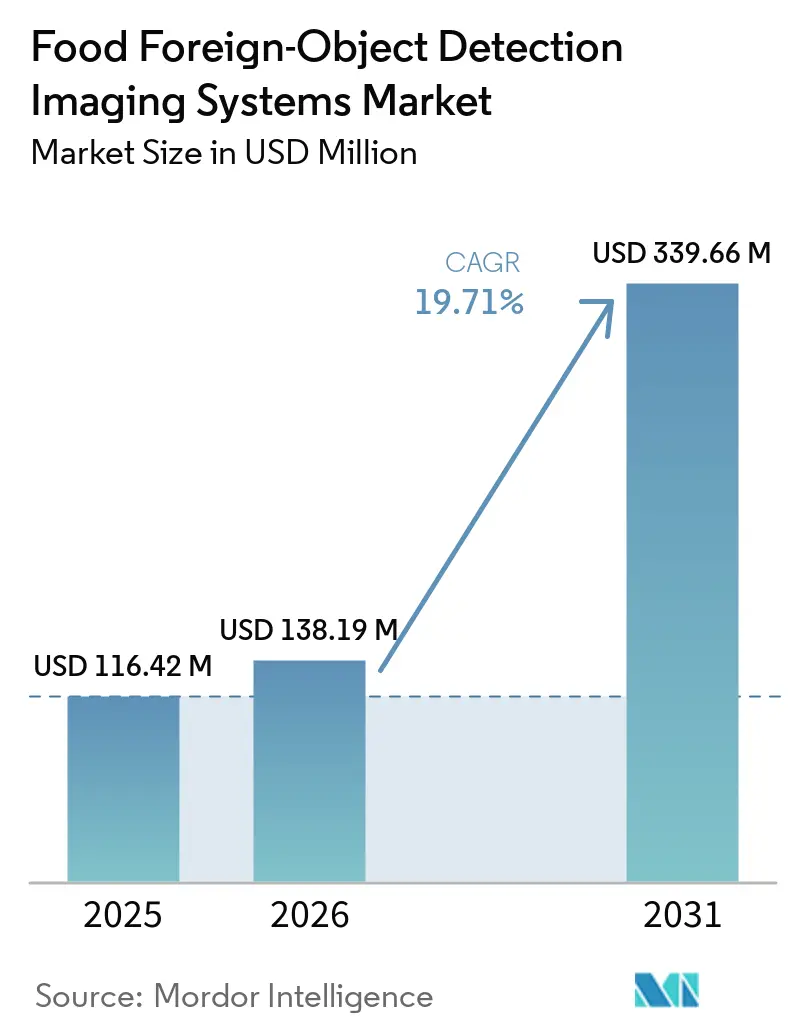
| Market Size (2026) | USD 138.19 Million |
| Market Size (2031) | USD 339.66 Million |
| Growth Rate (2026 - 2031) | 19.71 % |
| Fastest Growing Market | Asia-Pacific |
| Largest Market | Europe |
| Market Concentration | Medium |
Major Players *Disclaimer: Major Players sorted in no particular order Image © Mordor Intelligence. Reuse requires attribution under CC BY 4.0. | |
Food Foreign-Object Detection Imaging Systems Market Analysis by Mordor Intelligence
The food foreign-object detection imaging systems market size is projected to expand from USD 116.42 million in 2025 to USD 138.19 million in 2026, and to USD 339.66 million by 2031, registering a CAGR of 19.71% between 2026 and 2031. Food manufacturers are increasing their investment in inspections because physical contamination can cause recalls, production disruptions, and customer losses. Food safety rules and retailer audit requirements are making documented contaminant controls a routine operating need. The food foreign-object detection imaging systems market also benefits as processors replace periodic checks with continuous inline inspection. Software-based detection is becoming common in mid-range equipment, which makes reliable image analysis a broader purchasing requirement. Supplier opportunities extend to processing, packaging, and contract manufacturing lines that need adaptable inspection across several products.
Key Report Takeaways
- Among imaging technologies, X-ray imaging systems held 55.67% of the food foreign-object detection imaging systems market revenue share in 2025, while hyperspectral imaging systems are projected to expand at a 20.14% CAGR through 2031.
- By foreign object type, metal contaminants held 31.29% revenue share in 2025, while plastic and rubber contaminants are projected to expand at a 21.56% CAGR through 2031.
- By food product, meat, poultry, and seafood accounted for 25.89% of the food foreign-object detection imaging systems market revenue share in 2025, while processed and ready-to-eat foods are projected to expand at a 22.13% CAGR through 2031.
- By detection method, 2D imaging systems held 43.21% revenue share in 2025, while multimodal and sensor-fusion imaging is projected to expand at an 22.56% CAGR through 2031.
- By system architecture, integrated production-line systems held 52.78% food foreign-object detection imaging systems market revenue share in 2025, while multi-inspection and combination systems are projected to expand at a 20.59% CAGR through 2031.
- By end-user, food processing companies held 27.73% revenue share in 2025, while food packaging companies are projected to expand at a 21.14% CAGR through 2031.
- By geography, Europe held 32.34% of the food foreign-object detection imaging systems market in 2025, while Asia-Pacific is projected to expand at a 21.67% CAGR through 2031.
Note: Market size and forecast figures in this report are generated using Mordor Intelligence’s proprietary estimation framework, updated with the latest available data and insights as of January 2026.
Global Food Foreign-Object Detection Imaging Systems Market Trends and Insights
Drivers Impact Analysis*
| Driver | (~) % Impact on CAGR Forecast | Geographic Relevance | Impact Timeline |
|---|---|---|---|
| Stricter Food Safety Regulations and Retailer Requirements | +2.3% | Global, concentrated in North America and Europe | Short term (≤ 2 years) |
| Growth of Processed and Packaged Food Production | +1.7% | Asia-Pacific core, spill-over to Middle East and Africa | Medium term (2-4 years) |
| Automation of Inline Quality Control | +1.4% | Global | Medium term (2-4 years) |
| Increasing Cost of Recalls and Brand Damage | +1.1% | North America and Europe | Short term (≤ 2 years) |
| AI-Enabled Reduction of False Rejects | +0.7% | Global, with early gains in North America and Europe | Medium term (2-4 years) |
| Detection of Low-Density and Internally Hidden Contaminants | +0.5% | Global | Long term (≥ 4 years) |
| Source: Mordor Intelligence | |||
Stricter Food Safety Regulations and Retailer Requirements
Food safety requirements remain a central driver of purchasing for the food foreign-object detection imaging systems market. The U.S. Food Safety Modernization Act requires food facilities to identify and control foreseeable hazards in their preventive controls plans. Regulation (EU) 2017/625 requires official controls across the agri-food chain and supports checks on compliance with food law.[1] These obligations make recorded inspection activity valuable at critical production points. BRCGS and GFSI-benchmarked programs, as well as major buyers, also expect suppliers to maintain demonstrable control systems. This combination makes high-sensitivity inspection relevant in export-oriented plants as well as established domestic facilities.[2]
Growth of Processed and Packaged Food Production
Processed and packaged foods require repeated handling, cutting, mixing, filling, and sealing steps, which widens the number of points where contamination can occur. The food foreign-object detection imaging systems market gains when processors add lines for ready-to-eat, bakery, dairy, snack, and protein products. Brazil’s ANVISA updated tolerance requirements for foreign matter in foods through Instrução Normativa No. 351, strengthening the compliance setting for industrial food production.[3] A broad product base limits dependence on a single food category or customer group. Contract manufacturers and co-packers need systems that can handle several package formats and contaminant profiles. Their preference for flexible equipment can support demand for higher-specification inspection configurations.
Automation of Inline Quality Control
Manufacturers are moving from sample-based checks toward continuous inspection of products on the line. The food foreign-object detection imaging systems market supports this change by providing detection, rejection, and production records within a single workflow. Automated systems can reduce reliance on manual visual checking where trained inspection staff are scarce. Polysense raised USD 10.7 million in July 2026 to scale its AI-powered inline quality control platform for food manufacturers.[4] Its deployments with Agristo, Darta, and Poppies Bakeries showed that the approach can be used across vegetable, potato, and bakery lines. Connected inspection equipment can also help plants respond before a quality deviation results in material waste.
Increasing Cost of Recalls and Brand Damage
Foreign-object recalls can create direct costs from product recovery, testing, disposal, and corrective actions. They can also disrupt retail relationships and expose processors to product safety claims. U.S. recall reporting and enforcement activity maintains attention on preventive controls in food facilities. A detection system, therefore,` has value beyond compliance because it helps a plant avoid a disruptive event. This rationale can move investment decisions from plant operations to corporate risk management teams. The food foreign-object detection imaging systems market is supported when processors assess inspection costs against the wider consequences of product withdrawal.
Restraints Impact Analysis*
| Restraint | (~) % Impact on CAGR Forecast | Geographic Relevance | Impact Timeline |
|---|---|---|---|
| High Capital and Lifecycle Costs | -1.8% | Asia-Pacific emerging markets, South America, Africa | Medium term (2-4 years) |
| Product Effect and Sensitivity Trade-Offs | -1.2% | Global | Short term (≤ 2 years) |
| Validation Burden for Variable Product and Packaging Conditions | -0.9% | Global | Medium term (2-4 years) |
| Limited Availability of Market-Specific Inspection Data for AI Training | -0.7% | Global | Long term (≥ 4 years) |
| Source: Mordor Intelligence | |||
High Capital and Lifecycle Costs
Industrial imaging equipment requires a significant upfront investment, especially for smaller food processors. Entry-level inline X-ray systems typically require USD 50,000 to USD 150,000 in capital. Hyperspectral and multi-sensor platforms carry higher equipment costs and may need specialized integration work. Installation, calibration, software licenses, service coverage, and compliance validation add to lifecycle expenditure. Service access can be limited in developing regions, while sensor replacement can lengthen downtime. Equipment-as-a-service and usage-based models may reduce this barrier, but these models remain less established outside North America and Western Europe.
Product Effect and Sensitivity Trade-Offs
Some food characteristics reduce the practical sensitivity of standard inspection setups. High-moisture, high-salt, and high-fat products can interfere with metal detection signals. Operators may then lower sensitivity thresholds, creating a harder balance between contamination detection and false rejects. X-ray inspection also becomes more difficult where product density varies sharply or packaging masks similar-density material. Bone-in poultry, layered frozen meals, and metallic packaging may require additional validation or multiple detection methods. Mettler-Toledo and Sesotec introduced AI-enabled inspection systems in 2026 to improve operations under difficult product conditions.
*Our forecasts treat driver/restraint impacts as directional, not additive. The impact forecasts reflect baseline growth, mix effects, and variable interactions.
Segment Analysis
By Imaging Technology: X-Ray Leads While Hyperspectral Systems Gain Ground
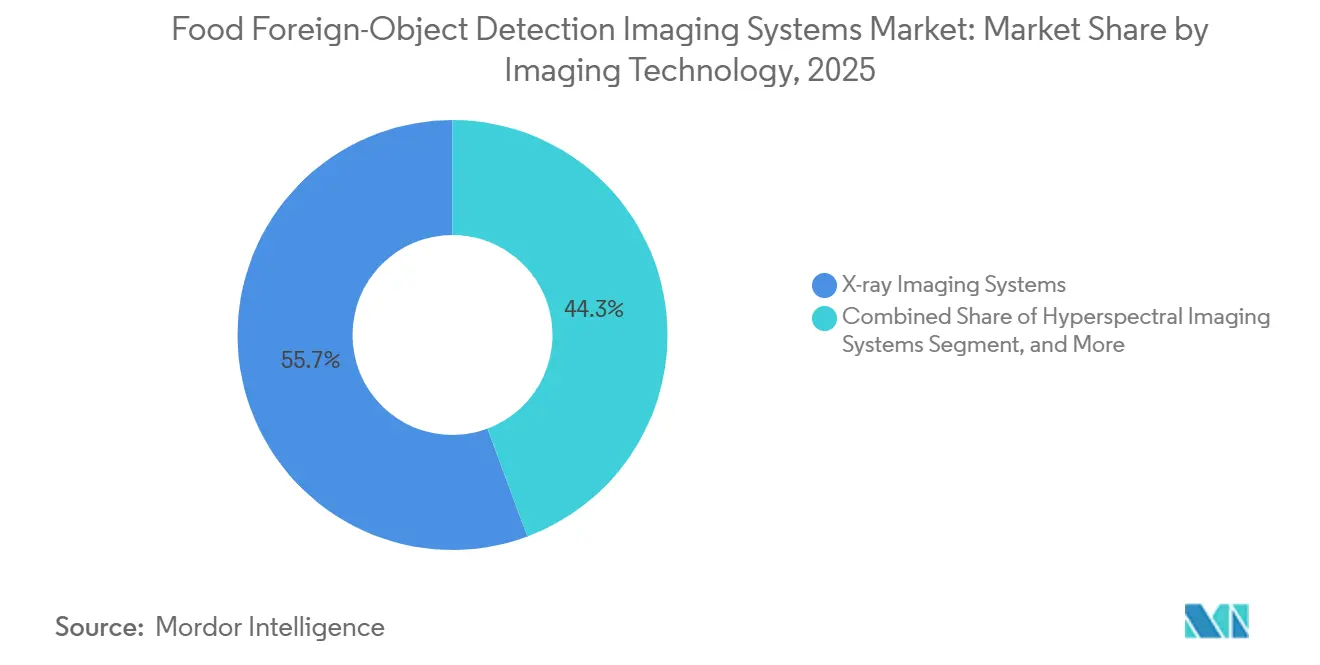
X-ray imaging systems accounted for 55.67% of the food foreign-object detection imaging systems market share in 2025. They detect metal, glass, dense plastic, stone, and calcified bone in one pass. This broad capability supports their use in meat, dairy, bakery, and packaged-food lines. Their established installed base also aligns with long-standing regulatory and retailer expectations. Mettler-Toledo introduced the X56 DXD+ dual-energy photon-counting X-ray system in May 2026 for low-density contaminants and overlapping products. The system uses AI-enabled functions to reduce the manual adjustments needed on complex lines.
The food foreign-object detection imaging systems industry also includes optical, multispectral, and thermal equipment for specific use cases. Optical systems help identify surface defects in produce. Multispectral systems support sorting based on color and spectral properties. Thermal and infrared systems can assess temperature uniformity in cooked and ready-to-eat foods. Hyperspectral imaging is projected to expand at a 20.14% CAGR through 2031. HSI-AgriFoodAnomaly supplied 147 calibrated hyperspectral cubes for foreign-object detection in oat and chocolate matrices, supporting future algorithm training.

By Foreign Object Type: Metal Is the Established Control While Plastic and Rubber Risks Rise
Metal contaminants accounted for 31.29% of foreign object types in 2025. Contact between cutting, blending, and conveying equipment is a common source of metal fragments. Metal detection is therefore a basic control in many food facilities. Stone, ceramic, glass, and bone remain important hazards that established X-ray systems can address. These hazards are well understood in food-specific applications such as cereal, beverage, and protein processing. Their continued presence supports the replacement and upgrade cycle for conventional systems.
Plastic and rubber contaminants are projected to expand at a 21.56% CAGR through 2031. Plastic film, conveyor material, gaskets, and processing aids can introduce low-density fragments into a production stream. These contaminants can be difficult for density-based systems to detect when their density resembles that of the food product. Multimodal and hyperspectral methods can provide additional information for these difficult cases. Bone remains important in meat and seafood plants because natural product variation complicates density interpretation. Glass events are less frequent but require high-specification inspection in beverage and jarred-food production.
By Food Product: Protein Processing Holds the Largest Position While Ready-to-Eat Foods Expand
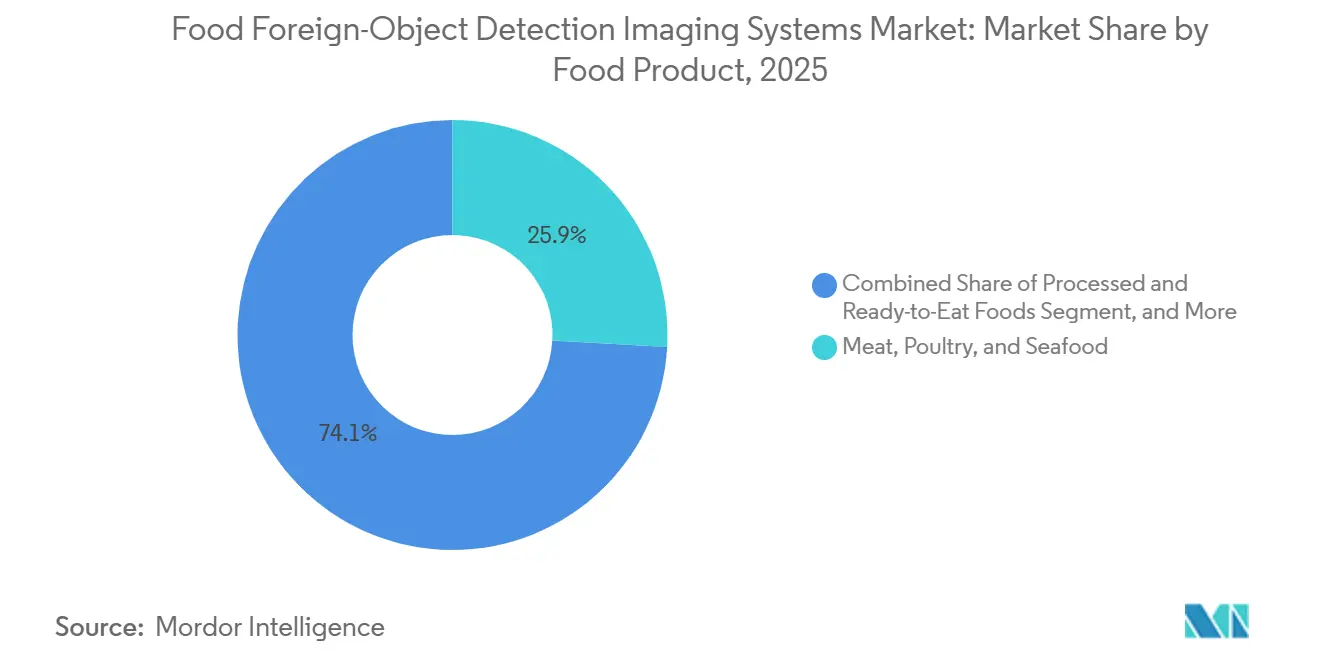
Meat, poultry, and seafood held 25.89% of the food product segment in 2025. The segment is exposed to contamination during deboning, cutting, portioning, and high-speed conveying. Protein-processing demand benefits from the stringent control needed for bone and metal fragments. X-ray equipment for chicken fillets and fish may require a resolution below 1.5 mm to detect dense bone fragments. This requirement raises equipment specifications and supports higher-value installations. Dairy, bakery, confectionery, grains, cereals, pulses, snacks, and nuts also drive substantial demand for equipment.
Processed and ready-to-eat foods are projected to expand at a 22.13% CAGR through 2031. Their production combines proteins, starches, sauces, packaging materials, and several preparation steps. This increases the number and variety of possible foreign objects in a single production flow. A 2025 peer-reviewed study reported a 92% recall rate for stone detection using an improved Faster R-CNN model in complex food scenarios. Fruits and vegetables remain a distinct application for optical and hyperspectral inspection. These methods can identify surface defects and organic contaminants without using X-ray exposure.
By Detection Method: 2D Systems Remain Widely Used While Sensor Fusion Advances
2D imaging systems accounted for 43.21% of the food foreign-object detection imaging systems market by detection method in 2025. Standard X-ray and optical inspection lines commonly use 2D imaging because it balances speed, cost, and resolution. Line-scan equipment continuously reconstructs images of products moving on a conveyor. It is a common approach for installed X-ray platforms. Area-scan imaging is useful when facilities need simultaneous views of irregular or bulk products. The large 2D base also presents an upgrade opportunity for systems with more advanced software capabilities.
Multimodal and sensor-fusion imaging is projected to expand at an 22.56% CAGR through 2031. These configurations combine X-ray data with near-infrared or optical color information. The richer data stream can improve classification when a single modality is insufficient. A 2026 study using an improved YOLOv13 and X-ray data reported a mean average precision above 98.50% for detecting metal, glass, and plastic. The study also reported a missed detection rate of 0.4%, compared with 2.2% for the baseline X-ray-only approach. 3D inspection remains specialized for irregular products where depth ambiguity affects 2D classification.
By System Architecture: Integrated Lines Lead While Combination Systems Gain Adoption
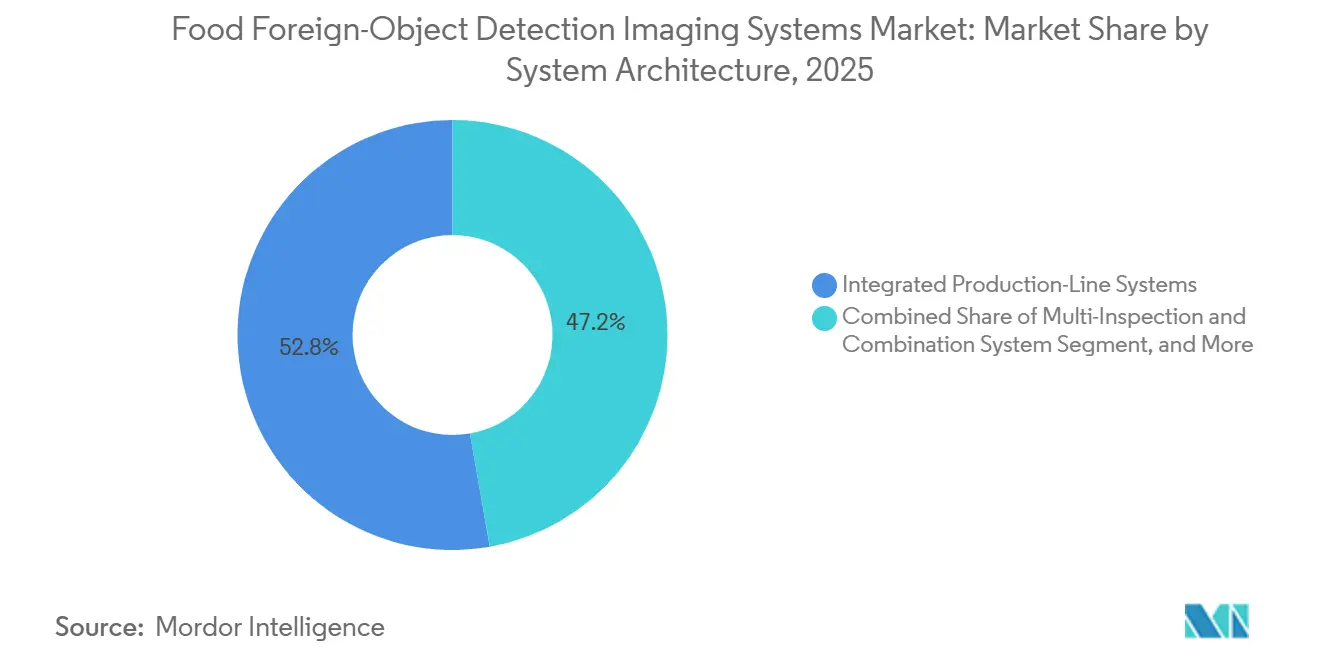
Integrated production-line systems accounted for 52.78% of the food foreign-object detection imaging systems market by system architecture in 2025. These installations connect inspection functions directly to high-speed production flows. They limit manual handling and maintain automatic rejection records for HACCP documentation. Their operating model supports continuous inspection, which major retailers require for complete throughput control. Standalone systems remain useful in research, quality assurance, and specialty processing environments. They are also suitable where product volumes or formats do not justify a permanent integrated line.
Multi-inspection and combination systems are projected to expand at a 20.59% CAGR through 2031. They bring metal detection, X-ray inspection, checkweighing, and label verification into a single platform. This arrangement is valuable for processors that have limited floor space. Fortress Technology introduced the Raptor Tritek in May 2026, featuring metal detection, checkweighing, and label vision inspection in a single frame. The company stated that the system is at least 40% shorter than comparable modular configurations. Combination equipment changes inspection from a single quality checkpoint into a more connected production control process.
By End-User: Food Processors Are the Main Customer Group While Packaging Companies Accelerate
Food processing companies held 27.73% of the 2025 end-user segment. They are a primary point of contamination control because cutting, mixing, portioning, and thermal processing can introduce hazards. Meat and seafood, dairy, and bakery processors have different needs based on product density and package format. Beverage manufacturers face a distinct technical issue with glass fragments in glass containers. Standard X-ray systems can struggle when the density contrast between a shard and the container wall is very small. These applications may require dual-energy X-ray systems or optical support.
Food packaging companies are projected to expand at a 21.14% CAGR through 2031. Packaging lines can introduce metal clips, plastic film fragments, and rubber seals. Brand owners are increasingly asking packaging suppliers to use inline inspection as part of their supply requirements. This broadens the food foreign-object detection imaging systems industry beyond its traditional processor customer base. It also distributes inspection duties across more stages of the supply chain. Supplier investment can rise as packaging companies seek clear inspection records for customers and auditors.
Geography Analysis
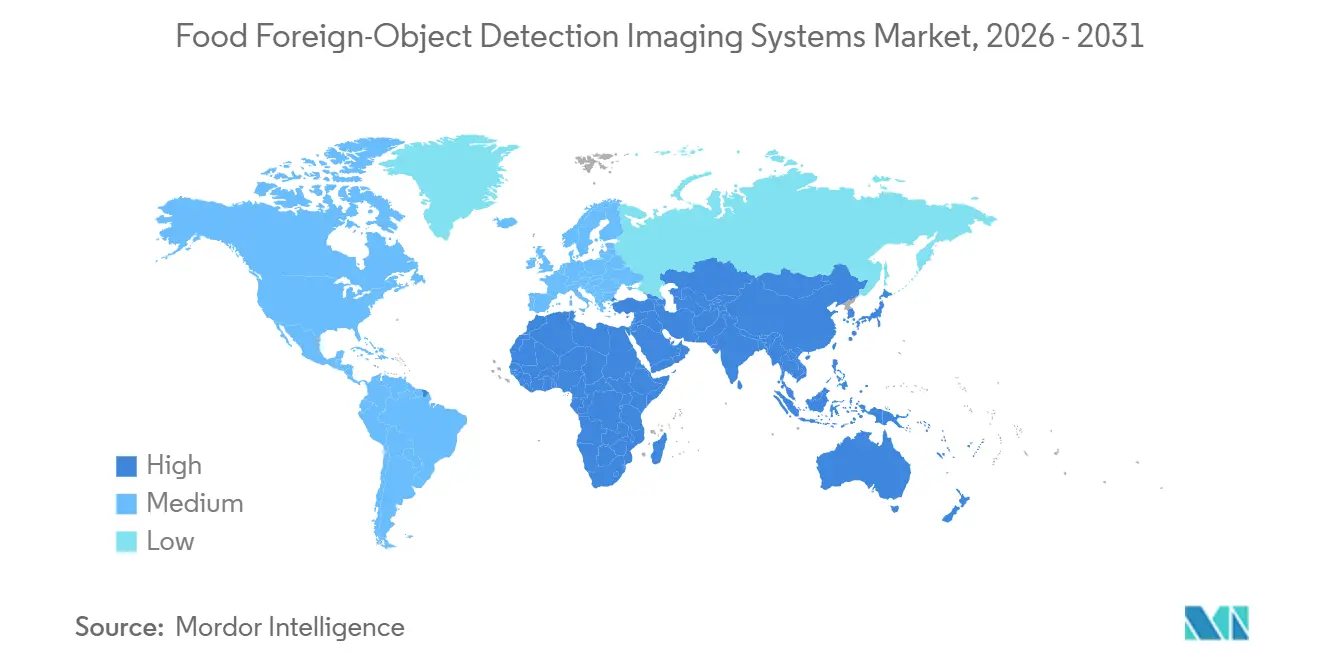
Europe held 32.34% of the food foreign-object detection imaging systems market share in 2025. The region has a detailed regulatory environment for traceability, hazard control, and food law enforcement. Regulation (EC) No 178/2002 established general principles of food law and traceability requirements. EUR-LEX Regulation (EU) 2017/625 supports official controls throughout the food chain. EUR-LEX Germany, the United Kingdom, France, Italy, and Spain host major food processing and packaging clusters. Private buyer requirements through BRCGS and IFS reinforce the demand for documented inspection processes.
Asia-Pacific is projected to expand at a 21.67% CAGR through 2031. New processing capacity in China, India, and Southeast Asia adds potential demand for inline inspection equipment. China published T/CEATEC 133-2025 in December 2025 for AI-based X-ray detection of foreign objects and defects in food. NATIONAL STANDARDS LIBRARY OF CHINA The guideline describes technical requirements, implementation processes, and detection methods for AI-integrated X-ray systems. It supports a more formal framework for equipment upgrades in domestic food processing. Japan and South Korea provide stable replacement demand because both maintain stringent food safety requirements.
North America remains a significant part of the food foreign-object detection imaging systems market. U.S. preventive control requirements and documented recall activity support capital spending on inspection. Canada and Mexico add demand through their food production and trade links with the United States. South America is developing as a procurement area, led by Brazil's large food production base and regulatory requirements for foreign matter. The Middle East and Africa remain smaller in aggregate, although the UAE and Saudi Arabia are active centers for processing and packaging investment. South Africa supports regional adoption through export buyer requirements linked to European retail channels.
Competitive Landscape
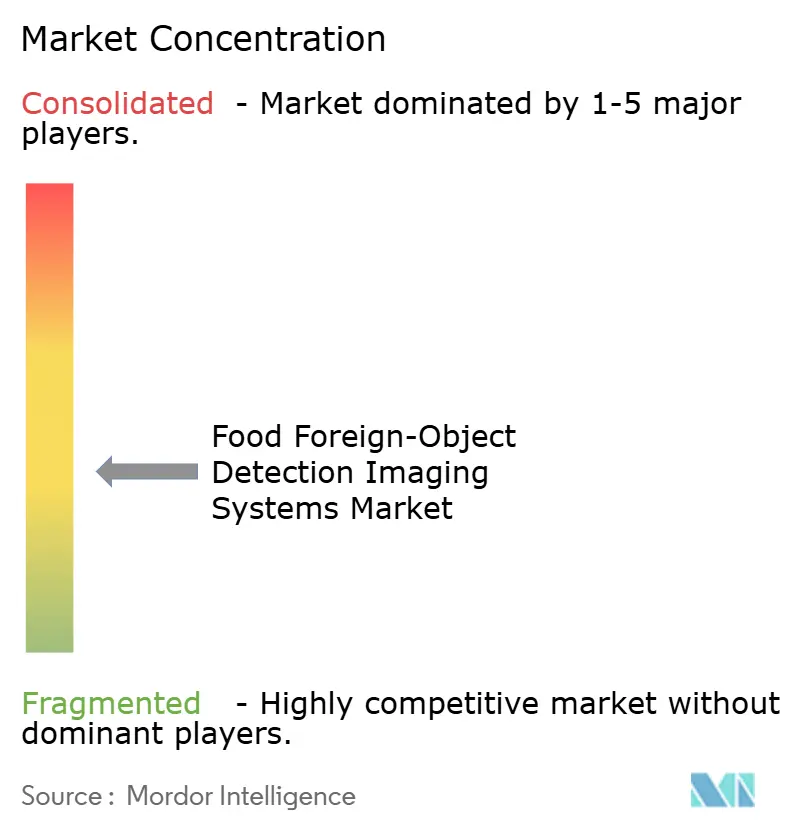
The food foreign-object detection imaging systems market is moderately consolidated. Mettler-Toledo International Inc. and Thermo Fisher Scientific Inc. are in the leading group because they have broad product lines and established service networks. Their relationships with multinational food manufacturers also support their position. Mettler-Toledo introduced the X56 DXD+ at Interpack 2026, featuring dual-energy photon-counting X-ray inspection and AI capabilities. It also introduced the M50 R-Series AdvancedLine metal detector, developed at its Safeline research and development center in Manchester. These launches show continuing investment in complex inspection applications and connected equipment.
Chinese manufacturers, including Techik Instrument (Shanghai) Co., Ltd. and Hefei Meyer Optoelectronic Technology Inc., compete strongly where pricing and local support shape purchase decisions. Their pressure is most visible in the Asia-Pacific region and is also relevant in South America and the Middle East. China's 2025 AI X-ray inspection guideline gives domestic suppliers with established algorithm capabilities an early compliance advantage. NATIONAL STANDARDS LIBRARY OF CHINA Fortress Technology uses compact combination systems to address facilities with limited space. Its Raptor Tritek joins metal detection, checkweighing, and vision inspection in a single machine frame. This gives smaller processors an alternative to several separate units.
Specialist hyperspectral suppliers, including Mekitec Group, can address demand for plastic and organic contaminant detection. Firms using Teledyne DALSA's Kaleido SWIR platform can also target applications where X-ray inspection has practical limits. Teledyne introduced the camera in May 2026 with 1,280-pixel spatial resolution and line rates exceeding 2.3 kHz. TELEDYNE VISION SOLUTIONS Sesotec introduced INTUITY NEX in April 2026, using AI-enabled functions for high-hygiene meat, fish, and poultry lines. FOODENGINEERINGMAG.COM The food foreign-object detection imaging systems market remains open to regional and specialist vendors that can meet specific plant needs.
Food Foreign-Object Detection Imaging Systems Industry Leaders
-
Mettler-Toledo International Inc.
-
Anritsu Corporation
-
ISHIDA CO., LTD.
-
Loma Systems
-
Thermo Fisher Scientific Inc.
- *Disclaimer: Major Players sorted in no particular order
Recent Industry Developments
- July 2026: Polysense, a Belgian AI food inspection startup, raised USD 10.7 million in an oversubscribed seed round led by Felix Capital, with participation from Fortino Ventures and angel investors including Syndicate One and 100IN. The funding was directed toward scaling global deployments of its continuous inline inspection and automated process control platform across vegetable, potato, bakery, and confectionery lines, following commercial rollouts with Agristo, Darta, and Poppies Bakeries in Europe, the United States, and the Middle East.
- May 2026: Mettler-Toledo Product Inspection launched the X56 DXD+, a dual-energy photon-counting X-ray inspection system with integrated AI capabilities, at Interpack 2026. The system identifies low-density contaminants including plastic, rubber, and wood in complex packaged products featuring overlapping textures and varying density profiles, expanding the company’s X6 Series into medium-to-large-product single-lane and multi-lane configurations.
- May 2026: Mettler-Toledo also introduced the M50 R-Series AdvancedLine metal detector at Interpack 2026, developed at its Safeline research and development center in Manchester. The platform integrates AI-based machine learning algorithms, multi-simultaneous frequency technology, and embedded Wi-Fi connectivity, alongside the INFINITY Electronic Test System, an automated performance monitoring tool up to 3 times faster than manual testing routines, reducing line downtime and audit preparation burden.
- May 2026: Fortress Technology unveiled the Raptor Tritek 3-in-1 integrated inspection system at Interpack 2026, combining metal detection, checkweighing, and label vision inspection in a single hygienic frame at least 40% shorter than modular equivalents. The system meets HACCP, BRCGS, GFSI, and IFS food safety design principles and incorporates Contact 4.0 data connectivity for multi-machine production data consolidation.
Global Food Foreign-Object Detection Imaging Systems Market Report Scope
The Food Foreign-Object Detection Imaging Systems Market encompasses advanced inspection technologies that use X-ray, optical, multispectral, hyperspectral, and thermal imaging to detect physical contaminants such as metal, glass, stone, plastic, and bone in food products during processing and packaging. These systems deliver real-time, non-destructive, high-resolution inspection that ensures product safety, protects brand integrity, and enables compliance with stringent food safety regulations and standards, including HACCP, FSMA, and ISO 22000. Their key value proposition lies in safeguarding consumer health, minimizing product recalls, and maintaining operational efficiency across high-speed production environments.
The Food Foreign-Object Detection Imaging Systems Market Report is Segmented by Imaging Technology (X-ray Imaging Systems, Optical and Visible-Light Imaging Systems, Multispectral Imaging Systems, Hyperspectral Imaging Systems, Thermal and Infrared Imaging Systems, and Other Imaging Technologies), Foreign Object Type (Metal, Glass, Stone and Ceramic, Bone, Plastic and Rubber, and Other Foreign Object Types), Food Product (Meat, Poultry, and Seafood; Dairy and Dairy Products; Bakery and Confectionery; Fruits and Vegetables; Processed and Ready-to-Eat Foods; Grains, Cereals, and Pulses; Snacks and Nuts; and Other Food Products), Detection Method (2D Imaging, 3D Imaging, Line-Scan Imaging, Area-Scan Imaging, and Multimodal and Sensor-Fusion Imaging), System Architecture (Standalone Inspection Systems, Integrated Production-Line Systems, and Multi-Inspection and Combination Systems), End-User (Food Processing Companies, Food Packaging Companies, Meat and Seafood Processors, Dairy Processors, Bakery and Confectionery Manufacturers, Beverage Manufacturers, and Other End-Users), and Geography (North America, South America, Europe, Asia-Pacific, Middle East and Africa). The Market Forecasts are Provided in Terms of Value (USD).
| X-ray Imaging Systems |
| Optical and Visible-Light Imaging Systems |
| Multispectral Imaging Systems |
| Hyperspectral Imaging Systems |
| Thermal and Infrared Imaging Systems |
| Other Imaging Technologies |
| Metal |
| Glass |
| Stone and Ceramic |
| Bone |
| Plastic and Rubber |
| Other Foreign Object Types |
| Meat, Poultry, and Seafood |
| Dairy and Dairy Products |
| Bakery and Confectionery |
| Fruits and Vegetables |
| Processed and Ready-to-Eat Foods |
| Grains, Cereals, and Pulses |
| Snacks and Nuts |
| Other Food Products |
| 2D Imaging |
| 3D Imaging |
| Line-Scan Imaging |
| Area-Scan Imaging |
| Multimodal and Sensor-Fusion Imaging |
| Standalone Inspection Systems |
| Integrated Production-Line Systems |
| Multi-Inspection and Combination Systems |
| Food Processing Companies |
| Food Packaging Companies |
| Meat and Seafood Processors |
| Dairy Processors |
| Bakery and Confectionery Manufacturers |
| Beverage Manufacturers |
| Other End-Users |
| North America | United States | |
| Canada | ||
| Mexico | ||
| South America | Brazil | |
| Argentina | ||
| Rest of South America | ||
| Europe | Germany | |
| United Kingdom | ||
| France | ||
| Italy | ||
| Spain | ||
| Rest of Europe | ||
| Asia-Pacific | China | |
| Japan | ||
| India | ||
| South Korea | ||
| Rest of Asia-Pacific | ||
| Middle East and Africa | Middle East | Saudi Arabia |
| United Arab Emirates | ||
| Turkey | ||
| Rest of the Middle East | ||
| Africa | South Africa | |
| Nigeria | ||
| Rest of Africa | ||
| By Imaging Technology | X-ray Imaging Systems | ||
| Optical and Visible-Light Imaging Systems | |||
| Multispectral Imaging Systems | |||
| Hyperspectral Imaging Systems | |||
| Thermal and Infrared Imaging Systems | |||
| Other Imaging Technologies | |||
| By Foreign Object Type | Metal | ||
| Glass | |||
| Stone and Ceramic | |||
| Bone | |||
| Plastic and Rubber | |||
| Other Foreign Object Types | |||
| By Food Product | Meat, Poultry, and Seafood | ||
| Dairy and Dairy Products | |||
| Bakery and Confectionery | |||
| Fruits and Vegetables | |||
| Processed and Ready-to-Eat Foods | |||
| Grains, Cereals, and Pulses | |||
| Snacks and Nuts | |||
| Other Food Products | |||
| By Detection Method | 2D Imaging | ||
| 3D Imaging | |||
| Line-Scan Imaging | |||
| Area-Scan Imaging | |||
| Multimodal and Sensor-Fusion Imaging | |||
| By System Architecture | Standalone Inspection Systems | ||
| Integrated Production-Line Systems | |||
| Multi-Inspection and Combination Systems | |||
| By End-User | Food Processing Companies | ||
| Food Packaging Companies | |||
| Meat and Seafood Processors | |||
| Dairy Processors | |||
| Bakery and Confectionery Manufacturers | |||
| Beverage Manufacturers | |||
| Other End-Users | |||
| By Geography | North America | United States | |
| Canada | |||
| Mexico | |||
| South America | Brazil | ||
| Argentina | |||
| Rest of South America | |||
| Europe | Germany | ||
| United Kingdom | |||
| France | |||
| Italy | |||
| Spain | |||
| Rest of Europe | |||
| Asia-Pacific | China | ||
| Japan | |||
| India | |||
| South Korea | |||
| Rest of Asia-Pacific | |||
| Middle East and Africa | Middle East | Saudi Arabia | |
| United Arab Emirates | |||
| Turkey | |||
| Rest of the Middle East | |||
| Africa | South Africa | ||
| Nigeria | |||
| Rest of Africa | |||
Key Questions Answered in the Report
What is the food foreign-object detection imaging systems market size?
The food foreign-object detection imaging systems market size is USD 138.19 million in 2026 and is projected to reach USD 339.66 million by 2031 at an 19.71% CAGR.
Which imaging technology has the largest position in food foreign-object detection systems?
X-ray imaging systems held 55.67% revenue share in 2025 because they can detect several dense contaminants across many food applications.
Which technology is expected to expand the fastest through 2031?
Hyperspectral imaging systems are projected to expand at a 20.14% CAGR because they can help detect low-density organic contaminants.
Why do food processors invest in foreign-object detection equipment?
Processors use the equipment to support preventive controls, meet buyer audit expectations, reduce contamination risk, and maintain inspection records.
Which food application leads demand for inspection imaging systems?
Meat, poultry, and seafood held 25.89% revenue share in 2025 because deboning, cutting, and portioning require close control of physical hazards.
Which region is forecast to expand the fastest?
Asia-Pacific is projected to expand at a 21.67% CAGR through 2031 as processing capacity increases and AI-based inspection standards develop.