
Food Color and Appearance Inspection Systems Market Size and Share
Market Overview
| Study Period | 2020 - 2031 |
|---|---|
| Market Size (2026) | USD 412.56 Million |
| Market Size (2031) | USD 719.40 Million |
| Growth Rate (2026 - 2031) | 11.76 % |
| Fastest Growing Market | Asia-Pacific |
| Largest Market | Europe |
| Market Concentration | Low |
Major Players *Disclaimer: Major Players sorted in no particular order Image © Mordor Intelligence. Reuse requires attribution under CC BY 4.0. | |
Food Color and Appearance Inspection Systems Market Analysis by Mordor Intelligence
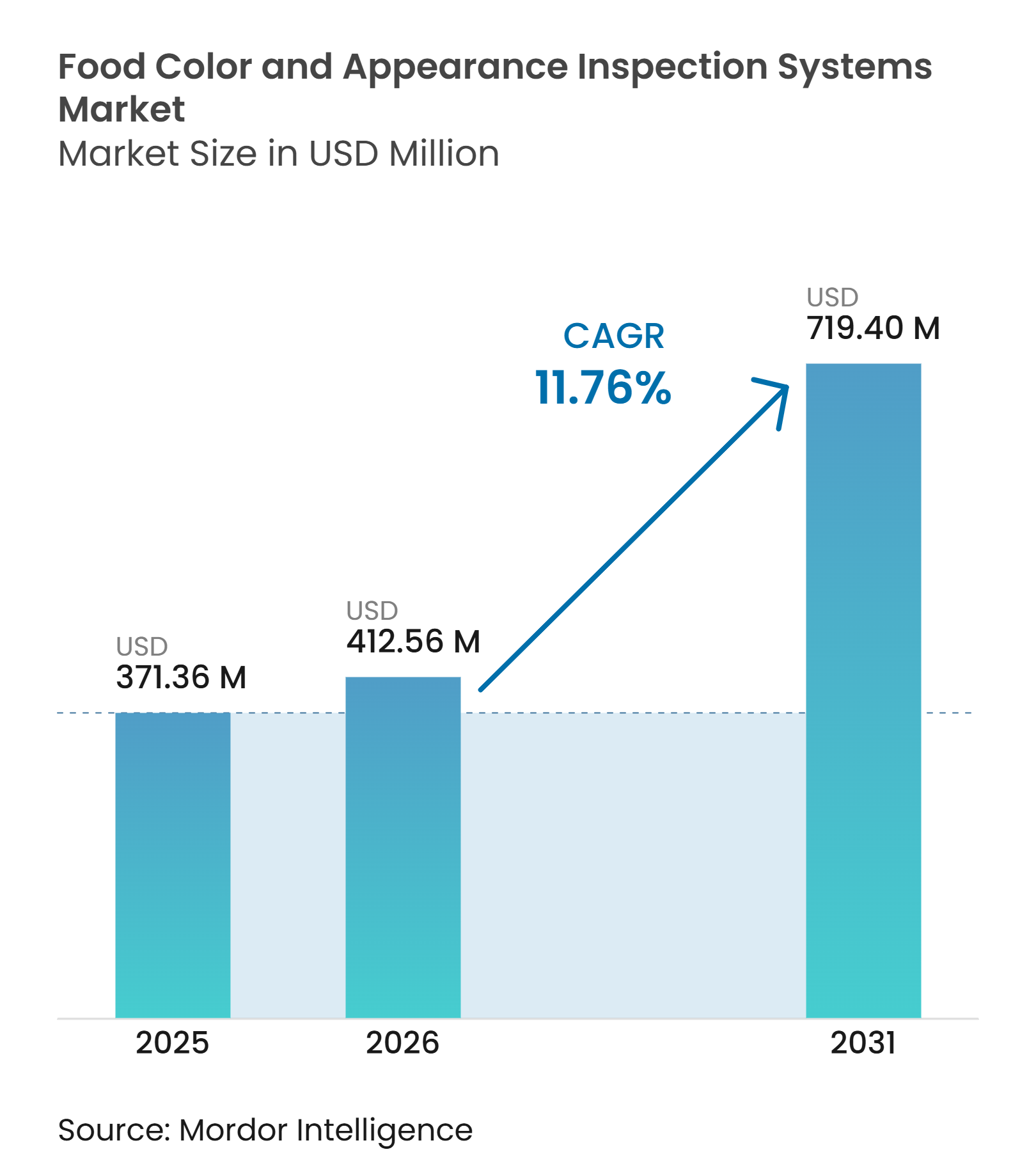
The Food Color and Appearance Inspection Systems Market size is expected to increase from USD 371.36 million in 2025 to USD 412.56 million in 2026 and reach USD 719.40 million by 2031, registering a CAGR of 11.76% over 2026-2031. The Food Color and Appearance Inspection Systems Market is moving from manual sampling toward continuous inspection on production lines. AI-enabled sensing and edge computing are supporting faster decisions at the line level. Large manufacturers are also seeking to reduce the cost of rejected products and reprocessing. Systems that combine sensing with real-time analysis can support earlier quality intervention rather than defect removal after production. This shift favors suppliers that can combine inspection hardware, analytics, and production-line connectivity.
Key Report Takeaways
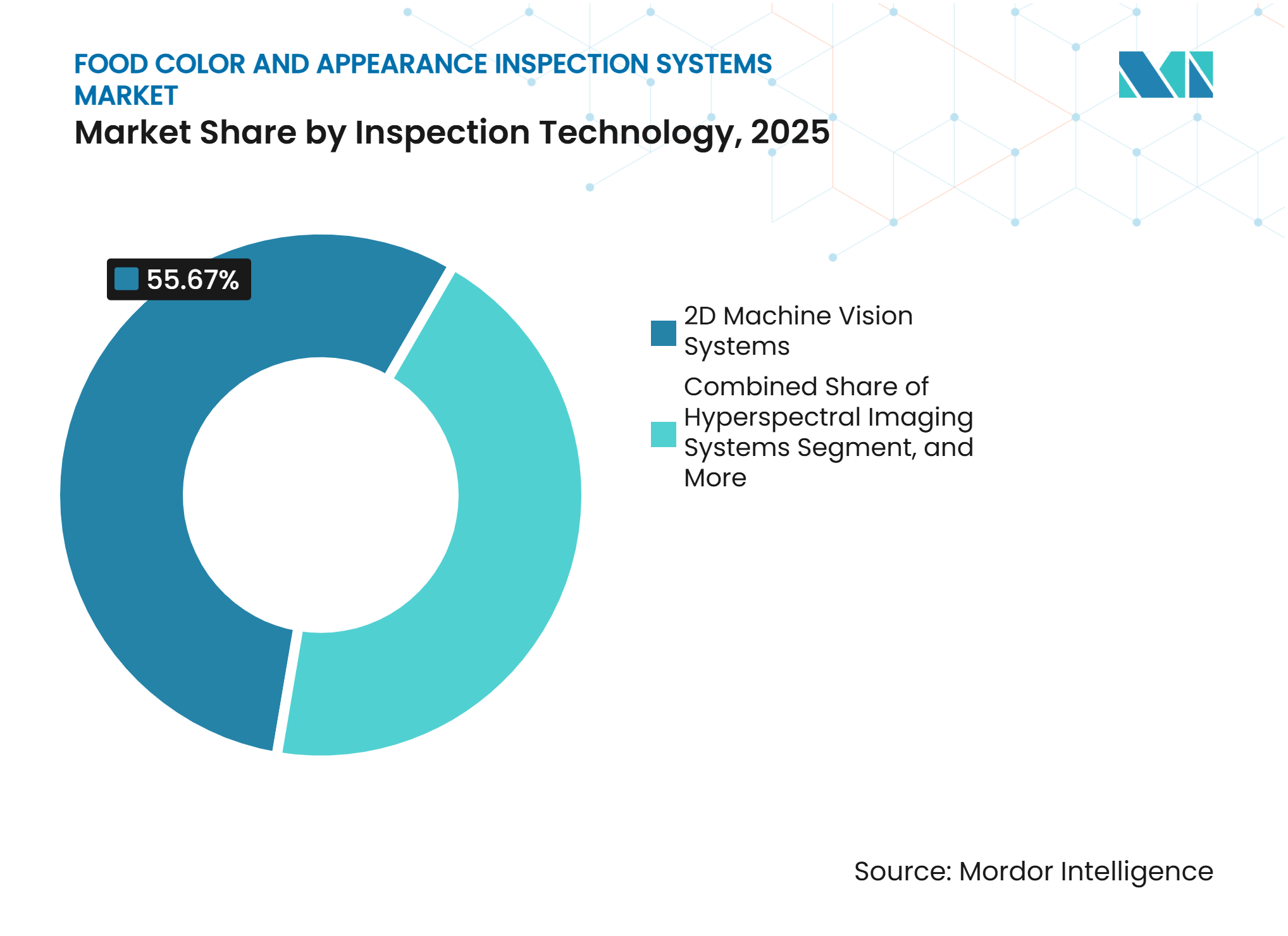
- By inspection technology, 2D machine vision systems held 55.67% of the Food Color and Appearance Inspection Systems Market share in 2025, while hyperspectral imaging systems are projected to expand at a 12.14% CAGR through 2031.
- By inspection type, color and shade inspection accounted for 27.78% of revenue in 2025, while appearance uniformity and consistency inspection is projected to expand at a 12.11% CAGR through 2031.
- By food product, meat, poultry, and seafood held 25.89% of the Food Color and Appearance Inspection Systems Market revenue in 2025, while processed and ready-to-eat foods are projected to expand at a 12.13% CAGR through 2031.
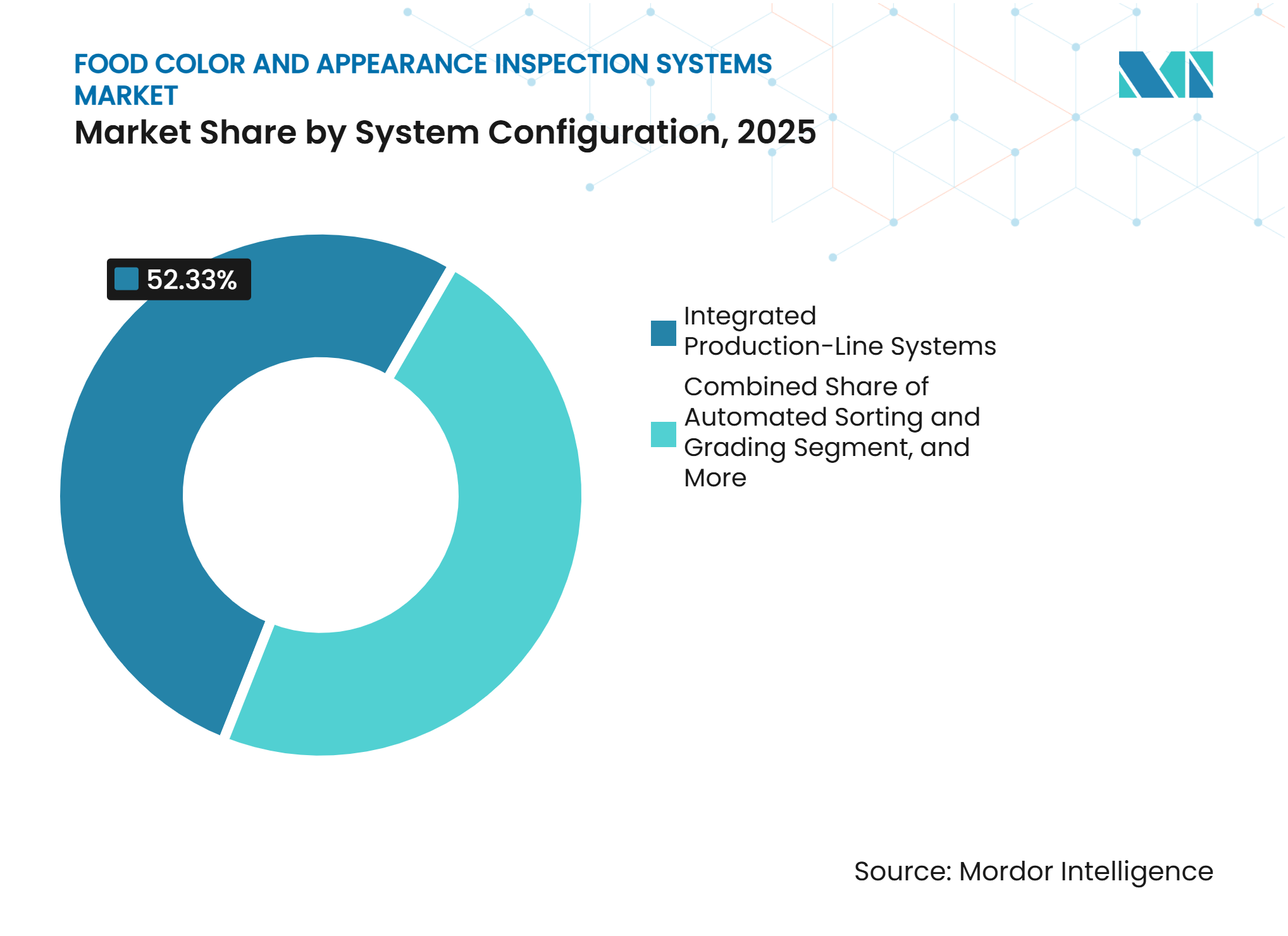
- By system configuration, integrated production-line systems accounted for 52.33% of revenue in 2025, while automated sorting and grading systems are projected to expand at a 12.55% CAGR through 2031.
- By end-user, meat and seafood processors held 22.56% of the Food Color and Appearance Inspection Systems Market revenue in 2025, while processed food manufacturers are projected to expand at a 12.78% CAGR through 2031.
- By geography, Europe held 32.34% of revenue in 2025, while Asia-Pacific is projected to expand at a 12.67% CAGR through 2031.
Note: Market size and forecast figures in this report are generated using Mordor Intelligence’s proprietary estimation framework, updated with the latest available data and insights as of January 2026.
Market Trends and Insights
Drivers Impact Analysis of Food Color and Appearance Inspection Systems Market*
| Driver | (~) % Impact on CAGR Forecast | Geographic Relevance | Impact Timeline |
|---|---|---|---|
| Stricter Food Safety and Traceability Requirements | +2.1% | Global, concentrated enforcement in North America and Europe | Short term (≤ 2 years) |
| Expansion of Automated Quality Control in High-Speed Food Lines | +1.5% | Global, early gains in Europe and Asia-Pacific core | Medium term (2-4 years) |
| Consumer and Brand Demand for Consistent Product Appearance | +1.1% | North America, Europe, and Asia-Pacific modern retail corridors | Medium term (2-4 years) |
| Shift Toward AI-Enabled Classification and Sorting | +0.9% | Global, early gains in North America and East Asia | Long term (≥ 4 years) |
| Non-Visible Defect Detection Through Hyperspectral Imaging | +0.5% | Global, early commercial traction in Europe and North America | Long term (≥ 4 years) |
| Aflatoxin and Allergen Detection at Commercial Throughput | +0.3% | Global, concentrated in Africa, South Asia, and Asia-Pacific grain corridors | Long term (≥ 4 years) |
| Source: Mordor Intelligence | |||
Stricter Food Safety and Traceability Requirements Drive Inspection Capital Expenditure
Regulatory compliance remains a clear reason for investment in the Food Color and Appearance Inspection Systems Market. The FDA Food Traceability Rule requires covered entities to maintain records for critical tracking events involving listed foods. Covered entities must provide an electronic sortable spreadsheet within 24 hours of an FDA request. Congress directed the FDA to delay enforcement until July 20, 2028.[1] Large processors are still preparing systems before the compliance date. Regulation (EU) 2017/625 requires official controls across the food chain, which supports demand for documented traceability and quality records. Inspection platforms that create lot-level records for each SKU can offer more value than equipment that only removes defective products.[2]
Expansion of Automated Quality Control in High-Speed Food Lines Resets the Baseline
High-speed production lines make periodic manual checks less practical for the Food Color and Appearance Inspection Systems Market. Continuous inspection can verify more products than sample-based checks. Integrated production-line systems held 52.33% of 2025 revenue, reflecting this operating requirement. Cognex introduced the In-Sight 3900 Vision System in May 2026 with embedded AI processing and imaging resolutions up to 25 megapixels. The company stated that the platform processed images up to 4 times faster than its prior generation.[3] Embedded processing can shorten the time between detection and product ejection on high-speed lines.
Consumer and Brand Demand for Consistent Product Appearance Creates Measurable Return on Investment
Brand owners increasingly assess visible product quality across physical and digital retail channels. Color and shade inspection held 27.78% of 2025 revenue by inspection type. The Food Color and Appearance Inspection Systems Market serves bakery, confectionery, fresh produce, and processed protein lines where color can signal freshness, ripeness, or process consistency. Ready-meal and snack producers use uniform appearance requirements across shifts and facilities. Appearance uniformity and consistency inspection is projected to expand at a 12.11% CAGR through 2031. Suppliers that provide real-time color-deviation information can help quality teams review production conditions rather than only accept or reject products.
Shift Toward AI-Enabled Classification and Sorting Compresses False-Reject Rates
False rejects affect both yield and line throughput in the Food Color and Appearance Inspection Systems Market. TOMRA Food presented its 4C optical sorter at Interpack 2026 after its global introduction in late 2025. The company reported false-reject rates below 1% for nuts and below 0.5% for individually quick frozen products. It also reported defect and foreign-material detection above 97%. The system runs LUCAi deep learning and traditional machine learning simultaneously. The installed base of LUCAi models can support adaptation to raw-material variation and new defect categories.[4]
Restraints Impact Analysis of Food Color and Appearance Inspection Systems Market*
| Restraint | (~) % Impact on CAGR Forecast | Geographic Relevance | Impact Timeline |
|---|---|---|---|
| High Capital and Validation Costs for Integrated Inspection Lines | -1.2% | Global, concentrated pressure on mid-sized processors in South America and Middle East and Africa | Short term (≤ 2 years) |
| Integration Complexity Across Legacy Equipment and Food Formats | -0.9% | Global, acute friction in Asia-Pacific and South America legacy-line environments | Medium term (2-4 years) |
| Product Variability and Calibration Drift | -0.5% | Global, particular impact in fresh produce and protein segments | Medium term (2-4 years) |
| Limited Availability of Food-Systems Integration and Machine-Vision Skills | -0.4% | Concentrated in Asia-Pacific excluding Japan and South Korea, South America, and Middle East and Africa | Long term (≥ 4 years) |
| Source: Mordor Intelligence | |||
High Capital and Validation Costs Narrow Early Adoption to Large-Scale Processors
Integrated inspection systems require spending beyond the listed price of cameras or sensors. Installations can require hygienic enclosures, conveyor changes, challenge tests, and validation studies. These studies document performance at specified defect sizes and production speeds. Frequent SKU changes can also require revalidation after a line configuration change. This cost structure favors multinational protein and dairy companies, large grain millers, and major bakery groups. Smaller facilities often retain simpler 2D systems or periodic manual checks, which limit adoption in price-sensitive regions.
Integration Complexity Across Legacy Equipment and Food Formats Slows Retrofit Timelines
Food plants operate equipment with different mechanical interfaces, communication protocols, and throughput specifications. These differences make standardized retrofits difficult in the Food Color and Appearance Inspection Systems Market. Hygienic design needs, washdown conditions, and varied food formats add to the integration work. Shared lines also require system settings to change when products change. AI platforms can adapt models, but staff must be able to manage the retraining process. These requirements can extend the implementation period for mid-sized processors beyond the initial vendor proposal.
*Our forecasts treat driver/restraint impacts as directional, not additive. The impact forecasts reflect baseline growth, mix effects, and variable interactions.
Food Color and Appearance Inspection Systems Market Segment Analysis
By Inspection Technology:
2D Vision Leads While Hyperspectral Systems Expand2D machine vision systems held 55.67% of the Food Color and Appearance Inspection Systems Market share in 2025. Their position reflects standardized hardware, broad integrator support, and established tools for color, shape, and surface-defect checks. These systems meet the needs of many conveyor-based applications. Their established position also reflects long equipment replacement cycles. Color and shade inspection is particularly well-suited to 2D imaging. The technology remains practical for facilities that need a proven inspection format. Its broad application supports continuing use across food categories.
The Food Color and Appearance Inspection Systems Market size for hyperspectral imaging is projected to expand at a 12.14% CAGR through 2031. Hyperspectral systems can assess quality characteristics outside the visible spectrum without damaging the product. A 2025 study reported that near-infrared hyperspectral imaging quantified aflatoxin B1 in maize with an R²p of 0.99 and an RMSEP of 2.3 µg/kg. The study reported an 86.4% improvement over conventional partial least squares regression. Insort stated that its Sherlock Hypernova system operated at up to 400,000 data points per hour. It also stated that the system maintained light-intensity fluctuations of less than 2%. The food color and appearance inspection systems industry is therefore moving toward systems that combine multiple sensing methods for demanding applications.



By Inspection Type:
Color Inspection Leads While Appearance Uniformity Gains GroundRGB and color-vision systems retained 41.23% of sorter demand in 2025. Their position reflects competitive camera costs and replacement cycles that can extend for a decade or more. These systems remain suitable for many surface-color and appearance decisions across commodity lines. Near-infrared platforms provide accessible indicators of sugar content and moisture, while multispectral systems fall between RGB and hyperspectral equipment. Satake launched the SLASH β PLUS in June 2026 with four-color LED and multi-wavelength infrared detection, plus dual configurable ejection patterns.
Hyperspectral systems are projected to expand at a 22.29% CAGR through 2031. Their value comes from an internal quality assessment that RGB and conventional near-infrared platforms cannot consistently provide. A 2024 study found that Support Vector Machine-based hyperspectral sorting of apples achieved Adjusted Rand Index scores of up to 0.854 for rot detection. Frontiers in Plant Science reported in 2026 that HyperVision-HSI frameworks achieved prediction errors in soluble solids content as low as 0.62°Brix for grapes and tomatoes in real-time operation. This supports use in retail and export channels that require internal differentiation, although higher system cost limits wider adoption.
By Food Product:
Meat and Seafood Lead While Convenience Foods AccelerateMeat, poultry, and seafood held 25.89% of revenue in 2025. Protein lines have high capital intensity and require controls for contamination risk. Their throughput can justify the use of dedicated inline inspection equipment. Poultry deboning and portioning applications can simultaneously inspect bone-fragment risk, color variation, and trim dimensions. Mettler-Toledo introduced the MAXIMIZER RMI in Europe in April 2026. The system combines Eagle RMI 400 X-ray technology with automated material handling to inspect raw deboned poultry. Dairy, bakery and confectionery, and fruits and vegetables remain important applications.
Processed and ready-to-eat foods are projected to expand at a 12.13% CAGR through 2031. Convenience food consumption is increasing across urban markets in the Asia-Pacific, South America, and the Middle East. Buyers of meal kits and frozen meals can compare the product with the package imagery. This increases the importance of color and portion consistency. Grains, cereals, and pulses remain a major application for optical sorting and foreign-material detection. Growth is slower in established North American and European facilities that already use optical sorting infrastructure. The food color and appearance inspection systems industry suppliers can address convenience producers that need quick model changes across expanding SKU ranges. The Food Color and Appearance Inspection Systems Market can therefore support applications where appearance and changeover control must work together.
By System Configuration:
Integrated Lines Lead While Automated Sorting AdvancesIntegrated production-line systems held 52.33% of revenue in 2025. They enable product verification before downstream processing adds more value. This position reduces rework costs for high-value products. Portioned protein and premium confectionery are examples where early defect removal can be important. Standalone systems remain relevant for smaller operations. They also support laboratory checks and incoming goods inspection. Modular AI vision platforms can now be installed at belt-transition points without a full line redesign.
Automated sorting and grading systems are projected to expand at a 12.55% CAGR through 2031. Their adoption reflects AI learning platforms, advances in optical sensors, and pressure to improve yield from variable inputs. Bühler launched the SORTEX AI700 in May 2025 as a deep-learning sorting platform trained on millions of labeled images. The company stated that the initial oat-processing application removed allergens from barley, wheat, and rye more effectively than rule-based optical sorters at comparable throughput. Asia-Pacific has a strong preference for automated grain and rice sorting. Satake Corporation and Hefei Meyer Optoelectronic Technology have established installed bases in the region. The Food Color and Appearance Inspection Systems Market can favor connected platforms that receive software updates rather than require full hardware replacement. This preference makes the Food Color and Appearance Inspection Systems Market relevant to operators seeking simpler updates across varied product lines.

By End-User:
Meat Processors Lead While Processed Food Manufacturers Gain GroundMeat and seafood processors held 22.56% of revenue in 2025. High production speeds and strict specifications make accurate grading important in this segment. Processors also seek to reduce trim loss through color and dimensional inspection. Dairy processors form a significant mid-tier application. They use color-consistency inspection for regulatory grade requirements and freshness perception. Bakery and confectionery producers are active users of inline color inspection. Fruit and vegetable processors represent a high-volume optical-sorting application, although spending per throughput unit is lower than in protein processing.
Processed food manufacturers are projected to expand at a 12.78% CAGR through 2031. Retailer supplier requirements and convenience-food demand are tightening quality specifications. Micro Technica launched ToyoUkeVision in September 2026 for boxed lunches and prepared foods. The system can be configured using a small set of good product reference images. It supports checks for ingredient placement and missing items without requiring operators to have AI expertise. Beverage producers are an adjacent group that uses automated inspection for fill levels, color consistency, and label placement. The Food Color and Appearance Inspection Systems Market has a growing serviceable base in processed and convenience food production. This Food Color and Appearance Inspection Systems Market has a scope where menu changes are frequent, and operators need adaptable settings.
Geography Analysis
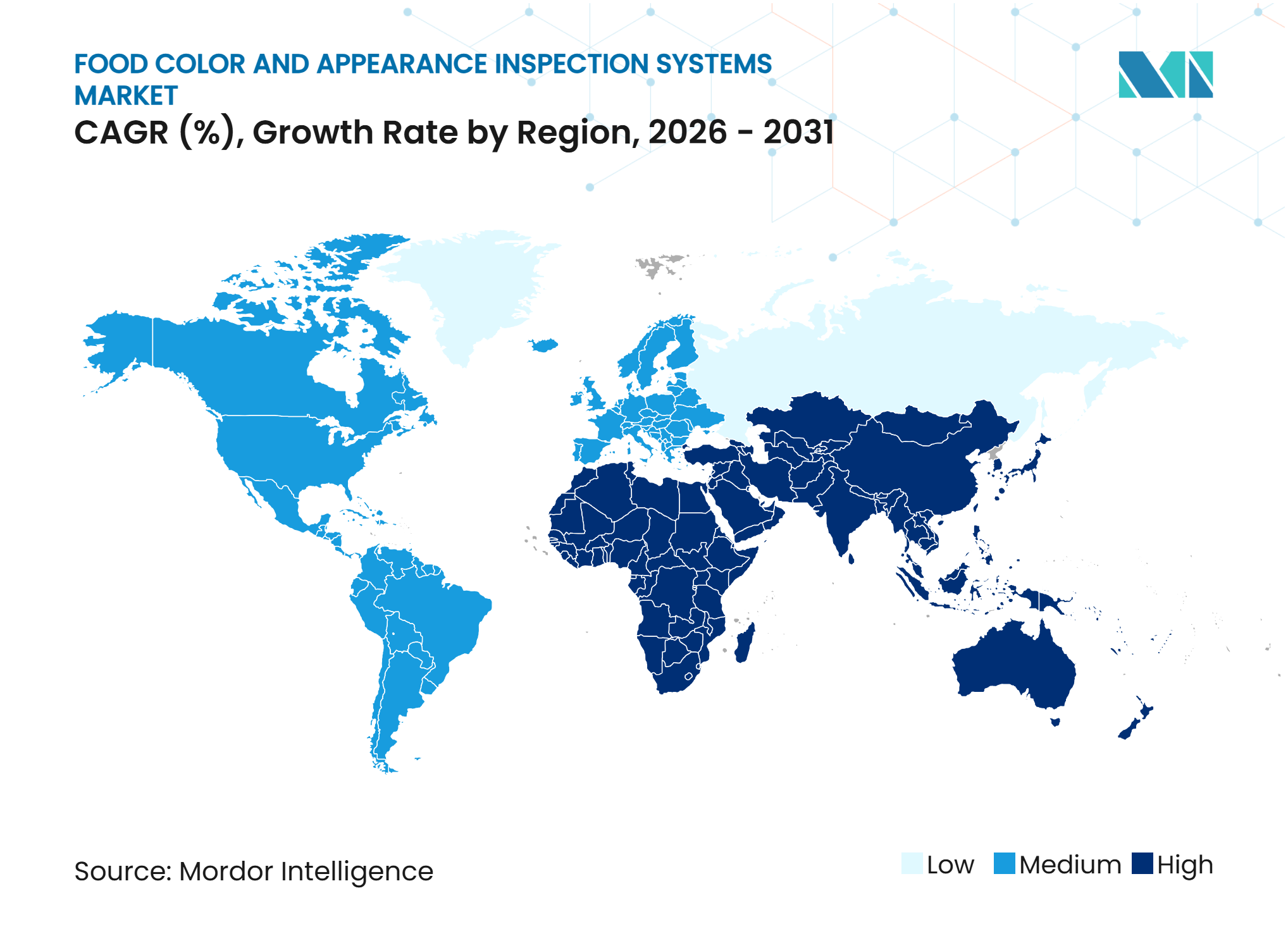
Europe held 32.34% of revenue in 2025. Its position reflects mature optical sorting activity in Germany, Switzerland, and Italy. The region also has dense food processing operations in the United Kingdom, France, Spain, and the Netherlands. Regulation (EU) 2017/625 supports documented controls across the agri-food chain. Germany remains a technology center for food inspection hardware. Italy also contributes suppliers such as Raytec Vision and Datalogic that serve processors in Europe and export markets.
Asia-Pacific is projected to expand at a 12.67% CAGR through 2031. China, Japan, India, South Korea, and ASEAN countries are the region's main growth markets. Japan's food plants have faced inspection automation challenges related to hygiene requirements, washdown conditions, and varied food formats. Nichirei Foods introduced an AI-assisted spectral inspection deployment at its Funabashi facility in August 2026. China has domestic suppliers in grain, nut, and tea processing, including Hefei Meyer Optoelectronic Technology and Techik Instrument. These companies increasingly compete in ASEAN markets on price and local service.
North America holds a substantial position due to FDA oversight and large meat, poultry, and prepared-food processing operations. Suppliers, including Cognex, Mettler-Toledo, and Thermo Fisher Scientific, support the Food Color and Appearance Inspection Systems Market size in the region. The FDA compliance extension to July 2028 has encouraged major manufacturers to prepare traceability-capable inspection systems. Brazil and Argentina are modernizing protein and grain export operations, but limited access to capital and limited integration skills constrain adoption. Saudi Arabia and the United Arab Emirates are potential growth areas because food-processing investments align with halal quality requirements. South Africa supports industrial-scale fruit and protein inspection activity in Africa. The Food Color and Appearance Inspection Systems Market remains shaped by the distinct compliance and investment conditions across these regions.
Competitive Landscape
Market Concentration
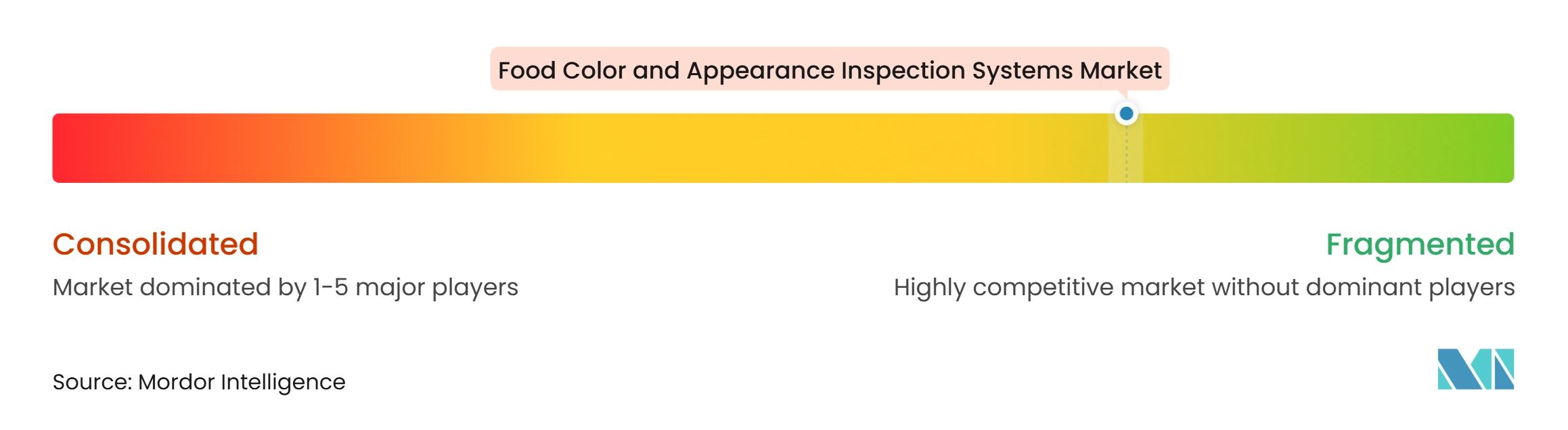
The Food Color and Appearance Inspection Systems Market is fragmented. TOMRA Systems, Bühler AG, Mettler-Toledo International, and Cognex Corporation hold notable positions in optical sorting, X-ray inspection, and edge AI vision. Specialists also compete in color measurement, hyperspectral sensing, and food-specific hardware. Cognex launched the In-Sight 3900 in May 2026 with edge AI computing within the vision-system housing. The design avoids the need for an external PC on compact production lines. The Food Color and Appearance Inspection Systems Market increasingly rewards suppliers that embed AI and connectivity in core hardware. In the Food Color and Appearance Inspection Systems Market, customer retention can depend on the value of integrated hardware and software.
Leading suppliers differentiate through their installed base, application knowledge, and trained models. TOMRA Food's 4C sorter combines LUCAi deep learning with traditional machine learning. The company reported that the product had a defect and a foreign material detection rate above 97% in nuts and individually quick-frozen applications. Bühler introduced the SORTEX AI700 in May 2025 for allergen removal in oat processing. The launch shows continued supplier investment in AI-based optical sorting. Mettler-Toledo extended the Eagle portfolio in Europe through the MAXIMIZER RMI for raw deboned poultry inspection in April 2026. These moves show how the Food Color and Appearance Inspection Systems Market is being addressed through specialized application systems.
Mid-market processors may lack capital, integration expertise, and local vendor support for complex inline installations. This creates room for modular systems with simpler deployment and flexible SKU changes. Polysense and INSPECTRA compete around these needs. Chinese suppliers such as Hefei Meyer Optoelectronic Technology and Techik Instrument compete in price-sensitive Asian markets. Color measurement specialists include X-Rite, Konica Minolta, Hunter Associates Laboratory, NIPPON DENSHOKU INDUSTRIES, and Agtron. Their measurement capabilities support calibration and instrument alignment for inline systems. The food color and appearance inspection systems industry has a competitive structure that combines large integrators with application-focused specialists. The Food Color and Appearance Inspection Systems Market includes both broad platform suppliers and focused measurement providers.
Food Color and Appearance Inspection Systems Industry Leaders
-
Cognex Corporation
-
Keyence Corporation
-
TOMRA Systems ASA
-
Bühler AG
-
X-Rite, Incorporated
- *Disclaimer: Major Players sorted in no particular order
Food Color and Appearance Inspection Systems Market Companies Covered in this Report
- TOMRA Systems ASA
- Bühler AG
- Cognex Corporation
- Keyence Corporation
- X-Rite, Incorporated
- Mettler-Toledo International Inc.
- Thermo Fisher Scientific Inc.
- ISHIDA CO., LTD.
- Anritsu Corporation
- Loma Systems
- Satake Corporation
- Raytec Vision S.p.A.
- Optimum Sorting Inc.
- Duravant LLC
- Antares Vision Group
- Hefei Meyer Optoelectronic Technology Inc.
- DAEWON GSI CO., LTD.
- Techik Instrument (Shanghai) Co., Ltd.
- Konica Minolta, Inc.
- Hunter Associates Laboratory, Inc.
- VeriVide Limited
- Agtron Inc.
- NIPPON DENSHOKU INDUSTRIES CO., LTD.
- Teledyne Technologies Incorporated
- Omron Corporation
- SICK AG
- Basler AG
- Datalogic S.p.A.
- MVTec Software GmbH
- JAI A/S
Recent Industry Developments in Food Color and Appearance Inspection Systems Market
- September 2026: Micro Technica (Japan) launched ToyoUkeVision, an AI image-inspection machine for boxed lunches and prepared foods. The system applies pharmaceutical-grade image-processing expertise to detect missing ingredients, placement errors, and container protrusions at approximately 60 inspections per second, targeting Japan's high-frequency product-changeover food supply chains.
- September 2026: Nichirei Foods deployed a SWIR-spectral camera and AI-based foreign-object detection system at its Funabashi, Japan factory, developed with Sony Semiconductor Solutions and Shibuyaseiki. The system uses 4-band near-infrared spectral data to detect transparent plastic fragments indistinguishable from raw ingredients by conventional color cameras, advancing food-defense capability for raw-material receiving inspection.
- July 2026: Mettler-Toledo Product Inspection introduced the X56 DXD+, a dual-energy photon-counting X-ray inspection system with AI capabilities for complex packaged food formats including pet food, potato chips, and fresh produce. The AI platform improves differentiation between low-density contaminants such as rubber and plastic and legitimate product variation, reducing false-rejection rates on high-throughput lines.
- May 2026: Cognex Corporation launched the In-Sight 3900 Vision System powered by the Qualcomm Dragonwing platform, delivering processing speeds up to 4 times faster than the prior generation at imaging resolutions up to 25 megapixels. The system enables deterministic edge AI execution at full line speed without an external PC, supporting demanding food and beverage packaging inspection.
Global Food Color and Appearance Inspection Systems Market Report Scope
Food Color and Appearance Inspection Systems are advanced automated vision solutions designed to evaluate the visual quality of food products by analyzing color consistency, surface defects, shape, and texture, ensuring compliance with quality standards, reducing waste, and enhancing consumer satisfaction through precise sorting and grading.
The Food Color and Appearance Inspection Systems Market Report is Segmented by Inspection Technology (2D Machine Vision Systems, 3D Machine Vision Systems, Multispectral Imaging Systems, Hyperspectral Imaging Systems, and Other Inspection Technologies), Inspection Type (Color and Shade Inspection, Surface Defect Inspection, Shape and Form Inspection, Size and Dimensional Inspection, Texture and Surface-Quality Inspection, Appearance Uniformity and Consistency Inspection, and Other Inspection Types), Food Product (Meat, Poultry, and Seafood, Dairy and Dairy Products, Bakery and Confectionery, Fruits and Vegetables, Processed and Ready-to-Eat Foods, Grains, Cereals, and Pulses, and Other Food Products), System Configuration (Standalone Inspection Systems, Integrated Production-Line Systems, and Automated Sorting and Grading Systems), End-User (Meat and Seafood Processors, Dairy Processors, Bakery and Confectionery Manufacturers, Fruit and Vegetable Processors, Processed Food Manufacturers, Beverage Manufacturers, and Other End-Users), and Geography (North America, South America, Europe, Asia-Pacific, Middle East and Africa). The Market Forecasts are Provided in Terms of Value (USD).
Segmentation Overview
| 2D Machine Vision Systems |
| 3D Machine Vision Systems |
| Multispectral Imaging Systems |
| Hyperspectral Imaging Systems |
| Other Inspection Technologies |
| Color and Shade Inspection |
| Surface Defect Inspection |
| Shape and Form Inspection |
| Size and Dimensional Inspection |
| Texture and Surface-Quality Inspection |
| Appearance Uniformity and Consistency Inspection |
| Other Inspection Types |
| Meat, Poultry, and Seafood |
| Dairy and Dairy Products |
| Bakery and Confectionery |
| Fruits and Vegetables |
| Processed and Ready-to-Eat Foods |
| Grains, Cereals, and Pulses |
| Other Food Products |
| Standalone Inspection Systems |
| Integrated Production-Line Systems |
| Automated Sorting and Grading Systems |
| Meat and Seafood Processors |
| Dairy Processors |
| Bakery and Confectionery Manufacturers |
| Fruit and Vegetable Processors |
| Processed Food Manufacturers |
| Beverage Manufacturers |
| Other End-Users |
| North America | United States | |
| Canada | ||
| Mexico | ||
| South America | Brazil | |
| Argentina | ||
| Rest of South America | ||
| Europe | Germany | |
| United Kingdom | ||
| France | ||
| Italy | ||
| Spain | ||
| Rest of Europe | ||
| Asia-Pacific | China | |
| Japan | ||
| India | ||
| South Korea | ||
| Rest of Asia-Pacific | ||
| Middle East and Africa | Middle East | Saudi Arabia |
| United Arab Emirates | ||
| Turkey | ||
| Rest of the Middle East | ||
| Africa | South Africa | |
| Nigeria | ||
| Rest of Africa | ||
| By Inspection Technology | 2D Machine Vision Systems | ||
| 3D Machine Vision Systems | |||
| Multispectral Imaging Systems | |||
| Hyperspectral Imaging Systems | |||
| Other Inspection Technologies | |||
| By Inspection Type | Color and Shade Inspection | ||
| Surface Defect Inspection | |||
| Shape and Form Inspection | |||
| Size and Dimensional Inspection | |||
| Texture and Surface-Quality Inspection | |||
| Appearance Uniformity and Consistency Inspection | |||
| Other Inspection Types | |||
| By Food Product | Meat, Poultry, and Seafood | ||
| Dairy and Dairy Products | |||
| Bakery and Confectionery | |||
| Fruits and Vegetables | |||
| Processed and Ready-to-Eat Foods | |||
| Grains, Cereals, and Pulses | |||
| Other Food Products | |||
| By System Configuration | Standalone Inspection Systems | ||
| Integrated Production-Line Systems | |||
| Automated Sorting and Grading Systems | |||
| By End-User | Meat and Seafood Processors | ||
| Dairy Processors | |||
| Bakery and Confectionery Manufacturers | |||
| Fruit and Vegetable Processors | |||
| Processed Food Manufacturers | |||
| Beverage Manufacturers | |||
| Other End-Users | |||
| By Geography | North America | United States | |
| Canada | |||
| Mexico | |||
| South America | Brazil | ||
| Argentina | |||
| Rest of South America | |||
| Europe | Germany | ||
| United Kingdom | |||
| France | |||
| Italy | |||
| Spain | |||
| Rest of Europe | |||
| Asia-Pacific | China | ||
| Japan | |||
| India | |||
| South Korea | |||
| Rest of Asia-Pacific | |||
| Middle East and Africa | Middle East | Saudi Arabia | |
| United Arab Emirates | |||
| Turkey | |||
| Rest of the Middle East | |||
| Africa | South Africa | ||
| Nigeria | |||
| Rest of Africa | |||
Key Questions Answered in the Report
What is the Food Color and Appearance Inspection Systems Market size?
The sector is projected to reach USD 719.40 million by 2031 from USD 412.56 million in 2026, at an 11.76% CAGR. The forecast reflects expanding use of continuous inspection in food production.
Which inspection technology has the largest revenue share?
2D machine vision systems held 55.67% of 2025 revenue because they support widely used color, shape, and surface-defect checks. The technology also benefits from established hardware and integrator support. Its established use reflects the suitability of 2D systems for many conveyor-based food lines. These systems provide adequate performance for common color and shade checks. Equipment replacement cycles that typically run 5 to 8 years also support continued use of existing 2D installations across established food processing facilities.
Which technology is expected to expand fastest through 2031?
Hyperspectral imaging systems are projected to expand at a 12.14% CAGR because they can detect quality characteristics outside the visible spectrum. The systems support non-destructive assessment in demanding safety applications.
Which food product uses these systems most extensively?
Meat, poultry, and seafood held 25.89% of 2025 revenue, supported by high throughput and stringent contamination-control requirements. Dedicated inline systems can check several protein quality factors during processing.
Which region is expected to expand fastest?
Asia-Pacific is projected to expand at a 12.67% CAGR through 2031, supported by food-processing investment in China, Japan, India, South Korea, and ASEAN countries. The region also includes established domestic sorting equipment suppliers.
What limits wider adoption of inline inspection?
High installation and validation costs, legacy equipment integration, product variability, and limited specialist skills can slow adoption. These challenges are especially relevant for mid-sized processors and price-sensitive locations.