
Flue Gas Scrubber Wastewater Treatment Systems Market Size and Share
Market Overview
| Study Period | 2021 - 2031 |
|---|---|
| Market Size (2026) | USD 0.78 Billion |
| Market Size (2031) | USD 1.03 Billion |
| Growth Rate (2026 - 2031) | 5.71 % |
| Fastest Growing Market | Asia-Pacific |
| Largest Market | Asia-Pacific |
| Market Concentration | Low |
Major Players *Disclaimer: Major Players sorted in no particular order Image © Mordor Intelligence. Reuse requires attribution under CC BY 4.0. | |
Flue Gas Scrubber Wastewater Treatment Systems Market Analysis by Mordor Intelligence
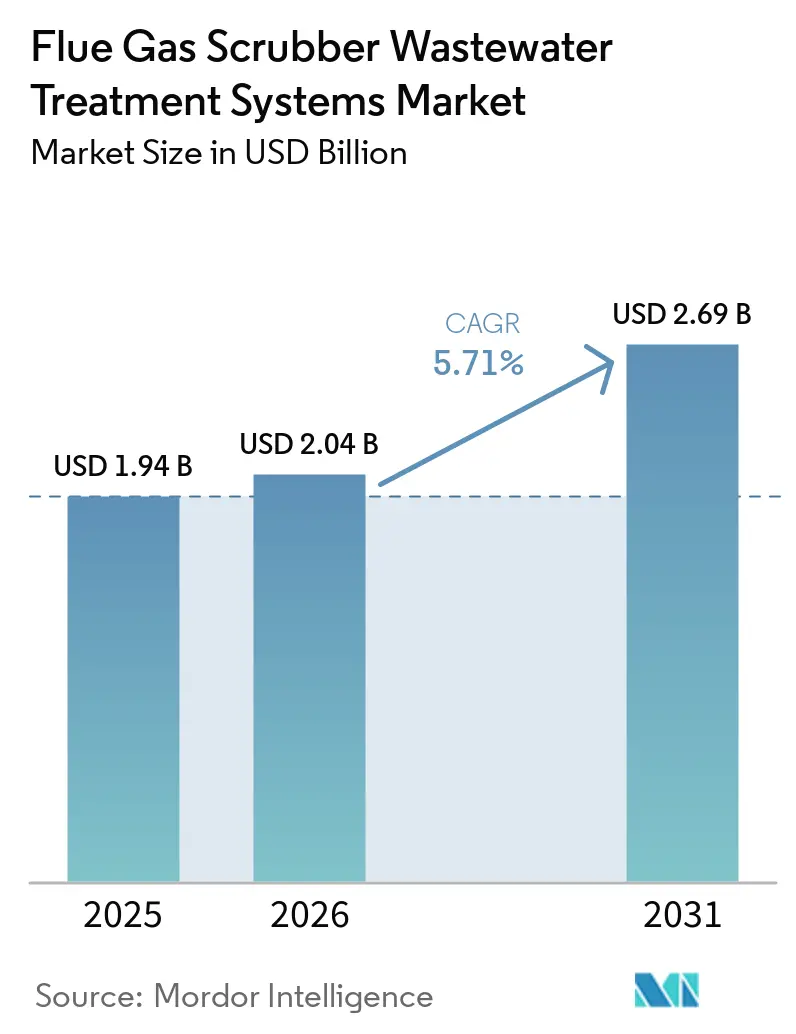
The Flue Gas Scrubber Wastewater Treatment Systems Market size is expected to grow from USD 0.74 billion in 2025 to USD 0.78 billion in 2026 and is forecast to reach USD 1.03 billion by 2031 at 5.71% CAGR over 2026-2031. The flue gas scrubber wastewater treatment systems market is shaped primarily by discharge regulations, which make treatment spending a compliance requirement rather than a discretionary plant investment. The 2024 U.S. rule requires zero discharge of pollutants from flue gas desulfurization (FGD) wastewater and is expected to reduce annual pollutant releases by 660 million to 672 million pounds. China's T/CWDPA 150-2026 standard, which took effect on May 25, 2026, sets requirements for the design, construction, operation, solidification, and reuse of zero-liquid-discharge systems at thermal power plants. The market also benefits from delayed coal retirements and longer compliance schedules, which give utilities more time to fund treatment upgrades. Competition is shifting toward integrated treatment, long-term operations, and digital performance monitoring as membrane and thermal approaches are combined in larger projects.
Key Report Takeaways
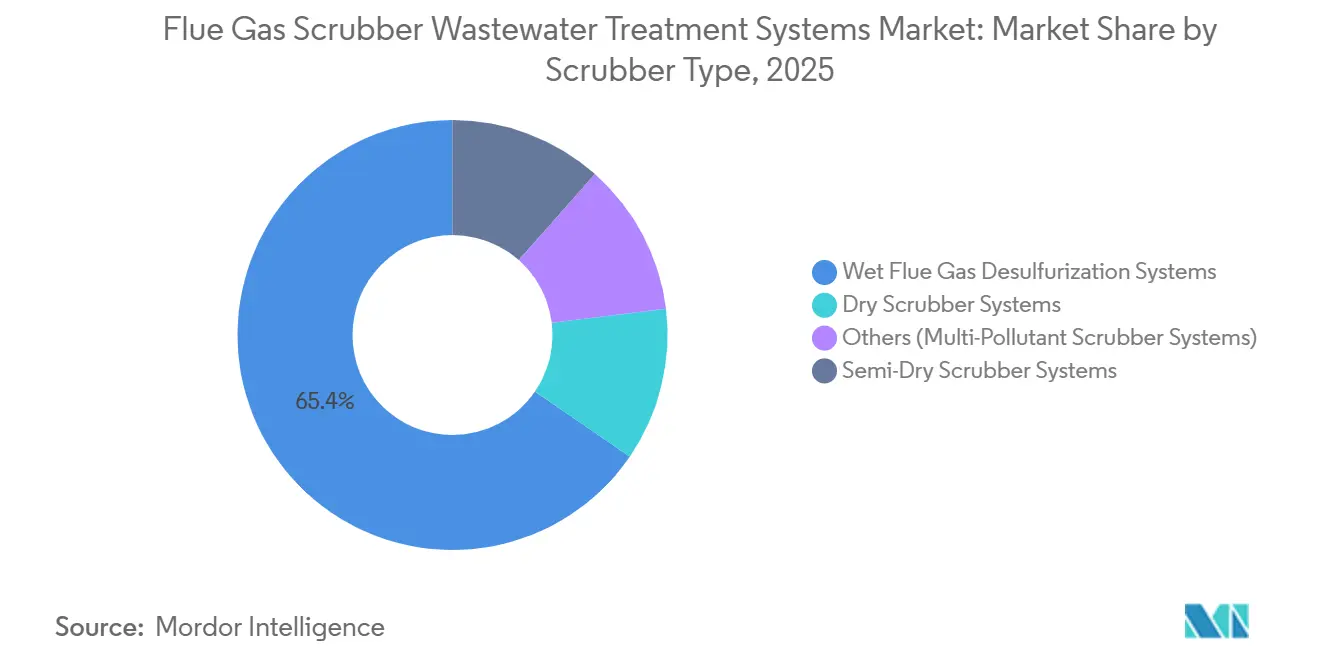
- By scrubber type, wet FGD systems held 65.42% of the flue gas scrubber wastewater treatment systems market share in 2025, while dry scrubber systems are forecast to grow at a 6.34% CAGR through 2031.
- By treatment technology, physical and chemical treatment accounted for 36.87% of flue gas scrubber wastewater treatment systems market share in 2025, while evaporation and crystallization systems are projected to expand at a 6.12% CAGR through 2031.
- By contaminant type, heavy metals held 41.26% of revenue in 2025, while chlorides and sulfates are forecast to advance at a 6.58% CAGR through 2031.
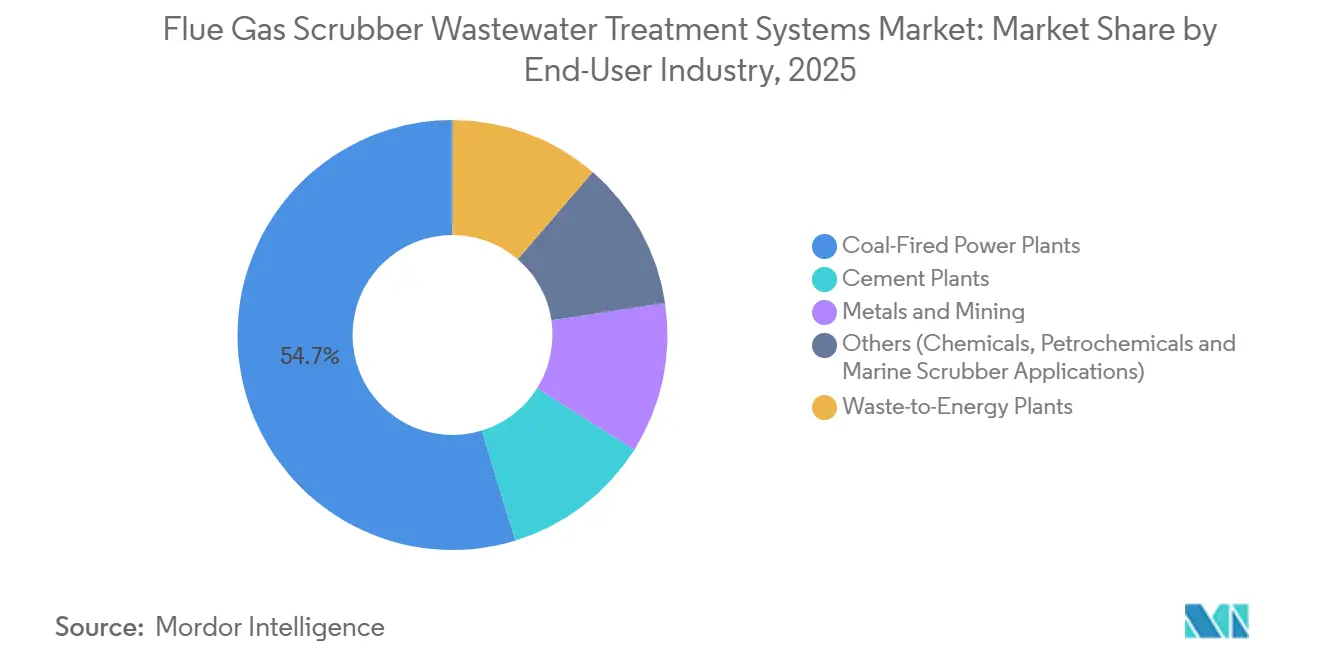
- By end-user industry, coal-fired power plants accounted for 54.73% of revenue in 2025, while waste-to-energy plants are projected to grow at a 7.11% CAGR through 2031.
- By geography, Asia-Pacific held 43.18% of 2025 revenue and is forecast to grow at a 6.47% CAGR through 2031.
Note: Market size and forecast figures in this report are generated using Mordor Intelligence’s proprietary estimation framework, updated with the latest available data and insights as of January 2026.
Market Trends and Insights
Drivers Impact Analysis of Flue Gas Scrubber Wastewater Treatment Systems Market*
| Drivers | (~) % Impact on CAGR Forecast | Geographic Relevance | Impact Timeline |
|---|---|---|---|
| Tightening Zero-Discharge and Toxic-Metal Limits | +1.6% | Global, with high intensity in North America and China | Short term (≤ 2 years) |
| Expansion of Dedicated Flue Gas Desulfurization (FGD) Wastewater Treatment Facilities | +1.2% | Asia-Pacific, North America | Medium term (2-4 years) |
| Retrofitting of Aging Coal-Fired Units | +0.9% | North America, Europe | Medium term (2-4 years) |
| Water Reuse Pressure in Water-Stressed Power Clusters | +0.7% | Asia-Pacific core, spillover to the Middle-East and Africa | Long term (≥ 4 years) |
| Modular Biological Removal of Selenium and Nitrates | +0.5% | North America, Asia-Pacific | Medium term (2-4 years) |
| Brownfield Integration with Ash-Pond and Legacy-Wastewater Remediation | +0.4% | North America, Europe | Long term (≥ 4 years) |
| Source: Mordor Intelligence | |||
Tightening Zero-Discharge and Toxic-Metal Limits
The U.S. EPA's 2024 Final Rule, which took effect on July 8, 2024, requires complete pollutant elimination from FGD wastewater through membrane filtration, spray-dry evaporation, or thermal treatment. The rule sets limits of 29 µg/L for selenium and 34 ng/L for mercury as a 30-day average. These limits make conventional chemical precipitation inadequate for many sites and increase demand for multi-stage treatment. The EPA's December 2025 extension moved the compliance deadline to December 31, 2034, replacing an immediate capital requirement with a longer project planning period. China's current standard establishes parallel design and acceptance requirements for zero-discharge desulfurization wastewater systems. Together, these requirements narrow the range of acceptable technologies and support demand for established vendors in the flue gas scrubber wastewater treatment systems market.
Expansion of Dedicated FGD Wastewater Treatment Facilities
FGD blowdown contains 20,000-60,000 mg/L of chlorides, suspended solids above 13,000 mg/L, and heavy metals that vary with coal source. These conditions can overwhelm a central plant wastewater system and prompt the use of purpose-built treatment facilities. Georgia Power completed construction of a dedicated FGD wastewater system at Plant Bowen, with optimization underway by September 2025. The project combines physical and chemical treatment for arsenic and mercury with biological treatment for selenium and nitrate-nitrite removal. Stantec's Winyah Generating Station project included a 200,000-square-foot, two-story facility with ultrafiltration, chemical storage, dosing systems, and filter presses. Such facilities can generate longer operations and maintenance contracts because environmental liabilities remain after a unit closes, supporting recurring revenue in the flue gas scrubber wastewater treatment systems market.
Retrofitting of Aging Coal-Fired Units
The U.S. EPA reported that wet FGD capital costs increased by 48% over the 2016 baseline, driven largely by a 29% supply chain escalation between January 2021 and January 2022. Higher installed costs raise the value of engineering, equipment, and treatment orders for retrofit projects. The U.S. Energy Information Administration reported that coal retirements totaled only 2.6 GW in 2025, the lowest level since 2010, and that planned retirements at several plants were delayed through emergency federal orders, extending the operating lives of affected units. Europe also retains a phased treatment need, as operating coal assets face increasingly strict waste management requirements at permit renewal. Retrofitting aging facilities therefore remains an important demand driver for the flue gas scrubber wastewater treatment systems market through the forecast period.
Water Reuse Pressure in Water-Stressed Power Clusters
Coal power clusters in northern China, inland India, the U.S. Southwest, and South Africa face tighter discharge requirements and limited availability of raw water. India's National Institute of Advanced Studies estimated that the universal installation of FGDs at inland thermal power plants could increase freshwater use by 9.6% by 2030[1]. This condition supports closed-loop reuse and zero-liquid-discharge designs over discharge-based solutions. A 300 MW coal unit in Shandong reduced annual operating costs by 50% after installing an integrated high-efficiency clarification system, replacing its prior triple-tank process. This case illustrates why advanced treatment can be selected even where operators are sensitive to operating costs. Water security adds a long-term demand layer to the flue gas scrubber wastewater treatment systems market, as treatment plants can recover water while reducing discharge risk.
Restraints Impact Analysis of Flue Gas Scrubber Wastewater Treatment Systems Market*
| Restraints | (~) % Impact on CAGR Forecast | Geographic Relevance | Impact Timeline |
|---|---|---|---|
| High Thermal-Evaporation Energy and Lifecycle Cost | -1.3% | Global, most acute in emerging economies | Long term (≥ 4 years) |
| Coal-Fleet Retirement and FGD Stranded-Asset Risk | -0.9% | North America, Europe | Medium term (2-4 years) |
| Corrosion, Scaling, and High-Chloride Reliability Risk | -0.8% | Global | Medium term (2-4 years) |
| Shortage of Site-Specific Treatability Data and Skilled Operators | -0.5% | Global, acute in South and Southeast Asia | Long term (≥ 4 years) |
| Source: Mordor Intelligence | |||
High Thermal-Evaporation Energy and Lifecycle Cost
Thermal zero-liquid-discharge systems, including brine concentrators, forced-circulation crystallizers, and spray-dry evaporators, consume 7 kWh/m³ to 12 kWh/m³ of treated FGD wastewater. Membrane-based zero-liquid-discharge systems consume 3 kWh/m³ to 6 kWh/m³, giving membrane-based configurations an energy-cost advantage. This difference is significant in regions with high electricity prices or carbon costs. Full zero-liquid-discharge capital expenditure has increased by 48% since 2016, limiting affordability for smaller facilities and municipal waste-to-energy sites. Waste-heat integration can reduce this burden but does not eliminate the underlying energy requirement. This cost constraint slows adoption in the flue gas scrubber wastewater treatment systems market, particularly where discharge requirements are less strict or project budgets are limited.
Corrosion, Scaling, and High-Chloride Reliability Risk
FGD wastewater contains 20,000-60,000 mg/L of chlorides, suspended solids exceeding 13,000 mg/L, and multiple heavy metal species. This chemical composition accelerates corrosion, causes gypsum and silica scaling, and fouls membranes. A study at a Shandong plant recorded suspended solids of 13,650 mg/L and found that the original triple-tank treatment process was unreliable under the site's wastewater conditions[2]. Research on hybrid zero-liquid-discharge systems identifies silica, gypsum, and organic contaminants as key sources of membrane fouling. Incomplete evaporation leaves chloride-rich deposits in electrostatic precipitators and stack equipment. These reliability risks affect treatment availability, maintenance costs, and performance guarantees, and delay purchasing decisions in the flue gas scrubber wastewater treatment systems market.
*Our forecasts treat driver/restraint impacts as directional, not additive. The impact forecasts reflect baseline growth, mix effects, and variable interactions.
Flue Gas Scrubber Wastewater Treatment Systems Market Segment Analysis
By Scrubber Type:
Wet FGD Systems Anchor Installed-Base DemandWet flue gas desulfurization (FGD) systems held 65.42% of the flue gas scrubber wastewater treatment systems market share in 2025. Their installed base consists of long-running limestone-gypsum systems that produce continuous wastewater blowdown under normal operating conditions. Wet FGD was the reference utility-scale flue gas treatment technology in 2025, with Andritz, Doosan Lentjes, Babcock & Wilcox, Mitsubishi Heavy Industries, and GEA among its suppliers. The market size associated with wet systems is therefore linked mainly to upgrades of an existing fleet, rather than to new installations alone.
Dry scrubber systems are forecast to record the highest growth at a 6.34% CAGR through 2031. They are gaining relevance at units below 100 MW, where wet FGD capital costs of USD 1,330/kW can make dry alternatives more attractive. Dry systems produce a solid byproduct and do not require a dedicated wastewater treatment facility, while semi-dry and multi-pollutant systems continue to play a role in Europe and Japan. Wider dry adoption could reduce the long-term wastewater treatment base, even though wet FGD continues to determine near-term demand.

By Treatment Technology:
Evaporation and Crystallization Lead the Growth FrontierPhysical and chemical treatment captured 36.87% of the flue gas scrubber wastewater treatment systems market share in 2025. Lime softening, iron co-precipitation, and coagulation-flocculation provide common first-stage treatment for solids and selected dissolved contaminants. Their USD 4/ton to USD 6/ton operating cost supports use where operators do not face zero-discharge requirements. These methods also remain important upstream steps in larger membrane and thermal treatment trains.
Evaporation and crystallization systems are forecast to grow at a 6.12% CAGR through 2031. Zero-discharge rules require operators to manage the residual brine after partial treatment, thereby supporting this technology category. A 2025 review reported up to 94% water recovery for hybrid reverse-osmosis and forced-circulation crystallizer systems, and 89% recovery with 99.7% ion removal for forward-osmosis and membrane-distillation systems. Aquatech's Taean project achieved near-100% water recovery and reduced operating expenditure by more than 20%, while membrane and biological systems support pre-concentration and the removal of selenium or nitrate.
By Contaminant Type:
Heavy Metal Regulation Drives Core DemandHeavy metals, including mercury, selenium, and arsenic, accounted for 41.26% of revenue in 2025. The category is supported by the U.S. EPA's specific discharge limits for mercury and selenium. Selenium requires the conversion of dissolved selenate and selenite into insoluble elemental selenium, making biological treatment particularly relevant. U.S. Department of Energy-supported work identified selenium-reducing activity in Anaerosolibacter, Mesobacillus, and Tepidibacillus species, indicating that treatment optimization remains active.
Chlorides and sulfates are projected to advance at a 6.58% CAGR through 2031. Zero-discharge obligations require management of the full ionic load and support electrodialysis, bipolar membrane electrodialysis, and chloride-precipitation approaches. Treatment of total suspended solids remains mature, while nitrates, ammonia, and mixed contaminants are receiving greater regulatory attention. A three-dimensional packed-bed electrochemical reactor achieved 74.4% peak selenium removal from real FGD wastewater in 2025, indicating another treatment option for high-chloride conditions.
By End-User Industry:
Coal Power Dominates, Waste-to-Energy AcceleratesCoal-fired power plants accounted for 54.73% of revenue in 2025. Demand is supported by compliance needs at 127 wet-FGD-equipped U.S. units and by large installed fleets in China, India, and South Korea. The U.S. wastewater deadline extension gives affected operators a longer capital planning period through 2034. Consequently, coal power remains the primary end-user segment for the flue gas scrubber wastewater treatment systems market.
Waste-to-energy plants are forecast to grow at a 7.11% CAGR through 2031. Municipal waste incineration produces chloride-heavy, dioxin-contaminated scrubber blowdown that often lacks dedicated treatment capacity. Cement plants generate acidic scrubbing liquor from wet FGD retrofits, while metals and mining sites produce arsenic- and mercury-bearing liquors that require similar treatment. Marine open-loop scrubber applications are an adjacent opportunity, as high-chloride blowdown can be directed to onshore treatment facilities.
Geography Analysis
APAC Flue Gas Scrubber Wastewater Treatment Systems Market
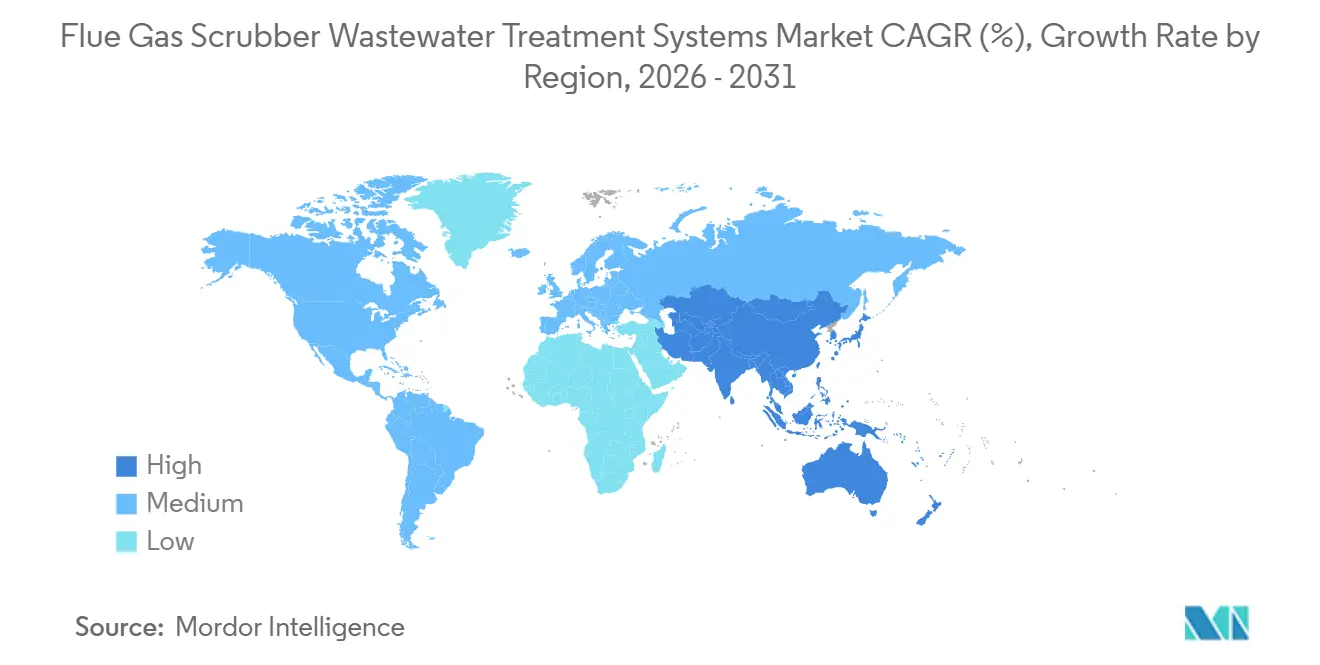
Asia-Pacific held 43.18% of the flue gas scrubber wastewater treatment systems market share in 2025 and is forecast to grow at a 6.47% CAGR through 2031. China's zero-discharge standard defines treatment-system design and acceptance requirements across thermal power plants. This framework supports regional demand for systems designed for reuse, brine management, and solidification. South Korea remains a premium technology market for large treatment projects. Aquatech's 60 m³/h zero-liquid-discharge system at the 6.1 GW Taean station achieved near-100% commercial water recovery.
North America Flue Gas Scrubber Wastewater Treatment Systems Market
North America is the second-largest regional market, supported by compliance requirements at more than 127 wet-flue-gas-desulfurization (FGD)-equipped U.S. coal units. Plant Bowen optimized its dedicated FGD wastewater system by September 2025. The 200,000-square-foot Winyah facility illustrates the scale of the region's dedicated treatment infrastructure. The EPA's extension converts a short compliance cycle into a longer capital program through 2034. The EIA reported that only 2.6 GW of coal capacity retired in 2025, despite 8.5 GW planned at the beginning of that year.
EMEA and South America Flue Gas Scrubber Wastewater Treatment Systems Market
Europe maintains stable treatment demand, driven by phased coal exit plans and requirements under the Industrial Emissions Directive. Germany's 2038 target leaves operating units subject to permit and waste-management conditions, while Poland and the Czech Republic sustain compliance spending. Veolia's USD 500 million industrial-water contract for the Saudi Aramco Total Refining and Petrochemical Company (SATORP) complex in Jubail reflects the scale of industrial-water investment in the Middle-East. Brazil's waste-to-energy pipeline and South Africa's coal-heavy generation fleet offer selective opportunities in the flue gas scrubber wastewater treatment systems market.
Competitive Landscape
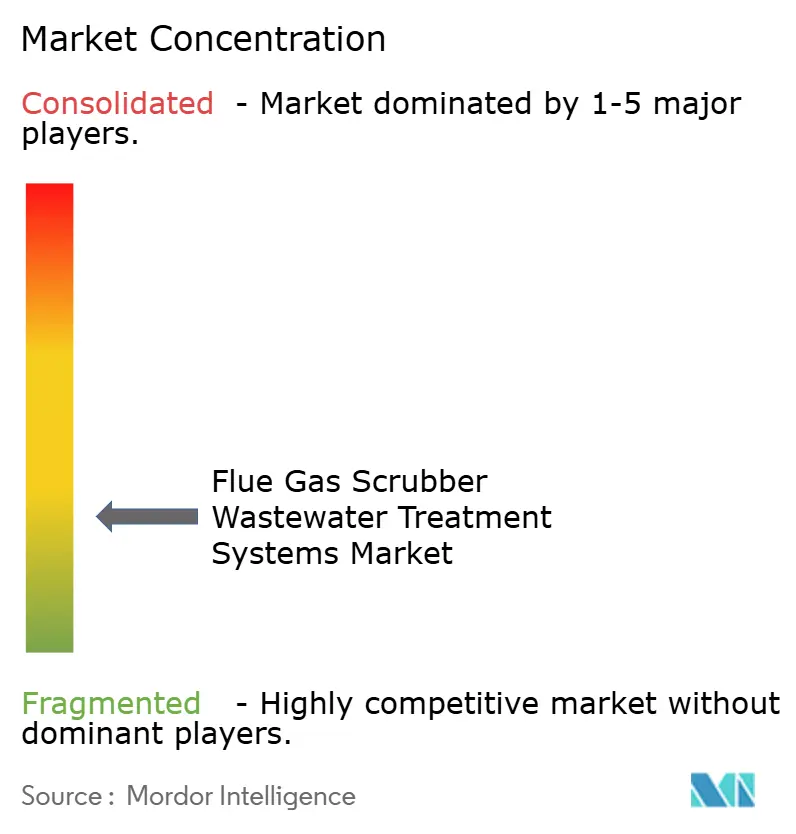
The flue gas scrubber wastewater treatment systems market is fragmented. Veolia, Aquatech, and Xylem lead large water treatment deployments. Mitsubishi Heavy Industries and Doosan Enerbility hold strong positions in the Asia-Pacific region as original equipment manufacturers of scrubbers. Their ability to bundle treatment with FGD supply links equipment projects to subsequent service work.
Veolia Korea signed a 10-year operations and maintenance agreement with SK Chemicals for a 10,200 tons/day wastewater treatment plant at the Ulsan Industrial Complex, effective January 1, 2026. The contract highlights the importance of recurring service revenue in the flue gas scrubber wastewater treatment systems market. CECO Environmental announced a USD 2.2 billion combination with Thermon Group in February 2026, targeting USD 40 million in annual cost synergies within 36 months. Babcock & Wilcox received a USD 40 million contract for wet-gas scrubbing at a Canadian refinery in December 2025.
Marine scrubber blowdown treatment can apply high-chloride FGD treatment knowledge at onshore facilities. Co-treating FGD wastewater and coal combustion residual leachate can increase project value by combining environmental streams into a single contract. Suppliers are developing graphene oxide and metal-organic-framework anti-fouling membranes, while biological selenium treatment remains a technical focus. ISO 14001 certification and documented compliance records for the National Pollutant Discharge Elimination System (NPDES) or DL/T 997-2020 are increasingly relevant in long-term operations and maintenance tenders. The market favors suppliers with verifiable site-level operating records; however, no combined top-player share data was available to provide a numeric concentration score.
Flue Gas Scrubber Wastewater Treatment Systems Industry Leaders
-
Veolia
-
SUEZ
-
Xylem
-
Aquatech
-
Thermax Limited
- *Disclaimer: Major Players sorted in no particular order
Flue Gas Scrubber Wastewater Treatment Systems Market Companies Covered in this Report
- Andritz
- Aquatech
- Babcock and Wilcox Enterprises, Inc.
- CECO ENVIRONMENTAL
- Chiyoda Corporation
- Doosan Enerbility
- Ducon Infratechnologies Ltd.
- GEA Group Aktiengesellschaft
- Hitachi Zosen Inova AG
- Kurita Water Industries Ltd.
- MITSUBISHI HEAVY INDUSTRIES, LTD.
- SUEZ
- Thermax Limited
- Veolia
- Xylem
Recent Industry Developments in Flue Gas Scrubber Wastewater Treatment Systems Market
- December 2025: Babcock & Wilcox received a USD 40 million contract to supply ExxonMobil-licensed low-pressure Wet Gas Scrubbing technology at a major Canadian petroleum refinery, following an initial USD 10 million order placed in September 2025.
- November 2025: Veolia Korea signed a 10-year operations and maintenance (O&M) contract with SK Chemicals for the 10,200 ton/day joint wastewater treatment plant at Ulsan Industrial Complex, effective January 1, 2026.
Global Flue Gas Scrubber Wastewater Treatment Systems Market Report Scope
Flue gas scrubber wastewater treatment is a multi-step process for purifying contaminated water generated by wet scrubbing systems used to clean industrial exhaust gases. This wastewater contains heavy metals, high total dissolved solids (TDS), chlorides, and suspended solids, all of which must be treated before safe environmental discharge or reuse within the plant.
The flue gas scrubber wastewater treatment systems market is segmented by scrubber type, treatment technology, contaminant type, end-user industry, and geography. By scrubber type, the market is segmented into wet flue gas desulfurization systems, semi-dry scrubber systems, dry scrubber systems, and others (multi-pollutant scrubber systems). By treatment technology, the market is segmented into physical and chemical treatment, membrane filtration systems, evaporation and crystallization systems, biological treatment systems, and others (zero liquid discharge systems). By contaminant type, the market is segmented into heavy metals (mercury, selenium, arsenic), chlorides and sulfates, total suspended solids (TSS), and others (nitrates, ammonia, mixed contaminants). By end-user industry, the market is segmented into coal-fired power plants, waste-to-energy plants, cement plants, metals and mining, and others (chemicals, petrochemicals and marine scrubber applications). The report also covers market size and forecasts for flue gas scrubber wastewater treatment systems across 16 countries in major regions. The market sizes and forecasts are provided in terms of value (USD).
Segmentation Overview
| Wet Flue Gas Desulfurization Systems |
| Semi-Dry Scrubber Systems |
| Dry Scrubber Systems |
| Others (Multi-Pollutant Scrubber Systems) |
| Physical and Chemical Treatment |
| Membrane Filtration Systems |
| Evaporation and Crystallization Systems |
| Biological Treatment Systems |
| Others (Zero Liquid Discharge Systems) |
| Heavy Metals (Mercury, Selenium, Arsenic) |
| Chlorides and Sulfates |
| Total Suspended Solids (TSS) |
| Others (Nitrates, Ammonia, Mixed Contaminants) |
| Coal-Fired Power Plants |
| Waste-to-Energy Plants |
| Cement Plants |
| Metals and Mining |
| Others (Chemicals, Petrochemicals and Marine Scrubber Applications) |
| Asia-Pacific | China |
| India | |
| Japan | |
| South Korea | |
| Rest of Asia-Pacific | |
| North America | United States |
| Canada | |
| Mexico | |
| Europe | Germany |
| United Kingdom | |
| France | |
| Italy | |
| Rest of Europe | |
| South America | Brazil |
| Argentina | |
| Rest of South America | |
| Middle-East and Africa | Saudi Arabia |
| South Africa | |
| Rest of Middle-East and Africa |
| By Scrubber Type | Wet Flue Gas Desulfurization Systems | |
| Semi-Dry Scrubber Systems | ||
| Dry Scrubber Systems | ||
| Others (Multi-Pollutant Scrubber Systems) | ||
| By Treatment Technology | Physical and Chemical Treatment | |
| Membrane Filtration Systems | ||
| Evaporation and Crystallization Systems | ||
| Biological Treatment Systems | ||
| Others (Zero Liquid Discharge Systems) | ||
| By Contaminant Type | Heavy Metals (Mercury, Selenium, Arsenic) | |
| Chlorides and Sulfates | ||
| Total Suspended Solids (TSS) | ||
| Others (Nitrates, Ammonia, Mixed Contaminants) | ||
| By End-User Industry | Coal-Fired Power Plants | |
| Waste-to-Energy Plants | ||
| Cement Plants | ||
| Metals and Mining | ||
| Others (Chemicals, Petrochemicals and Marine Scrubber Applications) | ||
| By Geography | Asia-Pacific | China |
| India | ||
| Japan | ||
| South Korea | ||
| Rest of Asia-Pacific | ||
| North America | United States | |
| Canada | ||
| Mexico | ||
| Europe | Germany | |
| United Kingdom | ||
| France | ||
| Italy | ||
| Rest of Europe | ||
| South America | Brazil | |
| Argentina | ||
| Rest of South America | ||
| Middle-East and Africa | Saudi Arabia | |
| South Africa | ||
| Rest of Middle-East and Africa | ||
Key Questions Answered in the Report
What is current market size of Flue Gas Scrubber Wastewater Treatment Systems Market?
The Flue Gas Scrubber Wastewater Treatment Systems Market size is expected to grow from USD 0.74 billion in 2025 to USD 0.78 billion in 2026 and is forecast to reach USD 1.03 billion by 2031 at 5.71% CAGR over 2026-2031.
Which scrubber type has the largest installed treatment need?
Wet FGD systems held a 65.42% share in 2025 because their operating process produces continuous wastewater blowdown.
Which treatment technology is growing fast for flue gas desulfurization (FGD) wastewater?
Evaporation and crystallization systems are forecast to expand at a 6.12% CAGR through 2031 as zero-discharge requirements increase.
Why are chlorides and sulfates important in FGD wastewater projects?
They are projected to grow at a 6.58% CAGR because zero-discharge systems must manage the full dissolved ionic load.