
First-Party Data Monetization Services Market Size and Share
Market Overview
| Study Period | 2020 - 2031 |
|---|---|
| Market Size (2026) | USD 5.67 Billion |
| Market Size (2031) | USD 13.51 Billion |
| Growth Rate (2026 - 2031) | 18.96 % |
| Fastest Growing Market | Asia-Pacific |
| Largest Market | North America |
| Market Concentration | Low |
Major Players *Disclaimer: Major Players sorted in no particular order Image © Mordor Intelligence. Reuse requires attribution under CC BY 4.0. | |
First-Party Data Monetization Services Market Analysis by Mordor Intelligence
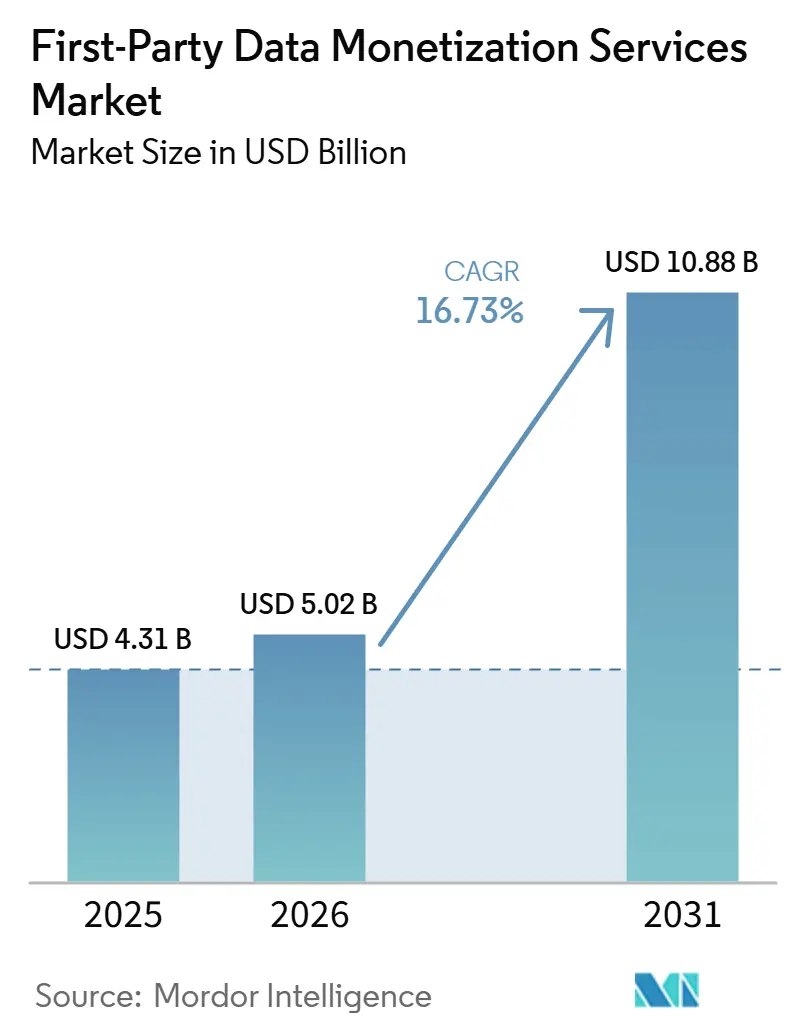
The First-Party Data Monetization Services Market size is expected to increase from USD 4.74 billion in 2025 to USD 5.67 billion in 2026 and reach USD 13.51 billion by 2031, growing at a CAGR of 18.96% over 2026-2031. The First-Party Data Monetization Services Market is supported by tighter controls on third-party signals, stronger commercial demand for consented customer information, and wider adoption of privacy-preserving collaboration tools that allow partners to work under defined controls. Enterprise buyers are directing spending toward data engineering, identity resolution, governance, and managed operations because these capabilities determine whether customer information can be safely activated, consistently measured, and used in approved commercial relationships. The First-Party Data Monetization Services Market also benefits from retail and commerce media programs that increase demand for audience products, measurement, partner activation, and clearer links between customer information and commercial outcomes. Competitive strategies increasingly combine media services, data infrastructure, and customer experience tools, which raises the importance of platform neutrality for buyers that need their data to remain usable across several technology, agency, retailer, and publisher partners. The First-Party Data Monetization Services Market has opportunities in formalizing consent-rich data assets, improving data quality, reducing duplicate identity records, and supporting controlled collaboration without exposing raw customer records across complex commercial settings, while allowing companies to define permitted uses, maintain auditable consent records, align partners around common identity rules, and adapt operating processes as commercial data partnerships grow, with work that extends beyond a single campaign or technology deployment into data preparation, partner governance, measurement design, operational support, and ongoing review of eligibility rules across customer, media, retail, and technology environments across extended partner networks and operating models over time.
Key Report Takeaways
- By service type, Data Collaboration and Clean Room Services held 28.12% of the First-Party Data Monetization Services Market share in 2025 and are projected to expand at a 20.92% CAGR through 2031.
- By application, Personalized Marketing accounted for 31.82% of revenue in the First-Party Data Monetization Services Market 2025, while Recommendation Engines are projected to expand at a 21.51% CAGR through 2031.
- By end-user industry, Retail and E-commerce held 26.28% of revenue in 2025, while Healthcare and Lifesciences are projected to expand at a 19.21% CAGR through 2031.
- By geography, North America accounted for 40.12% of revenue in the First-Party Data Monetization Services Market 2025, while Asia-Pacific is projected to expand at a 20.56% CAGR through 2031.
Note: Market size and forecast figures in this report are generated using Mordor Intelligence’s proprietary estimation framework, updated with the latest available data and insights as of January 2026.
Global First-Party Data Monetization Services Market Trends and Insights
Drivers Impact Analysis*
| Driver | (~) % Impact on CAGR Forecast | Geographic Relevance | Impact Timeline |
|---|---|---|---|
| Retail Media and Commerce Media Expansion Increasing Demand for Audience Monetization | +4.2% | Global, with core concentration in North America and Asia-Pacific | Short term (≤ 2 years) |
| Third-Party Signal Loss Accelerating Demand for Owned Identity Graphs | +3.6% | Global, with North America and Europe leading investment | Short term (≤ 2 years) |
| Enterprise AI and Personalization Investments Raising the Value of Consent-Rich Customer Data | +2.8% | North America and Europe, with rapid Asia-Pacific adoption | Medium term (2-4 years) |
| Growth in Privacy-Safe Data Collaboration and Clean Room Adoption | +2.1% | Global, driven by North America and EU compliance corridors | Medium term (2-4 years) |
| Interoperability Standards Lowering Activation Friction | +1.3% | North America and Europe, emerging across Asia-Pacific | Medium term (2-4 years) |
| Non-Endemic Data Partnerships Unlocking New Revenue Pools | +0.8% | North America, with spillover to Asia-Pacific and South America | Long term (≥ 4 years) |
| Source: Mordor Intelligence | |||
Retail Media and Commerce Media Expansion Increasing Demand for Audience Monetization
Retail media has become a practical route for companies to generate value from authenticated customer relationships in the First-Party Data Monetization Services Market. Its expansion into non-endemic categories is broadening demand beyond brands sold through retailers. Retail networks are developing audience segments, analytical products, and measurement services that can be offered separately from advertising inventory. This shifts service demand toward data engineering, identity resolution, and the preparation of audience products for partner use. Amperity launched Audience Monetization in January 2026 to help brands create identity-resolved audiences, automate marketplace distribution, and apply governance controls. The First-Party Data Monetization Services Market, therefore, has a growing need for services that connect customer data with compliant activation and measurement workflows.[1]Amperity, “Amperity Introduces Audience Monetization to Turn First-Party Data into a Revenue Stream,” Amperity, amperity.com
Third-Party Signal Loss Accelerating Demand for Owned Identity Graphs
The continuing loss of reliable third-party signals is increasing the value of owned identity infrastructure in the First-Party Data Monetization Services Market. Browser settings and mobile privacy controls have reduced the durability of identifiers that companies do not control directly. Authenticated Audiences standards place greater emphasis on hashed email addresses, login identifiers, and authenticated session data as usable activation inputs.[2]Interactive Advertising Bureau Tech Lab, “Authenticated Audiences Standards and Unified ID 2.0 Framework,” IAB Tech Lab, iabtechlab.com Organizations that developed deterministic identity graphs before 2026 have a stronger basis for measurement and customer activation. Many enterprises still need identity resolution and profile unification before their customer data can support monetization programs. The First-Party Data Monetization Services Market is consequently seeing demand for managed identity graph construction, not only for software licenses.
Enterprise AI and Personalization Investments Raising the Value of Consent-Rich Customer Data
AI and personalization programs are increasing the value placed on clean, consented, and identity-resolved customer information in the First-Party Data Monetization Services Market. Organizations need reliable information when models are used to support individual-level customer decisions. Adobe introduced CX Enterprise in April 2026 with Brand Intelligence and Engagement Intelligence capabilities for customer experience operations.[3]Adobe, “Adobe Redefines Customer Experience Orchestration Vision in the Agentic AI Era with Introduction of CX Enterprise,” Adobe News, news.adobe.com Yobi announced a partnership with Microsoft in April 2026 to develop an enterprise behavioral intelligence model based on consented consumer data. These offerings make governance, strategy, and compliance services more important because data must meet clear quality and permission requirements. The First-Party Data Monetization Services Market is therefore gaining from the need to make customer datasets fit for AI-enabled activation.
Growth in Privacy-Safe Data Collaboration and Clean Room Adoption
Clean rooms are becoming a more common operating model for companies that need to compare or analyze sensitive datasets without direct sharing of raw data. They support audience overlap analysis, incrementality measurement, and controlled model development across partners. Snowflake and NIQ announced a dedicated clean-room environment in October 2025 for campaign measurement and consumer-signal enrichment across media owners, technology platforms, and retail networks.[4]Snowflake, “Snowflake Data Clean Rooms Release Notes,” Snowflake Documentation, docs.snowflake.com LiveRamp added NVIDIA GPU infrastructure to its clean rooms in 2026, reporting up to 15x faster AI model performance compared to CPU-based environments. The First-Party Data Monetization Services Market is supported by the resulting need for clean room design, governance, query management, and managed operations. The technology is also moving beyond simple analytics toward controlled environments for more demanding AI workloads.
Restraints Impact Analysis*
| Restraint | (~) % Impact on CAGR Forecast | Geographic Relevance | Impact Timeline |
|---|---|---|---|
| Fragmented Privacy Laws and Consent Enforcement Complexity | -0.9% | Global, most acute in Europe, North America, and Asia-Pacific | Short term (≤ 2 years) |
| Cloud Egress and Query Costs Compressing Monetization Margins | -0.6% | Global | Medium term (2-4 years) |
| Infrastructure Neutrality Concerns Slowing Ecosystem Participation | -0.4% | North America and Europe | Medium term (2-4 years) |
| Uneven First-Party Data Maturity Extending Implementation Cycles | -0.3% | Global, most acute among mid-market enterprises | Medium term (2-4 years) |
| Source: Mordor Intelligence | |||
Fragmented Privacy Laws and Consent Enforcement Complexity
Fragmented privacy requirements make it difficult for organizations to use one consent and governance design across all operating regions. The GDPR requires a documented lawful basis for processing, while California rules include opt-out mechanisms and separate requirements for sensitive information. By 2026, 20 U.S. states had enacted comprehensive consumer privacy laws, adding different applicability thresholds and enforcement approaches. China also maintains strict limits on the scope of consent for secondary uses of personal information. Service providers must therefore conduct consent validation, map cross-border data flows, and assess activation eligibility in real time. The First-Party Data Monetization Services Market faces slower activation in some cases, even as this complexity supports demand for privacy, consent, and governance services.
Cloud Egress and Query Costs Compressing Monetization Margins
Multi-party clean rooms can generate charges when information moves across cloud environments or when partners run repeated queries. The costs are most visible in neutral, multi-cloud arrangements that connect a brand, publisher, or retailer across separate platforms. The EU Data Act entered into full application in September 2025 and sets a path to prohibit cross-provider data transfer charges in the European Union from January 12, 2027. Live clean room queries can still require operational spending during the transition period. Outside the European Union, organizations may need to choose between a single cloud-native environment and recurring multi-cloud costs. The First-Party Data Monetization Services Market can face margin pressure when the expected value of data collaboration does not cover these operating costs.
*Our forecasts treat driver/restraint impacts as directional, not additive. The impact forecasts reflect baseline growth, mix effects, and variable interactions.
Segment Analysis
By Service Type: Data Collaboration and Clean Rooms Define Market Architecture
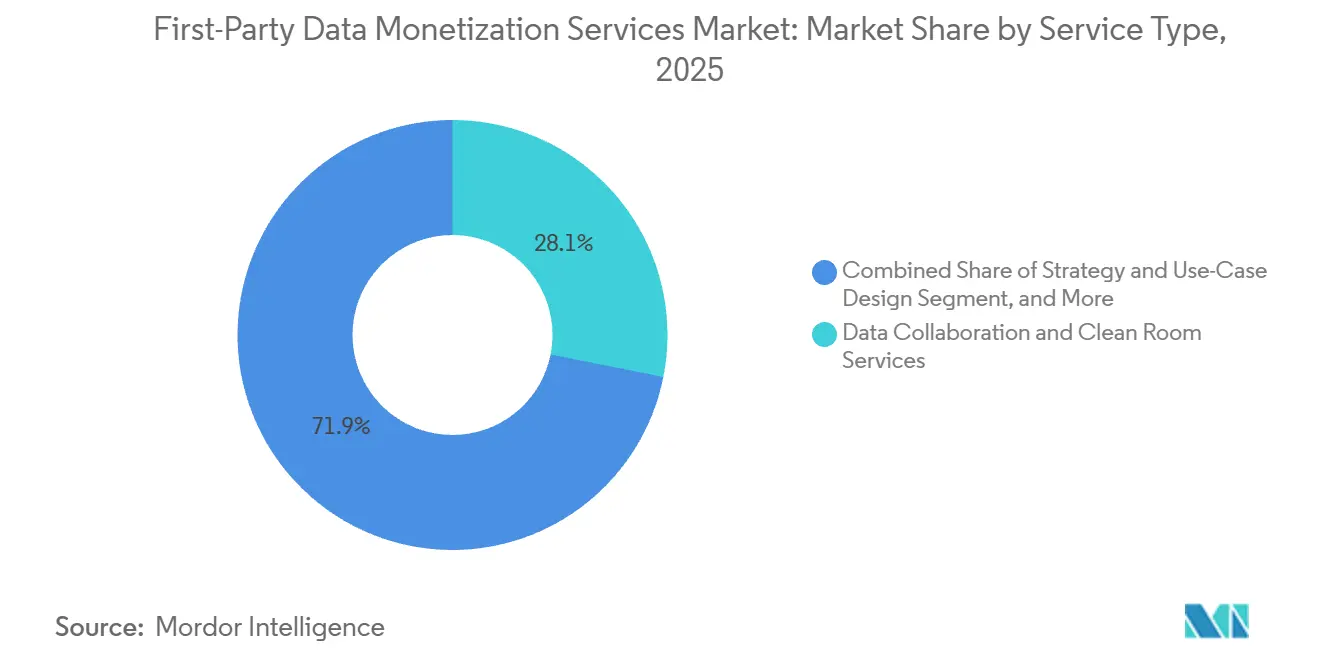
Data Collaboration and Clean Room Services captured 28.12% of service-type revenue in 2025 and led the First-Party Data Monetization Services Market share. Enterprises increasingly treat controlled collaboration as an ongoing capability rather than a temporary project. This creates continuing demand for query design, partner provisioning, measurement governance, access controls, and AI workload management. The Authenticated Audiences standards and Unified ID 2.0 framework provide an identity foundation that can reduce friction between identity resolution and downstream collaboration. Audience Productization and Activation Services are also expanding as retail networks and second-party marketplaces package consented audiences for non-endemic partners and programmatic channels.
The First-Party Data Monetization Services Market size for Data Collaboration and Clean Room Services is projected to grow at a 20.92% CAGR between 2026 and 2031. Strategy and Use-Case Design, together with Data Engineering and Platform Implementation, remain the main entry points for organizations beginning formal monetization programs. These engagements can become multiyear work when organizations move from advisory programs to governed data products and partner workflows. Privacy, Consent, and Governance Services are seeing greater demand because activation can be limited until permissions, use purposes, and cross-jurisdiction controls are established. Measurement and Monetization Optimization Services become more important as brands quantify incremental revenue yield and meet higher closed-loop attribution expectations.



By Application: Personalized Marketing Anchors Revenue as Recommendation Engines Lead Growth
Personalized Marketing accounted for 31.82% of application revenue in 2025, giving it the largest share in the First-Party Data Monetization Services Market. The segment reflects the use of consent-rich customer information in omnichannel personalization across retail, financial services, and e-commerce. Companies are combining CRM information with identity-resolved behavioral data as third-party targeting becomes less dependable. Customer Analytics, Advertising, and Audience Insights constitute the next group of demand, as closed-loop attribution and incrementality measurement require owned customer data. Business Intelligence and Customer Experience Management are expanding as enterprises use monetization outputs in operational analytics and broader customer programs.
Recommendation Engines are projected to expand at a 21.51% CAGR between 2026 and 2031, making them the fastest-growing application segment in the First-Party Data Monetization Services Market. These systems need deterministic, consented, and identity-resolved inputs when they support individualized recommendations. Adobe introduced CX Enterprise in April 2026 with Brand Intelligence and Engagement Intelligence capabilities for customer experience operations. Enterprise investment in AI is creating related demand for upstream data engineering and identity resolution services. Fraud detection intelligence, competitive benchmarking, and supply chain analytics are additional applications as companies broaden the commercial scope of consented customer datasets.
By End-user Industry: Retail and E-commerce Leads While Healthcare Accelerates
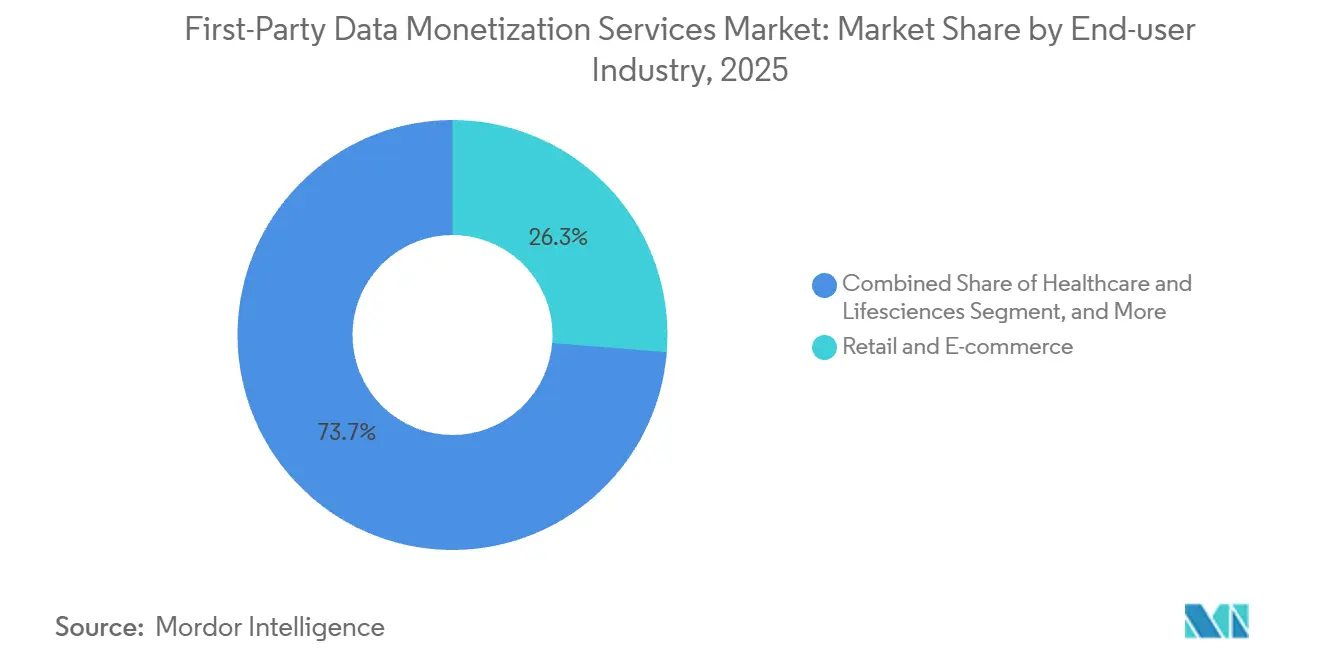
Retail and E-commerce accounted for 26.28% of end-user revenue in 2025 and led the First-Party Data Monetization Services Market share. Retailers hold detailed, authenticated purchase and behavioral information, and their investment in retail media has created a direct route from data assets to audience products and non-endemic partnerships. BFSI is the next major vertical, leveraging transaction and account data for cross-sell personalization and controlled-collaboration programs. Media and Entertainment, Telecommunications, and Travel and Hospitality are gaining traction as they develop audience products and partner relationships. Telecom operators in Asia-Pacific and the Middle East are particularly relevant because they hold large authenticated subscriber bases.
Healthcare and Lifesciences is projected to expand at a 19.21% CAGR between 2026 and 2031, making it the fastest-growing end-user segment in the First-Party Data Monetization Services Market. Patient engagement platforms, pharmaceutical education programs, and real-world evidence products are creating demand for consent-based data use. HIPAA and the GDPR increase the need for governance support in healthcare use cases. This makes healthcare programs more service-intensive than many consumer applications. Manufacturing and Automotive are early-stage verticals where connected-product telemetry and dealer transaction data are beginning to support audience-level monetization efforts.
Geography Analysis
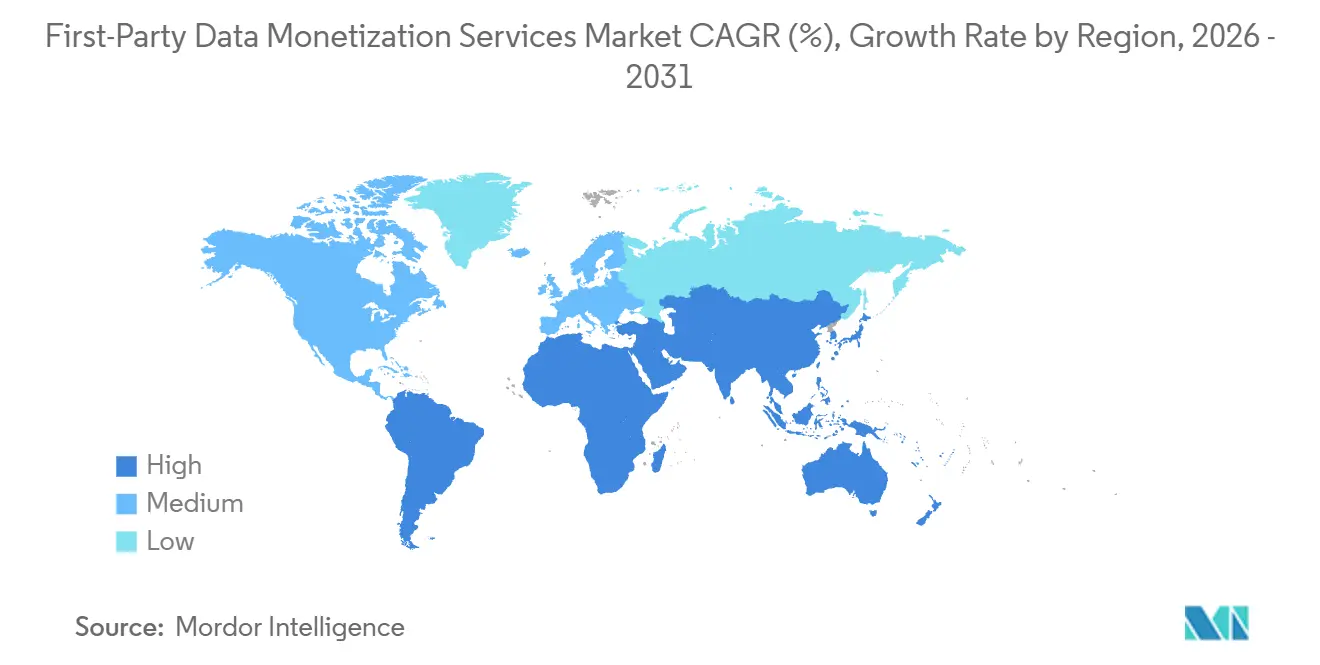
North America held 40.12% of revenue in 2025, representing the largest First-Party Data Monetization Services Market share and reflecting retail media activity, mature customer data platform adoption, and state-level privacy obligations. Amazon and Walmart support substantial retail media activity in the United States, creating demand among brands and agencies for identity resolution, clean room design, audience activation, and measurement optimization. Canada is progressing federal digital privacy discussions, while Mexico's expanding e-commerce and financial technology sectors are creating earlier-stage demand for customer data infrastructure among retailers and financial services organizations.
Asia-Pacific is projected to expand at a 20.56% CAGR between 2026 and 2031, making it the fastest-growing geographic area in the First-Party Data Monetization Services Market. India's Digital Personal Data Protection Rules were notified in November 2025, creating an 18-month phased compliance window. This timing has encouraged enterprises to invest in consent infrastructure, identity resolution, and clearer data-use controls before programs become more complex. China's Personal Information Protection Law and data security framework are shaping more formal approaches to commercial data use, while national data asset rules are adding clarity to commercial data transactions. Japan's Ministry of Economy, Trade, and Industry published its Transparency and Fairness evaluation in December 2025, and Catalina Marketing Japan launched the AOUMI retail media network in August 2025. South Korea and Australia add secondary growth through retail and financial services organizations that are developing audience products and customer data programs.
Europe, South America, the Middle East, and Africa account for the remaining share of the First-Party Data Monetization Services Market. Europe has a regulation-led pattern of demand, with the GDPR supporting continued investment in consent management, governance, identity controls, and clean room programs across Germany, the United Kingdom, and France. South America is at an earlier stage, led by Brazil under the Lei Geral de Proteção de Dados, while retailers, banks, and e-commerce platforms in Argentina and Chile are beginning audience productization programs. The United Arab Emirates and Saudi Arabia are seeing growing interest from telecom operators and financial institutions with large authenticated subscriber bases that may support non-endemic partnership models. Africa remains at an early stage, with fintech platforms in Nigeria and retail groups in South Africa beginning customer data unification programs.

Competitive Landscape
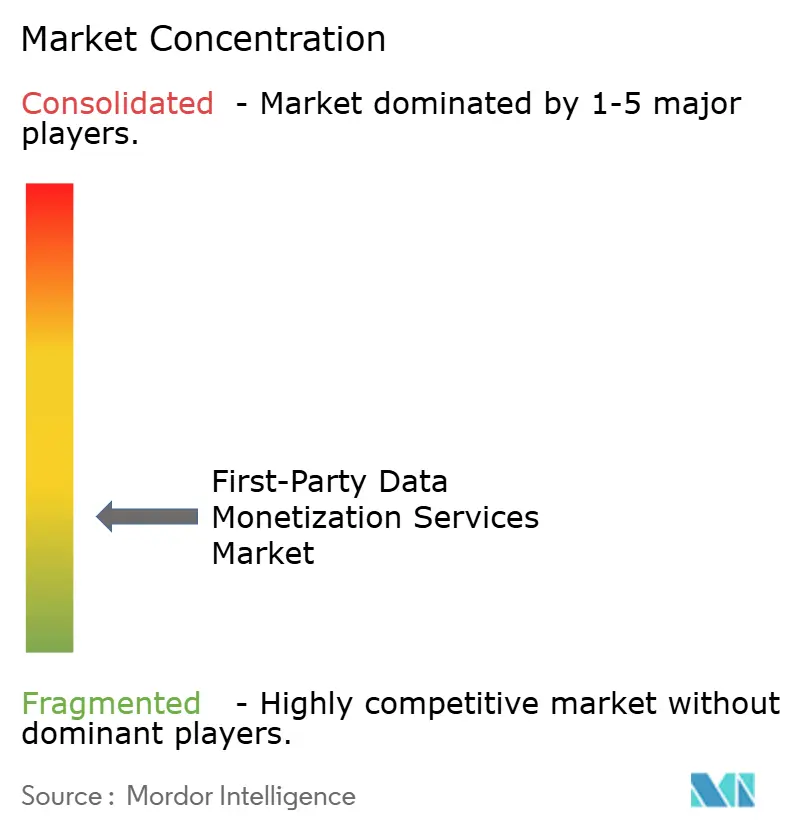
The First-Party Data Monetization Services Market is fragmented at the specialized services layer, while cloud and data platform providers hold more concentrated positions in the underlying infrastructure. Amazon Web Services, Google, Snowflake, and Salesforce provide data cloud and clean room tools that can give enterprises a low-cost entry point and extend the provider relationship into adjacent monetization work. Google Ads Data Hub, Amazon Marketing Cloud, and Snowflake clean room capabilities demonstrate an investment in proprietary privacy-preserving collaboration methods that may be difficult for specialized practitioners to replicate at a comparable scale. These platforms can create switching costs because customer data workflows, identity tools, governance policies, and measurement practices become embedded in the broader environment. The First-Party Data Monetization Services Market, therefore, combines active competition for execution services with stronger supplier positions in the technology layer that supports those services.
Holding companies are also moving toward greater ownership of data infrastructure. Publicis Groupe announced an agreement to acquire LiveRamp for USD 2.167 billion in May 2026, a move intended to build a data co-creation layer for agentic AI and bring LiveRamp together with Publicis Sapient, Epsilon, and Marcel. WPP acquired InfoSum in April 2025 to add privacy-preserving data collaboration capabilities to its AI-driven data offering. These transactions indicate that agency groups want to reduce dependence on independent intermediaries and have a greater role in the data infrastructure used for client programs. They also make platform neutrality more important for enterprise buyers who work across competing agency networks and need their data to remain usable across several commercial relationships.
Specialist providers such as Amperity, BlueConic, Permutive, and Dawex compete by focusing on capabilities in identity resolution, publisher audience packaging, data exchange, and the operational requirements for regulated customer information. Dawex operates an ISO 27001-certified data exchange platform for cross-industry data partnerships, including commercial data licensing between organizations that previously had no direct connection. Databricks CustomerLake, Yobi's behavioral intelligence work, and Monetate's acquisition of Simon AI point to a newer group of AI-centered offerings that place first-party data activation closer to the data and model infrastructure. Monetate acquired Simon AI in July 2026 to combine customer data unification, behavioral understanding, cross-channel activation, and AI governance. The First-Party Data Monetization Services Market is likely to remain competitive because buyers require broad interoperability, governance, specialized execution, and a clear path from customer data to measurable commercial use.
First-Party Data Monetization Services Industry Leaders
LiveRamp Holdings, Inc.
Publicis Groupe S.A.
Omnicom Group Inc.
WPP plc
Accenture plc
- *Disclaimer: Major Players sorted in no particular order

Recent Industry Developments
- July 2026: Monetate acquired Simon AI, the AI-first composable CDP, creating the industry's first platform combining customer data unification, behavioral understanding, cross-channel activation, and AI governance in a single zero-copy architecture integrated with Snowflake, Databricks, and BigQuery. The acquisition was accompanied by a significant growth capital injection for accelerated product development and expanded strategic services.
- July 2026: LiveRamp Holdings, Inc. partnered with Adobe to integrate commerce purchase data into Adobe GenStudio for Commerce Media Networks, enabling commerce media networks to build and launch targeted campaigns by combining LiveRamp's data collaboration network with Adobe Real-Time CDP Collaboration. The integration creates a direct link between first-party purchase data and AI-driven content production workflows.
- May 2026: Publicis Groupe announced an agreement to acquire LiveRamp Holdings, Inc. for a total enterprise value of USD 2.167 billion in an all-cash transaction at USD 38.50 per share, a 29.8% premium to LiveRamp's prior closing price. The deal positions Publicis to build a data co-creation layer for agentic AI, integrating LiveRamp with Publicis Sapient, Epsilon, and Marcel, with transaction close expected before end of 2026.
- April 2026: LiveRamp Holdings, Inc. announced native NVIDIA GPU infrastructure support inside its clean room architecture, with benchmarks showing up to 15x faster AI model performance versus CPU-based environments. The capability enables AI partners and brands to train and deploy sophisticated models within LiveRamp clean rooms without exposing data or model weights.


Global First-Party Data Monetization Services Market Report Scope
The first-party data monetization services market refers to professional and managed services that help organizations transform their self-collected customer data into revenue-generating assets. This includes strategy design, data engineering, identity resolution, privacy and consent management, data clean room collaboration, and audience activation. By leveraging these services, businesses can securely package, share, and monetize their first-party data with advertisers, partners, or internal departments while maintaining strict compliance with evolving global privacy regulations.
The First-Party Data Monetization Services Market Report is Segmented by Service Type (Strategy and Use-Case Design, Data Engineering and Platform Implementation, Identity Resolution and Profile Unification, Privacy, Consent, and Governance Services, Data Collaboration and Clean Room Services, Audience Productization and Activation Services, Measurement and Monetization Optimization Services, and Other Services), Application (Personalized Marketing, Customer Analytics, Advertising and Audience Insights, Recommendation Engines, Business Intelligence, Customer Experience Management, and Other Applications), End-user Industry (Retail and E-commerce, BFSI, Healthcare and Lifesciences, Media and Entertainment, Telecommunications, Travel and Hospitality, Manufacturing, Automotive, and Other End User Industries), and Geography (North America, South America, Europe, Asia-Pacific, Middle East, and Africa). The Market Forecasts are Provided in Terms of Value (USD).
| Strategy and Use-Case Design |
| Data Engineering and Platform Implementation |
| Identity Resolution and Profile Unification |
| Privacy, Consent, and Governance Services |
| Data Collaboration and Clean Room Services |
| Audience Productization and Activation Services |
| Measurement and Monetization Optimization Services |
| Other Service Types |
| Personalized Marketing |
| Customer Analytics |
| Advertising and Audience Insights |
| Recommendation Engines |
| Business Intelligence |
| Customer Experience Management |
| Other Applications |
| Retail and E-commerce |
| BFSI |
| Healthcare and Lifesciences |
| Media and Entertainment |
| Telecommunications |
| Travel and Hospitality |
| Manufacturing |
| Automotive |
| Other End User Industries |
| North America | United States |
| Canada | |
| Mexico | |
| South America | Brazil |
| Argentina | |
| Chile | |
| Rest of South America | |
| Europe | Germany |
| United Kingdom | |
| France | |
| Italy | |
| Spain | |
| Rest of Europe | |
| Asia-Pacific | China |
| Japan | |
| India | |
| South Korea | |
| Australia | |
| Rest of Asia-Pacific | |
| Middle East | United Arab Emirates |
| Saudi Arabia | |
| Qatar | |
| Rest of Middle East | |
| Africa | South Africa |
| Egypt | |
| Nigeria | |
| Rest of Africa |
| By Service Type | Strategy and Use-Case Design | |
| Data Engineering and Platform Implementation | ||
| Identity Resolution and Profile Unification | ||
| Privacy, Consent, and Governance Services | ||
| Data Collaboration and Clean Room Services | ||
| Audience Productization and Activation Services | ||
| Measurement and Monetization Optimization Services | ||
| Other Service Types | ||
| By Application | Personalized Marketing | |
| Customer Analytics | ||
| Advertising and Audience Insights | ||
| Recommendation Engines | ||
| Business Intelligence | ||
| Customer Experience Management | ||
| Other Applications | ||
| By End-user Industry | Retail and E-commerce | |
| BFSI | ||
| Healthcare and Lifesciences | ||
| Media and Entertainment | ||
| Telecommunications | ||
| Travel and Hospitality | ||
| Manufacturing | ||
| Automotive | ||
| Other End User Industries | ||
| By Geography | North America | United States |
| Canada | ||
| Mexico | ||
| South America | Brazil | |
| Argentina | ||
| Chile | ||
| Rest of South America | ||
| Europe | Germany | |
| United Kingdom | ||
| France | ||
| Italy | ||
| Spain | ||
| Rest of Europe | ||
| Asia-Pacific | China | |
| Japan | ||
| India | ||
| South Korea | ||
| Australia | ||
| Rest of Asia-Pacific | ||
| Middle East | United Arab Emirates | |
| Saudi Arabia | ||
| Qatar | ||
| Rest of Middle East | ||
| Africa | South Africa | |
| Egypt | ||
| Nigeria | ||
| Rest of Africa | ||


Key Questions Answered in the Report
What is the First-Party Data Monetization Services Market size?
The First-Party Data Monetization Services Market is expected to increase from USD 5.67 billion in 2026 to USD 13.51 billion by 2031, at an 18.96% CAGR.
Which service category leads first-party data monetization?
Data Collaboration and Clean Room Services led with 28.12% of service-type revenue in 2025 and are projected to grow at a 20.92% CAGR through 2031.
Which application has the largest role in customer data monetization?
Personalized Marketing held 31.82% of application revenue in 2025, while Recommendation Engines are projected to grow at a 21.51% CAGR through 2031.
Which end-user sector is growing fastest?
Healthcare is projected to grow at a 19.21% CAGR through 2031 as patient engagement, verified education, and evidence-related data uses develop.
Which region is growing fastest?
Asia-Pacific is projected to expand at a 20.56% CAGR through 2031, supported by consent, identity, retail media, and governance investment.
How do privacy rules affect data monetization programs?
Privacy rules require real-time consent validation, data flow mapping, and activation checks, which can slow use while increasing demand for governance services.
Page last updated on:





