
Fire Door Market Size and Share
Market Overview
| Study Period | 2021 - 2032 |
|---|---|
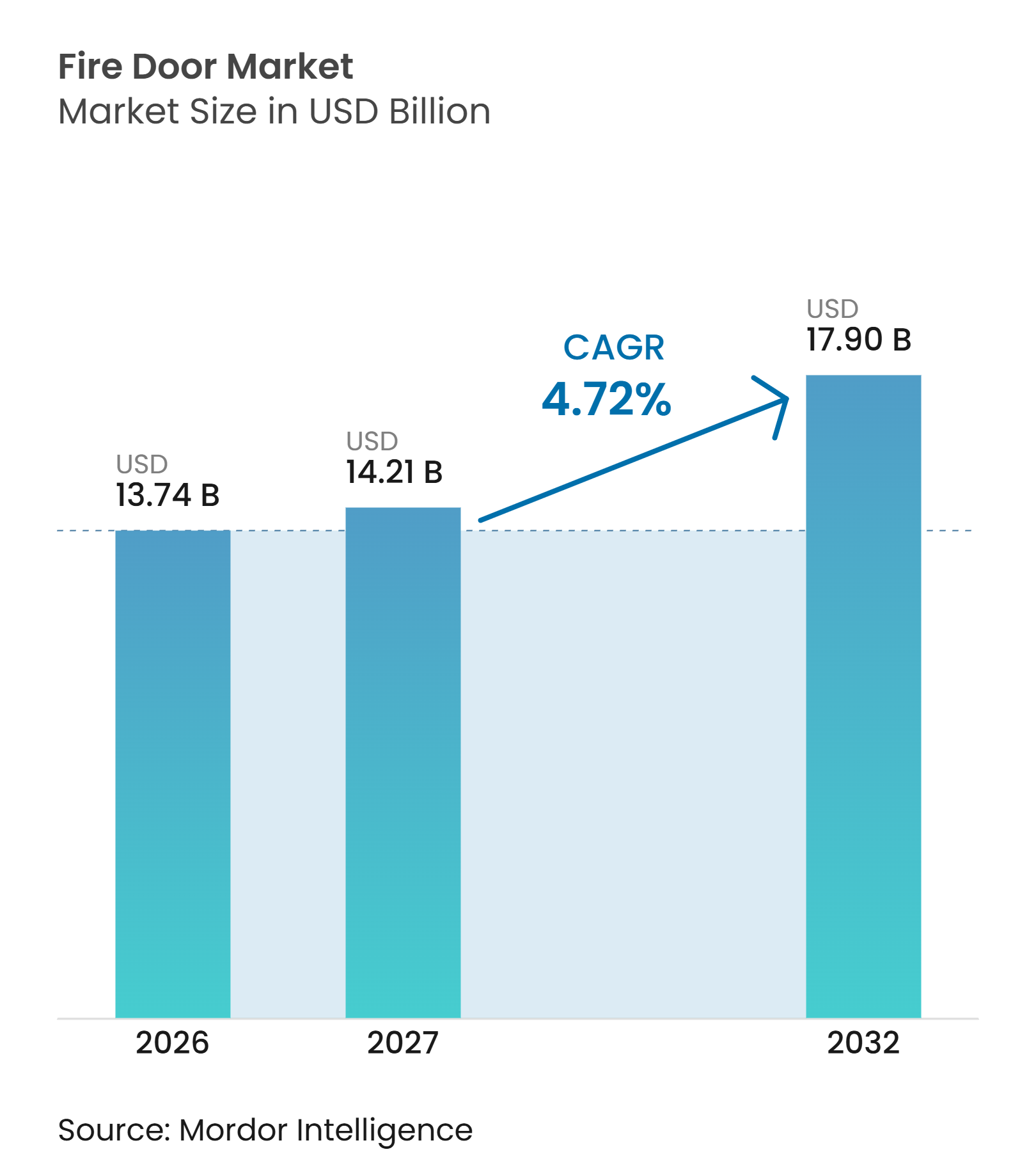
| Market Size (2027) | USD 14.21 Billion |
| Market Size (2032) | USD 17.90 Billion |
| Growth Rate (2027 - 2032) | 4.72 % |
| Fastest Growing Market | Middle East and Africa |
| Largest Market | Asia-Pacific |
| Market Concentration | Low |
Major Players *Disclaimer: Major Players sorted in no particular order Image © Mordor Intelligence. Reuse requires attribution under CC BY 4.0. | |
Fire Door Market Analysis by Mordor Intelligence
The fire door market size is expected to increase from USD 13.74 billion in 2026 to USD 14.21 billion in 2027 and reach USD 17.90 billion by 2032, growing at a CAGR of 4.72% over 2027-2032. The fire door market is expanding as building owners face tighter duties to specify, inspect, maintain, and document tested doorsets. This shifts demand toward complete assemblies with reliable test evidence rather than individual door leaves. Retrofit work provides a steadier source of demand where building owners must correct gaps, damaged components, or incomplete records. New data centers, logistics facilities, hospitals, and public buildings also require higher-rated assemblies and integrated controls. Suppliers that combine certification, fabrication, inspection support, and digital records are better placed to serve these projects.
Key Report Takeaways
- By product type, hinged and swinging fire doors held 67.15% of the fire door market share in 2026, while flush-glazed fire doors are projected to grow at the fastest CAGR of 6.12% between 2027 and 2032.
- By material, metal fire doors accounted for 50.23% of the fire door market share in 2026, while composite fire doors are projected to grow at the fastest CAGR of 6.65% between 2027 and 2032.
- By door location, internal fire doors accounted for 75.42% of the fire door market share in 2026, while external fire doors are projected to grow at the fastest CAGR of 6.08% between 2027 and 2032.
- By application, commercial applications accounted for 68.45% of the fire door market share in 2026, and are projected to grow at the fastest CAGR of 6.30% between 2027 and 2032.
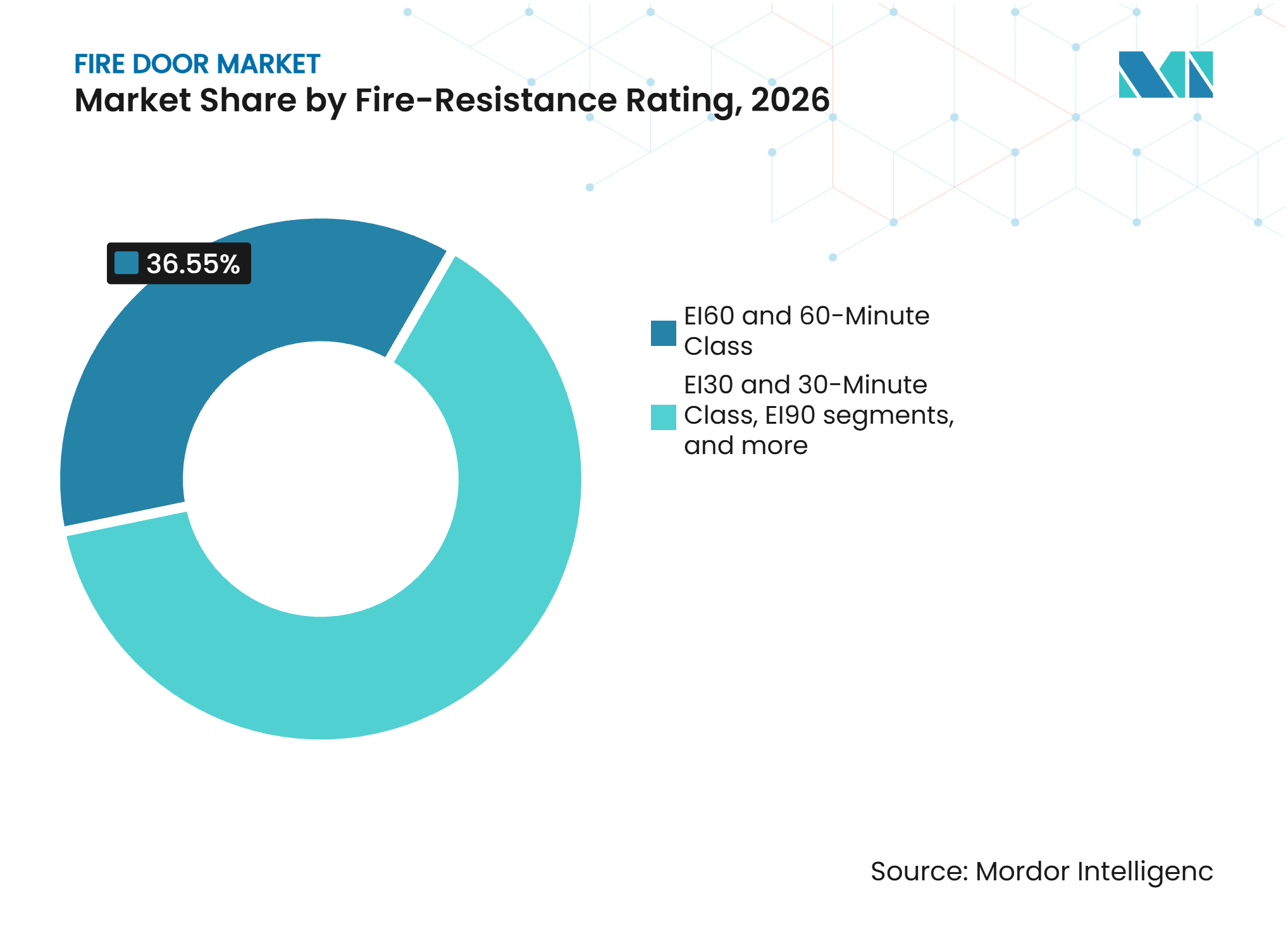
- By fire-resistance rating, EI60 and 60-minute class assemblies held 36.55% of the fire door market share in 2026, while ratings above 120 minutes are projected to grow at the fastest CAGR of 6.52% between 2027 and 2032.
- By installation and project type, new construction accounted for 63.25% of the fire door market share in 2026, while retrofit and replacement are projected to grow at the fastest CAGR of 6.13% between 2027 and 2032.
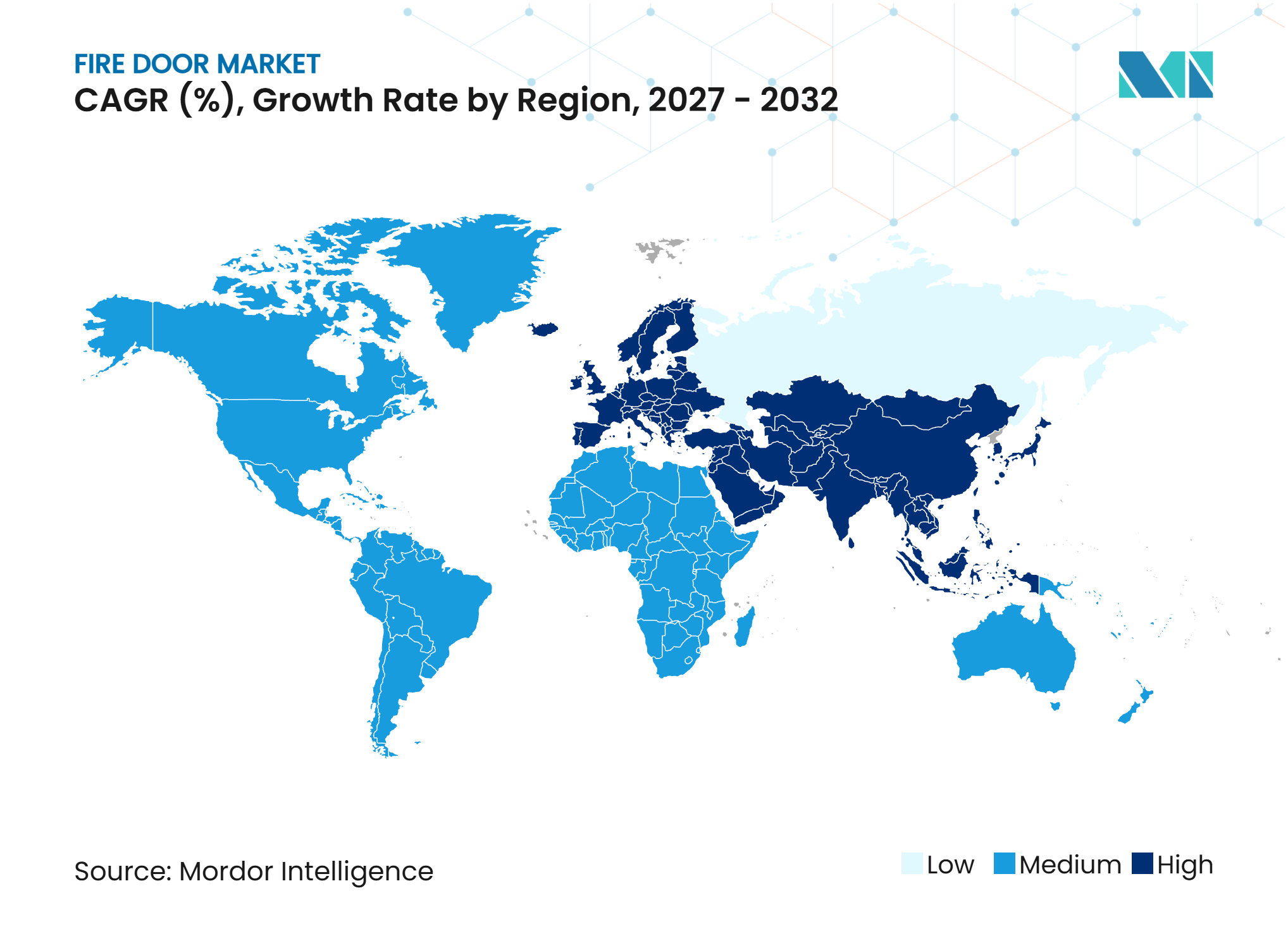
- By geography, Asia-Pacific held 34.12% of the fire door market share in 2026, while the Middle East & Africa is projected to grow at the fastest CAGR of 7.51% between 2027 and 2032.
Note: Market numbers in this report are based on Mordor Intelligence's proprietary estimation framework, which combines nine months of actuals with Q4 projections for base year 2026.
Market Trends and Insights
Drivers Impact Analysis of Fire Door Market*
| Driver | (~) % Impact on CAGR Forecast | Geographic Relevance | Impact Timeline |
|---|---|---|---|
| Stricter Fire-Safety Codes and Enforcement | +1.1% | Global, with near-term impact in the United Kingdom, EU, UAE, Saudi Arabia, and Japan | Short term (≤ 2 years) |
| Retrofit and Replacement of Aging Building Stock | +0.9% | Europe and North America, with spillover to urban Asia-Pacific | Medium term (2-4 years) |
| Critical-Infrastructure Construction | +1.0% | Global, strongest in the US, Germany, Japan, India, and GCC | Medium term (2-4 years) |
| Expansion of Healthcare, Education, and Public Infrastructure Worldwide | +0.8% | Asia-Pacific, Middle East & Africa, and South America, with sustained demand in North America and Europe | Long term (≥ 4 years) |
| Glazed and Automated Doors in Design-Led Buildings | +0.6% | North America and Europe, with growth in premium Asia-Pacific commercial projects | Medium term (2-4 years) |
| Traceable Doorset Data for Digital Building Handover | +0.4% | United Kingdom, EU, and high-specification projects globally | Long term (≥ 4 years) |
| Source: Mordor Intelligence | |||
Stricter Fire-Safety Codes and Enforcement
The fire door market benefits when regulations make tested products and documented maintenance compulsory. In September 2029, England is moving from national BS 476 classifications toward EN 13501-2 classifications, with the transition to be completed[1]. This shift encourages specification teams to choose EN-classified doorsets before the deadline. From July 2025, Japan added constantly closed fire doors to its inspection checklist, enlarging the inspection work required in commercial and institutional buildings. The 2025 edition of NFPA 80 also clarifies inspection requirements for fire door assemblies, including labels, clearances, components, and operation. These rules make regular maintenance more relevant to the fire door market, even when construction activity is uneven.
Retrofit and Replacement of Aging Building Stock
Existing buildings create recurring demand because aging doorsets must be inspected, repaired, or replaced when they no longer meet their tested configuration. The Fire Safety Act 2021 and Building Safety Act 2022 continue to support systematic fire-door activity in higher-risk residential buildings in the United Kingdom. Chelsea and Westminster Hospital completed phase 3 of its fire-door replacement work in 2025 using FD30 and FD60 doorsets with BM TRADA Q-Mark certification. England’s regulations require quarterly checks of fire doors in common areas of high-rise residential buildings above 11 meters. DBI and JELD-WEN also reported in 2025 that tested 15-year-old hospital fire doors retained BD30 performance after 200,000 open-close cycles[2]. The result supports a future role for certified refurbishment where the original assembly remains suitable.
Growth of Industrial, Data-Center and Critical-Infrastructure Construction
Data centers, industrial sites, and critical infrastructure raise demand for high-rated assemblies that protect people, equipment, and operational continuity. Hilti cited global data-center investment above USD 232.30 billion for 2024-2028 and referenced fire losses near USD 700,000 per incident[3]. Germany’s VdS 6003:2025-06 provides dedicated fire-protection guidance for IT rooms and data centers. This guidance supports more defined specifications for containment zones and related openings. Steel doors and frames are also used for large openings and high-use areas in data-center facilities. The fire door market therefore gains from projects that require EI90, EI120, or higher configurations with alarm and access-control interfaces.
Expansion of Healthcare, Education, and Public Infrastructure Worldwide
Healthcare, education, and public facilities require compartmentation in buildings where evacuation may be difficult. England’s updated Approved Document B provisions require sprinklers and self-closing fire doors in all new care homes, regardless of height. Saudi requirements under SBC 201 and SBC 801 apply fire-rated assemblies at stair cores, corridors, and service-room openings. Civil Defence approval raises the importance of third-party test evidence in public building procurement. The growth of hospitals, universities, logistics sites, and government facilities increases the number of rated openings in a project. It also favors suppliers that can provide installation details, test records, and product support across several building uses.
Restraints Impact Analysis of Fire Door Market*
| Restraint | (~) % Impact on CAGR Forecast | Geographic Relevance | Impact Timeline |
|---|---|---|---|
| Certification and Testing Cost Burden | -0.6% | Global, most acute for small and mid-sized manufacturers and retrofit specialists | Short term (≤ 2 years) |
| Residential Construction Cyclicality | -0.5% | Europe and North America, with moderate exposure in Asia-Pacific high-rise residential | Short term (≤ 2 years) |
| Field Installation Variability and Incomplete Maintenance Records | -0.4% | Global, with highest severity where annual inspections are not mandatory | Medium term (2-4 years) |
| Non-Certified Substitution in Price-Sensitive Markets | -0.7% | South and Southeast Asia, Sub-Saharan Africa, and parts of South America | Long term (≥ 4 years) |
| Source: Mordor Intelligence | |||
Certification and Testing Cost Burden
Manufacturers face higher costs when they must test several door types, materials, sizes, and hardware combinations. The shift to EN 13501-2 in England requires many suppliers to update evidence that had relied on BS 476 classifications. EN 1634-1 tests and related evidence can be costly for smaller firms with limited product ranges. The pressure is higher for suppliers that need different approvals across regions. Owners also carry continuing costs because NFPA 80 requires regular inspection of individual assembly components[4]. Certification expense may favor established suppliers, but it can reduce the number of lower-volume products available in the fire door market.
Non-Certified Substitution in Price-Sensitive Markets
Non-certified products can displace tested assemblies where buyers focus on initial price instead of documented performance. The Office for Product Safety and Standards has raised concerns about doorsets carrying conformity markings without the third-party certification required for fire-resisting or panic-exit assemblies. Dubai Civil Defence’s 2025 updates require CE-marked products tested under EN 16034 and EN 1634-1 for fire-rated doors. Stronger enforcement can reduce substitution over time. However, enforcement capacity is uneven across countries and project types. This leaves a gap between formal code requirements and what is installed in some buildings. Certified suppliers must therefore combine product availability with clear evidence of compliance.
*Our forecasts treat driver/restraint impacts as directional, not additive. The impact forecasts reflect baseline growth, mix effects, and variable interactions.
Fire Door Market Segment Analysis
By Product Type:
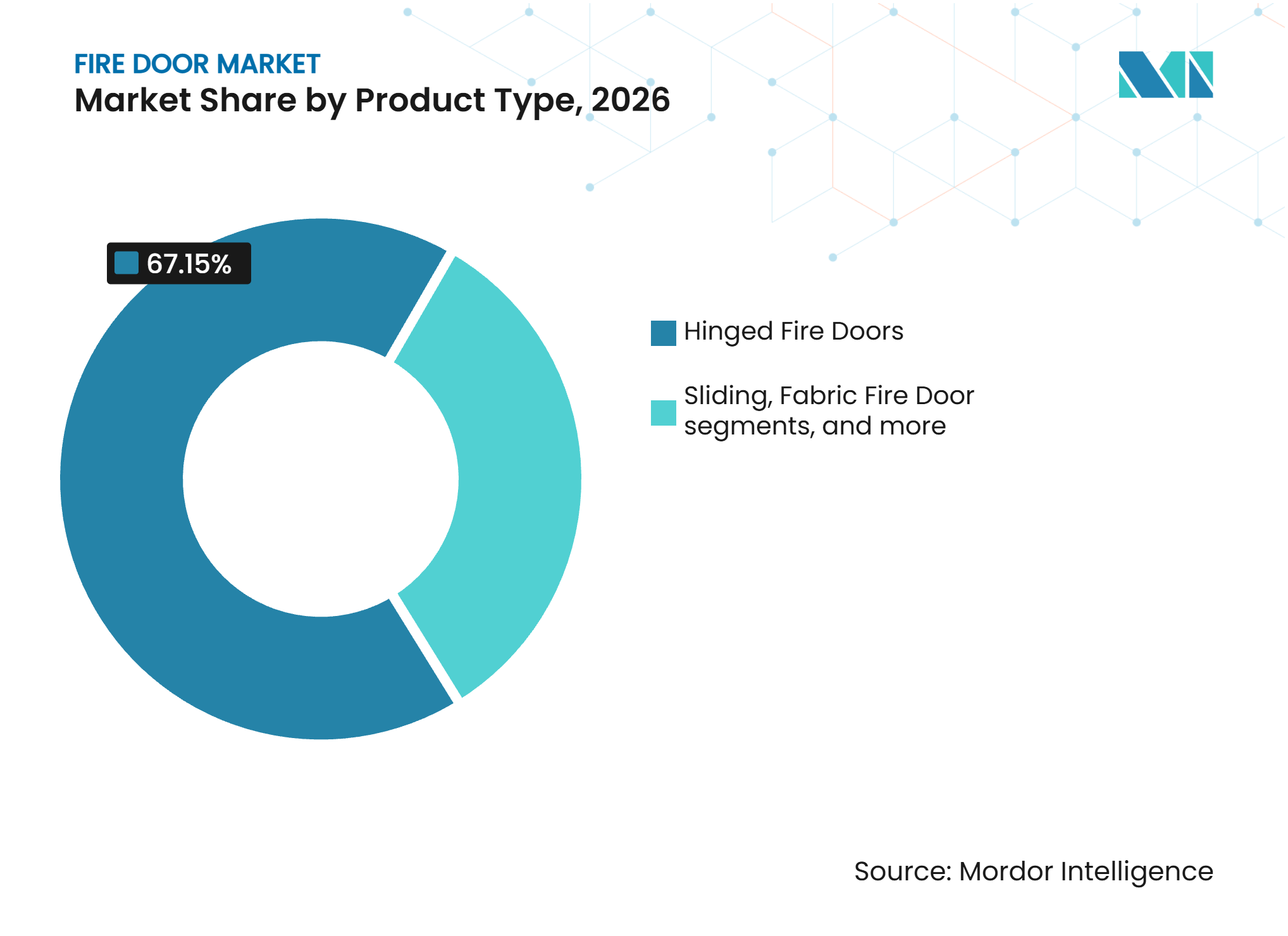
Glazed and Specialized Formats Gain GroundHinged and swinging fire doors held 67.15% of the fire door market in 2026. Their wide use reflects established egress requirements, familiar installation practices, and broad availability under national testing systems. These conditions retain their central role in the fire door market across building types. They remain common in stairwells, corridors, and compartment boundaries across commercial and industrial buildings. Sliding products meet needs where a swing arc is impractical. Double-action doors support high traffic in hospital wings, food-service areas, and logistics facilities. Rolling shutter doors are relevant for loading bays, large openings, and data-center compartments where wide apertures need rated protection.
Flush-glazed fire doors are forecast to grow at 6.12% CAGR through 2032. The segment benefits from demand for open interiors, better sightlines, and tested glass systems. Healthcare and education operators can use glazed products to retain supervision between rooms and corridors. The revised BS 8214:2026 extends its guidance to steel, aluminum, and composite doorset constructions. This gives specifiers clearer guidance for multi-material doorsets. Fire curtains provide another option where a fixed leaf would reduce usable floor area.



By Material:
Metal Leads While Composites Meet New Performance NeedsMetal fire doors captured 50.23% of the global market in 2026. Steel remains widely specified because it has established certification routes, durability, and broad availability. These features continue to support metal suppliers across the fire door market. It is particularly suited to logistics, industrial, and data-center sites where impact resistance and high ratings matter. Sanwa Shutter received Japanese ministerial certification in 2025 for its Shakunetsu Guard heat-shielding door with 60-minute heat-insulation performance. The product supports applications that need rated doors within timber-hybrid construction. Timber doors remain relevant in United Kingdom and European interiors where FD30 and FD60 products are commonly used.
Composite fire doors are forecast to grow at 6.65% CAGR through 2032. Their design can combine mineral insulation, lighter weight, dimensional flexibility, and finish options. This makes them relevant where thermal performance and visual requirements sit alongside a fire rating. The EU Construction Products Regulation 2024/3110 supports greater use of environmental product information and digital product records from 2026. Aluminum products are also gaining use in glazed assemblies and curtain-wall interfaces. Glass systems serve premium interiors that need transparent rated screens. The fire door industry increasingly competes on the ability to combine several required performance attributes in one assembly.
By Door Location:
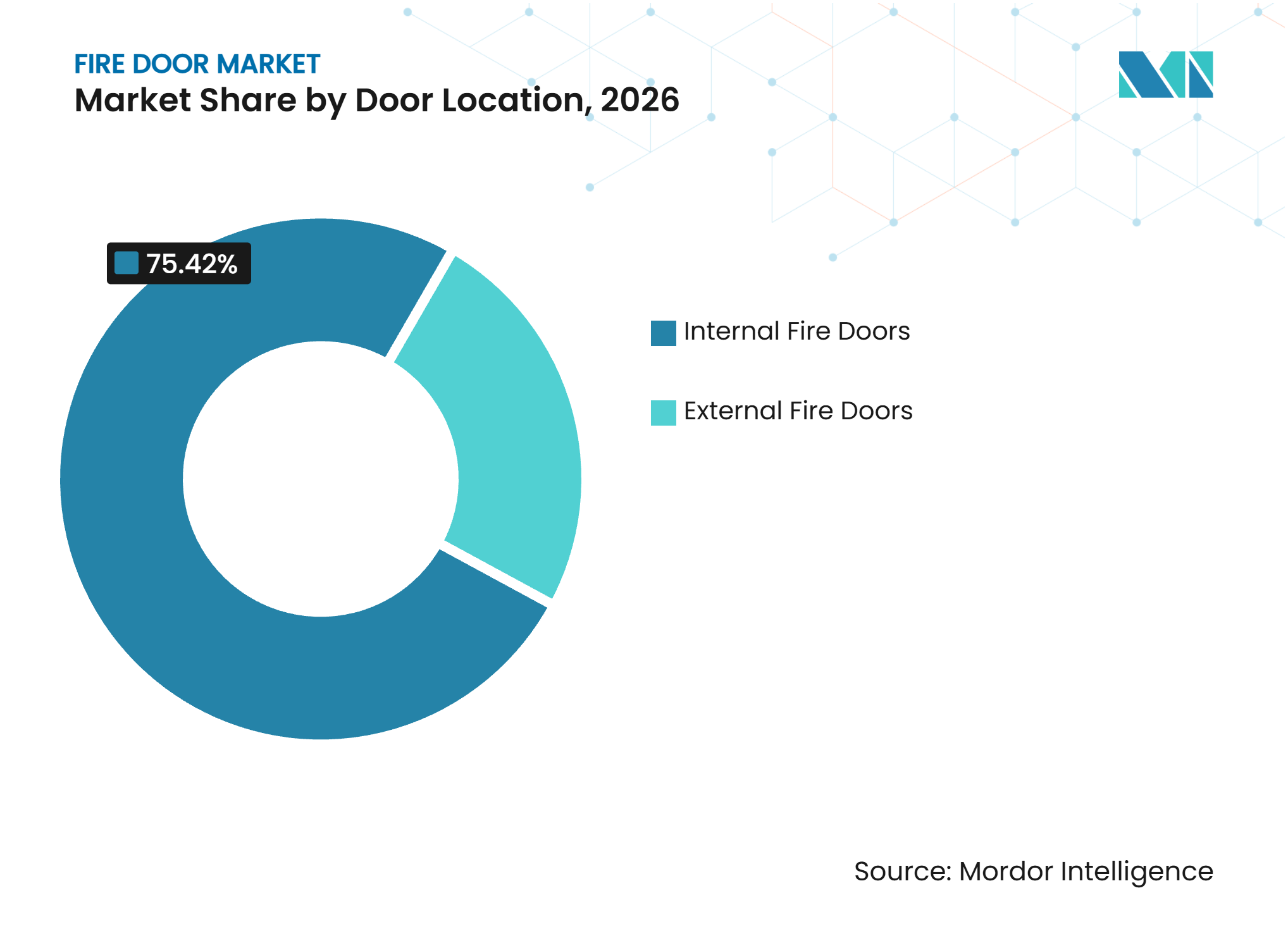
Internal Doors Form the Installed BaseInternal fire doors accounted for 75.42% of the global market in 2026. Internal corridors, stair enclosures, lobby separations, and room boundaries create the largest number of rated openings in most multi-occupancy buildings. Japan’s 2025 inspection update includes constantly closed fire doors, making inspection of internal doors more important. England’s regulations also require quarterly checks in common areas of qualifying high-rise residential buildings. These requirements create continuing work for facilities teams and specialist contractors. They also make dependable service coverage relevant to suppliers in the fire door market. They also encourage owners to maintain assembly records over the life of the building.
External fire doors are forecast to grow at 6.08% CAGR through 2032. These products often need to combine fire resistance with thermal performance, security, accessibility, and weather resistance. Hörmann introduced flood-resistant industrial steel fire doors in 2025 that protect against floodwater up to 900 mm while retaining other stated performance features. The product direction shows why external doors may carry a higher specification value. Suppliers need more extensive product testing when a single assembly must meet several building requirements. This favors firms with established internal engineering, manufacturing, and certification resources.

By Application:
Commercial Projects Combine Volume and High SpecificationsCommercial applications accounted for 68.45% of the fire door market in 2026 and are forecast to grow at a 6.30% CAGR through 2032. The segment includes offices, hospitals, schools, hotels, data centers, logistics facilities, and pharmaceutical sites. These buyers often need higher ratings and complete assembly documentation. NAFFCO signed a two-year agreement with Borouge in November 2025 for specialty fire-safety products, including fire-rated doors, valued at AED 200 million, equivalent to USD 54.50 million. TECFIRE installed EI120-rated systems at King Salman Science Oasis in Riyadh during 2025.
Residential applications accounted for the remaining 31.55% in 2026. Demand in this segment often follows statutory inspection and replacement requirements rather than discretionary improvement plans. Hackney Council reported a major replacement program for high-risk blocks after the Grenfell-related safety reforms. Residential programs generally place greater weight on installation speed and cost control. Commercial buyers more often require integrated records and premium-rated configurations. Suppliers serving both applications must use different product and service approaches. The fire door industry therefore has distinct demand patterns across these two buyer groups.
By Fire-Resistance Rating:
EI60 Sets a Broad BaselineEI60 and 60-minute class assemblies accounted for 36.55% of the global market in 2026. They are a common choice for corridors, egress routes, and compartment boundaries across commercial, healthcare, education, and residential buildings. UAE requirements identify FD60 as a minimum rating for hotel corridor doors. EI30 assemblies address lower-risk areas, including standard residential corridors and some offices. EI90 is used in escape stairs, plant rooms, and high-rise corridor boundaries. EI120 products are used where fire separation must also protect critical assets or maintain operations.
Ratings above 120 minutes are forecast to grow at 6.52% CAGR through 2032. Data centers, energy sites, chemical facilities, and secure government infrastructure require these products for battery rooms, generators, transformers, and server halls. These applications can require three-hour or four-hour configurations for selected openings. TECFIRE’s 2025 installation at King Salman Science Oasis used EI120-rated systems. Higher ratings require more demanding evidence for large openings, glazing, and access-control interfaces. This limits participation by suppliers without appropriate test and approval portfolios.
By Installation and Project Type:
Retrofit Activity Gains Relative ImportanceNew construction accounted for 63.25% of fire door market revenue in 2026. Commercial, institutional, and industrial construction remains important in Asia-Pacific and the Middle East. New hospitals, universities, logistics centers, and data centers create a first-fit installation base for tested assemblies. Saudi Arabia’s SBC 201 and SBC 801 support more formal product approval in public projects. Code updates can increase the value of each rated opening when they require documented doorsets. This supports suppliers that can meet procurement requirements without delays. It also maintains the link between code enforcement and new-project demand in the fire door market.
Retrofit and replacement are forecast to grow at 6.13% CAGR through 2032. Aging commercial and institutional stock in Europe and North America needs repairs or replacement when inspection identifies non-compliant conditions. Matrix Hardware introduced its FrameFit gap-filling system for 30- and 60-minute timber fire doors in 2025. Such systems can serve cases where the leaf remains serviceable but frame clearances need correction. Certified refurbishment could further reduce the need for full replacement in suitable buildings. Retrofit projects can be more complex than first-fit work because they require surveying, occupant coordination, and clear evidence that the installed solution remains compliant.
Geography Analysis
Asia-Pacific
Asia-Pacific held 34.12% of the fire door market in 2026. China, India, Japan, South Korea, and Southeast Asian countries support demand through commercial construction, logistics development, healthcare investment, and manufacturing expansion. China has an important domestic base for fire-resistant glass components, supporting glazed-assembly supply. Japan’s ministerial certification of Sanwa’s 60-minute heat-shielding door in 2025 supports rated applications in timber-hybrid construction. Japan’s revised inspection practices also make maintenance of constantly closed fire doors more visible to building owners. Semiconductor sites, data centers, Grade-A offices, and hospitals create demand for both premium and volume products. The region’s opportunity depends on suppliers providing tested assemblies at several price and performance levels. This range is important to the fire door market because project requirements vary widely across the region.
Middle East & Africa
Middle East & Africa is forecast to grow at 7.51% CAGR through 2032. GCC code enforcement and major infrastructure programs are increasing the need for assemblies with recognized test evidence. Dubai Civil Defence’s 2025 changes require CE-marked products that meet EN 16034 and EN 1634-1 test requirements for fire-rated doors. Saudi public projects apply SBC 201 and SBC 801 alongside Civil Defense approval procedures. TECFIRE’s 2025 work at King Salman Science Oasis and EY North Tower reflects demand for EN- and UL-compliant systems in Riyadh. NAFFCO also completed fire-protection work at Bole International Airport in Ethiopia in 2025. These projects show wider regional demand in aviation, hospitality, commercial, and public infrastructure.
North America, Europe, and South America
North America relies on NFPA 80 inspection requirements and replacement demand from the installed base in commercial and healthcare buildings. The 2025 NFPA 80 guidance clarifies clearances and accessory configurations, which can increase remediation work after inspection. Europe has stronger retrofit drivers in the United Kingdom and specialized data-center requirements in Germany through VdS 6003:2025-06. Hörmann reported revenue of USD 605.2 million (EUR 514.5 million) for the first 9 months of 2025, compared with USD 700.4 million (EUR 595.50 million) in the comparable 2024 period, reflecting softer construction conditions in Germany and Central Europe. South American demand is centered on organized commercial and industrial construction where certification is written into contracts. Brazil and Chile have more established activity, while Argentina and Peru have developing enforcement systems. These mixed conditions create a need for regionally tailored product approval and service models. The fire door market remains dependent on locally accepted test evidence and installation support.
Competitive Landscape
Market Concentration
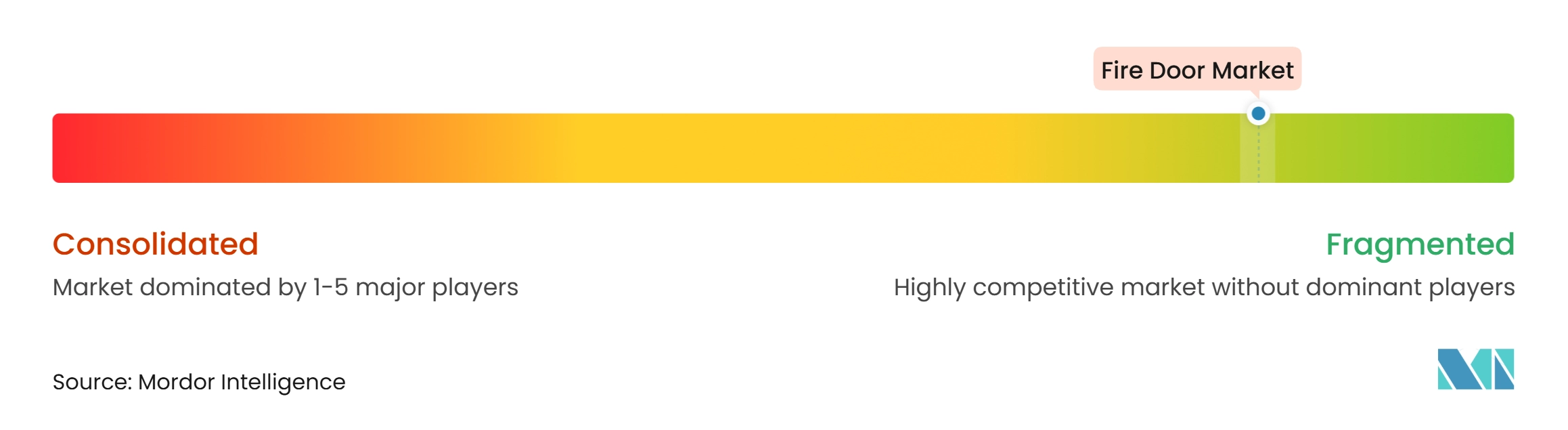
The fire door market is fragmented, with the top 4 producers holding very little market share. Certification depth and lifecycle service capabilities increasingly determine access to regulated projects. ASSA ABLOY has expanded its European and United States manufacturing position through acquisitions. In 2025, it acquired Danish fire-rated-door specialist Door System, strengthening its coverage of pharmaceutical, food, and retail customers. During December 2025, ASSA ABLOY also acquired International Door Products in Michigan, adding fire-rated steel frame production capability. Its Openings Studio platform supports assembly data through construction, maintenance, and future inspections.
Allegion pursued acquisitions across hardware, access, and digital technology during 2025. The company acquired UAP Group in the United Kingdom, adding fire and security hardware with nearly 200 patents, trademarks, and registered designs. It also acquired Elatec in Germany for USD 390.00 million, adding electronic access-reader technology. In October 2025, Allegion and Brivo introduced a connected openings solution that links Schlage XE360 Wi-Fi locks with Brivo’s security platform. The strategy gives Allegion a stronger role in connected hardware and compliance records. This part of the fire door market can produce recurring revenue after the initial installation.
Regional companies remain important because they understand local approvals, building practices, and delivery requirements. Hörmann added Holler Tore in 2025, expanding its Central European door-and-gate portfolio. Sanwa, NAFFCO, TECFIRE, Buyang Group, and Taotao Group compete where domestic manufacturing or regional customization matters. JELD-WEN’s digital pins and its work with DBI on fire-door reuse show how data and circularity can create differentiated offerings. EN 16034, BM TRADA Q-Mark, and UL listing protect established suppliers while also raising the burden on smaller competitors.
Fire Door Industry Leaders
-
ASSA ABLOY AB
-
Hörmann KG Verkaufsgesellschaft
-
Allegion plc
-
Sanwa Holdings Corporation
-
NAFFCO FZCO
- *Disclaimer: Major Players sorted in no particular order
Fire Door Market Companies Covered in this Report
- ASSA ABLOY AB
- Hörmann KG Verkaufsgesellschaft
- Allegion plc
- Sanwa Holdings Corporation
- NAFFCO FZCO
- Chase Industries, Inc.
- Mesker Openings Group LLC
- JELD-WEN, Inc.
- Novoferm GmbH
- Ninz S.p.A.
- Dierre S.p.A.
- Teckentrup GmbH & Co. KG
- Firedoorworks
- Manusa
- Lindner Group
- Malerba
- Daloc AB
- Republic Doors and Frames
- Buyang Group Co., Ltd.
- Taotao Group Co., Ltd.
Recent Industry Developments in Fire Door Market
- September 2026: ASSA ABLOY Door Group raised awareness of
- Week 2026: highlighting complete doorset performance and smoke-control compatibility.
- December 2025: ASSA ABLOY acquired International Door Products, a Michigan-based manufacturer of standard and custom fire-rated steel door frames for multi-family, hospitality, commercial, and healthcare applications.
- November 2025: NAFFCO signed a 2-year strategic partnership with Borouge for specialty fire safety products, including fire-rated doors, valued at USD 54.5 million (AED 200.0 million), covering major infrastructure projects worldwide.
- November 2025: TECFIRE MEA completed the installation of STEELFIRE S50/70 fire-rated steel doors and partitions at EY North Tower in Riyadh, meeting EN and UL testing standards.
Global Fire Door Market Report Scope
Segmentation Overview
| Hinged/Swinging Fire Doors |
| Sliding Fire Doors |
| Double-Action Fire Door |
| Fabric Fire Door/Curtain |
| Flush-Glazed Fire Door |
| Rolling Shutter Fire Door |
| Folding / Other Mechanisms |
| Metal |
| Timber |
| Glass |
| Aluminum |
| Composite |
| Others |
| Internal Fire Doors |
| External Fire Doors |
| Commercial |
| Residential |
| EI30 and 30-Minute Class |
| EI60 and 60-Minute Class |
| EI90 and 90-Minute Class |
| EI120 and 120-Minute Class |
| Ratings Above 120 Minutes |
| New Construction |
| Retrofit and Replacement |
| North America | Canada |
| United States | |
| Mexico | |
| South America | Brazil |
| Peru | |
| Chile | |
| Argentina | |
| Rest of South America | |
| Europe | United Kingdom |
| Germany | |
| France | |
| Spain | |
| Italy | |
| BENELUX (Belgium, Netherlands, Luxembourg) | |
| NORDICS (Denmark, Finland, Iceland, Norway, Sweden) | |
| Rest of Europe | |
| Asia-Pacific | India |
| China | |
| Japan | |
| Australia | |
| South Korea | |
| South-East Asia | |
| Rest of Asia-Pacific | |
| Middle East & Africa | United Arab Emirates |
| Saudi Arabia | |
| South Africa | |
| Nigeria | |
| Rest of Middle East & Africa |
| By Product Type | Hinged/Swinging Fire Doors | |
| Sliding Fire Doors | ||
| Double-Action Fire Door | ||
| Fabric Fire Door/Curtain | ||
| Flush-Glazed Fire Door | ||
| Rolling Shutter Fire Door | ||
| Folding / Other Mechanisms | ||
| By Material | Metal | |
| Timber | ||
| Glass | ||
| Aluminum | ||
| Composite | ||
| Others | ||
| By Door Location | Internal Fire Doors | |
| External Fire Doors | ||
| By Application | Commercial | |
| Residential | ||
| By Fire-Resistance Rating | EI30 and 30-Minute Class | |
| EI60 and 60-Minute Class | ||
| EI90 and 90-Minute Class | ||
| EI120 and 120-Minute Class | ||
| Ratings Above 120 Minutes | ||
| By Installation and Project Type | New Construction | |
| Retrofit and Replacement | ||
| By Geography | North America | Canada |
| United States | ||
| Mexico | ||
| South America | Brazil | |
| Peru | ||
| Chile | ||
| Argentina | ||
| Rest of South America | ||
| Europe | United Kingdom | |
| Germany | ||
| France | ||
| Spain | ||
| Italy | ||
| BENELUX (Belgium, Netherlands, Luxembourg) | ||
| NORDICS (Denmark, Finland, Iceland, Norway, Sweden) | ||
| Rest of Europe | ||
| Asia-Pacific | India | |
| China | ||
| Japan | ||
| Australia | ||
| South Korea | ||
| South-East Asia | ||
| Rest of Asia-Pacific | ||
| Middle East & Africa | United Arab Emirates | |
| Saudi Arabia | ||
| South Africa | ||
| Nigeria | ||
| Rest of Middle East & Africa | ||
Key Questions Answered in the Report
What is the projected value of the fire door market by 2032?
The fire door market is forecast to reach USD 17.90 billion by 2032, growing at a 4.72% CAGR from 2027.
Which fire door mechanism has the largest share?
Hinged and swinging fire doors held 67.15% of global revenue in 2026 because they remain widely used in egress routes and compartment boundaries.
Which material is growing fastest for fire doors?
Composite fire doors are projected to grow at 6.65% CAGR through 2032 because they combine insulation, weight advantages, and design flexibility.
Why are retrofit fire doors becoming more important?
Retrofit and replacement are forecast to expand at 6.13% CAGR through 2032 as building owners address aging doorsets and inspection findings.
Which region will grow fastest through 2032?
Middle East & Africa is projected to record a 7.51% CAGR through 2032, supported by GCC code enforcement and infrastructure construction.
What is driving demand for high-rated fire doors?
Data centers, energy facilities, and secure infrastructure require ratings above 120 minutes, which are projected to grow at a 6.52% CAGR through 2032.