
Fatty Acids Market Size and Share
Market Overview
| Study Period | 2021 - 2031 |
|---|---|
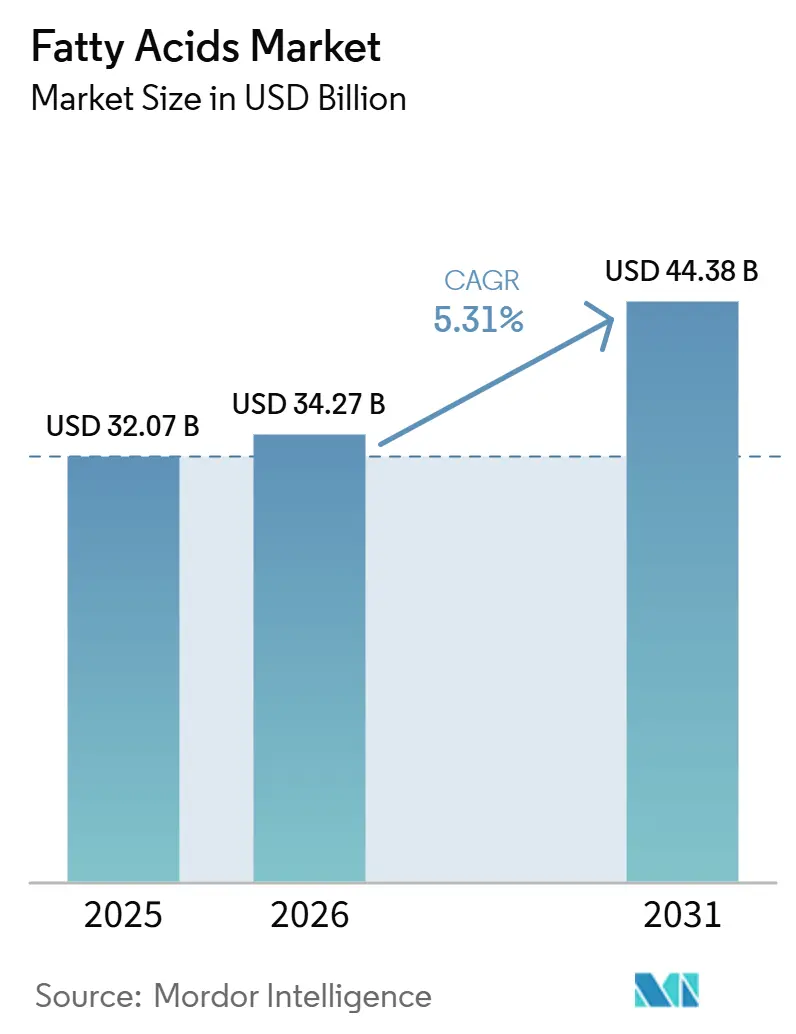
| Market Size (2026) | USD 34.27 Billion |
| Market Size (2031) | USD 44.38 Billion |
| Growth Rate (2026 - 2031) | 5.31 % |
| Fastest Growing Market | Asia-Pacific |
| Largest Market | Asia-Pacific |
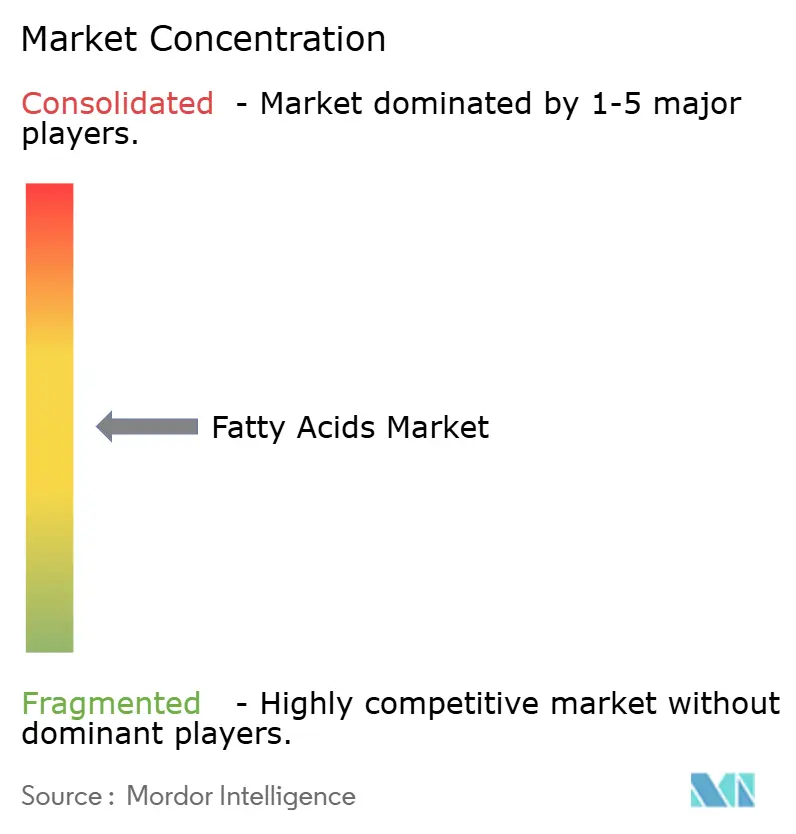
| Market Concentration | Medium |
Major Players *Disclaimer: Major Players sorted in no particular order Image © Mordor Intelligence. Reuse requires attribution under CC BY 4.0. | |
Fatty Acids Market Analysis by Mordor Intelligence
The Fatty Acids Market was valued at USD 32.07 billion in 2025 and is estimated to grow from USD 34.27 billion in 2026 to reach USD 44.38 billion by 2031, at a CAGR of 5.31% during the forecast period (2026–2031). Demand comes from several end markets, which reduces reliance on any single customer group. Sustainability requirements are changing procurement practices, especially for palm-derived inputs sold into Europe. Health products are increasing demand for purified omega fatty acids, while cleaning products continue to provide high-revenue demand. Producers are responding by expanding integrated supply chains, improving traceability, and developing higher-value grades. The fatty acids market, therefore, offers opportunities in certified supply, specialty processing, and fermentation-based ingredients.
Key Report Takeaways
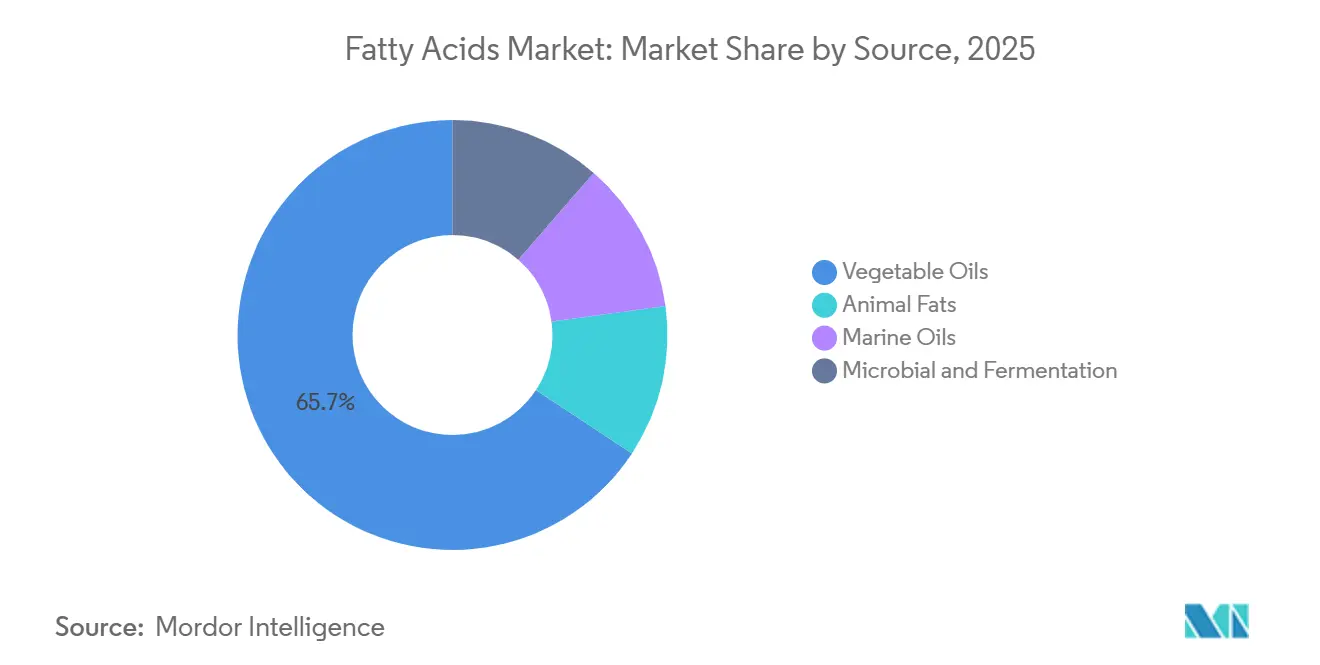
- By source, vegetable oils held 65.72% of the fatty acids market share in 2025, while microbial and fermentation sources are forecast to grow at an 8.06% CAGR through 2031.
- By product type, saturated fatty acids held 52.16% of the fatty acids market share in 2025, while specialty fatty acids are forecast to expand at a 6.93% CAGR through 2031.
- By application, soaps and detergents accounted for 24.84% of the fatty acids market size in 2025, while dietary supplements and nutraceuticals are forecast to grow at a 7.66% CAGR through 2031.
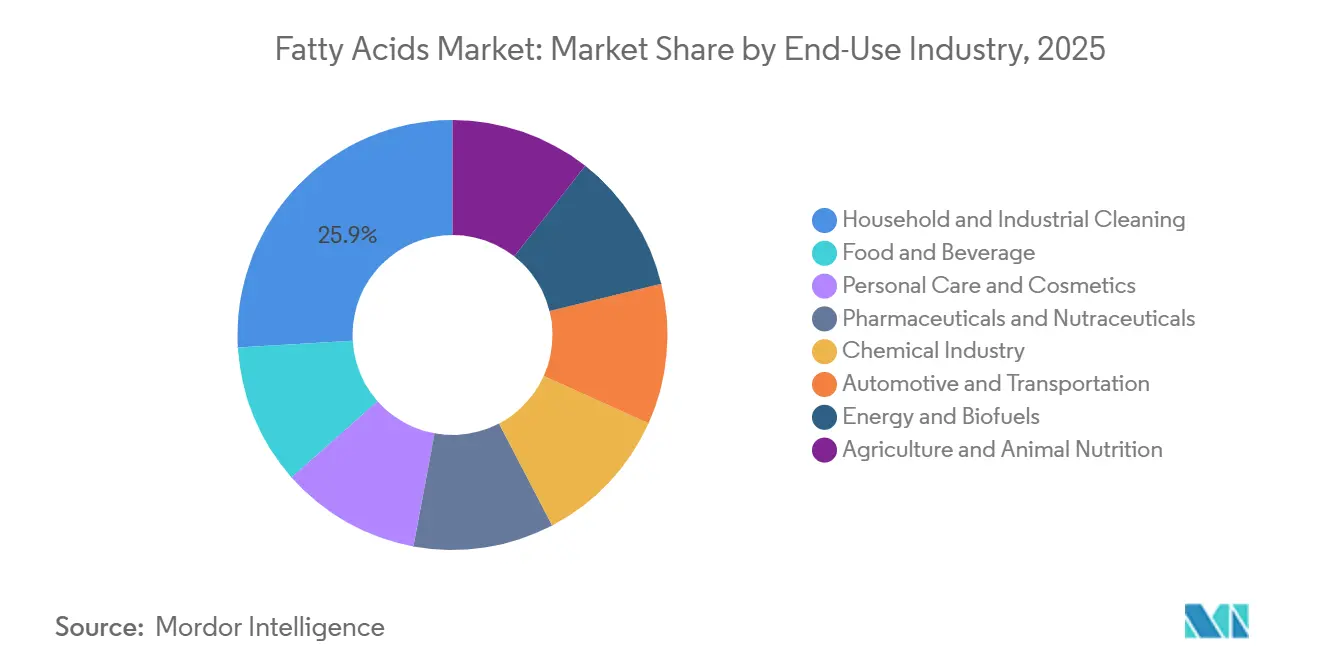
- By end-use industry, household and industrial cleaning held 25.93% of the fatty acids market share in 2025, while pharmaceuticals and nutraceuticals are forecast to advance at a 6.45% CAGR through 2031.
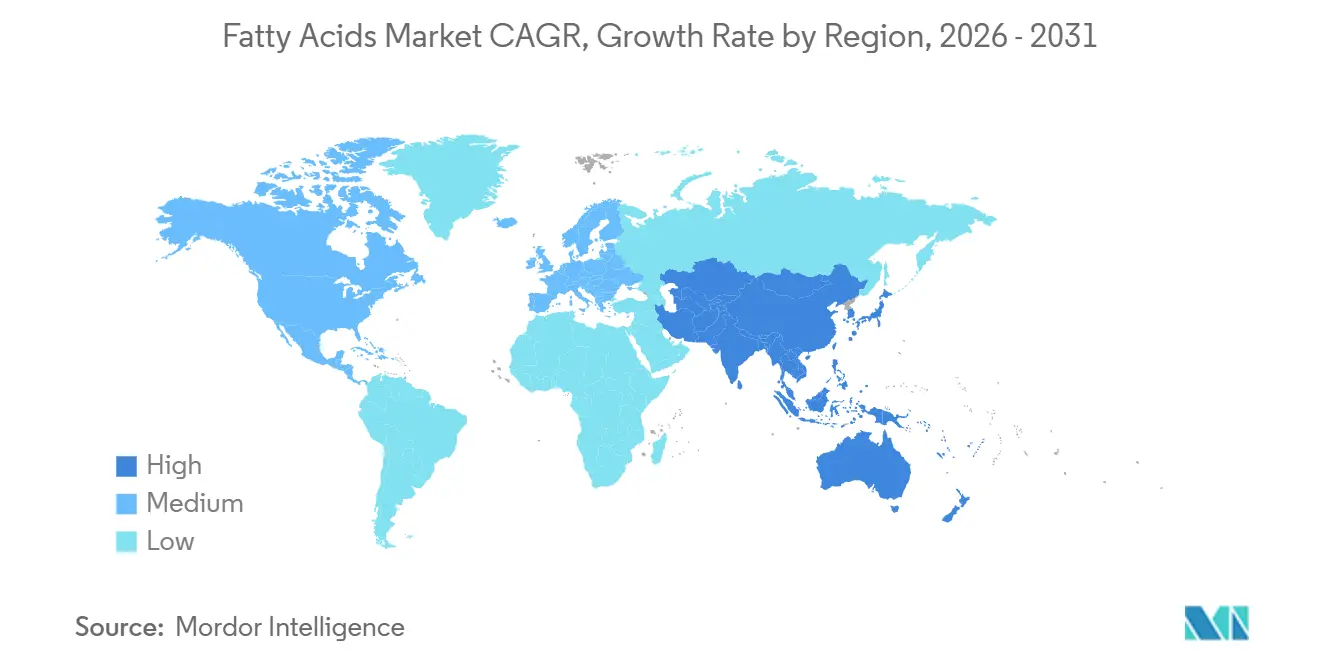
- By geography, Asia-Pacific held 45.67% of the fatty acids market share in 2025 and is forecast to grow at a 6.27% CAGR through 2031.
Note: Market size and forecast figures in this report are generated using Mordor Intelligence’s proprietary estimation framework, updated with the latest available data and insights as of January 2026.
Market Trends and Insights
Drivers Impact Analysis of Fatty Acids Market*
| Driver | (~) % Impact on CAGR Forecast | Geographic Relevance | Impact Timeline |
|---|---|---|---|
| Growing Consumer Demand for Omega Fatty Acids and Health-Oriented Nutritional Products | +1.2% | Global; highest pull in North America, Europe, and Northeast Asia | Medium term (2-4 years) |
| Expanding Use of Fatty Acids in Soaps, Detergents, and Industrial Cleaning Applications | +1.5% | Global; APAC core, spill-over to MEA | Short term (≤ 2 years) |
| Rising Adoption of Bio-Based Lubricants, Surfactants, and Renewable Chemical Products | +0.8% | Europe & North America; APAC gaining pace | Medium term (2-4 years) |
| Increasing Preference for Natural, Plant-Based, and Sustainably Sourced Fatty Acids | +0.7% | Europe & North America; early gains in Japan and South Korea | Long term (≥ 4 years) |
| Advancements in Enzymatic, Fermentation, and Algae-Based Fatty Acid Production Technologies | +0.6% | APAC core (China, Japan); spill-over to North America and Europe | Long term (≥ 4 years) |
| Source: Mordor Intelligence | |||
Growing Consumer Demand for Omega Fatty Acids and Health-Oriented Nutritional Products
Omega-3 ingredient volume reached 136,000 metric tons globally in 2025, increasing 2.60% from 2024. Total value declined 4.30% to USD 2.53 billion after post-El Niño price normalization. The Global Organization for eicosapentaenoic acid (EPA) and docosahexaenoic acid (DHA) Omega-3s (GOED) expects ingredient volumes to grow 3% to 4% annually through 2028. Dietary supplements and pharmaceutical-grade EPA products support this demand across established consumer health channels. Tighter purity specifications make molecular distillation and fractionation more important for suppliers. In the fatty acids market, premium grades can therefore carry more strategic importance than commodity volume and support closer supplier relationships.
Expanding Use of Fatty Acids in Soaps, Detergents, and Industrial Cleaning Applications
Soaps and detergents remain a large outlet because palmitic and lauric acids are central to saponification and surfactant production. European detergent makers are reformulating products for colder washing and lower energy use. These products use inputs such as methyl ester sulfonates and alkyl polyglucosides. Suppliers in Indonesia and Malaysia are adapting purity and certification practices for customers serving European markets. Natural ingredient targets also support fatty alcohol-based alkyl polyglucosides in premium personal care formulations. This broad cleaning demand gives the fatty acids market a stable base even as specialty uses expand across health and personal care applications.
Rising Adoption of Bio-Based Lubricants, Surfactants, and Renewable Chemical Products
Environmental compliance is moving bio-based lubricants into procurement specifications for sensitive operating areas. Marine, forestry, and agricultural equipment are relevant users where biodegradability requirements apply. Bio-surfactants from agricultural oil feedstocks are also replacing petroleum-derived ingredients in detergents and personal care. Renewable ingredient targets among consumer goods companies support demand for oleochemical intermediates. Fatty acid ester formulations are qualifying for wind turbine gearboxes and electric vehicle transmission fluids. These uses create a more durable demand base for the fatty acids market than consumer preference alone and broaden the customer base.
Advancements in Enzymatic, Fermentation, and Algae-Based Fatty Acid Production Technologies
Demand for plant-based and traceable inputs is growing in Europe, North America, Japan, and South Korea. Fermentation and algae-based systems can produce customized lipid profiles without conventional agricultural feedstocks. Fermentalg launched OMEGA ORIGINS in 2025 with 40% EPA and 20% DHA without concentration processing. Research published in 2026 reported that combinatorial additive engineering improved microalgal fatty acid yields. ÄIO also demonstrated batch consistency for its yeast-fermented ZymaLipid Complex in cosmetics. These technologies support premium fatty acids market applications where land-use exposure and conventional feedstock price cycles are less acceptable.
Restraints Impact Analysis of Fatty Acids Market*
| Restraint | (~) % Impact on CAGR Forecast | Geographic Relevance | Impact Timeline |
|---|---|---|---|
| Volatility in Vegetable Oil, Animal Fat, and Marine Feedstock Prices | -0.8% | Global; most acute in Southeast Asia and South America | Short term (≤ 2 years) |
| Sustainability Concerns Related to Palm Oil Production and Marine Resource Utilization | -0.5% | Europe (EUDR-driven), North America | Medium term (2-4 years) |
| Complex Regulatory Requirements Across Food, Pharmaceutical, and Industrial Applications | -0.4% | Europe, North America | Long term (≥ 4 years) |
| Source: Mordor Intelligence | |||
Volatility in Vegetable Oil, Animal Fat, and Marine Feedstock Prices
Vegetable oil prices remain sensitive to weather, biofuel policy, and changes in global inventory levels. The FAO Vegetable Oil Price Index fell 4.60% in May 2026 from the previous month[1]Food and Agriculture Organization of the United Nations, “Food Outlook: Biannual Report on Global Food Markets,” Food and Agriculture Organization of the United Nations, fao.org. El Niño–Southern Oscillation (ENSO) cycles can disrupt Southeast Asian palm supply on recurring patterns. Animal fat availability also faces pressure as biofuel mandates divert suitable grades toward hydrotreated vegetable oil pathways. Peruvian anchovy quota variability creates a parallel risk for marine fatty acid inputs. These factors can raise working capital needs and complicate contract pricing across the fatty acids market for processors, distributors, and buyers.
Sustainability Concerns Related to Palm Oil Production and Marine Resource Utilization
The EU Deforestation Regulation places covered palm-linked products under due diligence and traceability requirements[2]European Union, “Regulation EU 2023/1115 on the Making Available on the Union Market of Certain Commodities and Products Associated With Deforestation,” EUR-Lex, eur-lex.europa.eu. The regulation affects supply-chain decisions for industrial palm-derived fatty acids entering Europe. Roundtable on Sustainable Palm Oil (RSPO) Certification Systems became effective in May 2026 and introduced stronger requirements related to legality, No Deforestation, No Peat, No Exploitation (NDPE) commitments, and smallholder compliance. Certification can support due diligence, but it does not replace statutory requirements. Food, pharmaceutical, and industrial uses also have separate quality and compliance obligations. These rules may favor fatty acids market suppliers with documented traceability, technical documentation, and established regulatory systems.
*Our forecasts treat driver/restraint impacts as directional, not additive. The impact forecasts reflect baseline growth, mix effects, and variable interactions.
Fatty Acids Market Segment Analysis
By Source:
Vegetable Oils Lead Revenue While Microbial and Fermentation Supports Specialty SupplyVegetable oils held 65.72% of the fatty acids market share in 2025. Palm and soybean oils provide the scale required for high-volume fatty acid production across global cleaning and industrial supply chains. Integrated producers benefit from direct access to oil processing and downstream oleochemical operations. This structure supports supply to soaps, detergents, industrial applications, and a wide range of formulation customers. Animal fats held the second source position and remain important for tallow-based stearic acid production.
Microbial and fermentation sources are forecast to grow at an 8.06% CAGR through 2031. These producers target specialty lipid applications that need customized compositions, assured purity, and defined performance. A 2025 study showed engineered Prototheca moriformis producing a high-oleic palm oil alternative at a lipid titer of 48.00 g/L in a 1-liter bioreactor. Fermentation can reduce exposure to land constraints and palm-price changes in premium grades. The fatty acids industry is therefore likely to retain conventional feedstocks for quantity while using fermentation for differentiated products in the fatty acids market.



By Product Type:
Saturated Fatty Acids Support Core Demand While Specialty Fatty Acids Grow FasterSaturated fatty acids accounted for 52.16% of the fatty acids market size in 2025. Palmitic and stearic acids are used in soaps, plastic additives, rubber processing, and other established applications. Their roles are difficult to replace in many high-volume formulations, supporting steady demand across industrial value chains. Unsaturated fatty acids include oleic, linoleic, and linolenic acids. These materials support personal care, food emulsification, and industrial lubricants.
Specialty fatty acids are forecast to grow at a 6.93% CAGR through 2031. Demand includes high-purity medium-chain grades for lipid nanoparticle delivery and pharmaceutical excipients. It also includes precision cosmetic ingredients with defined performance characteristics. IOI Oleo GmbH developed the LipoGalen polyglycerol ester family for lipid nanoparticle drug delivery applications. These offerings show how the fatty acids market is shifting selected grades from commodity inputs toward functional ingredients for regulated customers.
By Application:
Soaps and Detergents Lead Demand While Dietary Supplements and Nutraceuticals Grow FastestSoaps and detergents held 24.84% of the revenue share in 2025, making them the largest application. The segment relies on fatty acids that support soap bars, liquid detergents, and related cleaning products. High-volume household consumption creates consistent demand for these materials and gives suppliers dependable sales volumes. Industrial cleaning also requires ingredients with predictable performance and cost. Personal care and food applications provide additional demand for emulsifiers, texture agents, and formulation ingredients.
Dietary supplements and nutraceuticals are forecast to grow at a 7.66% CAGR through 2031. Preventive health demand supports omega-3 ingredients used for cardiovascular, cognitive, and joint health products. Pharmaceutical-grade EPA prescriptions add demand for more tightly specified materials. GOED expects global omega-3 ingredient volumes to keep growing through 2028. The fatty acids market benefits where suppliers can meet the quality needs of health-focused customers and provide reliable technical documentation for increasingly specialized buyers.
By End-Use Industry:
Household and Industrial Cleaning Holds the Largest Position While Pharmaceuticals and Nutraceuticals AdvanceHousehold and industrial cleaning held 25.93% of the fatty acids market in 2025. The segment uses palmitic and lauric acid derivatives across bar soap, detergent, and industrial cleaning formulations. Large production centers in Indonesia and Malaysia support these applications with integrated oleochemical supply. Chemical and personal care customers also use oleochemical alternatives in reformulated products. Agriculture, animal nutrition, energy, and biofuels consume lower-grade fatty acid fractions.
Pharmaceuticals and nutraceuticals are forecast to grow at a 6.45% CAGR through 2031. Prescription omega-3 therapies, lipid nanoparticle excipients, and DHA in infant nutrition support this growth. These applications require strong quality control and consistent composition. BASF inaugurated a specialty emollients plant in Düsseldorf in July 2026 to serve skin care and sun protection applications. These end uses broaden the fatty acids industry beyond traditional commodity outlets.
Geography Analysis
APAC Fatty Acids Market
Asia-Pacific held 45.67% of the fatty acids market share in 2025 and is forecast to grow at a 6.27% CAGR through 2031. Indonesia and Malaysia together supply the majority of global palm-derived fatty acids through integrated oleochemical complexes. Feedstock proximity gives regional producers a strong cost and supply advantage. The region is also a large and expanding consumption base for cleaning, personal care, food, and health products. Its dual role as supplier and customer supports continued investment in downstream capacity.
North America Fatty Acids Market
North America is a technically demanding region for the fatty acids market. Specialty and pharmaceutical-grade products, bio-based lubricants, and omega-3 supplements shape regional demand. Cargill expanded its Port Klang facility in March 2026 with a specialty fats line that serves global food ingredient customers. The investment added cocoa butter equivalents, low-trans fatty acid replacers, and performance fats. Supply from integrated Asian operations can support specialized North American requirements in the fatty acids market.
Europe, Africa, South America and APAC Fatty Acids Market
Europe has the most demanding regulatory conditions among the major regions. EU Deforestation Regulation (EUDR) requirements are moving palm-derived supply chains toward traceable and deforestation-free sourcing. Croda opened a manufacturing facility in Dahej, India, in March 2026 using RSPO-certified oleochemicals, renewable energy, and zero liquid discharge systems. South America benefits from soybean processing capacity, which supports feedstock availability. Wilmar expanded a soybean crushing joint venture in Vietnam and commissioned refining capacity in South Africa.

Competitive Landscape
The fatty acids market is moderately concentrated, with the top five players including Wilmar International Ltd, BASF, Cargill, Incorporated, ADM, and Oleon NV. Competition differs between commodity production and specialty ingredients. Commodity suppliers compete through feedstock integration, plant scale, and operational efficiency. Specialty suppliers compete through purity, traceability certification, and application support.
Integrated Southeast Asian producers are moving further into specialty products and downstream processing. European producers are also investing in Asian manufacturing to serve sustainability-focused customers. AAK made an equity investment in Savor in July 2026 and agreed to develop specialty fat-based ingredients using Savor's Carbon Crafted platform. Insempra's agreement with Brenntag widened the commercial route for a fermentation-derived omega-7 ingredient.
Pharmaceutical-grade medium-chain fatty acids remain an area where quality requirements limit available supply. Fermentation-derived omega-7 and odd-chain lipids also address specialty applications with differentiated needs. EUDR-compliant supply chains create a further opportunity for suppliers serving European buyers. Cargill's Port Klang expansion added specialty fats processing technology to its global network. The fatty acids market remains competitive, but specialized grades provide more scope for differentiation than high-volume commodity acids across the fatty acids market value chain.
Fatty Acids Industry Leaders
Wilmar International Ltd
BASF
Cargill, Incorporated
ADM
Oleon NV
- *Disclaimer: Major Players sorted in no particular order
Fatty Acids Market Companies Covered in this Report
- AAK AB
- ADM
- Ashland
- BASF
- Cargill, Incorporated
- Croda International Plc
- Eastman Chemical Company
- Ecogreen Oleochemicals
- Godrej Chemicals
- IOI Corporation Berhad
- KLK OLEO
- Mitsubishi Chemical Corporation
- Oleon NV
- Permata Group
- Stepan Company
- Wilmar International Ltd

Recent Industry Developments in Fatty Acids Market
- June 2026: Savor and AAK signed a strategic collaboration agreement for the development and commercialization of dairy alternatives and bakery applications, which included an equity investment by AAK in Savor. The collaboration combined Savor's Carbon Crafted platform with AAK's expertise in vegetable fats and oils to develop specialty fat solutions.
- March 2026: Cargill expanded its edible oil plant in Port Klang, Malaysia, with a new specialty fats production line, strengthening its fatty acid processing capabilities across its global network. The expansion introduced cocoa butter equivalents, low-trans fatty acid replacers, and performance baking and filling fats, making the Port Klang facility the first in Cargill's global network to deploy specialty fats processing technology.


Global Fatty Acids Market Report Scope
Fatty acids are naturally occurring carboxylic acids derived from vegetable oils, animal fats, marine oils, and other renewable sources. They are essential raw materials used in the production of soaps, detergents, food ingredients, personal care products, pharmaceuticals, lubricants, and industrial chemicals due to their functional and chemical properties.
The Fatty Acids Market is segmented by source, product type, application, end-use industry, and geography. By source, the market is segmented into vegetable oils, animal fats, marine oils, and microbial and fermentation oils. By product type, the market is segmented into saturated fatty acids, unsaturated fatty acids, and specialty fatty acids. By application, the market is segmented into soaps and detergents, food and beverages, dietary supplements and nutraceuticals, personal care and cosmetics, pharmaceuticals, industrial chemicals, lubricants, plastics and rubber, biofuels, animal feed, and other applications. By end-use industry, the market is segmented into household and industrial cleaning, food and beverage, personal care and cosmetics, pharmaceuticals and nutraceuticals, chemical industry, automotive and transportation, energy and biofuels, and agriculture and animal nutrition. The report also covers the market size and forecasts for fatty acids in 16 countries across major regions. For each segment, the market sizing and forecasts have been done on the basis of value (USD).
| Vegetable Oils |
| Animal Fats |
| Marine Oils |
| Microbial and Fermentation |
| Saturated Fatty Acids |
| Unsaturated Fatty Acids |
| Specialty Fatty Acids |
| Soaps and Detergents |
| Food and Beverages |
| Dietary Supplements and Nutraceuticals |
| Personal Care and Cosmetics |
| Pharmaceuticals |
| Industrial Chemicals |
| Lubricants |
| Plastics and Rubber |
| Biofuels |
| Animal Feed |
| Other Applications |
| Household and Industrial Cleaning |
| Food and Beverage |
| Personal Care and Cosmetics |
| Pharmaceuticals and Nutraceuticals |
| Chemical Industry |
| Automotive and Transportation |
| Energy and Biofuels |
| Agriculture and Animal Nutrition |
| Asia-Pacific | China |
| India | |
| Japan | |
| South Korea | |
| Rest of Asia-Pacific | |
| North America | United States |
| Canada | |
| Mexico | |
| Europe | Germany |
| United Kingdom | |
| France | |
| Italy | |
| Russia | |
| Rest of Europe | |
| South America | Brazil |
| Argentina | |
| Rest of South America | |
| Middle-East and Africa | Saudi Arabia |
| South Africa | |
| Rest of Middle-East and Africa |
| By Source | Vegetable Oils | |
| Animal Fats | ||
| Marine Oils | ||
| Microbial and Fermentation | ||
| By Product Type | Saturated Fatty Acids | |
| Unsaturated Fatty Acids | ||
| Specialty Fatty Acids | ||
| By Application | Soaps and Detergents | |
| Food and Beverages | ||
| Dietary Supplements and Nutraceuticals | ||
| Personal Care and Cosmetics | ||
| Pharmaceuticals | ||
| Industrial Chemicals | ||
| Lubricants | ||
| Plastics and Rubber | ||
| Biofuels | ||
| Animal Feed | ||
| Other Applications | ||
| By End-Use Industry | Household and Industrial Cleaning | |
| Food and Beverage | ||
| Personal Care and Cosmetics | ||
| Pharmaceuticals and Nutraceuticals | ||
| Chemical Industry | ||
| Automotive and Transportation | ||
| Energy and Biofuels | ||
| Agriculture and Animal Nutrition | ||
| By Geography | Asia-Pacific | China |
| India | ||
| Japan | ||
| South Korea | ||
| Rest of Asia-Pacific | ||
| North America | United States | |
| Canada | ||
| Mexico | ||
| Europe | Germany | |
| United Kingdom | ||
| France | ||
| Italy | ||
| Russia | ||
| Rest of Europe | ||
| South America | Brazil | |
| Argentina | ||
| Rest of South America | ||
| Middle-East and Africa | Saudi Arabia | |
| South Africa | ||
| Rest of Middle-East and Africa | ||


Key Questions Answered in the Report
What is the size of the fatty acids market?
The fatty acids market stands at USD 34.27 billion and is projected to reach USD 44.38 billion by 2031.
Which source held the largest share in 2025?
Vegetable oils held a 65.72% share in 2025, supported by palm and soybean oil-based production.
Which application is expected to grow fastest through 2031?
Dietary supplements and nutraceuticals are forecast to grow at a 7.66% CAGR through 2031. Demand includes omega-3 products for preventive health and pharmaceutical-grade EPA formulations, which require closer control of purity and ingredient consistency.
Why are fermentation-derived fatty acids gaining attention?
Fermentation supports customized, high-purity lipids for pharmaceutical, nutraceutical, and cosmetics uses. It can reduce land-use exposure and offer lipid profiles that conventional feedstocks cannot readily supply, particularly for premium health and personal care formulations.
Page last updated on:





