
Facial Wipes Market Size and Share
Market Overview
| Study Period | 2022 - 2032 |
|---|---|
| Market Size (2027) | USD 2.02 Billion |
| Market Size (2032) | USD 2.31 Billion |
| Growth Rate (2027 - 2032) | 2.75 % |
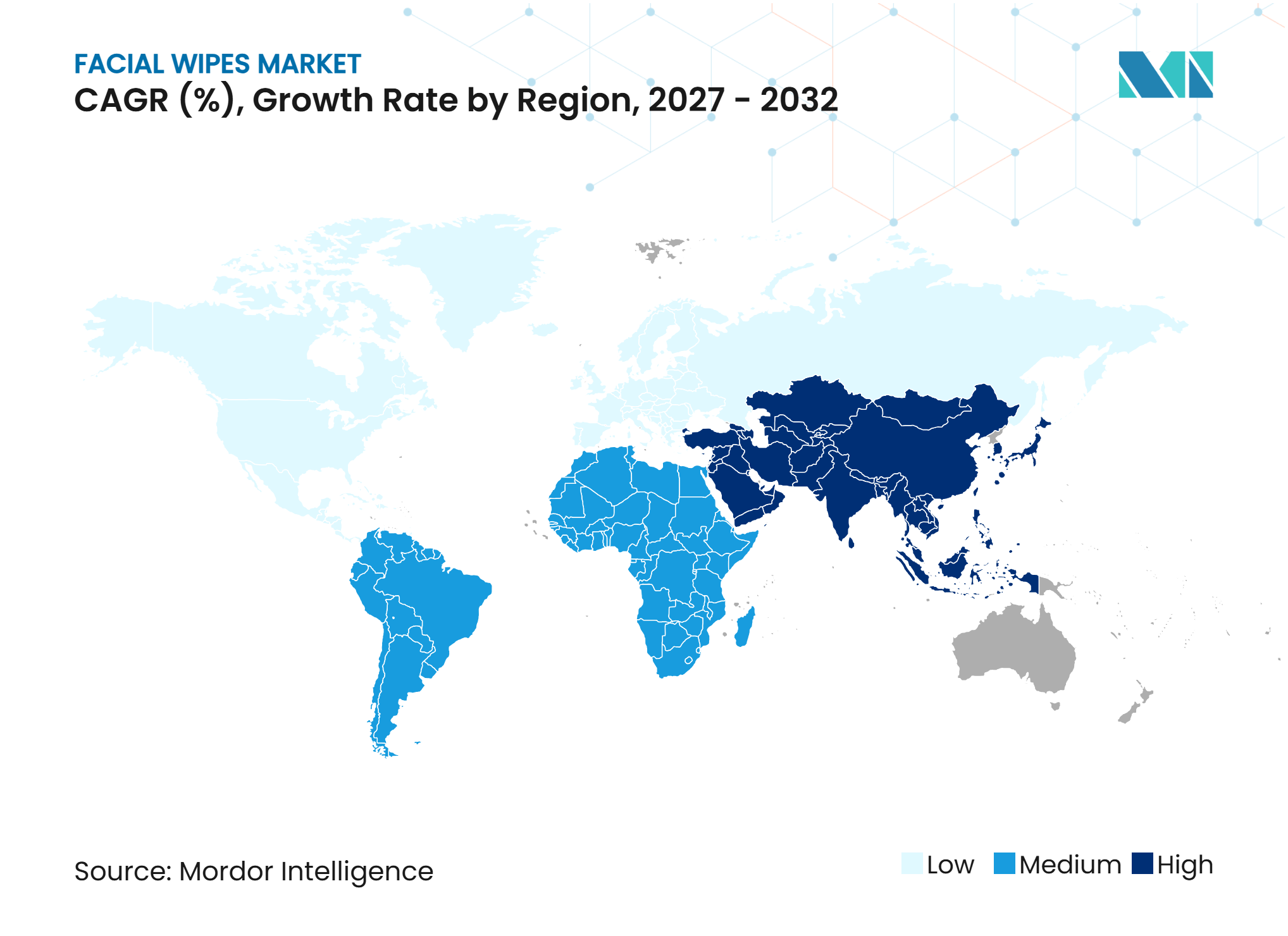
| Fastest Growing Market | Asia-Pacific |
| Largest Market | North America |
| Market Concentration | Medium |
Major Players *Disclaimer: Major Players sorted in no particular order Image © Mordor Intelligence. Reuse requires attribution under CC BY 4.0. | |
Facial Wipes Market Analysis by Mordor Intelligence
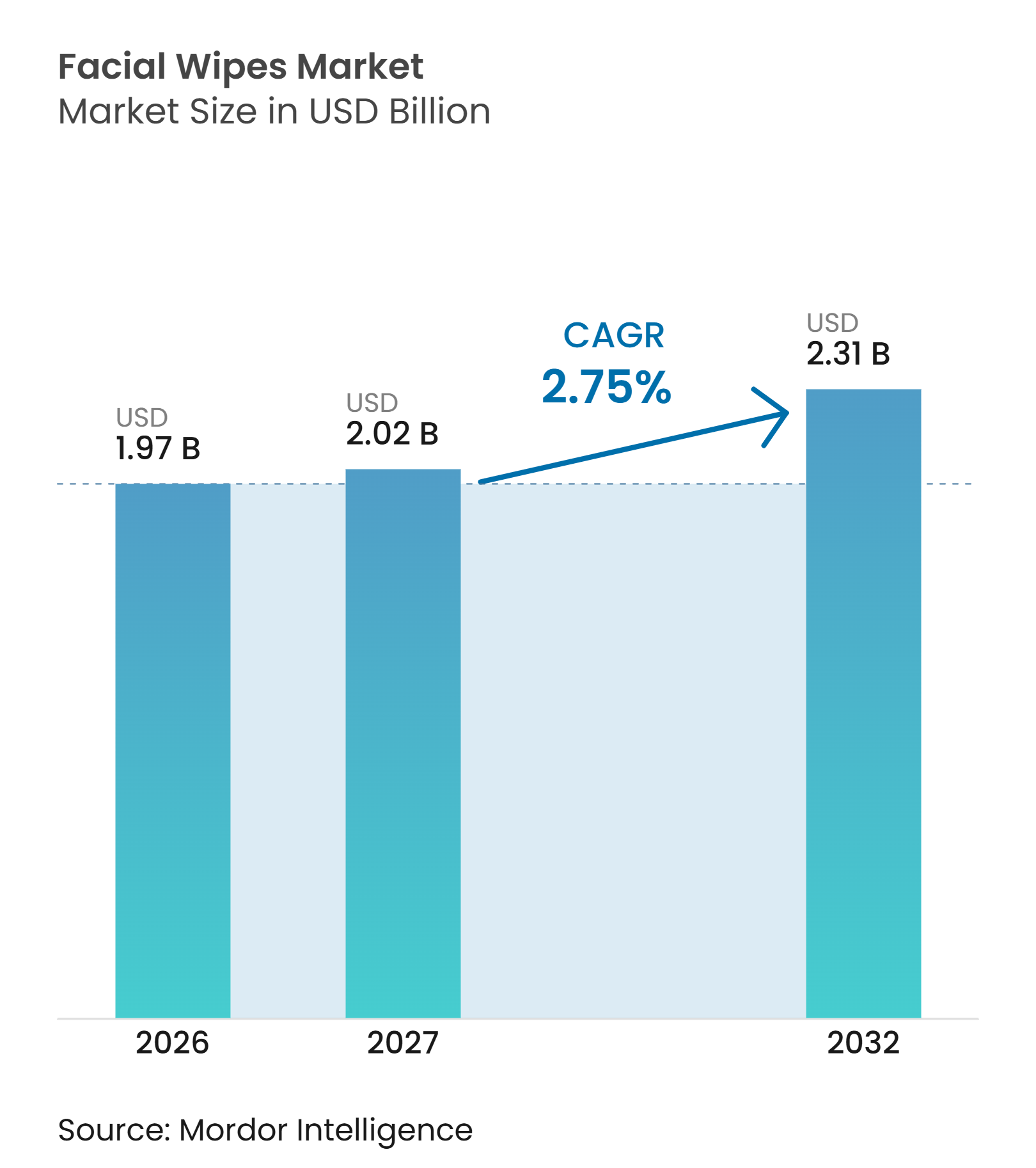
The facial wipes market size is expected to grow from USD 1.97 billion in 2026 to USD 2.02 billion in 2027 and is forecast to reach USD 2.31 billion by 2032 at a 2.75% CAGR over 2027-2032. The facial wipes market is mature in many high-income countries, where growth increasingly depends on product innovation, premium offerings, and repeat purchases rather than first-time adoption. Products containing cleansing actives such as niacinamide, micellar water, and hyaluronic acid are gaining attention, while basic formats face competition from private-label brands. Urban retail expansion and rising disposable incomes continue to improve product accessibility in developing economies. The convenience of no-rinse cleansing also supports demand among consumers seeking practical skincare solutions for travel, exercise, and everyday use.
Key Report Takeaways
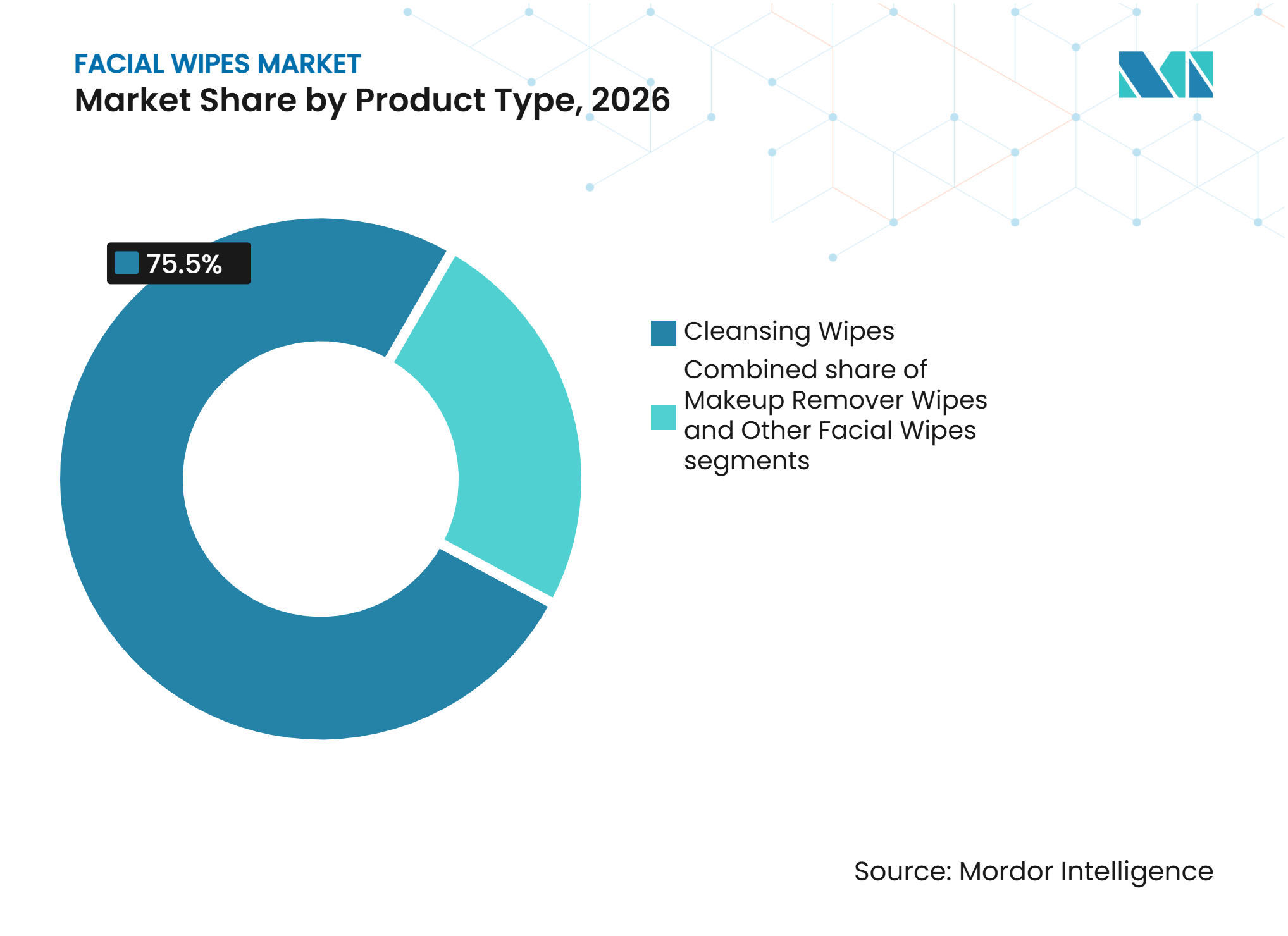
- By product type, cleansing wipes held 75.52% of the facial wipes market share in 2026, while makeup remover wipes are projected to expand at a CAGR of 2.86% through 2032.
- By form, wet facial wipes held 91.52% of the facial wipes market share in 2026, while dry facial wipes are projected to expand at a CAGR of 3.33% through 2032.
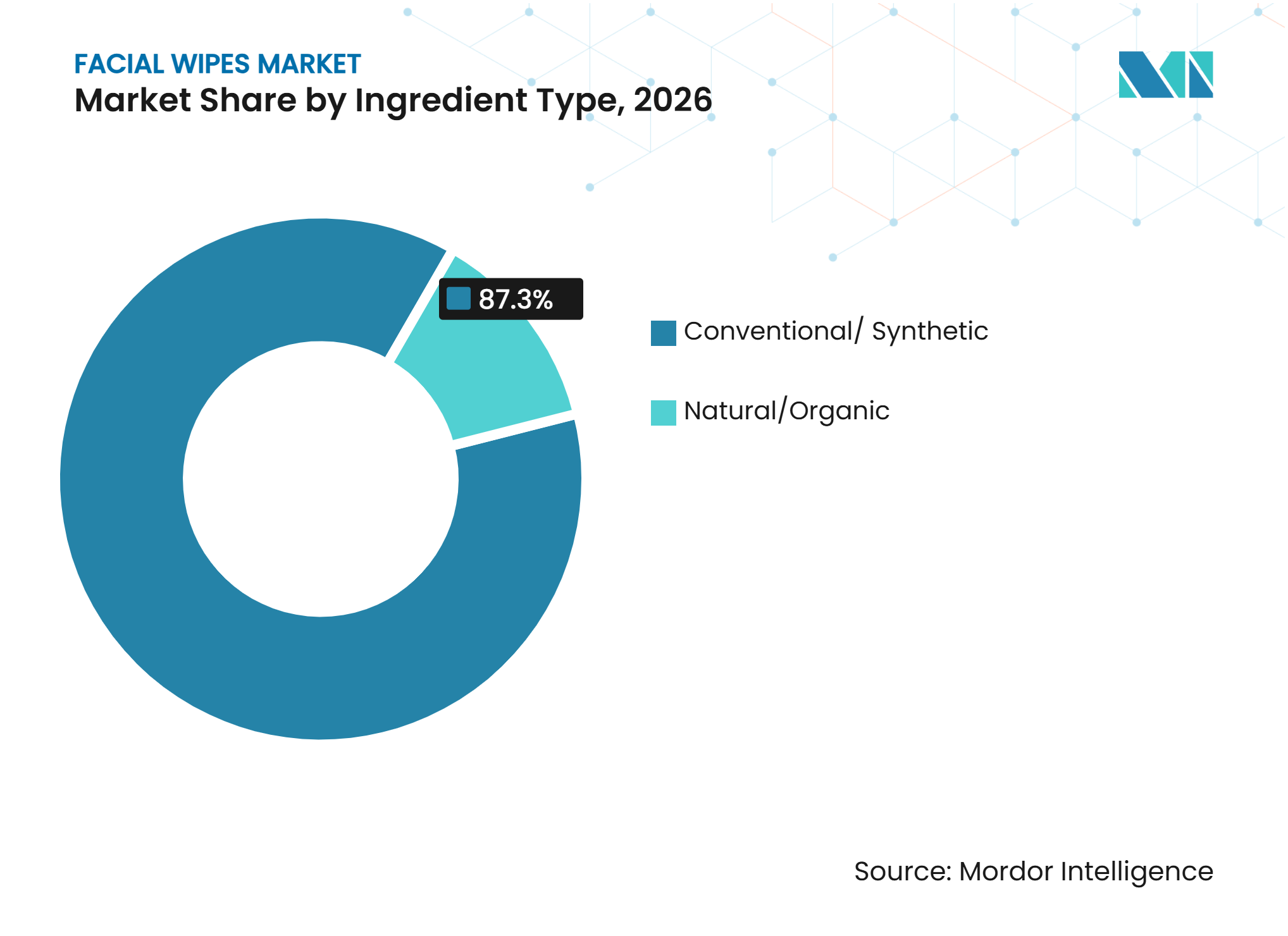
- By ingredient type, conventional/synthetic held 87.32% of the facial wipes market share in 2026, while natural/organic are projected to expand at a CAGR of 3.41% through 2032.
- By distribution channel, supermarkets and hypermarkets held 51.21% of the facial wipes market share in 2026, while online retail stores are projected to expand at a CAGR of 3.11% through 2032.
- By geography, North America held 41.12% of the facial wipes market share in 2026, while Asia-Pacific is projected to expand at a CAGR of 2.99% through 2032.
Note: Market numbers in this report are based on Mordor Intelligence's proprietary estimation framework, which combines nine months of actuals with Q4 projections for base year 2026.
Market Trends and Insights
Drivers Impact Analysis of Facial Wipes Market of Facial Wipes Market*
| Driver | (~) % Impact on CAGR Forecast | Geographic Relevance | Impact Timeline |
|---|---|---|---|
| Growing demand for convenient, no-rinse facial cleansing | +0.7% | Global | Short term (≤ 2 years) |
| Increasing preference for biodegradable and plastic-free facial wipes | +0.5% | North America and Europe, spillover to Asia-Pacific | Medium term (2-4 years) |
| Travel Recovery Structurally Reinforces On-the-Go Skincare Occasions | +0.4% | North America, Europe, and core Asia-Pacific markets | Medium term (2-4 years) |
| Premium and Multifunctional Wipes Are Restructuring Category Value | +0.3% | Global | Short term (≤ 2 years) |
| Growing demand for makeup-removal wipes and occasion-based facial cleansing | +0.3% | North America, Europe, and Asia-Pacific | Medium term (2-4 years) |
| Rising adoption of facial-care products among male consumers | +0.2% | North America and Asia-Pacific, with spillover to Middle East and Africa | Long term (≥ 4 years) |
| Source: Mordor Intelligence | |||
Growing demand for convenient, no-rinse facial cleansing
The demand for convenient facial cleansing solutions supports the continued use of facial wipes among consumers seeking practical alternatives to conventional cleansing routines. Their ready-to-use format allows consumers to remove makeup and cleanse their faces without water or additional accessories, making them suitable for everyday skincare and travel. For instance, in 2025, the Netherlands' National Institute for Public Health and the Environment (RIVM), in its Cosmetics Fact Sheet developed with Health Canada, identified a 75th-percentile usage frequency of 1.03 applications per day for facial cleansing and makeup-removal wipes. The report also estimated 376 applications annually for adults, highlighting the recurring nature of facial-wipe usage [1]. These usage patterns support the relevance of convenient, ready-to-use cleansing formats in personal care routines.
Increasing preference for biodegradable and plastic-free facial wipes
Growing environmental awareness is encouraging consumers to consider the material composition and environmental impact of personal-care wipes when making purchasing decisions. Manufacturers are responding by expanding plastic-free alternatives that use cellulose-based fibers instead of conventional synthetic materials. For instance, in February 2026, the Scottish Government's assessment of its proposed plastic wet-wipes ban found that the second most common theme in consultation responses was that consumers considered plastic-free wipes just as effective as plastic-containing alternatives. The assessment also reported that retailers had not received negative customer feedback regarding these alternatives. Furthermore, the consultation found that 62% of wet wipes sold were already plastic-free, indicating the availability of alternative products in the market [2].
Travel Recovery Structurally Reinforces On-the-Go Skincare Occasions
The recovery in international travel is creating additional opportunities for convenient personal-care products, including facial wipes. For instance, in September 2026, according to Airports Council International (ACI) World, global airports handled a record 9.8 billion passengers in 2025 [3]. Increased passenger movement creates additional travel-related occasions for the use of portable skincare products. This relevance is reflected in Saskatchewan Blue Cross's 2025 Wellness Guide, which specifically recommends face wipes as an essential carry-on item for long flights. These developments support opportunities for facial-wipe manufacturers to offer compact and travel-friendly formats that facilitate convenient cleansing and skincare routines during journeys
Premium and Multifunctional Wipes Are Restructuring Category Value
Premium formulations are shifting the facial wipes market towards products that combine cleansing with additional skincare benefits. Ingredients such as CICA, retinol, salicylic acid, and hyaluronic acid appeal to consumers seeking more than basic makeup and dirt removal. Manufacturers are increasingly incorporating these ingredients to develop multifunctional wipes that support skin hydration, soothing, exfoliation, and targeted skincare needs. This shift is encouraging product differentiation through specialised formulations that cater to different skin types and consumer preferences. By combining everyday cleansing with added skincare benefits, manufacturers can strengthen product positioning, support premium pricing, and expand innovation across wet and dry facial wipe formats.
Restraints Impact Analysis of Facial Wipes Market of Facial Wipes Market*
| Restraint | (~) % Impact on CAGR Forecast | Geographic Relevance | Impact Timeline |
|---|---|---|---|
| Higher costs of sustainable substrates and certification requirements | -0.4% | North America and Europe | Medium term (2-4 years) |
| Skin irritation and friction-related concerns | -0.3% | Global | Short term (≤ 2 years) |
| Moisture loss and packaging integrity challenges | -0.2% | Global | Short term (≤ 2 years) |
| Preference for Conventional Facial Cleansing Alternatives | -0.3% | Europe and North America | Long term (≥ 4 years) |
| Source: Mordor Intelligence | |||
Higher costs of sustainable substrates and certification requirements
Higher costs of sustainable substrates and certification requirements can create financial challenges for facial wipes manufacturers, particularly smaller and mid-sized producers. Replacing conventional synthetic materials with cellulose-based and other sustainable substrates can increase raw material and processing expenses. Manufacturers must also bear additional costs for testing, certification, and compliance to substantiate environmental and compostability claims. These requirements increase the overall cost of product development and production, making it difficult for smaller companies to adopt sustainable materials while maintaining competitive pricing. Larger manufacturers with established supply chains and greater financial resources may be better positioned to absorb these expenses.
Skin irritation and friction-related concerns
Skin irritation and friction-related concerns can limit the adoption and regular use of facial wipes, particularly among consumers with sensitive or reactive skin. Repeated wiping and excessive rubbing can create friction against the skin, potentially causing redness, dryness, itching, and discomfort. Certain cleansing ingredients, fragrances, preservatives, and other formulation components may also trigger irritation or sensitivity in some users. These effects can become more noticeable when wipes are used frequently or applied to delicate areas of the face, particularly around the eyes. Inadequate formulation compatibility, rough substrate textures, and insufficient moisture retention can further affect the cleansing experience and skin comfort. Such concerns may reduce consumer confidence in facial wipes, encourage cautious usage, and prompt consumers to choose alternative cleansing products, including micellar water, cleansing balms, and rinse-off facial cleansers
*Our forecasts treat driver/restraint impacts as directional, not additive. The impact forecasts reflect baseline growth, mix effects, and variable interactions.
Facial Wipes Market Segment Analysis
By Product Type:
Cleansing Wipes Retain Scale While Makeup Remover Wipes Gain ValueCleansing wipes accounted for 75.52% of facial wipes market share in 2026, reflecting their broad use across routine skincare occasions. Their market presence is supported by frequent everyday usage and broad availability across supermarkets, drugstores, and online retail channels. Consumers prefer these products for quick, convenient cleansing after exercise, while traveling, and at the end of the day. Familiar packaging, affordable pricing, and suitability across different age groups further support their adoption. Basic cleansing formats continue to contribute to market volume because of their straightforward functionality, ease of selection, and accessibility. Purchasing decisions are largely influenced by brand familiarity, product availability, pack convenience, and consistent cleansing performance, sustaining demand among routine users.
Makeup remover wipes are projected to expand at a CAGR of 2.86% through 2032. Their appeal is driven by the ability to remove different types of makeup, including foundation, eye shadow, and waterproof mascara. Consumers may be willing to pay more for products that effectively remove long-wear cosmetics without excessive rubbing or residue. This creates opportunities for manufacturers to incorporate skincare ingredients and gentle cleansing formulations that improve product performance and skin comfort. The segment also benefits from makeup usage among younger consumers and demand for convenient, travel-friendly packaging. The visible results of makeup removal make product effectiveness easier for brands to demonstrate through product trials, sampling, and digital content.



By Form:
Wet Wipes Maintain Habit While Dry Wipes Expand Their RoleWet facial wipes held 91.52% of the facial wipes market share in 2026. Wet facial wipes benefit from strong consumer familiarity and an established retail supply chain built around ready-to-use packaging. Their appeal lies in providing a convenient, single-step cleansing experience that requires no water, a separate cleanser, or additional preparation. Wide retail availability and multiple pack sizes and price points make these products accessible to different consumer groups and usage occasions, including daily cleansing, makeup removal, travel, and quick refreshment. Packaging also plays an important role in product performance, as effective moisture retention helps maintain the quality and usability of wipes throughout their shelf life and after opening. Secure resealable closures and durable packaging materials further support convenience, product freshness, and repeat purchases.
Dry facial wipes are projected to expand at a CAGR of 3.33% through 2032. Dry facial wipes offer an alternative to wet formats by allowing consumers to select the cleansing liquid used with the sheet, such as water, micellar water, or other facial cleansers. This flexibility appeals to consumers who prefer greater control over their cleansing routines and the ingredients in their products. Their lower moisture content can support longer shelf life, reduce the need for certain preservatives, and lower packaging weight compared with pre-moistened alternatives. The format also provides opportunities for manufacturers to develop products compatible with different cleansing solutions and skincare routines. Growing interest in layered skincare practices, particularly in markets such as Japan and South Korea, creates additional opportunities for dry facial wipes
By Ingredient Type:
Conventional Products Lead While Organic Formats Build MomentumConventional/Synthetic accounted for 87.32% of the facial wipes market size in 2026. Conventional facial wipes maintain their market position through cost efficiency, wide availability of raw materials, and established manufacturing processes. Their reliance on familiar substrates and standard formulations allows manufacturers to achieve large-scale production while maintaining consistent supply across different pack sizes, price points, and retail channels. These advantages support their availability in value packs, single-use packs, and mainstream retail outlets. Conventional products also remain accessible to price-conscious consumers who prioritize affordability and basic cleansing performance. Their established distribution networks and strong retail presence make them difficult to replace quickly with alternative formulations.
Natural/Organic are forecast to expand at a CAGR of 3.41% through 2032. Growing consumer awareness of ingredient quality, responsible sourcing, and product certifications is creating opportunities for organic facial wipes. Consumers increasingly value transparent ingredient lists, traceable raw materials, and recognized certifications that provide confidence in product quality and formulation standards. This encourages manufacturers to expand their organic product portfolios and strengthen their positioning through certified substrates and clearly communicated ingredient information. Retailers are also creating greater visibility for products that meet recognised standards and appeal to health-conscious and environmentally aware shoppers.

By Distribution Channel:
Supermarkets Lead While Online Retail Changes AccessSupermarkets and hypermarkets accounted for 51.21% of the facial wipes market share in 2026. Supermarkets and hypermarkets benefit from high household footfall, promotional offers, and prominent product placement in skincare and personal care sections. Their wide product selection allows consumers to purchase facial wipes alongside other everyday essentials, increasing product visibility and encouraging additional purchases during routine shopping trips. The channel supports a broad range of offerings, from affordable value packs to branded products with specialized formulations and added skincare benefits. Convenient in-store availability also encourages purchases when consumers require immediate cleansing solutions. Health and beauty stores provide another important retail channel, particularly for facial wipes positioned around skincare benefits.
Online retail stores are projected to expand at a CAGR of 3.11% through 2032. Online retail channels are creating new growth opportunities for facial wipes manufacturers by providing wider market reach and greater flexibility in product offerings. Brands can offer multipacks, subscription options, and bundled products to encourage repeat purchases and strengthen customer engagement. Direct-to-consumer platforms also help manufacturers understand consumer preferences and purchasing patterns, allowing them to refine product sizes, formulations, and promotional strategies. Online marketplaces enable emerging brands to reach consumers across different regions and introduce specialised products without relying entirely on physical retail distribution.
Geography Analysis
North America
North America held 41.12% of the facial wipes market share in 2026. North America benefits from an established retail network comprising mass merchants, drugstores, warehouse clubs, supermarkets, and online platforms, supporting the widespread availability of facial wipes. High consumer familiarity with cleansing wipes encourages manufacturers to differentiate their offerings by improving formulations, adding skincare benefits, and offering more convenient packaging. Subscription services and direct-to-consumer platforms further support repeat purchases and demand for multipack formats. Canada offers opportunities for products focused on organic ingredients, skin compatibility, and health-conscious formulations, while Mexico offers potential for broader market adoption through the expansion of modern retail and online distribution.
Asia-Pacific
Asia-Pacific is forecast to expand at a CAGR of 2.99% in the facial wipes market through 2032. Asia-Pacific encompasses diverse skincare routines, consumer preferences, purchasing power, and retail environments, creating opportunities across different facial wipe categories. Japan and South Korea have established skincare markets in which consumers are interested in specialized cleansing products and multifunctional formulations. South Korea also contributes to product innovation through K-beauty trends, including ingredient-focused and skincare-oriented cleansing formats, which can reach international markets through beauty exports. India offers opportunities for broader adoption of facial wipes as makeup usage, personal-care awareness, and online retail penetration expand among younger consumers. The growth of e-commerce across Tier 2 and Tier 3 cities is further improving product accessibility beyond major metropolitan areas.
Competitive Landscape
Market Concentration
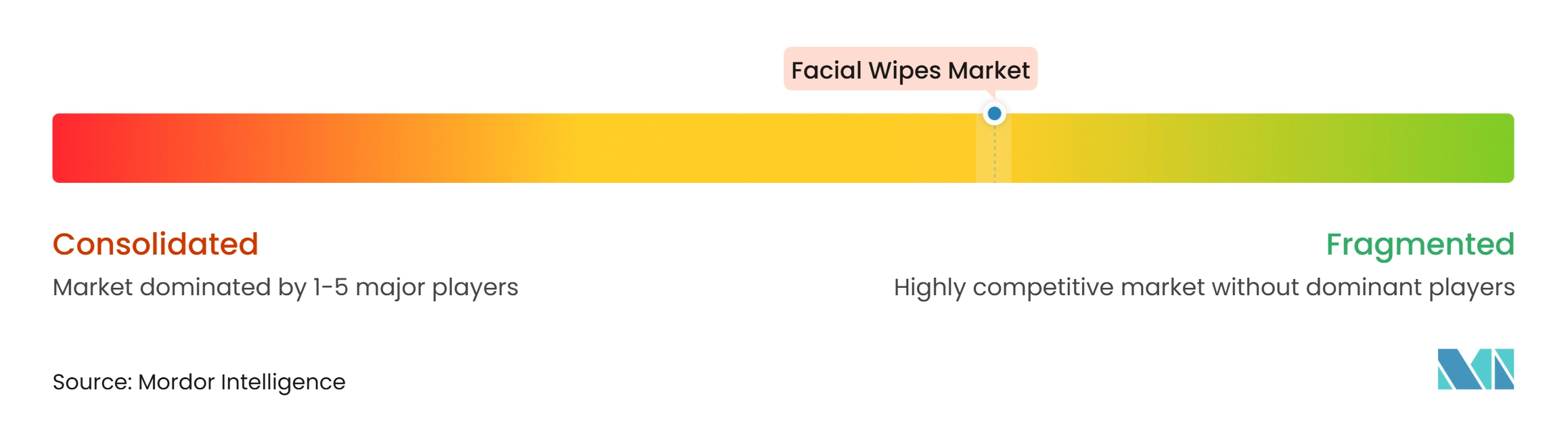
The facial wipes market remains moderately fragmented, with no single company holding dominant global authority. Leading multinational manufacturers compete through established brands, extensive distribution networks, and large-scale manufacturing capabilities. Regional companies maintain strong positions in their respective home markets through products aligned with local consumer preferences and established brand relationships. The competitive landscape combines multinational companies with strong distribution capabilities and regional players with established market positions. Private-label production and manufacturing capabilities also influence competition. Manufacturers supplying branded and private-label products support market availability across different regions and price categories.
Their ability to work with a variety of nonwoven materials is becoming increasingly important as the industry explores sustainable substrate alternatives. Larger companies generally have greater resources to support packaging improvements, certification, and distribution expansion, while smaller brands can compete through focused product positioning, ingredient transparency, and specialized retail partnerships. This creates opportunities for companies with differentiated products and flexible manufacturing capabilities. Growth opportunities exist across both premium and value-oriented product categories. Premium suppliers can strengthen their portfolios through specialised formulations, gentle materials, and products designed for specific skincare requirements.
Value-oriented manufacturers can expand adoption among price-sensitive consumers through affordable products and convenient pack formats. The male skincare category also presents opportunities as manufacturers explore dedicated facial cleansing solutions for this consumer group. Digital engagement initiatives can help brands strengthen customer relationships and encourage repeat purchases. Recognised certifications and transparent product information can support retailer confidence and improve product differentiation. Overall, competitive success depends on aligning product formulations, pricing, distribution, and regulatory compliance with regional consumer preferences. The fragmented market structure provides opportunities for both multinational manufacturers and specialised regional brands.
Facial Wipes Industry Leaders
-
The Procter & Gamble Company
-
Kimberly-Clark Corporation (Kenvue Inc.)
-
Indian Health & Hygienics Corporation
-
Foshan Niceday Sanitary Products Co., Ltd.
-
PERFECT GROUP CORP., LTD. (Yangzhou Perfect Daily Chemicals Co., Ltd.)
- *Disclaimer: Major Players sorted in no particular order
Facial Wipes Market Companies Covered in this Report
- The Procter & Gamble Company
- Kimberly-Clark Corporation (Kenvue Inc.)
- Indian Health & Hygienics Corporation
- Foshan Niceday Sanitary Products Co., Ltd.
- PERFECT GROUP CORP., LTD. (Yangzhou Perfect Daily Chemicals Co., Ltd.)
- Albaad Massuot Yitzhak Ltd.
- Beiersdorf AG
- Diamond Wipes International, Inc.
- Pigeon Corporation
- Zhejiang Yiwu Zhien Biotechnology Co., Ltd.
- Isola Castle Ltd. (Vinda International Holdings Limited)
- Tongling Jieya Biologic Technology Co., Ltd.
- Shanghai Chicmax Cosmetic Co., Ltd.
- President Pharmaceutical Corp.
- Morita Group (DR JOU Biotech Co., Ltd.)
- Yujiahui Co., Ltd. (Yujiahui Cosmetics Manufacturing Co., Ltd.)
- Shanghai Jahwa United Co., Ltd. (Shanghai Herborist Cosmetics Co., Ltd.)
- LG Corp. (LG Household & Health Care Ltd.)
- Natura Cosméticos S.A. (Avon Products, Inc.)
- Ningbo Riway Industrial Co., Ltd.
Recent Industry Developments in Facial Wipes Market
- July 2026: Neutrogena introduced Fragrance-Free Makeup Remover Cleansing Towelette Singles, which included individually wrapped, full-sized facial wipes for convenient makeup removal and facial refreshing while traveling or away from home.
- May 2026: 4 AM launched Clean Sheets facial cleansing wipes in Target stores across the United States. The individually wrapped wipes featured a micellar water-based formula infused with skincare ingredients, combining makeup removal and cleansing with added skin-conditioning benefits.
- June 2025: Nice-Pak relaunched its Wet-Nap brand with an all-purpose cleansing wipe featuring a gentle formulation for cleaning the face, hands, and body. The relaunch expanded the brand’s retail positioning beyond traditional foodservice applications.
Global Facial Wipes Market Report Scope
The facial wipes market includes disposable cleansing sheets designed for facial hygiene, makeup removal, and skincare, available in wet and dry formats and formulated with conventional or natural ingredients. The market is segmented by Product Type, Form, Ingredient Type, Distribution Channel, and Geography. Based on Product Type, the market is segmented into Cleansing Wipes, Makeup Remover Wipes, and Other Facial Wipes. Based on Form, the market is segmented into Wet and Dry Facial Wipes. Based on Ingredient Type, the market is segmented into Conventional/Synthetic and Natural/Organic Facial Wipes. Based on Distribution Channel, the market is segmented into Supermarkets and Hypermarkets, Health and Beauty Stores, Online Retail Stores, and Other Distribution Channels. By geography, the market is segmented into North America, Europe, Asia-Pacific, South America, and the Middle East and Africa. Each segment's market forecasts are provided in terms of value (USD).
Segmentation Overview
| Cleansing Wipes |
| Makeup Remover Wipes |
| Other Facial Wipes |
| Wet |
| Dry |
| Conventional/Synthetic |
| Natural/Organic |
| Supermarkets and Hypermarkets |
| Health and Beauty Stores |
| Online Retail Stores |
| Other Distribution Channels |
| North America | United States |
| Canada | |
| Mexico | |
| Rest of North America | |
| Europe | United Kingdom |
| Germany | |
| France | |
| Italy | |
| Spain | |
| Netherlands | |
| Poland | |
| Belgium | |
| Sweden | |
| Rest of Europe | |
| Asia-Pacific | China |
| Japan | |
| India | |
| Australia | |
| Indonesia | |
| South Korea | |
| Thailand | |
| Singapore | |
| Rest of Asia-Pacific | |
| South America | Brazil |
| Argentina | |
| Colombia | |
| Chile | |
| Peru | |
| Rest of South America | |
| Middle East and Africa | South Africa |
| Saudi Arabia | |
| United Arab Emirates | |
| Nigeria | |
| Egypt | |
| Morocco | |
| Turkey | |
| Rest of Middle East and Africa |
| By Product Type | Cleansing Wipes | |
| Makeup Remover Wipes | ||
| Other Facial Wipes | ||
| By Form | Wet | |
| Dry | ||
| By Ingredient Type | Conventional/Synthetic | |
| Natural/Organic | ||
| By Distribution Channel | Supermarkets and Hypermarkets | |
| Health and Beauty Stores | ||
| Online Retail Stores | ||
| Other Distribution Channels | ||
| By Geography | North America | United States |
| Canada | ||
| Mexico | ||
| Rest of North America | ||
| Europe | United Kingdom | |
| Germany | ||
| France | ||
| Italy | ||
| Spain | ||
| Netherlands | ||
| Poland | ||
| Belgium | ||
| Sweden | ||
| Rest of Europe | ||
| Asia-Pacific | China | |
| Japan | ||
| India | ||
| Australia | ||
| Indonesia | ||
| South Korea | ||
| Thailand | ||
| Singapore | ||
| Rest of Asia-Pacific | ||
| South America | Brazil | |
| Argentina | ||
| Colombia | ||
| Chile | ||
| Peru | ||
| Rest of South America | ||
| Middle East and Africa | South Africa | |
| Saudi Arabia | ||
| United Arab Emirates | ||
| Nigeria | ||
| Egypt | ||
| Morocco | ||
| Turkey | ||
| Rest of Middle East and Africa | ||
Key Questions Answered in the Report
What is the projected value of the facial wipes market by 2032?
The facial wipes market is projected to reach USD 2.31 billion by 2032, expanding at a 2.75% CAGR from 2027 to 2032. The outlook reflects steady replacement demand in mature countries and wider access to convenient cleansing formats in developing markets.
Which facial wipe product type has the largest share?
Cleansing wipes leads with a 75.52% share in 2026 as they support routine cleansing across several purchase occasions. Their established retail presence and simple no-rinse use reinforce their relevance for regular household purchasing.
Why are biodegradable facial wipes becoming more important?
Retailer requirements and European plastic-marking rules are increasing the value of cellulose-based and certified plastic-free products. The shift also makes certification, sourcing documentation, and clear disposal information more relevant to supplier selection.
Which region offers the fastest growth outlook in the facial wipes market?
Asia-Pacific is projected to expand at a CAGR of 2.99% through 2032, supported by expanding retail access and specialized skincare routines. The region combines premium innovation in developed skincare markets with rising availability in large developing economies. This allows suppliers to use different portfolios across countries rather than relying on one product proposition for the whole region.