
Facial Kits Market Size and Share
Market Overview
| Study Period | 2022 - 2032 |
|---|---|
| Market Size (2027) | USD 4.16 Billion |
| Market Size (2032) | USD 5.69 Billion |
| Growth Rate (2027 - 2032) | 6.45 % |
| Fastest Growing Market | South America |
| Largest Market | Asia-Pacific |
| Market Concentration | Low |
Major Players *Disclaimer: Major Players sorted in no particular order Image © Mordor Intelligence. Reuse requires attribution under CC BY 4.0. | |
Facial Kits Market Analysis by Mordor Intelligence
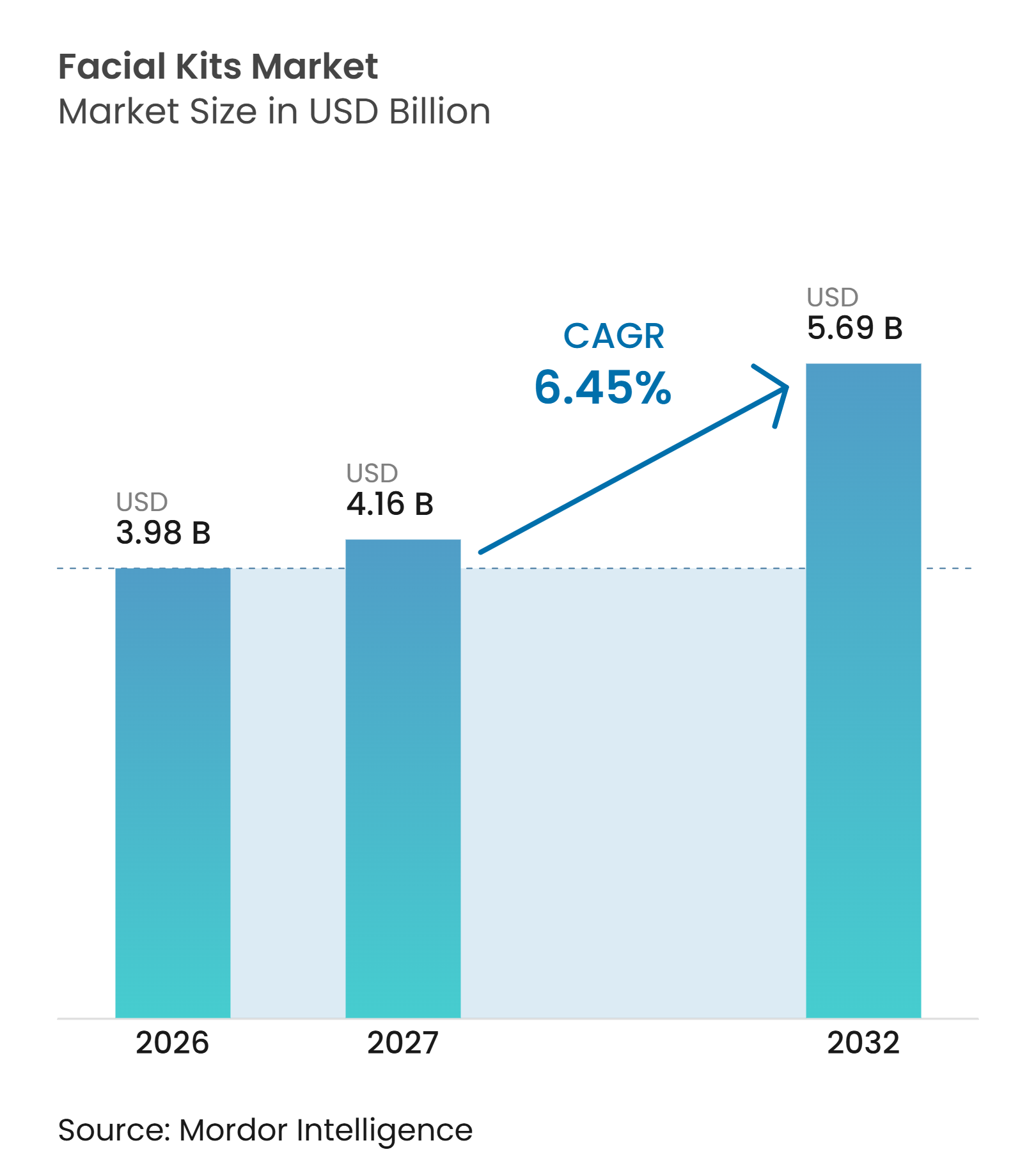
The facial kits market size is expected to grow from USD 3.98 billion in 2026 to USD 4.16 billion in 2027 and is forecast to reach USD 5.69 billion by 2032 at a 6.45% CAGR over 2027-2032. The market is driven by growing consumer interest in skincare, personal grooming, and convenient at-home beauty treatments. Increasing awareness of multi-step skincare routines and demand for products offering targeted skin benefits are supporting the adoption of facial kits as accessible alternatives to professional salon treatments. Consumers are increasingly seeking formulations that combine cleansing, exfoliation, nourishment, and hydration within convenient product formats. The growing influence of digital platforms, beauty content, and online product discovery is further shaping purchasing behavior and expanding consumer access to facial care products. Additionally, rising interest in ingredient-focused skincare, personalized beauty solutions, and premium self-care experiences is encouraging product innovation and broadening the market's consumer appeal.
Key Report Takeaways
- By facial kit type, fruit-based kits held 28.37% of the Facial kits market share in 2026 and are forecast to grow at a 7.13% CAGR during 2027-2032.
- By skin concern, hydration and nourishment held 24.26% of the facial kits market share in 2026, while acne and oil control is forecast to grow at a 7.28% CAGR from 2027 to 2032.
- By skin type, oily skin held 27.83% of the facial kits market share in 2026, while sensitive skin is forecast to grow at a 7.36% CAGR from 2027 to 2032.
- By category, mass-market facial kits held 61.74% of the market share in 2026, while premium facial kits are forecast to grow at a 6.97% CAGR from 2027 to 2032.
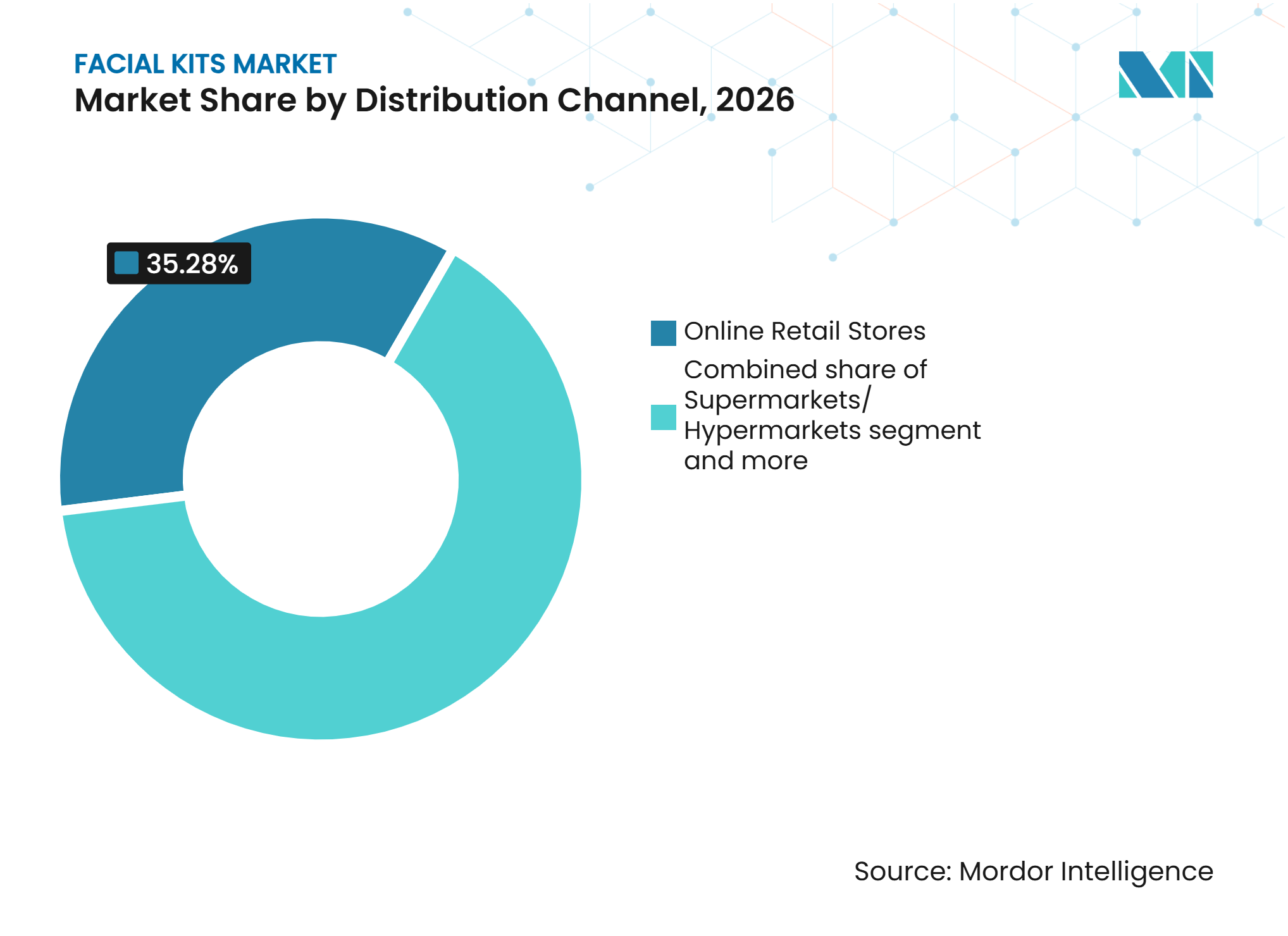
- By distribution channel, online retail stores held 35.28% of the market share in 2026 and are forecast to grow at a 7.47% CAGR from 2027 to 2032.
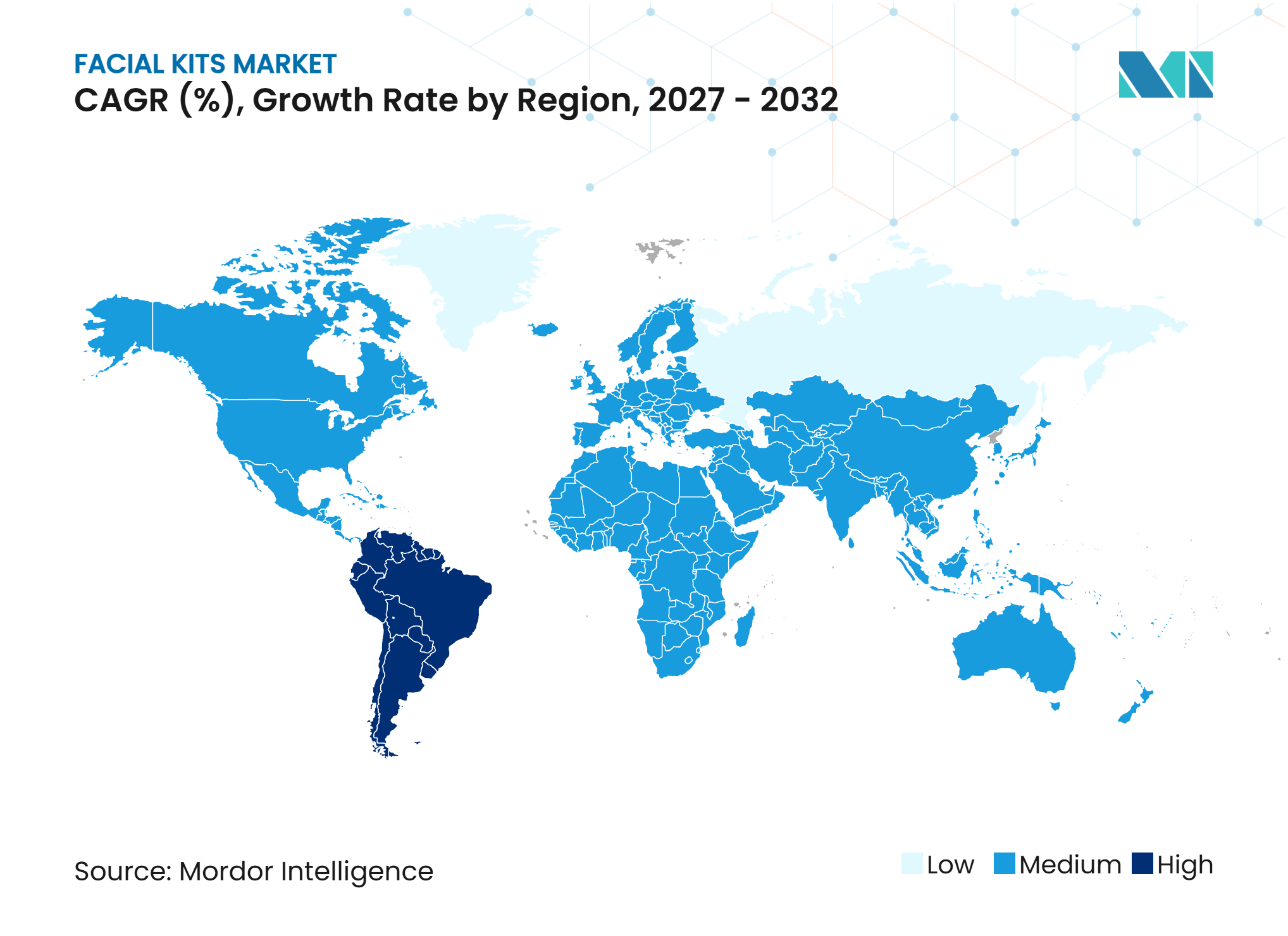
- By geography, Asia-Pacific held 33.86% of the facial kits market share in 2026, while South America is forecast to grow at a 7.39% CAGR from 2027 to 2032.
Note: Market numbers in this report are based on Mordor Intelligence's proprietary estimation framework, which combines nine months of actuals with Q4 projections for base year 2026.
Market Trends and Insights
Drivers Impact Analysis of Facial Kits Market*
| Driver | (~) % Impact on CAGR Forecast | Geographic Relevance | Impact Timeline |
|---|---|---|---|
| Rising preference for natural and organic skincare formulations | +1.8% | Global; intensity in India, Southeast Asia, Western Europe | Medium term (2-4 years) |
| Expansion of online beauty purchasing and digital product discovery | +1.5% | Global; North America, Asia-Pacific, Latin America lead | Short term (≤ 2 years) |
| Growing demand for facial treatments addressing specific skin concerns | +1.2% | Asia-Pacific core, spill-over to South America | Medium term (2-4 years) |
| Increasing adoption of regular, multi-step skincare routines | +0.9% | Asia-Pacific, North America | Medium term (2-4 years) |
| Greater consumer emphasis on skincare product efficacy and visible results | +0.7% | Global; higher elasticity in Europe and North America | Long term (≥ 4 years) |
| Rising consumer expenditure on beauty and personal care products | +0.8% | Emerging markets: India, Brazil, Indonesia, Colombia | Medium term (2-4 years) |
| Source: Mordor Intelligence | |||
Rising Preference for Natural and Organic Skincare Formulations
Growing consumer awareness of ingredient transparency, skin compatibility, and personal well-being is encouraging demand for natural and organic skincare formulations. According to a March 2025 consumer survey released by the National Sanitation Foundation (NSF), 74% of American consumers consider organic ingredients important in personal care products, while 45% are willing to pay more for certified personal care products containing organic ingredients[1]. This increasing preference is encouraging manufacturers to incorporate botanical extracts, fruit-derived ingredients, and naturally sourced components into skincare products. Facial kits featuring recognizable natural ingredients and ingredient-focused formulations can benefit from this shift, supporting product innovation and wider consumer adoption.
Expansion of Online Beauty Purchasing and Digital Product Discovery
The growing adoption of e-commerce and digital retail platforms is creating additional opportunities for beauty product discovery and purchasing. According to the United States Census Bureau, United States e-commerce sales increased by 12.2% year-over-year in the second quarter of 2026 compared with the second quarter of 2025, while total retail sales increased by 6.7% over the same period[2]. E-commerce also accounted for 17.1% of total United States retail sales in the second quarter of 2026, highlighting the increasing role of online purchasing in consumer retail activity. The growing accessibility of digital retail platforms and online product information is supporting consumer discovery and evaluation of facial care products, expanding the reach of facial kits through online purchasing channels.
Growing Demand for Facial Treatments Addressing Specific Skin Concerns
Increasing consumer awareness of individual skin concerns is encouraging demand for targeted facial treatments and skincare solutions. According to the American Society for Dermatologic Surgery (ASDS), its 2025 Consumer Survey, covering more than 3,500 United States consumers, found that 78% of respondents were concerned about skin texture and discoloration, while an equal proportion reported concerns about lines and wrinkles around and under the eyes. Additionally, 73% identified lines, wrinkles, and folds on the mid-face as a bothersome concern[3]. The American Academy of Dermatology (AAD) also reported in May 2025 that half of surveyed American adults were concerned about premature skin aging, while 40% reported wrinkles or dark spots they associated with sun exposure[4]. These concerns are encouraging demand for facial treatments offering targeted benefits such as hydration, exfoliation, skin brightening, oil control, and anti-aging care, supporting the development and adoption of specialized facial kits.
Increasing Adoption of Regular, Multi-Step Skincare Routines
Growing awareness of skincare maintenance and the importance of consistent self-care is encouraging consumers to incorporate regular facial care practices into their daily routines. Consumers are increasingly combining cleansing, exfoliation, toning, masking, and moisturization to address different aspects of skin health and appearance. This shift towards structured skincare regimens is creating opportunities for convenient product formats that combine multiple treatment steps within a single package. Facial kits align with this preference by offering coordinated products that can be incorporated into at-home skincare rituals, making multi-step facial care more accessible and convenient. The growing association of skincare with personal wellness and everyday self-care is further supporting interest in regular facial treatments and packaged skincare solutions.
Restraints Impact Analysis of Facial Kits Market*
| Restraint | (~) % Impact on CAGR Forecast | Geographic Relevance | Impact Timeline |
|---|---|---|---|
| Stringent cosmetic product safety and regulatory compliance requirements | -0.5% | Global; heightened in Europe, India, and the United States | Short to medium term (≤ 4 years) |
| Counterfeit facial care products and unauthorised online distribution | -0.4% | Asia-Pacific, with spill-over to the Middle East and Africa, and online-heavy North America and Europe | Medium term (2-4 years) |
| Risk of skin irritation and adverse reactions from facial treatment products | -0.3% | Global, especially for sensitive skin segments in Europe and North America | Short to medium term (≤ 4 years) |
| Consumer price sensitivity and competition from lower-cost standalone skincare products | -0.4% | Emerging markets: India, Southeast Asia, South America | Medium term (2-4 years) |
| Source: Mordor Intelligence | |||
Stringent Cosmetic Product Safety and Regulatory Compliance Requirements
Stringent regulatory requirements governing cosmetic product safety, ingredient approvals, labelling, and quality standards can increase compliance responsibilities for facial kit manufacturers. Companies must ensure that individual formulations meet applicable safety requirements, with particular attention to ingredient restrictions, product testing, manufacturing practices, and accurate disclosure of product information. The use of multiple formulations and active ingredients within facial kits can further increase the need for product-specific safety assessments and regulatory documentation. Compliance with changing regulations across different markets may also require manufacturers to periodically review formulations, packaging, and labelling practices. These requirements can increase product development timelines and operational costs, potentially affecting the pace of new product introductions and market expansion.
Counterfeit Facial Care Products and Unauthorized Online Distribution
The proliferation of counterfeit facial care products and unauthorised online distribution channels creates challenges for product authenticity, consumer confidence, and brand protection. The availability of imitation products through third-party sellers and unverified digital marketplaces can make it difficult for consumers to distinguish genuine facial kits from unauthorized alternatives. Such products may contain undisclosed or unsuitable ingredients, lack adequate quality controls, and fail to meet applicable cosmetic safety requirements. The circulation of counterfeit products can also affect established brands by weakening consumer trust and creating inconsistencies in product quality and purchasing experiences. Addressing these concerns requires manufacturers to strengthen supply chain monitoring, distribution controls, product authentication measures, and online marketplace oversight.
*Our forecasts treat driver/restraint impacts as directional, not additive. The impact forecasts reflect baseline growth, mix effects, and variable interactions.
Facial Kits Market Segment Analysis
By Facial Kit Type:
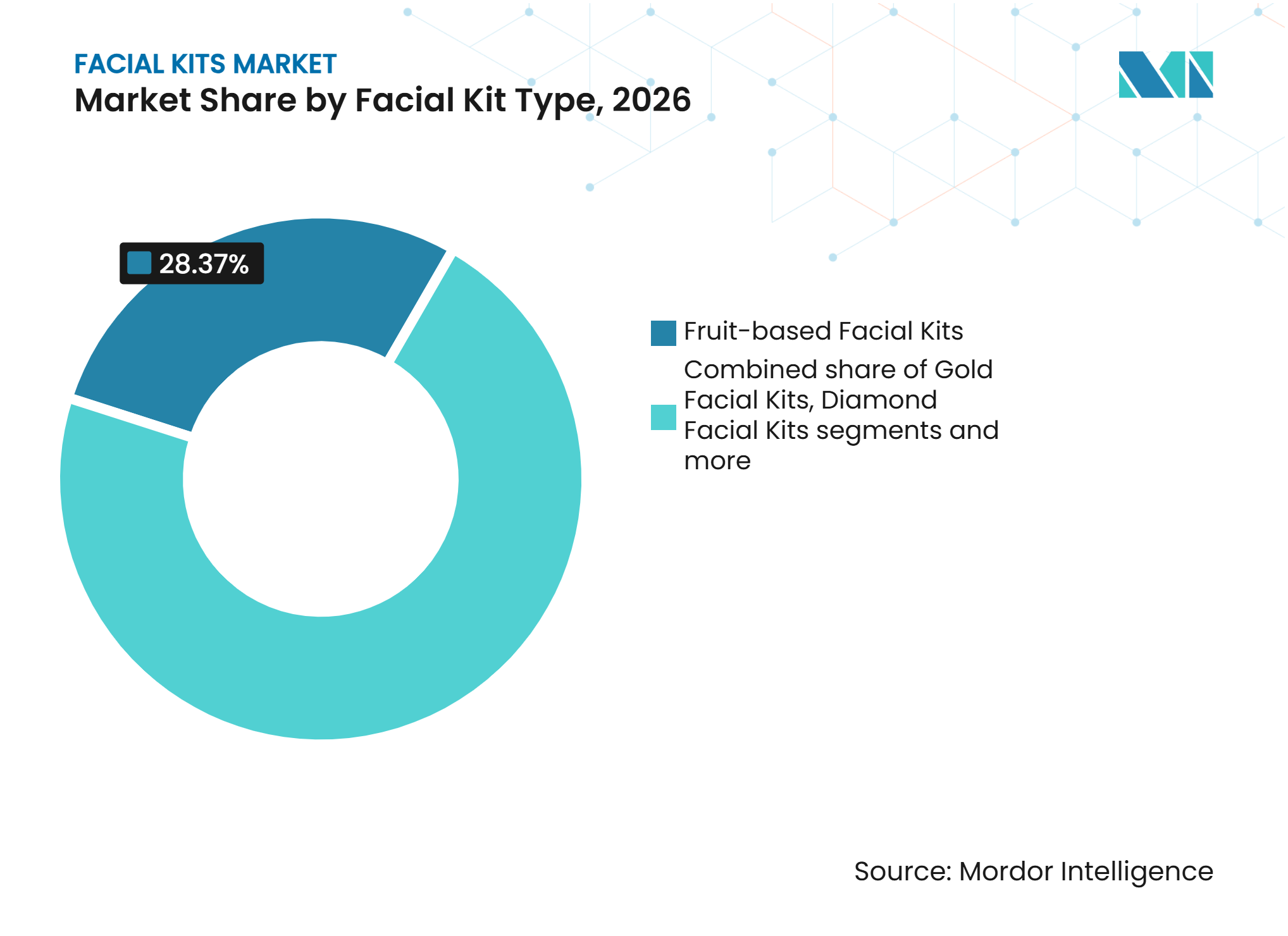
Fruit-Based Formats Anchor Consumer PreferenceFruit-based facial kits account for the largest market share of 28.37% in 2026 and are also the fastest-growing segment, registering a CAGR of 7.13% during 2027–2032. Their popularity is supported by increasing consumer interest in ingredient-focused skincare and formulations incorporating recognizable fruit-derived ingredients. These products are commonly associated with skincare benefits such as exfoliation, hydration, nourishment, and skin brightening, making them suitable for consumers seeking convenient, multi-step facial care solutions. Their versatility across different skin concerns and facial treatment formats further supports segment growth.
Gold facial kits maintain demand through their association with premium skincare experiences, particularly for consumers seeking specialized facial treatments and occasion-based beauty routines. Diamond and platinum facial kits appeal to consumers interested in prestige-oriented formulations and treatments positioned around skin brightening, nourishment, and anti-ageing benefits. Meanwhile, the others segment includes diverse formulations such as charcoal-based, herbal, and other ingredient-focused facial kits, catering to consumers seeking alternatives to conventional facial treatment formats. Product innovation and the introduction of formulations addressing varied skincare preferences continue to support demand across these segments.



By Skin Concern:
Targeted Formulations Reshape Category ValueHydration and nourishment account for the largest share of the facial kits market at 24.26% in 2026, supported by consistent consumer demand for products that maintain skin moisture, improve softness, and provide nourishment. These formulations are widely incorporated into facial care routines as consumers increasingly prioritize skin hydration and overall skin health. Their broad applicability across different skin types and skincare routines supports their leading market position. The growing availability of multi-step kits combining moisturizing, nourishing, and conditioning products further reinforces demand within this segment.
Acne and oil control is the fastest-growing skin concern segment, registering a CAGR of 7.28% during 2027–2032. Growth is supported by increasing consumer attention to acne management, excess sebum, and related skin concerns, particularly among younger consumers. Brightening and radiance kits continue to attract demand from consumers seeking improved skin tone uniformity and enhanced complexion. Anti-ageing facial kits appeal to consumers looking for treatments targeting fine lines, wrinkles, and visible signs of ageing. Meanwhile, tan removal and pigmentation kits address concerns related to uneven skin tone, sun exposure, and dark spots, contributing to demand for specialized facial care formulations.
By Skin Type:
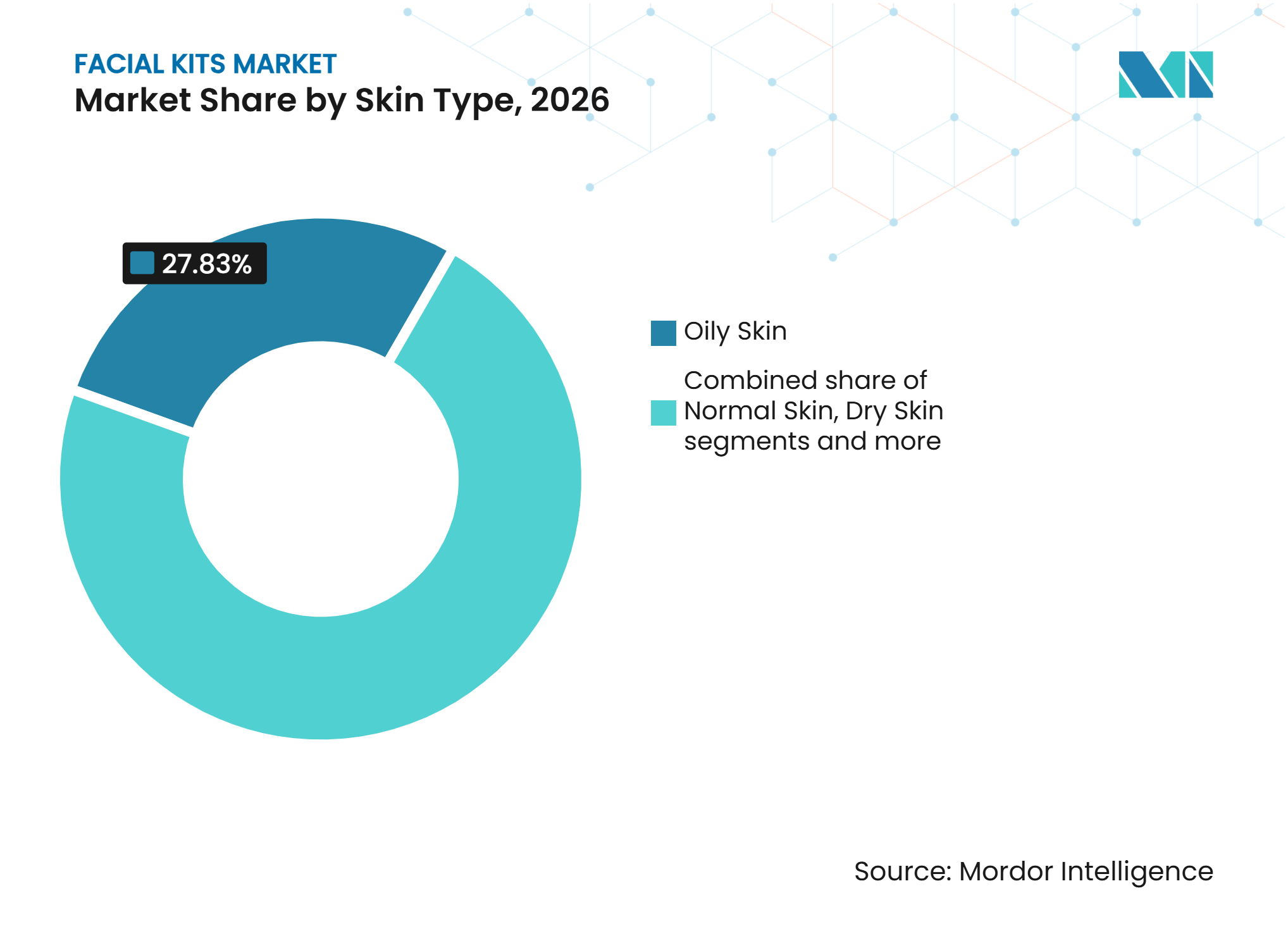
Oily Skin Solutions Define Category DepthOily skin accounts for the largest share of the facial kits market at 27.83% in 2026, supported by consumer demand for products addressing excess sebum, clogged pores, and acne-related concerns. Consumers with oily skin increasingly seek facial treatments that help maintain skin balance, manage oil production, and improve overall skin appearance. The broad applicability of purifying, cleansing, and oil-control formulations across regular skincare routines further supports this segment's leading position. Facial kits combining multiple treatment steps for oily skin provide convenient solutions for consumers seeking targeted skincare benefits.
Sensitive skin is the fastest-growing skin-type segment, registering a CAGR of 7.36% during 2027–2032, reflecting increasing consumer attention to skin compatibility and gentle skincare formulations. Demand is supported by growing interest in products designed to address irritation, redness, and skin sensitivity while maintaining hydration and skin comfort. Normal skin continues to represent an established consumer base, with demand supported by general skincare maintenance and routine facial treatments. Dry skin kits attract consumers seeking moisturizing and nourishing formulations, while combination skin products address the varying skincare requirements of consumers experiencing both oily and dry areas.

By Category:
Mass Leads as Premium Accelerates Structural MomentumThe mass category accounts for the largest share of the facial kits market at 61.74% in 2026, supported by broad consumer accessibility and demand for affordable skincare solutions. Mass-market facial kits offer convenient alternatives to professional facial treatments, allowing consumers to incorporate multi-step skincare routines into their regular personal care practices. Their accessible pricing and availability across retail channels support wider adoption among consumers seeking value-oriented facial care products. The availability of formulations addressing different skin types and concerns further reinforces the segment's leading position.
The premium category is the fastest-growing segment, registering a CAGR of 6.97% during 2027–2032, supported by increasing consumer interest in enhanced skincare experiences and specialized formulations. Demand is encouraged by growing awareness of premium ingredients, targeted treatment benefits, and product quality. The availability of facial kits incorporating ingredients such as hyaluronic acid, peptides, and niacinamide is also broadening the appeal of premium offerings. Additionally, the increasing overlap between professional-grade facial treatments and at-home skincare products is creating opportunities for premium facial kits to attract consumers seeking more specialized beauty solutions.
By Distribution Channel:
Digital Commerce Becomes the Primary Sales VenueOnline retail stores account for the largest share of the facial kits market at 35.28% in 2026 and are also the fastest-growing distribution channel, registering a CAGR of 7.47% during 2027–2032. Their leading position is supported by increasing consumer preference for convenient purchasing, wider product accessibility, and the availability of diverse facial care offerings across digital platforms. Online channels also enable consumers to compare product formulations, evaluate customer reviews, and discover new products through digital content and recommendations. The growing integration of beauty content and online shopping is further strengthening the role of e-commerce in facial kit distribution.
Supermarkets and hypermarkets remain important distribution channels, particularly for consumers preferring to purchase facial care products during routine shopping trips. Beauty and health stores support product discovery through specialized assortments and opportunities for consumers to explore different skincare formulations. Other distribution channels, including salons, direct-to-consumer websites, and specialty retailers, provide additional purchasing avenues and cater to specific consumer preferences. The continued availability of facial kits across these channels supports wider product accessibility and enables manufacturers to reach diverse consumer groups.
Geography Analysis
Asia-Pacific
Asia-Pacific accounts for the largest share of the global facial kits market at 33.86% in 2026, supported by established skincare routines, growing beauty consciousness, and increasing consumer expenditure on personal care products. Countries such as India, China, South Korea, Indonesia, and Thailand contribute to regional demand through widespread adoption of facial treatments and multi-step skincare practices. The region also benefits from a well-established beauty and personal care industry, strong domestic product availability, and growing consumer interest in ingredient-focused formulations. Increasing digital retail adoption and the influence of beauty content are further supporting product discovery and accessibility, strengthening demand for facial kits across the region.
South America
South America is the fastest-growing regional market, registering a projected CAGR of 7.39% during 2027–2032, supported by increasing consumer expenditure on beauty and personal care products. Growing awareness of skincare routines and rising interest in facial treatments are encouraging consumers to incorporate specialized skincare products into their personal care practices. Brazil, Colombia, Chile, and Peru represent important markets, with expanding skincare adoption and increasing availability of beauty products through modern retail channels. The growing influence of international beauty trends, ingredient-focused formulations, and digital product discovery is further creating opportunities for facial kit manufacturers across the region.
North America, Europe, and Middle East and Africa
North America benefits from established beauty and personal care markets, relatively high consumer spending, and growing interest in premium and specialized skincare products. Europe represents a mature market, supported by established cosmetic retail networks and consumer demand for efficacy-oriented skincare formulations across countries such as Germany, France, Italy, and Spain. Meanwhile, the Middle East and Africa offer emerging opportunities, particularly in the Gulf Cooperation Council (GCC) countries, where expanding modern retail infrastructure and demand for premium beauty products are supporting market development. Markets such as South Africa and Nigeria also present opportunities through increasing awareness of facial care routines and improving access to packaged skincare products.
Competitive Landscape
Market Concentration
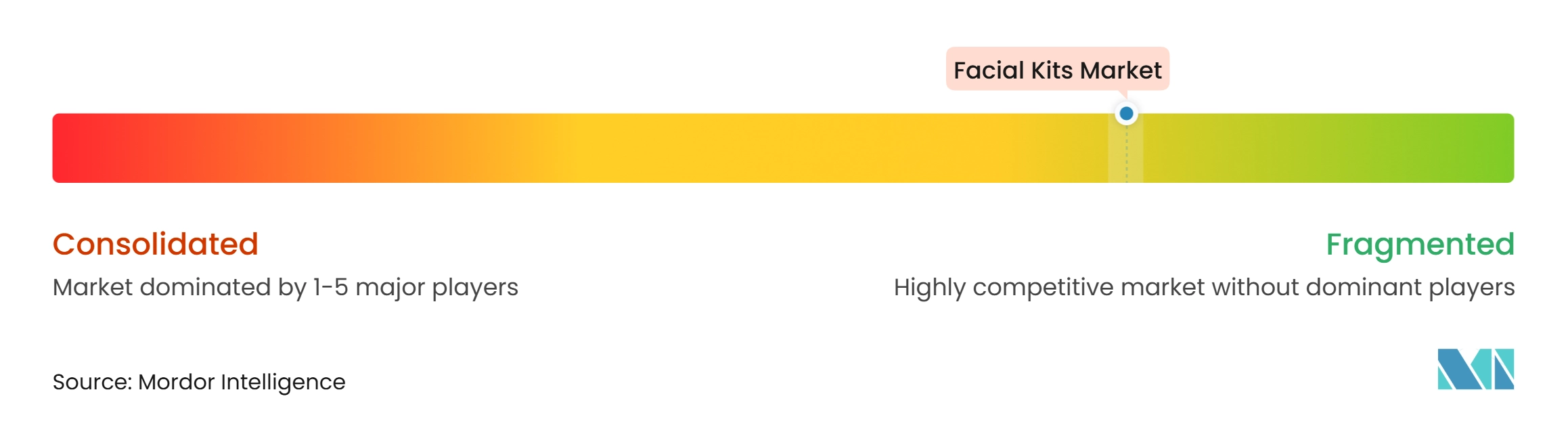
The facial kits market is fragmented, characterized by the presence of established international beauty companies and regional specialists, with no single player exercising significant control over the overall market. Leading participants include Christina Cosmetics, Casmara, Lotus Herbals Pvt. Limited, VLCC Limited, and Dabur India Limited, which maintain competitive positions through established product portfolios, brand recognition, distribution networks, and presence across retail skincare channels. Competition is primarily shaped by product formulation, pricing, brand positioning, treatment specialization, and accessibility across different consumer groups.
Leading players are focusing on expanding their facial kit portfolios through new formulations, product upgrades, and treatments addressing specific skin concerns. Companies are increasingly incorporating ingredient-focused formulations, botanical extracts, and specialized skincare components to strengthen product differentiation and address evolving consumer preferences. Portfolio expansion across mass-market and premium offerings, alongside greater emphasis on digital marketing, salon partnerships, and retail distribution, remains central to competitive strategies. These activities reflect efforts to strengthen brand positioning and reach a broader consumer base.
Emerging players are increasingly targeting opportunities through specialized formulations, digitally driven brand positioning, and products designed around specific skincare needs. Newer brands are focusing on ingredient transparency, targeted treatment benefits, and convenient at-home facial care solutions to attract consumers seeking alternatives to established offerings. Direct-to-consumer distribution, social media engagement, and online product discovery are also providing emerging participants with opportunities to build brand visibility and reach consumers without relying entirely on traditional retail and salon networks.
Facial Kits Industry Leaders
-
Christina Cosmetics
-
Casmara
-
Lotus Herbals Pvt Limited
-
VLCC Limited
-
Dabur India Limited
- *Disclaimer: Major Players sorted in no particular order
Facial Kits Market Companies Covered in this Report
- Sonage Skincare
- Christina Cosmetics
- Casmara
- Kaeso Beauty
- Kanpeki Labs
- Clover Cosmetics Company Limited
- Cosmecnique Beauty Gallery Sdn Bhd
- Visage Beauty & Health Care Private Limited (O3+)
- Lotus Herbals Pvt Limited
- VLCC Limited
- Dabur India Limited
- Nature's Essence
- Raaga Professional
- Biotique
- Aroma Magic
- Shahnaz Husain
- OxyGlow Professional
- Serenite Professional
- FYC Professional
- Skinolin
Recent Industry Developments in Facial Kits Market
- May 2026: FACE FOUNDRIÉ relaunched its Glow On The Go Facial Kit, a six-step at-home facial treatment containing a cleanser, exfoliant, mask, serum, eye cream, and moisturiser. The relaunch restored the brand's e-commerce facial-kit offering, targeting consumers seeking convenient, multi-step facial treatments at home.
- January 2026: Ozone Ayurvedics introduced its Platinum Facial Kit, a six-step at-home facial treatment targeting fine lines, wrinkles, and dullness. The kit is positioned as a salon-inspired skincare experience for consumers seeking facial treatments at home.
- November 2025: FEM launched two single-use facial kits, Niacinamide Glass Glow and Hyaluronic Lumi Bright, marking its entry into the single-use facial-kit category. The seven-step at-home treatments incorporate ingredients such as niacinamide, hyaluronic acid, 24K gold, and red algae. Actress Sonam Bajwa was appointed as the brand face for the launch.
- September 2025: VLCC partnered with actress Tamannaah Bhatia as the brand ambassador for its facial-kit portfolio. The partnership was intended to strengthen consumer engagement and promote the company's facial-kit offerings through a consumer-facing brand campaign.
Global Facial Kits Market Report Scope
The facial kits market comprises packaged facial care products combining multiple treatment steps to provide skincare solutions addressing different skin concerns and skin types. The market includes facial kits offered across mass-market and premium categories through various retail and distribution channels. The market is segmented by facial kit type into gold facial kits, diamond facial kits, platinum facial kits, fruit-based facial kits, and others; skin concern into brightening and radiance, anti-ageing, hydration and nourishment, acne and oil control, tan removal and pigmentation, and others; skin type into normal skin, dry skin, oily skin, combination skin, and sensitive skin; category into mass and premium; distribution channel into supermarkets and hypermarkets, beauty and health stores, online retail stores, and other distribution channels; and geography into North America, Europe, Asia-Pacific, South America, and the Middle East and Africa. The market forecasts are provided in terms of value in USD.
Segmentation Overview
| Gold Facial Kits |
| Diamond Facial Kits |
| Platinum Facial Kits |
| Fruit-based Facial Kits |
| Others |
| Brightening & Radiance |
| Anti-ageing |
| Hydration & Nourishment |
| Acne & Oil Control |
| Tan Removal & Pigmentation |
| Others |
| Normal Skin |
| Dry Skin |
| Oily Skin |
| Combination Skin |
| Sensitive Skin |
| Mass |
| Premium |
| Supermarkets/Hypermarkets |
| Beauty and Health Stores |
| Online Retail Stores |
| Other Distribution Channels |
| North America | United States |
| Canada | |
| Mexico | |
| Rest of North America | |
| Europe | Germany |
| United Kingdom | |
| Italy | |
| France | |
| Spain | |
| Netherlands | |
| Poland | |
| Belgium | |
| Sweden | |
| Rest of Europe | |
| Asia-Pacific | China |
| India | |
| Japan | |
| Australia | |
| Indonesia | |
| South Korea | |
| Thailand | |
| Singapore | |
| Rest of Asia-Pacific | |
| South America | Brazil |
| Argentina | |
| Colombia | |
| Chile | |
| Peru | |
| Rest of South America | |
| Middle East and Africa | South Africa |
| Saudi Arabia | |
| United Arab Emirates | |
| Nigeria | |
| Egypt | |
| Morocco | |
| Turkey | |
| Rest of Middle East and Africa |
| By Facial Kit Type | Gold Facial Kits | |
| Diamond Facial Kits | ||
| Platinum Facial Kits | ||
| Fruit-based Facial Kits | ||
| Others | ||
| By Skin Concern | Brightening & Radiance | |
| Anti-ageing | ||
| Hydration & Nourishment | ||
| Acne & Oil Control | ||
| Tan Removal & Pigmentation | ||
| Others | ||
| By Skin Type | Normal Skin | |
| Dry Skin | ||
| Oily Skin | ||
| Combination Skin | ||
| Sensitive Skin | ||
| By Category | Mass | |
| Premium | ||
| By Distribution Channel | Supermarkets/Hypermarkets | |
| Beauty and Health Stores | ||
| Online Retail Stores | ||
| Other Distribution Channels | ||
| By Geography | North America | United States |
| Canada | ||
| Mexico | ||
| Rest of North America | ||
| Europe | Germany | |
| United Kingdom | ||
| Italy | ||
| France | ||
| Spain | ||
| Netherlands | ||
| Poland | ||
| Belgium | ||
| Sweden | ||
| Rest of Europe | ||
| Asia-Pacific | China | |
| India | ||
| Japan | ||
| Australia | ||
| Indonesia | ||
| South Korea | ||
| Thailand | ||
| Singapore | ||
| Rest of Asia-Pacific | ||
| South America | Brazil | |
| Argentina | ||
| Colombia | ||
| Chile | ||
| Peru | ||
| Rest of South America | ||
| Middle East and Africa | South Africa | |
| Saudi Arabia | ||
| United Arab Emirates | ||
| Nigeria | ||
| Egypt | ||
| Morocco | ||
| Turkey | ||
| Rest of Middle East and Africa | ||
Key Questions Answered in the Report
What is the forecast for facial kits through 2032?
The market is projected to reach USD 5.69 billion by 2032 from USD 3.98 billion in 2026, growing at a 6.45% CAGR from 2027 to 2032.
Which facial kit type has the largest share?
Fruit-based kits lead with 28.37% share in 2026 and are forecast to grow at 7.13% CAGR through 2032.
Which skincare concern is growing fastest in facial kits?
Acne and oil control is the fastest-growing skin concern segment, with a projected CAGR of 7.28% from 2027 to 2032.
Which region offers the fastest growth for facial kits?
South America is expected to grow at a 7.39% CAGR from 2027 to 2032.