
Fabric Wallpaper Market Size and Share
Market Overview
| Study Period | 2020 - 2031 |
|---|---|
| Market Size (2026) | USD 1.09 Billion |
| Market Size (2031) | USD 1.31 Billion |
| Growth Rate (2026 - 2031) | 3.72 % |
| Fastest Growing Market | Asia-Pacific |
| Largest Market | North America |
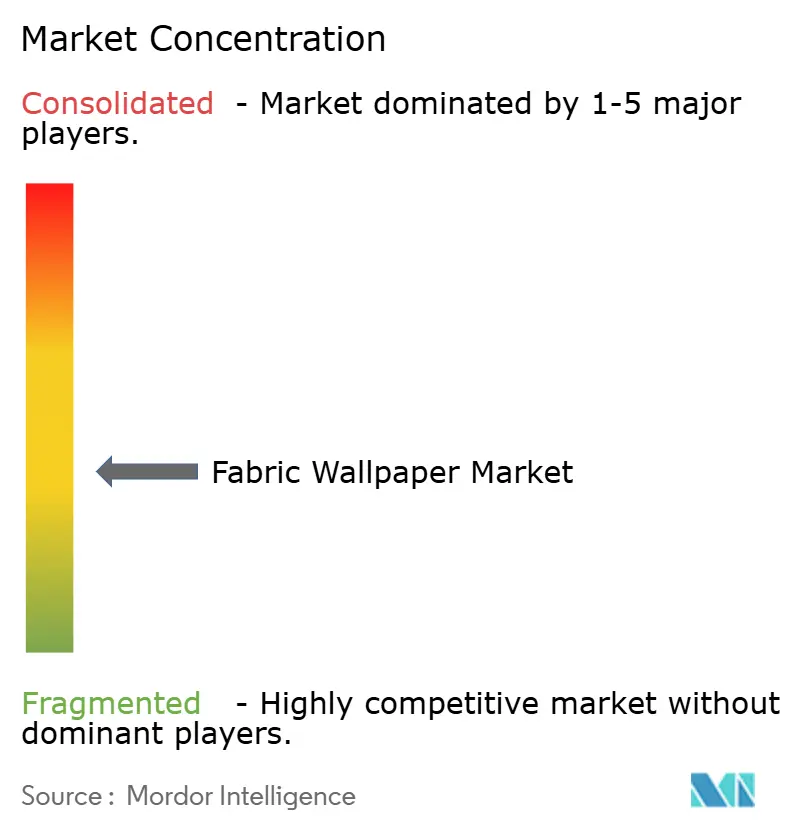
| Market Concentration | Medium |
Major Players *Disclaimer: Major Players sorted in no particular order Image © Mordor Intelligence. Reuse requires attribution under CC BY 4.0. | |
Fabric Wallpaper Market Analysis by Mordor Intelligence
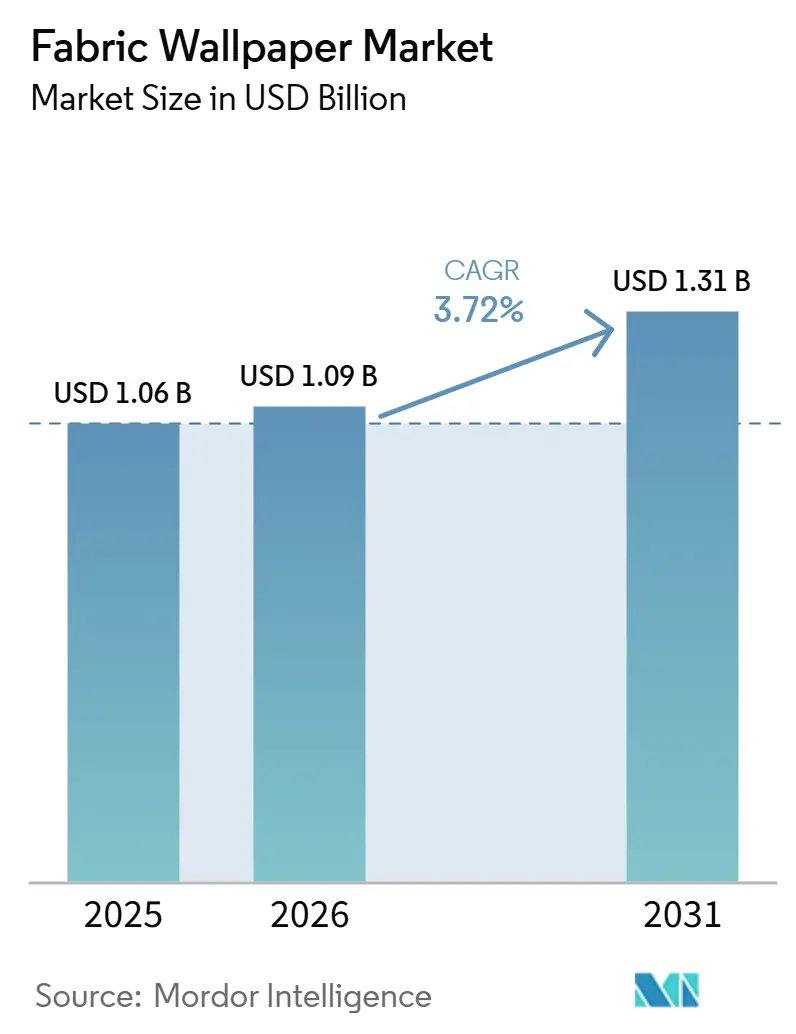
The fabric wallpaper market size was valued at USD 1.06 billion in 2025 and estimated to grow from USD 1.09 billion in 2026 to reach USD 1.31 billion by 2031, at a CAGR of 3.72% during the forecast period (2026-2031). The fabric wallpaper market is supported by demand for textured surfaces that combine design value with acoustic and indoor environmental performance. Premium residential renovations, hotel refresh programs, office refits, and healthcare projects are expanding the range of projects that specify textile surfaces. Procurement is moving toward architects, designers, contractors, and institutional buyers, which places greater value on documented performance, material health credentials, and reliable installation support. Producers with digital printing capacity can accommodate shorter custom runs and reduce delivery times, while producers with verified recycled or bio-based materials can meet more stringent project requirements. Competition remains shaped by the contrast between Asian production scale, European design heritage, and North American contract-market certifications.
Key Report Takeaways
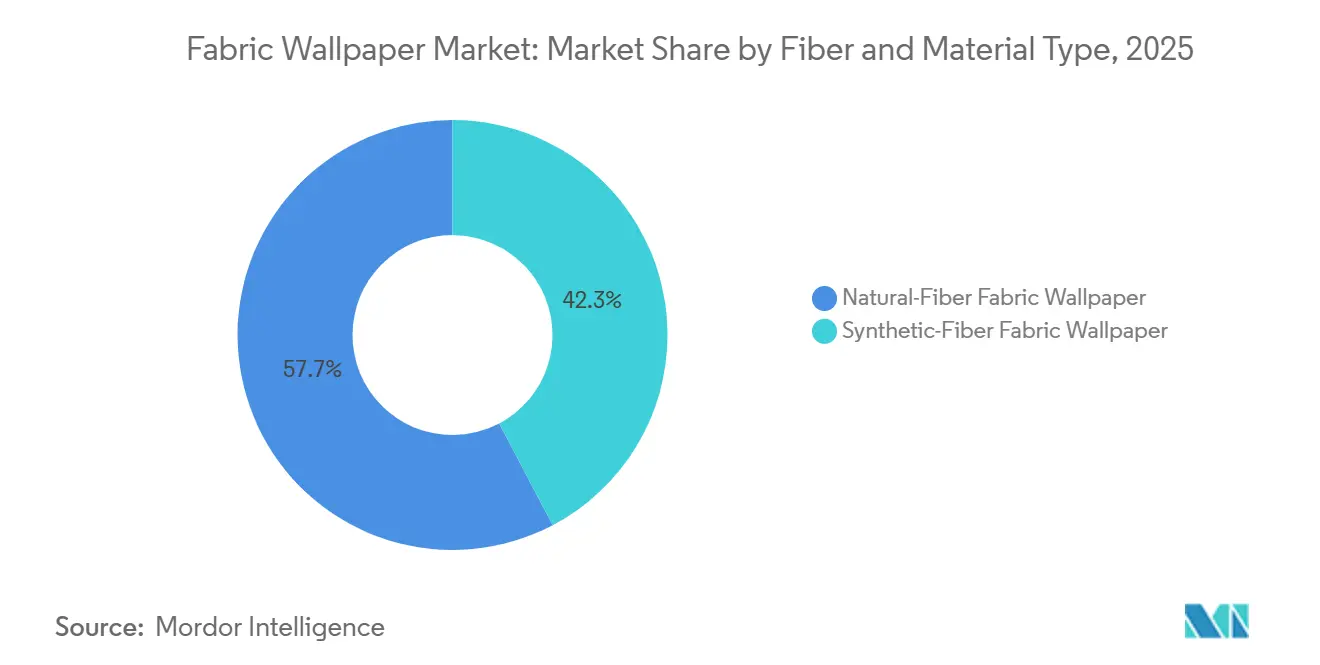
- By fiber and material type, synthetic-fiber fabric wallpaper led the fabric wallpaper market with a 42.28% revenue share in 2025, while natural-fiber fabric wallpaper is forecast to expand at an 4.8% CAGR through 2031.
- By application, renovation and remodeling accounted for 60.6% of the fabric wallpaper market share in 2025 and is projected to grow at a 4.3% CAGR through 2031.
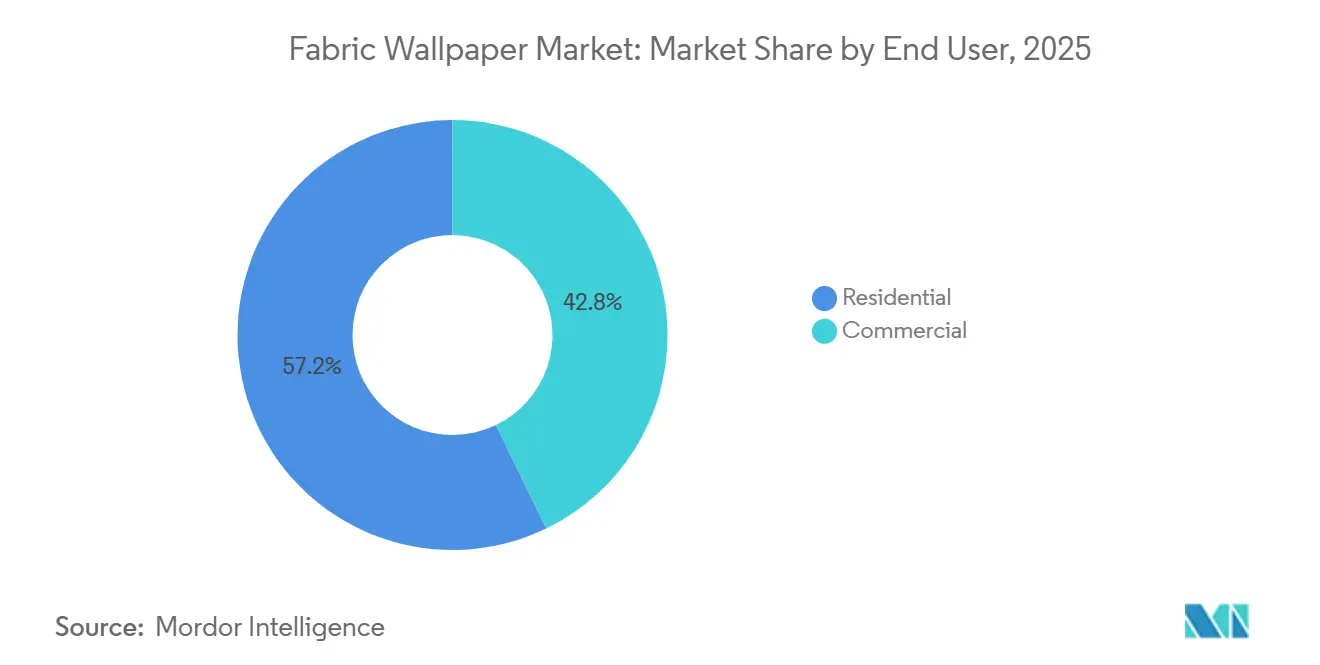
- By end user, residential users accounted for 57.18% of demand in the fabric wallpaper market in 2025 and recorded the highest projected CAGR of 4.5% through 2031.
- By distribution channel, B2C accounted for 64.16% of demand in the fabric wallpaper market in 2025 and is forecast to expand at a 4.2% CAGR through 2031.
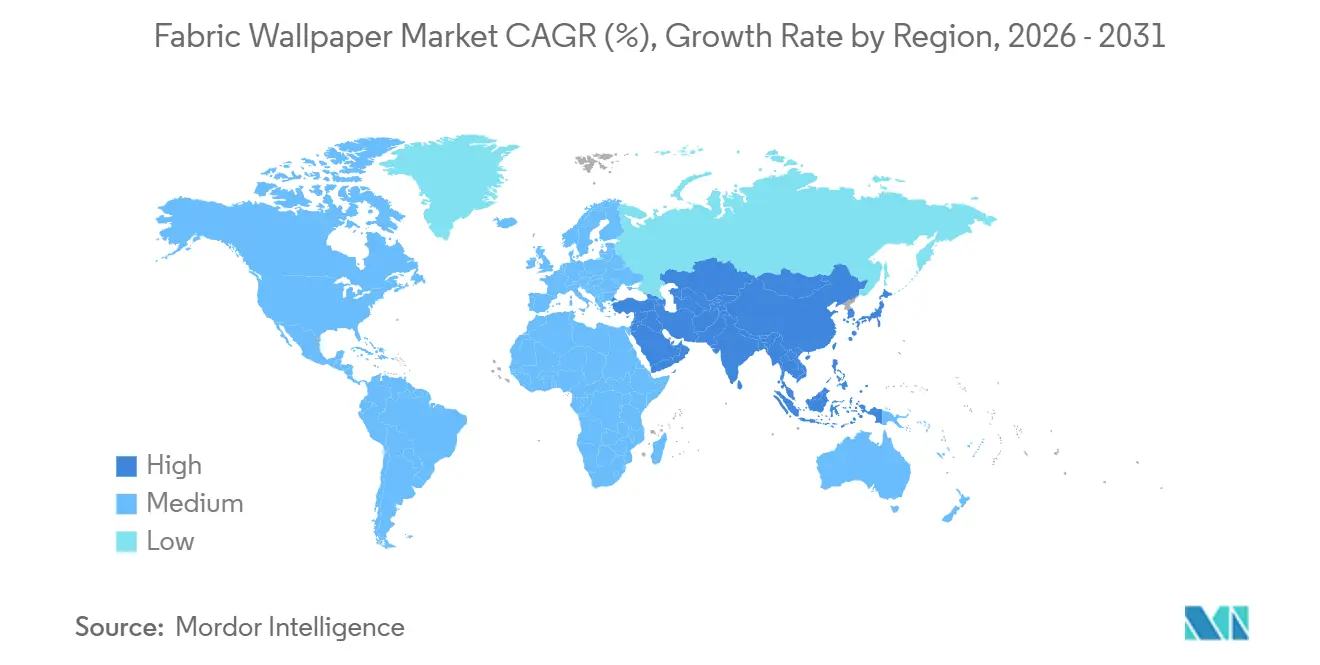
- By geography, North America led the fabric wallpaper market with a 34.27% share in 2025, while Asia-Pacific is forecast to grow at a 5.5% CAGR through 2031.
Note: Market size and forecast figures in this report are generated using Mordor Intelligence’s proprietary estimation framework, updated with the latest available data and insights as of January 2026.
Market Trends and Insights
Drivers Impact Analysis of Fabric Wallpaper Market*
| Driver | (~) % Impact on CAGR Forecast | Geographic Relevance | Impact Timeline |
|---|---|---|---|
| Premium Interior Design and Luxury Décor Demand | +0.9% | Global, led by North America, the European Union, and the GCC | Medium term (2-4 years) |
| Commercial Renovation Across Hospitality, Offices, Retail, and Healthcare | +1.1% | Global, with concentrated activity in the Middle East, Africa, and Asia-Pacific | Medium term (2-4 years) |
| Demand for Acoustic and Indoor-Environmental Performance | +0.8% | North America and the European Union, LEED and WELL-driven markets | Medium term (2-4 years) |
| Digital Printing and Bespoke Short-Run Customization | +0.7% | Global | Short term (≤ 2 years) |
| Growth of Sustainable, PVC-Free, and Low-VOC Textile Wallcoverings | +0.6% | North America, the European Union, and the core Asia-Pacific markets | Medium term (2-4 years) |
| Design Specification Through Online Visualization and Digital Procurement | +0.4% | Global | Short term (≤ 2 years) |
| Source: Mordor Intelligence | |||
Premium Interior Design and Luxury Décor Demand Drives Specification Upgrades
Premium interior projects increasingly use fabric wallcoverings beyond single-feature walls, specifying them throughout entire rooms. The 2026 United States Houzz and Home Study reported that 54% of United States homeowners renovated in 2025, with median spending of USD 20,000 and top-decile project spending of USD 150,000, up 7% year over year [1]Houzz, “2026 U.S. Houzz and Home Study,” Houzz, houzz.com.. This spending profile supports demand for distinctive finishes in higher-value renovation work. Wallpaper selection is also moving earlier in the design process, giving surface materials greater influence over furniture, lighting, and color choices. Projects exceeding USD 50,000 commonly use professional installers, preserving the role of specialty contractors in premium specifications. F. Schumacher, The Romo Group, and Osborne & Little benefit when interior architects select materials on design authority rather than price alone. The fabric wallpaper market, therefore, draws support from a renovation tier that places greater value on visual differentiation and professional execution.
Commercial Renovation across Hospitality, Offices, Retail, and Healthcare Supports Demand
Hotels renew room interiors on recurring cycles that are commonly shorter than a building’s overall life. That pattern creates demand for wallcovering specifications that are separate from new construction. Hospitality projects use fabric surfaces in guest rooms, corridors, and public areas where design consistency, durability, and acoustic comfort matter together. Office refits also place greater weight on acoustic privacy in meeting rooms and shared work areas as hybrid work arrangements continue. Healthcare projects create another outlet for textile products that can meet antimicrobial, mold-resistance, and cleanability requirements. AATCC 147 antimicrobial testing and ASTM G21 mold-resistance testing are relevant to material selection in patient-facing areas. These uses do not replace vinyl in every setting, but they support a multi-material specification approach. Momentum Textiles & Wallcovering identified digital nomad accommodations and hospitality interiors designed for video conferencing as current commercial design considerations. Textured surfaces can be selected for video backgrounds, which adds a use case that was not present in earlier commercial renovation cycles. This broadens the addressable specification base for the fabric wallpaper market across hospitality, workplace, retail, and healthcare settings.
Demand for Acoustic and Indoor-Environmental Performance Reshapes Contract Specification
Open-plan workplace layouts and greater attention to indoor environmental quality have increased the relevance of acoustic surface materials. Fabric wallcoverings can address visual design, acoustic comfort, and material health requirements within a single specification. LEED v4.1 and the WELL Building Standard include indoor air quality and acoustic considerations that can favor products with low-emitting certifications. SCS Indoor Advantage Gold certification is one product-level route used to document indoor air quality performance. Carnegie Fabrics presents its biobased Xorel material as carrying Cradle to Cradle Gold certification and an embodied-carbon figure of 1.12 kg CO2 per yard. These credentials enable project teams to consider acoustic performance, material health, and circular design goals together. Hybrid workplace retrofits can also use modular acoustic fabric panels without a complete building fit-out. That can shorten procurement and installation cycles compared with structural renovation. The fabric wallpaper market benefits when these performance requirements are considered at the earliest stage of contract design.
Digital Printing and Bespoke Short-Run Customization Reshapes Production Economics
Digital printing has reduced the practical minimum order size for customized wallcoverings. It allows producers to fulfill location- or project-specific designs without the need for traditional screen or cylinder preparation. Integrated producers have used Canon’s UVgel platform to support 200-300 custom orders per day with minimal staff involvement. This production model can reduce lead times to 48 hours for specialist producers. Roland DG released the DIMENSE DA-640 in June 2025, adding dimensional and full-color embossed-surface capabilities to on-demand production. Digital printing accounted for minimum share of wallpaper volume, but its value contribution could be stronger because custom designs command higher selling prices. Short-run capacity enables producers to compete for bespoke briefs while avoiding large inventory commitments. It also improves the relevance of online visualization tools, because customers can order a design after viewing it in a scaled room rendering. This capability shifts some of the competition in the fabric wallpaper market from catalog breadth to response time, customization, and production flexibility.
Restraints Impact Analysis of Fabric Wallpaper Market*
| Restraint | (~) % Impact on CAGR Forecast | Geographic Relevance | Impact Timeline |
|---|---|---|---|
| High Installation Skill Requirements and Surface-Preparation Costs | -0.5% | Global, acute in Asia-Pacific and emerging markets | Long term (≥ 4 years) |
| Price Competition From Vinyl, Nonwoven, Paint, and Wall Panels | -0.7% | Price-sensitive markets in Asia-Pacific, the Middle East and Africa, and South America | Medium term (2-4 years) |
| Textile Fiber, Backing, Adhesive, and Coating Complexity Limits Recycling | -0.3% | European Union, with stricter EPR and circular-economy regulation | Long term (≥ 4 years) |
| Fire, VOC, Cleanability, and Performance Certification Burden for Contract Projects | -0.4% | North America and the European Union | Medium term (2-4 years) |
| Source: Mordor Intelligence | |||
High Installation Skill Requirements Constrain Mid-Market Penetration
Fabric wallcovering installation requires careful wall repair, primer selection, seam matching, and surface preparation. These requirements are more demanding than those for paint application or for many paste-the-wall nonwoven formats. Installation cost, therefore, remains a meaningful part of the delivered project cost. These limits do-it-yourself use and concentrate demand in professionally managed renovation work. A shortage of skilled construction labor in North America and Europe adds pressure to this constraint. The issue is structural because fabric installation skills require training and practice, not a short adjustment in labor availability. Specialty installers may retain stronger margins, but thinner installer networks can limit adoption in new geographies. Paste-the-wall formats and modular panel systems reduce part of the burden. Their adoption has not fully closed the gap between demand for textile finishes and the availability of qualified installers. The fabric wallpaper industry must balance product design with practical installation support to broaden use beyond the upper end of renovation work.
Price Competition From Vinyl, Nonwoven, Paint, and Wall Panels Limits Value Growth
Fabric wallcoverings compete with vinyl, nonwoven wallpaper, paint, and clip-on acoustic wall panels. Many of these alternatives have lower material and installation costs per square meter. Wall panels also combine acoustic control with rapid installation, making them relevant for meeting rooms and open-plan spaces. Mid-range synthetic products face the most pressure when they cannot show a clear acoustic, environmental, or design advantage. Multi-layer fiber, backing, adhesive, and coating structures can also complicate recycling under extended producer responsibility requirements. Fire, VOC, and cleanability certifications add a technical burden to contract projects, including requirements for ASTM E84, ISO 22196, and AATCC 147 [2]International Organization for Standardization, “Standards,” International Organization for Standardization, iso.org.. Products with bio-based content, documented low emissions, acoustic certification, or digital customization have more ways to defend their value. The fabric wallpaper market consequently faces its sharpest price pressure where product differentiation is limited.
*Our forecasts treat driver/restraint impacts as directional, not additive. The impact forecasts reflect baseline growth, mix effects, and variable interactions.
Fabric Wallpaper Market Segment Analysis
By Fiber and Material Type:
Synthetic Volume Leads While Bio-Based Formats Grow FasterSynthetic-fiber fabric wallpaper held 42.28% of the fabric wallpaper market share in 2025. Polyester, viscose, and polypropylene substrates support printability, dimensional stability, and abrasion resistance across residential and contract projects. Their broad compatibility with backing systems helps producers offer paste-the-wall formats as well as Type II commercial products. Synthetic materials can also support fire-rating requirements without adding a separate chemical treatment in every product design. These features help the segment serve a wide price range. Natural-fiber fabric wallpaper is forecast to grow at an 4.8% CAGR through 2031, the highest rate among material types. The growth reflects demand for verified bio-based content and Environmental Product Declarations (EPD) in projects guided by LEED v4.1, WELL, or Cradle to Cradle requirements. Carnegie Fabrics states that its Xorel material can contain up to 91% biobased content from sugarcane and carries Cradle to Cradle Gold certification. Favini updated its Refit substrate in Milan in May 2026, with 40% recovered textile fiber and 50% total recycled content, and is certified under FSC and the Global Recycled Standard. These developments make the backing layer more important to environmental product positioning. The fabric wallpaper market size for sustainable materials is supported by documented composition and traceability rather than surface appearance alone.
Natural-fiber products include cotton, linen, silk, jute, grasscloth, and wool. They occupy a premium position where provenance and texture influence selection in luxury homes and hospitality projects. Their buyer base is less exposed to the pricing dynamics of the synthetic tier. Blended-fiber products combine the appearance of natural fibers with the stability of synthetic yarns. This makes them relevant to contract settings that require consistent performance in accordance with ASTM standards. Flocked and embossed textile wallpaper serves a smaller high-design residential use case where three-dimensional texture is central to the design brief. EU REACH and California Proposition 65 also influence choices of fiber, finish, and chemical content [3]California Office of Environmental Health Hazard Assessment, “Proposition 65,” OEHHA, oehha.ca.gov.. Health Product Declarations can provide an additional advantage in institutional and green-building projects. Producers are therefore placing more attention on traceable raw materials and documented product chemistry. The fabric wallpaper industry has room for both high-volume synthetic products and premium natural or circular material formats.



By Application:
Renovation Leads Through Recurring Refresh CyclesRenovation and remodeling accounted for 60.06% of the fabric wallpaper market size in 2025 and is forecast to grow at a 4.3% CAGR through 2031. The segment combines the largest application share with the fastest application growth rate. This position reflects recurring upgrades rather than only a short-term increase in renovation spending. High-value renovation programs often use wall finishes to change a room's feel without altering its structure. Larger projects can allocate funds to specialty wall finishes because they consider durability, design distinction, and installation quality together. Hotel refresh cycles create similar recurring demand, especially when room upgrades require coordinated finishes. Office refits connected to hybrid work also support textile specifications where acoustic performance is relevant.
New construction represented the remaining 39.94% of application demand in 2025. It is most relevant to premium residential developments and commercial projects in the GCC, India, and Southeast Asia. International design consultancies often specify fabric wallcoverings during the design intent stage of luxury hospitality projects. That process can make fabric surfaces a default choice for premium room categories. Educational and healthcare facilities provide another new-build use case. Those projects can integrate acoustic fabric wall systems that align with low-VOC and PVC-free material preferences and acoustic goals. This application pathway is distinct from renovation demand. It extends the fabric wallpaper market into projects where material specifications are established well before occupancy. The relative balance between renovation and construction will remain important to manufacturers’ product planning.
By End User:
Residential Demand Leads While Commercial Buyers Grow FasterResidential end users accounted for 57.18% of demand in 2025 and are forecast to grow at a 4.5% CAGR through 2031. This lead indicates a preference for tactile, textured interiors in higher-value home projects. Grasscloth, linen, and embossed textile surfaces are moving from small accent areas to more complete room applications. Designers increasingly select wall surfaces before finalizing furniture, which makes wallcoverings more influential in the overall room design. Generation X homeowners had a median project spend of USD 24,000 in 2025, while the top decile spent USD 150,000. This customer group can accommodate premium wall finishes within a wider renovation budget. Residential demand still depends on professional installation for many fabric formats. Producers must therefore support both consumer preferences and the installers who translate those preferences into completed rooms.
Commercial users held the remaining 42.82% share in 2025. Hospitality, corporate, and healthcare procurement combine acoustic needs, sustainability requirements, and recurring renovation programs. Commercial buyers often prioritize fire certification, lifecycle durability, cleanability testing, and relationships with installers. These criteria favor suppliers with documented performance records. Carnegie Fabrics and Muraspec both address contract applications alongside residential product ranges. The commercial segment can be more stable in volume because project teams make selections against established performance requirements. It can also sustain premium prices when the contract requires documentation. The fabric wallpaper market is consequently becoming more dependent on suppliers that can combine visual appeal with technical evidence. That balance shapes supplier investment in testing, certifications, and contractor support.
By Distribution Channel:
B2B Growth Follows Specification-Led PurchasingB2C channels retained 64.16% of demand in 2025 and are forecast to expand at a 4.23% CAGR through 2031. Specialty stores, home centers, and online platforms serve a large share of residential renovation buyers. Online visualization tools can let customers and designers view textile surfaces in scaled room settings before purchase. This reduces the need to rely only on local showroom availability. Digital-first producers can also turn online interest into bespoke orders with short delivery windows. Custom order dispatch within 48 hours has made online purchasing more relevant for bespoke work. Roland DG’s DIMENSE technology supports on-demand dimensional surfaces, while other digital systems reduce the cost of small production runs. Online is therefore not only a reorder channel. It can become a practical way to access custom products when design visualization, manufacturing, and logistics are linked. The channel is most effective when samples, project support, and installer guidance are available alongside digital ordering.
B2B channels, such as contractors, installers, interior designers, architects, and institutional procurement teams, shape this channel. Architects and designers often pre-qualify materials for commercial projects. Their shortlists commonly favor EPDs, LEED-aligned credentials, and demonstrated contract performance. Sangetsu Corporation identified sales growth in hotels, educational facilities, and commercial properties as contributors to improved profitability in its North American segment in its Q3 FY2026 supplementary materials. This result illustrates the role of project-based commercial distribution. It also indicates that high-margin products can be important alongside sales volume. Future competition is likely to be contested at the design specification stage as much as at the retail shelf. Manufacturers with strong consumer brands may still need more direct relationships with specifiers and installers. The fabric wallpaper market gains from channel partners that can translate technical documentation into project selections.
Geography Analysis
North America Fabric Wallpaper Market
North America led with 34.27% regional share in 2025. The region has a mature renovation base, but its slower growth rate does not indicate weak demand. Higher-value projects can sustain spending on premium finishes even when lower-budget renovation activity is less stable. The fabric wallpaper market remains strong in this region, with established designers and installers supporting premium project execution. LEED v4.1 and GREENGUARD Gold thresholds support the use of products that can meet low-emission and green-building requirements. Canada’s renovation activity and Mexico’s hospitality sector provide additional regional demand. Construction of Mexican resorts and hotels can create commercial opportunities for mid-tier and premium textile wallcoverings. The fabric wallpaper market can serve these projects through regional contract distribution and material ranges suited to varied project budgets.
APAC and MEA Fabric Wallpaper Market
Asia-Pacific is forecast to grow at a 5.5% CAGR through 2031, the fastest regional rate. This scale gives Asian supply chains a cost advantage, while China also becomes a premium consumption market in major cities. Urban consumers in tier-1 and tier-2 cities increasingly consider textured fabric wall finishes as an alternative to paint. Housing and commercial real estate activity in technology and financial hubs support this demand. The Middle East and Africa also benefit from hotel construction and premium hospitality projects. Southeast Asia’s hospitality and co-working sectors create further potential as distribution infrastructure expands. Sangetsu announced a regional distribution partnership in Southeast Asia during Q1 2026 for fire-rated fabric wallcoverings used in hospitality and institutional construction [4]Sangetsu Corporation, “Investor Relations,” Sangetsu Corporation, sangetsu.co.jp.. The fabric wallpaper market is well-positioned to benefit from commercial developers seeking design-led finishes with documented safety performance.

Competitive Landscape
The fabric wallpaper market remains moderately fragmented. Competition is divided among companies with design authority, documented performance credentials, and manufacturing scale. European design houses such as Sanderson Design Group, The Romo Group, and F. Schumacher use heritage archives, specifier relationships, and limited-edition collections to support premium positioning. This approach helps them compete where design selection is more important than low unit cost. The fabric wallpaper market consequently supports several viable competitive models rather than a single route to leadership. Sanderson launched the Highgrove by Sanderson collection in May 2025, a 108-piece collection developed with the Highgrove Estate and produced at its United Kingdom factories. The launch demonstrates how archive-based design and controlled production can create differentiation. Japanese supplier Sangetsu competes through the breadth of its catalog and commercial solutions. Its wallpaper unit reported FY2026 revenue growth of 1.7% to JPY 799.4 billion, and it identified North American hotels, educational facilities, and institutional projects as important to profitability. Belgian specialist Omexco and North American producer Carnegie Fabrics combine design credentials with product documentation. Cradle to Cradle certifications, EPDs, and LEED-related material information can be essential for projects that require transparency. The fabric wallpaper market rewards suppliers that make these credentials clear to architects, contractors, and institutional buyers.
White-space opportunities center on products that combine acoustic functionality, sustainability, and digital customization. Few suppliers offer all 3 elements within a fully integrated product range. Digital production using Canon UVgel, Roland DG DIMENSE, and Xeikon platforms reduces minimum order quantities and can shorten delivery time. This can make bespoke work more accessible to a broader group of commercial and residential buyers. The Wallcoverings Association has supported a pilot take-back recycling program for end-of-life contract wallcoverings, with Wolf-Gordon participating. This program indicates that circularity can become a stronger differentiator as project teams examine embodied carbon and waste records. Texdecor, Wall&decò, and Arte International use limited-edition, artisan-focused collections in premium hospitality and interior design channels. The fabric wallpaper market can create opportunities for smaller suppliers by offering distinctive responses to these design requirements.
Such companies can gain attention beyond their scale by offering distinctive design collections. Established suppliers need to preserve catalog depth while responding to demand for individual project customization. The fabric wallpaper industry remains fragmented because successful strategies differ by region, channel, product certification, and design position. The fabric wallpaper market, therefore, leaves room for specialists who serve a clearly defined design or technical requirement.
Fabric Wallpaper Industry Leaders
Sangetsu Corporation
A.S. Création Tapeten AG
York Wallcoverings, Inc.
Brewster Home Fashions LLC
Grandeco Wallfashion Group NV
- *Disclaimer: Major Players sorted in no particular order
Fabric Wallpaper Market Companies Covered in this Report
- Sangetsu Corporation
- A.S. Création Tapeten AG
- York Wallcoverings, Inc.
- Brewster Home Fashions LLC
- Grandeco Wallfashion Group NV
- F. Schumacher and Co.
- The Romo Group
- Osborne and Little Limited
- Sanderson Design Group plc
- Graham and Brown Limited
- Wolf-Gordon
- Erismann and Cie. GmbH
- Vescom
- Arte International BV
- Omexco NV
- Muraspec Group
- Desima GmbH
- Carnegie Fabrics LLC
- Texdecor
- Wall&decò Srl

Recent Industry Developments in Fabric Wallpaper Market
- July 2026: Carnegie Fabrics launched the “Crush” collection at the June Market, featuring 39 SKUs across 7 patterns for commercial textiles and wallcoverings. Constructions span Greenguard Gold-certified Sunbrella acrylic/polyester blends, recycled Trevira, and Seaqual marine plastic, with PFAS-free and low-emitting formulations that advance Carnegie's sustainability-led contract positioning.
- May 2025: Sanderson Design Group unveiled the “Curios” collection for AW2025–26, a global travel-inspired range of wallpapers, fabrics, and weaves incorporating ikat-style textile wallcoverings and layered print techniques, available through Sanderson's international retailer network.
- March 2025: Newmor, a fabric-backed vinyl wallcovering specialist distributed in over 80 countries, invested in a Canon Colorado M5W wide-format printer and automated Neolt finishing systems, enabling custom wallcovering production with dispatch in as little as 48 hours and reduced material waste, materially expanding its short-run bespoke production capacity.


Global Fabric Wallpaper Market Report Scope
The fabric wallpaper market covers revenues from the sale of textile-based wallcoverings, including synthetic- and natural-fiber products. It assesses demand from renovation and new construction projects across residential and commercial sectors. The study segments the market by material type, application, end user, distribution channel, and geography, covering North America, Europe, Asia-Pacific, South America, and the Middle East and Africa.
| Natural-Fiber Fabric Wallpaper | Cotton Wallpaper |
| Linen Wallpaper | |
| Silk Wallpaper | |
| Jute and Grasscloth Wallpaper | |
| Recycled and Bio-Based Textile Wallpaper | |
| Wool and Other Natural-Fiber Wallpaper | |
| Synthetic-Fiber Fabric Wallpaper | Polyester Wallpaper |
| Viscose and Rayon Wallpaper | |
| Polypropylene Wallpaper | |
| Acrylic and Other Synthetic-Fiber Wallpaper | |
| Blended-Fiber Fabric Wallpaper |
| New Construction |
| Renovation and Remodeling |
| Residential |
| Commercial |
| B2C Channels | Hypermarkets and Supermarkets |
| Specialty Stores | |
| Home Centers | |
| Online | |
| Local Shops | |
| Other Distribution Channels | |
| B2B Channels (Contractors and Installers, Interior Designers and Architects, Project Procurement and Institutional Sales) |
| North America | Canada |
| United States | |
| Mexico | |
| South America | Brazil |
| Peru | |
| Chile | |
| Argentina | |
| Rest of South America | |
| Europe | United Kingdom |
| Germany | |
| France | |
| Spain | |
| Italy | |
| BENELUX (Belgium, Netherlands, Luxembourg) | |
| NORDICS (Denmark, Finland, Iceland, Norway, Sweden) | |
| Rest of Europe | |
| Asia-Pacific | India |
| China | |
| Japan | |
| Australia | |
| South Korea | |
| South-East Asia | |
| Rest of Asia-Pacific | |
| Middle East & Africa | United Arab Emirates |
| Saudi Arabia | |
| South Africa | |
| Nigeria | |
| Rest of Middle East & Africa |
| By Fabric/Material Type | Natural-Fiber Fabric Wallpaper | Cotton Wallpaper |
| Linen Wallpaper | ||
| Silk Wallpaper | ||
| Jute and Grasscloth Wallpaper | ||
| Recycled and Bio-Based Textile Wallpaper | ||
| Wool and Other Natural-Fiber Wallpaper | ||
| Synthetic-Fiber Fabric Wallpaper | Polyester Wallpaper | |
| Viscose and Rayon Wallpaper | ||
| Polypropylene Wallpaper | ||
| Acrylic and Other Synthetic-Fiber Wallpaper | ||
| Blended-Fiber Fabric Wallpaper | ||
| By Application | New Construction | |
| Renovation and Remodeling | ||
| By End User | Residential | |
| Commercial | ||
| By Distribution Channel | B2C Channels | Hypermarkets and Supermarkets |
| Specialty Stores | ||
| Home Centers | ||
| Online | ||
| Local Shops | ||
| Other Distribution Channels | ||
| B2B Channels (Contractors and Installers, Interior Designers and Architects, Project Procurement and Institutional Sales) | ||
| By Geography | North America | Canada |
| United States | ||
| Mexico | ||
| South America | Brazil | |
| Peru | ||
| Chile | ||
| Argentina | ||
| Rest of South America | ||
| Europe | United Kingdom | |
| Germany | ||
| France | ||
| Spain | ||
| Italy | ||
| BENELUX (Belgium, Netherlands, Luxembourg) | ||
| NORDICS (Denmark, Finland, Iceland, Norway, Sweden) | ||
| Rest of Europe | ||
| Asia-Pacific | India | |
| China | ||
| Japan | ||
| Australia | ||
| South Korea | ||
| South-East Asia | ||
| Rest of Asia-Pacific | ||
| Middle East & Africa | United Arab Emirates | |
| Saudi Arabia | ||
| South Africa | ||
| Nigeria | ||
| Rest of Middle East & Africa | ||


Key Questions Answered in the Report
What is the forecast for fabric wallpaper through 2031?
The category is projected to increase from USD 1.09 billion in 2026 to USD 1.31 billion by 2031, at a 3.7% CAGR.
Which material type leads the demand for fabric wallpaper?
Synthetic-fiber products led with 42.28% share in 2025 because they support printability, stability, and broad backing compatibility.
Why is natural-fiber fabric wallpaper growing quickly?
The segment is forecast to grow at an 4.82% CAGR through 2031 as projects increasingly seek verified recycled content, EPDs, and bio-based materials.
Which application is most important for fabric wallcoverings?
Renovation and remodeling accounted for 60.06% of demand in 2025 and is also forecast to grow at a 4.3% CAGR through 2031.
Why are residential buyers becoming more important?
Residential users accounted for 57.18% of demand in 2025 and are forecast to grow at 4.5% through 2031 as households require acoustic, durable, and documented materials.
Which region offers the strongest growth opportunity?
Asia-Pacific is forecast to expand at a 5.5% CAGR through 2031, supported by regional production capacity, urban demand, hospitality, and commercial development.
Page last updated on:


 Your data is secure and never sold or shared.


