
Extended Reality (XR) In Virtual Retail and Immersive E-Commerce Market Size and Share
Market Overview
| Study Period | 2020 - 2031 |
|---|---|
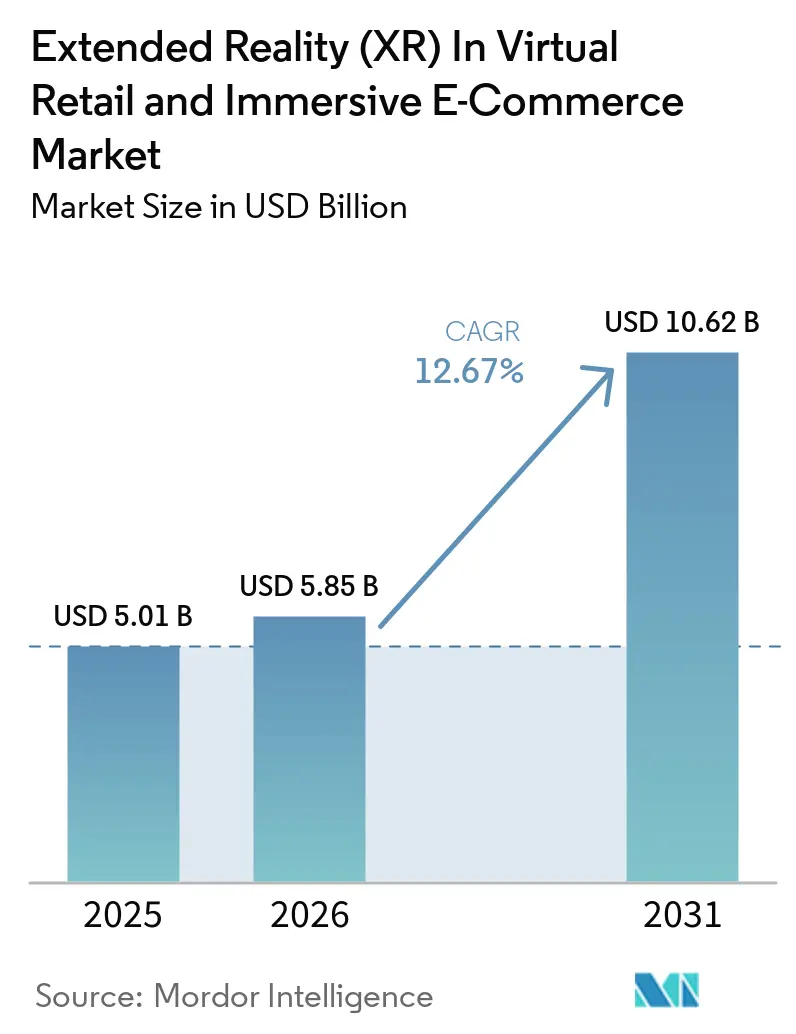
| Market Size (2026) | USD 5.85 Billion |
| Market Size (2031) | USD 10.62 Billion |
| Growth Rate (2026 - 2031) | 12.67 % |
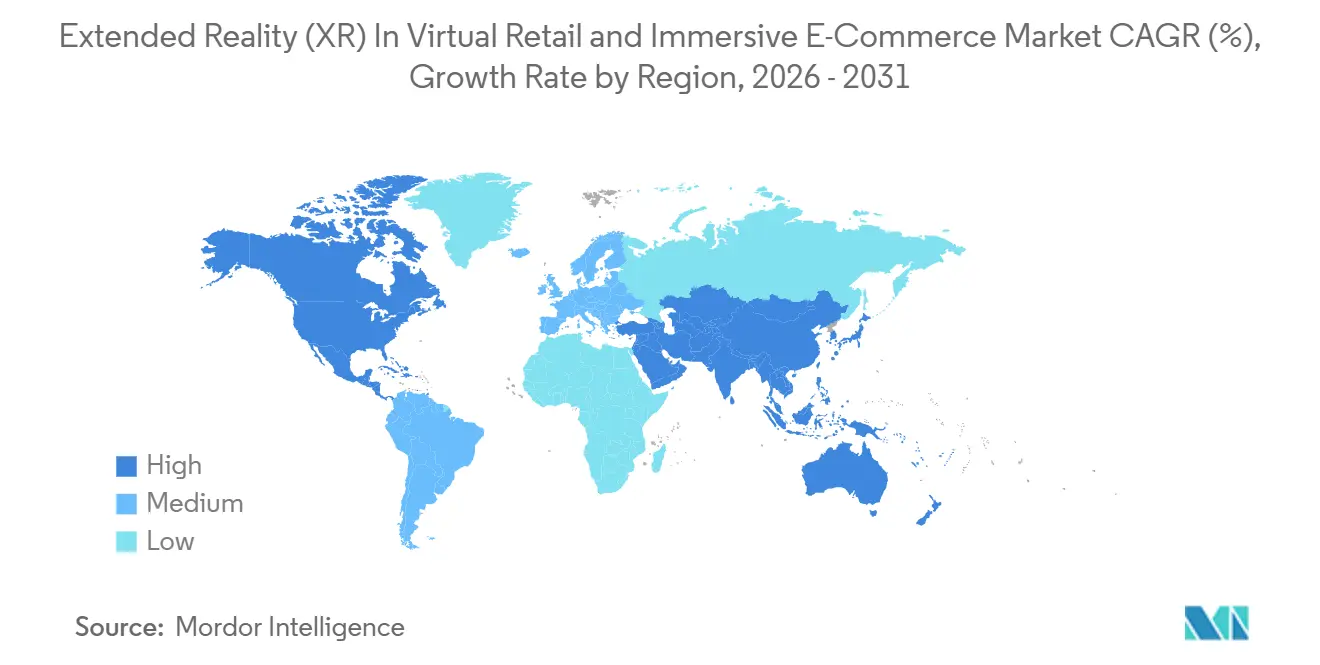
| Fastest Growing Market | Asia-Pacific |
| Largest Market | North America |
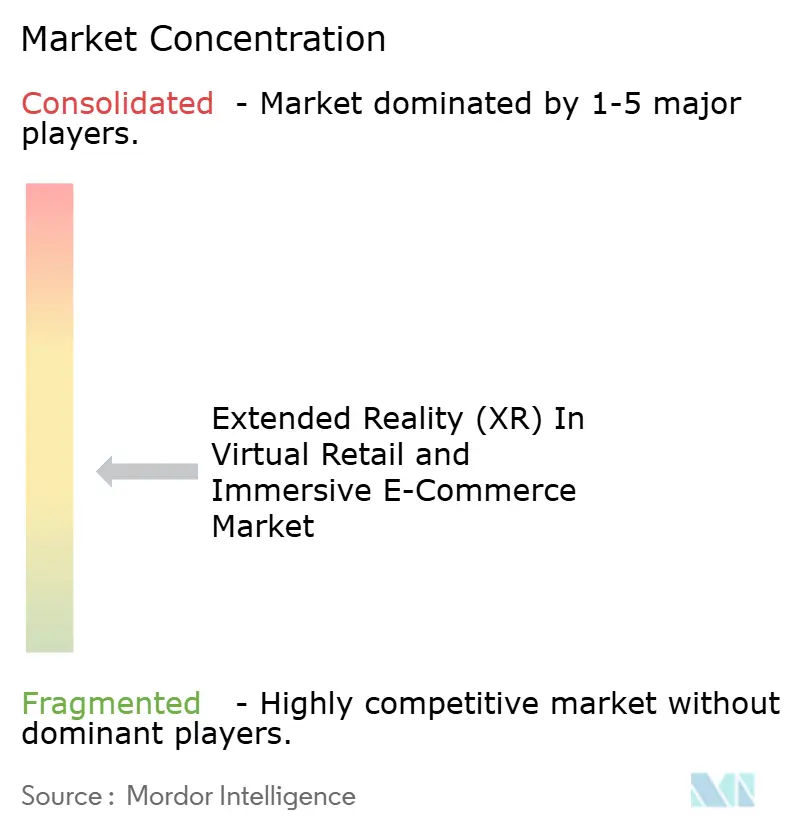
| Market Concentration | Medium |
Major Players *Disclaimer: Major Players sorted in no particular order Image © Mordor Intelligence. Reuse requires attribution under CC BY 4.0. | |
Extended Reality (XR) In Virtual Retail and Immersive E-Commerce Market Analysis by Mordor Intelligence
The extended reality (XR) market size in virtual retail and immersive e-commerce was valued at USD 5.01 billion in 2025 and is estimated to increase from USD 5.85 billion in 2026 to USD 10.62 billion by 2031, at a CAGR of 12.67% during the forecast period (2026-2031). Retailers are increasingly treating immersive tools as part of their commerce systems rather than short-term promotional features. AI-based personalization, lower 3D production costs, and browser support are making these experiences easier to deploy across product catalogs. Better product visualization can improve purchase confidence and can help retailers address return-related costs. Firms are also focusing on direct digital channels, where immersive storefronts can support stronger customer relationships and reduce reliance on marketplace intermediaries. Competition is likely to favor providers that combine category-specific content libraries with practical integration tools.
Key Report Takeaways
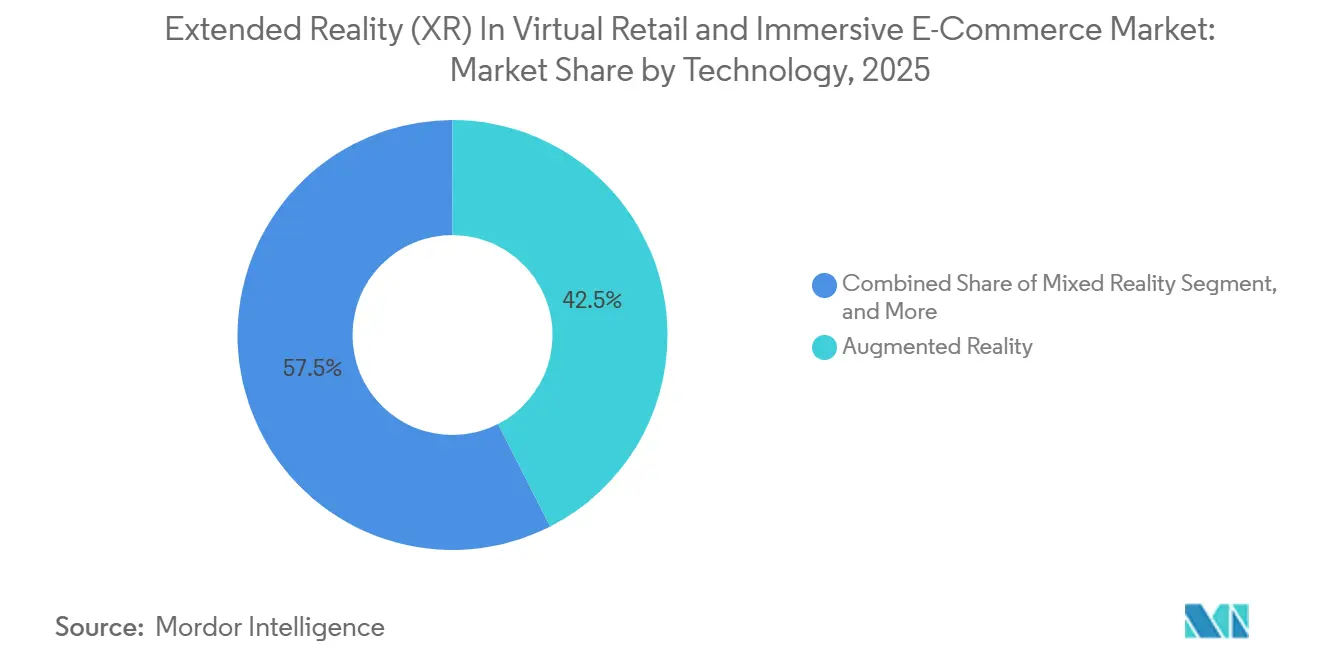
- By technology, Augmented Reality accounted for 42.48% of the extended reality (XR) market share in virtual retail and immersive e-commerce in 2025, while Web-Based Three-Dimensional Commerce is projected to expand at a 13.38% CAGR through 2031.
- By offering, Software held a 38.45% revenue share in 2025, while Services are projected to expand at a 13.56% CAGR through 2031 in the extended reality (XR), virtual retail, and immersive e-commerce market.
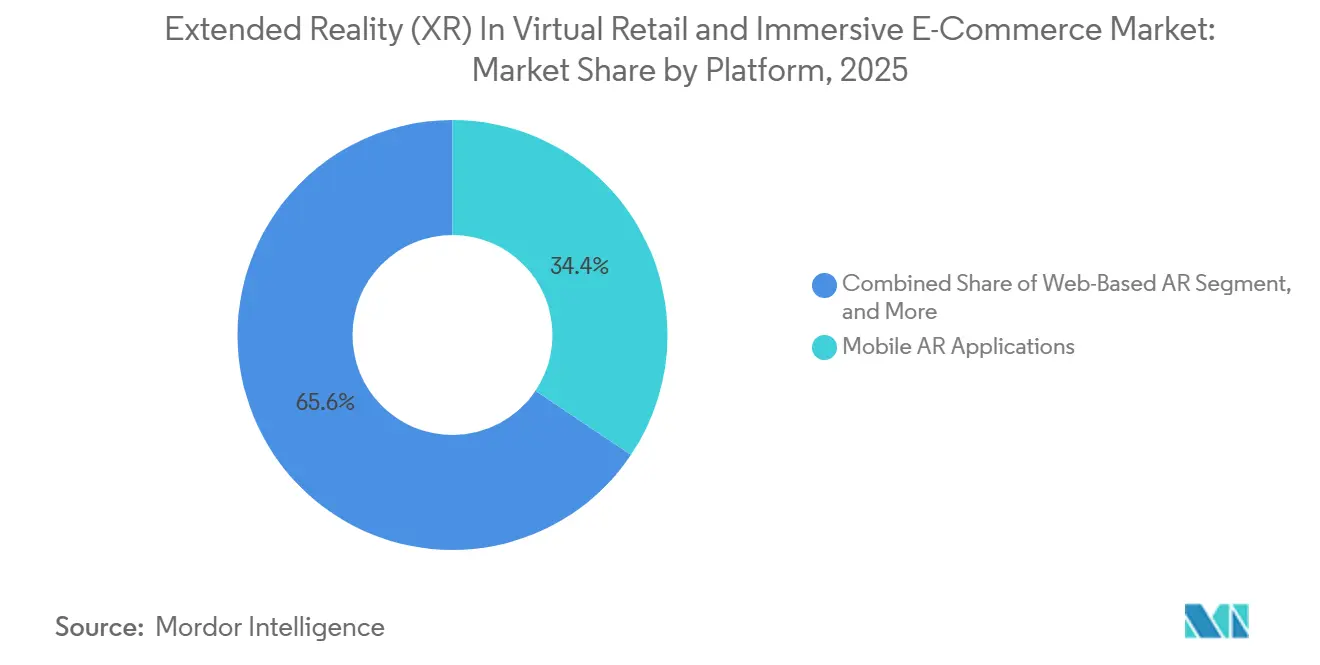
- By platform, Mobile AR Applications held 34.40% revenue share in 2025, while Web-Based AR is projected to expand at a 13.67% CAGR through 2031 in the XR in virtual retail and immersive e-commerce market.
- By display and device, Handheld Devices held 28.35% revenue share in 2025, while Smart Glasses are projected to expand at a 13.53% CAGR through 2031.
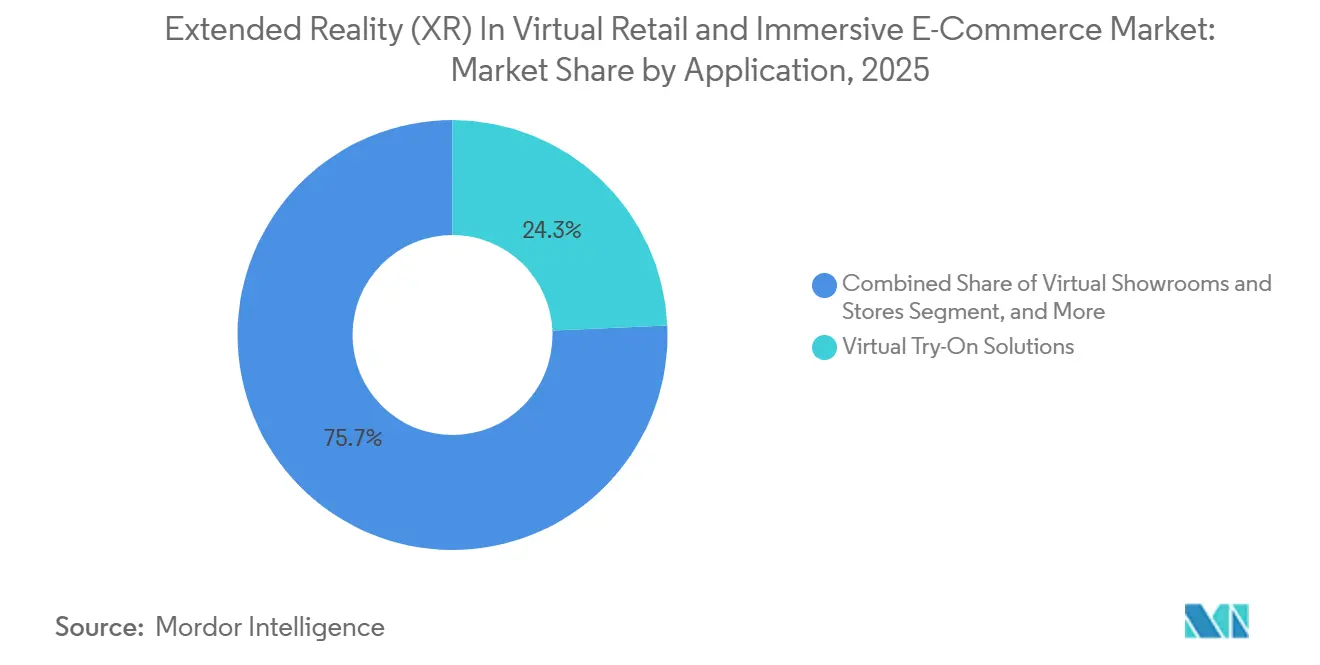
- By application, Virtual Try-On Solutions held 24.30% revenue share in 2025, while Virtual Showrooms and Stores are projected to expand at a 13.75% CAGR through 2031.
- By retail vertical, Fashion and Apparel held 20.26% revenue share in 2025, while Furniture and Home Decor is projected to expand at a 13.43% CAGR through 2031.
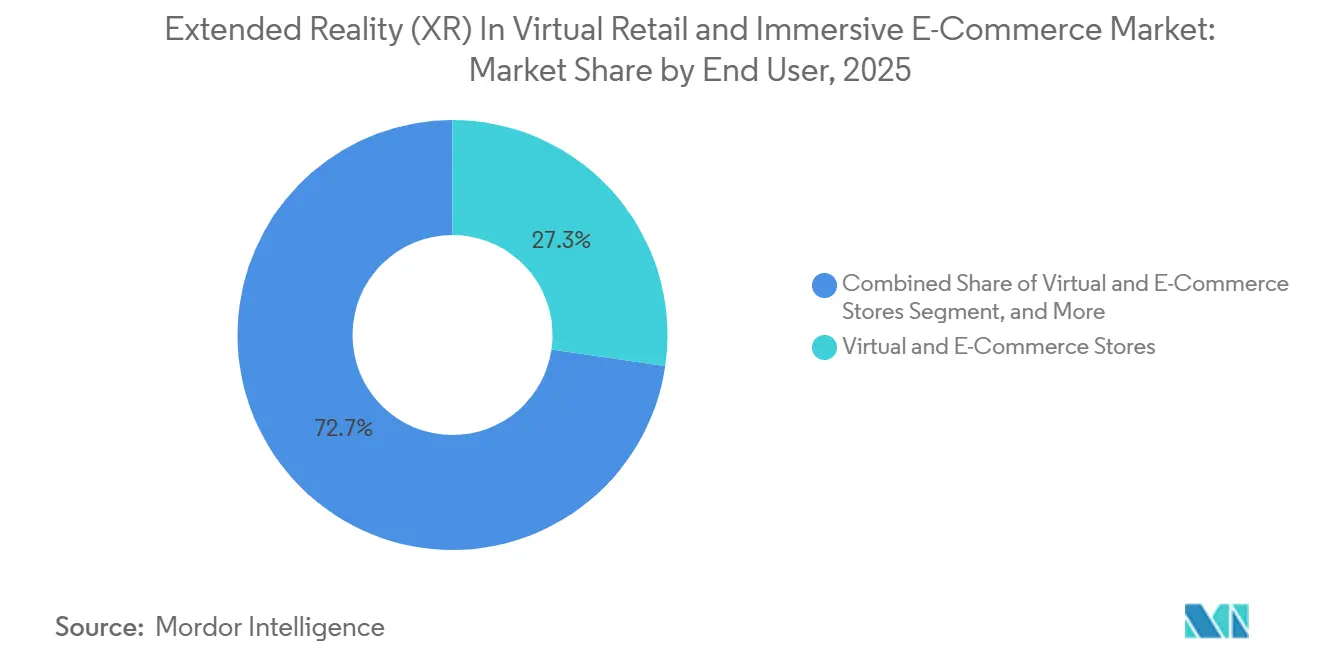
- By end user, Virtual and E-Commerce Stores held 27.30% revenue share in 2025, while Brand-Owned Digital Commerce is projected to expand at a 13.89% CAGR through 2031.
- By deployment, Cloud-Based deployment held 58.66% revenue share in 2025, while Hybrid deployment is projected to expand at a 13.56% CAGR through 2031.
- By geography, North America held 34.38% revenue share in 2025, while Asia-Pacific is projected to expand at a 13.32% CAGR through 2031.
Note: Market size and forecast figures in this report are generated using Mordor Intelligence’s proprietary estimation framework, updated with the latest available data and insights as of January 2026.
Market Trends and Insights
Drivers Impact Analysis of Extended Reality (XR) In Virtual Retail and Immersive E-Commerce Market*
| Driver | (~) % Impact on CAGR Forecast | Geographic Relevance | Impact Timeline |
|---|---|---|---|
| Demand for Immersive and Personalized Online Shopping | +3.0% | Global | Medium term (2-4 years) |
| Smartphone AR Adoption and Native Spatial Frameworks | +2.7% | Global, strongest in Asia-Pacific and North America | Short term (≤ 2 years) |
| Retailer Need to Reduce Product Returns | +2.2% | North America and Europe | Short term (≤ 2 years) |
| Lower 3D Content-Creation Costs | +1.8% | Global | Medium term (2-4 years) |
| Spatial Commerce Signals from Packaging, Shelves, and Stores | +1.3% | North America and Europe, emerging in Asia-Pacific | Long term (≥ 4 years) |
| Generative AI Avatars for Inclusive and Adaptive Shopping | +1.0% | Global | Medium term (2-4 years) |
| Source: Mordor Intelligence | |||
Rising Demand for Immersive and Personalized Online Shopping
The gap between product images and the experience of handling or wearing an item remains a barrier to online purchase decisions. Genlook reported that, in Q2 2026, sessions with at least 1 virtual try-on converted to cart at 29.2%, compared with 9.4% for sessions without a try-on.[1] This difference is encouraging retailers to assess immersive tools against conversion and customer-engagement goals. Consumers entering their peak spending years increasingly expect interactive product visualization when shopping online. Retailers that do not offer this experience can face a less engaging product discovery process.
AI personalization strengthens the use case by enabling body profiles, style preferences, and spatial context to shape the experience for each shopper. This can make virtual product interaction more relevant than a standard catalog page. Retailers can also use these interactions to understand product interest and guide recommendations. Longer sessions and more confident selections can support conversion performance when the experience is reliable. These benefits make immersive commerce relevant to both customer experience and operating priorities. The extended reality (XR) market in virtual retail and immersive e-commerce is therefore benefiting from a shift toward shopping journeys that are more visual, personalized, and interactive.
Smartphone-Based AR Adoption and Native Spatial Frameworks
Smartphones have reduced the need for specialized hardware in many retail XR deployments. Apple ARKit and Google ARCore support markerless tracking, depth estimation, and real-time lighting adjustment on compatible devices. These functions allow retailers to offer product placement and try-on experiences through mobile applications and browsers. Genlook reported that more than 90% of virtual try-on sessions in Q2 2026 took place on mobile devices. Mobile access is therefore central to the current delivery model for immersive retail.
WebXR support also reduces the need to download an app before a customer can access an experience. Safari for visionOS and Chrome for Android support browser-based spatial experiences, which broadens distribution options for brands. Retailers can embed product visualization directly within product pages and campaign links. This reduces friction between product discovery and product interaction. Smartphone-based access remains more important for retail reach than headset ownership. Extended reality (XR) in the virtual retail and immersive e-commerce market can therefore reach consumers through devices they already use for online shopping.
Retailer Pressure to Reduce Product Returns
Returns remain a material concern in apparel and other categories where fit and appearance are difficult to assess online. A 2026 study of virtual try-on user experience found that the tools can reduce exploration time and improve pre-delivery expectations when users receive credible fit information. This makes virtual try-on relevant to both operational efficiency and marketing. Accurate visualization can help customers make better-informed selections before checkout. The commercial value depends on realistic fit, fabric, scale, and sizing cues.
Retailers are moving toward tools that connect try-on results with sizing and product information. Trust can fall when the virtual representation does not match the delivered item. The next stage of development will depend on stronger fabric drape simulation and more precise personal sizing models. These capabilities can reduce the uncertainty that drives avoidable returns. The potential savings extend beyond the returned item to include shipping, restocking, and customer service activities. The extended reality (XR) in virtual retail and immersive e-commerce market is supported by this direct connection between product confidence and return management.
Lower 3D Content-Creation Costs
The cost of creating 3D assets has historically limited immersive retail programs to high-margin products and small catalogs. Retailers often needed specialized studios and lengthy production cycles for each product. SCAYLE Studios reported in July 2026 that its AI-enabled content workflow reduced production costs by 90% and time-to-market by more than 95% across ABOUT YOU operations. It also reported annual studio and editorial savings exceeding EUR 8 million (USD 8.8 million). These outcomes show why catalog-scale digitization is becoming more practical.
Microsoft described a workflow between Unilever and Collective World that reduced production timelines from months to days and cut asset costs by 50%.[2] The workflow also reduced duplicate content creation by 5 times across markets. Lower asset costs can help retailers extend visualization to a broader range of stock-keeping units. This is particularly relevant for web-based 3D commerce and virtual showroom programs. Extended reality (XR) in virtual retail and immersive e-commerce benefits from a cost structure that is increasingly suitable for large, frequently changing catalogs. Content production is still an implementation challenge, but it is less restrictive than it was for early retail XR programs.
Restraints Impact Analysis of Extended Reality (XR) In Virtual Retail and Immersive E-Commerce Market*
| Restraint | (~) % Impact on CAGR Forecast | Geographic Relevance | Impact Timeline |
|---|---|---|---|
| High Integration and 3D Content Costs | -1.8% | Global, particularly affecting SMBs | Medium term (2-4 years) |
| Privacy Exposure from Body, Gaze, Spatial, and Biometric Data | -1.4% | Europe and North America | Short term (≤ 2 years) |
| Fragmented XR Standards and Platform Interoperability | -1.0% | Global | Medium term (2-4 years) |
| Device Ergonomics, Battery Life, and Hygiene Constraints | -0.8% | Consumer-facing deployments globally | Long term (≥ 4 years) |
| Source: Mordor Intelligence | |||
High Integration and 3D Content Costs
Lower production costs have not removed the wider cost of integrating XR into retail systems. Retailers may need API development, product-data restructuring, and real-time inventory synchronization before launching an experience. These requirements are more difficult for smaller retailers with limited technology budgets. Shopify, Salesforce Commerce Cloud, Magento, and regional commerce platforms can each require distinct integration work. The absence of a universal XR middleware layer can make a deployment more customized than retailers expect.
Large fashion, furniture, and beauty retailers may justify these investments through catalog scale and higher transaction values. Smaller operators can face longer payback periods and less predictable implementation costs. The EU AI Act also creates documentation and conformity obligations for certain AI-enabled systems operating in the European Union.[3] These obligations can add compliance work alongside technology integration. As a result, the extended reality (XR) in virtual retail and immersive e-commerce market may develop more quickly among well-resourced retailers than among smaller businesses. Providers that offer reusable integrations and simpler content workflows can reduce this barrier.
Privacy Exposure from Body, Gaze, Spatial, and Biometric Data
XR retail tools can process sensitive information, including body measurements, facial geometry, gaze patterns, and views of private spaces. This data can improve personalization, but it also requires careful consent, notice, and retention practices. The EU AI Act prohibits certain biometric categorization uses that infer sensitive attributes. Retailers must consider privacy requirements when they design in-store and home-based experiences. These issues are especially important when an application collects data from non-direct users.
The legal requirements shape product design rather than serving only as a post-launch compliance check. Retailers need clear explanations of what data is collected and how it is retained. They also need controls that limit unnecessary collection and protect consumer information. Consent processes that are difficult to understand can reduce the use of a try-on or spatial shopping feature. Privacy-safe design is therefore an important condition for sustained consumer adoption. The extended reality (XR) in virtual retail and immersive e-commerce market will need to balance richer personalization with strong data governance in Europe and North America.
*Our forecasts treat driver/restraint impacts as directional, not additive. The impact forecasts reflect baseline growth, mix effects, and variable interactions.
Extended Reality (XR) In Virtual Retail and Immersive E-Commerce Market Segment Analysis
By Technology:
Augmented Reality Leads While Web-Based 3D Commerce ExpandsAugmented Reality accounted for 42.48% of revenue in 2025, making it the largest technology category. It is widely available on smartphones, reducing the need for dedicated equipment. ARKit and ARCore have made markerless tracking and lighting adjustment more accessible to retail developers. This supports product placement and try-on use cases in categories such as fashion, beauty, eyewear, and home furnishings. Virtual Reality is well-suited to categories where a full environment can help customers evaluate a higher-consideration purchase. Mixed Reality is also being used in physical stores where digital overlays can support product discovery and assisted selling.
Web-Based Three-Dimensional Commerce is projected to expand at a 13.38% CAGR through 2031, the fastest rate in this segmentation. Browser delivery can reduce dependency on app stores and give brands a direct route to product-page interaction. The extended reality (XR) market size in virtual retail and immersive e-commerce is supported by WebXR experiences that work across compatible browsers and devices. NVIDIA described CloudXR 6.0 as supporting zero-install streaming through WebRTC and the WebXR Device API. This approach can help mid-sized retailers avoid maintaining a separate application for each use case. The technology segment will remain dependent on browser support, content quality, and reliable network performance. Its wider appeal comes from a delivery model that aligns with standard e-commerce journeys.

By Offering:
Software Holds the Largest Position as Services Gain DemandSoftware accounted for 38.45% of revenue in 2025, underscoring the importance of platforms, APIs, and analytics tools in retail XR projects. The extended reality (XR) in virtual retail and immersive e-commerce markets relies on software that connects visualization with commerce workflows. Subscription and consumption-based models allow retailers to access features without buying perpetual licenses. Software providers can also update visualization and AI models without requiring an on-premises upgrade cycle. This is useful for retailers that need regular product and campaign refreshes. Hardware remains important for headsets, smart mirrors, and kiosk installations. However, smartphone and browser delivery reduces the hardware requirement for many consumer-facing applications.
Services are projected to expand at a 13.56% CAGR through 2031, the highest rate within the offering segment. Retailers often need support with 3D asset creation, system integration, campaign design, and performance analysis. Perfect Corp. introduced 9 Fashion APIs at CES 2026 for products including watches, jewelry, scarves, hats, shoes, and bags. Its modular model illustrates how service providers can integrate specialized functions for retail clients. The XR in virtual retail and immersive e-commerce industry is likely to use services as brands need continuing operational support rather than a single initial build. Service demand will also rise where retailers need localized assets, seasonal updates, and measurement frameworks. The combination of software and services reflects an industry that is moving from pilot work toward ongoing operation.
By Platform:
Mobile AR Applications Lead While Web-Based AR Broadens AccessMobile AR Applications held 34.40% revenue share in 2025, confirming the central role of smartphones in immersive commerce. These applications include brand-owned apps and social-commerce integrations where users discover products in a content feed. Mobile delivery reaches consumers at the point of interest as well as on a product detail page. It is well suited to virtual try-on, product placement, and promotional experiences. Smart mirrors and kiosks serve stores where retailers control the screen, sensor, and customer journey. AR glasses and headsets remain more focused on premium, specialized, and enterprise-led deployments.
Web-Based AR is projected to expand at a 13.67% CAGR through 2031, the fastest platform category. Puma and Meta launched a WebXR shopping experience for the All-Pro Nitro basketball shoe in June 2025 that was accessible through the Meta Quest browser without an app download. The experience allowed 1:1-scale product inspection and shoe-size measurement using hand controllers. Blippar states that its WebAR SDK supports world tracking on iOS Safari and Android Chrome without plugin requirements. The XR in virtual retail and immersive e-commerce market benefits when customers can enter an AR experience from a product link. This model can give retailers broader distribution with fewer download-related barriers.
By Display and Device:
Handheld Devices Lead as Smart Glasses DevelopHandheld Devices accounted for 28.35% of revenue in 2025, supported by the widespread use of smartphones for online shopping. Extended reality (XR) in virtual retail and immersive e-commerce markets depends on handheld access, as it provides retailers with a broad consumer reach. The devices allow consumers to access AR product experiences without buying separate equipment. They are well-suited to virtual try-on and room-scale product placement. Head-Mounted Displays remain relevant for higher-consideration purchases and controlled showroom settings. Gesture-Tracking Devices are being used in touch-free retail kiosks and smart mirrors. Head-Up Displays, projectors, and display walls serve more specialized in-store product presentation needs.
Smart Glasses are projected to expand at a 13.53% CAGR through 2031, the fastest device category. They can support hands-free product information in retail locations and configuration support for sales teams. Their adoption will depend on comfort, battery life, privacy controls, and the availability of clear retail use cases. Device safety and electromagnetic-emission requirements can also influence specifications and deployment planning. The extended reality (XR) in virtual retail and immersive e-commerce market will not depend on smart glasses for broad consumer reach in the near term. Instead, the category can add value in assisted selling and more immersive product evaluation. Handheld devices are likely to remain the main access point while smart-glass use cases become more defined.
By Application:
Virtual Try-On Leads While Virtual Showrooms Gain UseVirtual Try-On Solutions held 24.30% revenue share in 2025, the largest application category. The application has a clear link to conversion, fit confidence, and return management. It is most developed in fashion, eyewear, and beauty, where visual appearance is central to purchasing. FittingBox reported in June 2026 that it generated nearly 1 million virtual eyewear try-ons each day and digitized more than 5,000 frames per month. Digital product information and AR advertising can support this application by bringing product interaction to discovery channels. These tools help retailers place detailed product context closer to the point where a consumer first becomes interested.
Virtual Showrooms and Stores are projected to expand at a 13.75% CAGR through 2031, the fastest application category. Owned virtual spaces can work as persistent digital storefronts rather than short campaign activations. They are particularly relevant to luxury, furniture, automotive, and consumer electronics purchases where visual context supports evaluation. Three-dimensional product configuration can help customers compare options before committing to a purchase. Personalized shopping experiences can use customer preferences to guide users through a virtual setting. In the extended reality (XR) market for virtual retail and immersive e-commerce, the market share of virtual try-on remains larger, but virtual showrooms offer a broader brand-building role. Their performance will depend on whether retailers make the environments useful for product exploration rather than treating them solely as visual displays.
By Retail Vertical:
Fashion and Apparel Leads While Furniture and Home Decor AdvancesFashion and Apparel accounted for 20.26% of revenue in 2025, making it the largest retail vertical. Apparel purchasing is highly dependent on fit, style, and appearance, which makes virtual try-on relevant to a wide range of products. The category also faces significant return-management pressures, giving retailers a reason to improve purchase confidence. Beauty and Cosmetics is another mature vertical, as color matching and adaptive visualization can be delivered via phones and social platforms. Consumer Electronics and Automotive are smaller segments, but their complex product features and higher unit values can justify the use of immersive visualization. Eyewear and Accessories, Footwear, Grocery and Convenience, and Automotive and Accessories each offer different opportunities for product interaction.
Furniture and Home Decor is projected to expand at a 13.43% CAGR through 2031, the fastest retail vertical. Room-scale visualization helps consumers assess size, texture, and spatial fit before a product arrives. 3D Cloud reported that 87% of in-store furniture shoppers interacted with a salesperson, while 30% used 3D visualization during that interaction. This gap shows room for broader use of visualization tools before and during store visits. GlamAR went live on West Elm and Pottery Barn in May 2026 with room-scale product placement. The extended reality (XR) in virtual retail and immersive e-commerce market is supported by this use case because it addresses a practical decision problem rather than only creating a more attractive product page. Wider furniture adoption will depend on the accuracy of dimensions, materials, and room placement.
By End User:
Virtual and E-Commerce Stores Lead While Brand-Owned Channels AccelerateVirtual and E-Commerce Stores held 27.30% revenue share in 2025, the largest end-user category. The extended reality (XR) in virtual retail and immersive e-commerce market is closely tied to these stores because they can embed immersive features directly into an established shopping process. Physical Retail Stores use smart mirrors, AR kiosks, navigation tools, and assisted-selling functions to connect digital content with store visits. Online Marketplaces are also adding 3D and AR capabilities, although quality control across large numbers of third-party listings can be difficult. Retail Media and Advertising Networks are emerging users because immersive experiences can create new placement options for contextual brand promotion. Each end-user group has different needs for content governance, integration, and data management.
Brand-Owned Digital Commerce is projected to expand at a 13.89% CAGR through 2031, the fastest end-user category. Direct immersive storefronts can help brands maintain customer relationships and preserve margins, which marketplace fees can erode. Infinite Reality entered an agreement to acquire Obsess in January 2025 after raising USD 3 billion at a USD 12.25 billion valuation. Obsess had launched more than 400 virtual stores and recorded more than 150 million consumer interactions before the transaction. The extended reality (XR) in virtual retail and immersive e-commerce market is likely to see more investment in owned channels as brands seek control over experience and customer data. This also creates an opportunity for providers that offer scalable storefront templates and commerce integrations.
By Deployment:
Cloud-Based Systems Lead While Hybrid Architectures Gain RelevanceCloud-Based deployment accounted for 58.66% of revenue in 2025, reflecting the preference for software-as-a-service delivery in enterprise XR programs. Cloud systems allow retailers to update models, scale for seasonal traffic, and deliver content across markets. They can reduce the maintenance burden associated with on-premises infrastructure. On-premises deployment remains relevant for retailers with strict data residency or compliance requirements. It can also suit businesses that need close control over the processing of consumer information. As visualization quality rises, pure cloud and on-premises systems face growing competition from hybrid designs.
Hybrid deployment is projected to expand at a 13.56% CAGR through 2031, the fastest deployment category. High-resolution configurators and real-time measurement engines need low response times to maintain a credible consumer experience. NVIDIA stated that CloudXR 6.0 uses WebRTC and the WebXR Device API to support zero-install spatial streaming on compatible devices. Hybrid systems can combine centrally managed content with edge processing where it is needed for performance. This is relevant to furniture, automotive, and consumer electronics configurations that require detailed rendering. The XR in the virtual retail and immersive e-commerce industries will use hybrid deployments more often when high-fidelity experiences require both scalability and low latency. The model can help retailers meet performance expectations without moving every processing task into a local environment.
Geography Analysis
North America Extended Reality (XR) in Virtual Retail and Immersive E-Commerce Market
North America accounted for 34.38% of revenue in 2025, making it the largest regional market. The United States has a high concentration of enterprise XR projects, technology-focused retail brands, and immersive commerce providers. Many retailers in the region have moved virtual try-on and product visualization from limited pilots into operating programs. The region also has a broad base of direct-to-consumer fashion and home-goods businesses that can test and refine digital shopping features. Illinois biometric privacy requirements continue to shape consent and data-governance practices for tools that process facial geometry or body measurements. Canada and Mexico are secondary regional opportunities that can benefit from broader platform rollout and smartphone AR use.
Europe Extended Reality (XR) in Virtual Retail and Immersive E-Commerce Market
Europe remains an important spending region, with the United Kingdom and Germany among its more established deployment markets. France and Italy have supported virtual flagship programs through luxury retail and fashion activity. The EU AI Act is a major factor in the region, as it sets rules for certain AI practices and establishes compliance requirements for covered systems. These requirements can raise near-term implementation costs, but they can also improve consumer trust through clearer governance. The extended reality (XR) market size in virtual retail and immersive e-commerce in Europe will be influenced by retailers’ ability to manage compliance without slowing customer-facing innovation. Russia remains less connected to the mainstream platform ecosystem because of geopolitical conditions.
North American Platform Extended Reality (XR) in Virtual Retail and Immersive E-Commerce Market
North America a in 2025, making it the largest regional market. The United States has a high concentration of enterprise XR projects, technology-focused retail brands, and immersive commerce providers. Many retailers in the region have moved virtual try-on and product visualization from limited pilots into operating programs. The region also has a broad base of direct-to-consumer fashion and home-goods businesses that can test and refine digital shopping features. Illinois biometric privacy requirements continue to shape consent and data-governance practices for tools that process facial geometry or body measurements. Canada and Mexico are secondary regional opportunities that can benefit from broader platform rollout and smartphone AR use., platform ecosystems, and retail maturity vary substantially.
Competitive Landscape
The extended reality (XR) in virtual retail and immersive e-commerce market is fragmented, with specialists active in eyewear, apparel, furniture, and beauty alongside horizontal API providers. These firms hold category-specific 3D libraries, training data, and commerce-platform integrations that can be difficult to replicate. FittingBox reported nearly 1 million daily virtual eyewear try-ons and more than 5,000 digitized frames per month in June 2026. That scale gives a specialist an advantage in its category. The competitive balance depends on whether retailers value vertical depth or a platform that supports several product categories.
Acquisition activity shows that larger platforms are pursuing established capabilities rather than building every feature internally. Infinite Reality’s January 2025 agreement to acquire Obsess followed a USD 3 billion fundraising round and added a provider with more than 400 launched virtual stores. Perfect Corp. expanded its offer in January 2026 with 9 modular Fashion APIs for virtual try-on across accessories and footwear. SCAYLE launched its AI-powered content-production platform in July 2026, extending lower-cost asset creation to retailers outside its own operations. These moves focus on scale, content creation, and easier deployment.
The ein virtual retail and immersive e-commerce market is fragmented, with specialists active in eyewear, apparel, furniture, and beauty alongside horizontal API providers. These firms hold category-specific 3D libraries, training data, and commerce-platform integrations that can be difficult to replicate. FittingBox reported nearly 1 million daily virtual eyewear try-ons and more than 5,000 digitized frames per month in June 2026. That scale gives a specialist an advantage in its category. The competitive balance depends on whether retailers value vertical depth or a platform that supports several product categories.s applications.
Extended Reality (XR) In Virtual Retail and Immersive E-Commerce Industry Leaders
-
Obsess, Inc.
-
ByondXR Ltd.
-
Emperia Ltd.
-
Perfect Corp.
-
3DLOOK, Inc.
- *Disclaimer: Major Players sorted in no particular order
Extended Reality (XR) In Virtual Retail and Immersive E-Commerce Market Companies Covered in this Report
- Obsess, Inc.
- Emperia Ltd.
- ByondXR Ltd.
- rooom AG
- Vection Technologies Ltd.
- GlamAR Inc.
- 3DLOOK, Inc.
- Perfect Corp.
- Zugara, Inc.
- Tangiblee, Inc.
- VNTANA, Inc.
- Virtusize Co., Ltd.
- Sizebay, Inc.
- ELSE Corp S.r.l.
- FittingBox S.A.S.
- Nextech3D.ai
- Marxent Labs, LLC
- Blippar Group Limited
- Holition Ltd.
- ViewAR GmbH
- Wikitude GmbH
- Augment SAS
- Kudan Limited
- INDE Limited
Recent Industry Developments in Extended Reality (XR) In Virtual Retail and Immersive E-Commerce Market
- July 2026: SCAYLE (ABOUT YOU Group) launched SCAYLE Studios, an AI-powered e-commerce content production platform achieving 90% lower production costs, more than 95% faster time-to-market, and over EUR 8 million (USD 8.8 million) in annual studio and editorial cost savings within ABOUT YOU's operations. The platform's commercial availability to other retailers marks a pivotal shift in 3D content economics for the broader immersive commerce sector.
- June 2026: FittingBox celebrated its 20th anniversary, disclosing that the company currently generates nearly 1 million virtual eyewear try-ons daily and digitizes more than 5,000 frames per month, illustrating the operational scale that category-specialist XR platforms can sustain in the eyewear retail vertical.
- February 2026: Perfect Corp. partnered with fashion designer Nicole Miller at Fashion Forward Week to debut a generative AI-powered virtual fitting room featuring Nicole Miller's archival designs, demonstrating a use case for AI-powered try-on in high-fashion archival and heritage-collection contexts.
- January 2026: Perfect Corp. unveiled 9 new Fashion APIs at CES 2026, covering virtual try-on for watches, bracelets, rings, earrings, necklaces, scarves, hats, shoes, and bags. APIs were built with Model Context Protocol (MCP) compatibility for integration with modern AI agent ecosystems, expanding the company's virtual try-on coverage to accessories and footwear at enterprise API scale.
Global Extended Reality (XR) In Virtual Retail and Immersive E-Commerce Market Report Scope
The Extended Reality (XR) in Virtual Retail and Immersive E-Commerce Market refers to the ecosystem of technologies, platforms, software, hardware, and services that leverage extended reality, including virtual reality (VR), augmented reality (AR), and mixed reality (MR), to enhance digital shopping experiences and retail operations.
The Extended Reality (XR) in Virtual Retail and Immersive E-Commerce Market Report is Segmented by Technology (Augmented Reality, Virtual Reality, Mixed Reality, and Web-Based Three-Dimensional Commerce), Offering (Hardware, Software, and Services), Platform (Mobile AR Applications, Web-Based AR, Smart Mirrors and Kiosks, AR Glasses and Headsets, and Virtual Reality Storefronts), Display and Device (Head-Mounted Displays, Smart Glasses, Head-Up Displays, Handheld Devices, Gesture-Tracking Devices, and Projectors and Display Walls), Application (Virtual Try-On Solutions, Product Visualization and Placement, Virtual Showrooms and Stores, Three-Dimensional Product Configuration, Digital Product Information, AR Advertising and Marketing, Personalized Shopping Experiences, and In-Store Navigation and Assisted Selling), Retail Vertical (Fashion and Apparel, Beauty and Cosmetics, Furniture and Home Decor, Eyewear and Accessories, Footwear, Consumer Electronics, Grocery and Convenience, and Automotive and Accessories), End User (Physical Retail Stores, Virtual and E-Commerce Stores, Brand-Owned Digital Commerce, Online Marketplaces, and Retail Media and Advertising Networks), Deployment (Cloud-Based, On-Premises, and Hybrid), and Geography (North America, South America, Europe, Asia-Pacific, Middle East, and Africa). The Market Forecasts are Provided in Terms of Value (USD).
| Augmented Reality |
| Virtual Reality |
| Mixed Reality |
| Web-Based Three-Dimensional Commerce |
| Hardware |
| Software |
| Services |
| Mobile AR Applications |
| Web-Based AR |
| Smart Mirrors and Kiosks |
| AR Glasses and Headsets |
| Virtual Reality Storefronts |
| Head-Mounted Displays |
| Smart Glasses |
| Head-Up Displays |
| Handheld Devices |
| Gesture-Tracking Devices |
| Projectors and Display Walls |
| Virtual Try-On Solutions |
| Product Visualization and Placement |
| Virtual Showrooms and Stores |
| Three-Dimensional Product Configuration |
| Digital Product Information |
| AR Advertising and Marketing |
| Personalized Shopping Experiences |
| In-Store Navigation and Assisted Selling |
| Fashion and Apparel |
| Beauty and Cosmetics |
| Furniture and Home Decor |
| Eyewear and Accessories |
| Footwear |
| Consumer Electronics |
| Grocery and Convenience |
| Automotive and Accessories |
| Physical Retail Stores |
| Virtual and E-Commerce Stores |
| Brand-Owned Digital Commerce |
| Online Marketplaces |
| Retail Media and Advertising Networks |
| Cloud-Based |
| On-Premises |
| Hybrid |
| North America | United States |
| Canada | |
| Mexico | |
| South America | Brazil |
| Argentina | |
| Rest of South America | |
| Europe | United Kingdom |
| Germany | |
| France | |
| Italy | |
| Spain | |
| Russia | |
| Rest of Europe | |
| Asia-Pacific | China |
| Japan | |
| South Korea | |
| India | |
| Australia | |
| Southeast Asia | |
| Rest of Asia-Pacific | |
| Middle East | United Arab Emirates |
| Saudi Arabia | |
| Turkey | |
| Rest of Middle East | |
| Africa | South Africa |
| Egypt | |
| Nigeria | |
| Rest of Africa |
| By Technology | Augmented Reality | |
| Virtual Reality | ||
| Mixed Reality | ||
| Web-Based Three-Dimensional Commerce | ||
| By Offering | Hardware | |
| Software | ||
| Services | ||
| By Platform | Mobile AR Applications | |
| Web-Based AR | ||
| Smart Mirrors and Kiosks | ||
| AR Glasses and Headsets | ||
| Virtual Reality Storefronts | ||
| By Display and Device | Head-Mounted Displays | |
| Smart Glasses | ||
| Head-Up Displays | ||
| Handheld Devices | ||
| Gesture-Tracking Devices | ||
| Projectors and Display Walls | ||
| By Application | Virtual Try-On Solutions | |
| Product Visualization and Placement | ||
| Virtual Showrooms and Stores | ||
| Three-Dimensional Product Configuration | ||
| Digital Product Information | ||
| AR Advertising and Marketing | ||
| Personalized Shopping Experiences | ||
| In-Store Navigation and Assisted Selling | ||
| By Retail Vertical | Fashion and Apparel | |
| Beauty and Cosmetics | ||
| Furniture and Home Decor | ||
| Eyewear and Accessories | ||
| Footwear | ||
| Consumer Electronics | ||
| Grocery and Convenience | ||
| Automotive and Accessories | ||
| By End User | Physical Retail Stores | |
| Virtual and E-Commerce Stores | ||
| Brand-Owned Digital Commerce | ||
| Online Marketplaces | ||
| Retail Media and Advertising Networks | ||
| By Deployment | Cloud-Based | |
| On-Premises | ||
| Hybrid | ||
| By Geography | North America | United States |
| Canada | ||
| Mexico | ||
| South America | Brazil | |
| Argentina | ||
| Rest of South America | ||
| Europe | United Kingdom | |
| Germany | ||
| France | ||
| Italy | ||
| Spain | ||
| Russia | ||
| Rest of Europe | ||
| Asia-Pacific | China | |
| Japan | ||
| South Korea | ||
| India | ||
| Australia | ||
| Southeast Asia | ||
| Rest of Asia-Pacific | ||
| Middle East | United Arab Emirates | |
| Saudi Arabia | ||
| Turkey | ||
| Rest of Middle East | ||
| Africa | South Africa | |
| Egypt | ||
| Nigeria | ||
| Rest of Africa | ||
Key Questions Answered in the Report
What is the size of the XR in virtual retail and immersive e-commerce market?
The market was valued at USD 5.01 billion in 2025, is estimated at USD 5.85 billion in 2026, and is expected to reach USD 10.62 billion by 2031 at a 12.67% CAGR.
Which technology leads immersive retail adoption?
Augmented Reality (AR) led technology revenue with a 42.48% share in 2025 because it can be accessed through smartphones without dedicated hardware.
Which application is expanding most quickly?
Virtual Showrooms and Stores are projected to expand at a 13.75% CAGR through 2031, while Virtual Try-On Solutions remained the largest application in 2025.
Why are retailers using virtual try-on tools?
Virtual try-on can improve product confidence and help retailers address fit uncertainty, returns, and customer engagement in categories such as fashion, eyewear, and beauty.
Which region offers the fastest expansion?
Asia-Pacific is projected to expand at a 13.32% CAGR through 2031, supported by mobile commerce, super-app ecosystems, and digital-first consumer behavior.
What deployment model is becoming more important for high-fidelity experiences?
Hybrid deployment is projected to expand at a 13.56% CAGR through 2031 because it can combine scalable cloud content delivery with lower-latency processing.