
Examination Tables Market Size and Share
Market Overview
| Study Period | 2020 - 2031 |
|---|---|
| Market Size (2026) | USD 540.47 Million |
| Market Size (2031) | USD 696.38 Million |
| Growth Rate (2026 - 2031) | 5.20 % |
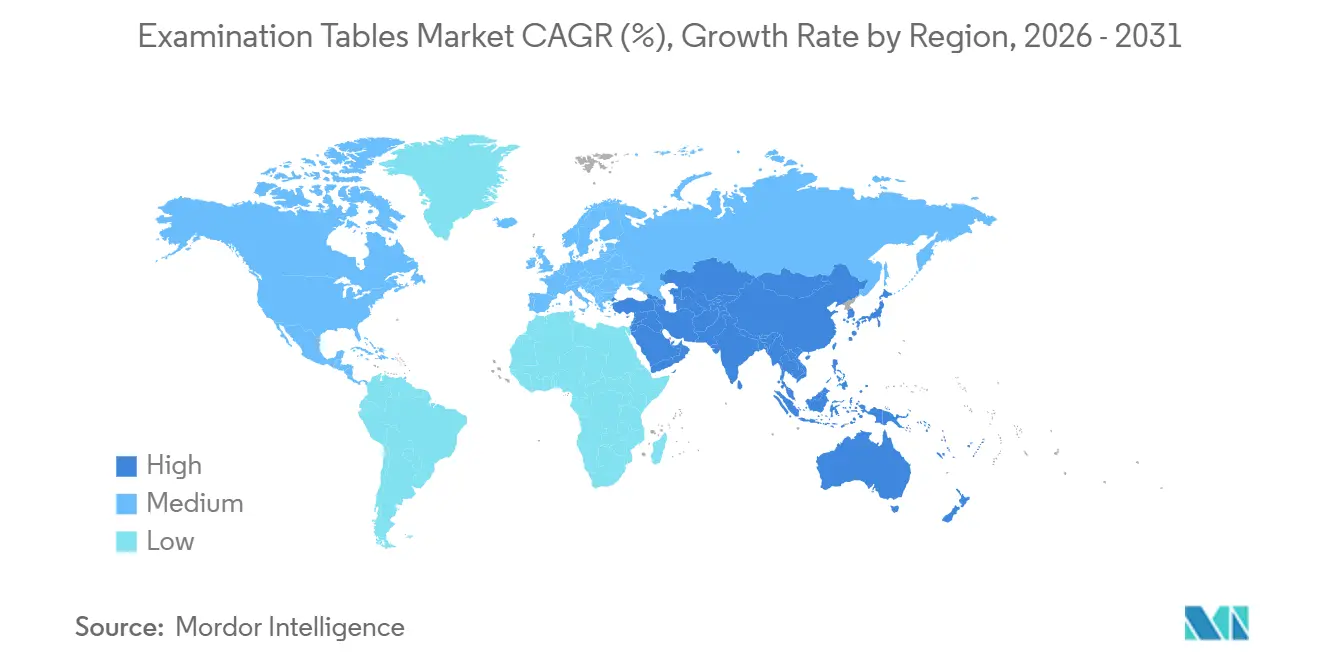
| Fastest Growing Market | Asia-Pacific |
| Largest Market | North America |
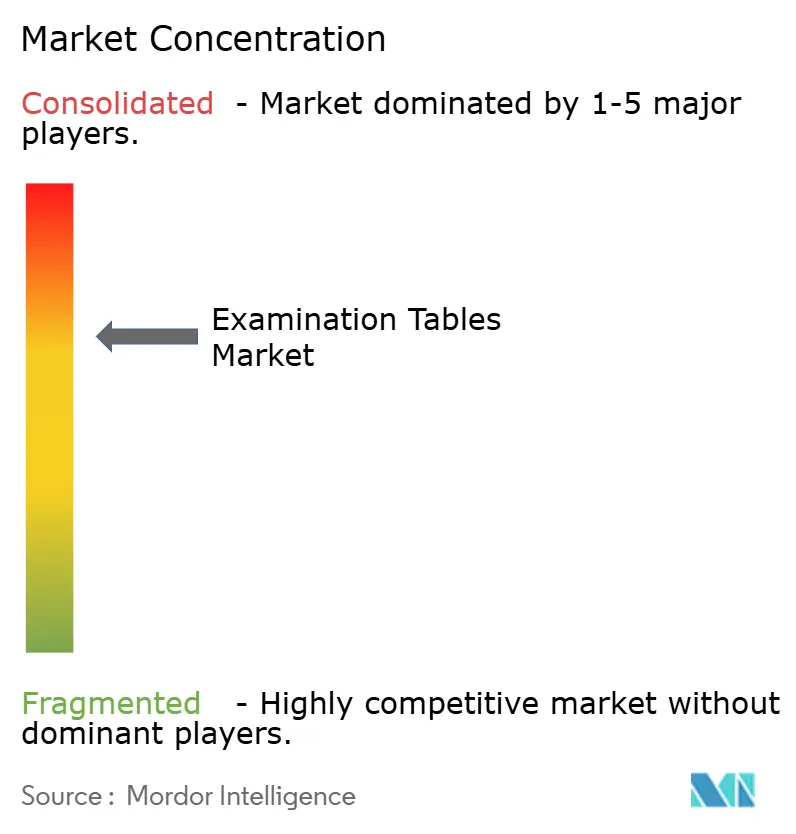
| Market Concentration | Medium |
Major Players *Disclaimer: Major Players sorted in no particular order Image © Mordor Intelligence. Reuse requires attribution under CC BY 4.0. | |
Examination Tables Market Analysis by Mordor Intelligence
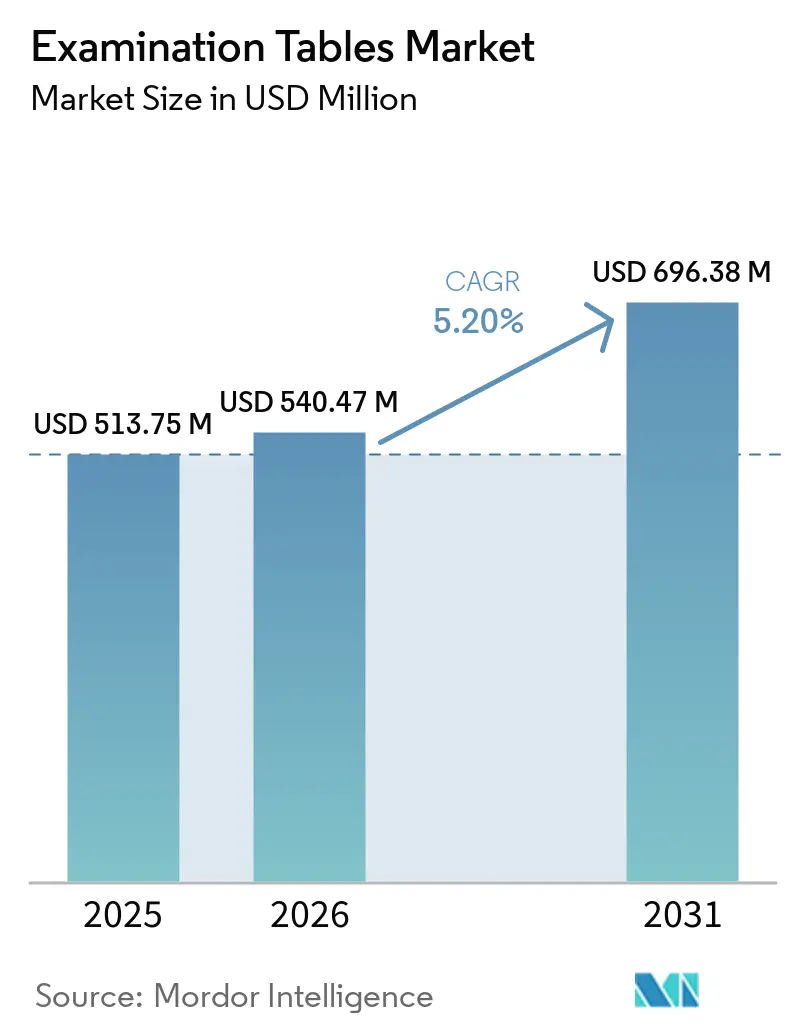
The Examination Tables Market size is expected to grow from USD 513.75 million in 2025 to USD 540.47 million in 2026 and is forecast to reach USD 696.38 million by 2031 at 5.20% CAGR over 2026-2031.
The examination tables market is supported by hospital construction, outpatient expansion, and replacement demand for accessible equipment. U.S. national health expenditure is projected to increase by 5.4% a year through 2034, while hospital spending is projected to rise by 5.2% annually, which supports capital equipment planning across care sites. Healthcare spending in the United States is expected to reach USD 8.6 trillion by 2033, sustaining the institutional base for new examination room equipment and replacement purchases. The examination tables market is also being shaped by accessible transfer heights, infection-control surfaces, safer patient handling, and digital workflow requirements. These requirements favor manufacturers that can combine durable construction with powered positioning, compliance documentation, and service support.
Key Report Takeaways
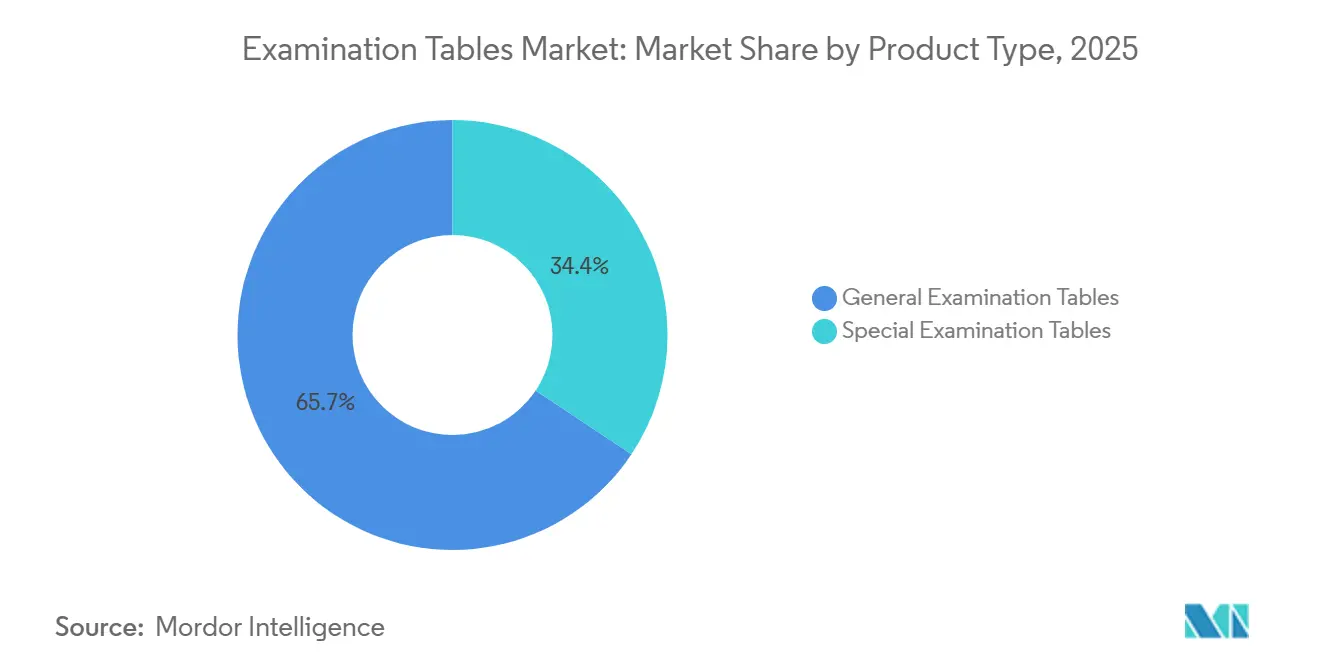
- By product type, general examination tables held 65.7% of global revenue in 2025, while special examination tables are forecast to grow at a 7.4% CAGR through 2031.
- By source type, manual tables held 38.5% of segment revenue in 2025, while powered tables are forecast to grow at a 7.0% CAGR through 2031.
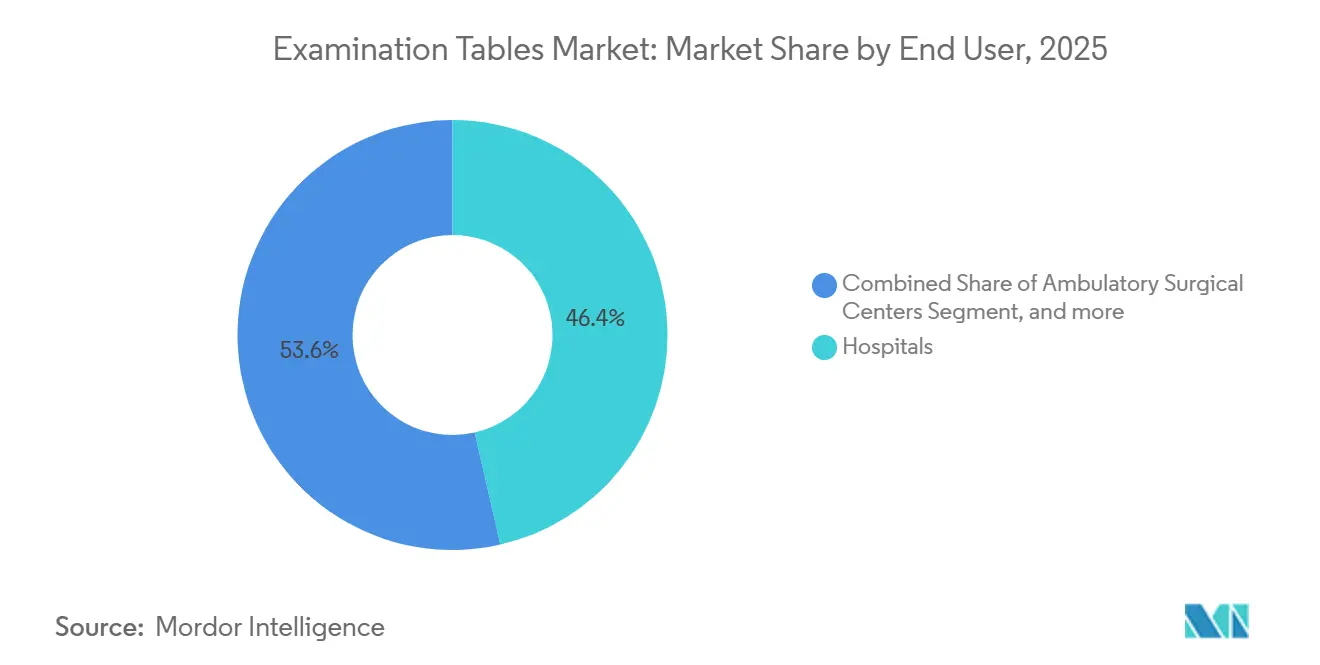
- By end user, hospitals held 46.4% of demand in 2025, while ambulatory surgical centers are forecast to grow at an 8.3% CAGR through 2031.
- By material, metal-frame tables held 44.6% of revenue in 2025, while composite materials are forecast to grow at a 7.1% CAGR through 2031.
- By geography, North America held 42.4% of global revenue in 2025, while Asia-Pacific is forecast to grow at a 6.6% CAGR through 2031.
Note: Market size and forecast figures in this report are generated using Mordor Intelligence’s proprietary estimation framework, updated with the latest available data and insights as of January 2026.
Market Trends and Insights
Drivers Impact Analysis of Examination Tables Market*
| Driver | (~) % Impact on CAGR Forecast | Geographic Relevance | Impact Timeline |
|---|---|---|---|
| Healthcare Infrastructure Expansion and Outpatient Care Growth | +1.20% | Global, with strongest pull in Asia-Pacific and North America | Medium term (2-4 years) |
| Chronic Disease Management and Population Aging | +0.90% | Global, particularly Europe, Asia-Pacific, and North America | Long term (≥ 4 years) |
| Infection-Control and Accessibility Requirements | +0.60% | North America and Europe, with spillover to Asia-Pacific and the Middle East and Africa | Short term (≤ 2 years) |
| Ergonomic Patient Handling and Clinician Safety | +0.50% | North America and Western Europe | Medium term (2-4 years) |
| Connected Workflow Features and Digital Examination-Room Integration | +0.40% | North America, Western Europe, and Asia-Pacific urban centers | Long term (≥ 4 years) |
| Antimicrobial, Seamless, and Circular-Design Procurement | +0.30% | Europe and North America | Medium term (2-4 years) |
| Source: Mordor Intelligence | |||
Healthcare Infrastructure Expansion and Outpatient Care Growth
Healthcare infrastructure expansion supports the examination tables market because each new care site requires examination rooms, treatment areas, and supporting clinical furniture. The Asian Infrastructure Investment Bank approved a USD 226.4 million loan in 2025 for the reconstruction of the RSAB Harapan Kita hospital in Indonesia[1]. The project is expected to increase capacity from 271 beds to 550 beds and equip the facility with advanced medical technology. Singapore’s Eastern General Hospital campus began main construction in August 2025 and is planned to open progressively from 2029. These projects add near-term equipment requirements and create future replacement demand as clinical rooms age. The examination tables market, therefore, benefits from a longer purchasing cycle that follows construction, commissioning, and later equipment renewal.
Chronic Disease Management and Population Aging
Population aging increases the frequency of examinations across primary care, cardiology, endocrinology, and physiotherapy settings. The number of people aged 60 years and older is projected to rise from 1.1 billion in 2023 to 1.4 billion by 2030[2]. The World Health Organization reported in 2025 that premature deaths from noncommunicable diseases were rising with population growth and aging. Heart disease, stroke, diabetes, and cancer increase the need for repeated assessment and routine clinical visits. The examination tables market is consequently moving toward higher-capacity and more adjustable products for patients with different mobility and weight needs. This shift can raise the value of an installation because reinforced frames, powered functions, and safer transfer features are more frequently specified.
Infection-Control, Accessibility, and Sustainable Materials Requirements
Infection-control requirements are changing the specifications used for clinical room equipment in the examination tables market. Facilities increasingly seek seamless upholstery and antimicrobial surfaces that reduce areas where contaminants can collect. Federal medical diagnostic equipment rules place new attention on accessible transfer heights for people with disabilities[3]. The guidance described a 17-inch minimum low transfer height for powered tables procured after October 2024, while enforcement attention also covered a 17-19-inch range. European purchasers also reference electrical safety and quality management requirements in their procurement processes. Requirements for antimicrobial surfaces, recyclable materials, and documented compliance give established suppliers an advantage when hospitals update their product standards.
Ergonomic Patient Handling, Connected Rooms, and Digital Workflows
Safe patient handling programs make table height, transfer support, and positioning functions more important in procurement decisions. Powered high-low designs can support clinician safety by reducing manual patient handling during transfers and examinations. The Brewer Company’s Access High-Low PLUS table received the Gold Award in the Furniture Clinician Support category at the 2024 Nightingale Awards. Midmark’s 626 Barrier-Free Examination Chair has a 15.5-inch low seat height and is positioned above the 2024 access baseline described for medical diagnostic equipment. The examination tables market is also moving toward examination rooms that connect vital signs devices, equipment, and electronic medical record workflows. These capabilities can improve the value of bundled solutions, although connected products also face added software and interoperability obligations.
Restraints Impact Analysis of Examination Tables Market*
| Restraint | (~) % Impact on CAGR Forecast | Geographic Relevance | Impact Timeline |
|---|---|---|---|
| High Upfront Cost of Powered and Specialty Tables | -0.50% | Emerging markets and rural and small-practice segments globally | Short term (≤ 2 years) |
| Regulatory, Electrical-Safety, and Compliance Burden | -0.40% | North America, Europe, and emerging-market late adopters | Medium term (2-4 years) |
| Serviceability Constraints and Actuator Downtime | -0.30% | Global, with greatest effect where service infrastructure is limited | Long term (≥ 4 years) |
| Low Utilization and Limited Financing at Smaller Facilities | -0.30% | South America, the Middle East and Africa, Southeast Asia, and rural North America | Long term (≥ 4 years) |
| Source: Mordor Intelligence | |||
High Upfront Cost, Limited Financing, and Serviceability Constraints
The price difference between manual and powered products limits adoption in price-sensitive parts of the examination tables market. Powered high-low tables were priced from USD 6,000 to USD 12,000, compared with USD 800 to USD 1,500 for manual alternatives. This difference can exclude independent practices, community health centers, and rural clinics when leasing or financing is unavailable. Equipment downtime also matters in busy ambulatory settings because failed actuators can interrupt scheduled patient visits. Larger hospitals may release usable manual tables into secondary channels when they install accessible powered products. That secondary supply can extend the operating life of manual equipment and place pressure on entry-level new-equipment pricing.
Regulatory, Electrical-Safety, and Compliance Burden
Powered examination tables sold in the United States must navigate the FDA 510(k) pathway and meet UL 60601-1 electrical safety expectations. The related product-development and post-market requirements increase the cost and time needed to introduce a new product. In Europe, the Medical Device Regulation has increased conformity assessment requirements and created capacity constraints for certification processes. These conditions favor manufacturers that already have quality, regulatory, and documentation systems. Connected products may face additional requirements when features link equipment data with clinical information systems. The examination tables market can therefore remain difficult for smaller suppliers that do not have the resources for compliance, service, and digital integration.
*Our forecasts treat driver/restraint impacts as directional, not additive. The impact forecasts reflect baseline growth, mix effects, and variable interactions.
Examination Tables Market Segment Analysis
By Product Type:
General Tables Retain Broad Clinical Use While Specialty Products Gain GroundGeneral examination tables accounted for 65.7% of the examination tables market share in 2025. Their position reflects their broad use in primary care, family medicine, internal medicine, and urgent-care settings. A configurable general table can support routine diagnostic work with adjustable backrests, stirrup compatibility, paper-roll dispensers, and seamless upholstery. This versatility allows a facility to serve several care needs with one standard platform. Hospitals and clinics often use these products to simplify purchasing, staff familiarization, and routine maintenance. Their established installed base also supports demand for replacements that fit existing room layouts. General products remain important in the examination tables industry because they serve the widest range of basic examinations. However, larger health systems can treat these tables as standardized equipment and focus procurement decisions more strongly on price. This creates pressure on mid-market suppliers that lack clear clinical or service differentiation. Scale, dependable distribution, and durable construction remain central to success in this established product category.
Special examination tables are projected to grow at a 7.4% CAGR from 2026 to 2031, making them the fastest-growing product category. The examination tables market size for special products is supported by growth in gynecology, bariatric care, cardiology imaging, orthopedic casting, and dermatology. Specialty practices need products that fit defined clinical tasks instead of general examination requirements. Dermatology and aesthetic practices use procedure chairs with multi-axis electric articulation and patient-comfort features. Bariatric care requires higher weight capacities and reinforced systems for safe transfers and positioning. Imaging-linked settings increasingly require radiolucent, MRI-compatible, carbon-fiber, or polymer-composite surfaces. These features allow imaging equipment to operate around the patient without obstruction. Hybrid ambulatory rooms can combine examination and diagnostic imaging in a single workflow. Suppliers with imaging-compatible designs are therefore better positioned where clinics make these specialized specifications a requirement. The product shift expands value per installation because specialty functionality is generally more complex than standard manual designs.
By Source Type:
Manual Products Retain a Value Role While Powered Tables Address Clinical RequirementsManual tables held 38.5% of segment revenue in 2025. Their continued use reflects operating needs as well as their lower acquisition cost. Physical therapy rooms, orthopedic casting settings, and treatment rooms can use manual products when patient acuity does not require electrically assisted positioning. Manual tables avoid actuator-related downtime and can remain operational with simple maintenance. This reliability matters in locations where a product failure would disrupt a full day of appointments. Their lower price allows smaller providers to purchase new equipment without extensive capital planning. Clinton Industries maintains a position in the mid-market through manual product lines with practical features and lower costs than premium specialists. Manual products can also be easier to service in locations with limited technical support. The examination tables market still needs these products because a large share of clinical rooms has modest utilization and limited budgets. Their mature design leaves less room for price increases, but it sustains a stable volume base.
Powered tables are forecast to grow at a 7.0% CAGR from 2026 to 2031. Their growth is linked to accessibility rules, patient handling programs, and demand for flexible room use. Powered height adjustment can make transfers safer for patients and staff, particularly in higher-acuity outpatient settings. Ambulatory surgery centers and hospital outpatient departments are key users because schedules can require frequent repositioning. Midmark received U.S. Patent 12,350,202 B2 in July 2025 for an examination table with a retractable moving-wheel assembly. The design addresses room repositioning without full equipment disassembly. The powered-table opportunity can benefit when facilities assess costs beyond the purchase price. Reduced clinician strain and improved room flexibility can strengthen the return-on-investment case for powered designs. However, service planning remains necessary because motors, control systems, and actuators introduce maintenance needs that manual products do not have.
By End User:
Hospital Scale Supports Demand While Ambulatory Surgical Centers Expand FasterHospitals represented 46.4% of end-user demand in 2025. Their share is sustained by the large number of examination rooms within acute-care campuses and outpatient departments. Hospitals often follow scheduled equipment refresh cycles that are linked to accreditation, room renovation, and safety programs. Purchasing is increasingly organized through group purchasing organizations, which can concentrate buying power and favor competitive pricing. This structure may reduce supplier margins even when replacement volumes remain stable. Hospital committees also consider accessibility, patient handling, infection control, and maintenance support when choosing products. These criteria favor suppliers with documentation, service networks, and established product ranges. U.S. hospital expenditure is projected to grow by 5.2% annually through 2034, supporting the capital equipment environment. The examination tables industry relies on hospitals for large orders and consistent replacement cycles. Hospital procurement remains important even as buyers seek lower costs and more standardized product specifications.
Ambulatory surgical centers are projected to grow at an 8.3% CAGR from 2026 to 2031. The examination tables market size for this end-user group is strengthened by the continuing movement of procedures from inpatient hospitals to outpatient settings. Centers for Medicare & Medicaid Services reported 6,467 Medicare-certified ambulatory surgical centers in the United States and 18,812 operating rooms across the network in 2025. The sector added 102 centers in the first quarter of 2025, representing a 1.1% net growth rate in that quarter. Ambulatory surgical centers require compact, durable, and easy-to-clean equipment for high-turnover clinical environments. Their procurement cycles can be shorter and more flexible than committee-led hospital purchasing. This gives manufacturers opportunities to sell differentiated products that may take longer to enter group purchasing contracts. Clinics and diagnostic centers also create aggregate demand for compact manual and lower-specification powered tables. Diagnostic centers increasingly need radiolucent specialty products when imaging is located next to examination space. The end-user mix therefore gives suppliers opportunities across high-volume institutional orders and more varied outpatient purchasing channels.

By Material:
Metal Maintains a Strong Installed Base While Composites Gain Use in Imaging SettingsMetal-frame tables accounted for 44.6% of the material segment revenue in 2025. The segment benefits from mature supply chains, established maintenance knowledge, and familiarity among facility managers. Stainless steel and powder-coated steel are widely viewed as dependable choices for clinical environments. Metal components also offer procurement teams predictable cost structures and straightforward durability comparisons. These features help value-analysis committees make decisions under capital budget constraints. Metal frames can withstand repeated cleaning and high levels of day-to-day use. Their long service record supports replacement purchases when a facility wants a familiar product configuration. The examination tables market continues to rely on metal because it meets the practical needs of general examination rooms. Wood-frame products remain a smaller niche for private specialty practices and wellness-focused settings. Their visual appearance can be valued in those environments, but they have less broad use in high-volume clinical facilities.
Composite materials are projected to expand at a 7.1% CAGR from 2026 to 2031. Composite surfaces support imaging-integrated examination because they can be radiolucent and lighter than traditional materials. Carbon-fiber and polymer designs can allow free C-arm movement and unobstructed fluoroscopy in hybrid rooms. The composite segment can gain share as outpatient facilities combine diagnosis, examination, and minor procedures in the same room. Lower weight can also help teams reconfigure room layouts where mobility is important. Resistance to frequent disinfectant exposure is another purchasing consideration for these materials. European public procurement is also giving greater attention to recycled content and product designs that support recycling. Suppliers with materials expertise can use these criteria to distinguish their products in formal tenders. Composite products must still show durability, cleaning compatibility, and safety performance that match clinical expectations. Their expansion is therefore tied to specialized workflows rather than a universal replacement of metal-frame products.
Geography Analysis
North America Examination Tables Market
North America held 42.4% of the global examination tables market share in 2025. The region benefits from a high concentration of healthcare facilities, established reimbursement structures, and formal equipment standards. U.S. hospital spending is projected to rise by 5.2% annually through 2034, which supports ongoing capital equipment upgrades. Accessibility requirements and patient handling policies are encouraging facilities to replace manual products that do not meet current clinical needs. Federal guidance on accessible examination equipment reinforces attention to powered tables with lower transfer heights. Canada’s outpatient expansion and modernization activity within the U.S. Veterans Health Administration adds demand beyond commercial hospital networks. Accreditation and compliance expectations create a higher quality threshold for suppliers. This can limit price-based competition in premium product categories. North America remains important to the examination tables market because it combines large purchasing institutions with demanding product requirements.
Europe Examination Tables Market
Europe is the second-largest regional segment, led by Germany, the United Kingdom, and France. Public healthcare purchasing systems provide predictable demand but usually place substantial weight on price and tender compliance. The Medical Device Regulation favors suppliers with established conformity assessment processes and certification capabilities. European specialists, including Schmitz u. Söhne, Promotal SAS, and Medifa GmbH, benefit from existing regional relationships and compliance knowledge. Procurement criteria increasingly include supply chain documentation, recyclable material options, and refurbishment practices. This supports suppliers that can document circular-design features alongside clinical performance. Southern and Eastern European markets have lower penetration than Western Europe. These markets can create demand for cost-optimized manual and pneumatic products as healthcare investment increases. EN ISO 13485 and IEC 60601 requirements remain important reference points for equipment procurement. The examination tables market in Europe therefore rewards a balance of cost discipline, certification, and product sustainability.
APAC, South America and MEA Examination Tables Market
Asia-Pacific is forecast to grow at a 6.6% CAGR from 2026 to 2031, the fastest regional rate. The examination tables market size in the region is supported by hospital construction in China, India, Indonesia, Thailand, and other Southeast Asian economies. The Asian Development Bank signed a USD 25 million sustainability-linked loan with Mitra Plumbon Healthcare in February 2026 for a hospital in Batang and outpatient expansion in Cirebon, Indonesia. The project is expected to add 350 beds, creating demand across new inpatient and outpatient departments. Demand varies across the region because purchasing budgets, local service support, and financing options differ by country. South America, led by Brazil and Argentina, and the Middle East and Africa are smaller contributors to global demand. GCC hospital investment and medical tourism plans support demand for premium, patient-comfort-oriented configurations. These regions also maintain demand for lower-cost products where capital budgets and service infrastructure are more limited.
Competitive Landscape
The examination tables market is moderately fragmented, with specialist manufacturers serving premium institutional customers and diversified suppliers competing through cost and distribution. Midmark Corporation is a leading U.S. specialist through its Ritter product family and its connected point-of-care approach. The company links examination chairs, diagnostic devices, and electronic medical record workflows within a broader clinical equipment offering. This approach can raise switching costs because customers can source several related products through one provider. The Brewer Company competes through powered, accessible examination tables and manufacturing capacity for larger accounts. Clinton Industries serves the mid-market with lower-priced products for independent practices and smaller clinic networks. These companies compete on access features, powered functionality, room mobility, cleaning design, product availability, and service coverage. The examination tables market remains open to regional manufacturers where buyers prioritize price, local support, or specific clinical configurations. Competition is less concentrated in standard products than in highly regulated, connected, or specialized applications.
Manufacturers are pursuing product differentiation through connected workflows, asset management, imaging compatibility, and sustainable materials. No supplier was described as having broad adoption of a fully sensor-equipped table that sends positioning, weight, and utilization information directly into hospital management and record systems. This leaves room for connected equipment that can support clinical workflows and maintenance planning. OneRoom Health’s CareRoom platform provides an example of connected examination-room architecture that increases pressure on standalone equipment suppliers to offer interoperable products. Digital features may help suppliers win strategic accounts, but they also add software, cybersecurity, and interoperability requirements. Imaging-compatible composites are another area of product differentiation in specialty settings. Midmark’s July 2025 patent for retractable wheels shows continuing product development in mobility functions. The examination tables market is therefore moving beyond basic height adjustment toward broader clinical room functionality. Suppliers that combine practical reliability with specialized workflow benefits can improve their position in higher-value categories.
Distribution and capacity investments are also important competitive tools. Midmark announced a 2026 trade-in promotion that offered USD 300 to USD 500 per chair for customers purchasing at least 25 Barrier-Free chairs and trading in 25 existing exam tables. The program targets fleet-scale replacement among ambulatory and clinic networks. The Brewer Company expanded its manufacturing footprint in Menomonee Falls in 2025, supporting its capacity for powered and accessible products. Oakworks Medical partnered with MedPro Associates in October 2024 to extend coverage across acute, non-acute, and government channels. These moves show that access to buyers and reliable fulfillment matter as much as product specifications. Suppliers with national distribution and technical service can compete more effectively for large network contracts. Smaller manufacturers can remain relevant where they have specialized products or strong local sales relationships.
Examination Tables Industry Leaders
-
Midmark Corporation
-
Stryker Corporation
-
STERIS plc
-
Skytron, LLC
-
GF Health Products, Inc.
- *Disclaimer: Major Players sorted in no particular order
Examination Tables Market Companies Covered in this Report
- AGA Sanitätsartikel GmbH
- Clinton Industries, Inc.
- Cardinal Health
- Favero Health Projects S.p.A.
- GF Health Products, Inc.
- Harloff Company, Inc.
- Lemi Group
- Medifa GmbH & Co. KG
- Midmark
- Oakworks, Inc.
- Promotal
- Schmitz u. Söhne GmbH & Co. KG
- Stryker
- Skytron
- The Brewer Company
- United Metal Fabricators, Inc.
- STERIS
Recent Industry Developments in Examination Tables Market
- March 2026: Midmark Corporation announced its 2026 Trade-In Promotion offering rebates of USD 300-500 per examination chair for customers purchasing a minimum of 25 Barrier-Free chairs with the trade-in of 25 existing exam tables. The promotion targets fleet-scale replacement cycles across large ambulatory and clinic networks in the U.S.
- March 2026: The Asian Development Bank signed a sustainability-linked loan of up to IDR 415 billion (USD 25 million) to Mitra Plumbon Healthcare for the construction of a new hospital in Batang and an outpatient building expansion in Cirebon, West Java. The project will add 350 hospital beds and generate demand for clinical examination equipment across new inpatient and outpatient departments.
- August 2025: The Eastern General Hospital Campus in Bedok North completed piling works and began main construction, with progressive opening planned from 2029. The campus is designed with smart building systems and will require clinical furniture procurement across inpatient and outpatient departments.
- July 2025: The U.S. Patent and Trademark Office granted Midmark Corporation patent US 12,350,202 B2 for an examination table with a retractable moving-wheel assembly that moves between stationary and mobile configurations without manual disassembly.
Global Examination Tables Market Report Scope
According to the report’s scope, the examination tables are specialized medical furniture used by healthcare professionals to position and support patients during medical examinations, treatments, and procedures. They are designed to provide comfort, accessibility, and proper positioning for both patients and healthcare providers.
The examination tables market is segmented into product type, source type, end user, material, and geography. By product type, the market is segmented into general examination tables and special examination tables. By source type, the market is segmented into manual and powered. By end user, the market is segmented into hospitals, ambulatory surgical centers, clinics, and other end users. By material, the market is segmented into metal, wood, and composite. By geography, the market is segmented into North America, Europe, Asia-Pacific, the Middle East and Africa, and South America. The report also covers the estimated market sizes and trends for 17 countries across major regions globally. The report offers values (USD) for all the above segments.
Segmentation Overview
| General Examination Tables |
| Special Examination Tables |
| Manual |
| Powered |
| Hospitals |
| Ambulatory Surgical Centers |
| Clinics |
| Other End Users |
| Metal |
| Wood |
| Composite |
| North America | United States |
| Canada | |
| Mexico | |
| Europe | Germany |
| United Kingdom | |
| France | |
| Italy | |
| Spain | |
| Rest of Europe | |
| Asia-Pacific | China |
| Japan | |
| India | |
| Australia | |
| South Korea | |
| Rest of Asia-Pacific | |
| Middle East and Africa | GCC |
| South Africa | |
| Rest of Middle East and Africa | |
| South America | Brazil |
| Argentina | |
| Rest of South America |
| By Product Type | General Examination Tables | |
| Special Examination Tables | ||
| By Source Type | Manual | |
| Powered | ||
| By End User | Hospitals | |
| Ambulatory Surgical Centers | ||
| Clinics | ||
| Other End Users | ||
| By Material | Metal | |
| Wood | ||
| Composite | ||
| Geography | North America | United States |
| Canada | ||
| Mexico | ||
| Europe | Germany | |
| United Kingdom | ||
| France | ||
| Italy | ||
| Spain | ||
| Rest of Europe | ||
| Asia-Pacific | China | |
| Japan | ||
| India | ||
| Australia | ||
| South Korea | ||
| Rest of Asia-Pacific | ||
| Middle East and Africa | GCC | |
| South Africa | ||
| Rest of Middle East and Africa | ||
| South America | Brazil | |
| Argentina | ||
| Rest of South America | ||
Key Questions Answered in the Report
What is the forecast growth rate for examination tables through 2031?
The examination tables market is forecast to grow at a 5.2% CAGR from 2026 to 2031, reaching USD 696.4 million in 2031.
Which examination table product category is growing fastest?
Special examination tables are forecast to grow at a 7.4% CAGR through 2031, supported by specialty care and imaging-linked workflows.
Why are powered examination tables becoming more widely used?
Powered products support accessible transfer heights, patient handling, and flexible positioning, but their higher cost and service needs can limit adoption.
Which end user is expanding fastest for examination table suppliers?
Ambulatory surgical centers are forecast to grow at an 8.3% CAGR through 2031 as procedures continue to shift to outpatient settings.
Which region offers the fastest growth for examination table manufacturers?
Asia-Pacific is forecast to grow at a 6.6% CAGR through 2031, supported by hospital construction and outpatient expansion.
What material is gaining importance in imaging-related examination rooms?
Composite materials are forecast to grow at a 7.1% CAGR because radiolucent surfaces support imaging-integrated clinical workflows.