
Europe Urban Design Market Size and Share
Market Overview
| Study Period | 2020 - 2031 |
|---|---|
| Forecast Data Period | 2026 - 2031 |
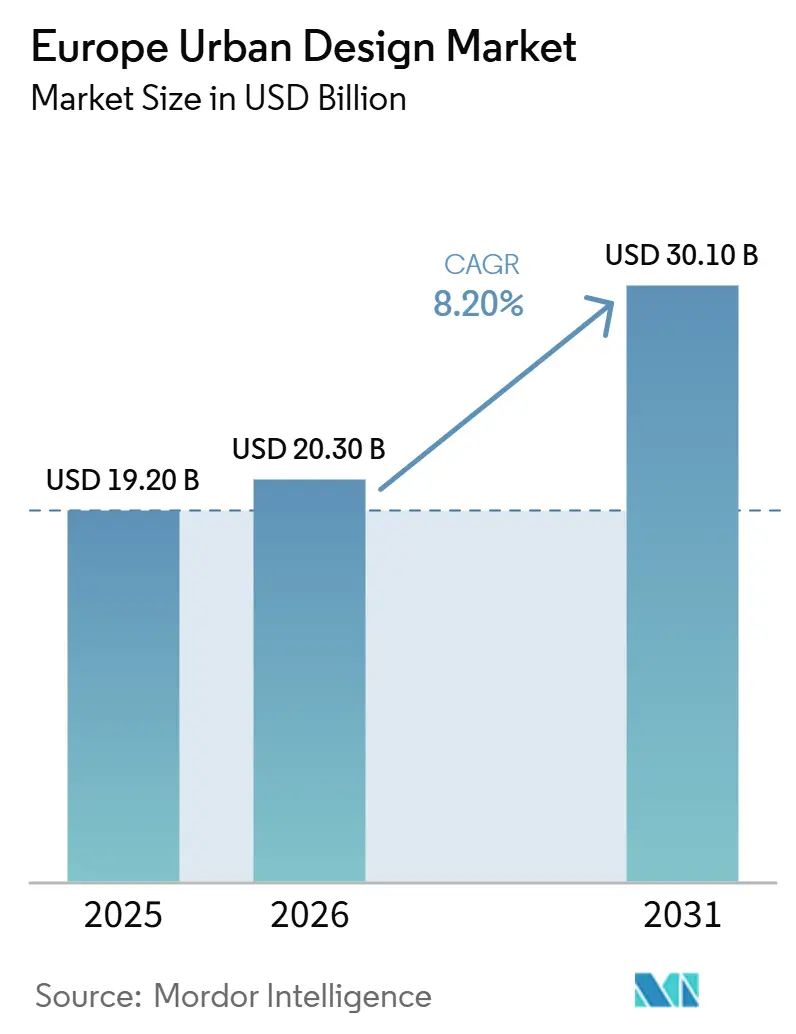
| Base Year Market Size (2025) | USD 19.20 Billion |
| Market Size (2026) | USD 20.30 Billion |
| Market Size (2031) | USD 30.10 Billion |
| Growth Rate (2026 - 2031) | 8.20 % |
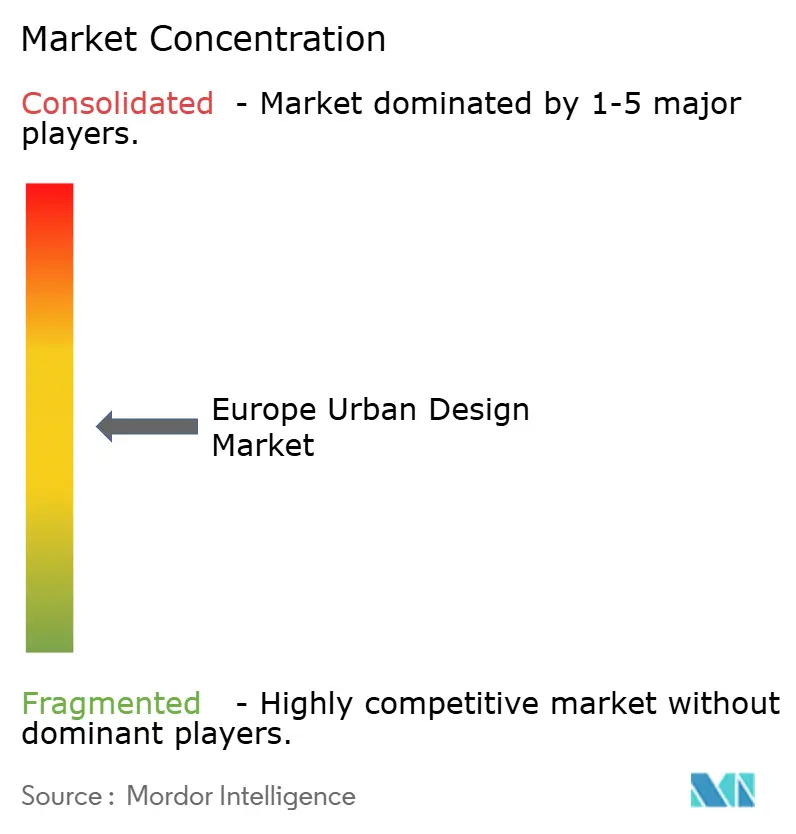
| Market Concentration | Medium |
Major Players *Disclaimer: Major Players sorted in no particular order Image © Mordor Intelligence. Reuse requires attribution under CC BY 4.0. | |
Europe Urban Design Market Analysis by Mordor Intelligence
The Europe Urban Design Market size was valued at USD 19.20 billion in 2025 and is estimated to grow from USD 20.30 billion in 2026 to reach USD 30.10 billion by 2031, at a CAGR of 8.20% during the forecast period (2026-2031). The Europe urban design market is supported by climate commitments, housing renewal, and transport-led regeneration across cities. The European Commission’s Climate-Neutral and Smart Cities Mission supports city investment planning and provides municipalities with a clearer basis for integrated design. Funding for sustainable cities and regions also supports projects that combine public transport, public spaces, buildings, and land use. In the Europe urban design market, public clients remain central, while private investors are taking a larger role in brownfield and mixed-use schemes. Heritage controls, fragmented planning rules, and capacity limits in planning offices can delay projects and raise the value of regulatory advisory services.
Key Report Takeaways
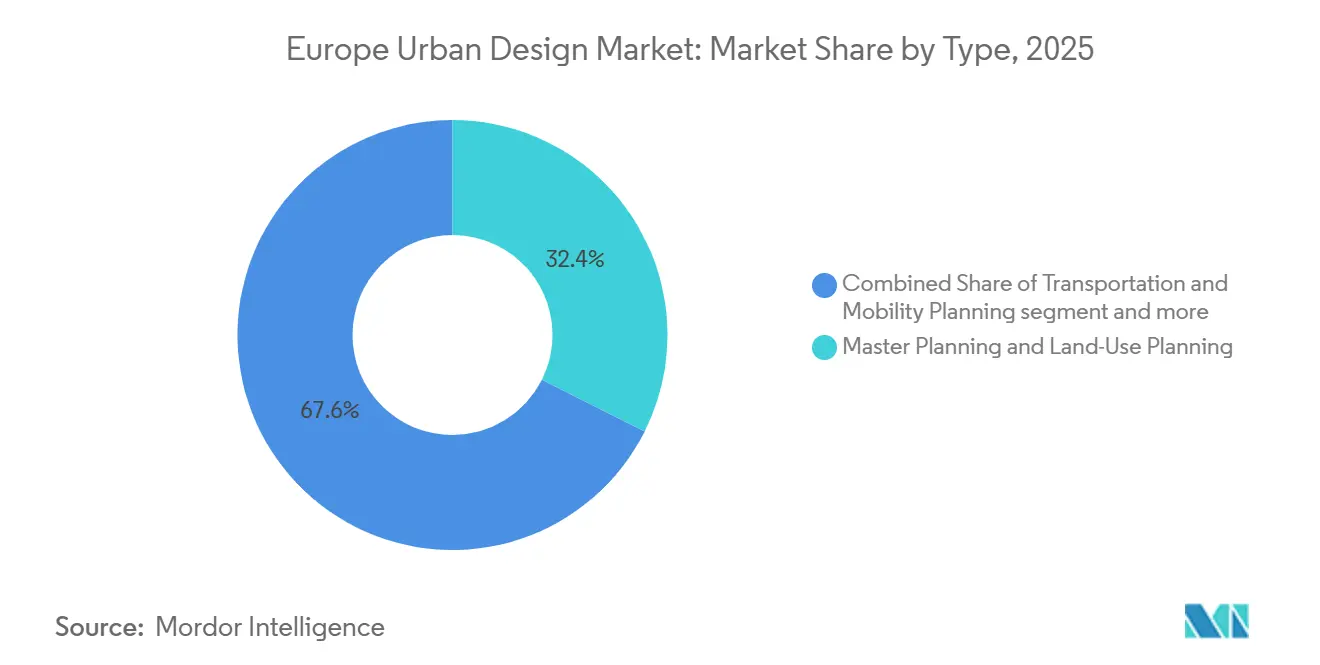
- By type, master planning and land-use planning held 32.4% of Europe urban design market share in 2025, while zoning, development control and implementation advisory is projected to grow at a 9.0% CAGR through 2031.
- By sector, mixed-use and township developments accounted for 34.8% of the Europe urban design market size in 2025, while transportation and infrastructure is projected to expand at a 9.4% CAGR through 2031.
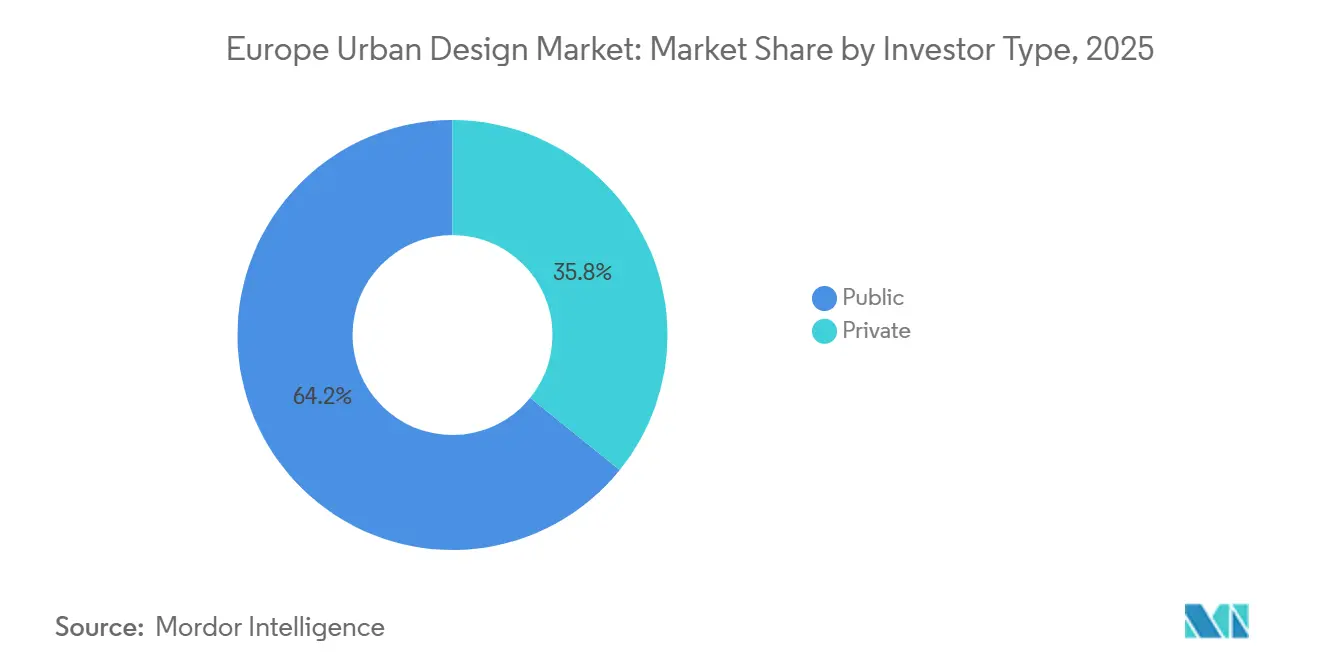
- By investor type, public investors accounted for 64.2% of revenue in 2025, while private investors recorded the highest projected CAGR of 9.9% through 2031.
- By geography, Germany accounted for 18.9% of revenue share in 2025, while the Rest of Europe is forecast to grow at a 11.9% CAGR through 2031.
Note: Market size and forecast figures in this report are generated using Mordor Intelligence’s proprietary estimation framework, updated with the latest available data and insights as of January 2026.
Europe Urban Design Market Trends and Insights
Drivers Impact Analysis*
| Drivers | (~) % Impact on CAGR Forecast | Geographic Relevance | Impact Timeline |
|---|---|---|---|
| Climate-Neutral City and Renovation Targets | +2% | EU-wide, concentrated in Mission Cities across Member States | Medium term (2-4 years) |
| Rail-Led Development and Transit-Oriented Regeneration | +1.4% | United Kingdom, Germany, France, Poland, Romania, and Baltic states | Medium term (2-4 years) |
| Housing Shortages and Urban Densification | +1.3% | Pan-European, strongest in Germany, United Kingdom, France, Spain, and Portugal | Short term (≤ 2 years) |
| Brownfield Redevelopment and Industrial Transition | +1.2% | United Kingdom, France, Germany, Romania, Portugal, and Belgium | Long term (≥ 4 years) |
| Public-Realm Enhancement and Active Mobility | +1% | Europe-wide, with early activity in Nantes, Madrid, Athens, Tallinn, and Ghent | Medium term (2-4 years) |
| Digital Urban Planning and Permitting Tools | +0.9% | EU-wide, particularly Mission Cities and complex development jurisdictions | Medium term (2-4 years) |
| Source: Mordor Intelligence | |||
Climate-Neutral City and Renovation Targets
The EU Mission on Climate-Neutral and Smart Cities is making urban design procurement more structured across participating municipalities, with 112 cities supported in their work toward climate neutrality by 2030. Climate City Contracts bring energy, buildings, waste, and transport into common investment roadmaps, broadening planning briefs and requiring coordination across municipal departments. The Mission Label gives cities a route to advisory support and blended finance through the Climate City Capital Hub, making a completed city plan more useful when seeking project finance. The 2026-2027 Horizon Europe work program allocates EUR 85.5 million (USD 97.14 million) to planning and management tools and to circular construction models for district-level programs. Germany has 8 cities in the Mission, and their continuing climate plans require citywide planning and mobility work through 2030. In the Europe urban design market, these formal plans provide a steadier pipeline for renovation, district planning, public realm work, and implementation advice.
Rail-Led Development and Transit-Oriented Regeneration
Rail investment is increasing demand for commissions that combine mobility planning, station-area design, land-use planning, and public-realm improvements. Arcadis and AtkinsRéalis were appointed as Programme Partner for Network Rail’s GBP 10.7 billion (USD 14.24 billion) Transpennine Route Upgrade in April 2026. The program covers 122 km of railway and requires planning around multiple station precincts where rail capacity, local access, and land development must be considered together. Gdańsk Nowe Południe covers 164 hectares around 6 future railway stations, where planning is progressing alongside rail construction and provides an early Polish example of coordinated transport and urban procurement. A 2025 DB Eco Group paper described the relocation of Hamburg’s Altona station as part of a mixed-use master plan, following the opening of the new Diebsteich S-Bahn station in February 2025. This approach creates a repeatable model for station districts in the Europe urban design market, including rail-adjacent projects in Romania, the Baltic states, and the Iberian Peninsula.
Housing Shortages and Urban Densification
Housing shortages are increasing demand for plans that support infill, adaptive reuse, and higher-density neighborhoods without leaving public services and mobility behind. The European Commission stated in 2025 that closing the EU supply gap would require 650,000 additional dwellings per year beyond the 1.6 million then built annually. The same document reported that permits for new construction and renovation had fallen by 22.2% between 2021 and 2024, further pressuring municipal delivery systems. This gap underscores the need to plan work that can unlock underused land, vacant buildings, and former offices in established urban areas. The RRF allocated EUR 19.6 billion (USD 22.34 billion) to housing measures across 20 Member States, including EUR 13.5 billion (USD 15.9 billion) for energy-efficiency objectives, providing a clear funding link for the delivery of renovations. The Europe urban design market benefits when housing programs require district-level design, mobility changes, public facilities, and planning approvals rather than individual building approvals alone.
Brownfield Redevelopment and Industrial Transition
Brownfield land is creating a large pipeline for mixed-use and regeneration planning, particularly where industrial land can be connected to existing transport and utilities. A January 2026 C40, Arup, and Urban Partners report identified 19,000 sq km of underused brownfield land in Europe and an investment opportunity of approximately USD 4.6 trillion. The report also noted that private investment flows into European urban land assets increased from USD 19.7 billion to USD 21.6 billion between late 2023 and early 2026. In Cluj-Napoca, the RIVUS project received its building permit in March 2026 for the redevelopment of the former Carbochim industrial platform, backed by an approximately USD 456 million green loan. Lille’s Fives Cail site is also being converted into a mixed-use district through an approximately USD 177 million investment, demonstrating how former industrial land can support a broader urban district. These projects give the European urban design market a longer cycle of remediation, site preparation, master planning, public-space design, and implementation.
Restraints Impact Analysis*
| Restraints | (~) % Impact on CAGR Forecast | Geographic Relevance | Impact Timeline |
|---|---|---|---|
| Heritage and Conservation Restrictions | -1.4% | Pan-European, strongest in Italy, France, United Kingdom, Spain, Poland, and UNESCO World Heritage cities | Long term (≥ 4 years) |
| Fragmented National and Local Planning Regulations | -1.2% | EU-wide, most acute in cross-border projects and multi-Member-State programs | Medium term (2-4 years) |
| High Development Costs and Land Scarcity | -1% | High-density urban cores, including Paris, London, Munich, Amsterdam, and Madrid | Short term (≤ 2 years) |
| Slow Environmental and Public Consultation Processes | -0.8% | EU-wide, particularly where Bird and Habitats Directives and environmental impact assessments overlap | Medium term (2-4 years) |
| Source: Mordor Intelligence | |||
Heritage and Conservation Restrictions
Heritage protection can limit redevelopment intensity in historic urban centers. The Granada Convention continues to shape conservation requirements across much of Europe. A 2025 academic study found that differences in local interpretation can lead to delays and redesign costs. The revised Energy Performance of Buildings Directive permits exemptions for heritage buildings, but national rules differ. In Visby, building changes require approval from both the County Administrative Board and Region Gotland, which extends project timelines. In the Europe urban design market, this makes specialist conservation and planning expertise important for work in high-demand historic districts.
Fragmented National and Local Planning Regulations
Different technical rules, permitting practices, and local approval processes complicate cross-border development. A comparative study of 30 European countries found that different requirements added 15-30% to cross-border development compliance costs. Permitting periods also ranged from weeks to more than 9 months across Member States. The European Commission opened a public consultation on simplifying building regulations in July 2026, with responses due in September 2026. These constraints combine with high land values, development costs, environmental review, and public consultation requirements in major city centers. The Europe urban design market therefore gives greater weight to zoning, development-control, and implementation advisory services that can manage these approvals.
*Our forecasts treat driver/restraint impacts as directional, not additive. The impact forecasts reflect baseline growth, mix effects, and variable interactions.
Segment Analysis
By Type: Master Planning Retains Scale While Advisory Services Grow Faster
Master Planning and Land-Use Planning held 32.4% of Europe urban design market share in 2025. Its position reflects the fact that climate contracts, brownfield conversions, and transit-oriented projects commonly begin with a master plan that establishes land use, infrastructure priorities, and development sequencing. This early planning stage often shapes later public-realm, mobility, and regulatory work. The Europe urban design industry depends on these commissions because they establish the framework for the subsequent design and advisory work. Urban Design, Public Realm and Landscape Design also receives support from sustainable-city funding and active mobility programs, including the European Investment Bank’s EUR 20.6 billion (USD 23.40 billion) in sustainable-city and regional commitments in 2025[1]European Investment Bank, “Sustainable Cities and Regions,” European Investment Bank, eib.org.
Zoning, Development Control, and Implementation Advisory is forecast to grow at a 9.0% CAGR from 2026 to 2031. The service responds to planning requirements for brownfield sites, heritage-sensitive projects, and station districts, while helping clients navigate uneven national and local rules. Horizon Europe’s 2026-2027 call includes AI-based planning and management tools that could support scenario analysis in these workflows. The Others category includes community participation platforms and digital twin commissions. Nordic firms have built a presence in these specialized services.



By Sector: Mixed-Use Development Leads Revenue While Transport Expands Fastest
Mixed-Use and Township Developments represented 34.8% of the Europe urban design market size in 2025. Brownfield-to-mixed-use projects provide a large share of this demand because they combine homes, workplaces, local services, public spaces, and access improvements in a single development program. The segment includes projects in Dublin, Lisbon, Luxembourg, and other urban centers. Public, Civic and Institutional Developments remain supported by schools, hospitals, and civic facilities within densification plans. The Europe urban design industry uses these projects to connect building programs with streets, parks, local mobility, and community needs.
Transportation and Infrastructure is projected to grow at a 9.4% CAGR through 2031. Its growth is linked to TEN-T corridors and national rail programs that require coordinated planning around stations and transport routes. The Transpennine Route Upgrade shows how a rail program can create work in master planning, analytics, risk management, and strategic advisory. Large multidisciplinary firms are well placed to manage these complex programs, while design studios often enter the region through mixed-use commissions. This difference shapes the project mix across the Europe urban design market.
By Investor Type: Public Programs Lead While Private Capital Gains Ground
Public investors held 64.2% of revenue in 2025. Municipal governments, regional authorities, and EU-funded bodies account for much of the demand for master planning and public-realm work. Climate City Contracts, RRF housing measures, and national urban renewal programs all support this position. Baden-Württemberg allocated EUR 247.5 million (USD 282.1 million) across 307 urban renewal measures in 275 municipalities in 2025. This dispersed spending supports work beyond major capital cities and provides a stable base for the Europe urban design market.
Private investors are forecast to grow at a 9.9% CAGR from 2026 to 2031. Institutional real estate capital is seeking value in brownfield conversion and mixed-use township projects. Green loans and blended-finance tools are increasingly linking finance to design and sustainability requirements. This can make design advice part of the financing process rather than a separate discretionary service. Private commissions are expected to narrow the gap with public revenue, though public programs should remain the larger source of work through at least 2028, as current government pipelines remain active.
Geography Analysis
Germany held 18.9% revenue share in 2025 and remained the largest national market in the Europe urban design market. Its pipeline combines climate-neutral urban transformation with pressure on the housing stock. The German federal government reported that 8 German cities are enrolled in the EU Mission. Public funding programs support urban renewal across different municipality sizes. The United Kingdom has major rail and brownfield projects, including the Transpennine Route Upgrade and TfL’s Professional Services Framework 3[2]Arcadis, “Arcadis Supports Complex Transport Delivery,” Arcadis, arcadis.com.
France has a pipeline of brownfield regeneration projects in Lille, Paris, and Bordeaux. Fives Cail in Lille is undergoing a EUR 155 million (USD 176.7 million) investment. Italy’s activity is concentrated in Milan and supported by large mixed-use conversions, while Spain combines public realm improvements in Madrid with rail-to-city integration in Alicante. These locations must balance redevelopment, mobility, heritage, and environmental review within their planning systems.
Rest of Europe is the fastest-growing geography, with an 11.9% CAGR projected from 2026 to 2031. Romania is developing a broader set of commissions through RIVUS in Cluj-Napoca, as well as projects in Constanța and Iași. The Europe urban design market also benefits from transit-integrated development in Tallinn and the broader Rail Baltica corridor. Tallinn Airport reported that the Rail Baltica terminal is intended to make Ülemiste a second city center by 2030[3]Tallinn Airport, “Completion of Rail Baltica Terminal Will Turn Ülemiste into Tallinn’s Second City Centre by 2030,” Tallinn Airport, airport.ee. Nordic markets continue to support long-duration projects based on sustainability performance standards.
Competitive Landscape
The Europe urban design market is moderately concentrated among large multidisciplinary consultancies and specialist design studios. Arcadis, WSP, Arup, Ramboll, AECOM, AtkinsRéalis, and Stantec compete for major public-sector and program-management frameworks. Foster + Partners, UNStudio, OMA, and Skidmore, Owings & Merrill compete for design-led master plans and mixed-use commissions. Large firms have greater capacity to manage complex transport and public works programs. Specialist studios compete through design competitions and distinctive master planning work.
Arcadis and AtkinsRéalis formed a joint venture for the Transpennine Route Upgrade Programme Partner framework in April 2026. This move reflects the scale of programs that combine design, analytics, risk management, and delivery advice. Arcadis also reported 4 data center project wins in Frankfurt and Berlin through KUA in November 2025. The projects had a combined value of EUR 8 million and covered zoning, permitting, tender preparation, and construction monitoring.
Opportunities are strongest in regulatory advice for Central and Eastern European projects and in services that connect design standards with green-finance requirements. Brownfield remediation and urban ecology consultancies can also enter projects during feasibility and site preparation. The Europe urban design market remains competitive because large frameworks favor scale, while design competitions allow specialist studios to win prominent work. No combined market share for the top firms was supplied, so the available evidence supports a moderate concentration assessment rather than a quantified ranking.
Europe Urban Design Industry Leaders
Arcadis N.V.
WSP Global Inc.
Arup Group Limited
Ramboll Group A/S
AECOM
- *Disclaimer: Major Players sorted in no particular order

Recent Industry Developments
- July 2026: Arcadis was appointed to Transport for London’s Professional Services Framework 3, a multi-million-pound, 3-year framework from April 2026 covering risk management, planning, scheduling, and procurement support across TfL’s rail, stations, depots, highways, and property programs.
- June 2026: AtkinsRéalis was named as a supplier on a major United Kingdom government construction framework, supporting design and delivery of infrastructure and building programs across built environment, defense, and nuclear sectors over 4 years.
- June 2026: The United Kingdom Government Commercial Agency awarded places on a GBP 4.2 billion construction professional services framework. Arcadis, AECOM, AtkinsRéalis, Ramboll, and WSP collectively secured appointments across multiple lots spanning infrastructure, defense, nuclear, and flood-risk work.
- April 2026: Arcadis and AtkinsRéalis, in a joint venture, were appointed by Network Rail as Programme Partner for the GBP 10.7 billion Transpennine Route Upgrade. The 5-year framework is valued at up to GBP 100 million and covers program management, analytics, risk management, and strategic advisory for the 122 km Manchester-Leeds-York rail modernization.


Europe Urban Design Market Report Scope
| Master Planning and Land-Use Planning |
| Urban Design, Public Realm and Landscape Design |
| Transportation and Mobility Planning |
| Zoning, Development Control and Implementation Advisory |
| Others |
| Mixed-Use and Township Developments |
| Transportation and Infrastructure |
| Public, Civic and Institutional Developments |
| Others |
| Public |
| Private |
| Germany |
| United Kingdom |
| France |
| Italy |
| Spain |
| Sweden |
| Denmark |
| Norway |
| Rest of Europe |
| By Type | Master Planning and Land-Use Planning |
| Urban Design, Public Realm and Landscape Design | |
| Transportation and Mobility Planning | |
| Zoning, Development Control and Implementation Advisory | |
| Others | |
| By Sector | Mixed-Use and Township Developments |
| Transportation and Infrastructure | |
| Public, Civic and Institutional Developments | |
| Others | |
| By Investor Type | Public |
| Private | |
| By Country | Germany |
| United Kingdom | |
| France | |
| Italy | |
| Spain | |
| Sweden | |
| Denmark | |
| Norway | |
| Rest of Europe |


Key Questions Answered in the Report
What is the projected value of Europe urban design services by 2031?
The Europe urban design market is projected to reach USD 30.1 billion by 2031, rising from USD 20.3 billion in 2026 at an 8.2% CAGR.
Which service type leads urban design demand in Europe?
Master Planning and Land-Use Planning led with 32.4% share in 2025, while Zoning, Development Control and Implementation Advisory is forecast to grow at 9.0% CAGR.
Which project sector is growing fastest?
Transportation and Infrastructure is projected to grow at a 9.4% CAGR through 2031, supported by rail upgrades and station-area regeneration.
Why are brownfield projects important for European urban design?
Brownfield sites create long project cycles for remediation, master planning, mobility design, and implementation support. C40 identified 19,000 sq km of underused European brownfield land.
Page last updated on:





