
Europe Prefabricated Bathroom Modules Market Size and Share
Market Overview
| Study Period | 2020 - 2031 |
|---|---|
| Forecast Data Period | 2026 - 2031 |
| Base Year Market Size (2025) | USD 0.69 Billion |
| Market Size (2026) | USD 0.73 Billion |
| Market Size (2031) | USD 1.03 Billion |
| Growth Rate (2026 - 2031) | 7.13 % |
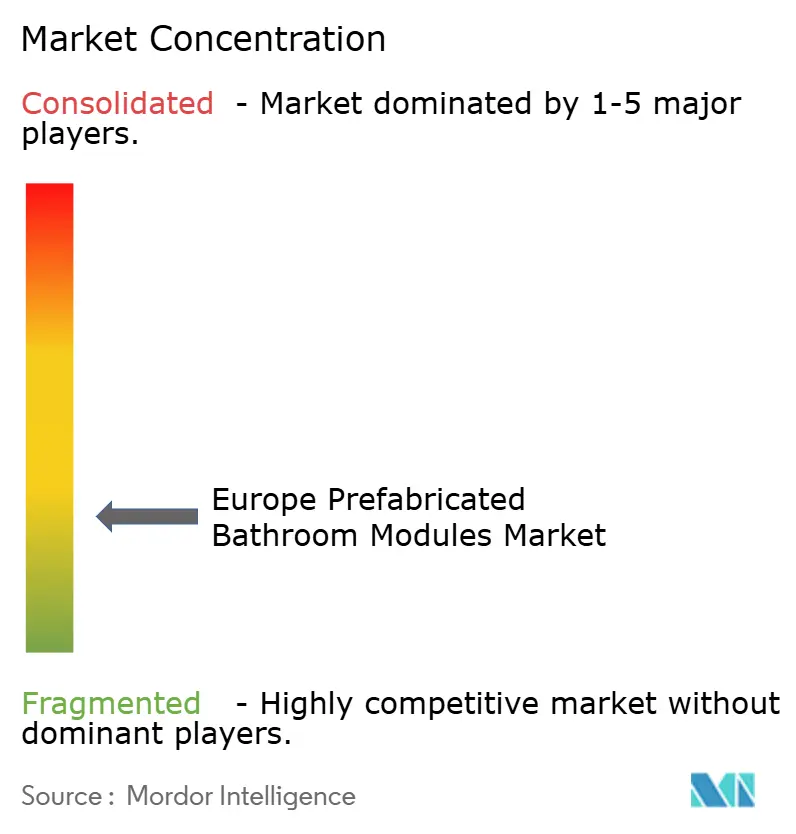
| Market Concentration | Low |
Major Players *Disclaimer: Major Players sorted in no particular order Image © Mordor Intelligence. Reuse requires attribution under CC BY 4.0. | |
Europe Prefabricated Bathroom Modules Market Analysis by Mordor Intelligence
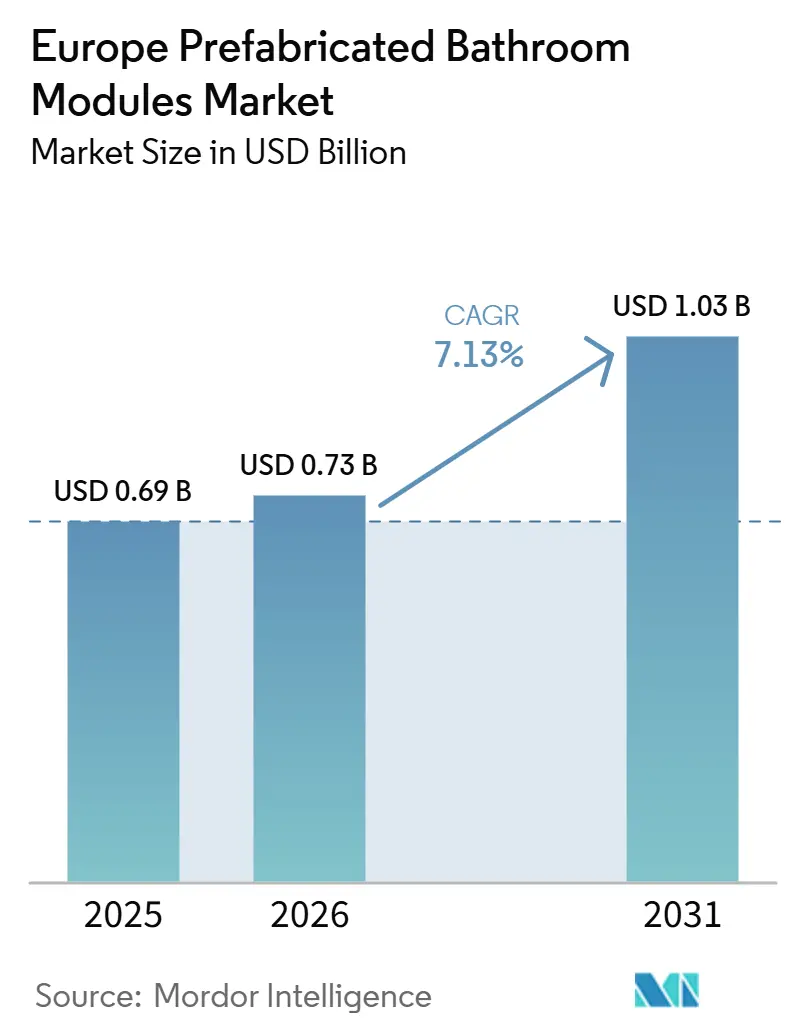
The Europe Prefabricated Bathroom Modules Market size is projected to expand from USD 0.69 billion in 2025 and USD 0.73 billion in 2026 to USD 1.03 billion by 2031, registering a CAGR of 7.13% between 2026 to 2031.
The Europe prefabricated bathroom modules market is expanding because developers are treating offsite bathroom delivery as a way to reduce schedule risk on dense urban projects where delays quickly raise financing and labor costs. The Europe prefabricated bathroom modules market is also benefiting from persistent shortages in plumbing, tiling, and wet-room installation trades, which makes factory completion more attractive than coordinating multiple site crews. Demand is widening as renovation programs across the region move from planning into execution, especially where owners need to upgrade occupied buildings with less disruption. Competition is increasingly centered on traceable manufacturing records, finish consistency, and the ability to support repeat layouts across hospitality, residential, and healthcare projects. Logistics pressure and the need to freeze designs early still limit adoption, but these factors are not strong enough to offset the broad move toward more controlled project delivery.
Key Report Takeaways
- By product type, steel framed modules held 38.60% of the Europe prefabricated bathroom modules market share in 2025, while hybrid modules are forecast to grow at a 8.60% CAGR through 2031.
- By installation type, new build accounted for 68.80% of the Europe prefabricated bathroom modules market in 2025, while retrofit and renovation is projected to expand at a 8.20% CAGR through 2031.
- By end user, hospitality accounted for 31.90% of revenue in 2025, while healthcare is expected to record the fastest growth at a 8.80% CAGR through 2031.
- By geography, the United Kingdom held 24.50% share in 2025, while Germany is forecast to grow at 8.40% CAGR through 2031.
Note: Market size and forecast figures in this report are generated using Mordor Intelligence’s proprietary estimation framework, updated with the latest available data and insights as of January 2026.
Europe Prefabricated Bathroom Modules Market Trends and Insights
Drivers Impact Analysis*
| Driver | (~) % Impact on CAGR Forecast | Geographic Relevance | Impact Timeline |
|---|---|---|---|
| Hospitality and Mixed-Use Construction Drives Bathroom Module Demand | +1.5% | United Kingdom, Germany, France, Portugal, and Turkey | Short term (≤ 2 years) |
| Skilled Trade Labor Shortages Accelerate Offsite Construction Adoption | +1.4% | EU-wide, strongest in Germany, France, Spain, and the Nordics | Long term (≥ 4 years) |
| Faster Urban Project Delivery Increases Prefabricated Bathroom Module Usage | +1.2% | EU-wide, concentrated in London, Paris, Amsterdam, and Berlin | Short term (≤ 2 years) |
| Growth in Occupied-Building Retrofits Supports Bathroom Pod Installations | +1.0% | United Kingdom, France, Germany, and the Netherlands | Medium term (2-4 years) |
| Rising Demand for Hygienic Wet-Room Solutions Boosts Market Adoption | +0.8% | Western Europe, especially healthcare and hospitality clusters | Medium term (2-4 years) |
| Sustainability Regulations Encourage Prefabricated Bathroom Module Deployment | +0.7% | EU-wide, with earlier gains in Germany, the Nordics, and the Netherlands | Medium term (2-4 years) |
| Source: Mordor Intelligence | |||
Hospitality and Mixed-Use Construction Drives Bathroom Module Demand
Hospitality construction is a strong demand driver for prefabricated bathroom modules because hotel developers value faster room delivery, consistent finishes, and tighter control over interior fit-out risk. Europe’s hotel construction pipeline stands at 1,731 projects with 255,354 rooms in Q1 2026, providing bathroom pod suppliers with a large, active base of projects where specification decisions are already underway. Within this pipeline, 792 projects covering 119,106 rooms are under construction, which supports near-term procurement demand for factory-built bathroom solutions. The early planning stage has reached 604 projects with 86,128 rooms, indicating a longer runway for modular bathroom adoption over the next few years. The United Kingdom leads with 268 pipeline projects, followed by Germany with 144 and France with 125, which aligns closely with the countries where bathroom pod specification is already more established. Upscale and upper-upscale hotels are expanding the fastest, and these formats favor prefabricated bathrooms because they need uniform room quality across large room counts while keeping construction schedules under close control.
Skilled Trade Labor Shortages Accelerate Offsite Construction Adoption
The Europe prefabricated bathroom modules market is being driven forward by a labor gap that has shifted from a short-cycle issue to a structural limit on project delivery. FIEC stated in late 2025 that the EU construction sector will need 2 million additional workers by 2030, and that the renovation wave alone may require 486,600 to 1,549,000 more workers over that period. The same paper noted that Germany faces annual age-related attrition of 80,000 workers, Spain needs 500,000 workers in the short to medium term, and France requires 100,000 new entrants each year to sustain current output. The European Construction Observatory also noted that construction employment reached 16.8 million workers in 2024, yet shortages still constrained the sector’s ability to meet demand. Bathroom installation is exposed to this pressure because it depends on several wet trades that must be sequenced correctly, and those trades are among the hardest roles to replace in aging workforces. Factory-built modules reduce that dependence by shifting plumbing, tiling, electrical, and finishing work into a controlled production line, which is why procurement teams in the Europe prefabricated bathroom modules market are increasingly using labor scarcity as a direct specification argument.
Faster Urban Project Delivery Increases Prefabricated Bathroom Module Usage
The Europe prefabricated bathroom modules market is also gaining ground because dense urban projects leave little room for installation errors and almost no tolerance for trade congestion on site. Developers of high-rise residential, student accommodation, and hotel assets are using pods to shorten interior fit-out sequences and reduce the number of handovers between trades. This matters most where crane windows, delivery slots, and floor-by-floor access are tightly managed, because a single late trade can disrupt several subsequent packages. StercheleGroup’s July 2026 delivery of 324 bathroom pods for Hampton by Hilton Venice showed how integrated offsite structural and bathroom planning can compress site assembly on a constrained urban project, with the hotel structure completed in 104 days. EcoReadyBath’s 2025 work on the PettCo mixed-use project in Berlin also showed that suppliers can support complex inner-city sequencing when pod layouts and deliveries are coordinated in detail. As a result, the Europe prefabricated bathroom modules market is being supported not only by cost considerations, but also by a growing preference for predictable delivery on sites where conventional bathroom construction creates too many moving parts.
Growth in Occupied-Building Retrofits Supports Bathroom Pod Installations
Occupied-building retrofit growth is a clear demand driver for prefabricated bathroom modules, as many residential, healthcare, and care-facility upgrades cannot tolerate long periods of on-site wet-trade work. Building owners increasingly need bathroom solutions that minimize disruption to residents, patients, and staff while still enabling upgrades to proceed within tight renovation schedules. This is especially relevant in dense urban markets, where full building evacuation is often too costly or operationally difficult, making faster and more controlled installation methods more attractive. The driver is also being reinforced by regulation, as EU member states were required to submit draft National Building Renovation Plans by December 2025 under the Energy Performance of Buildings framework, which is helping move renovation activity from policy targets into funded project pipelines. Prefabricated bathroom modules meet this requirement well by shifting more work to the factory and reducing time spent in occupied buildings during installation.
Restraints Impact Analysis*
| Restraints | (~) % Impact on CAGR Forecast | Geographic Relevance | Impact Timeline |
|---|---|---|---|
| Logistics and Transportation Complexity Increases Project Costs | -1.3% | EU-wide, most severe in London, Paris, and Amsterdam | Medium term (2-4 years) |
| Limited Design Flexibility Restricts Adoption in Complex Projects | -0.9% | EU-wide, especially in premium hospitality and heritage retrofits | Long term (≥ 4 years) |
| Customization Requirements Reduce Standardization Benefits | -0.7% | EU-wide, strongest in luxury hotels and bespoke residential schemes | Medium term (2-4 years) |
| Early Design Freeze Requirements Limit Project Flexibility | -0.6% | EU-wide, especially for smaller developers and phased projects | Short term (≤ 2 years) |
| Source: Mordor Intelligence | |||
Logistics and Transportation Complexity Increases Project Costs
The Europe prefabricated bathroom modules market still faces a real operational constraint in the way pods must be transported, lifted, and installed. Bathroom modules are bulky finished units, and many projects depend on narrow crane windows and tightly timed delivery sequences that cannot be missed without affecting later work. Urban restrictions make that harder because major cities apply congestion rules, vehicle limits, and site access controls that raise both cost and coordination pressure. A delivery delay can therefore create a larger financial problem than the transport bill itself, since missed lifts and interrupted slab or façade sequences can quickly push back the full interior schedule. EcoReadyBath’s 2025 Berlin project demonstrated that these risks can be managed through detailed, just-in-time planning, but it also underscored the discipline required to make that approach work. The Europe prefabricated bathroom modules market will keep growing, but suppliers that cannot control logistics with the same rigor as manufacturing will struggle to convert demand into repeat orders.
Limited Design Flexibility Restricts Adoption in Complex Projects
The Europe prefabricated bathroom modules market also runs into limits when projects demand high design variation and late-stage changes. Pod economics work best when layouts, fixtures, and finishes can be repeated at scale, because standardization supports both cost control and production speed. Premium hotels, luxury residential assets, and heritage upgrades often require non-standard dimensions, distinctive finish palettes, or custom detailing that sit less comfortably within a factory template. That challenge becomes more serious once production starts, because changes to fixture locations, tile selections, or service routes are much harder to absorb than on a conventional site-built bathroom. Offsite Solutions addressed part of this issue in 2025 by expanding its hybrid range to include ceramic tile finishes within a GRP shell, demonstrating that suppliers are seeking to broaden design choice without sacrificing offsite efficiency. Even so, the Europe prefabricated bathroom modules market remains more favorable for projects that can decide earlier and repeat more often than for projects that rely on frequent late revisions.
*Our forecasts treat driver/restraint impacts as directional, not additive. The impact forecasts reflect baseline growth, mix effects, and variable interactions.
Segment Analysis
By Product Type: Steel Framed Commands Share While Hybrid Modules Redefine the Premium Tier
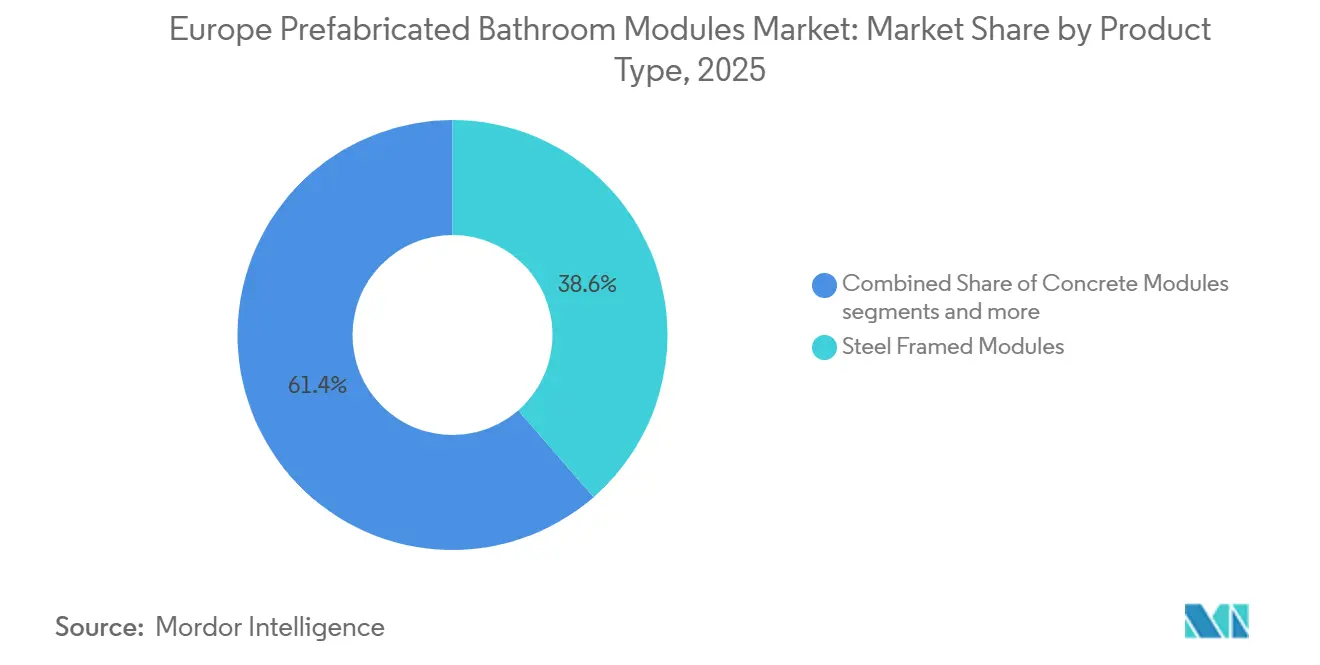
Steel-framed modules held a 38.60% share in 2025, keeping them in the lead across the Europe prefabricated bathroom modules market. Steel remains the preferred choice where structural accuracy, load performance, and documented fire resistance matter most, especially in taller buildings and regulated project types. Its position is reinforced by the fact that contractors and consultants already understand how steel pod frames interface with common high-rise construction methods. Concrete modules still offer durability, but their weight reduces flexibility on upper floors and increases transport pressure on cross-border deliveries. GRP modules play a significant role in healthcare, student housing, and cost-sensitive residential applications due to their corrosion resistance and ease of installation.
The hybrid modules are projected to expand at a 8.60% CAGR between 2026 and 2031. Hybrid formats are gaining traction because they combine a strong structural base with finish options that are closer to those of conventional premium bathrooms. That matters in hospitality and higher-end residential projects, where developers want the speed of pods without sacrificing the quality of tiled or composite surfaces. Offsite Solutions expanded its offer in 2025 by incorporating ceramic tile finishes into a hybrid pod format, which directly addressed one of the strongest objections to earlier GRP-led solutions[1]Offsite Solutions, “Offsite Solutions Expands Range of Bathroom Pods With Hybrid Design for Enhanced Finishes,” Offsite Solutions, offsitesolutions.com. Timber-based modules remain an emerging option, but their near-term uptake is still narrower because dense urban and high-rise specifications continue to favor materials with more established fire-performance acceptance.


By Installation Type: New Build Anchors Volume While Retrofit and Renovation Outpaces the Market
New build accounted for 68.80% of demand in 2025, making it the volume base of the Europe prefabricated bathroom modules market. This lead reflects the fact that pods work best when the structural grid, service routes, and delivery sequence are planned around them from the first design stage. Residential towers, student accommodation, and hotel projects fit that pattern because they contain repeated room types and large batches of similar bathrooms. Once a developer standardizes the pod approach in a single scheme, it becomes easier to carry that same logic into the next project, with fewer design debates. Temporary and relocatable units remain a smaller niche because they serve a narrower group of use cases than permanent building integration.
Retrofit and renovation are forecast to grow at a 8.20% CAGR from 2026 to 2031, placing it ahead of the overall Europe prefabricated bathroom modules market. The driver is not only policy, but also the practical challenge of upgrading buildings that remain occupied during construction. Owners of housing, care, and institutional assets increasingly need solutions that shorten on-site work and reduce disruption for residents, patients, or staff. EU member states had to prepare draft National Building Renovation Plans by December 2025, and that requirement is helping bring more building upgrades into active planning and procurement[2]European Commission, “National Building Renovation Plans,” European Commission, energy.ec.europa.eu . Suppliers that can provide lighter sections, tighter installation tolerances, and good access planning are likely to gain the most as retrofit demand becomes a larger part of the Europe prefabricated bathroom modules market.
By End User: Hospitality Anchors Revenue While Healthcare Fastest Growing by Margin
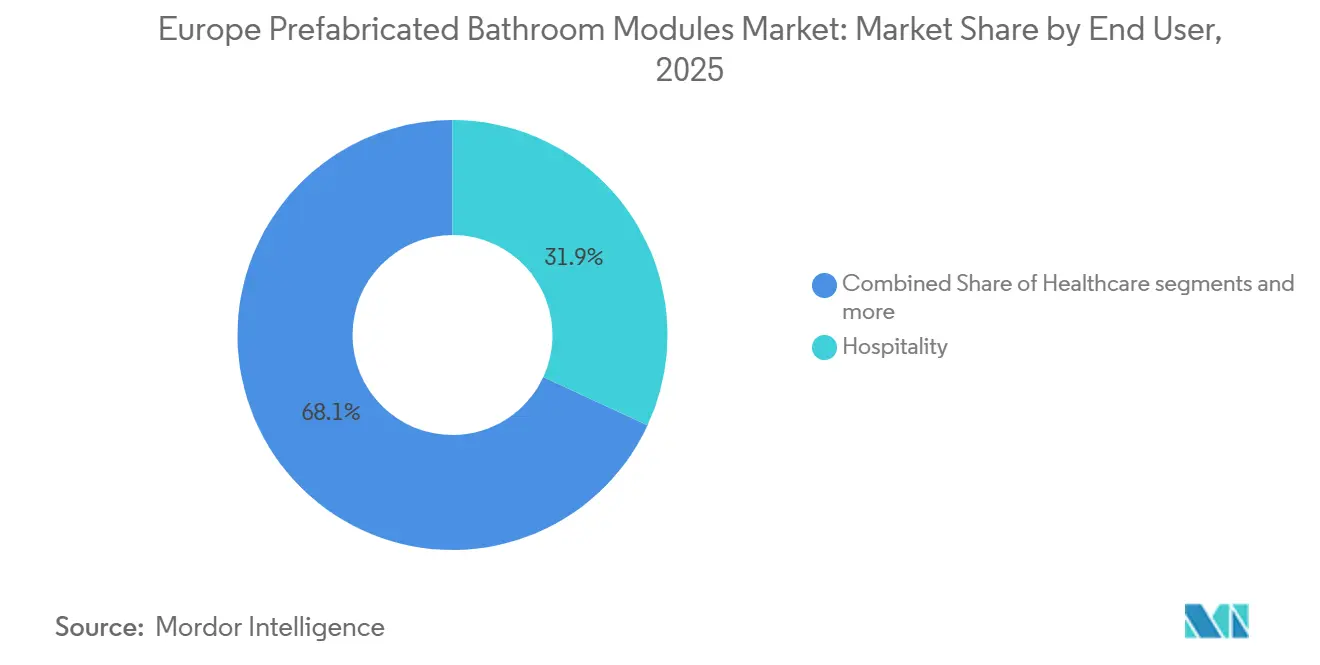
Hospitality accounted for 31.90% of revenue in 2025 and remained the largest end-user segment in the Europe prefabricated bathroom modules market. Hotels are a natural fit for pods because they need consistent bathroom finishes across many rooms and face clear penalties when interior handover slips. Bathrooms also account for a large share of fit-out complexity, which means developers can remove a meaningful risk package by shifting that work off-site. StercheleGroup’s 2026 Hampton by Hilton Venice project demonstrated how pods can enable fast hotel execution when bathroom delivery is closely tied to the structural plan. Residential and office demand also adds volume, with residential supported by repeat-unit formats and offices gaining relevance as renovation strategies become more common.
The healthcare is expected to grow at a 8.80% CAGR through 2031 in the Europe prefabricated bathroom modules market. Healthcare projects favor prefabrication because hospitals and care facilities rarely have the option to pause operations for extended wet-trade work. Pods reduce the number of contractors moving through sensitive clinical or residential areas and allow more work to be inspected before delivery to the site. DEBA stated that it supplies major German healthcare institutions, including Helios and Charité Berlin, and that it produces more than 2,500 units annually for healthcare clients. That combination of hygiene control, repeatability, and lower disruption is likely to keep healthcare as the fastest-growing vertical within the Europe prefabricated bathroom modules market.

Geography Analysis
The United Kingdom held 24.50% of the Europe prefabricated bathroom modules market share in 2025, which kept it in the leading country position. The market is more established there because off-site methods have been used for longer in student housing, build-to-rent, and hotel projects. United Kingdom developers and contractors are also more familiar with integrating pod procurement into early design coordination, which reduces resistance at the specification stage. Offsite Solutions stated in 2024 that it had won a GBP 4.2 million (USD 5.4 million) contract to supply 839 pods for Moda Living’s Hove development, which highlighted the scale of repeat orders in the United Kingdom pipeline. That maturity helps the United Kingdom remain a reference point for how the Europe prefabricated bathroom modules market can move from pilot use into routine project delivery.
Germany is forecast to grow at 8.40% CAGR through 2031, making it the fastest-expanding national market in the Europe prefabricated bathroom modules market. Labor pressure is one reason, with FIEC noting annual age-related attrition of 80,000 construction workers in the country. German supply is also supported by domestic manufacturing depth, with DEBA operating a 20,000 m² facility in Salzwedel and a capacity of up to 2,600 prefabricated bathrooms annually. EcoReadyBath’s 2025 project base in Berlin and Bad Saulgau shows that German demand already spans mixed-use residential and healthcare settings rather than relying on a single vertical.
France and Italy represent meaningful demand pools that are still moving through earlier adoption stages than the United Kingdom. In France, uptake is supported by the same broad pressures seen elsewhere, including labor availability, renovation needs, and the appeal of better factory control over wet-room quality. Italy stands out for visible project execution, with StercheleGroup supplying 192 bathroom pods for the Milano Cortina 2026 Olympic and Paralympic Village in Predazzo. Spain and the rest of Europe have a longer adoption runway, where policy-led building upgrades and labor shortages are likely to support broader adoption of pods over time. Nordic markets also add a sustainability-led angle, as Green Box Denmark’s 2025 work for the Comwell Aarhus City Tower reflected how bathroom pods are being tied to ecolabel and taxonomy-related project requirements[3]Green Box Denmark, “Bathroom Pods,” Green Box Denmark, greenboxdenmark.com.
Competitive Landscape
The Europe prefabricated bathroom modules market remains fragmented, with numerous regional and country-specific suppliers serving hospitality, healthcare, residential, and mixed-use projects. Competition is dispersed across United Kingdom specialists with strong contractor relationships and continental manufacturers with established expertise in modular bathroom solutions. Offsite Solutions is a notable participant in the United Kingdom, producing more than 10,000 pod units annually at its Somerset facility and targeting 15,000 units through planned capacity expansion. On the continent, StercheleGroup has strengthened its market presence through projects such as the Venice Hampton by Hilton development and the simultaneous production of more than 2,600 bathroom pods for student housing as of June 2026. DEBA further reinforces the competitive landscape with its German manufacturing operations and extensive experience in healthcare projects, particularly where regulatory compliance and standardized delivery are critical.
Suppliers in the Europe prefabricated bathroom modules market increasingly compete on factors beyond manufacturing capacity. Buyers now evaluate providers based on documentation quality, the ability to manage complex site logistics, the ability to deliver on customization, and alignment with low-carbon procurement requirements. Hybrid product offerings are becoming an important competitive differentiator by combining installation efficiency with premium interior finishes. For example, Offsite Solutions expanded its hybrid pod portfolio in 2025 by introducing ceramic tile finishes within a GRP shell structure. Similarly, DEBA's investments in lower-energy manufacturing processes and planned photovoltaic capacity demonstrate how sustainability credentials are becoming an increasingly important element of supplier differentiation.
Opportunities continue to emerge in retrofit-ready bathroom pods designed for installation within occupied buildings where site access and construction sequencing are more challenging. EcoReadyBath's Berlin project illustrates how expertise in urban logistics and phased delivery can provide a competitive advantage beyond standardized product supply. Likewise, Green Box Denmark's involvement in a Nordic Swan-certified hotel project highlights the growing importance of sustainability documentation during supplier selection. As a result, the Europe prefabricated bathroom modules market remains fragmented and relationship-driven. At the same time, competition is increasingly shaped by product innovation, project execution capabilities, and environmental performance rather than production scale alone.
Europe Prefabricated Bathroom Modules Industry Leaders
DEBA
StercheleGroup S.p.A.
BAUDET
TLC Unit
Green Box
- *Disclaimer: Major Players sorted in no particular order

Recent Industry Developments
- July 2026: EcoModular, IDS Build, and Modul Consult signed a definitive Combination and Share Exchange Agreement to create a single integrated volumetric modular construction platform spanning Europe, the United Kingdom, and the Gulf Cooperation Council region. Under the deal, EcoModular acquires a 60% interest in Modul Consult and a 20% interest in IDS, combining Latvia-based factory manufacturing with IDS's project management and delivery capabilities across the United Kingdom, Saudi Arabia, and the United Arab Emirates. The combined entity is also positioning for a direct listing on a United States senior securities exchange, signalling growing institutional appetite for pan-European modular construction platforms.
- March 2026: Walker Modular launched a new collection of smart bathroom pods integrating building automation systems and real-time water-monitoring capabilities. The range moves Walker Modular's value proposition beyond factory-built structural delivery into operational asset management, enabling features such as leak detection, occupancy-responsive ventilation, and predictive maintenance.
- January 2026: StercheleGroup supplied 192 prefabricated bathroom pods for the Olympic and Paralympic Village in Predazzo as part of the Milano Cortina 2026 Winter Games infrastructure, alongside prefabricated staircases for the G. Dal Ben Ski Jumping Stadium.


Europe Prefabricated Bathroom Modules Market Report Scope
The Europe Prefabricated Bathroom Modules Market Report is Segmented by Product Type (Steel Framed Modules, Concrete Modules, Hybrid Modules, and More), Installation Type (New Build, and More), End User (Hospitality, Healthcare, Residential, Commercial Offices, and Others), and Geography (United Kingdom, Germany, France, Italy, Spain, and Rest of Europe). The Market Forecasts are Provided in Terms of Value (USD).
| Steel Framed Modules |
| Concrete Modules |
| Hybrid Modules |
| Glass Reinforced Plastic Modules |
| Timber-Based Modules |
| New Build |
| Retrofit and Renovation |
| Temporary and Relocatable Units |
| Hospitality |
| Healthcare |
| Residential |
| Commercial Offices |
| Others |
| United Kingdom |
| Germany |
| France |
| Italy |
| Spain |
| Rest of Europe |
| By Product Type | Steel Framed Modules |
| Concrete Modules | |
| Hybrid Modules | |
| Glass Reinforced Plastic Modules | |
| Timber-Based Modules | |
| By Installation Type | New Build |
| Retrofit and Renovation | |
| Temporary and Relocatable Units | |
| By End User | Hospitality |
| Healthcare | |
| Residential | |
| Commercial Offices | |
| Others | |
| By Geography | United Kingdom |
| Germany | |
| France | |
| Italy | |
| Spain | |
| Rest of Europe |


Key Questions Answered in the Report
What is the projected value of Europe prefabricated bathroom modules by 2031?
The Europe prefabricated bathroom modules market is forecast to reach USD 1.03 billion by 2031, rising from USD 0.73 billion in 2026 at a 7.13% CAGR.
Which product type leads revenue in Europe prefabricated bathroom modules?
Steel framed modules led the market in 2025 with a 38.60% share because they fit well with high-rise, hospitality, and regulated building applications.
Why is healthcare growing faster than other end-user groups?
Healthcare is projected to grow at 8.80% CAGR through 2031 because hospitals and care facilities need faster installation, lower disruption, and better hygiene control than site-built wet rooms often provide.
Why is retrofit becoming more important for bathroom pods in Europe?
Retrofit and renovation is expected to expand at 8.20% CAGR through 2031 as owners upgrade occupied buildings and European Union (EU) renovation planning moves into project execution.
Which countries are shaping regional demand the most?
The United Kingdom led with 24.50% share in 2025, while Germany is the fastest-growing national market with an 8.40% CAGR through 2031.
Page last updated on:





