
Europe, Middle East, and Africa (EMEA) Biostimulants Seed Treatment Market Size and Share
Market Overview
| Study Period | 2021 - 2031 |
|---|---|
| Base Year Market Size (2025) | USD 390 Million |
| Market Size (2026) | USD 432.10 Million |
| Market Size (2031) | USD 721.40 Million |
| Growth Rate (2026 - 2031) | 10.79 % |
| Fastest Growing Market | Middle East |
| Largest Market | Europe |
Major Players *Disclaimer: Major Players sorted in no particular order Image © Mordor Intelligence. Reuse requires attribution under CC BY 4.0. | |
Europe, Middle East, and Africa (EMEA) Biostimulants Seed Treatment Market Analysis by Mordor Intelligence
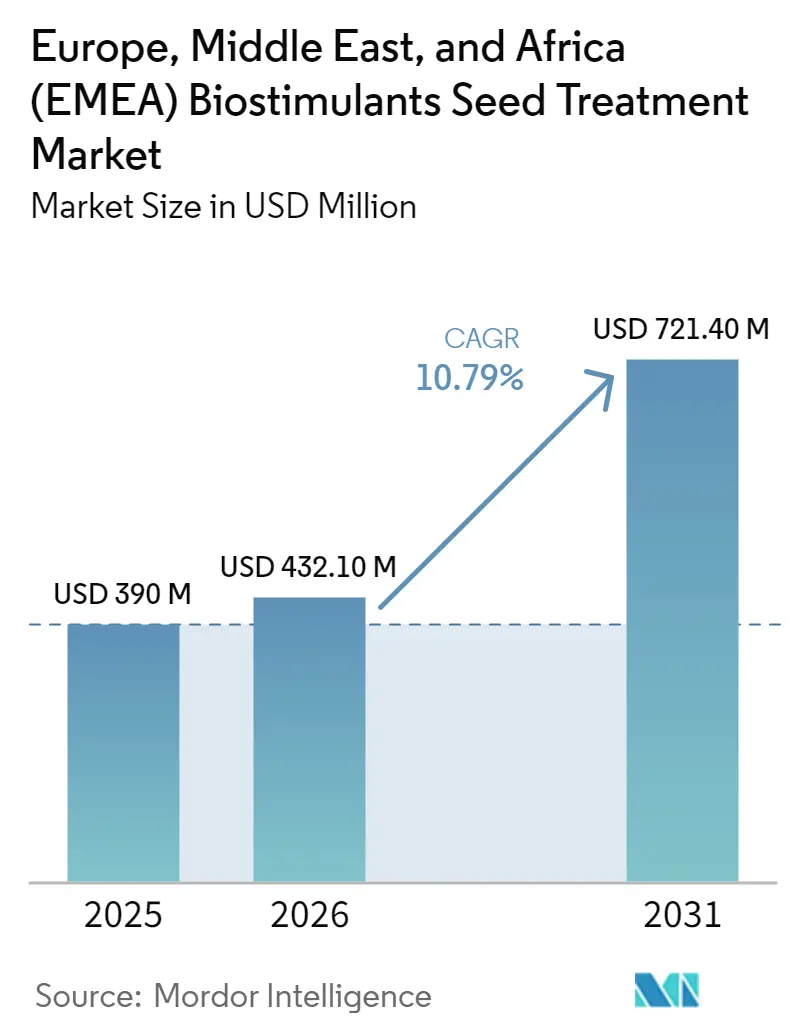
The Europe, Middle East, and Africa (EMEA) biostimulants seed treatment market was valued at USD 390.00 million in 2025 and is projected to grow from USD 432.10 million in 2026 to USD 721.40 million by 2031, registering a CAGR of 10.79% during the forecast period from 2026 to 2031. This growth is driven by increasing regulatory support for low-residue agricultural inputs and the rising adoption of biological solutions that enhance seed germination, root development, and early crop establishment. Additionally, climate variability and recurring drought conditions across parts of Europe, the Middle East, and Africa are boosting demand for seed-applied biostimulants that improve crop resilience during early growth stages. Expanding organic farming acreage and regenerative agriculture initiatives are further contributing to market growth, as growers prioritize input solutions that align with sustainability goals and environmental compliance. Competitive dynamics in the market remain moderately consolidated. Multinational agricultural input companies are broadening their biological product portfolios, while regional players focus on crop-specific formulations and localized agronomic expertise. However, challenges such as inconsistent field performance under varying soil and climatic conditions, limited standardization of efficacy claims, and higher costs compared to conventional seed treatments continue to hinder wider market adoption.
Key Report Takeaways
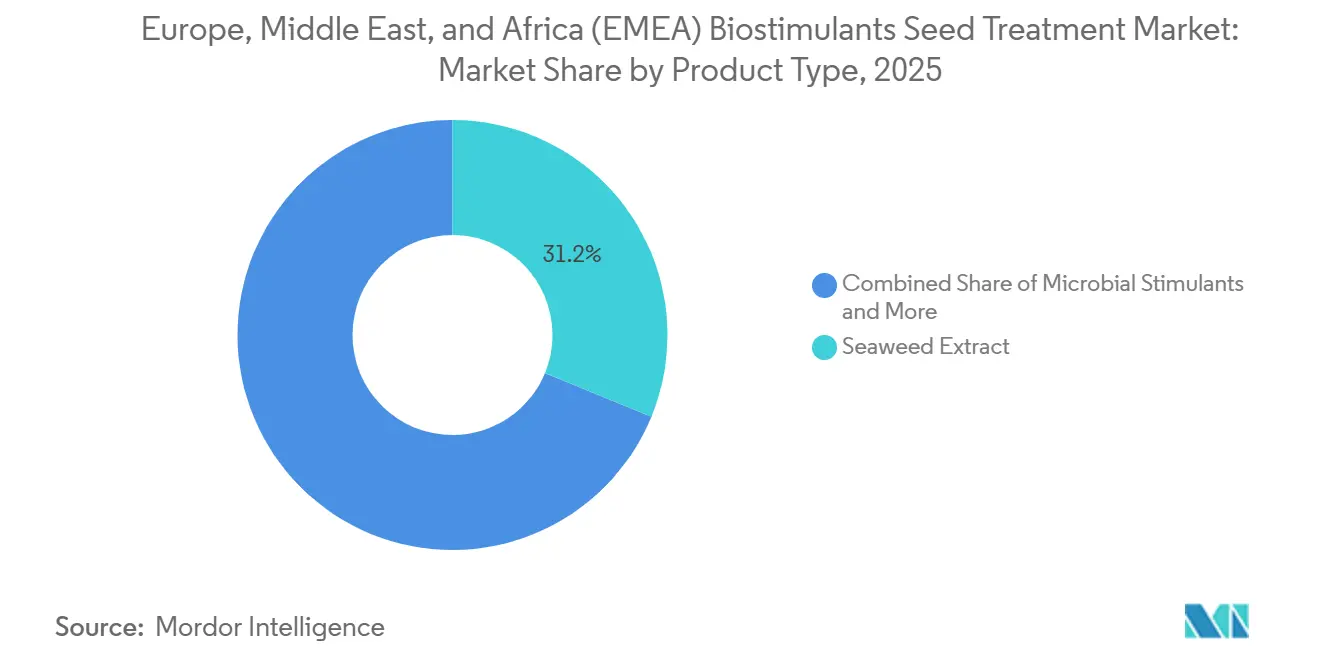
- By product type, Europe, Middle East, and Africa (EMEA) biostimulants seed treatment market share for seaweed extracts held the largest 31.2% in 2025, whereas microbial stimulants are projected to grow at the fastest 12.5% CAGR from 2026 to 2031.
- By form, liquid accounted for the largest 68.7% share in 2025, while the Europe, Middle East, and Africa (EMEA) biostimulants seed treatment market size for dry formulations is forecast to grow at the fastest CAGR of 11.2% from 2026 to 2031.
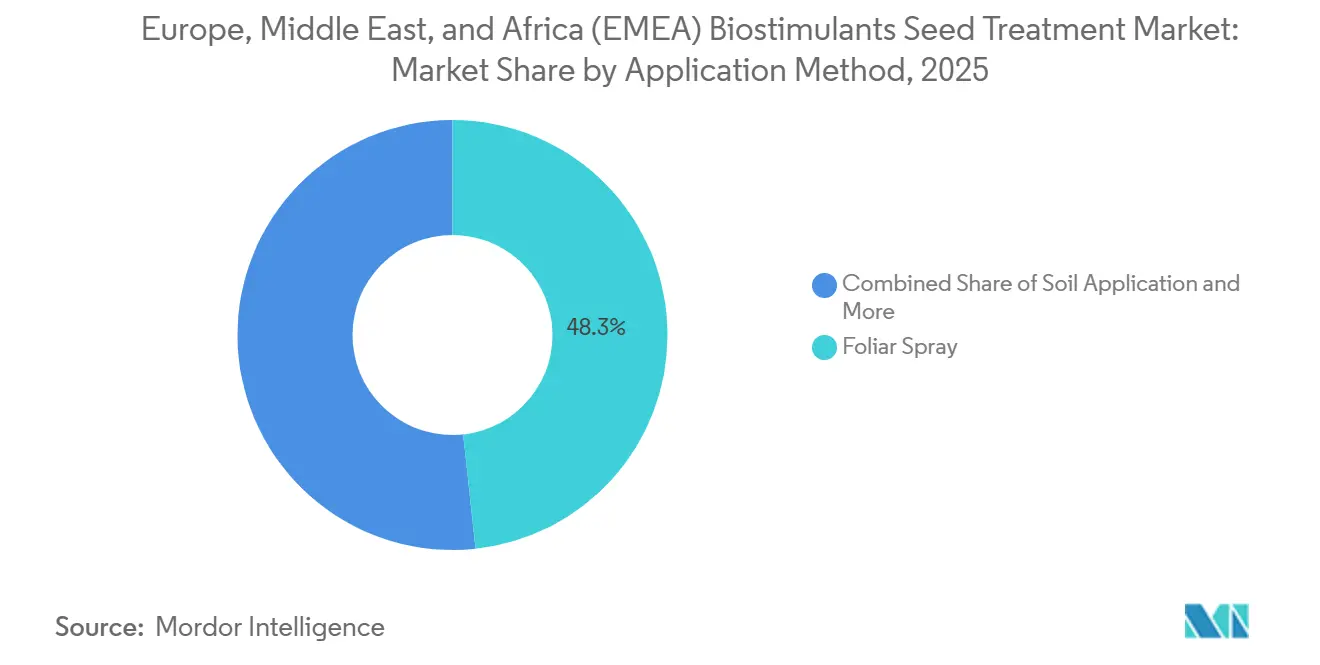
- By application method, foliar spray held the largest 48.3% share in 2025, whereas seed treatment application is projected to grow at the fastest 11.5% CAGR from 2026 to 2031.
- By crop type, cereals and grains accounted for the largest 42.3% share in 2025 and are also forecast to grow at the fastest 10.9% CAGR from 2026 to 2031.
- By geography, Europe held the largest 72.0% share of the Europe, Middle East, and Africa (EMEA) biostimulants seed treatment market in 2025, while the Middle East is projected to grow at the fastest 7.5% CAGR from 2026 to 2031.
Note: Market size and forecast figures in this report are generated using Mordor Intelligence’s proprietary estimation framework, updated with the latest available data and insights as of January 2026.
Market Trends and Insights
Drivers Impact Analysis of Europe, Middle East, and Africa (EMEA) Biostimulants Seed Treatment Market*
| Driver | (~) % Impact on CAGR Forecast | Geographic Relevance | Impact Timeline |
|---|---|---|---|
| Increasing demand for early-stage crop establishment protection | +2.8% | Highest in the European Union cereal belt, North Africa, and South Africa | Short term (≤ 2 years) |
| Rising regulatory preference for low-residue seed inputs | +2.2% | Europe and nearby markets including Turkey, Israel, and Morocco | Medium term (2-4 years) |
| Climate stress intensifies seed treatment adoption | +1.9% | Middle East, North Africa, and southeastern and eastern Europe | Short term (≤ 2 years) |
| Expansion of precision planting and seed coating technologies | +1.5% | Western and Central Europe, and South Africa | Medium term (2-4 years) |
| Growth of organic and regenerative farming programs | +1.2% | Italy, France, Spain, Germany, and Israel | Long term (≥ 4 years) |
| Local trial data and distributor education improve conversion rates | +0.8% | Eastern Europe, Sub-Saharan Africa, and the Gulf Cooperation Council | Long term (≥ 4 years) |
| Source: Mordor Intelligence | |||
Increasing Demand for Early-Stage Crop Establishment Protection
Early-season crop establishment has become a primary focus for growers across Europe, the Middle East, and Africa, driving demand in the EMEA biostimulants seed treatment market. Seed-applied biostimulants are increasingly utilized to improve germination, root development, nutrient uptake, and seedling vigor during critical early growth stages. A 2025 study published in BioMed Central (BMC) Plant Biology demonstrated that seed biopriming with plant growth-promoting bacteria significantly enhanced wheat germination and seedling vigor under suboptimal temperature conditions, emphasizing the importance of biological seed treatments in stress-prone environments[1]Source: BMC Plant Biology, “Seed Biopriming with Plant Growth Promoting Bacteria Improves Germination and Seedling Performance in Wheat (Triticum aestivum L.),” deepdyve.com.. As growers aim to mitigate establishment risks and enhance crop uniformity, the demand for biostimulant seed treatments continues to grow across major arable cropping systems.
Rising Regulatory Preference for Low-Residue Seed Inputs
The Europe, Middle East, and Africa (EMEA) biostimulants seed treatment market is experiencing growth due to regulatory frameworks promoting sustainable and low-residue agricultural inputs. A significant factor is the European Union Fertilising Products Regulation, which provides harmonized rules for biostimulants, simplifying market access across member states. Regulation (European Union) 2024/2516, adopted in 2024, introduced digital labeling requirements for European Union (EU) fertilising products, including biostimulants, enhancing product transparency and regulatory efficiency within the single market[2]Source: European Union, Regulation (EU) 2024/2516 Amending Regulation (EU) 2019/1009 as Regards the Digital Labelling of EU Fertilising Products, eur-lex.europa.eu.. This regulatory framework fosters investment in compliant biological seed treatment solutions and expands commercialization opportunities for established manufacturers.
Climate Stress Intensifies Seed Treatment Adoption
Climate-related production risks are emerging as a significant factor influencing the biostimulants seed treatment market in Europe, the Middle East, and Africa (EMEA), particularly during crop establishment and early root development stages. Seed-applied biostimulants are being increasingly utilized to enhance stress tolerance, nutrient uptake, and root growth under adverse environmental conditions. The European State of the Climate Report 2024 highlights that Europe experienced its warmest year on record in 2024, intensifying concerns about drought, heat stress, and risks to crop establishment in key agricultural regions. As climate variability continues to rise, growers are turning to biological seed treatment solutions as a preventive measure to strengthen crop resilience and mitigate early-season yield losses.
Expansion of Precision Planting and Seed Coating Technologies
Advancements in seed coating and precision planting technologies are driving growth in the Europe, Middle East, and Africa (EMEA) biostimulants seed treatment market by enhancing the delivery and effectiveness of biological inputs at the seed level. Modern coating systems facilitate more uniform application of biostimulants while preserving seed flowability and planting precision. According to the Fraunhofer Institute for Chemical Technology (Fraunhofer ICT), a biodegradable hydrogel seed coating developed in May 2026 improved germination rates by up to 58% under controlled conditions, highlighting the potential of advanced coating technologies to improve crop establishment[3]Source: Fraunhofer Institute for Chemical Technology (Fraunhofer ICT), “Biodegradable Seed Coating for Effective Seedling Protection and Supply,” 2026, fraunhofer.de.. These innovations are promoting the wider adoption of biostimulant seed treatments within precision agriculture systems in the region.
Restraints Impact Analysis of Europe, Middle East, and Africa (EMEA) Biostimulants Seed Treatment Market*
| Restraints | (~) % Impact on CAGR Forecast | Geographic Relevance | Impact Timeline |
|---|---|---|---|
| Inconsistent field performance across soil and weather conditions | -2.1% | Eastern Europe, Sub-Saharan Africa, and the semi-arid Middle East | Medium term (2-4 years) |
| Higher upfront cost versus conventional seed treatments | -1.6% | Africa outside South Africa, and lower-income European markets | Short term (≤ 2 years) |
| Limited standardization of efficacy testing and claims | -1.3% | Europe and Middle East registration systems | Medium term (2-4 years) |
| Low technical awareness among smallholder farmers in parts of Africa and the Middle East | -0.9% | Sub-Saharan Africa, rural Gulf Cooperation Council markets, and North Africa | Long term (≥ 4 years) |
| Source: Mordor Intelligence | |||
Higher Upfront Cost versus Conventional Seed Treatments
Higher upfront costs compared to conventional seed treatments continue to hinder the adoption of biostimulant-based seed treatments in parts of the Europe, Middle East, and Africa (EMEA) region. This issue is particularly pronounced in Africa and several Middle Eastern agricultural markets, where access to affordable farm financing remains limited. According to the 2025 State of the Sector Report by the Smallholder and Agri-SME Finance and Investment Network (SAFIN), the annual financing demand of smallholder farmers and agricultural SMEs exceeds USD 323 billion, while available financing amounts to only USD 95 billion, resulting in a significant funding gap in Africa. Limited access to capital discourages growers from investing in higher-cost biological seed treatment solutions, despite their agronomic advantages.
Low Technical Awareness Among Smallholder Farmers in Parts of Africa and the Middle East
Low technical awareness continues to hinder the growth of the biostimulants seed treatment market across parts of Africa and the Middle East, where limited access to agronomic training and extension services slows the adoption of biological seed technologies. Farmers often lack sufficient knowledge of application methods, anticipated field performance, and compatibility with conventional crop management practices. According to a 2024 study published in the journal Heliyon, 90% of surveyed smallholder farmers in Ethiopia did not identify agricultural biologicals as safer alternatives to conventional agricultural inputs, while 54% did not recommend biologicals to other farmers. These findings highlight persistent knowledge gaps that continue to limit the adoption of biostimulant seed treatment technologies across parts of Africa.
*Our forecasts treat driver/restraint impacts as directional, not additive. The impact forecasts reflect baseline growth, mix effects, and variable interactions.
Europe, Middle East, and Africa (EMEA) Biostimulants Seed Treatment Market Segment Analysis
By Product Type:
Microbial Stimulants Build Momentum While Seaweed Extracts Hold the LeadEurope, Middle East, and Africa (EMEA) biostimulants seed treatment market, seaweed extract seed treatment accounted for the largest share at 31.2% in 2025. Seaweed extracts maintain a strong position due to their broad compatibility across crop types and their ability to support nutrient uptake, root development, and tolerance to environmental stress. Their established use across commercial agriculture and specialty crops has supported widespread adoption. Humic substances and amino acids also remain important product categories, providing complementary benefits that enhance plant vigor and early-stage crop performance under diverse growing conditions.
Microbial stimulants are forecast to grow at the fastest CAGR of 12.5% from 2026 to 2031. Growth is supported by increasing interest in biological solutions that improve root colonization, nutrient efficiency, and plant resilience during crop establishment. Advances in formulation technologies are improving product stability, shelf life, and compatibility with modern seed treatment processes. Manufacturers are also investing in research and development to strengthen product performance and consistency. As growers seek sustainable alternatives that align with environmental objectives and regulatory requirements, microbial stimulants are gaining greater acceptance across a broad range of agricultural production systems.



By Form:
Liquids Keep Their Processing Advantage While Dry Formats Address Hot-Climate LimitsThe liquid segment accounted for the largest market share of 68.7% in 2025. These formulations are preferred due to their ability to provide uniform seed coverage and their seamless integration into commercial seed treatment operations. Their compatibility with automated application systems enables large-scale processing while ensuring consistent treatment quality. These operational benefits have solidified their position in industrial seed treatment facilities and established agricultural supply chains across the region.
The dry segment is projected to grow at the fastest CAGR of 11.2% from 2026 to 2031. This growth is driven by their storage stability, ease of transportation, and suitability for regions with limited cold-chain infrastructure. Dry formulations offer logistical advantages in areas with high temperatures and inconsistent distribution conditions. Manufacturers are continuously improving formulation technologies to enhance biological viability and product performance. As distribution networks expand into emerging agricultural markets, dry formulations are projected to gain wider acceptance while continuing to complement the dominance of liquid products.
By Application Method:
Seed Treatment Gains Ground Even as Foliar Spray Retains ScaleFoliar spray held the largest 48.3% share in 2025. This method remains widely adopted due to its established role in crop nutrition and management programs. Factors such as existing application infrastructure, grower familiarity, and adaptability across various crop systems have contributed to its sustained usage. Additionally, foliar spray enables growers to address crop requirements during the growing season, making it a practical element of integrated crop management strategies across diverse agricultural settings.
Seed treatment application is projected to grow at the fastest 11.5% CAGR from 2026 to 2031. This growth is attributed to the increasing recognition of the benefits of delivering biological inputs directly at germination and early root development stages. Seed-applied biostimulants offer targeted support during crop establishment, enhancing nutrient uptake and stress tolerance from the start of the production cycle. This approach aligns with precision agriculture goals and promotes more efficient input utilization. As growers prioritize consistency and improved early-season crop performance, seed treatment applications are gaining significant traction.
By Crop Type:
Cereals and Grains Anchor Volume and Continue to Lead GrowthCereals and grains accounted for the largest 42.3% share in 2025. This segment benefits from extensive cultivation in major agricultural regions and the widespread use of treated seeds in commercial production systems. Large planting areas and established seed treatment practices provide a solid foundation for the adoption of biostimulants. The need to enhance crop establishment, nutrient uptake, and tolerance to environmental stress continues to drive demand among cereal and grain producers. Additionally, the increasing emphasis on sustainable farming practices and the integration of biological inputs are promoting the broader use of biostimulant seed treatments in both conventional and environmentally conscious production systems.
Cereals and grains are forecast to grow at the fastest 10.9% CAGR from 2026 to 2031. This growth underscores the strategic importance of these crops in regional food security and agricultural production systems. Farmers are increasingly adopting biological technologies to improve crop establishment and maintain productivity under variable environmental conditions. While oilseeds and pulses also present significant opportunities, fruits and vegetables remain key higher-value markets. As sustainability initiatives and the adoption of biological inputs continue to expand, cereals and grains are projected to remain the primary driver of growth within the market.
Geography Analysis
Europe (EMEA) Biostimulants Seed Treatment Market
Europe held the largest 72.0% share in 2025, this leading position is attributed to its advanced regulatory framework, widespread adoption of biological agricultural inputs, and the strong presence of commercial seed treatment programs. The region benefits from extensive research activities, well-established distribution networks, and the integration of sustainability objectives into crop production systems. Additional drivers include the expansion of organic farming, environmental compliance requirements, and growers' interest in enhancing crop establishment and resilience. These factors continue to support the adoption of biostimulant seed treatment technologies across key agricultural markets in Europe.
Middle East (EMEA) Biostimulants Seed Treatment Market
The Middle East is projected to grow at the fastest 7.5% CAGR from 2026 to 2031. This growth is driven by a heightened focus on food security, water-use efficiency, and sustainable crop production. Governments and agricultural stakeholders in the region are promoting technologies that enhance crop performance under drought and heat stress conditions. Precision agriculture, protected cultivation, and the use of biological inputs are gaining importance as growers aim to maximize productivity from limited arable land. These trends are fostering favorable conditions for the adoption of biostimulant seed treatment solutions across various Middle Eastern agricultural markets.
Africa (EMEA) Biostimulants Seed Treatment Market
Africa remains an emerging opportunity within the market, supported by ongoing efforts to improve agricultural productivity and crop resilience. Adoption rates vary significantly across the continent, with South Africa having a more developed biological inputs sector compared to other regional markets. According to the Food and Agriculture Organization of the United Nations (FAO), 70% of the population in Sub-Saharan Africa relied on agriculture for their livelihoods in 2024, underscoring the importance of technologies that enhance crop establishment and productivity. However, challenges such as limited technical awareness and affordability persist, though the region's long-term growth potential remains significant.
Competitive Landscape
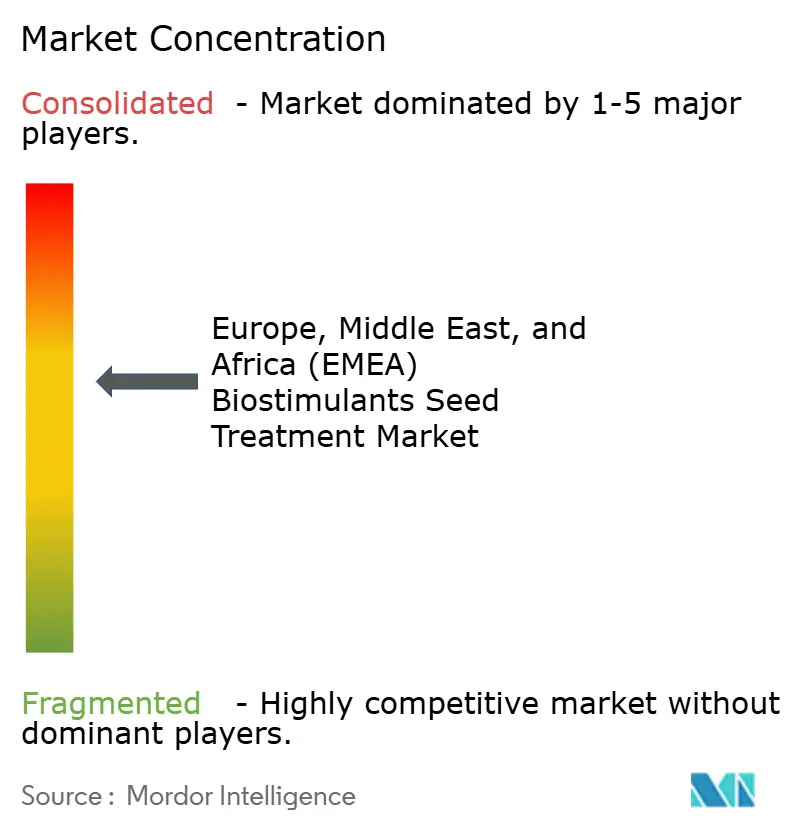
The Europe, Middle East, and Africa (EMEA) biostimulants seed treatment market is moderately consolidated, with key players including BASF SE, Bayer AG, Syngenta Crop Protection AG (Syngenta Group), UPL Limited, and Valagro S.p.A. These companies compete alongside regional biological specialists and emerging agricultural technology providers. Competition is primarily driven by factors such as product efficacy, regulatory compliance, formulation innovation, and agronomic support capabilities. Larger companies leverage established distribution networks, extensive research resources, and diversified biological portfolios, while smaller participants often focus on crop-specific expertise and localized technical services. Market participants are actively investing in product development and regulatory approvals to strengthen their positions across the region.
Strategic partnerships, portfolio expansion, and biological innovation are central themes shaping competition in the market. Companies are increasingly enhancing their biological product offerings through collaborations, licensing agreements, and targeted commercialization initiatives. Product differentiation is becoming more focused on performance consistency, compatibility with existing seed treatment systems, and the ability to address specific agronomic challenges. Additionally, manufacturers are expanding technical support programs and conducting field validation efforts to build grower confidence. As the adoption of biological agricultural inputs grows, companies are emphasizing scientific validation, alignment with sustainability goals, and customer support as critical competitive differentiators.
Investments also influence competition in the market in biological production capacity and supply chain capabilities. For instance, BASF SE announced the commissioning of its BioHub fermentation plant in Ludwigshafen, Germany, in May 2026, aiming to enhance production capacity for seed treatment solutions. This investment underscores the increasing importance of manufacturing scale and supply reliability within the biological inputs industry. Companies that combine regulatory expertise, robust production capacity, and agronomic validation are projected to be better positioned to meet the growing demand for biostimulant seed treatment solutions.
Europe, Middle East, and Africa (EMEA) Biostimulants Seed Treatment Industry Leaders
BASF SE
Bayer AG
Syngenta Crop Protection AG (Syngenta Group)
UPL Limited
Valagro S.p.A.
- *Disclaimer: Major Players sorted in no particular order
Europe, Middle East, and Africa (EMEA) Biostimulants Seed Treatment Market Companies Covered in this Report
- BASF SE
- Bayer AG
- Syngenta Crop Protection AG (Syngenta Group)
- UPL Limited
- Koppert B.V.
- Novonesis A/S
- Biolchim S.p.A. (J.M. Huber Corporation)
- Valagro S.p.A.
- FMC Corporation
- Acadian Seaplants Limited
- Seipasa, S.A.
- Bioiberica, S.A.U.
- Atlántica Agrícola, S.A.
- Sumitomo Chemical Company Limited
- Trade Corporation International, S.A.

Recent Industry Developments in Europe, Middle East, and Africa (EMEA) Biostimulants Seed Treatment Market
- December 2025: BASF SE, in collaboration with Acadian Plant Health, introduced the Elite Sea biostimulant in Morocco. This launch expands its biostimulant solutions portfolio and provides growers with improved nutrient efficiency, enhanced crop performance, and stress tolerance solutions.
- December 2025: Sumitomo Chemical Company, Limited, through its subsidiaries Sumitomo Chemical Agro Europe and Valent BioSciences LLC, introduced a new biostimulant portfolio for EMEA growers. This initiative aims to enhance biological solutions that improve nutrient efficiency, crop vigor, and stress tolerance.
- March 2025: Koppert B.V. introduced Stingray 25 in France, a plant-based biostimulant designed to enhance crop growth, nutrient efficiency, and productivity. This launch expands the company's portfolio of sustainable biological solutions and reinforces its position in the European biostimulants market.


Europe, Middle East, and Africa (EMEA) Biostimulants Seed Treatment Market Report Scope
Biostimulant seed treatment involves applying biological or naturally derived substances to seeds before planting. This process aims to enhance germination, nutrient absorption, root development, stress tolerance, and early crop establishment, thereby improving overall plant growth and productivity. The Europe, Middle East and Africa (EMEA) biostimulants seed treatment market report is segmented by product type (humic substances, amino acids, microbial stimulants, seaweed extracts, and other product types), by form (liquid and dry), by application method (foliar spray, seed treatment, and soil application), by crop type (cereals and grains, oilseeds and pulses, fruits and vegetables, turf and landscapes, and other crop types), and by geography (Europe, the Middle East, and Africa). The market forecasts are provided in terms of value (USD).
| Humic Substances |
| Amino Acids |
| Microbial Stimulants |
| Seaweed Extracts |
| Other Product Types |
| Liquid |
| Dry |
| Foliar Spray |
| Seed Treatment |
| Soil Application |
| Cereals and Grains |
| Oilseeds and Pulses |
| Fruits and Vegetables |
| Turf and Landscapes |
| Other Crop Types |
| Europe | Germany |
| France | |
| Italy | |
| United Kingdom | |
| Russia | |
| Rest of Europe | |
| Middle East | Saudi Arabia |
| United Arab Emirates | |
| Israel | |
| Turkey | |
| Rest of Middle East | |
| Africa | South Africa |
| Egypt | |
| Morocco | |
| Rest of Africa |
| By Product Type | Humic Substances | |
| Amino Acids | ||
| Microbial Stimulants | ||
| Seaweed Extracts | ||
| Other Product Types | ||
| By Form | Liquid | |
| Dry | ||
| By Application Method | Foliar Spray | |
| Seed Treatment | ||
| Soil Application | ||
| By Crop Type | Cereals and Grains | |
| Oilseeds and Pulses | ||
| Fruits and Vegetables | ||
| Turf and Landscapes | ||
| Other Crop Types | ||
| By Geography | Europe | Germany |
| France | ||
| Italy | ||
| United Kingdom | ||
| Russia | ||
| Rest of Europe | ||
| Middle East | Saudi Arabia | |
| United Arab Emirates | ||
| Israel | ||
| Turkey | ||
| Rest of Middle East | ||
| Africa | South Africa | |
| Egypt | ||
| Morocco | ||
| Rest of Africa | ||


Key Questions Answered in the Report
What is the 2031 outlook for biostimulants used in seed treatment across Europe, the Middle East, and Africa?
The Europe, Middle East And Africa (EMEA) Biostimulants market is projected to reach USD 721.40 million by 2031.
Which product type currently leads demand across the region?
Seaweed extracts led product demand with a largest 31.2% share in 2025 because they are widely compatible across crops and support stress tolerance and nutrient uptake.
Which application route is growing the fastest?
Seed treatment application is the fastest-growing method with an 11.5% CAGR from 2026 to 2031 because growers want rhizosphere benefits from the moment of germination.
Why is Europe the largest regional revenue contributor
Europe held the lagest 72.0% share in 2025 due to stronger biological distribution, high organic acreage, and a clearer regulatory route for compliant biostimulants.
Page last updated on:





