
Europe Gold Analyzer Testing Solutions Market Size and Share
Market Overview
| Study Period | 2021 - 2032 |
|---|---|
| Forecast Data Period | 2027 - 2032 |
| Base Year Market Size (2026) | USD 103.19 Million |
| Market Size (2027) | USD 110.22 Million |
| Market Size (2032) | USD 149.89 Million |
| Growth Rate (2027 - 2032) | 6.34 % |
| Market Concentration | Medium |
Major Players *Disclaimer: Major Players sorted in no particular order Image © Mordor Intelligence. Reuse requires attribution under CC BY 4.0. | |
Europe Gold Analyzer Testing Solutions Market Analysis by Mordor Intelligence
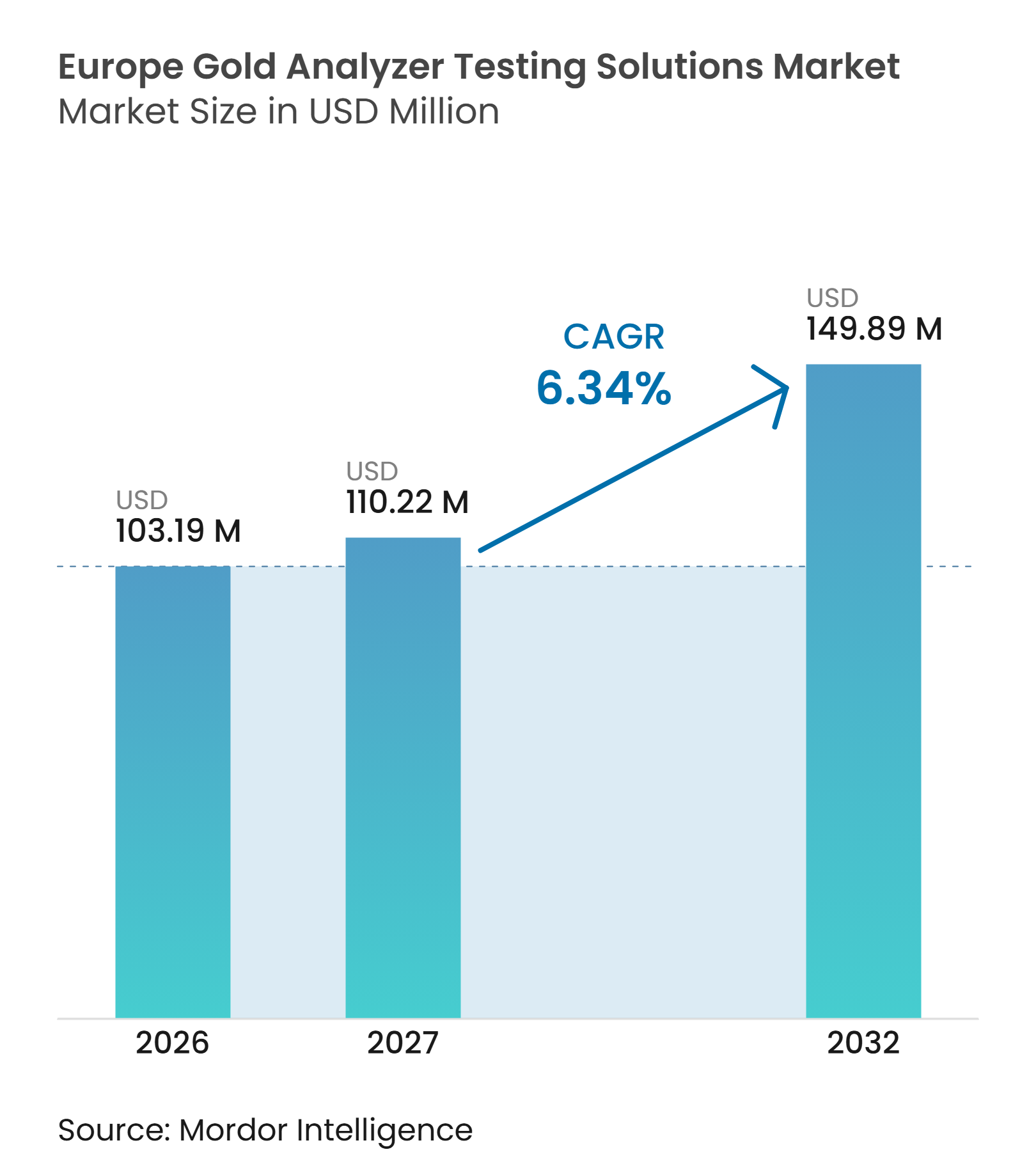
The Europe gold analyzer testing solutions market size is projected to be USD 103.19 million in 2026, USD 110.22 million in 2027, and reach USD 149.89 million by 2032, growing at a CAGR of 6.34% from 2027 to 2032. The Europe gold analyzer testing solutions market is supported by mandatory assay activity, established jewelry production centers, and expanding recovery of gold from scrap and electronic waste. Quality verification is becoming more important as refiners, jewelers, bullion traders, and assay offices manage higher-value material and more demanding documentation requirements. Non-destructive XRF testing remains the established choice across the handling chain, while automated laboratory systems are becoming more relevant where recycling volumes and sample throughput are increasing. Competition is concentrated in premium instrument categories, although lower-cost suppliers are widening access for smaller gold buyers and putting pressure on entry-level prices. High acquisition and service costs continue to limit adoption among independent assay offices and retail buyers, while hybrid workflows create an opportunity for suppliers that can combine fast screening with defensible laboratory confirmation.
Key Report Takeaways
- By end user, Jewellery Manufacturing and Retail held 34.86% of the Europe gold analyzer testing solutions market share in 2026, while Gold Refining, Recycling and Processing is projected to expand at a 7.33% CAGR through 2032.
- By technology, XRF Benchtop/Handheld accounted for 68.12% of market value in 2026, while Other, including Fire Assay Pre-Screening and Combined Systems, is projected to expand at a 7.16% CAGR through 2032.
- By form factor, Benchtop/Countertop Standalone instruments held 44.91% of market value in 2026, while Automated/Integrated Laboratory or Inline Systems are projected to expand at a 7.19% CAGR through 2032.
- By geography, Germany held 24.74% of market value in 2026, while Rest of Europe is projected to expand at a 7.31% CAGR through 2032.
Note: Market numbers in this report are based on Mordor Intelligence's proprietary estimation framework, which combines nine months of actuals with Q4 projections for base year 2026.
Market Trends and Insights
Drivers Impact Analysis of Europe Gold Analyzer Testing Solutions Market*
| Driver | (~) % Impact on CAGR Forecast | Geographic Relevance | Impact Timeline |
|---|---|---|---|
| Gold Hallmarking and Quality Certification Frameworks | +1.5% | Global, with core demand in the United Kingdom, Germany, France, Italy, and the Netherlands | Short term (≤ 2 years) |
| Established Jewellery Manufacturing and Trading Hubs | +1.3% | Italy, including Arezzo and Vicenza, Germany, and France | Medium term (2-4 years) |
| Precious Metal Recycling and Circular Economy Practices | +1.1% | Germany, Italy, France, and the United Kingdom, with spillover to Rest of Europe | Medium term (2-4 years) |
| Adoption of Non-Destructive XRF Analyzers | +1.0% | Global, with strong uptake across European jewelry retail and pawn segments | Short term (≤ 2 years) |
| Responsible Sourcing and Supply Chain Traceability | +0.7% | Global, with direct compliance pressure on the United Kingdom and EU-listed refineries | Long term (≥ 4 years) |
| Technological Advancements in Portable XRF Analyzers | +0.6% | Global, with spillover to Rest of Europe and emerging European markets | Long term (≥ 4 years) |
| Source: Mordor Intelligence | |||
Gold Hallmarking and Quality Certification Frameworks
National hallmarking systems create a continuing base of demand across the Europe gold analyzer testing solutions market. The International Hallmarking Convention accepts articles carrying the Common Control Mark only after national assay offices verify fineness under recognized methods, including ISO 11426 for gold analysis by cupellation.[1] Ireland requires compulsory assay for gold articles without a weight exemption, and France requires precious metal importers to register with the bureaux de garantie. The United Kingdom’s 4 Assay Offices also maintain laboratory testing demand outside the European Union framework. Germany does not require a compulsory pre-market hallmark, but manufacturers use private XRF systems to verify alloys for exports to countries with their own hallmark rules. ISO/IEC 17025 requirements, national weights and measures rules, calibration, and traceability requirements support recurring service activity and replacement cycles for the Europe gold analyzer testing solutions market.
Established Jewellery Manufacturing and Trading Hubs
Italy’s large jewelry production base supports the Europe gold analyzer testing solutions market through manufacturing, wholesale, and retail testing. Italy employed 33,000 people in jewelry production in 2025, accounting for 27.5% of the European Union's employment in the sector, ahead of France with 27,000 employees, Germany with 14,000, Spain with 7,000, and Poland with 6,000.[2] Italian jewelry production was close to EUR 15.5 billion (USD 17.5 billion) in 2025, and Arezzo accounted for 41.3% of national sector exports in the first quarter of 2025. Export shipments to Turkey, the United Arab Emirates, Switzerland, and the United States require alloy verification that can reduce quality disputes and customs-related risks. Arezzo also contains a concentrated refining cluster, including Italpreziosi and Chimet, which increases demand for reliable analysis within a high-throughput local operating environment.
Precious Metal Recycling and Circular Economy Practices
Gold recycling is increasing analytical checks across the Europe gold analyzer testing solutions market at refinery intake, during processing, and before final output. Gold recycling rose 6% worldwide in 2025, with Germany, Italy, France, and the United Kingdom recording double-digit growth, making Europe an important source of secondary supply.[3] Recycled gold from scrap and electronic waste reached 1,041 tons in the first 9 months of 2025, marking the second consecutive year in which the annualized total exceeded 1,000 tons. CIBJO’s 2025 definition of recycled gold requires traceability of pre-consumer and post-consumer streams throughout refining and fabrication, thereby increasing the need for purity verification at several points in the process. The European Commission designated Atlantic Copper’s CirCular project as strategic in March 2025, with EUR 410 million (USD 463 million) planned for the recovery of gold, silver, platinum, and palladium from WEEE. This scale of recovery activity supports demand for high-throughput analytical infrastructure in the Europe gold analyzer testing solutions market.
Adoption of Non-Destructive XRF Analyzers
XRF testing is reshaping the Europe gold analyzer testing solutions market because it replaces destructive methods without material removal. Handheld XRF instruments can provide gold alloy composition results in 2 to 15 seconds, while fire assay can take hours and requires specialist chemical handling. Evident Scientific introduced the Vanta Element XRF series in January 2025 with silicon drift detection, Axon Technology, and optional connectivity through Evident Connect. Adoption remains less developed among many independent pawn operators, cash-for-gold buyers, and small bullion traders, which leaves further room for instrument sales. Helmut Fischer introduced FISIQ X software in September 2025 and stated that the software calculates XRF results up to 13 times faster than its previous algorithms. Faster analysis and a lower skill requirement can support broader use of XRF across the Europe gold analyzer testing solutions market.
Restraints Impact Analysis of Europe Gold Analyzer Testing Solutions Market*
| Restraint | (~) % Impact on CAGR Forecast | Geographic Relevance | Impact Timeline |
|---|---|---|---|
| High Equipment Costs and Maintenance Requirements | -1.8% | Global, most acute for small assay offices in Rest of Europe and Southern Europe | Short term (≤ 2 years) |
| XRF Surface Composition and Sample-Heterogeneity Limitations | -1.1% | Global, particularly in high-purity refinery and assay certification laboratories | Medium term (2-4 years) |
| Reliance on Traditional Gold Assaying Methods | -0.8% | Southern Europe, including Italy and France, and Eastern Europe | Long term (≥ 4 years) |
| Varying Hallmarking Standards and Low-Cost Equipment Competition | -0.6% | Rest of Europe and Eastern European markets | Long term (≥ 4 years) |
| Source: Mordor Intelligence | |||
High Equipment Costs and Maintenance Requirements
The capital cost of analytical-grade XRF equipment remains a barrier for small gold buyers, pawn operators, jewelry retailers, and assay offices. Premium benchtop systems can require a multi-year payback period when transaction volumes are modest. ISO/IEC 17025-related calibration, certified reference materials, and preventive service contracts increase the annual ownership cost. Larger refineries and established assay offices generally replace premium systems on 5- to 7-year cycles, while smaller operators may defer upgrades or select lower-cost products. Silicon drift detectors need careful handling and periodic replacement, which can create unexpected operating costs for users moving from simpler equipment. This pattern concentrates supplier revenue within high-volume institutional accounts and limits the near-term reach of the Europe gold analyzer testing solutions market.
XRF Surface Composition and Sample-Heterogeneity Limitations
XRF is a surface measurement method, which limits its suitability for samples with plating, cladding, or uneven composition. Conventional instruments assess only the outer few microns, so gold-plated tungsten bars and layered alloys can produce misleading purity readings. Research on alloyed scrap gold has also shown that uneven elemental distribution can affect bulk composition estimates, especially in silver- and copper-rich alloys. Assay offices and bullion traders therefore continue to use confirmatory fire assay for high-value transactions. ISO 11426 conventions treat XRF principally as a preliminary or screening tool rather than the primary certification method. Combined pre-screening and confirmatory workflows address this limitation, but they also limit complete substitution of traditional methods in the most demanding testing applications.
*Our forecasts treat driver/restraint impacts as directional, not additive. The impact forecasts reflect baseline growth, mix effects, and variable interactions.
Europe Gold Analyzer Testing Solutions Market Segment Analysis
By End User:
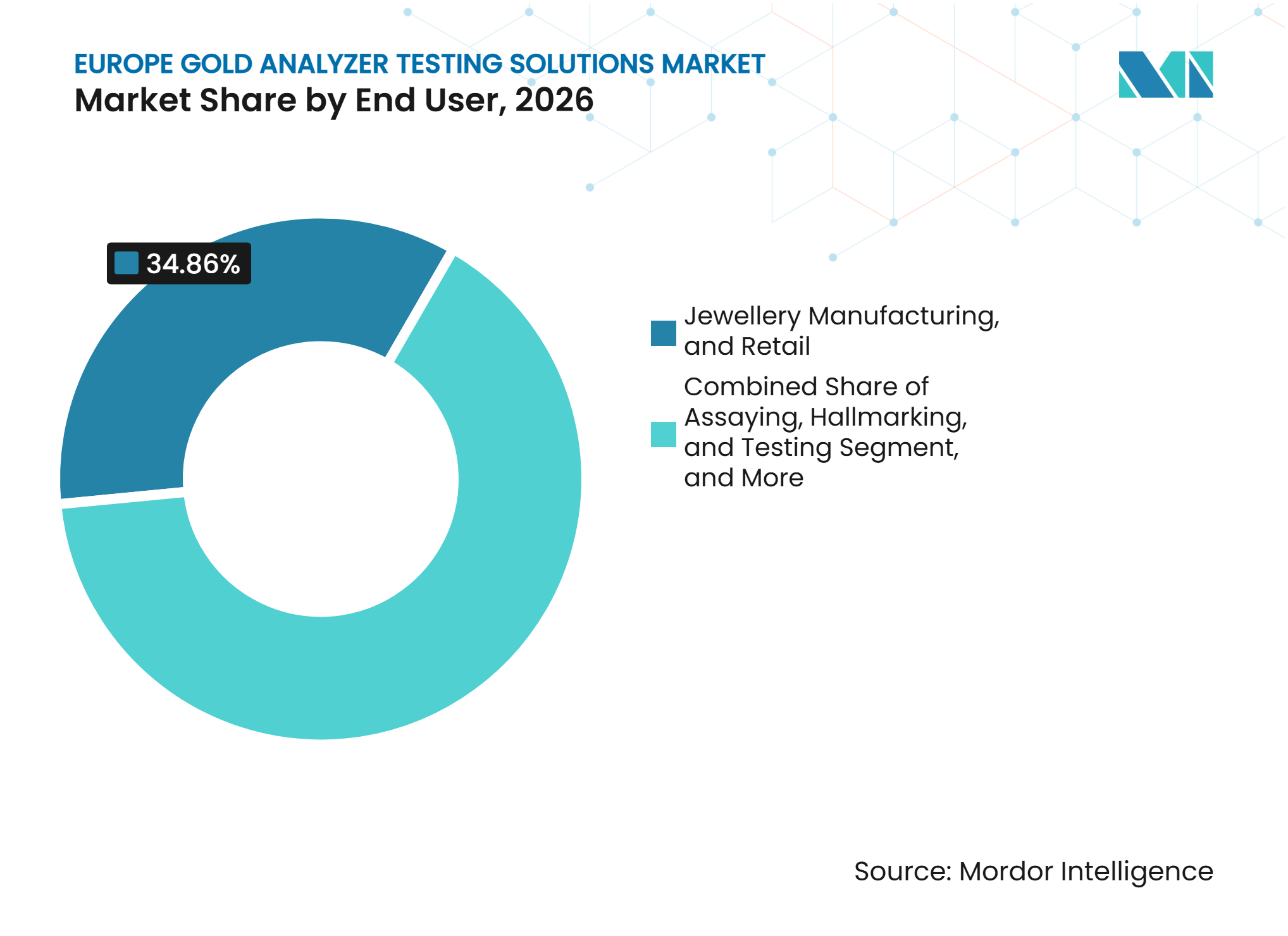
Jewellery Retail Anchors Volume, Recyclers Drive GrowthJewellery Manufacturing and Retail held 34.86% of Europe gold analyzer testing solutions market value in 2026, making it the largest end-user group. Italy and Germany support this position through their roles as jewelry production and export centers. In-house XRF testing is used across manufacturing, wholesale, and retail quality control. Assaying, Hallmarking and Testing is the second-largest end-user area because national assay offices need accredited testing. Gold Buying, Pawn and Cash-for-Gold is a meaningful user base, but standardized XRF use remains uneven and is more common among urban multi-outlet operators.
Gold Refining, Recycling and Processing is projected to expand at a 7.33% CAGR from 2027 to 2032, the fastest rate among end-user groups. Europe gold analyzer testing solutions market size in this end user is supported by rising recovery from jewelry scrap, electronic waste, and industrial material. Germany, Italy, France, and the United Kingdom recorded double-digit expansion in recycled gold activity during 2025. CIBJO’s traceability definition requires checks from material intake through refinery output. CIBJO The Atlantic Copper project supports laboratory and inline systems that can manage larger sample volumes.



By Technology:
XRF Dominates, Hybrid Workflows Gain MomentumXRF Benchtop/Handheld technology held 68.12% of market value in 2026. The Europe gold analyzer testing solutions market relies on this established, non-destructive technology across hallmarking laboratories, jewelry counters, and refinery intake stations. Density and specific gravity instruments maintain a smaller role among users seeking low-cost screening without X-ray licensing requirements. Electrical, conductivity, and resistivity methods are used principally for quick counterfeit screening of bullion bars and coins. XRF’s installed base has been built over years of use across European jewelry and assay operations.
Other technology, including Fire Assay Pre-Screening and Combined Systems, is projected to expand at a 7.16% CAGR from 2027 to 2032. High-volume refiners use XRF for quick sorting and fire assay for confirmation where a result requires regulatory defensibility. This approach allows incoming scrap to be screened before cupellation under ISO 11426. Thermo Fisher Scientific’s ARL iSpark platform supports simultaneous precious-metal analysis in 1 minute while removing the cupellation step. The Europe gold analyzer testing solutions market size for combined systems is supported by throughput needs that neither a standalone XRF nor a conventional fire assay process fully meets.
By Form Factor:
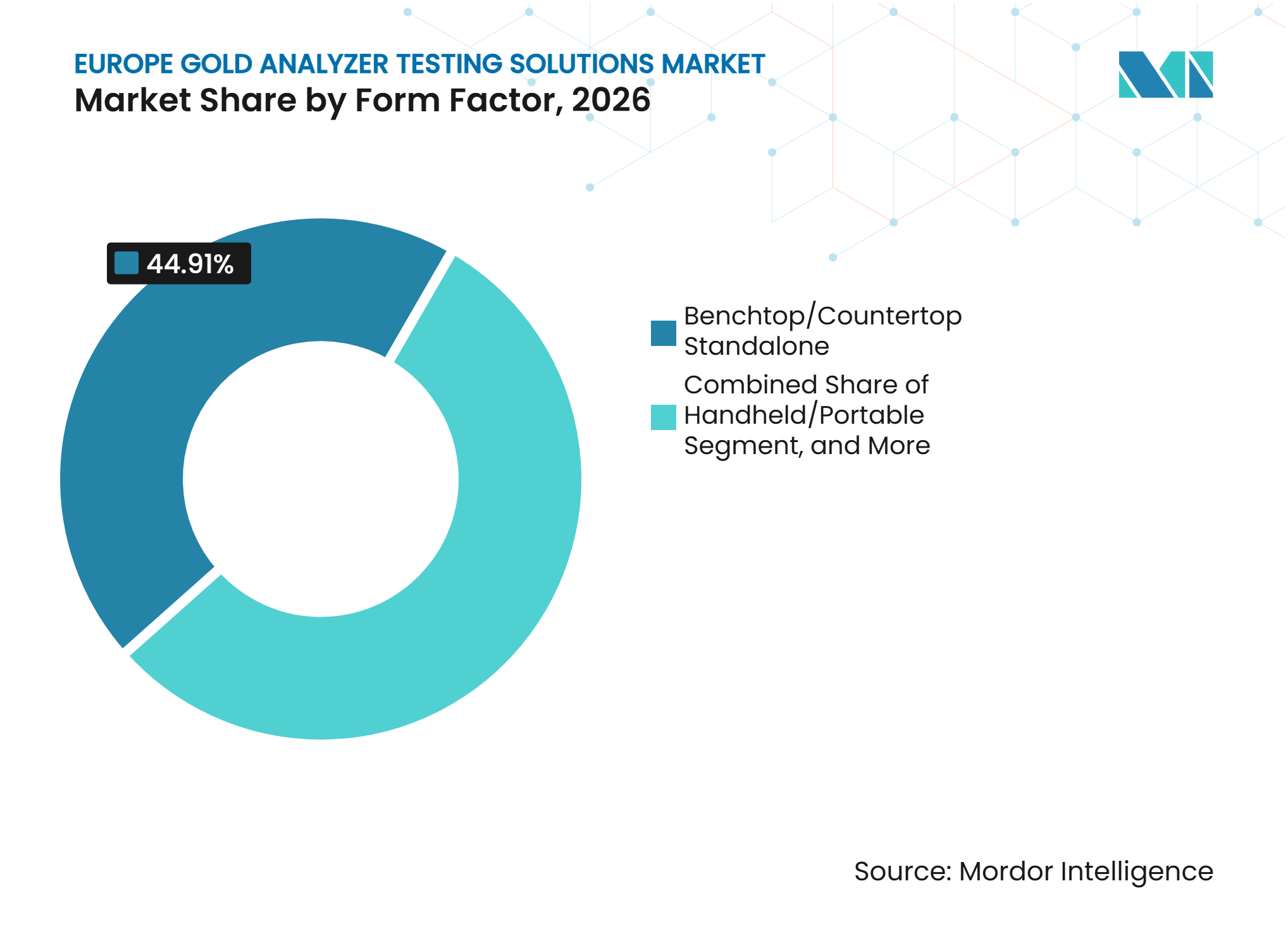
Benchtop Leads, Automation AcceleratesBenchtop/Countertop Standalone instruments held 44.91% of market value in 2026, the largest form-factor share. The Europe gold analyzer testing solutions market serves jewelry retailers, pawn operators, and assay offices that need fixed instruments with controlled measurement conditions. Closed-beam systems support radiation safety requirements and repeatable measurements without a mobile setup. Helmut Fischer introduced the GOLDSCOPE SD 300 in July 2025 with a compact format, a 50W X-ray tube, a 0.6mm precision collimator, and an integrated 13.3-inch touchscreen for jewelry and hallmarking settings. Handheld instruments serve mobile buyers and on-site recycling teams where sample transport is impractical.
Automated/Integrated Laboratory or Inline Systems are projected to expand at a 7.19% CAGR from 2027 to 2032. European refineries and larger assay laboratories are increasing analytical capacity to manage higher recycling volumes. Helmut Fischer introduced next-generation FISCHERSCOPE XDAL and FISCHERSCOPE XDV benchtop systems in September 2025 with FISIQ X software. The company reported 6-times faster Z-axis positioning and 14-times faster autofocus than predecessor models. This form factor has a smaller market value than benchtop equipment, but its application base is widening where repeatability and throughput are primary needs.

Geography Analysis
Germany: Structural Depth Underpins Market Leadership
Germany held 24.74% of regional market value in 2026. The Europe gold analyzer testing solutions market in Germany combines instrument manufacturing, gold trading, refining, bullion activity, and jewelry production areas in Pforzheim and Schwäbisch Gmünd. Helmut Fischer’s European headquarters and Frankfurt’s financial infrastructure support demand for analytical equipment from manufacturers and bullion institutions. Germany does not require a mandatory pre-market hallmark, but manufacturers still verify alloys for exports to markets with their own hallmarking rules. Germany was among the 4 European countries that recorded double-digit gold-recycling expansion in 2025, which supports more intake screening and inline systems.
Rest of Europe: Policy Harmonization Propels the Fastest-Growing Tier
Rest of Europe is projected to expand at a 7.31% CAGR from 2027 to 2032. The Europe gold analyzer testing solutions market spans the Netherlands, Spain, Poland, Romania, and Switzerland, where recycling infrastructure and certified testing practices are developing at different speeds. The Common Control Mark promotes regulatory equivalence and makes standardized fineness verification more valuable in markets that previously relied more heavily on visual checks or acid testing. Switzerland remains distinct because its refineries require high-precision analytical work under ISO/IEC 17025-accredited laboratory practices. BRAIN Biotech and PX Group began an e-waste gold recovery project in La Chaux-de-Fonds in 2025, creating further points for analytical verification.
Mature Markets and Emerging Nodes Across the Rest of the Continent
The United Kingdom has a mature testing base shaped by the London, Birmingham, Sheffield, and Edinburgh Assay Offices. The British Hallmarking Council administers compulsory hallmarking rules, and the United Kingdom does not automatically recognize European Union member-state hallmarks for new stock entering the country. France requires importers to register with the bureaux de garantie, supporting calibrated XRF use for import verification and domestic production control. France employed 27,000 people in jewelry production in 2025, while Italy is strengthening analytical infrastructure following its accession to the International Hallmarking Convention. Arezzo’s refinery cluster is shifting from manual checks toward higher-throughput automated and inline XRF systems.
Competitive Landscape
Market Concentration
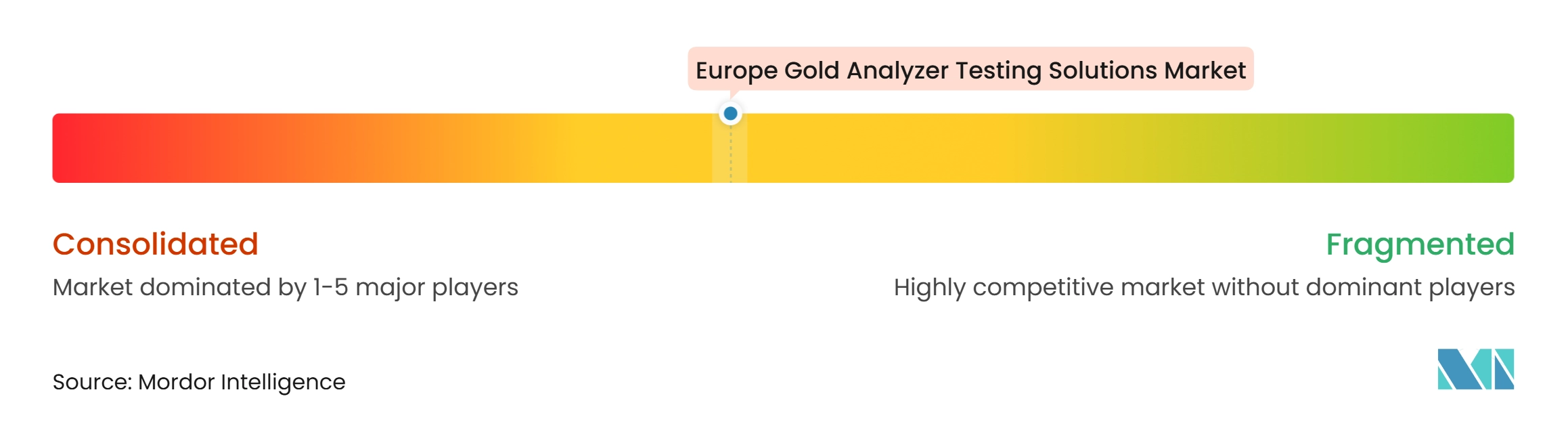
The Europe gold analyzer testing solutions market is moderately consolidated in premium XRF benchtop and handheld systems. Thermo Fisher Scientific, Helmut Fischer, Hitachi High-Tech Analytical Science, Bruker Corporation, Evident Scientific, and AMETEK/SPECTRO are the principal suppliers in this tier. Suppliers increasingly differentiate through software, connectivity, after-sales support, and laboratory workflow capabilities instead of hardware specifications alone. Helmut Fischer introduced FISIQ X in September 2025 and reported XRF calculation speeds up to 13 times faster than its previous approach. Evident Scientific’s Vanta Element series combines silicon drift detection, Axon Technology, and optional cloud connectivity for scrap sorting and precious-metal verification.
Thermo Fisher Scientific expanded its Niton line with the XL5e Handheld XRF Analyzer in January 2026, adding enhanced elemental detection, Bluetooth and Wi-Fi connectivity, IP54-rated field durability, and faster processing speeds. Helmut Fischer also introduced the GOLDSCOPE SD 300 in July 2025 for compact jewelry-counter and hallmarking applications. AMETEK/SPECTRO expanded xSORT application packages in April 2025 for geology, mining, environmental screening, and compliance testing. These moves extend the use of a single instrument platform across several screening activities. They also show a push toward more connected measurement workflows.
Lower-cost Chinese-origin products are increasing price competition in entry-level benchtop and handheld equipment. Mid-tier assay offices and recyclers that rely on first-generation handheld XRF but lack ISO/IEC 17025-compliant automation represent an upgrade opportunity. Bruker’s TITAN 350 Precious Metals handheld XRF and planned desktop test stand broaden the company’s form-factor coverage. Market concentration score: 6, reflecting a moderately consolidated premium tier led by 6 established vendors, while entry-level competition and many smaller operators prevent a higher assessment.
Europe Gold Analyzer Testing Solutions Industry Leaders
-
Thermo Fisher Scientific
-
Bruker Corporation
-
Helmut Fischer GmbH
-
Evident Scientific
-
Hitachi High-Tech Analytical Science
- *Disclaimer: Major Players sorted in no particular order
Europe Gold Analyzer Testing Solutions Market Companies Covered in this Report
- Thermo Fisher Scientific / Niton
- Hitachi High-Tech Analytical Science
- Helmut Fischer GmbH
- Bruker Corporation
- Evident Scientific (formerly Olympus)
- AMETEK / SPECTRO
- Arihant Maxsell Technologies / Maxsell
- Microanalytik Instruments
- Omio Technologies
- Neo Instrument Co.
- Jiangsu Skyray Instrument
- Guangdong Hongtuo Instrument Technology Co., Ltd.
Recent Industry Developments in Europe Gold Analyzer Testing Solutions Market
- August 2026: SPECTRO Analytical Instruments introduced an analyzer for metal testing. The analyzer provides measurements and element analysis. The introduction supports testing for gold and metals for jewelers, refiners, and assay laboratories in Europe.
- January 2026: Thermo Fisher Scientific launched the Niton XL5e Handheld XRF Analyzer. The product added enhanced elemental detection for scrap metal recycling, mining, and metal recovery, with Bluetooth and Wi-Fi connectivity, IP54-rated field durability, and faster processing speeds.
- January 2026: SciMed became the exclusive UK distributor for Evident's handheld Vanta XRF analyzers, responsible for sales, calibration, maintenance, and technical support. The appointment expands access to portable XRF testing solutions for precious metal identification and gold analysis across the United Kingdom.
- November 2025: Hitachi High-Tech Analytical Science conducted a 2-day X-MET80 user-training program at its Krefeld facility near Düsseldorf, Germany. The program provided certified XRF operator training for European customers in precious metals, alloy, and industrial applications.
Europe Gold Analyzer Testing Solutions Market Report Scope
The Europe Gold Analyzer Testing Solutions Market comprises instruments, analytical systems, and related services used to verify the purity, composition, and authenticity of gold and precious metals. These solutions support accurate testing, valuation, quality assurance, certification, and fraud detection across the gold ecosystem. Market growth is driven by increasing demand for reliable precious metal verification, rising gold trading and recycling activities, stricter quality standards, and technological advancements that enhance testing accuracy, speed, and operational efficiency.
The Europe Gold Analyzer Testing Solutions Market is Segmented by End-User (Jewellery Manufacturing, and Retail, Assaying, Hallmarking, and Testing, Gold Refining, Recycling, and Processing, Gold Buying, Pawn, and Cash-for-Gold, and Bullion Trading, and Financial Institutions (NBFCs and Banks)), Technology (X-Ray Fluorescence (XRF) , Density / Specific Gravity Testing, Electrical / Conductivity / Resistivity Testing, and Other Technologies), Form Factor (Benchtop/Countertop Standalone, Handheld/Portable, and Automated / Integrated Laboratory or Inline Systems), and Country (Germany, United Kingdom, France, Italy, and Rest of Europe). The Market Forecasts are Provided in Terms of Value (USD).
Segmentation Overview
| Jewellery Manufacturing, and Retail |
| Assaying, Hallmarking, and Testing |
| Gold Refining, Recycling, and Processing |
| Gold Buying, Pawn, and Cash-for-Gold |
| Bullion Trading and Financial Institutions (NBFCs and Banks) |
| XRF Benchtop/Handheld |
| Density/Specific Gravity |
| Electrical/Conductivity/Resistivity |
| Other (Fire Assay Pre-Screening, Combined Systems) |
| Benchtop/Countertop Standalone |
| Handheld/Portable |
| Automated/Integrated Laboratory or Inline Systems |
| Germany |
| United Kingdom |
| France |
| Italy |
| Rest of Europe |
| By End User | Jewellery Manufacturing, and Retail |
| Assaying, Hallmarking, and Testing | |
| Gold Refining, Recycling, and Processing | |
| Gold Buying, Pawn, and Cash-for-Gold | |
| Bullion Trading and Financial Institutions (NBFCs and Banks) | |
| By Technology | XRF Benchtop/Handheld |
| Density/Specific Gravity | |
| Electrical/Conductivity/Resistivity | |
| Other (Fire Assay Pre-Screening, Combined Systems) | |
| By Form Factor | Benchtop/Countertop Standalone |
| Handheld/Portable | |
| Automated/Integrated Laboratory or Inline Systems | |
| By Country | Germany |
| United Kingdom | |
| France | |
| Italy | |
| Rest of Europe |
Key Questions Answered in the Report
What is the size of the Europe gold analyzer testing solutions market?
The Europe gold analyzer testing solutions market is projected to increase from USD 103.19 million in 2026 and USD 110.22 million in 2027 to USD 149.89 million by 2032, at a 6.34% CAGR.
Which end user has the largest demand for gold analyzers in Europe?
Jewellery Manufacturing and Retail leads demand, with 34.86% of market value in 2026.
Which technology is most widely used for gold testing in Europe?
XRF Benchtop/Handheld systems lead the technology mix with 68.12% of market value in 2026 because they provide non-destructive results quickly.
Why are recycling operations increasing demand for gold analysis equipment?
Recyclers need purity verification at intake, during processing, and before output, while traceability rules require more documented checks across material flows.
Which form factor is expected to expand fastest through 2032?
Automated/Integrated Laboratory or Inline Systems are projected to expand at a 7.19% CAGR as refineries and larger assay laboratories increase sample throughput.
Which European geography is expected to expand fastest?
Rest of Europe is projected to expand at a 7.31% CAGR through 2032, supported by hallmarking alignment and expanding recycling infrastructure.