
Europe DIN Rail-Mounted Signal Processing Solutions Market Size and Share
Market Overview
| Study Period | 2021 - 2032 |
|---|---|
| Forecast Data Period | 2027 - 2032 |
| Base Year Market Size (2026) | USD 210.01 Billion |
| Market Size (2027) | USD 232.19 Billion |
| Market Size (2032) | USD 385.88 Billion |
| Growth Rate (2027 - 2032) | 10.69 % |
| Market Concentration | Medium |
Major Players *Disclaimer: Major Players sorted in no particular order Image © Mordor Intelligence. Reuse requires attribution under CC BY 4.0. | |
Europe DIN Rail-Mounted Signal Processing Solutions Market Analysis by Mordor Intelligence
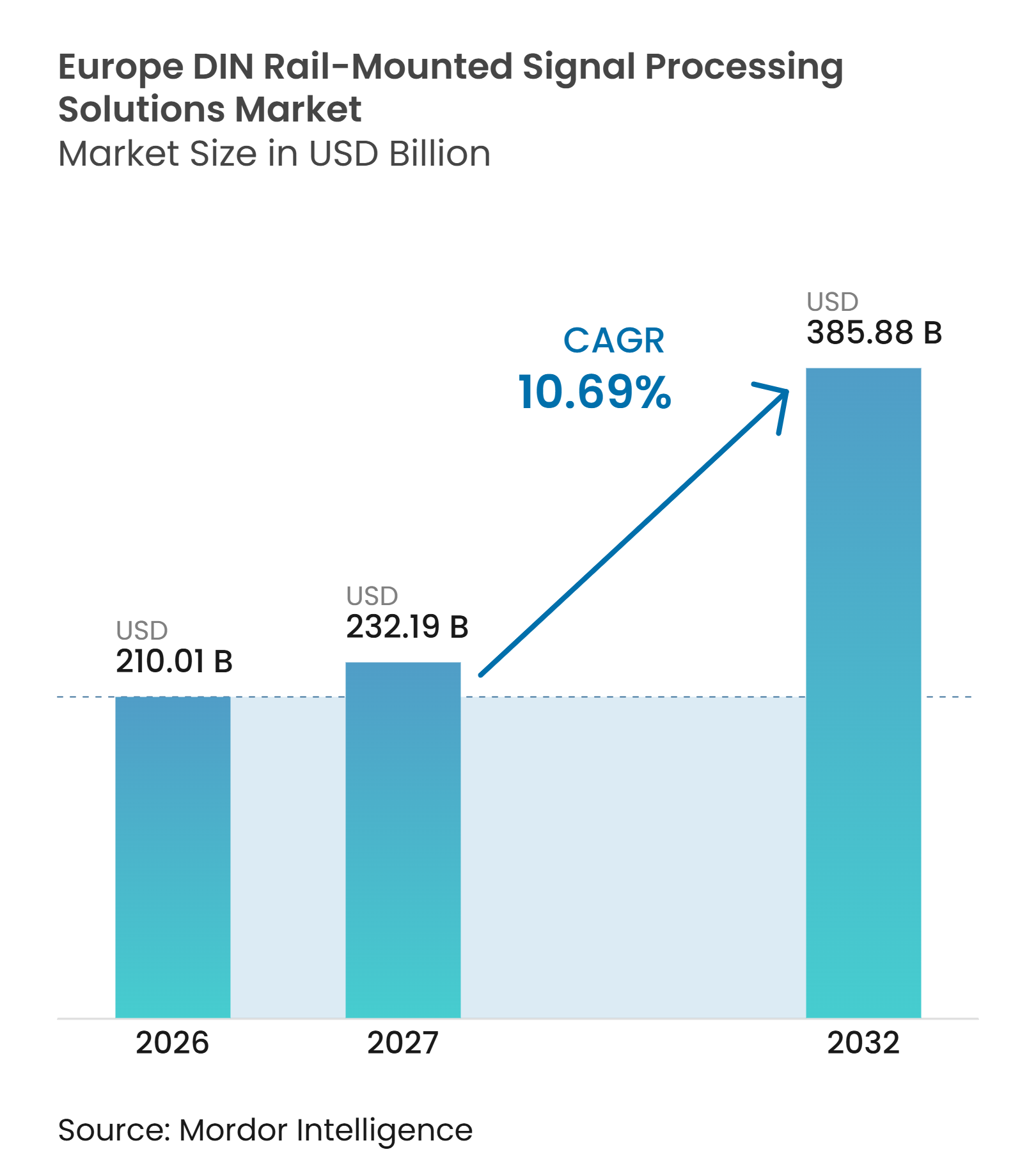
The Europe DIN Rail-Mounted Signal Processing Solutions Market size is expected to grow from USD 210.01 billion in 2026 to USD 232.19 billion in 2027 and is forecast to reach USD 385.88 billion by 2032 at a 10.69% CAGR over 2027-2032. Demand is supported by continued modernization of aging control systems, where plants can retain field wiring while adding isolation, conversion, diagnostic capability, and a clearer connection between field instruments and digital control architecture. For the Europe DIN rail-mounted signal processing solutions market, this approach is especially useful in process plants where safety, production continuity, and the cost of a broad replacement program limit the scope for a full change in instrumentation. Renewable energy assets also require more measurement points for power quality, temperature, frequency, grid status, and the operating data needed by wind, solar, and battery energy storage installations. Functional safety and hazardous-area requirements favor products that carry recognized approvals, clear documentation, appropriate isolation, and configurations that can be evaluated within established lifecycle procedures. Suppliers are responding with narrower housings, network-ready modules, HART-transparent designs, and tools that expose diagnostics from installed instruments without disrupting proven analog control loops. In the Europe DIN rail-mounted signal processing solutions market, this creates opportunities in retrofit projects because operators can add digital data access, improve panel density, and support staged equipment renewal without replacing every legacy loop.
Key Report Takeaways
- By form factor, DIN rail-mounted modules held 58.33% of the Europe DIN rail-mounted signal processing solutions market share in 2026, while plug-in and compact modules are projected to expand at a 6.36% CAGR through 2032.
- By signal and input type, temperature inputs held 22.92% share in 2026, while strain gauge, load cell, and bridge inputs are projected to expand at a 6.72% CAGR through 2032.
- By output signal, analog current output held 29.17% share in 2026, while HART-transparent and networked output is projected to expand at a 6.61% CAGR through 2032.
- By application, process control and automation held 33.33% share in 2026, while condition monitoring and predictive maintenance is projected to expand at a 6.43% CAGR through 2032.
- By end-user industry, chemical and petrochemical held 25.00% share in 2026, while power generation and utilities, including renewable energy, is projected to expand at a 6.41% CAGR through 2032.
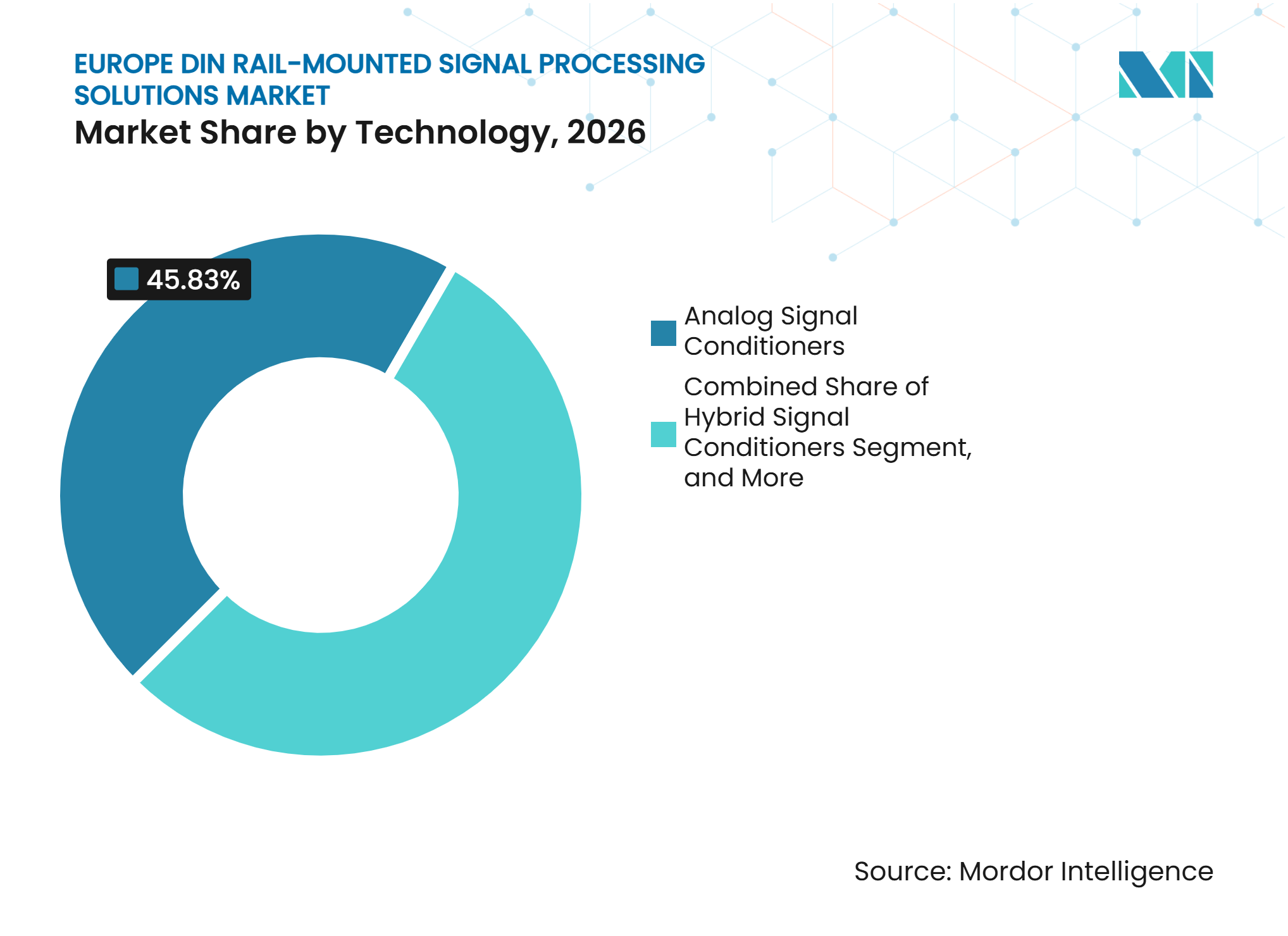
- By technology, analog signal conditioners held 45.83% share in 2026, while edge-connected and IIoT-enabled signal conditioners are projected to expand at a 6.38% CAGR through 2032.
- By safety and certification, general-purpose modules held 54.17% share in 2026, while intrinsically safe and hazardous-area modules are projected to expand at a 6.28% CAGR through 2032.
- By geography, Germany held 29.17% of the Europe DIN rail-mounted signal processing solutions market in 2026 and is projected to expand at a 6.48% CAGR through 2032.
Note: Market numbers in this report are based on Mordor Intelligence's proprietary estimation framework, which combines nine months of actuals with Q4 projections for base year 2026.
Market Trends and Insights
Drivers Impact Analysis of Europe DIN Rail-Mounted Signal Processing Solutions Market of Europe DIN Rail-Mounted Signal Processing Solutions Market*
| Driver | (~) % Impact on CAGR Forecast | Geographic Relevance | Impact Timeline |
|---|---|---|---|
| Industrial Automation and Legacy Control-System Modernization | +1.8% | Germany, France, Italy, Rest of Europe | Medium term (2-4 years) |
| Regulatory Demand for Functional Safety and Hazardous-Area Protection | +1.5% | Germany, United Kingdom, France | Long term (≥ 4 years) |
| Energy Transition and Renewable-Power Monitoring Requirements | +1.2% | Germany, United Kingdom, France, Italy, Rest of Europe | Medium term (2-4 years) |
| Smart Manufacturing and Industrial Internet of Things Adoption | +1.0% | Germany, United Kingdom | Medium term (2-4 years) |
| Expansion of Predictive Maintenance and Condition Monitoring | +0.7% | Germany, France, Italy | Long term (≥ 4 years) |
| Increasing Use of High-Density Modular Control Panels | +0.5% | Germany, Rest of Europe | Short term (≤ 2 years) |
| Source: Mordor Intelligence | |||
Industrial Automation and Legacy Control-System Modernization
European process sites are replacing aging control equipment without taking unnecessary risks with live field loops. Signal conditioners and isolators support this work because they retain 4-20 mA, thermocouple, and RTD connections while new control hardware is added above the field layer. This approach limits downtime and avoids broad rewiring programs in chemical and petrochemical facilities. VDMA expected Germany’s machinery and automation production to recover by 1% in 2026 after a prolonged decline, which supports a gradual return of modernization spending. Bitkom reported that 97% of German industrial companies use at least 1 Industry 4.0 application, while 45% use IoT platforms, reinforcing the need for reliable data from older instrumentation.[1] The Europe DIN rail-mounted signal processing solutions market therefore benefits when plants choose staged upgrades rather than full equipment replacement.
Regulatory Demand for Functional Safety and Hazardous-Area Protection
Functional safety and hazardous-area rules increase demand for certified isolation and signal conversion equipment. The British Standards Institution issued a draft revision to BS EN IEC 61508-1 in February 2025, keeping attention on the assessment of safety-related electrical and electronic systems. EEMUA released the second edition of its guidance on applying IEC 61511 in process industries, including implementation issues that operators still encounter. These requirements make documented SIL performance, intrinsic safety, and approved product configurations important in procurement. Phoenix Contact introduced the MINI Analog Pro Ex family in June 2025 with intrinsic safety capability and approvals for applications up to SIL 3 1oo1. The Europe DIN rail-mounted signal processing solutions market gains from this compliance focus because established plants must maintain approved protection layers as equipment is renewed.
Energy Transition and Renewable-Power Monitoring Requirements
The revised Renewable Energy Directive requires the European Union to reach at least a 42.5% renewable energy share by 2030 and includes a 1.6 percentage point annual increase in renewable use for industry.[2] These obligations increase the need to monitor generation, storage, and power quality at renewable facilities. Signal conditioning is relevant for frequency, AC RMS, temperature, and voltage data used in grid-facing equipment. BaxEnergy and Uniper announced a 2025 collaboration covering Uniper’s planned 10 GW renewable portfolio, which illustrates the scale of data integration work under development across Europe. Italy’s requirements for real-time monitoring at qualifying renewable assets also support the use of certified measurement hardware. The Europe DIN rail-mounted signal processing solutions market can gain where monitoring is added to wind, solar, and battery storage sites without changing the full control architecture.
Smart Manufacturing and Industrial Internet of Things Adoption
More connected machines require accurate signals before data can reach control, analytics, and maintenance systems. ZVEI identified electrical energy generation, including data centers, as a strong source of demand for measurement and process automation components during 2026. Rockwell Automation found that 50% of German manufacturers had invested in AI, 48% in generative AI, and 38% in digital twins in 2026.[3] HART-transparent and protocol-adapting modules allow facilities to expose diagnostic data while preserving installed analog wiring. Ethernet-APL creates a further path for two-wire digital communication from field devices to the control room. The Europe DIN rail-mounted signal processing solutions market is positioned to serve this transition when users need interoperability between analog assets and newer digital applications.
*Our forecasts treat driver/restraint impacts as directional, not additive. The impact forecasts reflect baseline growth, mix effects, and variable interactions.
Europe DIN Rail-Mounted Signal Processing Solutions Market Segment Analysis
By Form Factor:
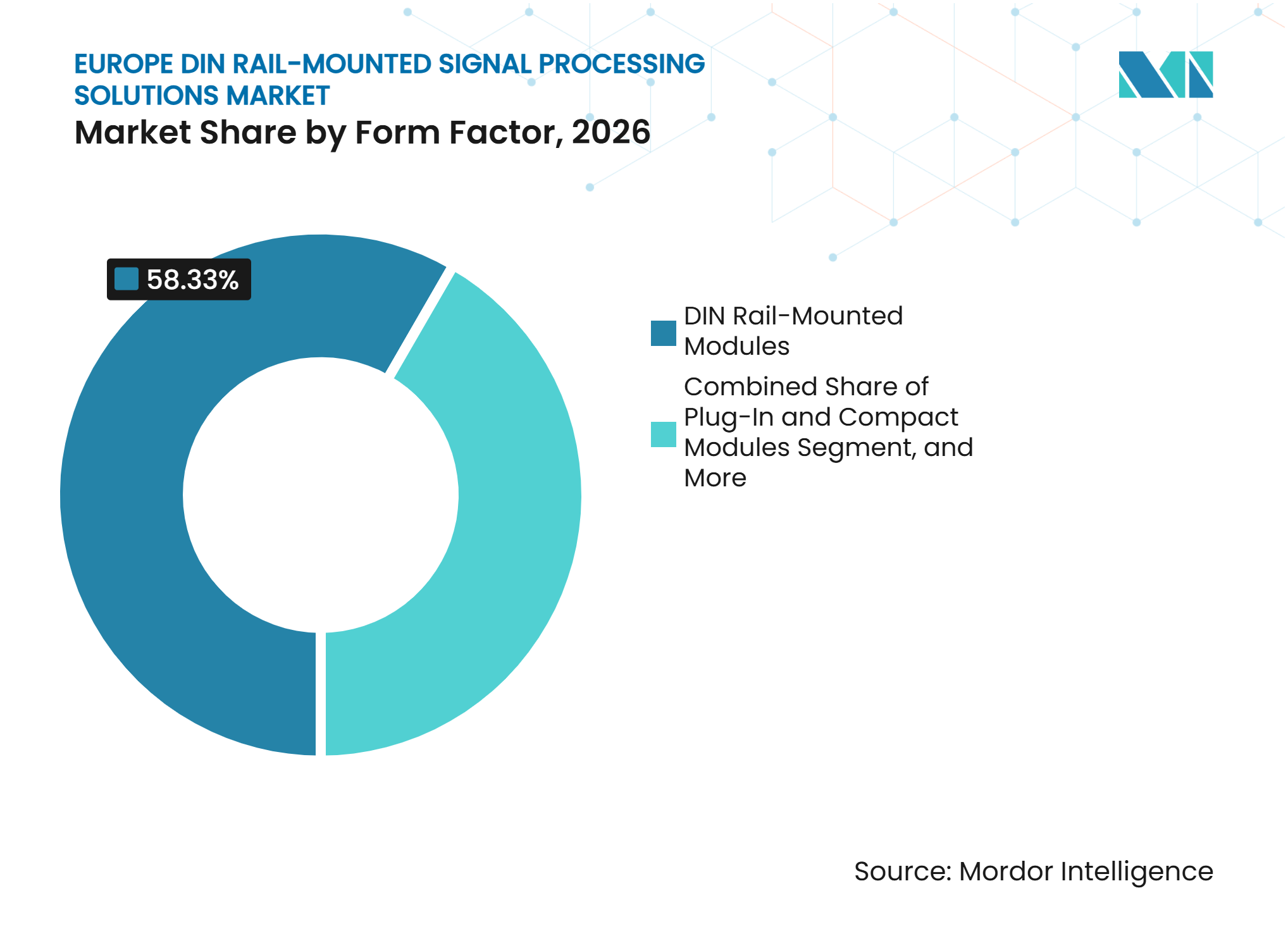
Compact Modules Challenge Traditional Rail DominanceDIN rail-mounted modules accounted for 58.33% of the Europe DIN rail-mounted signal processing solutions market share in 2026. Their leading position reflects the widespread use of 35 mm rails in European control panels. Plant maintenance teams already hold compatible spares and use panel layouts designed around this mounting approach. This makes replacement decisions predictable for chemical plants, water utilities, and machine builders. Rack and backplane-mounted modules remain relevant in data acquisition laboratories and older control-room marshaling racks. Stand-alone and panel modules continue to serve skid packages and original equipment manufacturers that place conditioning within an enclosure.
Plug-in and compact modules are projected to expand at a 6.36% CAGR through 2032. Narrow housings support higher channel density in cabinets where available rail space is limited. WAGO introduced its JUMPFLEX 857 family to the UK in October 2025, offering 6 mm housings, configurable ranges, push-in connections, and diagnostics for temperature models. Phoenix Contact also uses compact dimensions in its MINI Analog Pro portfolio for applications that combine isolation, conversion, and filtering. This form factor is useful where cabinet redesign is difficult but additional measurement channels are needed. Compact products also support transportation applications where space, vibration, and qualification requirements shape equipment selection.



By Signal and Input Type:
Mechanical Inputs Outpace Temperature SensingTemperature inputs held 22.92% of this segment in 2026. Temperature measurement is used across reactors, food processing lines, boilers, and other equipment that must operate within controlled ranges. RTD inputs are suitable for applications requiring accuracy and stability. Thermocouple inputs remain important in high-temperature settings such as furnaces and gas turbines. Process voltage and current inputs serve common 4-20 mA and 0-10 V loops. Frequency, pulse, and AC RMS inputs support electromechanical and renewable-power monitoring applications.
Strain gauge, load cell, and bridge inputs are projected to expand at a 6.72% CAGR through 2032. Automated sorting, packaging, and batch dosing require reliable force and weight data. Food, beverage, and pharmaceutical production lines increasingly use these measurements to support repeatable dosing and traceable records. Mechanical signal conditioning is also relevant where bridge circuits need isolation from noise and ground differences. OMEGA Engineering’s DMD4059 is a DIN rail-mounted bridge conditioner for load cell and strain gauge applications with three-way isolation. LVDT, RVDT, and displacement inputs benefit from the demand for precise positioning in robotics and automated assembly systems.
By Output Signal:
Analog Current Leads, HART Networking AcceleratesAnalog current output held 29.17% share in 2026. The 4-20 mA format remains common because it works reliably across long cable runs and provides clear fault behavior. A zero-current reading can indicate a wiring fault, which supports maintenance work in field environments. Many installed transmitters and control systems are calibrated around this signal range. Analog voltage output is used where shorter loops or application-specific voltage ranges are suitable. Digital, pulse, frequency, relay, and alarm outputs serve counting, switching, and protective functions.
HART-transparent and networked output is projected to expand at a 6.61% CAGR through 2032. Many HART-enabled field devices carry configuration and diagnostic information beyond the primary analog variable. HART-transparent modules can make this information available without replacing existing instruments or wiring. ProComSol released a DIN rail-mounted HART-IP Gateway in September 2025 that provides network access to HART field-device data. This capability supports asset management and IIoT programs where operators need more data from legacy equipment. The Europe DIN rail-mounted signal processing solutions market benefits when plant managers seek incremental digital access instead of a major instrumentation replacement.
By Application:
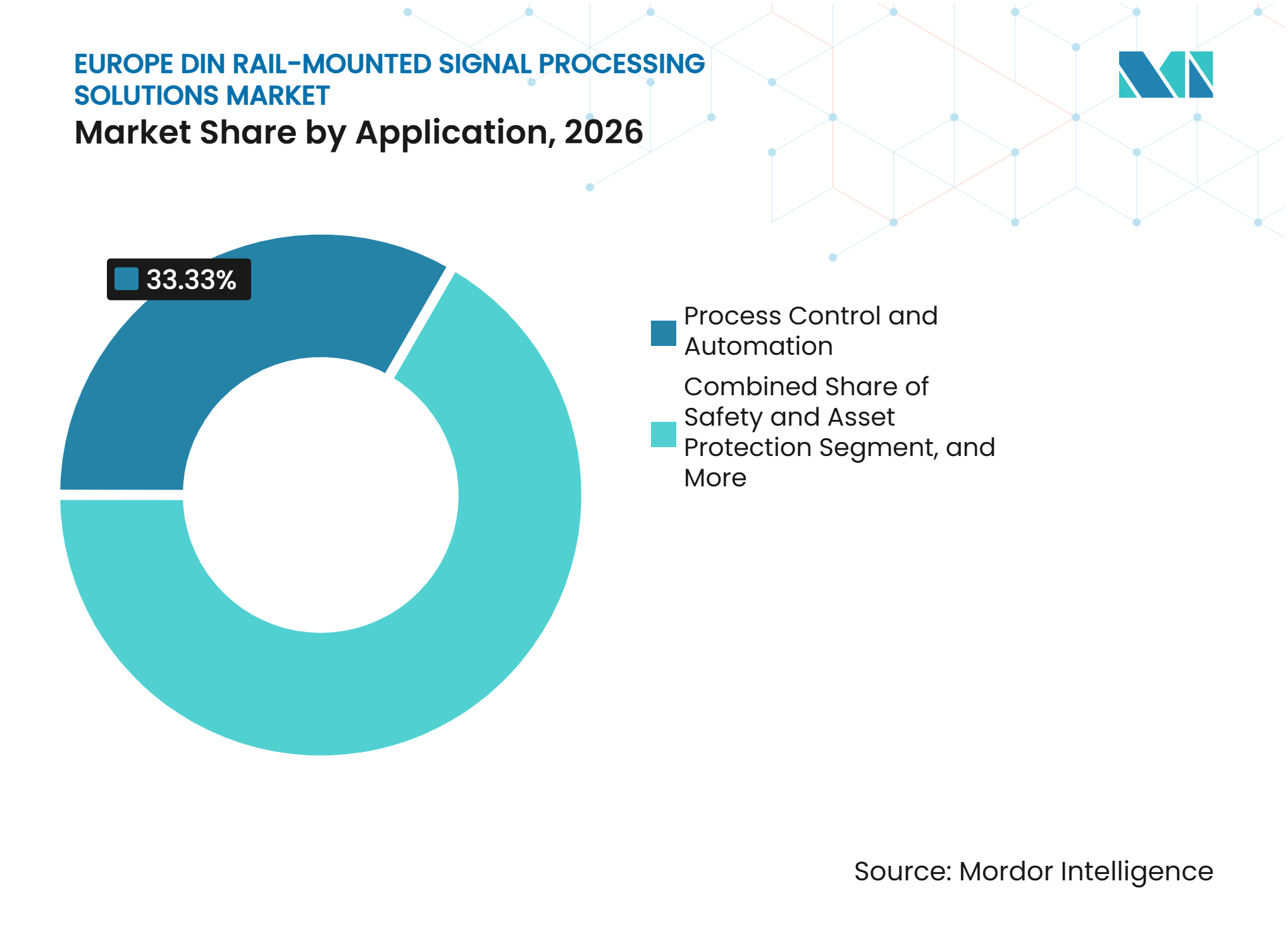
Process Control Anchors Market, Maintenance Use SurgesProcess control and automation accounted for 33.33% of this application segment in 2026. Chemical, oil and gas, and water facilities rely on conditioned field loops for regulatory control and safe operation. Procurement in these settings is linked to maintenance, replacement, and phased expansion. This produces a stable demand base even when capital spending becomes selective. Data acquisition and test measurement form another established application area. Energy and power-quality monitoring becomes more important as distributed energy assets increase.
Condition monitoring and predictive maintenance is projected to expand at a 6.43% CAGR through 2032. These programs depend on usable vibration, temperature, current, and frequency data before information reaches analytics software. Alfa Laval introduced its Clariot monitoring platform in 2025 for continuous surveillance of pumps and rotating equipment. Siemens applied its Senseye Predictive Maintenance approach at Sachsenmilch Leppersdorf in Germany to support continuous operations. Signal conditioners remain relevant because they protect and standardize field data before it enters a maintenance platform. Safety and asset protection applications add another layer of demand where assets operate in hazardous conditions.

By End-User Industry:
Renewables Reshape Demand Beyond Established VerticalsChemical and petrochemical held 25.00% of the end-user share in 2026. Continuous-process facilities use large numbers of 4-20 mA and thermocouple loops across reactors, storage, separation, and utility systems. These sites need consistent signal integrity and often operate under explosion-protection and functional-safety requirements. IEC 61511 also frames lifecycle practices for safety instrumented systems used in process plants. Oil and gas remains an important customer group because wellhead and downstream monitoring depend on accurate field measurements. The North Sea Transition Authority reported expected technology procurement of GBP 126 million, USD 161 million, in 2026, with real-time monitoring among the priority uses.
Power generation and utilities, including renewable energy, are projected to expand at a 6.41% CAGR through 2032. Wind, solar, and storage projects create demand for certified monitoring hardware at the grid interface. Italy requires qualifying medium-voltage wind and solar installations to use a Central Plant Controller with real-time monitoring functions. ZVEI also identified electrical energy generation as a strong demand area for process automation in 2026. Water and wastewater, food and beverage, and metals and mining complete the main customer base. Automated portioning and weighing in food production can create focused demand for load-cell signal conditioning where batch weights and doses must be recorded.
By Technology:
Digital Solutions Erode Traditional Analog StrongholdAnalog signal conditioners held 45.83% share in 2026. Their installed base is supported by the long service life of 4-20 mA infrastructure in European process industries. Simple analog designs remain valued where reliable operation and clear fault behavior are more important than advanced data features. They are also well suited to hazardous settings where equipment choice favors proven designs. Digital signal conditioners add microcontrollers for functions such as filtering, linearization, and communication. Hybrid products combine analog signal handling with digital configuration for users that need both approaches.
Edge-connected and IIoT-enabled signal conditioners are projected to expand at a 6.38% CAGR through 2032. These modules use interfaces such as OPC UA, HART-IP, and PROFINET to carry field measurements into edge or enterprise systems. Endress+Hauser reported a multi-vendor Ethernet-APL scalability test in May 2026 with Covestro, BASF, and Yokogawa. The test showed the interoperability work required as digital field architectures mature. The EU Cyber Resilience Act is also shaping software and security requirements for connected equipment. This raises the value of suppliers that can support both connectivity and compliance documentation.
By Safety and Certification:
Hazardous-Area Certifications Drive Premium ValueGeneral-purpose modules held 54.17% share in 2026. Much of the demand comes from panel environments where explosion protection is not required. Examples include machine-tool cabinets, water utility control rooms, and food processing equipment. These products commonly align with IEC 61010-1 requirements for measurement and control equipment. CE and UKCA requirements can add work for suppliers selling across both European Union and United Kingdom markets. Marine and transportation-approved modules remain a specialized area for rail, shipping, and offshore applications.
Intrinsically safe and hazardous-area modules are projected to expand at a 6.28% CAGR through 2032. ATEX and IECEx requirements shape selection in Zone 0 and Zone 1 applications. These applications need galvanic isolation and designs that limit available energy. Pepperl+Fuchs released M-LB-2600 surge protection modules in April 2025 for three-wire transmitters in hazardous and non-hazardous locations, with SIL 3 capability in a 6 mm package. Safety Integrity Level-rated modules are used in emergency shutdown and high-integrity protection systems. The segment can command premium value because certification evidence and application fit matter as much as the physical module.
Geography Analysis
Germany
Germany held 29.17% of the Europe DIN rail-mounted signal processing solutions market size in 2026 and is projected to expand at a 6.48% CAGR through 2032. Its position reflects the scale of its process industries, factory automation base, and digital manufacturing activity. The International Federation of Robotics reported 24,842 industrial robot installations in Germany during 2025, representing 41% of European Union installations. Bitkom also reported extensive adoption of Industry 4.0 applications and IoT platforms among German industrial companies. These conditions support retrofit demand because many sites need data from existing field systems. R. STAHL released an ATEX- and IECEx-certified Ethernet-APL Field Switch in October 2025 after Zone 1 trials, reflecting the region’s move toward digital process automation.
United Kingdom
The United Kingdom combines interest in industrial digitization with pressure on process-industry investment. A Schneider Electric survey reported that only a small share of UK organizations described their operations as fully autonomous, while a substantial majority of industrial leaders ranked autonomous operations among their priorities over the next several years. The Chemical Industries Association forecast a decline in UK chemical production in 2026, with high energy costs limiting capital budgets. This environment encourages upgrades that preserve usable wiring and hardware. North Sea activity provides an offset because operators are prioritizing real-time monitoring technology. UKCA and CE requirements can also lengthen qualification work for suppliers serving both markets. UK-based specialists can use familiarity with this compliance environment as a practical advantage.
France, Italy, Russia, and Rest of Europe
France, Italy, Russia, and the remaining European markets have different demand drivers. France combines industrial modernization with chemical, aerospace, nuclear, food, and semiconductor investment. The International Federation of Robotics recorded 4,500 industrial robot installations in France in 2025, including demand from food and chemicals. Italy’s food, metals, chemicals, and renewable sectors support the Europe DIN rail-mounted signal processing solutions market through equipment upgrades and new monitoring duties. Italy installed 7,800 industrial robots in 2025, which shows the scale of automated production equipment in the country. Russia’s domestic substitution programs reduce near-term demand for Western-branded components. The Netherlands, Belgium, Scandinavia, and Eastern Europe benefit from renewable projects, chemical investment, and decarbonization programs that need reliable measurement infrastructure.
Competitive Landscape
Market Concentration
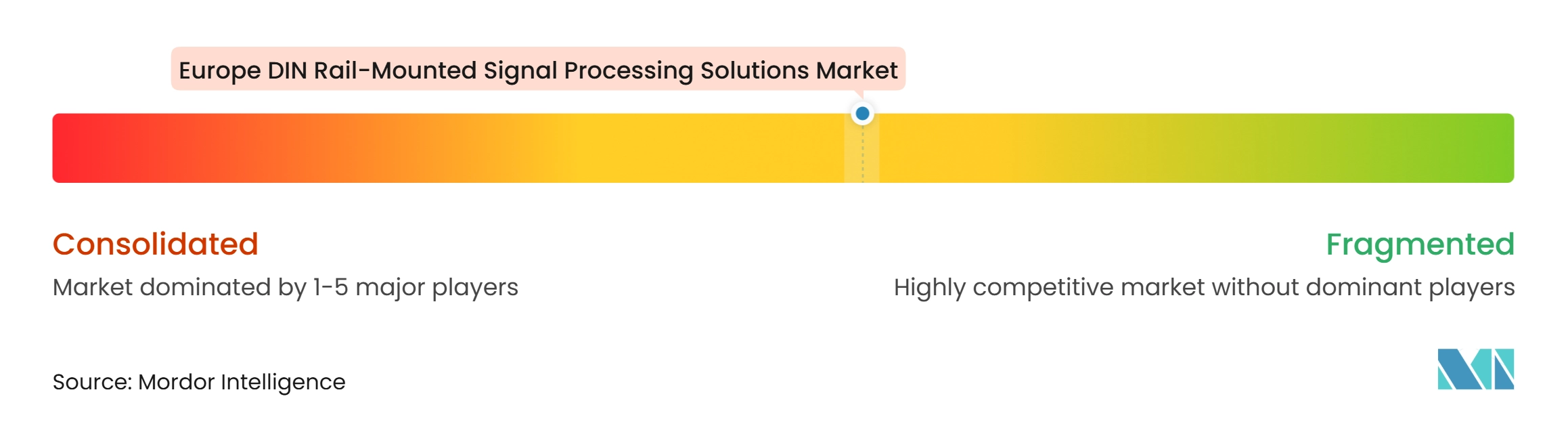
The Europe DIN rail-mounted signal processing solutions market has moderate concentration among specialized European suppliers, global automation companies, and certification-focused firms. Phoenix Contact, Weidmüller, Pepperl+Fuchs, and WAGO benefit from established positions in panel-building practices and regional distribution. Their portfolios address ATEX, IECEx, SIL, and other process-industry requirements. Pepperl+Fuchs states that its K-System includes 200 isolated barriers and 150 signal conditioners for process-industry applications. PR electronics, Acromag, Moore Industries, Status Instruments, and G.M. International compete through customization, application support, and specialized approvals. Carlo Gavazzi is also directly relevant because it supplies DIN rail process-control and energy-monitoring products.
Suppliers increasingly compete through compatibility with digital plant architectures rather than through basic conversion functions alone. Phoenix Contact published NE 95 test reports for selected MINI Analog Pro and MACX Analog families in April 2026, providing documented evidence for process-industry procurement and approvals. Endress+Hauser and SICK advanced their analytical measurement collaboration in 2025, illustrating broader integration across measurement technology. Yokogawa acquired Intellisync in October 2025 to strengthen data integration and operational intelligence capabilities. These moves make signal processing more closely tied to software, diagnostics, and broader automation platforms.
In the Europe DIN rail-mounted signal processing solutions market, high-density modules with embedded diagnostics are a clear product focus for panel upgrades in energy and process applications. Pre-validated SIL 3 product combinations can also help safety engineers who need evidence for IEC 61511 lifecycle work. Networked modules face a further requirement to address software security as connected equipment becomes more common. Larger platform suppliers may find it easier to absorb this product-development and compliance work. Specialized companies can remain competitive where their certification depth or customer response time is valued.
Europe DIN Rail-Mounted Signal Processing Solutions Industry Leaders
-
Phoenix Contact GmbH & Co. KG
-
Weidmüller Interface GmbH & Co. KG
-
Pepperl+Fuchs SE
-
Siemens AG
-
WAGO Kontakttechnik GmbH & Co. KG
- *Disclaimer: Major Players sorted in no particular order
Europe DIN Rail-Mounted Signal Processing Solutions Market Companies Covered in this Report
- Phoenix Contact GmbH & Co. KG
- Weidmuller Interface GmbH & Co. KG
- Pepperl+Fuchs SE
- Siemens AG
- WAGO Kontakttechnik GmbH & Co. KG
- PR electronics A/S
- Eaton Corporation plc
- R. STAHL AG
- Schneider Electric SE
- Rockwell Automation, Inc.
- Yokogawa Electric Corporation
- OMEGA Engineering, Inc.
- Red Lion Controls, LLC
- Acromag, Inc.
- M-System Co., Ltd.
- Turck Inc.
- Moore Industries-International, Inc.
- Status Instruments Ltd.
- G.M. International s.r.l.
- Endress+Hauser Group Services AG
Recent Industry Developments in Europe DIN Rail-Mounted Signal Processing Solutions Market
- November 2026: Endress+Hauser Group fully acquired the remaining 25% shares in Endress+Hauser BioSense from Hahn-Schickard gGmbH on November 1, 2026, integrating the PCR-based rapid analysis technology company as a wholly owned subsidiary focused on in-process molecular diagnostic measurement for pharmaceutical and food bioprocess applications requiring signal-conditioned sensor data under GMP compliance frameworks.
- May 2026: Endress+Hauser Digital Solutions, in collaboration with Covestro, BASF, and Yokogawa, conducted a large-scale Ethernet-APL scalability test integrating a Yokogawa CENTUM VP DCS and Plant Resource Manager with multi-vendor PROFINET field devices in a process automation environment, validating architectural breadth and interoperability across a broader combination of devices than any prior multi-vendor Ethernet-APL exercise.
- April 2026: Phoenix Contact published complete NE 95 test reports for selected MINI Analog Pro and MACX Analog signal conditioners, confirming robustness, accuracy, and interoperability to support procurement decisions, approvals, and tenders for European process-industry projects.
- February 2026: ABB launched the 216DB61, a DIN rail-mounted universal process signal conditioner and isolator designed to convert, isolate, and distribute RTD, thermocouple, mA, and V inputs while providing galvanic isolation for integration with PLCs, DCS, and recorders.
Europe DIN Rail-Mounted Signal Processing Solutions Market Report Scope
The Europe DIN Rail-Mounted Signal Processing Solutions Market refers to the regional market for compact, modular electronic devices, signal conditioners, isolators, transmitters, converters, splitters, and limit alarms designed to be snap-mounted on standard 35 mm DIN rails within industrial control cabinets, automation panels, and process control systems across Germany, France, the UK, Italy, Spain, and the rest of Europe.
The Europe DIN Rail-Mounted Signal Processing Solutions Market Report is Segmented by Form Factor (DIN Rail-Mounted Modules, Rack and Backplane-Mounted Modules, Stand-Alone and Panel Modules, and Plug-In and Compact Modules), Signal and Input Type (Temperature Inputs (RTD Inputs and Thermocouple Inputs), Process Voltage and Current Inputs (4-20 mA Inputs and 0-10 V and Related Standard Analog Inputs), Frequency, Pulse, and AC RMS Inputs, Strain Gauge, Load Cell, and Bridge Inputs, LVDT/RVDT and Displacement Inputs, and Other Signal and Input Types), Output Signal (Analog Current Output, Analog Voltage Output, Digital, Pulse, and Frequency Output, Relay and Alarm Output, and HART-Transparent and Networked Output), Application (Data Acquisition and Test Measurement, Process Control and Automation, Condition Monitoring and Predictive Maintenance, Energy and Power-Quality Monitoring, and Safety and Asset Protection), End-User Industry (Oil and Gas, Chemical and Petrochemical, Water and Wastewater, Power Generation and Utilities, Including Renewable Energy, Food and Beverage, Metals and Mining, and Other End-User Industries), Technology (Analog Signal Conditioners, Digital Signal Conditioners, Hybrid Signal Conditioners, and Edge-Connected and Industrial Internet of Things-Enabled Signal Conditioners), Safety and Certification (General-Purpose Modules, Intrinsically Safe and Hazardous-Area Modules, Safety Integrity Level-Rated and Functional-Safety Modules, and Marine- and Transportation-Approved Modules), and Europe (Germany, United Kingdom, France, Italy, Russia, and Rest of Europe). The Market Forecasts Are Provided in Terms of Value (USD).
Segmentation Overview
| DIN Rail-Mounted Modules |
| Rack and Backplane-Mounted Modules |
| Stand-Alone and Panel Modules |
| Plug-In and Compact Modules |
| Temperature Inputs | RTD Inputs |
| Thermocouple Inputs | |
| Process Voltage and Current Inputs | 4-20 mA Inputs |
| 0-10 V and Related Standard Analog Inputs | |
| Frequency, Pulse, and AC RMS Inputs | |
| Strain Gauge, Load Cell, and Bridge Inputs | |
| LVDT/RVDT and Displacement Inputs | |
| Other Signal and Input Types |
| Analog Current Output |
| Analog Voltage Output |
| Digital, Pulse, and Frequency Output |
| Relay and Alarm Output |
| HART-Transparent and Networked Output |
| Data Acquisition and Test Measurement |
| Process Control and Automation |
| Condition Monitoring and Predictive Maintenance |
| Energy and Power-Quality Monitoring |
| Safety and Asset Protection |
| Oil and Gas |
| Chemical and Petrochemical |
| Water and Wastewater |
| Power Generation and Utilities, Including Renewable Energy |
| Food and Beverage |
| Metals and Mining |
| Other End-User Industries |
| Analog Signal Conditioners |
| Digital Signal Conditioners |
| Hybrid Signal Conditioners |
| Edge-Connected and Industrial Internet of Things-Enabled Signal Conditioners |
| General-Purpose Modules |
| Intrinsically Safe and Hazardous-Area Modules |
| Safety Integrity Level-Rated and Functional-Safety Modules |
| Marine- and Transportation-Approved Modules |
| Germany |
| United Kingdom |
| France |
| Italy |
| Russia |
| Rest of Europe |
| By Form Factor | DIN Rail-Mounted Modules | |
| Rack and Backplane-Mounted Modules | ||
| Stand-Alone and Panel Modules | ||
| Plug-In and Compact Modules | ||
| By Signal and Input Type | Temperature Inputs | RTD Inputs |
| Thermocouple Inputs | ||
| Process Voltage and Current Inputs | 4-20 mA Inputs | |
| 0-10 V and Related Standard Analog Inputs | ||
| Frequency, Pulse, and AC RMS Inputs | ||
| Strain Gauge, Load Cell, and Bridge Inputs | ||
| LVDT/RVDT and Displacement Inputs | ||
| Other Signal and Input Types | ||
| By Output Signal | Analog Current Output | |
| Analog Voltage Output | ||
| Digital, Pulse, and Frequency Output | ||
| Relay and Alarm Output | ||
| HART-Transparent and Networked Output | ||
| By Application | Data Acquisition and Test Measurement | |
| Process Control and Automation | ||
| Condition Monitoring and Predictive Maintenance | ||
| Energy and Power-Quality Monitoring | ||
| Safety and Asset Protection | ||
| By End-User Industry | Oil and Gas | |
| Chemical and Petrochemical | ||
| Water and Wastewater | ||
| Power Generation and Utilities, Including Renewable Energy | ||
| Food and Beverage | ||
| Metals and Mining | ||
| Other End-User Industries | ||
| By Technology | Analog Signal Conditioners | |
| Digital Signal Conditioners | ||
| Hybrid Signal Conditioners | ||
| Edge-Connected and Industrial Internet of Things-Enabled Signal Conditioners | ||
| By Safety and Certification | General-Purpose Modules | |
| Intrinsically Safe and Hazardous-Area Modules | ||
| Safety Integrity Level-Rated and Functional-Safety Modules | ||
| Marine- and Transportation-Approved Modules | ||
| By Geography | Germany | |
| United Kingdom | ||
| France | ||
| Italy | ||
| Russia | ||
| Rest of Europe | ||
Key Questions Answered in the Report
What is the size of the Europe DIN rail-mounted signal processing solutions market?
The market is projected at USD 0.24 billion in 2026, USD 0.25 billion in 2027, and USD 0.32 billion by 2032, at a 5.92% CAGR.
Which form factor leads demand for DIN rail signal processing solutions in Europe?
DIN rail-mounted modules lead with 58.33% share in 2026 because installed control panels and maintenance practices are built around 35 mm rail mounting.
Which technology is expected to expand fastest in this sector?
Edge-connected and IIoT-enabled signal conditioners are projected to expand at a 6.38% CAGR through 2032 as facilities connect field data with analytics and asset-management systems.
Why are HART-transparent signal conditioners gaining adoption?
They provide access to diagnostic and configuration data from installed HART instruments while allowing plants to retain existing analog wiring.
Which end-user group is expected to show the strongest demand expansion?
Power generation and utilities, including renewable energy, is projected to expand at a 6.41% CAGR through 2032 as monitoring requirements increase.
Why do hazardous-area approvals matter for signal conditioning products?
ATEX, IECEx, and SIL requirements influence equipment selection in safety-critical sites, where documented isolation and approved configurations are necessary.