
Europe Data Center Water Treatment and Recycling Market Size and Share
Market Overview
| Study Period | 2021 - 2032 |
|---|---|
| Forecast Data Period | 2027 - 2032 |
| Base Year Market Size (2026) | USD 0.93 Billion |
| Market Size (2027) | USD 1.01 Billion |
| Market Size (2032) | USD 1.64 Billion |
| Growth Rate (2027 - 2032) | 10.18 % |
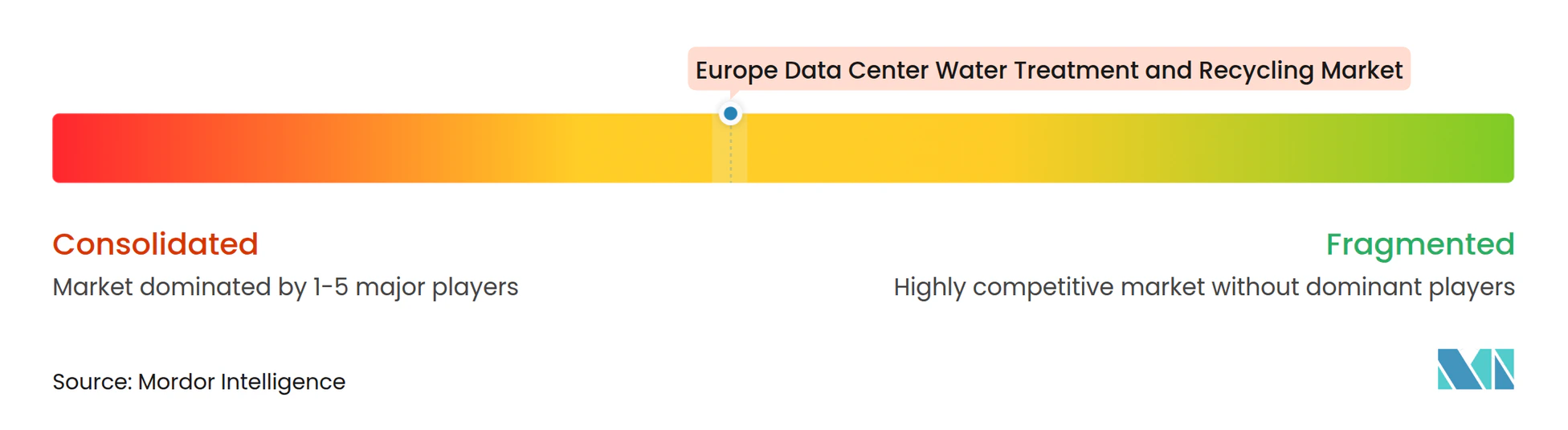
| Market Concentration | Medium |
Major Players *Disclaimer: Major Players sorted in no particular order Image © Mordor Intelligence. Reuse requires attribution under CC BY 4.0. | |
Europe Data Center Water Treatment and Recycling Market Analysis by Mordor Intelligence
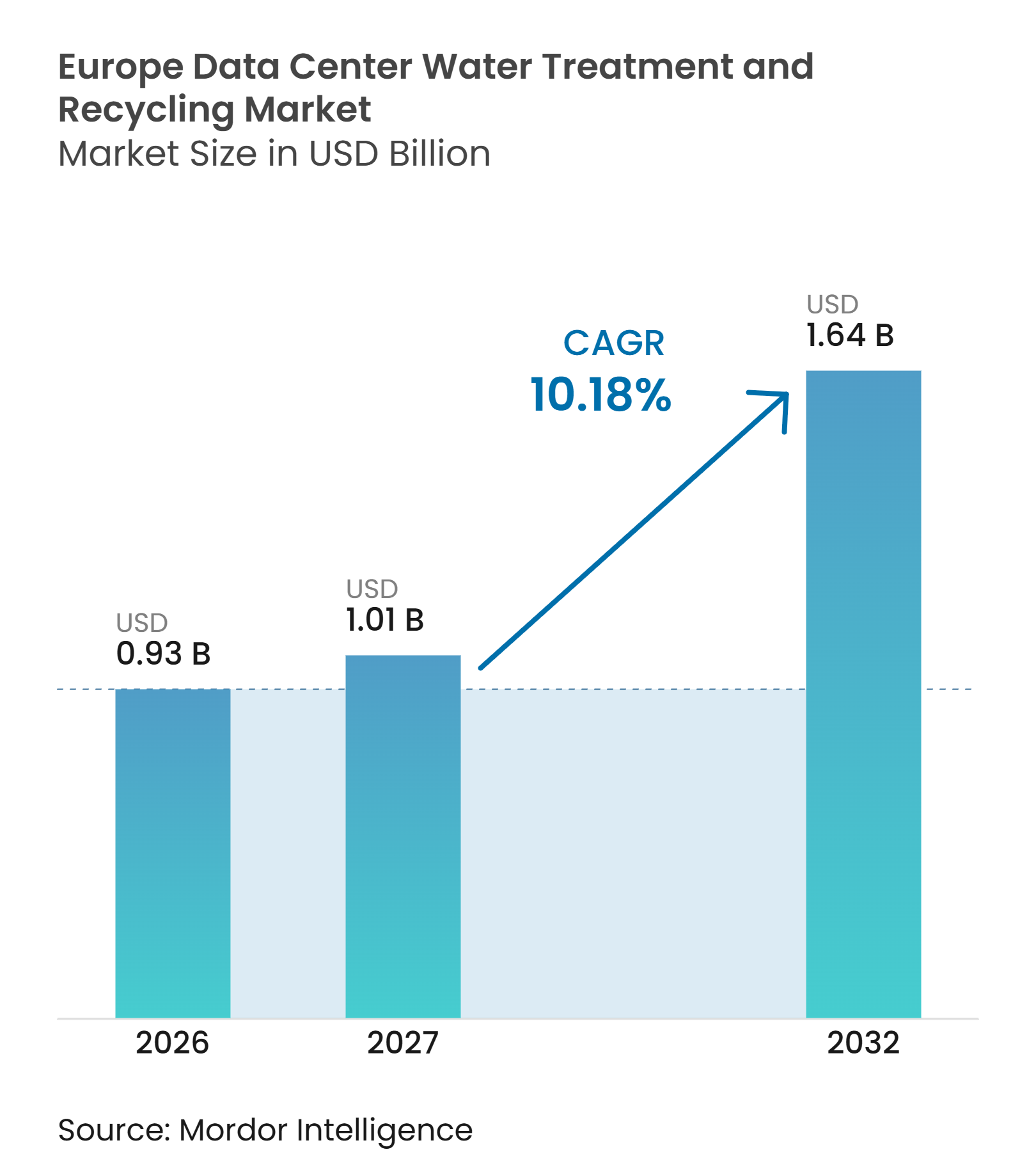
The Europe data center water treatment and recycling market size is projected to expand from USD 0.93 billion in 2026 and USD 1.01 billion in 2027 to USD 1.64 billion by 2032, registering a CAGR of 10.18% between 2027 to 2032. The Europe data center water treatment and recycling market is being shaped by larger AI facilities, where cooling design and water availability are becoming site-selection issues. Operators are putting water treatment into early campus planning because cooling circuits, discharge limits, and local supply conditions can affect a project before equipment is installed. Disclosure requirements are also moving water measurement from a voluntary practice toward a regular operating requirement for larger facilities. This is increasing the value of monitoring, reuse, and closed-loop systems that can document performance while reducing freshwater demand. Competition is therefore moving beyond standalone equipment toward integrated services that combine treatment, chemistry control, monitoring, and operations.
Key Report Takeaways
- By treatment technology, reverse osmosis held 21.66% of the Europe data center water treatment and recycling market in 2026, while membrane bioreactors are projected to expand at a 10.36% CAGR through 2032.
- By water source, municipal water held 41.89% in 2026, while reclaimed municipal wastewater is expected to expand at a 10.73% CAGR through 2032.
- By treatment application, cooling tower makeup water treatment accounted for 33.76% in 2026, while water recycling and reuse is projected to expand at a 10.62% CAGR through 2032.
- By solution type, water treatment equipment held 37.11% in 2026, while water quality monitoring and control systems are expected to expand at a 10.88% CAGR through 2032.
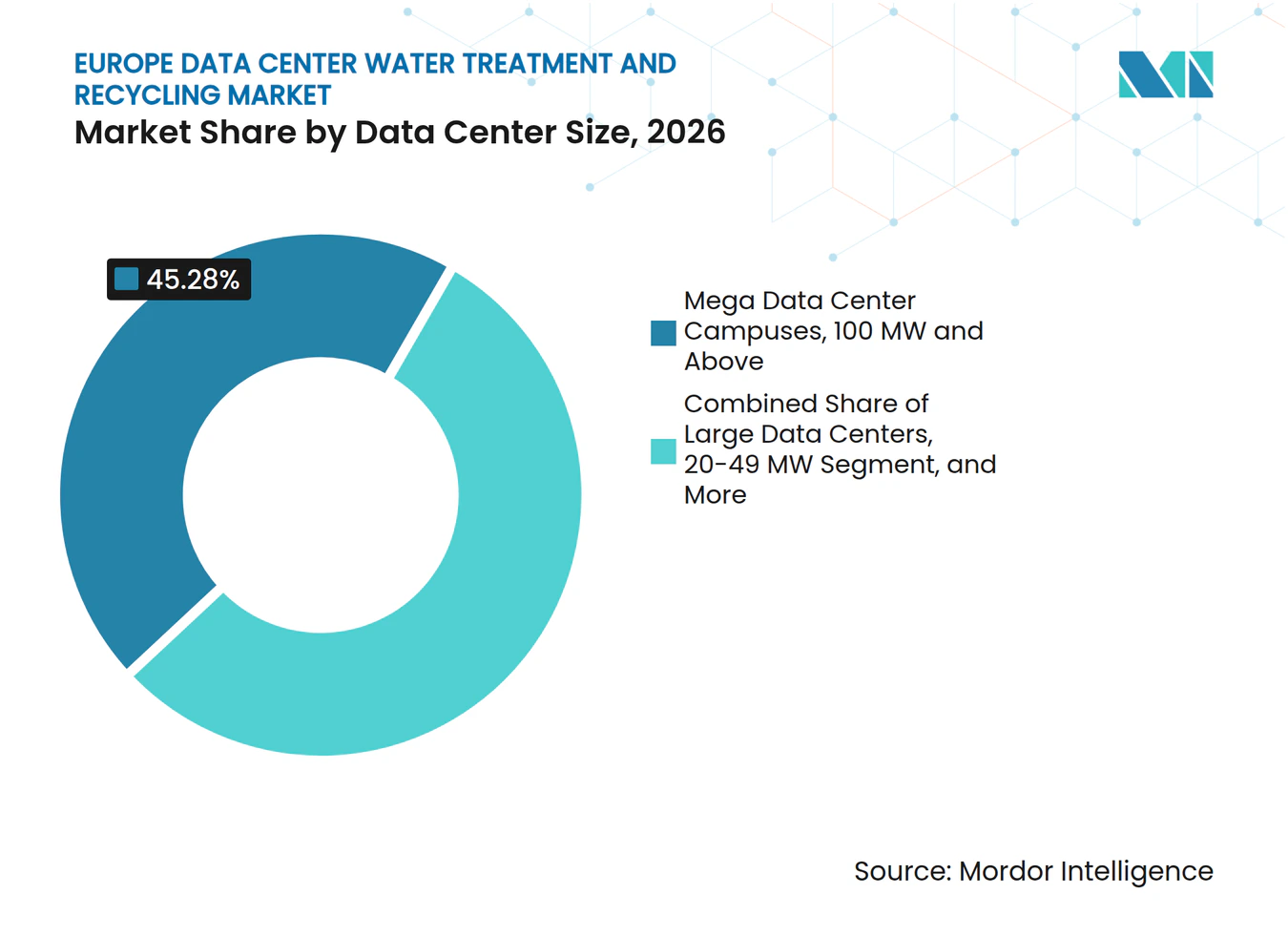
- By data center size, mega data center campuses of 100 MW and above held 45.28% in 2026 and are projected to expand at a 10.49% CAGR through 2032.
- By data center type, cloud service provider data centers held 41.67% in 2026 and are expected to expand at a 10.64% CAGR through 2032.
- By geography, the United Kingdom held 20.74% in 2026, while Spain is projected to expand at a 10.58% CAGR through 2032.
Note: Market numbers in this report are based on Mordor Intelligence's proprietary estimation framework, which combines nine months of actuals with Q4 projections for base year 2026.
Market Trends and Insights
Drivers Impact Analysis of Europe Data Center Water Treatment and Recycling Market*
| Driver | (~) % Impact on CAGR Forecast | Geographic Relevance |
|---|---|---|
| Hyperscale and AI Data Center Expansion | +3.2% | Global, concentrated in the United Kingdom, Germany, Netherlands, Nordics, and Spain |
| Stricter Water-Use Efficiency and Sustainability Disclosure Requirements | +2.1% | EU-wide, with early compliance gains in Germany, Netherlands, and Ireland |
| Adoption of Liquid and Direct-to-Chip Cooling | +1.6% | Global, concentrated in the United Kingdom, France, Germany, and Nordic hyperscale hubs |
| Rising Demand for Water Recycling and Closed-Loop Operations | +1.2% | EU-wide, with acute need in Spain, Italy, Southern Europe, and Ireland |
| Alternate Water Infrastructure for Water-Stressed Data Center Clusters | +0.9% | Spain, Italy, Southern France, Portugal, with spillover to the Netherlands |
| Modular Treatment Skids and Water-as-a-Service Models | +0.6% | Global, with early adoption in the United Kingdom, Germany, and Ireland |
| Source: Mordor Intelligence | ||
Hyperscale and AI Data Center Expansion Drives Treatment Capital Spending
AI workload density is changing water-treatment purchasing across the Europe data center water treatment and recycling market. A 100 MW data center can use 2.5 billion liters of water each year, which the UK Government report equates to the annual needs of 80,000 people.[1] Grundfos reported that cooling infrastructure accounts for 38% of total data center electricity use, which makes cooling design a central engineering decision.[2] AI racks with higher power density are supporting liquid cooling and placing more emphasis on treated make-up water, circuit chemistry, and dependable reuse systems. Site developers are therefore considering reverse osmosis, membrane bioreactors, and zero liquid discharge systems during feasibility work rather than after a location is selected. This brings water treatment spending closer to the critical path for new facilities, especially where water supply permits are difficult to obtain.
Water-Use Reporting Requirements Create Compliance-Driven Demand
Water reporting rules are making measurement and recordkeeping more important for larger data centers in the Europe data center water treatment and recycling market. The EU Energy Efficiency Directive requires data centers with at least 500 kW of installed IT power to report relevant performance information, including water-use indicators.[3]EU Germany's Energieeffizienzgesetz adds national reporting obligations, which give operators in the Frankfurt cluster a direct reason to improve water data quality. The European Commission's Water Resilience Strategy calls for stronger water efficiency, better use of reclaimed water, and improved resilience across water-intensive activities. The strategy also provides a policy setting for water performance standards and the sustainability evaluation of data centers. These rules favor systems that connect flow, quality, and water-use effectiveness data with operating records and compliance processes.
Liquid and Direct-to-Chip Cooling Creates Specialized Water Chemistry Demand EUR-LEX.EUROPA
Direct-to-chip cooling is adding a more demanding set of water-chemistry requirements to the Europe data center water treatment and recycling market. Closed loops that use glycol and water need control of glycol condition, microbes, particles, and corrosion to protect computing equipment. Ecolab introduced 3D TRASAR Technology for Direct-to-Chip Liquid Cooling in May 2025 to monitor glycol concentration, pH, turbidity, and flow rates. This type of monitoring addresses risks that are less prominent in traditional cooling-tower water programs. DCX Liquid Cooling Systems was selected in March 2025 to provide facility water systems and technology cooling loops for the DataOne project in Grenoble, France. The project shows how treatment, distribution hardware, and fluid-quality control are becoming linked in new liquid-cooled sites.
Water Recycling and Closed-Loop Operations Normalize Reuse Investment
Water recycling is becoming an operating requirement at some facilities in the Europe data center water treatment and recycling market. The European Commission calls for actions that support the safe reuse of water and improve water efficiency, including in sectors facing competing demand. DIGITALEUROPE has advocated policy measures that enable data centers to use recycled, reclaimed, and non-potable water where conditions allow. Data4 reported a group-level water-use effectiveness of 0.04 liters per kilowatt-hour in 2025 and plans to use gray water, rainwater, and industrial wastewater for process needs. Start Campus opened its SIN01 facility in Portugal in April 2025 with a seawater dual-loop cooling design that removes potable water from the cooling process. These examples support investment in reuse trains, reclaimed-water connections, and closed loops where freshwater use could limit development.
Restraints Impact Analysis of Europe Data Center Water Treatment and Recycling Market*
| Restraint | (~) % Impact on CAGR Forecast | Geographic Relevance | Impact Timeline |
|---|---|---|---|
| Drought Restrictions and Water-Withdrawal Limits | -1.5% | Spain, Italy, Portugal, Southern France, with spillover to Ireland and Netherlands | Short term (≤ 2 years) |
| Community Opposition and Extended Permitting Timelines | -1.0% | Netherlands, Ireland, Spain, and the United Kingdom Oxfordshire corridor | Short term (≤ 2 years) |
| Retrofit Integration Complexity in Operating Data Centers | -0.7% | EU-wide, concentrated in Germany, Netherlands, and United Kingdom legacy facilities | Medium term (2-4 years) |
| Legionella, Biofouling, and Cooling-Water Chemistry Control Risk | -0.4% | EU-wide, with heightened scrutiny under Legionella control guidelines | Medium term (2-4 years) |
| Source: Mordor Intelligence | |||
Drought Restrictions and Water-Withdrawal Limits Delay Greenfield Development
Water scarcity is a direct planning constraint for the Europe data center water treatment and recycling market, especially in southern Europe. The European Commission's water strategy identifies climate pressure, pollution, and competing demand as threats to water security across the region. A treatment system can lower withdrawal needs, but it cannot fully remove restrictions that apply when local authorities limit use at the water source. Operators in water-stressed regions must therefore assess reclaimed supply, seasonal availability, and discharge conditions before committing to cooling technology. This can extend permitting schedules and add project risk for greenfield sites. It also gives technologies that reduce freshwater dependence a clearer commercial role, even though they often require greater capital expenditure.
Community Opposition and Longer Permitting Timelines Defer Procurement
Community concern over water use can delay projects and move treatment procurement later in the Europe data center water treatment and recycling market. Local opposition is stronger when a new site appears to compete with households or agriculture for a limited supply. DIGITALEUROPE has noted that planning policy needs to recognize water resilience and support non-potable sources where appropriate. Restrictions in grid-constrained locations can shift activity toward brownfield expansion, where connecting advanced treatment to operating systems is more difficult. Retrofit work must fit within uptime requirements, available space, existing pipework, and legacy control systems. Suppliers that can demonstrate lower freshwater withdrawal and clear performance records may be better placed to support permits, but those benefits do not eliminate local scrutiny.
*Our forecasts treat driver/restraint impacts as directional, not additive. The impact forecasts reflect baseline growth, mix effects, and variable interactions.
Europe Data Center Water Treatment and Recycling Market Segment Analysis
By Treatment Technology:
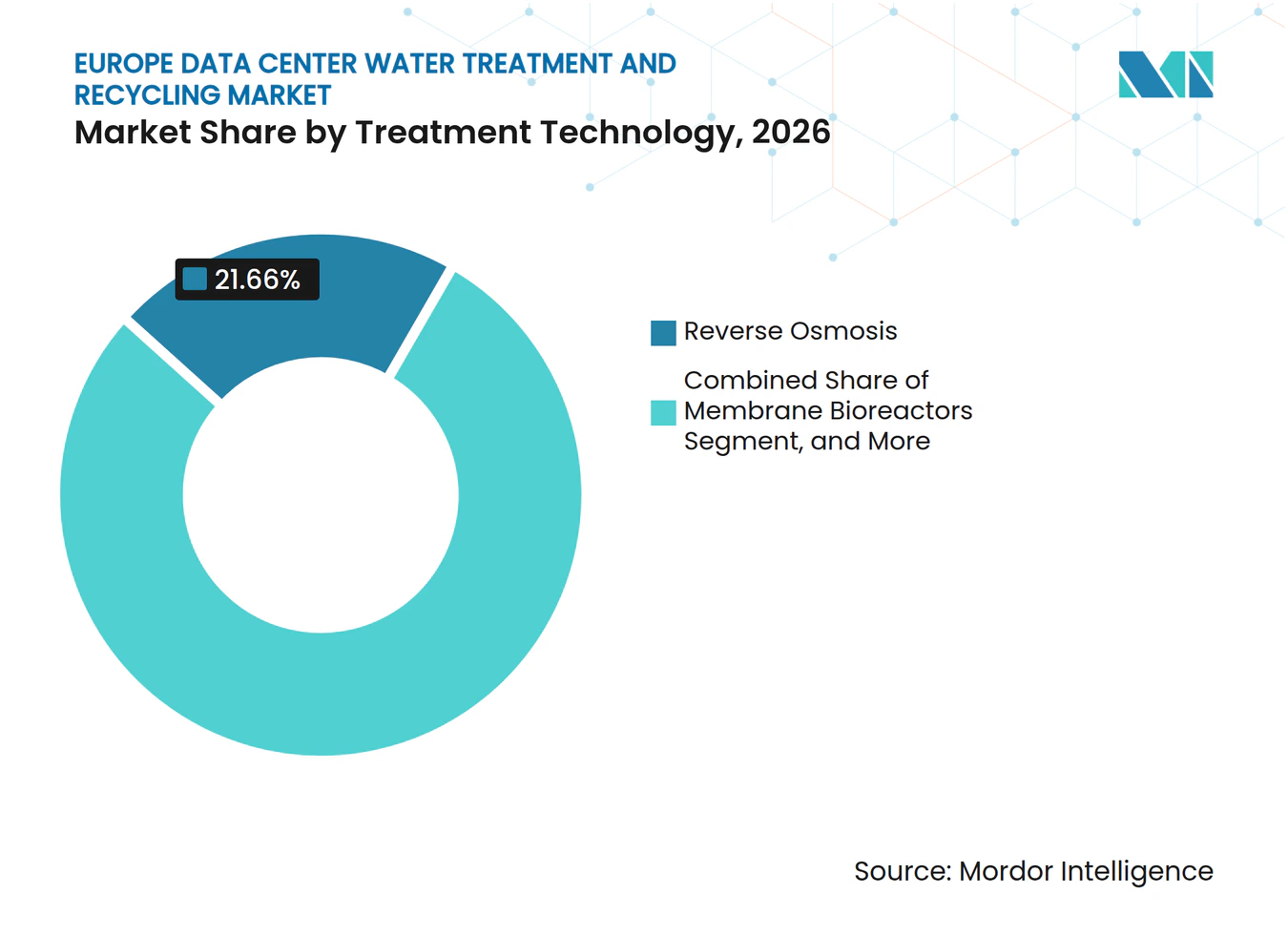
Membrane Bioreactors Gain Importance in Reclaimed-Water SystemsReverse osmosis held 21.66% of the Europe data center water treatment and recycling market share in 2026. It remains a familiar choice for producing low-conductivity and low-silica make-up water for cooling towers and chilled-water systems. Its installed base is supported by an established supply chain that includes Toray Industries, DuPont de Nemours, and Pentair. Operators also have experience with membrane cleaning, pretreatment, and reject-stream management. Membrane bioreactors are projected to expand at a 10.36% CAGR through 2032 because they can treat reclaimed municipal wastewater for reuse at sites where space is limited. Cerafiltec completed final module deliveries for the 49.2 million-liter-per-day ceramic membrane bioreactor installation at xAI's Colossus facility in October 2025. The project demonstrates that ceramic MBR technology can operate at a scale relevant to large computing facilities.
Filtration and ultrafiltration remain important pretreatment stages before reverse osmosis and membrane bioreactor trains. They remove solids and protect downstream membranes, which supports stable water quality and longer equipment life. Electrodeionization is gaining attention where direct-to-chip circuits require ultra-low conductivity water to limit corrosion risk. Ion exchange, softening, chemical treatment, and disinfection still serve legacy cooling-tower systems. These technologies are needed to control scale, corrosion, and microbial activity in operating facilities. Their use can become more targeted as closed-loop designs reduce blowdown and chemical discharge. The Europe data center water treatment and recycling industry is therefore likely to retain a broad technology mix instead of relying on one treatment route.



By Water Source:
Reclaimed Municipal Wastewater Gains Ground Under Water ConstraintsMunicipal water accounted for 41.89% of the Europe data center water treatment and recycling market in 2026. It remains important because operators value its dependable delivery, consistent quality, and established connections. Reclaimed municipal wastewater is projected to expand at a 10.73% CAGR through 2032. Its adoption is linked to the need to reduce potable-water use and document progress under sustainability reporting requirements. The EU Water Resilience Strategy places water efficiency and reuse within a broader approach to water security. This policy direction makes reclaimed water more relevant, where municipalities can offer a suitable source and dependable quality. It also favors treatment systems that can handle changes in incoming water conditions.
Groundwater and surface water remain subject to abstraction controls, particularly in catchments that face seasonal water stress. The Water Framework Directive provides the wider EU framework for protecting water bodies and managing water resources. Industrial recycled water can offer another non-potable supply option for appropriate sites. Seawater can be relevant at coastal campuses when the cooling system and materials are designed for that source. The Start Campus project in Sines illustrates a coastal design that uses seawater in a dual-loop cooling configuration. Alternative sources require dedicated treatment, storage, monitoring, and discharge planning. Their role will depend on local infrastructure as much as on the performance of the treatment technology.
By Treatment Application:
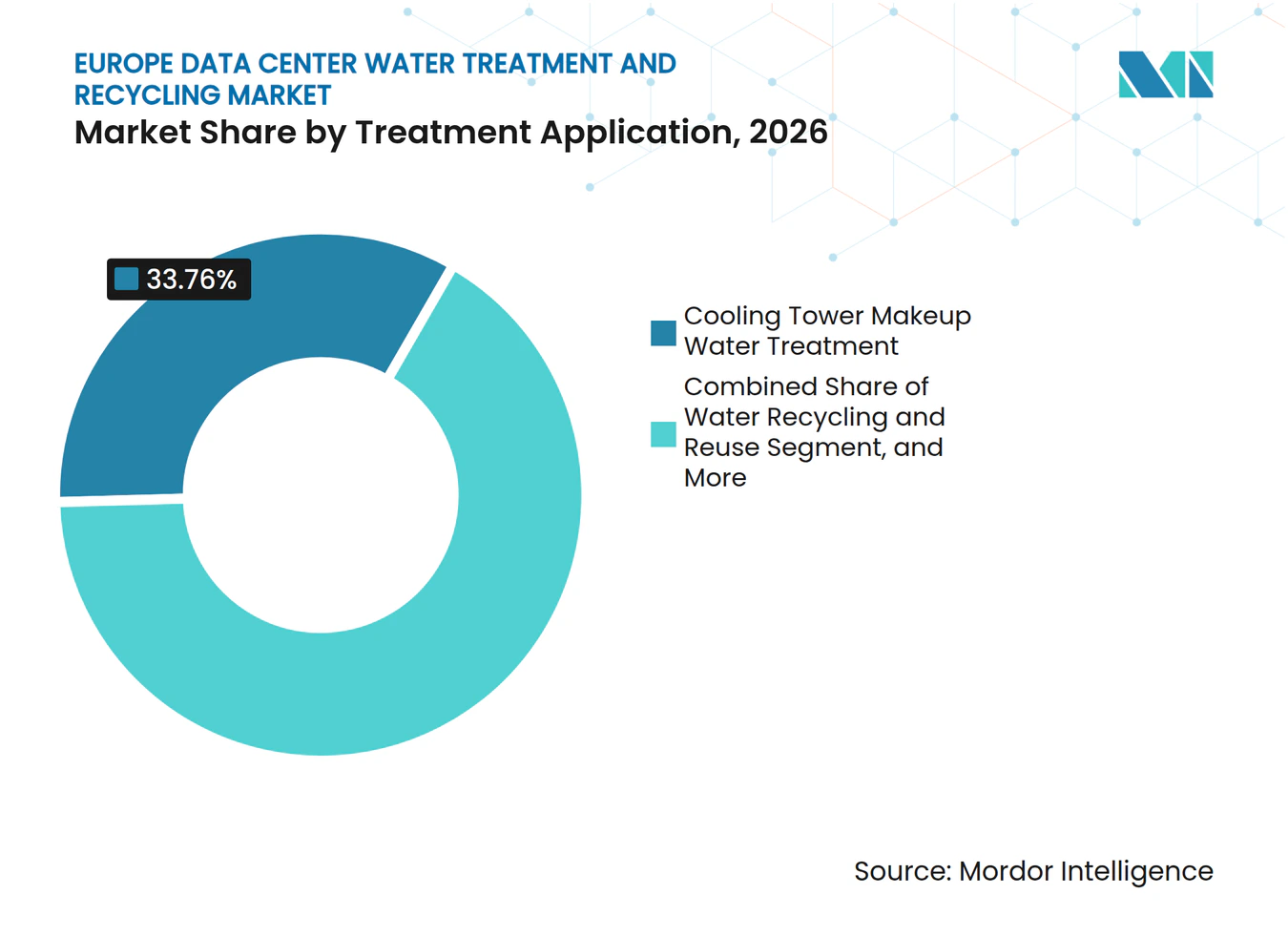
Recycling and Reuse Moves Ahead in Growth PriorityCooling tower makeup water treatment accounted for 33.76% of the Europe data center water treatment and recycling market size in 2026. It remains the base application because evaporative cooling is widely used across the operating data center estate. Treatment is needed to control scale, corrosion, and biological growth in cooling circuits. Water recycling and reuse are projected to expand at a 10.62% CAGR through 2032. This reflects interest in closed-loop designs and systems that reduce dependence on municipal supply. The Climate Neutral Data Centre Pact includes water efficiency commitments for participating operators, including a water-use effectiveness target for new facilities in water-stressed areas. This has made reuse design more relevant to both sustainability targets and site approvals.
Zero liquid discharge and concentrate management are becoming more relevant within reuse projects. These systems aim to recover more water on site and reduce liquid waste, but they require careful integration with energy, solids handling, and permitting. Gradiant's HyperSolved platform was presented as an integrated approach that combines treatment, reuse, and digital operations for data centers. Chilled-water and closed-loop treatment are also gaining importance as liquid cooling becomes more common. Boiler feedwater treatment remains a specific requirement in facilities that use steam or related thermal systems. Wastewater treatment continues to be driven by discharge permits and local water-quality rules. These applications are creating more demand for systems that can operate with plant controls and provide clear operating records.

By Solution Type:
Monitoring Systems Gain a Larger Role in ComplianceWater treatment equipment held 37.11% of the Europe data center water treatment and recycling market in 2026. New hyperscale campuses require physical treatment assets, including filtration, reverse osmosis, tanks, pumps, chemical dosing equipment, and reuse trains. This equipment demand is strongest where operators are building dedicated water infrastructure instead of relying only on utility supply. Water quality monitoring and control systems are projected to expand at a 10.88% CAGR through 2032. The increase reflects the need to document water-use effectiveness and maintain stable water conditions in more complex cooling systems. Ecolab's 3D TRASAR platform monitors glycol concentration, pH, turbidity, and flow in direct-to-chip cooling circuits. The product shows how digital monitoring is being positioned alongside chemical and equipment services.
Water treatment chemicals remain a recurring revenue stream for cooling towers and closed-loop circuits. Operators need scale and corrosion inhibitors, biocides, and closed-loop formulations that fit their water chemistry and operating conditions. Legionella prevention also requires disciplined monitoring and water management, particularly where open cooling systems are used. Treatment plant design and engineering services are expanding with greenfield construction. Operation and maintenance services can gain importance when owners seek a single provider for water performance and reporting. Water-as-a-Service models can move supplier responsibility beyond equipment availability toward delivered water quality and operational outcomes. This supports closer integration with building management systems and sustainability reporting processes.
By Data Center Size:
Mega Campuses Hold the Largest Value PoolMega data center campuses of 100 MW and above held 45.28% of the Europe data center water treatment and recycling market share in 2026 and are projected to expand at a 10.49% CAGR through 2032. Their position reflects the large treatment systems needed at high-density AI facilities. The UK Government report states that a 100 MW data center can use 2.5 billion liters of water annually. Such facilities can require multi-train treatment units, reclaimed-water agreements, and dedicated monitoring. Large operators also have more capacity to negotiate utility partnerships and finance specialized reuse infrastructure. This can concentrate advanced treatment investment among the biggest campuses. It also makes water availability a strategic part of large-scale development.
Large data centers in the 20 MW to 49 MW range form the next important group. They serve established colocation and regional cloud demand, often in mature urban clusters. Massive facilities in the 50 MW to 99 MW range can require substantial treatment infrastructure, although their project scale is lower than that of mega campuses. Medium-sized data centers in the 5 MW to 19 MW range often use more standard softening or reverse osmosis configurations. Small sites below 5 MW and edge locations may use air-cooled or hybrid designs with a lower individual water-treatment need. Their combined presence still creates demand across many locations. The segment structure means suppliers need both large engineered projects and repeatable smaller-scale packages.
By Data Center Type:
Cloud Providers Set the Pace for Water ManagementCloud service provider data centers accounted for 41.67% of the Europe data center water treatment and recycling market in 2026 and are expected to expand at a 10.64% CAGR through 2032. Hyperscalers are converting long-term water commitments into treatment, monitoring, and reuse requirements at European campuses. Microsoft described its approach to reducing water intensity while it expands data center capacity, including designs intended to reduce water use. Large cloud providers are also likely to influence supplier requirements because their water reporting and technical standards can become benchmarks for other operators. These companies can support investment in testing new cooling and reuse approaches. Their procurement scale favors providers that can combine equipment, chemistry, monitoring, and operations. This dynamic is reinforcing demand for full-cycle water management services.
Colocation providers remain a significant part of the addressable base because they serve multiple enterprise customers. Tenant sustainability requirements can move through the contract chain and shape operator budgets for water efficiency. Enterprise data centers are declining as a share of demand as companies consolidate computing workloads into cloud and colocation facilities. Edge data centers are increasing in site count, but their treatment needs remain limited when they rely on air-cooled or hybrid systems. The Europe data center water treatment and recycling industry must therefore serve a range of operating models. Providers need flexible systems for large cloud campuses and standard packages for smaller distributed sites. The service opportunity is strongest when equipment can support both reliable operations and visible compliance reporting.
Geography Analysis
United Kingdom
The United Kingdom held 20.74% of the Europe data center water treatment and recycling market in 2026. The London-Slough-Reading corridor and the Didcot-Oxfordshire AI growth zone support demand for specialized treatment and monitoring systems. A techUK and Environment Agency survey published in August 2025 found that 51% of 73 commercial data centers in England used waterless cooling, while 89% measured water use or ran systems with no external water intake. The figures show that water management practices are already well developed in part of the UK operating base. The United Kingdom designated data centers as Critical National Infrastructure in 2024, which supports a stable setting for longer-term capacity investment. Southern England nevertheless faces water-stress considerations that strengthen the case for waterless cooling, reuse, and more detailed site planning. Gradiant's Didcot contract and Veolia's work with large technology customers reflect the demand for full-service water solutions. The combination of mature capacity, regulation, and water constraints favors suppliers that can validate performance and support local compliance.
Germany, France, Ireland, Netherlands, Nordics, Italy, and Poland
Germany is the second-largest national opportunity, with demand centered on the Frankfurt cluster and reinforced by annual water-use effectiveness reporting under the Energieeffizienzgesetz. Hessen issued data center siting guidance in September 2025 that recommends municipal measures to prevent potable water use for cooling at new sites. This is an important regulatory influence because it increases the relevance of reclaimed and alternative water infrastructure in future developments. France has the DataOne project in Grenoble, where DCX was selected to provide water systems and technology cooling loops. Ireland and the Netherlands face restrictions in constrained locations, which may move activity toward expansions that require more difficult retrofit work. Nordic locations benefit from cooler climates that can reduce evaporative cooling demand, although large AI campuses still need appropriate make-up water treatment. Italy and Poland support developing southern and eastern corridors, with Warsaw adding cloud capacity. Across this group, national reporting rules, local water conditions, and utility capacity determine the choice between municipal supply, reuse, and lower-water cooling designs.
Spain, Portugal, Greece, and Southern Europe
Spain is projected to expand at a 10.58% CAGR through 2032 in the Europe data center water treatment and recycling market. Investment by Amazon, Microsoft, Meta, and Google across Madrid, Barcelona, Aragon, and Andalusia is increasing the need for water management infrastructure. The Spanish policy focuses on transparency, energy efficiency, and water use, giving monitoring systems a more prominent role in project planning. Water pressure also makes alternative-source systems central to operating resilience rather than an optional environmental measure. The European Commission's water strategy supports actions to improve efficiency and reuse in regions that face water-security challenges. Portugal provides a practical example through the Sines campus, where a seawater dual-loop cooling system was designed to avoid potable cooling water. Greece and other southern European locations share similar pressures, although local infrastructure will determine whether reclaimed municipal water, industrial effluent, or seawater is workable. Coastal sites can be well placed to assess seawater cooling, while inland campuses may place more value on high-recovery reclamation. These conditions create an opportunity for suppliers that can link water treatment with local permitting and long-term operating controls.
Competitive Landscape
Market Concentration
Veolia, Ecolab, Xylem, and SUEZ have broad capabilities across treatment equipment, chemicals, monitoring, and operations in the Europe data center water treatment and recycling market. This gives the leading groups an advantage when large operators prefer a single supplier for several parts of the water system. Veolia launched Data Center Resource 360 in April 2026, combining water management, local energy, and hazardous-waste treatment in one offer. Ecolab expanded its position in liquid cooling through its 3D TRASAR Technology for Direct-to-Chip Liquid Cooling. These moves show a shift toward performance-based offerings that cover water quality, monitoring, and compliance support. Kurita Water Industries, Kemira, and Solenis remain relevant in cooling-water chemistry and closed-loop inhibitor programs. Toray Industries, DuPont de Nemours, and Pentair are important in membranes, filtration, and reverse osmosis equipment.
The Europe data center water treatment and recycling market also includes specialists focused on complex reuse and low-discharge applications. Gradiant has positioned HyperSolved as an integrated platform for sourcing, treatment, chemistry, reuse, and discharge management. KMX Technologies focuses on high-recovery blowdown treatment, while Hydroleap uses electrochemical treatment to reduce chemical use and discharge volumes. These companies address opportunities where standard equipment packages do not provide enough water recovery or operational control. Reclaimed municipal wastewater, industrial effluent, and seawater require site-specific treatment designs. That complexity can support longer performance contracts and make technical service more important than the initial equipment sale. Suppliers that can prove reliable water quality over time are better placed to compete for these projects.
Procurement is also being shaped by water-use effectiveness reporting, digital data quality, and qualification through sector initiatives. The Climate Neutral Data Centre Pact gives participating companies a framework for improving water and energy performance. Providers need to work with building management systems and sustainability teams as well as facility engineers. This can raise switching costs for monitoring and Water-as-a-Service contracts once a supplier is embedded in daily operations. Product innovation is moving toward compact treatment skids, real-time quality sensors, closed-loop cooling support, and reuse packages. Community and permitting pressures can strengthen the commercial value of systems that reduce freshwater withdrawal. The competitive field is therefore moderately consolidated among broad-service leaders, while specialized firms can compete where reuse, zero liquid discharge, or advanced chemistry is essential.
Europe Data Center Water Treatment and Recycling Industry Leaders
-
Veolia Environnement S.A.
-
Ecolab Inc.
-
Xylem Inc.
-
SUEZ
-
Aquatech International LLC
- *Disclaimer: Major Players sorted in no particular order
Europe Data Center Water Treatment and Recycling Market Companies Covered in this Report
- Veolia Environnement S.A.
- Ecolab Inc.
- Xylem Inc.
- SUEZ
- Aquatech International LLC
- Kurita Water Industries Ltd.
- Solenis LLC
- DuPont de Nemours, Inc.
- Pentair plc
- Toray Industries, Inc.
- BWT Holding GmbH
- Alfa Laval AB
- Gradiant Corporation
- Ovivo Inc.
- Lenntech B.V.
- IDE Technologies
- ProMinent GmbH
- Kemira Oyj
- Whitewater Group
- EPS Group
- Industrie De Nora S.p.A.
- KMX Technologies
- Hydroleap Pte. Ltd.
- Ramboll Group A/S
Recent Industry Developments in Europe Data Center Water Treatment and Recycling Market
- July 2026: Veolia Water Technologies announced EUR 343 million (USD 377 million) in microelectronics-sector bookings since the beginning of 2026, including contracts for ultrapure-water production in Singapore and advanced wastewater reclamation to zero liquid discharge standards at a United States campus, confirming full-cycle water-treatment capabilities transferable to hyperscale data center applications.
- April 2026: Veolia launched its Data Center Resource 360 offering and publicly targeted more than EUR 1 billion (USD 1.10 billion) in annual revenue from data center and semiconductor manufacturing customers by 2030, covering water management, local energy, and hazardous-waste treatment in one integrated contract.
- April 2026: Veolia partnered with Amazon to develop reclaimed-water solutions for data center cooling operations, combining water-treatment expertise with AI-enabled optimization to advance water reuse and closed-loop cooling at hyperscale facilities.
- March 2026: Alfa Laval launched FreeWaterLoop at Data Centre World London on March 4. The integrated cooling system combines pumps, heat exchangers and filtration, using natural water sources to support efficient heat transfer while minimizing net water consumption and returning water to its source. It is relevant to European data centers transitioning toward high-density liquid cooling.
Europe Data Center Water Treatment and Recycling Market Report Scope
The Europe Data Center Water Treatment and Recycling Market refers to the regional market for technologies, equipment, chemicals, and services used to treat, condition, and recycle water within data centers across Europe, primarily for cooling systems, liquid-cooling loops, and wastewater management.
The Europe Data Center Water Treatment and Recycling Market Report is Segmented by Treatment Technology (Filtration and Ultrafiltration, Reverse Osmosis, Ion Exchange and Water Softening, Electrodeionization, Chemical Treatment and Disinfection, Membrane Bioreactors, and Other Water Treatment Technologies), Water Source (Municipal Water, Groundwater, Surface Water, Reclaimed Municipal Wastewater, Industrial Recycled Water, and Other Alternative Water Sources), Treatment Application (Cooling Tower Makeup Water Treatment, Chilled Water and Closed-Loop Water Treatment, Boiler Feedwater and Heat Rejection System Water Treatment, Wastewater Treatment, Water Recycling and Reuse, and Zero Liquid Discharge and Concentrate Management), Solution Type (Water Treatment Equipment, Water Treatment Chemicals, Water Quality Monitoring and Control Systems, Treatment Plant Design and Engineering, and Operation and Maintenance Services), Data Center Size (Small Data Centers, Below 5 MW; Medium-Sized Data Centers, 5-19 MW; Large Data Centers, 20-49 MW; Massive Data Centers, 50-99 MW; and Mega Data Center Campuses, 100 MW and Above), Data Center Type (Colocation Data Centers, Cloud Service Provider Data Centers, Enterprise Data Centers, and Edge Data Centers), and Geography (United Kingdom, Germany, France, Netherlands, Ireland, Spain, Italy, Nordics, and Rest of Europe). The Market Forecasts Are Provided in Terms of Value (USD).
Segmentation Overview
| Filtration and Ultrafiltration |
| Reverse Osmosis |
| Ion Exchange and Water Softening |
| Electrodeionization |
| Chemical Treatment and Disinfection |
| Membrane Bioreactors |
| Other Water Treatment Technologies |
| Municipal Water |
| Groundwater |
| Surface Water |
| Reclaimed Municipal Wastewater |
| Industrial Recycled Water |
| Other Alternative Water Sources |
| Cooling Tower Makeup Water Treatment |
| Chilled Water and Closed-Loop Water Treatment |
| Boiler Feedwater and Heat Rejection System Water Treatment |
| Wastewater Treatment |
| Water Recycling and Reuse |
| Zero Liquid Discharge and Concentrate Management |
| Water Treatment Equipment |
| Water Treatment Chemicals |
| Water Quality Monitoring and Control Systems |
| Treatment Plant Design and Engineering |
| Operation and Maintenance Services |
| Small Data Centers, Below 5 MW |
| Medium-Sized Data Centers, 5-19 MW |
| Large Data Centers, 20-49 MW |
| Massive Data Centers, 50-99 MW |
| Mega Data Center Campuses, 100 MW and Above |
| Colocation Data Centers |
| Cloud Service Provider Data Centers |
| Enterprise Data Centers |
| Edge Data Centers |
| United Kingdom |
| Germany |
| France |
| Netherlands |
| Ireland |
| Spain |
| Italy |
| Nordics |
| Rest of Europe |
| By Treatment Technology | Filtration and Ultrafiltration |
| Reverse Osmosis | |
| Ion Exchange and Water Softening | |
| Electrodeionization | |
| Chemical Treatment and Disinfection | |
| Membrane Bioreactors | |
| Other Water Treatment Technologies | |
| By Water Source | Municipal Water |
| Groundwater | |
| Surface Water | |
| Reclaimed Municipal Wastewater | |
| Industrial Recycled Water | |
| Other Alternative Water Sources | |
| By Treatment Application | Cooling Tower Makeup Water Treatment |
| Chilled Water and Closed-Loop Water Treatment | |
| Boiler Feedwater and Heat Rejection System Water Treatment | |
| Wastewater Treatment | |
| Water Recycling and Reuse | |
| Zero Liquid Discharge and Concentrate Management | |
| By Solution Type | Water Treatment Equipment |
| Water Treatment Chemicals | |
| Water Quality Monitoring and Control Systems | |
| Treatment Plant Design and Engineering | |
| Operation and Maintenance Services | |
| By Data Center Size | Small Data Centers, Below 5 MW |
| Medium-Sized Data Centers, 5-19 MW | |
| Large Data Centers, 20-49 MW | |
| Massive Data Centers, 50-99 MW | |
| Mega Data Center Campuses, 100 MW and Above | |
| By Data Center Type | Colocation Data Centers |
| Cloud Service Provider Data Centers | |
| Enterprise Data Centers | |
| Edge Data Centers | |
| By Geography | United Kingdom |
| Germany | |
| France | |
| Netherlands | |
| Ireland | |
| Spain | |
| Italy | |
| Nordics | |
| Rest of Europe |
Key Questions Answered in the Report
What is the Europe data center water treatment and recycling market size?
The Europe data center water treatment and recycling market is projected to move from USD 0.93 billion in 2026 and USD 1.01 billion in 2027 to USD 1.64 billion by 2032, at a 10.18% CAGR.
What is driving demand for water treatment in European data centers?
Larger AI facilities, liquid cooling, water-use reporting, and pressure to reduce freshwater withdrawals are supporting demand for treatment, reuse, and monitoring systems.
Which treatment technology is expanding fastest in European data centers?
Membrane bioreactors are projected to expand at a 10.36% CAGR through 2032, supported by their role in treating reclaimed municipal wastewater for reuse.
Why are reclaimed water systems becoming more important for data centers?
Reclaimed water can reduce potable-water demand, support resilience planning, and help operators respond to water-efficiency expectations and local permitting pressure.
Which European country is expected to expand fastest through 2032?
Spain is projected to expand at a 10.58% CAGR through 2032, as hyperscale investment and water constraints increase demand for monitoring and alternative-source infrastructure.