
Europe Data Center Transformer Market Size and Share
Market Overview
| Study Period | 2021 - 2032 |
|---|---|
| Forecast Data Period | 2027 - 2032 |
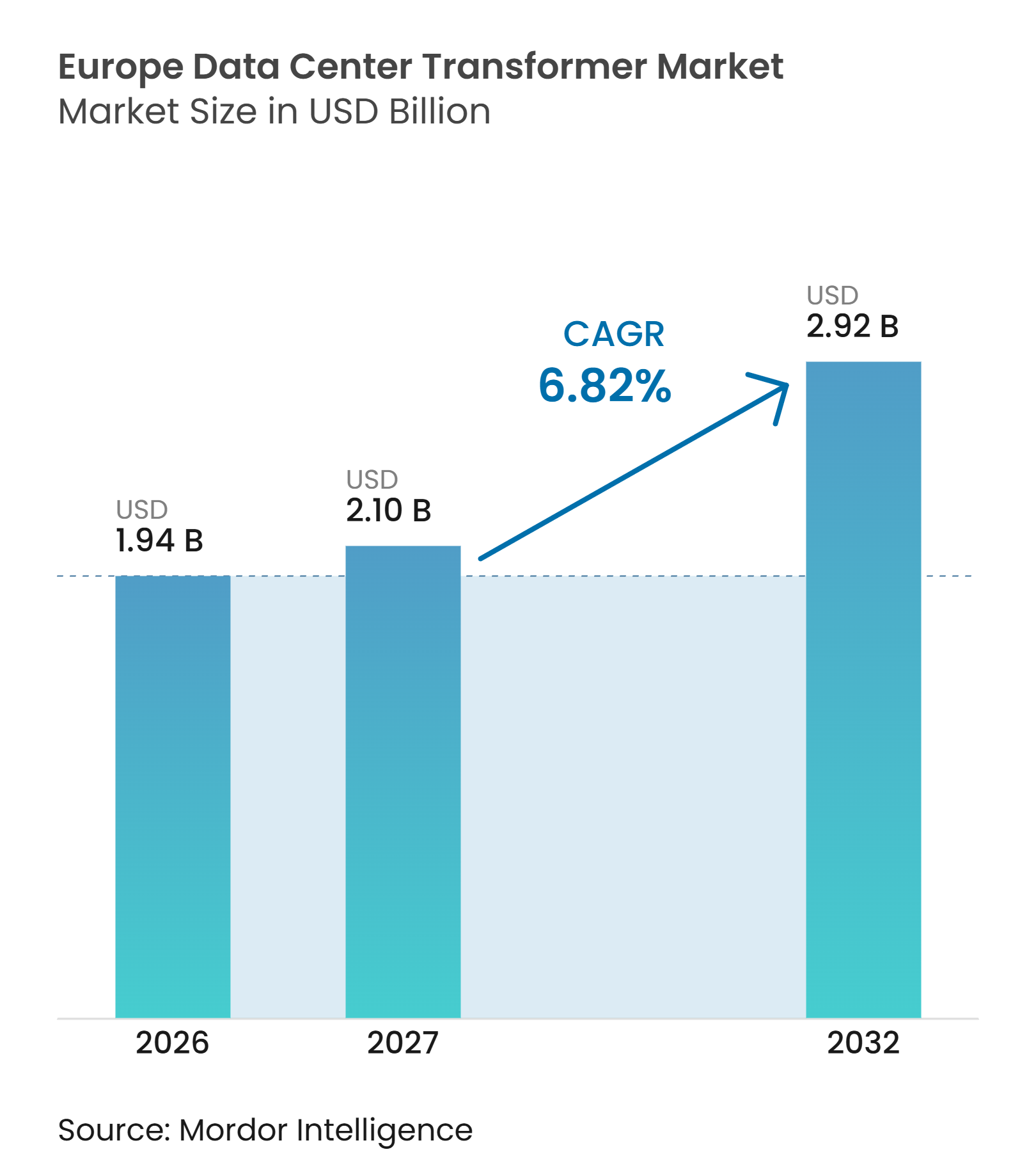
| Base Year Market Size (2026) | USD 1.94 Billion |
| Market Size (2027) | USD 2.10 Billion |
| Market Size (2032) | USD 2.92 Billion |
| Growth Rate (2027 - 2032) | 6.82 % |
| Market Concentration | Medium |
Major Players *Disclaimer: Major Players sorted in no particular order Image © Mordor Intelligence. Reuse requires attribution under CC BY 4.0. | |
Europe Data Center Transformer Market Analysis by Mordor Intelligence
The Europe data center transformer market size is projected to expand from USD 1.94 billion in 2026 and USD 2.10 billion in 2027 to USD 2.92 billion by 2032, registering a CAGR of 6.82% between 2027 to 2032. European data center electricity demand is expected to exceed 134 TWh by 2030, compared with 87 TWh in 2024, which raises the need for grid intake equipment, internal distribution units, redundancy arrangements, and more carefully planned utility connections across the Europe data center transformer market, from the first high-voltage interface through the final low-voltage step-down stage. The European Commission’s AI Continent Action Plan supports a major increase in regional data center capacity, creating longer procurement pipelines as developers must secure electrical equipment, factory slots, utility approvals, land access, construction sequencing, and site-specific substation designs before construction begins. Demand is shifting toward larger campuses, where higher rack densities require larger transformer ratings, greater fault tolerance, and more complex power designs than conventional enterprise facilities, while the Europe data center transformer market also continues to serve smaller sites through standardized distribution equipment that can be supplied and installed more quickly. Grid constraints and long equipment lead times are moving some projects from established hubs to Spain, Italy, and the Nordic countries, where project sequencing, utility access, renewable-power availability, and equipment selection can differ by location, campus scale, and the local transmission network. This geographic shift adds procurement locations, distinct utility interfaces, locally tailored transformer requirements, and opportunities for regional suppliers rather than removing demand from primary hubs, which broadens the project base for the Europe data center transformer market and makes delivery timing a central competitive consideration.
Key Report Takeaways
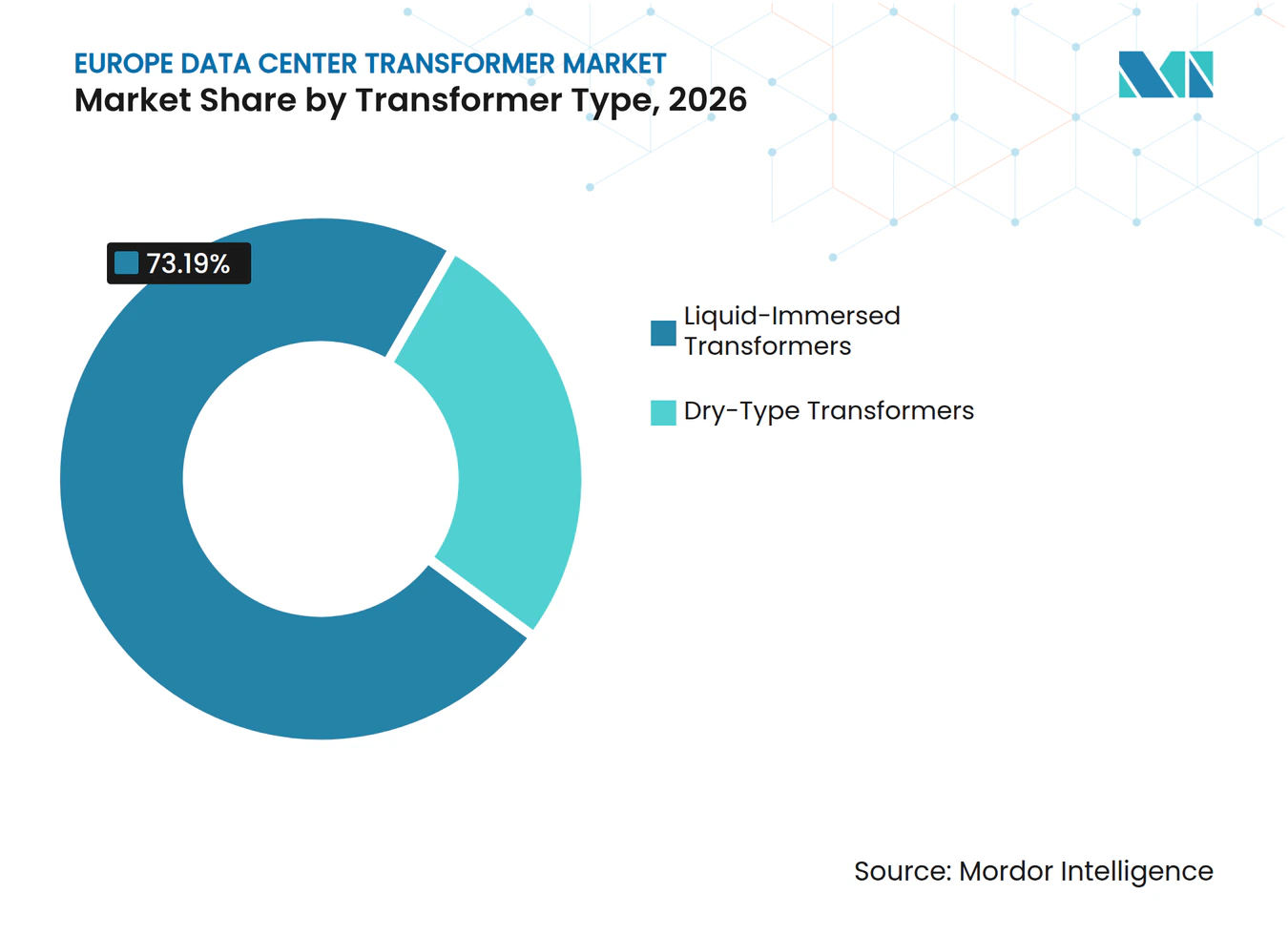
- By transformer type, liquid-immersed transformers held 73.19% of the Europe data center transformer market share in 2026, while dry-type transformers are projected to expand at a 7.68% CAGR through 2032.
- By power rating, the above 10 MVA to 30 MVA category held 38.51% share in 2026, while above 30 MVA units are projected to expand at a 7.51% CAGR through 2032.
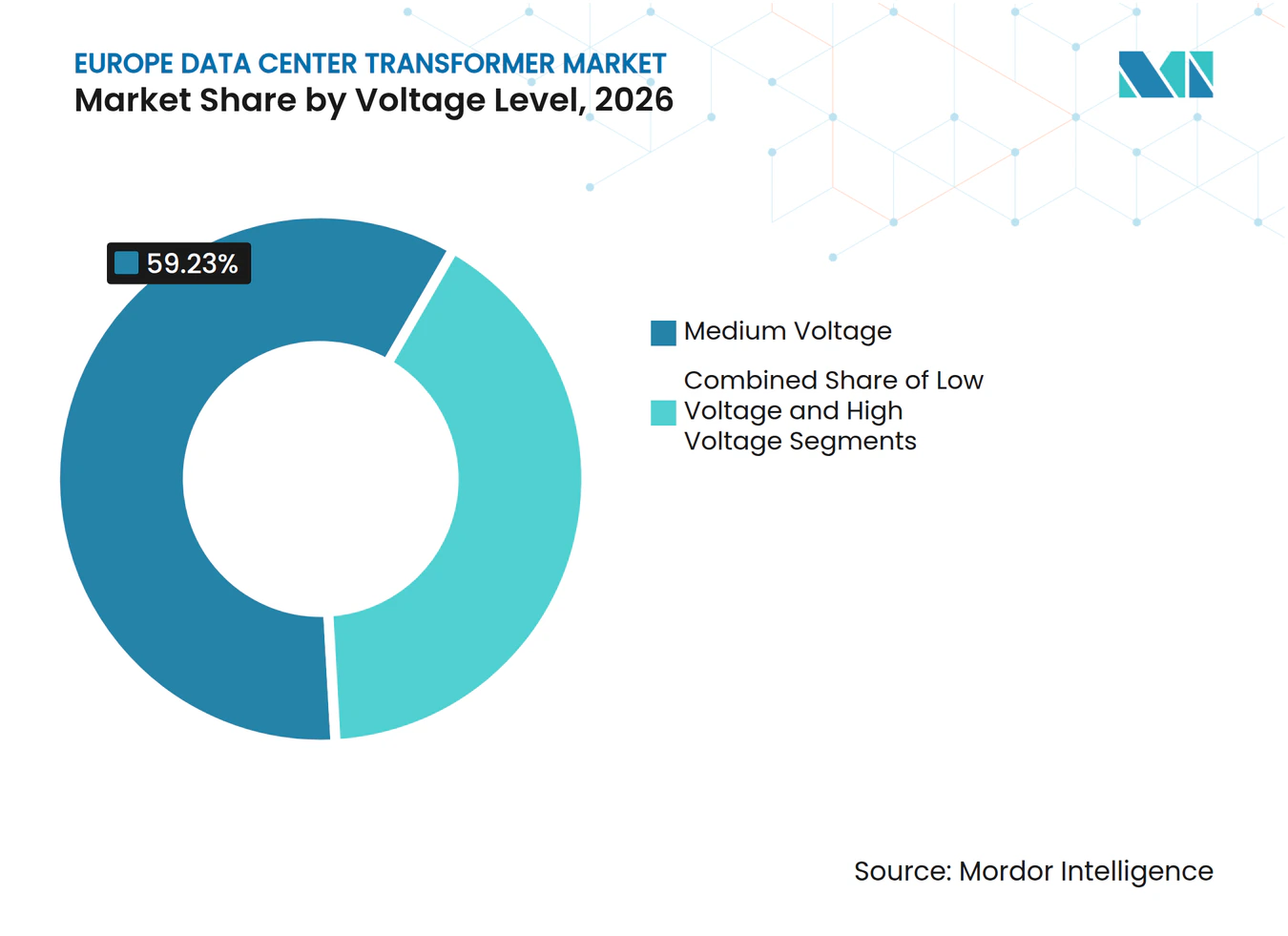
- By voltage level, medium-voltage transformers held 59.23% of the Europe data center transformer market share in 2026, while high-voltage transformers are projected to expand at a 7.76% CAGR through 2032.
- By installation, outdoor systems held 64.33% share in 2026, while indoor systems are projected to expand at a 7.46% CAGR through 2032.
- By data center size, hyperscale facilities held 38.47% of the Europe data center transformer market share in 2026 and are projected to expand at a 7.98% CAGR through 2032.
- By data center type, cloud service providers held 47.12% share in 2026 and are projected to expand at an 8.11% CAGR through 2032.
- By geography, Germany held 24.71% of the Europe data center transformer market share in 2026, while the United Kingdom is projected to expand at an 8.22% CAGR through 2032.
Note: Market numbers in this report are based on Mordor Intelligence's proprietary estimation framework, which combines nine months of actuals with Q4 projections for base year 2026.
Market Trends and Insights
Drivers Impact Analysis of Europe Data Center Transformer Market*
| Driver | (~) % Impact on CAGR Forecast | Geographic Relevance | Impact Timeline |
|---|---|---|---|
| Expansion of Hyperscale and Colocation Data Centers | +2.0% | Global, concentrated in Germany, United Kingdom, France, and Nordic countries | Medium term (2-4 years) |
| Rising AI-Driven Power Density and High-Capacity Campus Loads | +1.5% | FLAP-D markets and emerging United Kingdom, Spanish, and Italian hubs | Medium term (2-4 years) |
| EU Transformer Efficiency Upgrades and Ecodesign Compliance | +1.0% | EU27, with early adoption in Germany, France, and Benelux | Short term (≤ 2 years) |
| Renewable Power Integration and Electrification of Data Center Campuses | +0.8% | Nordic countries, Iberian Peninsula, and Central Europe | Long term (≥ 4 years) |
| Digital Monitoring and Predictive Maintenance Adoption | +0.5% | Broad EU, with highest uptake in German and United Kingdom hyperscale campuses | Medium term (2-4 years) |
| Shorter Energization Pathways Through Modular Substations | +0.3% | United Kingdom, Ireland, and grid-constrained urban FLAP-D nodes | Short term (≤ 2 years) |
| Source: Mordor Intelligence | |||
Expansion of Hyperscale and Colocation Data Centers
Hyperscale campuses are changing power designs because each site needs more transformer capacity and higher equipment ratings. European data center electricity demand is expected to exceed 134 TWh by 2030, which supports sustained demand for intake and distribution equipment. The EU policy agenda seeks to expand regional data center capacity, extending the need for equipment across several national markets. Grid congestion in major hubs is redirecting projects rather than stopping development. Italy recorded 42 GW of data center connection requests by the end of March 2025, compared with 30 GW at the end of 2024. Countries with shorter connection timelines can attract more facilities, and each new facility requires its own step-down equipment hierarchy.
Rising AI-Driven Power Density and High-Capacity Campus Loads
AI computing increases the capacity required from transformers because modern training racks can exceed 100 kW. Conventional cloud racks typically operated at 5 kW to 10 kW, creating a significant difference in site power design. Larger AI campuses, therefore, require higher-rated intake units and stronger internal distribution systems. Research on a 1.6 MW power block found that an 800 V DC arrangement could save 364.7 MWh annually compared with a 400 V AC design. Conventional medium-voltage isolation transformers remain necessary during the transition to these architectures. The Europe data center transformer market therefore retains demand across both established AC systems and emerging DC-oriented designs.
EU Transformer Efficiency Upgrades and Ecodesign Compliance
EU transformer rules require Tier 2 loss limits for new products placed on the European market. The framework was amended by Regulation EU 2019/1783 and has applied to relevant new transformers since July 2021. Operators with older fleets face a stronger reason to replace equipment that has higher operating losses. European requirements for power transformers are further covered by EN 50708-1-1:2023. The F-Gas Regulation also restricts new medium-voltage switchgear using SF₆ up to 24 kV from January 2026. Combined substation redesigns can bring forward purchases of transformers and associated switchgear.
Renewable Power Integration and Electrification of Data Center Campuses
Data centers using direct renewable procurement need transformer designs that can manage variable generation and power-quality requirements. This often requires bidirectional capability and windings that can tolerate harmonics. Schneider Electric supported Start Campus in Portugal, a 1.2 GW AI campus designed to operate with renewable power, showing the demand for tailored electrical systems.[1] Research from HES-SO Geneva examined medium-voltage DC distribution with solid-state transformers for data centers pursuing continuous renewable supply. These projects broaden the product requirements facing suppliers in the Europe data center transformer market. They also create a long-term opportunity for suppliers developing conventional and solid-state equipment.
Restraints Impact Analysis of Europe Data Center Transformer Market*
| Restraint | (~) % Impact on CAGR Forecast | Geographic Relevance | Impact Timeline |
|---|---|---|---|
| Extended Transformer Lead Times and Manufacturing Capacity Constraints | -1.4% | Global, most acute in FLAP-D markets and the United Kingdom | Medium term (2-4 years) |
| Grid Connection Queues and Local Network Congestion | -1.1% | Germany, United Kingdom, Netherlands, and Ireland | Long term (≥ 4 years) |
| Electrical Steel, Copper, and Specialized Component Cost Volatility | -0.7% | Global supply chain, with European exposure through import dependency | Medium term (2-4 years) |
| Harmonic-Rich Loads and More Complex Power-Quality Requirements | -0.4% | Broad EU, with highest exposure in dense colocation facilities | Short term (≤ 2 years) |
| Source: Mordor Intelligence | |||
Extended Transformer Lead Times and Manufacturing Capacity Constraints
Manufacturing lead times are a material constraint on new European data center capacity. The IEA reported in 2025 that procurement for large power transformers can take up to 4 years, twice the 2021 baseline.[2] Medium-voltage distribution units below 3.15 MVA generally have shorter schedules than high-voltage units above 30 MVA. Large units can carry 36-60 month schedules at Tier 1 suppliers. Operators can gain more flexibility by using smaller distribution transformers in parallel rather than one very large intake unit. This design choice is shaping procurement and engineering decisions across the Europe data center transformer market.
Grid Connection Queues and Local Network Congestion
Grid queues limit the speed at which ordered equipment becomes operating capacity. The IEA found that 76% of European data center operators identified access to electricity as their largest challenge for the next 3 years. Connection queues in major European markets commonly run for 7-10 years. Germany’s EnEfG introduces a PUE threshold of 1.2 for new data centers from 2026 and a 50% renewable supply requirement from 2027. These requirements increase the importance of early grid and equipment planning. Developers are redirecting part of their project pipeline to Italy and Spain, where available grid capacity can support faster development.
*Our forecasts treat driver/restraint impacts as directional, not additive. The impact forecasts reflect baseline growth, mix effects, and variable interactions.
Europe Data Center Transformer Market Segment Analysis
By Transformer Type:
Liquid-Immersed Systems Lead While Dry-Type Systems Gain GroundLiquid-immersed transformers held 73.19% share in 2026, giving them the leading position in the transformer type category. Their position reflects lower cost at high-voltage intake substations, established thermal performance, and suitability for large outdoor campus installations that have adequate space for fenced electrical compounds. CHINT delivered 2 132/15 kV, 60 MVA oil-immersed units for ARUBA’s IT3 Global Cloud Data Center in Italy during November 2025, confirming the continued use of this configuration for large campus intake infrastructure. Operators also benefit from familiar maintenance practices and a broad base of experience with these units, particularly where high-capacity grid connections feed a new campus. These advantages keep liquid-filled equipment central to large developments even as indoor alternatives gain wider acceptance.
Dry-type transformers are projected to expand at a 7.68% CAGR through 2032, making them the fastest-moving transformer type. Their adoption is supported by indoor installation requirements, fire-safety considerations, and dense urban settings where oil containment can be difficult or where site space limits an outdoor compound. Cast-resin systems can place equipment closer to internal distribution loads and can be integrated with building-based power designs without handling flammable liquids. IEC 60076-11 provides the relevant fire-performance framework, while EU Ecodesign requirements apply across liquid-immersed and dry-type equipment. The contrast between outdoor intake demand and indoor safety needs means that both product types will remain necessary across European data center projects.


By Power Rating:
Larger Units Support AI Campus ExpansionThe above 10 MVA to 30 MVA band held 38.51% of the Europe data center transformer market size in 2026. It serves colocation facilities and mid-tier hyperscale campuses with grid connections in the 30 MW to 100 MW range, where designs commonly use 2-4 transformers at the intake substation. This rating range offers a balance between capacity, redundancy, site layout, and the ability to isolate a fault without affecting the entire facility. Using several units also helps operators stage capacity additions as customer loads rise and improve resilience during maintenance. The category remains important for projects that need significant power capacity without relying entirely on one bespoke ultra-large transformer.
Above 30 MVA units are projected to expand at a 7.51% CAGR through 2032. AI campuses and direct transmission connections are increasing demand for large bespoke equipment, particularly where operators want to consolidate intake capacity at a dedicated substation. Higher ratings can reduce the number of intake transformers required, but they make factory slots, transport planning, lead times, and site commissioning more consequential. IEC 60076-1 standards remain relevant for manufacturers producing these large power transformers for critical electrical applications. The segment favors suppliers with specialized factory tooling, engineering capability, and the ability to reserve production capacity well before a project reaches construction.
By Voltage Level:
Medium Voltage Remains Essential While High Voltage AdvancesMedium voltage held 59.23% share in 2026, making it the core link between intake substations, uninterruptible power systems, generators, and server-room distribution equipment. Networks at 11 kV and 33 kV remain common because they support efficient movement of electricity through a campus before the final step-down near computing loads. ABB’s work with Kevlinx Data Centers combines HiPerGuard medium-voltage UPS equipment and UniGear switchgear at a common voltage level, which reduces conversion stages across the power chain.[3] This arrangement illustrates why medium-voltage equipment remains important in both conventional and high-density data center designs. Its broad role in internal distribution gives the category a stable demand base across new facilities, upgrades, and capacity additions.
High-voltage transformers are projected to expand at a 7.76% CAGR through 2032. Gigawatt-scale operators are seeking direct connections at 110 kV, 132 kV, or 400 kV to avoid constrained local distribution networks and to establish a more scalable path for future capacity. These arrangements require dedicated interface transformers, utility coordination, and substantial substation engineering that extends beyond normal building power systems. Direct transmission access can improve control over future power availability, although it increases dependence on scarce high-voltage transformer manufacturing slots. Low-voltage transformers continue to serve final step-down requirements within server rooms and support replacement demand tied to efficiency compliance.


By Installation:
Outdoor Systems Dominate While Indoor Systems Respond to Urban NeedsOutdoor installations held 64.33% share in 2026. The Europe data center transformer market continues to use fenced compounds beside large campus buildings for oil-immersed intake equipment, particularly where land availability allows safe separation from the main facility. This layout provides room for thermal management, maintenance access, and larger transformer footprints while supporting conventional substation designs familiar to utilities and engineering contractors. Outdoor sites can also accommodate high-voltage equipment that would be difficult to place within a building envelope. The category is therefore especially relevant to large campuses developed beyond dense city centers or on purpose-built industrial land.
Indoor systems are projected to expand at a 7.46% CAGR through 2032. Urban campuses and edge facilities may lack practical space for outdoor switchyards, while building location and local planning conditions can favor electrical equipment within the site boundary. Dry-type transformer designs remove flammable fluids from the immediate building environment and can help operators address fire-performance requirements. Indoor deployment can shorten cable runs to critical loads and can support integration with modular UPS systems in space-constrained facilities. These characteristics support a larger role for indoor equipment in high-density city locations, even as outdoor sites remain the main installation format.
By Data Center Size:
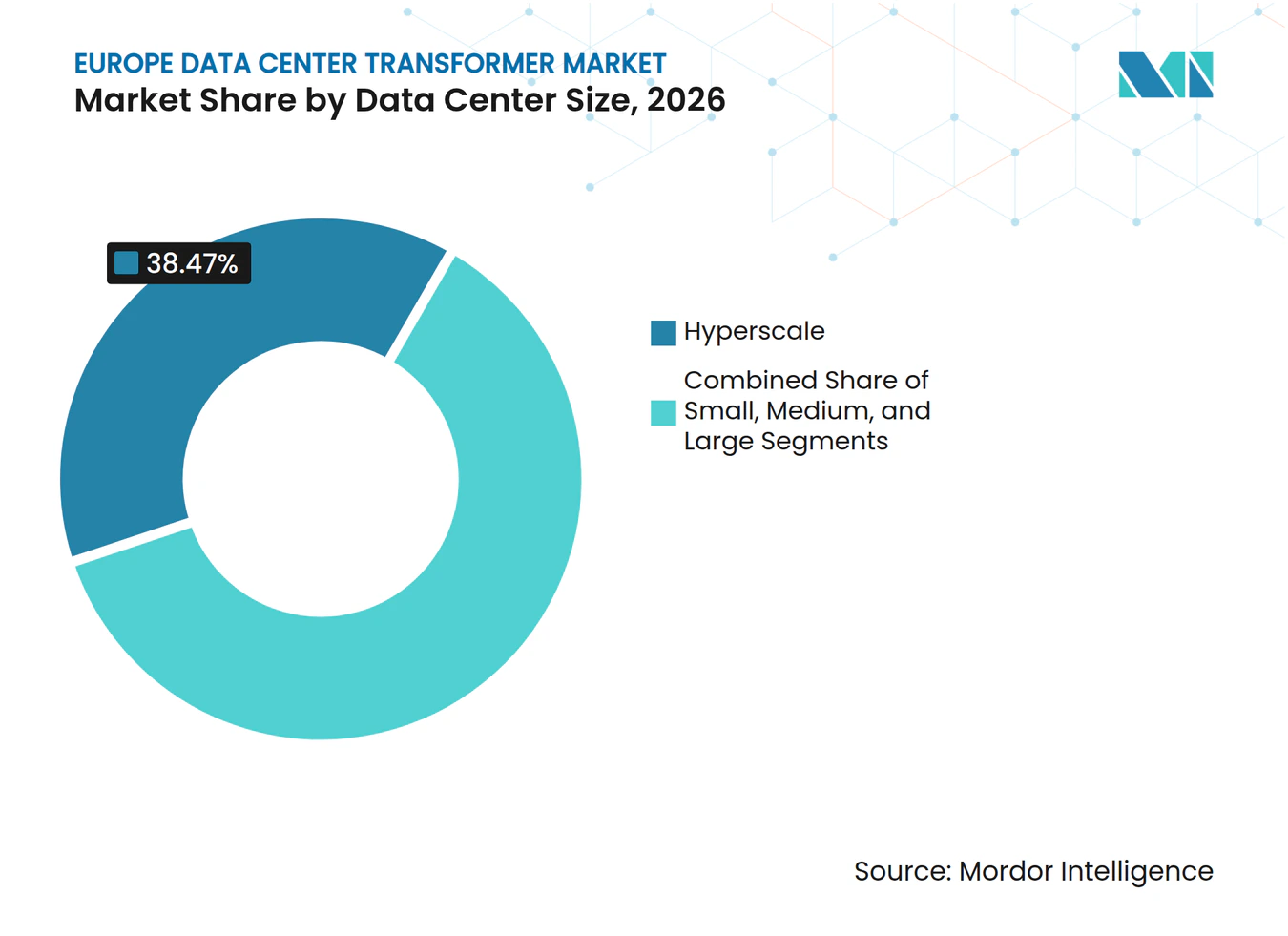
Hyperscale Facilities Lead in Share and Projected ExpansionHyperscale facilities held 38.47% share in 2026, concentrating transformer demand in a relatively small number of high-value projects. A 100 MW campus can require multiple large intake transformers and a broad fleet of distribution units, with redundancy built into the power design to meet availability requirements. This concentration means that a single project can generate multiyear procurement needs across several transformer ratings and installation points. The Europe data center transformer market, therefore, derives substantial value from the specification, timing, and expansion decisions of hyperscale operators. Suppliers able to meet demanding technical standards and delivery schedules can secure substantial orders, while smaller suppliers can participate in distribution-level packages.
Hyperscale facilities are projected to expand at a 7.98% CAGR through 2032. AI investment is concentrating demand in campuses that can support very high computing loads, dynamic power profiles, and strict uptime requirements. Manufacturers are responding with designs intended to handle high switching frequency and changing load conditions without compromising reliability. Large data centers retain demand through colocation expansion and regular equipment refresh cycles that maintain transformer procurement after initial construction. Small and medium facilities remain relevant through edge computing and enterprise modernization, but their more dispersed projects create lower equipment volumes per site.
By Data Center Type:
Cloud Service Providers Set the PaceCloud service providers held 47.12% share in 2026. Their framework agreements with transformer suppliers can provide better demand visibility than project-by-project tendering, especially when operators plan capacity across several campuses and countries. These customers require equipment across a wide range of locations, and their specifications can influence the technical standards adopted by other buyers in the Europe data center transformer market. Long-term agreements can protect preferred suppliers from short-term price competition and allow manufacturers to plan production capacity against known programs. This concentration of purchasing power makes cloud providers a central customer group for both large power equipment and standard distribution systems.
Cloud service providers are projected to expand at an 8.11% CAGR through 2032. Colocation operators remain important because their multi-tenant sites need different transformer ratings for varied customer loads, expansion phases, and redundancy requirements. Cost pressure and rising capital needs can encourage these operators to choose standardized designs that can be delivered faster than bespoke configurations. This can create openings for regional manufacturers offering proven products and shorter schedules, while enterprise and edge facilities provide recurring demand across a wider range of national markets. ISO 22237 lifecycle management requirements are increasingly referenced in enterprise data center specifications and reinforce the need for structured power-system planning.
Geography Analysis
Germany held 24.71% share in 2026, making it the largest national market. Frankfurt remains a major colocation hub, and data centers can account for up to 40% of municipal electricity consumption in the city. NRM Netzdienste Rhein-Main has used pro-rata allocation for new connections above 3.5 MW, illustrating the importance of grid access to project timing. E.ON announced a EUR 6 billion (USD 6.8 billion) grid upgrade program in July 2025 covering 29,000 transformers, while Hitachi Energy signed an agreement valued at up to USD 700 million to support Germany’s grid expansion.[4] Germany’s EnEfG requirements also make efficiency and renewable-power planning important for new facilities, which supports equipment specifications aligned with local compliance conditions.
The United Kingdom is projected to expand at an 8.22% CAGR through 2032, the fastest rate among the geographic markets. UK data center spending is expected to reach GBP 10 billion (USD 12.9 billion) per year by 2029. New projects require high-voltage intake substations and tailored connection designs because large campuses must secure capacity in a constrained electricity network. The United Kingdom has also attracted Korean power equipment suppliers, broadening the supplier base for high-voltage equipment. This competition can place pricing pressure on established European manufacturers while giving developers more choices for procurement and delivery planning.
France, Italy, Spain, and the Nordic countries form the emerging secondary demand tier for the Europe data center transformer market. Italy had 42 GW of data center connection requests by March 2025, and its grid queues are shorter than those in established FLAP-D hubs. Spain adds manufacturing capacity through Ormazabal’s Madrid facility and its EUR 35 million (USD 39.67 million) investment plan for 2024-2026, while Nordic countries offer hydroelectric power and favorable cooling conditions that attract hyperscale projects. France is also seeing higher demand for high-power transformers as data centers and broader electrification programs expand, giving suppliers additional routes to serve projects moving away from constrained hubs.
Competitive Landscape
Market Concentration
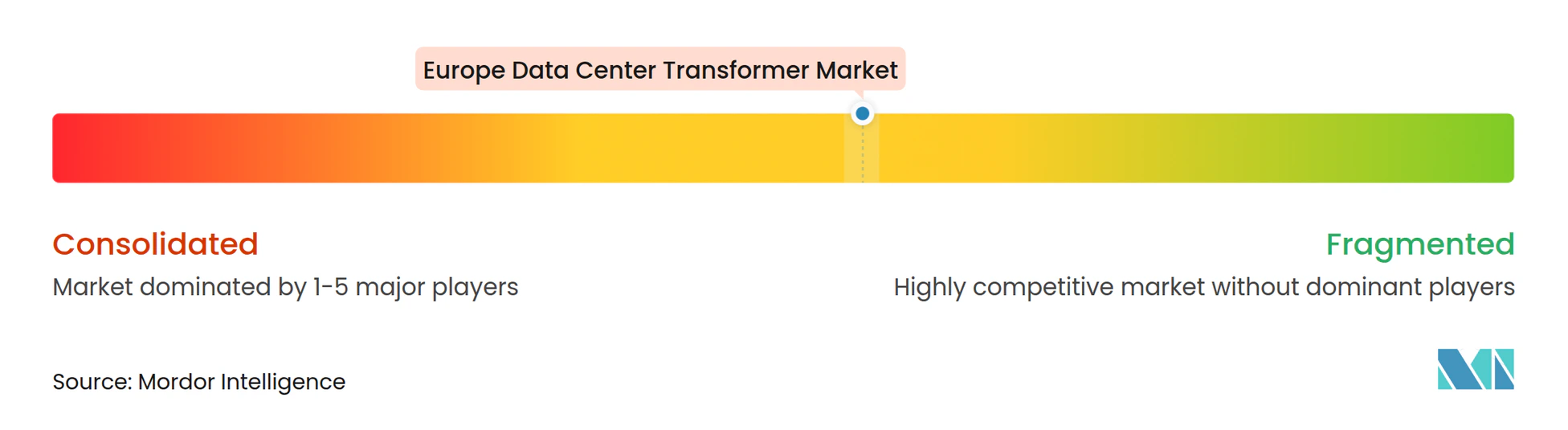
The Europe data center transformer market is moderately fragmented. ABB, Siemens Energy, Hitachi Energy, GE Vernova, Schneider Electric, and Eaton hold important positions in high-capacity transformer supply, where scale, technical capability, and manufacturing availability carry considerable weight. Regional specialists and Asian suppliers compete more actively in distribution-class equipment and standardized configurations, providing alternatives when large suppliers have limited capacity. European T&D industry members reported more than EUR 9 billion (USD 10.2 billion) of global manufacturing capacity investment from June 2024 to May 2025. Supplier strategies focus on integrated electrical packages, new power architectures, and multiyear supply agreements that secure production slots before demand turns into firm orders.
Eaton and Siemens Energy introduced a joint modular data center power offering in June 2025 that combined gas turbines, switchgear, and UPS equipment in a single package. ABB launched its Infinitus source-to-rack DC portfolio for AI data centers in 2026. Siemens and Reinhausen announced an August 2026 partnership to develop a modular solid-state transformer with up to 36 kV AC input and 800 VDC output. Hitachi Energy’s USD 700 million agreement with E.ON demonstrates the value of reserving manufacturing capacity through long-term frameworks. These moves show how leading companies compete on system integration, technology development, and delivery certainty rather than equipment price alone.
Pauwels Transformers, SGB-SMIT Group, Kolektor Etra, and Efacec Power Solutions can address orders that Tier 1 suppliers cannot deliver within required schedules. Their role is strongest where customers favor standardized equipment, faster manufacturing cycles, and proven performance over a fully bespoke design. Korean suppliers, including Hyosung Heavy Industries and HD Hyundai Electric, add competitive pressure through IEC-compliant 50 Hz products and competitive pricing. The Europe data center transformer market also includes solid-state transformer developers, although established firms retain advantages in manufacturing scale, long-standing customer relationships, certification experience, and ability to offer integrated equipment packages.
Europe Data Center Transformer Industry Leaders
-
ABB Ltd.
-
Siemens Energy AG
-
Eaton Corporation plc
-
Schneider Electric SE
-
SGB-SMIT Group
- *Disclaimer: Major Players sorted in no particular order
Europe Data Center Transformer Market Companies Covered in this Report
- ABB Ltd.
- Siemens Energy AG
- Hitachi Energy Ltd.
- Schneider Electric SE
- General Electric Vernova Inc.
- Eaton Corporation plc
- Mitsubishi Electric Corporation
- Toshiba Energy Systems and Solutions Corporation
- SGB-SMIT Group
- Hyosung Heavy Industries Co., Ltd.
- CG Power and Industrial Solutions Limited
- Ormazabal (Velatia)
- Pauwels Transformers NV
- KOŃCAR Power Transformers d.d.
- Weg Transformers
- Wilson Power Solutions Ltd.
- SEA S.p.A.
- GBE S.p.A.
- Efacec Power Solutions S.A.
- Kolektor Etra d.o.o.
Recent Industry Developments in Europe Data Center Transformer Market
- October 2026: Hitachi Energy and Ansaldo Energia signed a Memorandum of Understanding to develop integrated power generation and grid infrastructure solutions for data centers, combining Ansaldo's gas-turbine technologies with Hitachi Energy's transformer, automation, and HMAX Data Center platform for autonomous data center power management.
- October 2026: GE Vernova completed production of the first of 14 transformers for Eastern Green Link 1, a 2 GW HVDC subsea link between Scotland and England, at its Staffordshire factory, with converter station installation beginning from July 2027.
- September 2026: Hitachi Energy and Enedis signed long-term framework agreements worth EUR 350 million (USD 398 million) for power and distribution transformers supporting France's grid expansion, electric mobility, and industrial electrification programs.
- September 2026: Kolektor Etra inaugurated a 3,100 m² production hall in Belgrade with 2 winding drying ovens and a 70-ton crane, targeting a capacity increase from 70 to 150 transformers annually by 2030 to meet growing data center demand.
Europe Data Center Transformer Market Report Scope
The Europe data center transformer market defines the regional industry focused on the provisioning of specialized power transformers engineered to support the high-density power requirements of European data infrastructure. This market is heavily influenced by strict EU sustainability mandates, grid capacity limitations, and the expansion of facility clusters beyond traditional FLAP-D hubs into secondary European markets. It specifically tracks revenue, technological innovations like eco-design compliance, and deployment dynamics across Western, Central, and Eastern Europe.
The Europe Data Center Transformer Market Report is Segmented by Transformer Type (Liquid-Immersed Transformers and Dry-Type Transformers), Power Rating (Up to 10 MVA, Above 10 MVA to 30 MVA, and Above 30 MVA), Voltage Level (Low Voltage, Medium Voltage, and High Voltage), Installation (Indoor Installation and Outdoor Installation), Data Center Size (Small, Medium, Large, and Hyperscale), Data Center Type (Colocation, Cloud Service Provider, and Enterprise Data Centers/Edge), and Country (United Kingdom, Germany, France, Spain, Italy, and Rest of Europe). The Market Forecasts are Provided in Terms of Value (USD).
Segmentation Overview
| Liquid-Immersed Transformers |
| Dry-Type Transformers |
| Up to 10 MVA |
| Above 10 MVA to 30 MVA |
| Above 30 MVA |
| Low Voltage |
| Medium Voltage |
| High Voltage |
| Indoor Installation |
| Outdoor Installation |
| Small |
| Medium |
| Large |
| Hyperscale |
| Colocation |
| Cloud Service Provider |
| Enterprise Data Centers/Edge |
| United Kingdom |
| Germany |
| France |
| Spain |
| Italy |
| Rest of Europe |
| By Transformer Type | Liquid-Immersed Transformers |
| Dry-Type Transformers | |
| By Power Rating | Up to 10 MVA |
| Above 10 MVA to 30 MVA | |
| Above 30 MVA | |
| By Voltage Level | Low Voltage |
| Medium Voltage | |
| High Voltage | |
| By Installation | Indoor Installation |
| Outdoor Installation | |
| By Data Center Size | Small |
| Medium | |
| Large | |
| Hyperscale | |
| By Data Center Type | Colocation |
| Cloud Service Provider | |
| Enterprise Data Centers/Edge | |
| By Country | United Kingdom |
| Germany | |
| France | |
| Spain | |
| Italy | |
| Rest of Europe |
Key Questions Answered in the Report
What is the projected size of the Europe data center transformer market?
The Europe data center transformer market is projected to reach USD 2.92 billion by 2032 from USD 2.10 billion in 2027, at a 6.82% CAGR. The 2026 value was USD 1.94 billion.
Which transformer type has the largest share in Europe’s data center sector?
Liquid-immersed transformers held 73.19% share in 2026 because they remain suited to high-voltage outdoor intake substations. Their lower cost and established operating practices support their use on large campus sites.
Which data center customer group is expanding the fastest?
Cloud service providers are projected to expand at an 8.11% CAGR through 2032. Their long-term framework agreements can give manufacturers visibility across several campus locations and project phases.
Why are high-voltage transformers gaining importance for data centers?
Large operators are pursuing direct 110 kV, 132 kV, and 400 kV connections to reduce exposure to constrained local distribution networks. These projects need dedicated interface transformers and substantial substation engineering.
Which European country is expected to expand the fastest?
The United Kingdom is projected to expand at an 8.22% CAGR through 2032. New projects require high-voltage intake substations and tailored connection designs as operators seek more power capacity.
What is limiting project delivery across Europe?
Long transformer lead times and grid connection queues remain the main constraints. Large power transformer procurement can take up to 4 years, and the IEA found that 76% of European operators identified electricity access as their largest challenge.