
Europe Data Center On-Site Power Generation Market Size and Share
Market Overview
| Study Period | 2021 - 2032 |
|---|---|
| Forecast Data Period | 2027 - 2032 |
| Base Year Market Size (2026) | USD 3.91 Billion |
| Market Size (2027) | USD 4.56 Billion |
| Market Size (2032) | USD 8.28 Billion |
| Growth Rate (2027 - 2032) | 12.67 % |
| Market Concentration | High |
Major Players *Disclaimer: Major Players sorted in no particular order Image © Mordor Intelligence. Reuse requires attribution under CC BY 4.0. | |
Europe Data Center On-Site Power Generation Market Analysis by Mordor Intelligence
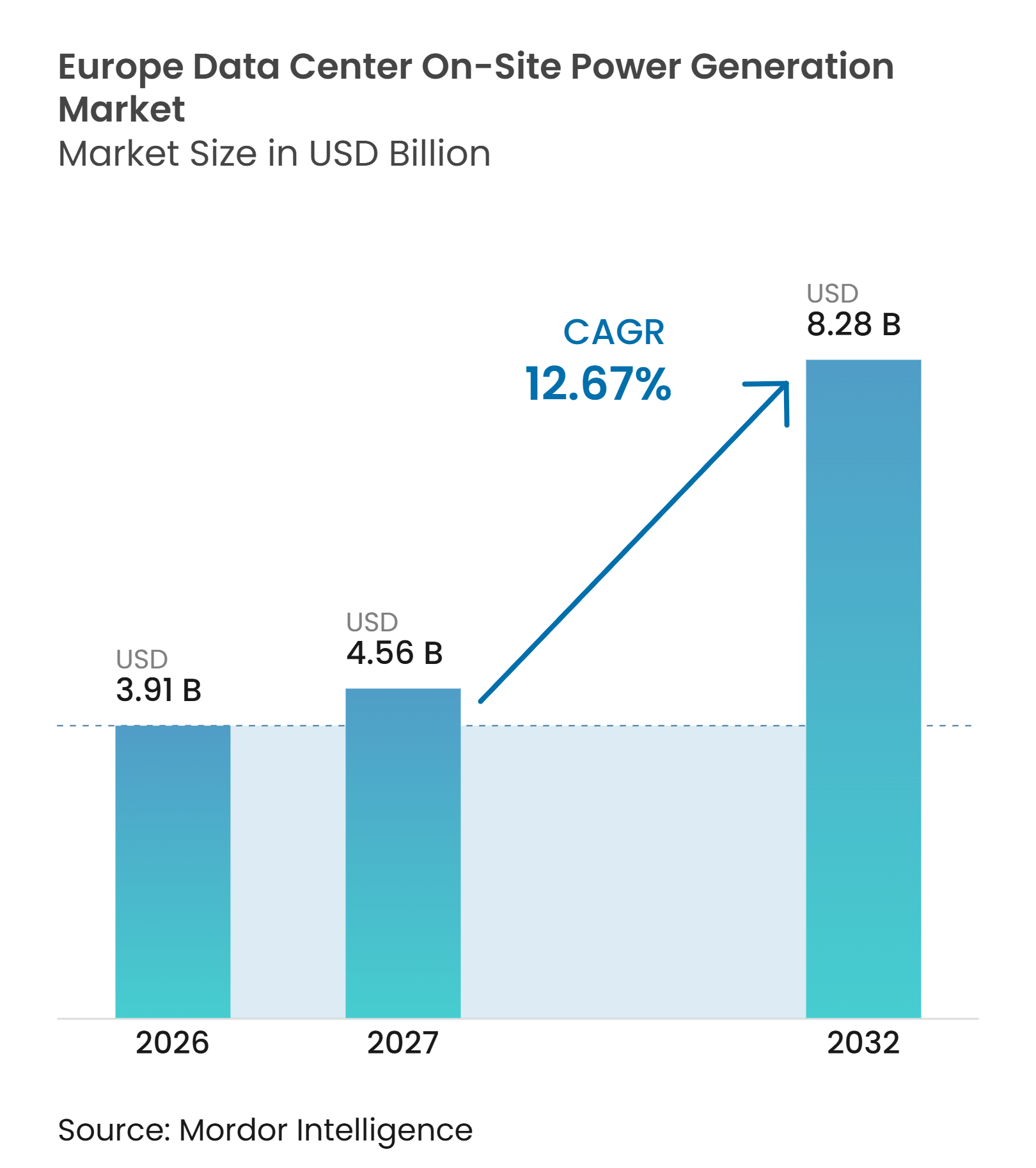
The Europe Data Center On-Site Power Generation Market size is expected to increase from USD 3.91 billion in 2026 to USD 4.56 billion in 2027 and reach USD 8.28 billion by 2032, growing at a CAGR of 12.67% over 2027-2032. In terms of installed base, the market was valued at 14.41 million megawatts in 2026 and is expected to grow from 15.53 million megawatts in 2027 to 22.52 million megawatts by 2032, at a CAGR of 7.74% during the forecast period (2027-2032). Revenue is projected to advance faster than installed capacity because hydrogen-ready reciprocating engines, solid oxide fuel cells, and large-frame gas turbines carry higher prices than conventional diesel sets. The European Commission’s April 2025 AI Continent Action Plan supports a major expansion in regional data center capacity, while long grid-connection queues make deployable on-site supply more important. The Europe data center on-site power generation market is also being shaped by larger AI campuses that need reliable power during construction and operation. Carbon costs, air-quality rules, and equipment compliance requirements are increasing the appeal of lower-emission power options.
Key Report Takeaways
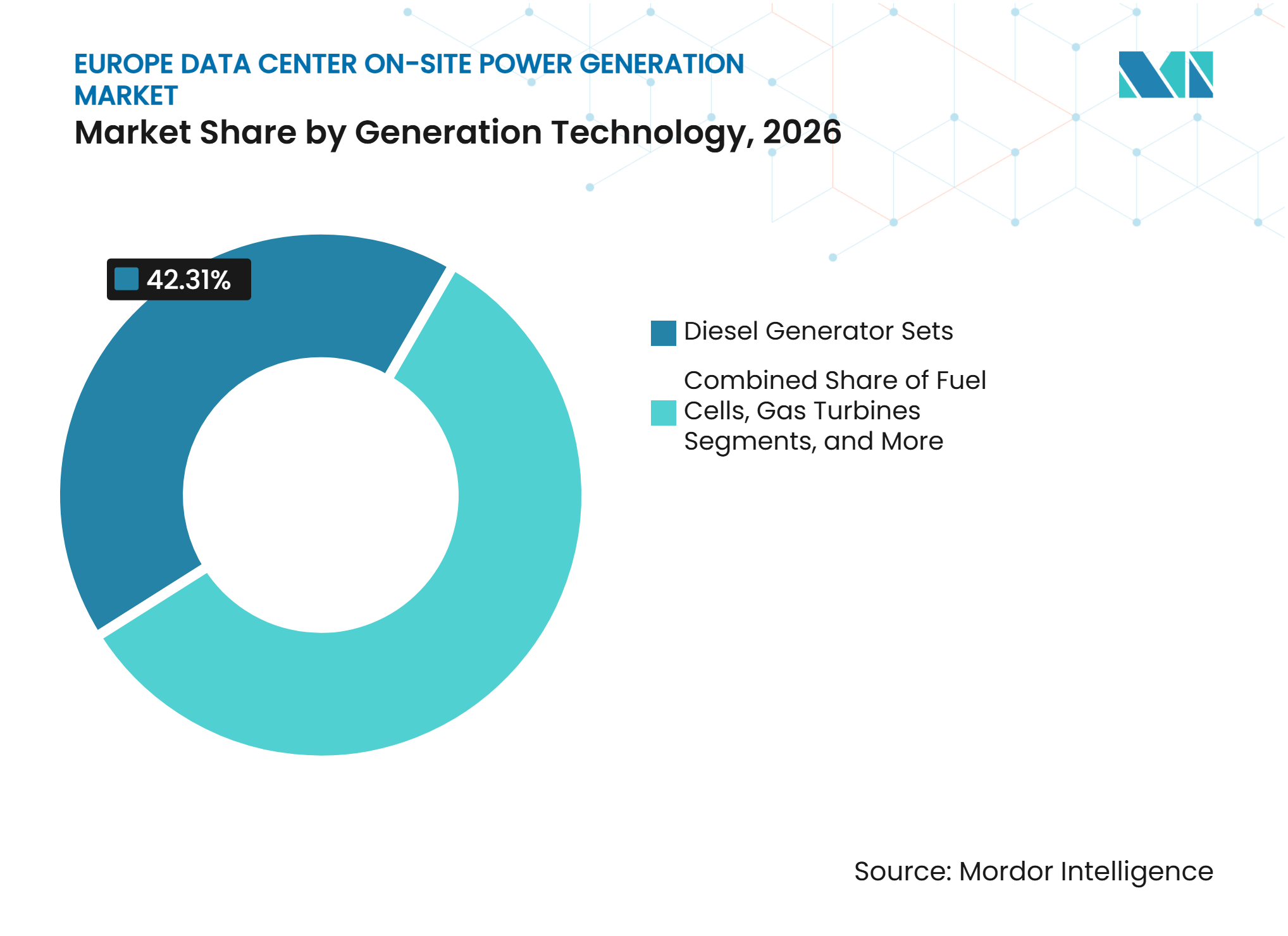
- By generation technology, diesel generator sets held 42.31% of the Europe data center on-site power generation market in 2026, while fuel cells are projected to expand at a 13.86% CAGR through 2032.
- By installed generation capacity, the 1-5 MW band held 33.83% in 2026, while the 5-20 MW band is projected to expand at a 13.44% CAGR through 2032.
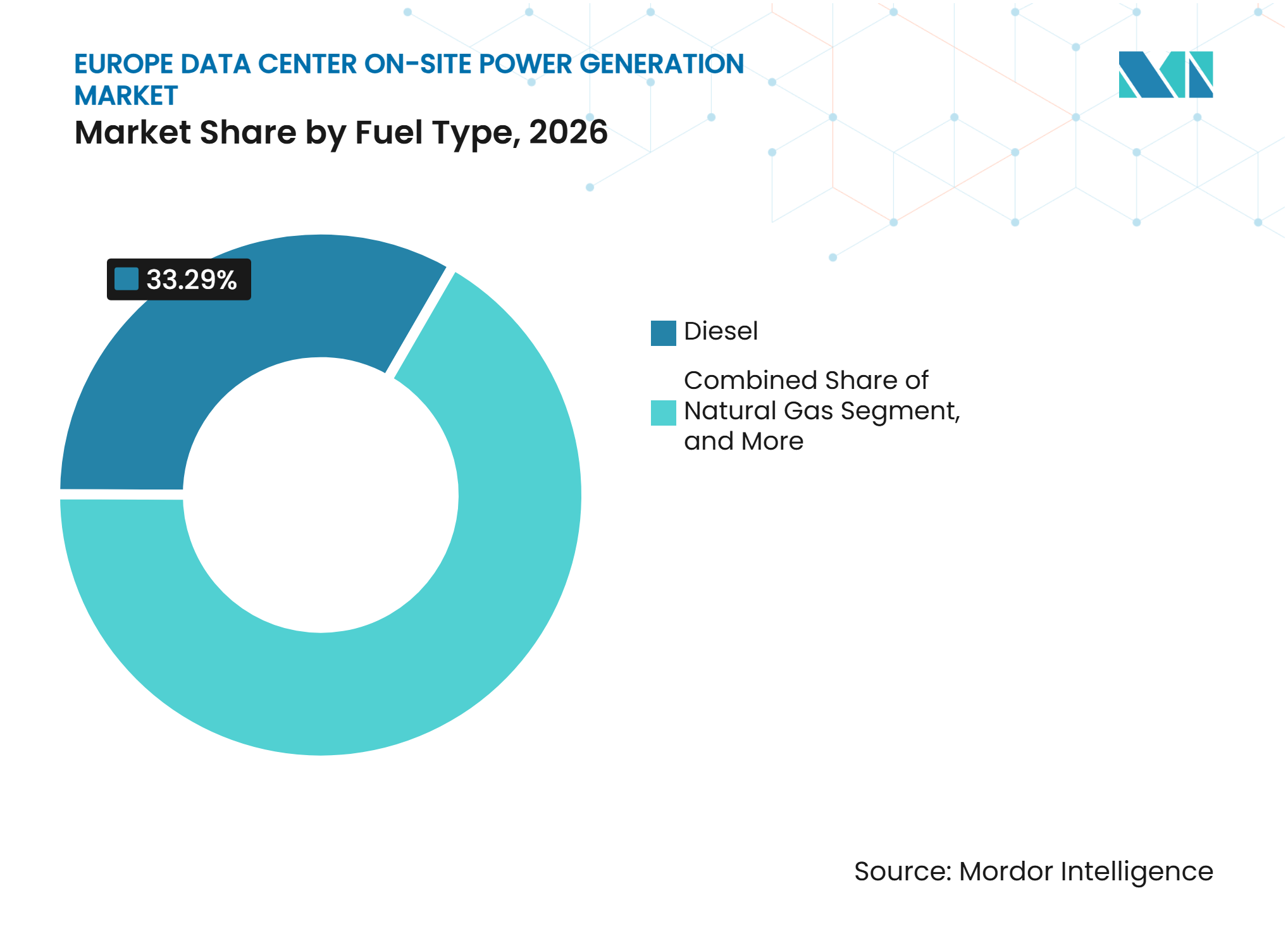
- By fuel type, diesel held 33.29% in 2026, while hydrogen and hydrogen blends are projected to expand at a 13.68% CAGR through 2032.
- By application, emergency backup power held 57.17% in 2026 in the Europe data center on-site power generation market, while continuous power is projected to expand at a 13.34% CAGR through 2032.
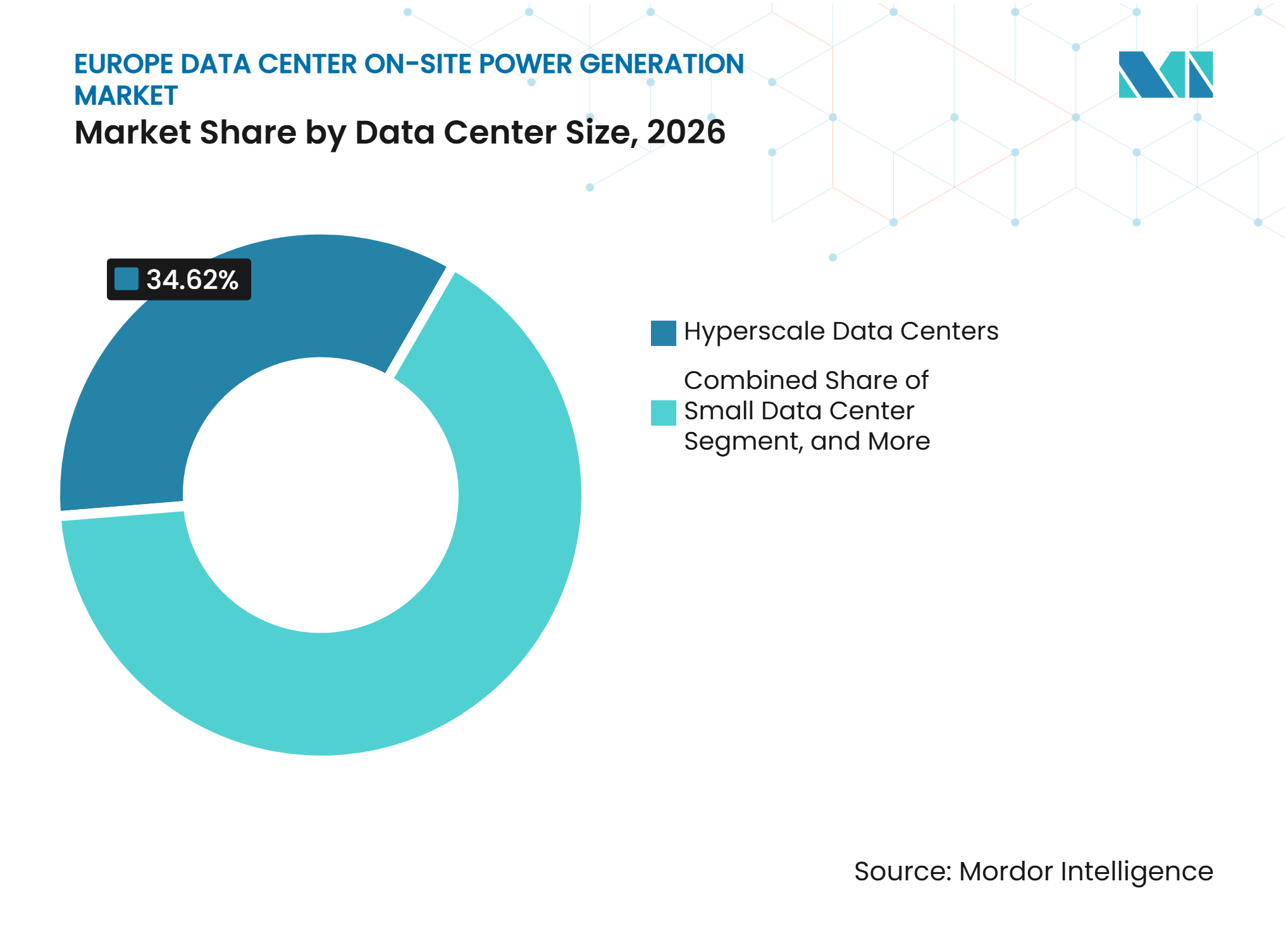
- By data center size, hyperscale facilities held 34.62% in 2026 and are projected to expand at a 13.29% CAGR through 2032.
- By data center type, colocation facilities held 42.74% in 2026, while cloud service providers are projected to expand at a 13.22% CAGR through 2032.
- By geography, the United Kingdom held 43.22% in 2026, while Germany is projected to expand at a 13.64% CAGR through 2032.
Note: Market numbers in this report are based on Mordor Intelligence's proprietary estimation framework, which combines nine months of actuals with Q4 projections for base year 2026.
Market Trends and Insights
Drivers Impact Analysis of Europe Data Center On-Site Power Generation Market*
| Driver | (~) % Impact on CAGR Forecast | Geographic Relevance | Impact Timeline |
|---|---|---|---|
| Accelerating Artificial Intelligence and Cloud Infrastructure Build-Out | +4.0% | Global, concentrated in FLAP-D and emerging European hubs including Spain, Finland, and Italy | Medium term (2-4 years) |
| Prolonged Grid-Connection Queues in FLAP-D Hubs | +2.8% | United Kingdom, Germany, France, Ireland, and Netherlands | Short term (≤ 2 years) |
| Rising Need for Dispatchable Power During Renewable Variability | +1.8% | Nordics, Ireland, and Germany, with spillover to Spain and Italy | Medium term (2-4 years) |
| Expansion of Hyperscale and Colocation Campuses | +1.3% | United Kingdom, Ireland, Germany, Netherlands, Nordic, and Iberian markets | Medium term (2-4 years) |
| European Decarbonization of Backup Generation | +0.9% | Europe-wide, with early gains in Ireland, United Kingdom, and Netherlands | Long term (≥ 4 years) |
| Behind-the-Meter Power Requirements for New Irish Data Centers | +0.5% | Ireland, with potential policy spillover to other grid-constrained locations | Short term (≤ 2 years) |
| Source: Mordor Intelligence | |||
Accelerating Artificial Intelligence and Cloud Infrastructure Build-Out
AI workloads are a central demand driver for the Europe data center on-site power generation market. The International Energy Agency projects that European data center capacity will be 70% higher in 2030 than in 2024, and that data centers will account for 10% of the increase in European Union electricity demand over that period.[1] AI workloads can move between 30% and 90% utilization, which creates rapid changes in load. This operating pattern raises the value of equipment with reliable transient response. INNIO completed a 3 MW hydrogen backup demonstration under AI training load profiles in April 2026, showing that a hydrogen-fueled gas engine can meet this mission-critical requirement.[2] The Europe data center on-site power generation market therefore favors solutions that address both high-load performance and future emissions requirements.
Prolonged Grid-Connection Queues in FLAP-D Hubs
Grid-connection delays are strengthening the commercial case for on-site generation in the Europe data center on-site power generation market. Hydrogen Europe reports that connection waiting periods in FLAP-D locations can extend from 7 to 10 years.[3] The International Energy Agency cites ACER’s estimate of EUR 4.3 billion in European grid-congestion costs during 2024. This delay can affect construction schedules, customer commitments, and utilization plans for new campuses. On-site systems allow operators to reduce dependence on a single delayed grid connection. The effect is most visible in locations where data center construction remains concentrated and available power capacity is limited.
Rising Need for Dispatchable Power During Renewable Variability
Rising renewable generation is raising the need for dispatchable power at facilities with large and inflexible loads. Hydrogen Europe states that fully grid-connected data centers are only 1% flexible under standard protocols. This leaves operators exposed when variable renewable output changes and grid balancing capacity is limited. Wärtsilä and AVK have presented a microgrid model that combines reciprocating engines, battery storage, and renewable supply for data center applications. Such configurations can support site reliability while also responding to grid needs. The Europe data center on-site power generation market is consequently moving toward equipment that can operate as an emergency asset, a prime-power unit, and a grid-support resource.
Expansion of Hyperscale and Colocation Campuses
Larger campuses are changing generation requirements across the Europe data center on-site power generation market. Hyperscale operators need systems that can be installed in modules while maintaining redundancy across a large site. High-capacity projects also need power available before a full utility connection is in place. INNIO reported an order for 1.1 GW of Jenbacher gas-engine capacity for a major data center campus in July 2026. The order illustrates the movement from small backup installations toward behind-the-meter prime power. Colocation providers face a related need because their service-level commitments require dependable power for multiple tenants. These factors support demand for modular engines, fuel cells, and other scalable systems.
Restraints Impact Analysis of Europe Data Center On-Site Power Generation Market*
| Restraint | (~) % Impact on CAGR Forecast | Geographic Relevance | Impact Timeline |
|---|---|---|---|
| Tightening Local Air-Quality and Runtime Restrictions | -2.2% | Europe-wide, with early pressure in the United Kingdom, Germany, and Netherlands | Short term (≤ 2 years) |
| High Fuel and Carbon-Cost Exposure for Fossil-Fueled Generation | -1.6% | Europe-wide, strongest in Germany, Netherlands, and Ireland | Medium term (2-4 years) |
| Limited Space and Permitting for On-Site Generation | -1.1% | FLAP-D urban cores including Frankfurt, London, and Amsterdam | Medium term (2-4 years) |
| Grid-Support and Fault-Ride-Through Integration Complexity | -0.7% | Europe-wide, strongest in grid-constrained markets with high renewable penetration | Long term (≥ 4 years) |
| Source: Mordor Intelligence | |||
Tightening Local Air-Quality and Runtime Restrictions
Air-quality permitting can limit diesel-based generation projects in the Europe data center on-site power generation market. The EU Medium Combustion Plant Directive applies a 190 mg/Nm³ NOₓ limit to gas-oil engines above 5 MW, with compliance required for existing installations from January 1, 2025. Member states may allow backup operation for up to 500 hours annually, but this is not an automatic right. Urban projects can also face local scrutiny related to generator testing and emissions. Compliance equipment can raise project cost and extend the permitting process. These conditions strengthen the case for fuel cells, hydrotreated vegetable oil, and other options with lower local emissions.
High Fuel and Carbon-Cost Exposure for Fossil-Fueled Generation
Fuel and carbon costs can weaken the long-term economics of continuous fossil-fueled power. The European Central Bank reported that energy costs, including EU Emissions Trading System allowances, accounted for 63% of electricity bills for energy-intensive industries in its February 2026 analysis. Continuous operation increases exposure because both fuel use and emissions costs rise with runtime. This issue is especially important for hyperscale sites that use on-site assets beyond emergency service. It can also change equipment selection before fuel cells and hydrogen-ready engines reach first-cost parity. The Europe data center on-site power generation market must therefore balance immediate deployment needs against operating costs over the asset life.
*Our forecasts treat driver/restraint impacts as directional, not additive. The impact forecasts reflect baseline growth, mix effects, and variable interactions.
Europe Data Center On-Site Power Generation Market Segment Analysis
By Generation Technology:
Fuel Cells Gain Ground Against Conventional Diesel SystemsDiesel generator sets held 42.31% of the Europe data center on-site power generation market share in 2026. Their position reflects proven reliability, established service coverage, a lower upfront cost for short emergency events, and operating procedures familiar to facilities teams across established European sites. Existing facilities also have diesel systems integrated into electrical distribution, testing routines, fuel storage, and maintenance contracts, which limits near-term replacement even where operators are considering cleaner fuels. Fuel cells are projected to expand at a 13.86% CAGR through 2032 because they provide low criteria-pollutant emissions and fuel flexibility. They can operate on natural gas, biogas, or hydrogen, helping operators address local rules and future fuel choices.
Fuel cells can also be installed more quickly than major grid upgrades in some locations. Bloom Energy disclosed a 10-year agreement with Nebius in May 2026 for 328 MW of solid oxide fuel cell capacity, with the first phase replacing planned combustion-based engines. Natural gas generator sets and reciprocating engines remain relevant for prime power because they offer lower NOₓ emissions than diesel and may support HVO or hydrogen blending. Gas turbines are suited to very large campuses that need high output from fewer units, and Siemens Energy and Eaton announced a 500 MW hydrogen-ready SGT-800 configuration in June 2025. The Europe data center on-site power generation industry is retaining several technology choices rather than moving to one replacement system.



By Installed Generation Capacity:
The 5-20 MW Band Supports New Hyperscale ProjectsThe 1-5 MW range accounted for 33.83% of the Europe data center on-site power generation market in 2026. This reflects the installed base of modular backup sets at colocation and enterprise facilities across the region, where multiple smaller systems support redundancy, staged replacement, and site-specific equipment layouts. These systems suit locations with limited demand that still require multiple redundant power units. The 5-20 MW range is projected to expand at a 13.44% CAGR through 2032. This size supports phased installation at new hyperscale sites while reducing exposure to a single equipment failure, allowing developers to match delivery schedules with construction milestones and tenant commitments.
Units below 1 MW remain suitable for edge facilities that value standardized equipment and rapid deployment. Capacity above 20 MW remains relevant for campuses needing very large power blocks and fewer integration points. Pure DC’s Dublin microgrid uses six Wärtsilä 34DF dual-fuel engines of 10 MW each and has a 110 MW design capacity. The configuration shows how medium-sized units can support hyperscale capacity without relying on one large-frame asset. Guaranteed engine allocation also affects schedules, which benefits integrated power providers with established manufacturing relationships.
By Fuel Type:
Hydrogen and Hydrogen Blends Build a Strategic RoleDiesel held 33.29% of the Europe data center on-site power generation market in 2026. It remains supported by a mature fuel supply chain, familiar operating practices, established tank infrastructure, and the large fleet of existing generators maintained by operators, service firms, and equipment providers. Diesel also remains practical for short-duration backup where runtime is limited and local requirements allow its use. Hydrogen and hydrogen blends are projected to expand at a 13.68% CAGR through 2032. Their role is supported by a need to lower local emissions while retaining fuel flexibility for long-lived equipment, especially where site owners must plan for future changes in permitting standards and fuel supply.
The Europe data center on-site power generation market size for low-emission fuel systems is supported by operators seeking options aligned with net-zero commitments. Hydrotreated vegetable oil provides a practical drop-in option for some diesel installations. Pure DC stated in July 2025 that its Brent, London facility adopted HVO without hardware modifications, maintenance changes, or staff retraining. INNIO’s 3 MW hydrogen backup demonstration in April 2026, validated by Microsoft, Google, and Data4, confirmed performance under AI training load profiles. Fuel selection will continue to depend on availability, equipment compatibility, runtime needs, and site-level emissions rules.

By Application:
Emergency Backup Remains Central While Continuous Power AdvancesEmergency backup power accounted for 57.17% of the Europe data center on-site power generation market in 2026. This application remains essential because facilities need resilience against utility failures, local electrical faults, planned maintenance events, and disruptions that could affect equipment supporting customer workloads. Backup equipment is designed around demanding uptime obligations, regular testing, and redundant operation. Continuous power is projected to expand at a 13.34% CAGR through 2032. Its advance shows that some operators are sizing equipment for operational independence instead of contingency service alone, particularly when utility capacity and connection timing cannot support the planned campus load.
This approach changes the role of fuel contracts, maintenance arrangements, power quality, and emissions compliance. Prime power is used where the grid is unavailable or contracted capacity is insufficient for campus demand. Ireland requires qualifying large data centers to provide dispatchable on-site or nearby generation matching Maximum Import Capacity and to participate in the Single Electricity Market. Temporary generation also serves as bridge power during construction and connection delays, as shown by Aggreko’s 20 MW Stage V package for a Dublin project. Suppliers must support extended operations while meeting reliability expectations traditionally associated with standby assets.
By Data Center Size:
Hyperscale Facilities Set Equipment RequirementsHyperscale data centers accounted for 34.62% of the Europe data center on-site power generation market in 2026. They are also projected to expand at a 13.29% CAGR through 2032. Individual campuses can need generation at a multi-hundred-MW scale, affecting equipment design, construction sequencing, procurement volumes, fuel arrangements, control systems, and the availability of trained service personnel. Their technical specifications often influence colocation and enterprise projects that follow similar reliability standards, particularly when developers reuse proven layouts, engine platforms, fuel strategies, and power management practices. Their need for power before full grid access is available also supports islanded and behind-the-meter generation designs.
A small number of hyperscale projects can require large equipment volumes and reshape supplier production planning. INNIO’s July 2026 disclosure of a 1.1 GW order for one major campus illustrates this level of demand. Large and medium facilities remain important because they represent a broad installed base with ongoing replacement requirements. These operators can upgrade diesel and gas backup arrangements with HVO capability or lower-emission alternatives. Investor scrutiny of Scope 1 emissions also encourages hyperscale developers to specify fuel-cell or hydrogen-compatible equipment at the first design stage.
By Data Center Type:
Colocation Leads Installed Demand and Cloud Providers Advance FastestColocation facilities accounted for 42.74% of the Europe data center on-site power generation market in 2026. Their position reflects strict service-level commitments to several cloud and enterprise tenants using the same facility, each of which depends on the operator’s ability to preserve availability during grid disturbances. Reliable backup capacity is therefore a core requirement of the colocation operating model. Cloud service providers are projected to expand at a 13.22% CAGR through 2032. They are building proprietary hyperscale facilities and are increasingly specifying generation that supports public emissions commitments, future fuel changes, long operating hours, and the technical demands of AI workloads.
Enterprise and edge facilities form a broad group with older diesel fleets and more gradual upgrade cycles. These sites can retain conventional equipment longer where operating hours are limited and local rules permit it. Ireland’s connection policy took effect on March 31, 2026, and requires large facilities with at least 10 MVA of Maximum Import Capacity to provide dispatchable on-site or proximate generation. This positions qualifying facilities as power resources as well as electricity consumers. The Europe data center on-site power generation industry must serve diverse facility types while meeting a higher standard for grid participation and emissions performance.
Geography Analysis
The United Kingdom held 43.22% of the Europe data center on-site power generation market share in 2026. Greater London combines a large hyperscale and colocation base with a developed rental-power ecosystem, allowing developers to access bridge-power services when construction progresses ahead of permanent grid availability. This makes temporary generation important during construction and grid-connection delays, while permanent equipment must meet stricter expectations for emissions, runtime, resilience, and local planning acceptance. Germany is projected to expand at a 13.64% CAGR through 2032. Frankfurt supports demand for systems that can be delivered quickly and operate with lower local emissions. Rolls-Royce Power Systems and INERATEC are developing synthetic e-diesel from green hydrogen for German data center emergency power, supporting a domestic lower-carbon fuel pathway.
Ireland has a distinct operating environment for the Europe data center on-site power generation market. The Central Statistics Office reported that data centers used 6,969 GWh of electricity in 2025, equal to 22% of national consumption. The Irish connection framework requires large facilities to provide dispatchable generation matching Maximum Import Capacity. This makes on-site generation part of the grid-access model rather than an optional backup investment, and it links new campus development to the availability of dispatchable resources and market participation. In the Netherlands, an Amsterdam moratorium limits development volume, although hydrogen backup projects continue to offer a technical reference for lower-emission systems.
Spain, Finland, and the Nordic countries are important secondary locations. The International Energy Agency states that planned Spanish data centers average 7 times the size of existing facilities. EdgeMode and Bloom Energy signed a June 2026 memorandum of understanding for a 300 MW Toledo AI campus designed around 30 Bloom 10 MW fuel cell modules. The project involved intended investment of EUR 3 billion (USD 3.42 billion), while Finland and the Nordic region offer renewable resources and land not available in established FLAP-D centers.
Competitive Landscape
Market Concentration
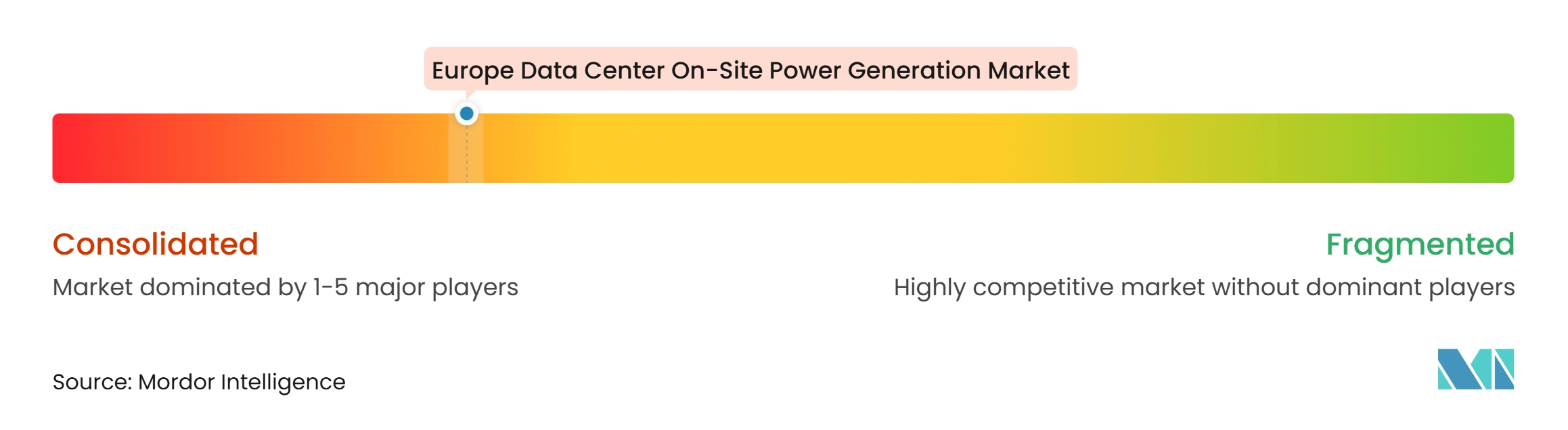
The Europe data center on-site power generation market includes large original equipment manufacturers, fuel-cell developers, regional specialists, and rental-power providers. Caterpillar, Cummins, Rolls-Royce Power Systems, INNIO Jenbacher, and Wärtsilä have strong positions in high-MW and prime-power applications. Competition is more fragmented across the broader backup-generator base, where lead time, local service, availability, fuel flexibility, installation capability, and the ability to support testing schedules affect supplier selection. Caterpillar and Cummins remain relevant for conventional standby requirements. INNIO and Wärtsilä are increasingly focused on engines that can support prime power and variable AI loads.
Fuel-cell suppliers compete where permitting, emissions, and grid delay favor alternatives to combustion-based generation. INNIO reported a 1.1 GW Jenbacher order for a major data center campus in July 2026, demonstrating its focus on large behind-the-meter opportunities. Bloom Energy’s May 2026 agreement with Nebius covers 328 MW over 10 years and replaced combustion-based engines in the first phase. Siemens Energy and Eaton introduced a modular 500 MW hydrogen-ready SGT-800 solution in June 2025. These moves show competition centered on deployment timing, module size, emissions performance, fuel compatibility, engineering support, and the supplier’s ability to provide dependable capacity for larger integrated projects.
Wärtsilä and AVK propose microgrids that combine reciprocating engines, batteries, and renewable power for site reliability and grid-balancing capacity. Centrica and Ceres formed a 2026 partnership for multi-GW on-site fuel-cell power in the United Kingdom and Europe. Providers with manufacturing capacity, local service, fuel partnerships, and established control-system expertise have an advantage as projects increase in scale and customers seek fewer interfaces between generation equipment and site operations. The Europe data center on-site power generation market remains most concentrated in large prime-power projects and less concentrated across the wider standby fleet.
Europe Data Center On-Site Power Generation Industry Leaders
-
Caterpillar Inc.
-
Cummins Inc.
-
Rolls-Royce Power Systems AG
-
Generac Holdings Inc.
-
Kohler Co.
- *Disclaimer: Major Players sorted in no particular order
Europe Data Center On-Site Power Generation Market Companies Covered in this Report
- Caterpillar Inc.
- Cummins Inc.
- Rolls-Royce Power Systems AG
- Generac Holdings Inc.
- Kohler Co.
- ABB Ltd.
- Siemens Energy AG
- Wärtsilä Corporation
- INNIO Jenbacher GmbH and Co OG
- Aggreko plc
- Atlas Copco AB
- Mitsubishi Heavy Industries, Ltd.
- Yanmar Holdings Co., Ltd.
- Himoinsa S.L.
- PRAMAC S.p.A.
- FG Wilson Engineering Ltd.
- Perkins Engines Company Limited
- Genesal Energy
- FuelCell Energy, Inc.
- Bloom Energy Corporation
Recent Industry Developments in Europe Data Center On-Site Power Generation Market
- July 2026: INNIO N.V. booked 1.1 GW of Jenbacher J624 gas engine capacity for a mega-scale data center campus, with more than 200 engines positioned for behind-the-meter prime power.
- June 2026: Equinix, ESB, and GeoPura trialed Ireland’s first hydrogen power units at Equinix’s DB3 facility in Dublin, deploying 2 PEM fuel cell containers totaling 500 kW in a 12-week pilot.
- May 2026: Bloom Energy disclosed a USD 2.6 billion service-fee agreement with European AI cloud provider Nebius for 328 MW of solid oxide fuel cell capacity in 3 phases over 10 years.
- April 2026: INNIO Group and the Net Zero Innovation Hub for Data Centers completed a 3 MW demonstration of 100% hydrogen-fueled gas-engine backup power at INNIO’s Jenbach, Austria facility.
Europe Data Center On-Site Power Generation Market Report Scope
The Europe Data Center On-Site Power Generation Market comprises solutions that enable data centers to generate electricity within or adjacent to their facilities to ensure a reliable, resilient, and uninterrupted power supply. These systems support operational continuity by reducing dependence on external grids, mitigating the risk of power outages, and addressing the growing energy demands of digital infrastructure. The market includes technologies designed for backup, primary, and continuous power generation, helping operators enhance energy security, optimize operational efficiency, support sustainability objectives, and meet the increasing power requirements of modern, high-density computing environments.
The Europe Data Center On-Site Power Generation Market Report is Segmented by Generation Technology (Diesel Generator Sets, Natural Gas Generator Sets, Gas Turbines, Reciprocating Gas Engines, Fuel Cells, and Other Generation Technologies), Installed Generation Capacity (Below 1 MW, 1–5 MW, 5–20 MW, and Above 20 MW), Fuel Type (Diesel, Natural Gas, Renewable Fuels and Biogas, Hydrogen and Hydrogen Blends, and Other Fuel Types), Application (Emergency Backup Power, Prime Power, Continuous Power, and Temporary and Bridge Power), Data Center Size (Small, Medium, Large, and Hyperscale), Data Center Type (Colocation, Cloud Service Providers, and Enterprise and Edge), and Geography (United Kingdom, Germany, France, Ireland, Netherlands, Spain, Italy, Finland, Sweden, and Rest of Europe). The Market Forecasts are Provided in Terms of Value (USD) and Volume (MW).
Segmentation Overview
| Diesel Generator Sets |
| Natural Gas Generator Sets |
| Gas Turbines |
| Reciprocating Gas Engines |
| Fuel Cells |
| Other Generation Technologies |
| Below 1 MW |
| 1-5 MW |
| Above 5-20 MW |
| Above 20 MW |
| Diesel |
| Natural Gas |
| Renewable Fuels and Biogas |
| Hydrogen and Hydrogen Blends |
| Other Fuels |
| Emergency Backup Power |
| Prime Power |
| Continuous Power |
| Temporary and Bridge Power |
| Small |
| Medium |
| Large |
| Hyperscale |
| Colocation |
| Cloud Service Providers (CSPs) |
| Enterprise and Edge |
| United Kingdom |
| Germany |
| France |
| Ireland |
| Netherlands |
| Spain |
| Italy |
| Finland |
| Sweden |
| Rest of Europe |
| By Generation Technology | Diesel Generator Sets |
| Natural Gas Generator Sets | |
| Gas Turbines | |
| Reciprocating Gas Engines | |
| Fuel Cells | |
| Other Generation Technologies | |
| By Installed Generation Capacity | Below 1 MW |
| 1-5 MW | |
| Above 5-20 MW | |
| Above 20 MW | |
| By Fuel Type | Diesel |
| Natural Gas | |
| Renewable Fuels and Biogas | |
| Hydrogen and Hydrogen Blends | |
| Other Fuels | |
| By Application | Emergency Backup Power |
| Prime Power | |
| Continuous Power | |
| Temporary and Bridge Power | |
| By Data Center Size | Small |
| Medium | |
| Large | |
| Hyperscale | |
| By Data Center Type | Colocation |
| Cloud Service Providers (CSPs) | |
| Enterprise and Edge | |
| By Geography | United Kingdom |
| Germany | |
| France | |
| Ireland | |
| Netherlands | |
| Spain | |
| Italy | |
| Finland | |
| Sweden | |
| Rest of Europe |
Key Questions Answered in the Report
What is the Europe data center on-site power generation market size?
The market is projected at USD 3.91 billion in 2026 and USD 4.56 billion in 2027, reaching USD 8.28 billion by 2032 at a 12.67% CAGR.
Which generation technology leads data center on-site power demand in Europe?
Diesel generator sets lead with 42.31% in 2026, while fuel cells are projected to record the highest CAGR of 13.86% through 2032.
Why are operators installing on-site power at European data centers?
Long grid-connection queues, AI load requirements, and the need for resilient power are increasing deployment of on-site systems.
Which fuel type is expected to advance fastest through 2032?
Hydrogen and hydrogen blends are projected to expand at a 13.68% CAGR as operators seek lower-emission and fuel-flexible solutions.
How does Ireland affect on-site power procurement for data centers?
Ireland requires qualifying large facilities to provide dispatchable on-site or proximate generation matching Maximum Import Capacity.
Which country is projected to advance fastest in Europe through 2032?
Germany is projected to record a 13.64% CAGR, supported by the scale of demand around Frankfurt and related power constraints.