
Europe Data Center Insurance Market Size and Share
Market Overview
| Study Period | 2021 - 2032 |
|---|---|
| Forecast Data Period | 2027 - 2032 |
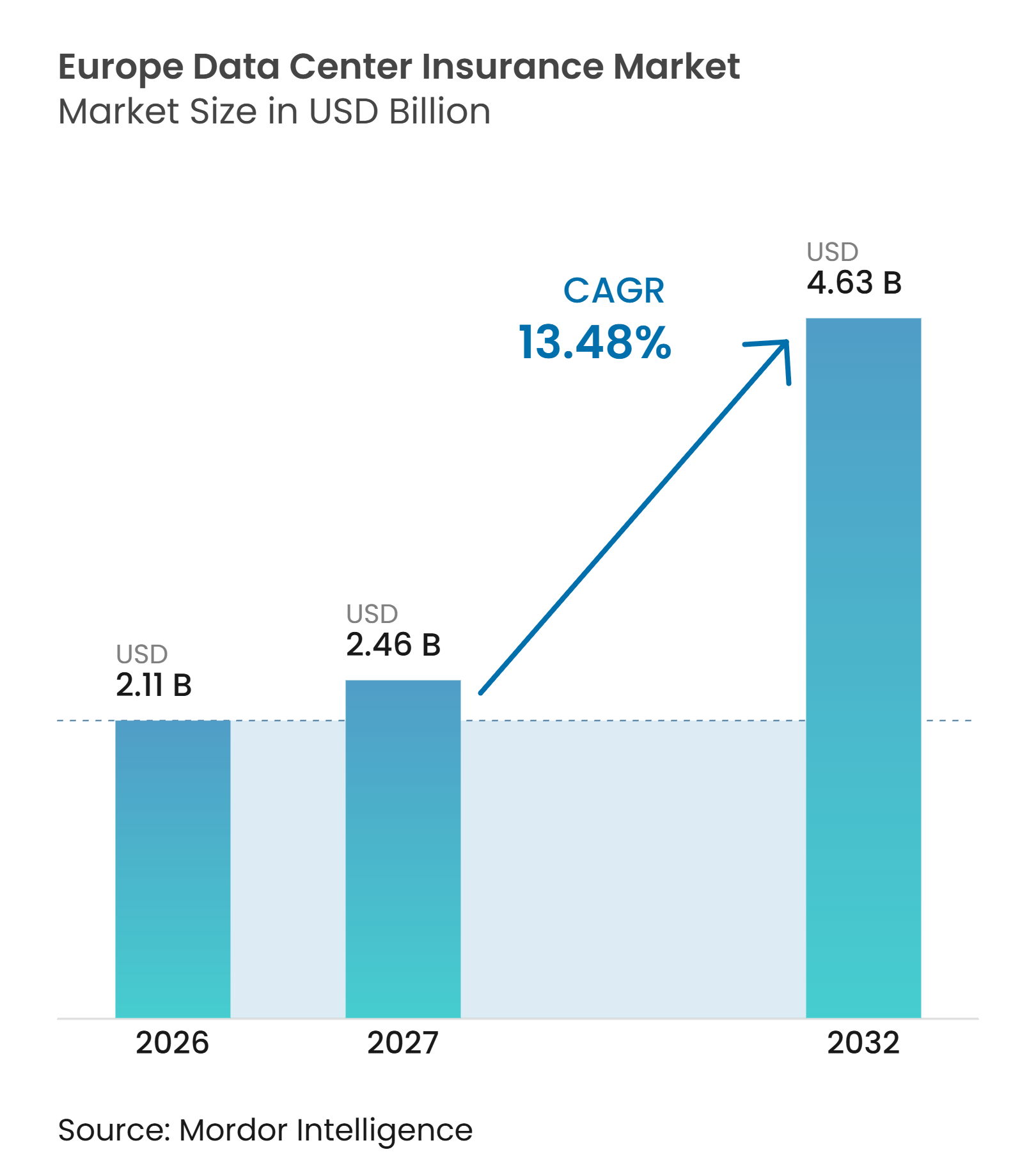
| Base Year Market Size (2026) | USD 2.11 Billion |
| Market Size (2027) | USD 2.46 Billion |
| Market Size (2032) | USD 4.63 Billion |
| Growth Rate (2027 - 2032) | 13.48 % |
| Market Concentration | Low |
Major Players *Disclaimer: Major Players sorted in no particular order Image © Mordor Intelligence. Reuse requires attribution under CC BY 4.0. | |
Europe Data Center Insurance Market Analysis by Mordor Intelligence
The Europe data center insurance market size is projected to increase from USD 2.11 billion in 2026 to USD 4.63 billion by 2032, growing at a CAGR of 13.48% during 2027-2032. The Europe data center insurance market is expanding as AI campuses combine costly construction, dense technology assets, and operational dependencies in a single location. This changes the insurance requirement because construction, property, business interruption, cyber, and liability needs often arise across the same facility lifecycle. Larger insured values are also making program design and available capacity more important than price alone. Lenders and major customers are placing more weight on comprehensive protection, especially where project financing and service commitments depend on it. The Europe data center insurance market also has room to grow in newer locations where power availability supports construction but specialist insurance services remain less established.
Key Report Takeaways
- By insurance type, Property Damage Insurance held 32.81% of the Europe data center insurance market share in 2026, while Cyber Insurance is projected to expand at a CAGR of 14.83% through 2032.
- By coverage structure, Combined Property and Business Interruption Policies accounted for 36.42% of the market share in 2026, while Parametric Insurance is projected to expand at a CAGR of 14.67% through 2032.
- By risk exposure, Electrical and Mechanical Equipment Failure held 21.67% of the market share in 2026, while Cyber-Related Operational Disruption is projected to expand at a CAGR of 14.93% through 2032.
- By policyholder, Data Center Owners and Operators accounted for 38.26% of the market share in 2026, while Cloud Service Providers are projected to expand at a CAGR of 14.42% through 2032.
- By insurance distribution channel, Insurance Brokers and Consultants held 54.83% of the market share in 2026, while Managing General Agents and Specialist Underwriting Agencies are projected to expand at a CAGR of 14.34% through 2032.
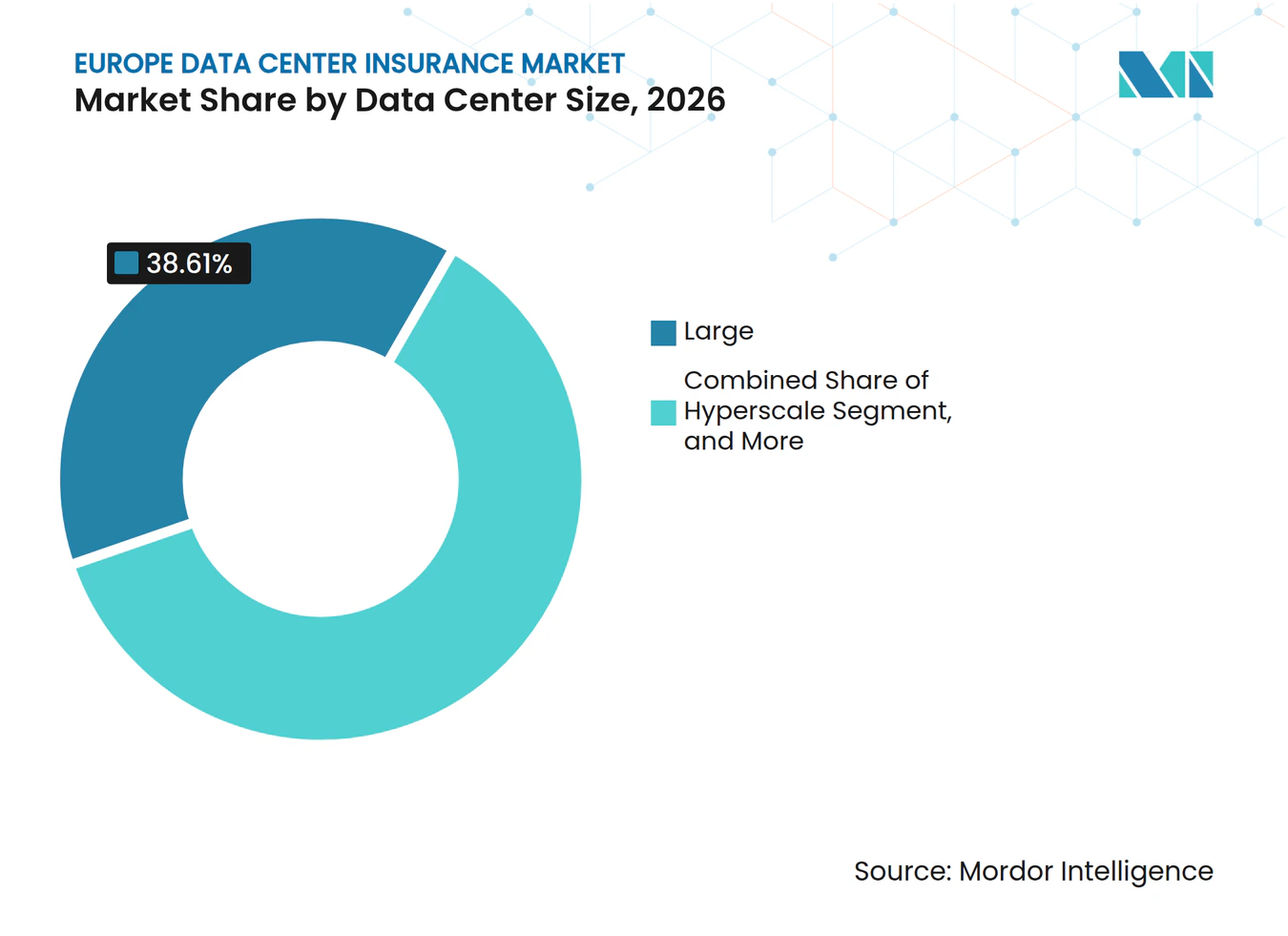
- By data center size, Large Data Centers accounted for 38.61% of the market share in 2026, while Hyperscale Data Centers are projected to expand at a CAGR of 14.17% through 2032.
- By data center type, Colocation Data Centers held 46.39% of the market share in 2026, while Cloud Service Providers are projected to expand at a CAGR of 14.23% through 2032.
- By geography, Germany held 28.64% of the Europe data center insurance market share in 2026, while Spain is projected to expand at a CAGR of 14.61% through 2032.
Note: Market numbers in this report are based on Mordor Intelligence's proprietary estimation framework, which combines nine months of actuals with Q4 projections for base year 2026.
Market Trends and Insights
Drivers Impact Analysis of Europe Data Center Insurance Market*
| Driver | (~) % Impact on CAGR Forecast | Geographic Relevance | Impact Timeline |
|---|---|---|---|
| AI and Hyperscale Capacity Expansion | +5.2% | Global, concentrated in Germany, United Kingdom, Ireland, and France | Short term (≤ 2 years) |
| Rising Insured Values and Business Interruption Severity | +3.1% | Global, most acute in Germany and United Kingdom hyperscale corridors | Short term (≤ 2 years) |
| Regulatory and Contractual Pressure for Cyber Resilience | +2.4% | EU-wide, DORA and NIS2, and United Kingdom Cyber Security and Resilience Bill | Medium term (2-4 years) |
| Expansion Into Power-Available Secondary Markets | +1.6% | Spain, Finland, Denmark, and the Nordics | Medium term (2-4 years) |
| Coverage Demand From Customer-Owned AI Hardware and SLA Risk | +1.2% | Global, concentrated in colocation hubs across Western Europe | Short term (≤ 2 years) |
| Lifecycle Insurance Demand at Construction-to-Operations Handover | +0.8% | Global, concentrated in the United Kingdom and Germany | Medium term (2-4 years) |
| Source: Mordor Intelligence | |||
AI and Hyperscale Capacity Expansion
The Europe data center insurance market benefits from the rapid buildout of AI-ready capacity. Hyperscalers committed more than USD 600 billion to physical AI infrastructure in 2026, representing a 36% annual increase, with USD 450 billion directly linked to data center construction, cooling, and power systems. Each stage creates distinct insurance needs, from engineering and delay-in-start-up cover during construction to property, business interruption, cyber, and liability protection after commissioning. This gives a single project a multiyear insurance requirement rather than a one-time placement. London added 193 MW of capacity in 2025, while European supply still struggled to meet demand. The continuing gap between supply and demand supports construction-line underwriting and brings more specialist capacity into the Europe data center insurance market.
Rising Insured Values and Business Interruption Severity
High asset values are increasing both premium potential and loss severity in the European data center insurance market. A large AI campus can exceed USD 20 billion in construction cost before its computing and network equipment is installed. A partial cooling or power event can therefore produce a much larger business interruption loss than physical damage alone would suggest. Insurers are responding through policy reviews, sublimit scrutiny, and higher demand for risk engineering at renewal.
Regulatory and Contractual Pressure for Cyber Resilience
DORA has been applied since January 2025 and has increased attention to ICT risk management, incident reporting, and third-party oversight. NIS2 adds a related framework for resilience and cybersecurity controls in critical sectors. Data center operators serving financial-sector clients may face DORA-aligned commitments in customer contracts, even when NIS2 is their primary regulatory framework. The proposed United Kingdom Cyber Security and Resilience Bill would also designate data centers as operators of essential services and introduce a 24-hour incident-notification requirement.[1] These requirements make cyber cover more closely connected to procurement and contractual performance. That makes demand less dependent on discretionary insurance spending and supports growth in the Europe data center insurance market.
Expansion Into Power-Available Secondary Markets
Grid limits, permitting delays, and land costs are redirecting development toward European locations with available power. Finland and Denmark are also attracting interest because of their power availability and permitting conditions. This diversification can reduce the concentration of property exposure in long-established hubs. It also creates demand for local risk engineering, broker support, and claims expertise where those services are less mature. The European data center insurance market can therefore extend with construction activity into secondary locations, even as insurers need to assess new weather, grid, and operating conditions.
Restraints Impact Analysis of Europe Data Center Insurance Market*
| Restraint | (~) % Impact on CAGR Forecast | Geographic Relevance | Impact Timeline |
|---|---|---|---|
| Capacity Shortfalls for Multi-Billion-Dollar Campuses | -1.8% | Global, most acute in United Kingdom and Germany hyperscale corridors | Short term (≤ 2 years) |
| Correlated Power, Cooling, Cyber, and Supply Chain Losses | -1.4% | Global | Medium term (2-4 years) |
| Coverage Ambiguity Between Property and Cyber Policies | -0.9% | United Kingdom and EU-wide | Medium term (2-4 years) |
| Planning, Environmental, Water, and Community-Impact Disputes | -0.6% | United Kingdom, Germany, Netherlands, and France | Long term (≥ 4 years) |
| Source: Mordor Intelligence | |||
Capacity Shortfalls for Multi-Billion-Dollar Campuses
The largest facilities require a complex tower of insurers because no single carrier can provide the full limit. Munich Re offers up to USD 250 million in net capacity per project, while Aon expanded its Data Center Lifecycle Insurance Program to USD 5 billion in 2026. Lenders may require full construction cover before debt can be drawn. A limited supply of competitively priced limits can delay financing and project execution. Swiss Re has stated that demand is growing quickly while capacity remains finite. The constraint makes insurance placement a project-enabling function, not merely an operating cost, in the European data center insurance market.
Correlated Power, Cooling, Cyber, and Supply Chain Losses
A grid failure, ransomware event, or cooling-system failure can trigger claims across several policy lines at once. This is especially relevant at multi-tenant facilities where a shared event affects the operator and multiple customers. New hyperscale sites have limited historical loss data, which makes systemic accumulation difficult to price. Equipment faults, electrical events, and cooling issues can also create persistent attritional losses across an insurer portfolio. Better shared loss data and more consistent technical submissions would help reinsurers assess these exposures. Until then, correlated risk may limit the pace at which capacity reaches the Europe data center insurance market.
*Our forecasts treat driver/restraint impacts as directional, not additive. The impact forecasts reflect baseline growth, mix effects, and variable interactions.
Europe Data Center Insurance Market Segment Analysis
By Insurance Type:
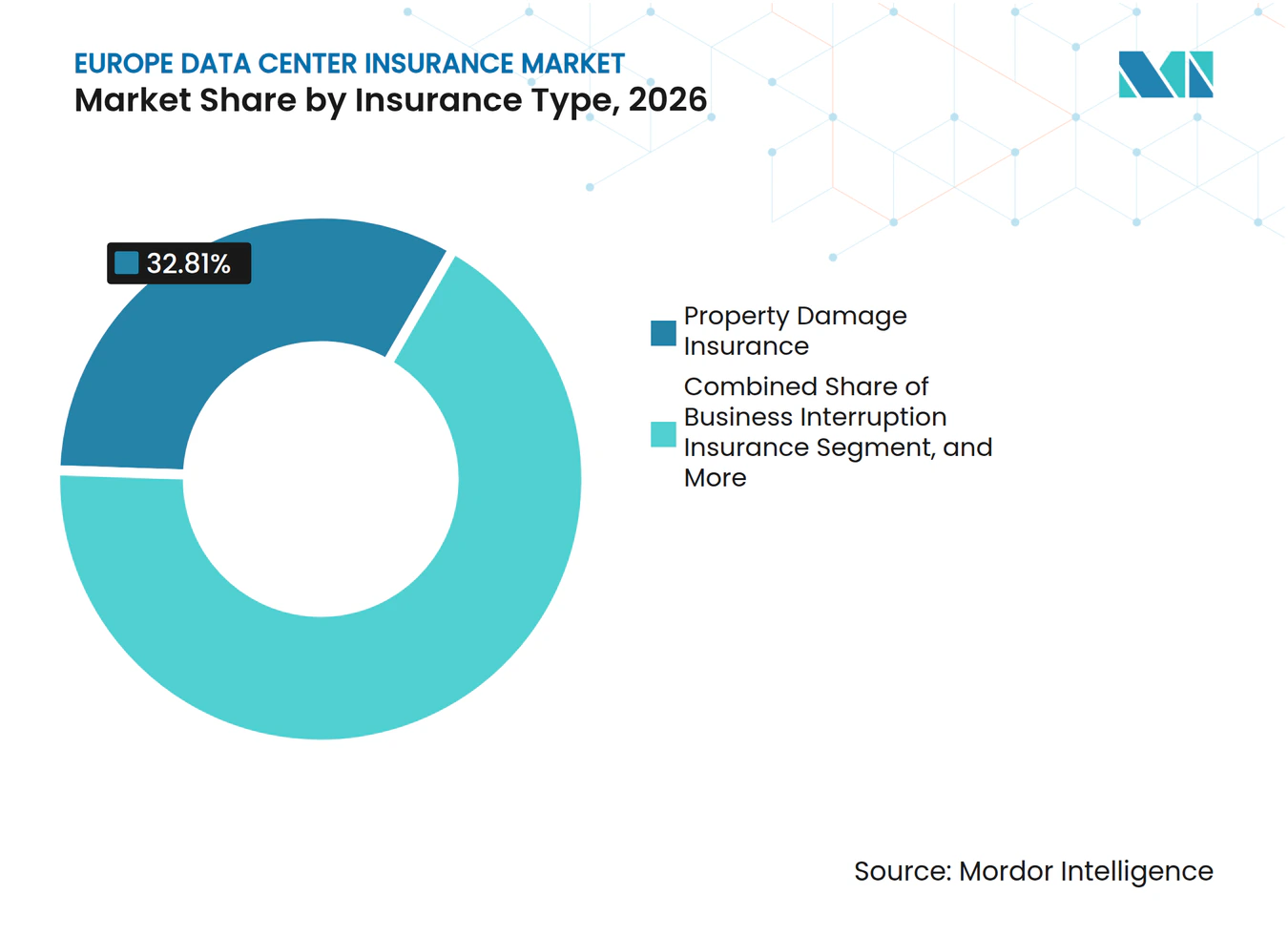
Property Damage Holds the Largest Position While Cyber Coverage Expands FastestProperty Damage Insurance held 32.81% of the regional market share in 2026. Its position reflects the physical asset base across established campuses in Germany, the United Kingdom, and France. Property cover remains central because buildings, power equipment, cooling equipment, and server infrastructure can all sustain high-value losses. Business Interruption Insurance and Equipment Breakdown Insurance complement property cover during the operating phase. Revenue loss from a short outage can materially exceed the direct repair bill at AI-intensive facilities. Cyber Insurance is projected to expand at a CAGR of 14.83% through 2032. The increase reflects operational technology links across power, cooling, security, and monitoring systems. Swiss Re has identified this connectivity as an expanding exposure at facilities once viewed as relatively contained cyber environments.
Natural Catastrophe Insurance and Construction and Erection All-Risk Insurance become increasingly relevant as projects move into locations with varying flood, wind, and seismic conditions. These policies also support investors during the high-value construction period. General and Third-Party Liability Insurance is becoming more relevant in multi-tenant facilities. One customer’s hardware can sit alongside another customer’s managed infrastructure in the same site. That arrangement can create liability questions that conventional property wording does not fully address. Insurers are therefore reviewing how ownership, access, and responsibility are defined across tenant contracts. Broader coverage design helps reduce gaps between physical damage, operational failure, and third-party claims. This keeps the Europe data center insurance market focused on coordinated coverage rather than isolated policies.



By Coverage Structure:
Combined Policies Lead While Parametric Cover Addresses Service CommitmentsCombined Property and Business Interruption Policies accounted for 36.42% of the regional market share in 2026. Most large policyholders prefer an integrated structure because physical damage and operational loss are closely connected. Standalone Policies remain relevant for individual exposures and established insurance relationships. Package Policies can offer smaller and medium-sized operators a simpler way to combine several protections. Traditional indemnity policies may not respond when a site misses a service-level agreement without physical damage. This issue is particularly relevant in major hyperscale tenancy arrangements. Parametric Insurance is projected to expand at a CAGR of 14.67% through 2032. Its triggers can be linked to measurable events or performance indicators rather than only to physical loss.
Descartes Underwriting launched a parametric data center product in January 2026 with cover of up to USD 140 million per policy across up to 20 natural catastrophe perils.[2] This type of structure can respond where conventional property cover does not provide a clear payment route. It is useful for lenders, investors, and operators who want more predictable recovery terms. Captive and self-insurance arrangements are also becoming more important for large hyperscalers. These organizations may retain part of a risk that the commercial insurance sector cannot absorb at acceptable terms. The Europe data center insurance market is therefore moving toward layered programs that combine indemnity cover, parametric protection, and retained risk. The change reflects the scale and complexity of modern facilities rather than a replacement of traditional property cover.
By Risk Exposure:
Equipment Failure Leads While Cyber-Related Disruption Records the Highest GrowthElectrical and Mechanical Equipment Failure accounted for 21.67% of the regional market share in 2026. Power supply disruptions accounted for 45% of operational outages in the data center sector. Even short power interruptions can produce large business interruption claims in high-revenue facilities. Battery backup units integrated near server equipment add a risk factor that older fire assessments did not fully capture. These conditions keep risk engineering central to underwriting decisions.
Power disruption, flooding, water damage, windstorms, and severe weather remain material physical exposures. Direct-to-chip liquid cooling can add water-loss considerations to AI-focused facilities. Cyber-Related Operational Disruption is projected to grow at a 14.93% CAGR through 2032, the highest rate among the risk exposure categories. The regional market size for this exposure reflects the growing recognition that a cyber event can disrupt physical systems and operations.
By Policyholder:
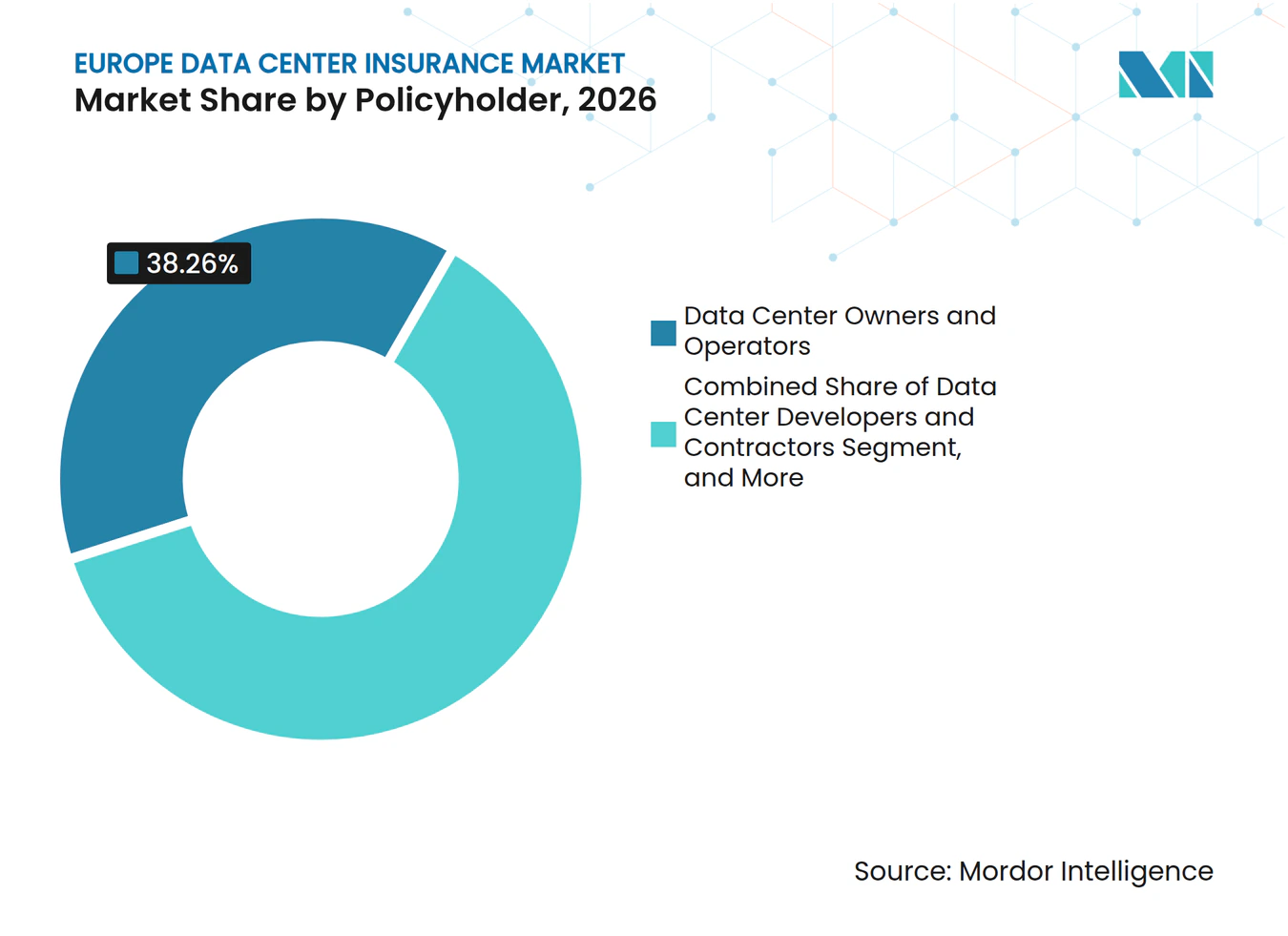
Owners and Operators Lead While Cloud Service Providers Grow FastestData Center Owners and Operators accounted for 38.26% of the regional market share in 2026. They buy cover directly because they own or control the core buildings and systems. Their established relationships with insurers are particularly important in Germany, the United Kingdom, and France. Colocation Providers form another major buyer group because they manage multitenant property, business interruption, and liability exposures. Their policy wording must address how losses are allocated between the operator and tenants. Data Center Developers and Contractors also need protection during construction and commissioning. Lifecycle programs extend insurance considerations from the planning stage through the early operations stage.
Cloud Service Providers are projected to expand at a CAGR of 14.42% through 2032. Their European infrastructure rollout increases the demand for cover across both primary and secondary locations. Customer contracts and operational resilience obligations can make formal insurance procurement more important. Equipment and service providers also face first-party and third-party exposure as their products become central to high-value facilities. A failure in a supplied component can affect the wider site and several customers. The Europe data center insurance market thus serves a broader set of buyers than the asset owner alone. Coverage requirements increasingly reflect each party’s role in the operating chain.

By Insurance Distribution Channel:
Brokers Lead While Specialist MGAs Extend Their RoleInsurance Brokers and Consultants held 54.83% of the regional market share in 2026. Large placements often require several insurers, so brokers assemble capacity towers and coordinate terms. They also provide risk engineering, service-level agreement analysis, and claims support. Direct channels are less suited to large, complex facilities that need tailored limits and multiple coverage lines. Reinsurance-Supported Insurance Programs help carriers manage high exposures by sharing risk across broader capital sources. This distribution structure reflects the specialist nature of data center underwriting. It also supports consistency between construction, property, cyber, and liability placement.
Managing General Agents and Specialist Underwriting Agencies are projected to expand at a CAGR of 14.34% through 2032. The MGA model can give policyholders access to delegated underwriting expertise in locations where specialist infrastructure is limited. ATA launched a USD 750 million AI infrastructure insurance facility in January 2026 with support from Arch Insurance International, Munich Re Specialty, and SCOR. The facility combined hardware, cyber, cargo, and liability protection. Such structures can move specialist capacity more quickly than conventional single-line arrangements. The Europe data center insurance market benefits when specialist underwriting is available closer to new development locations. This does not remove the broker role, but it broadens the ways tailored coverage can be delivered.
By Data Center Size:
Large Facilities Lead While Hyperscale Sites Redefine Underwriting NeedsLarge Data Centers accounted for 38.61% of the regional market share in 2026. Mature campuses in Germany, the United Kingdom, and France form the historic premium base. Medium and small facilities also contribute a significant premium because of their volume and more established loss patterns. These risks can help maintain portfolio balance when insurers manage large hyperscale exposures. Hyperscale Data Centers are projected to expand at a CAGR of 14.17% through 2032. AI-focused campuses can require more than 100 kilowatts per server rack, compared with 5 to 15 kilowatts for conventional hardware. This difference changes cooling, power, fire, and equipment-risk assumptions.
Hyperscale facilities are not simply larger versions of standard sites. Lithium-ion battery backup systems can introduce new ignition sources. Direct-to-chip liquid cooling can raise water-damage exposure. Greater operational technology connectivity can also expand cyber vulnerabilities. Allianz documented European losses of USD 50 million to USD 100 million from external cooling damage, fire incidents, and commissioning delays linked to power disturbances. Insurers need detailed information on design, resilience, and maintenance before pricing these risks. The Europe data center insurance market is therefore placing greater value on technical evidence and loss prevention for the largest facilities.
By Data Center Type, Colocation Leads While Cloud Service Providers Increase Accumulation Exposure
Colocation Data Centers held 46.39% of the regional market share in 2026. Their position reflects the concentration of commercial capacity across Frankfurt, London, Amsterdam, Paris, and Dublin. A single physical event at a colocation site can trigger claims for the operator and multiple tenants. Contractual service-level agreements influence which policy responds first. That can leave gaps where individual policies do not align with the total loss. Colocation placement requires clear coordination among property, business interruption, and liability policies.
Enterprise and Edge Data Centers have distinct risk profiles because they are more distributed and depend on local grid conditions. Their dispersed footprint can create aggregation questions across several locations. Cloud Service Providers are projected to expand at a CAGR of 14.23% through 2032. A single provider outage can affect many downstream businesses simultaneously. This can create contingent business interruption exposure beyond the affected site. The Europe data center insurance market must therefore consider system-wide dependence as well as individual building loss. The shift makes accumulation controls and clear contractual allocation more important for insurers and customers.
Geography Analysis
Germany
Germany accounted for 28.64% of the regional market share in 2026. Nearly USD 9 billion has been invested in German data center infrastructure since 2020. Frankfurt’s carrier-neutral colocation concentration makes it a key internet exchange location and a major accumulation area for property underwriters. The federal government aims to at least double installed data center capacity by 2030 in support of AI and sovereign digital infrastructure. Zurich introduced a specialist construction and operational product in Germany in June 2026.[3] It included modular options for commissioning delays, operational transition, and business interruption. Regulatory influence also comes through DORA and NIS2, which raise expectations for resilience and reporting. Flooding, heat stress, and water scarcity add further underwriting considerations at legacy sites, especially when drainage and equipment placement are insufficient.
Spain
Spain is projected to record a CAGR of 14.61% through 2032, the highest among the geographic segments. Commercial data center IT capacity reached 439 MW at the end of 2025, up 24% year over year. SpainDC projected total investment of EUR 66,900 million (USD 75,670 million) through 2030. Renewable energy access, subsea cable connections, and Spain’s position between Europe, the Americas, and Africa support this expansion. Madrid and Barcelona are drawing international capital as southern European digital hubs. Zurich’s Project Guard rollout in Spain signals growing insurance interest in the country’s construction pipeline. Grid access rules and a proposed government decree could, however, affect project timing if provisions create additional uncertainty. The regional market size in Spain will depend on how construction demand and power access conditions evolve together.
United Kingdom, France, Italy, Netherlands, and Other European Markets
The United Kingdom supports sophisticated insurance placement through its concentration of specialist underwriters, Lloyd’s syndicates, and MGAs. London added 193 MW of data center capacity in 2025 and proposed planning reforms to reduce consenting time from 18 months to 12 months. France combines the mature Paris cluster with a growing AI infrastructure presence in Marseille, where climate risk needs close attention. Italy requires more specialized policy design because of seismic exposure and urban constraints around Milan. The Netherlands faces localized pluvial and coastal flood exposure around Amsterdam, with site-level drainage design influencing the potential for loss. Finland and Denmark are gaining relevance because the availability of power and permitting conditions can support new hyperscale capacity. Russia remains within the scope of pre-existing policy structures, while geopolitical conditions have separated eastern and western insurance dynamics. Across the rest of Europe, the European data center insurance market is shaped by how new power locations are matched with resilient design, specialist underwriting, and local regulatory compliance.
Competitive Landscape
Market Concentration
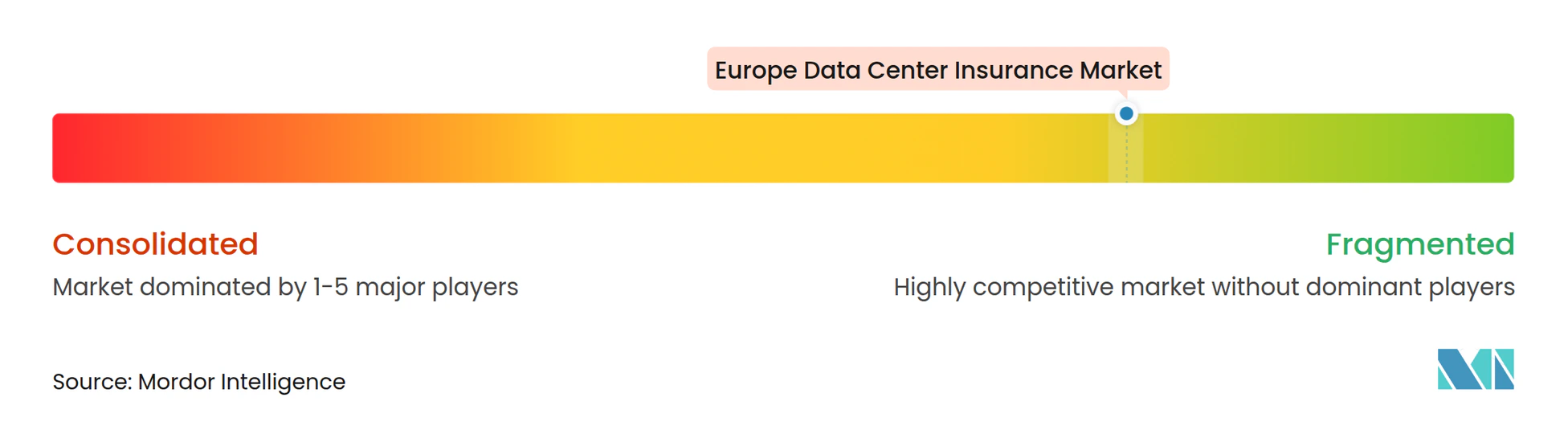
The Europe data center insurance market is moderately consolidated for large-account placement, while capacity below that level remains more fragmented. Global specialty insurers, major brokers, Lloyd’s syndicates, MGAs, and reinsurance-backed programs compete across different layers of the same risk. Their main differentiator is increasingly the ability to offer coordinated facilities across construction, cargo, property, cyber, business interruption, and liability. Aon expanded its Data Center Lifecycle Insurance Program to USD 5 billion in September 2026.[4] The program added up to USD 1 billion in terrorism capacity and extended third-party liability to USD 200 million globally. Munich Re’s ability to offer up to USD 250 million in net capacity on a single construction project supports its role in excess layers.
Parametric service-level agreement coverage remains an area with room for further capacity. It addresses cases where performance failure does not result in physical damage. Descartes launched a global parametric product in January 2026, providing up to USD 140 million of cover per policy for natural catastrophe risks. ATA also introduced a USD 750 million integrated AI infrastructure facility in January 2026. These moves show that insurers are competing through product structure and capacity coordination, not only policy pricing. The Europe data center insurance market also offers an opportunity for MGA-based programs in secondary locations with less established specialist support. Strong engineering data, exposure modeling, and resilience evidence are becoming important factors in winning capacity.
Large facilities favor insurers that can evaluate construction quality, fire protection, cooling design, power resilience, and cyber controls together. This raises the capability requirement for organizations that want to lead complex placements. Policyholders with detailed technical submissions and clear resilience measures are more likely to obtain capacity. Swiss Re has emphasized that its capacity decisions depend on a clear understanding of exposures and appropriate resilience measures. The effect is to favor well-documented operators with established risk engineering processes. Smaller or newer facilities may rely more on brokers and MGAs to improve submission quality and access specialist cover. Competitive strategies will therefore continue to center on integrated programs, technical knowledge, and capacity reliability. The Europe data center insurance market remains competitive, but large account leadership requires a specialized operational and underwriting platform.
Europe Data Center Insurance Industry Leaders
-
Aon plc
-
Marsh & McLennan Companies, Inc.
-
Allianz SE
-
AXA S.A.
-
Zurich Insurance Group AG
- *Disclaimer: Major Players sorted in no particular order
Europe Data Center Insurance Market Companies Covered in this Report
- Aon plc
- Marsh & McLennan Companies, Inc.
- Allianz SE
- AXA S.A.
- Zurich Insurance Group AG
- Munich Reinsurance Company
- Swiss Re Ltd.
- Chubb Limited
- American International Group, Inc.
- Lloyd's
- Arch Capital Group Ltd.
- SCOR SE
- Fidelis Insurance Holdings Limited
- Beazley plc
- QBE Insurance Group Limited
- Tokio Marine Holdings, Inc.
- The Travelers Companies, Inc.
- Berkshire Hathaway Inc.
- Sompo Holdings, Inc.
- HDI Global SE
Recent Industry Developments in Europe Data Center Insurance Market
- October 2026: HDI Global SE published detailed guidance on European data center climate and natural catastrophe risk, identifying micro-location flood exposure, flat-roof construction standards, inadequate emergency drainage and ground-level positioning of critical equipment, and operational preparedness gaps as key factors shaping coverage availability and policy terms across the continent. The guidance is directly influencing submission quality expectations in the London and European insurance markets.
- September 2026: Aon plc expanded its Data Center Lifecycle Insurance Program to USD 5 billion, adding up to USD 1 billion in terrorism capacity through existing Aon facilities, expanding third-party liability to USD 200 million globally, and incorporating climate risk advisory, environmental risk solutions, and operational resilience expertise through Aon Global Risk Consulting. This was the third capacity expansion of the program within 2026.
- June 2026: Zurich Gruppe Deutschland launched a specialized data center construction and operational insurance solution in the German market, combining construction-performance insurance with modular options for commissioning delays, operational transition, and business interruption, and drawing on more than 245 similar projects supported in the United States in 2025, with simultaneous rollouts in Italy and additional European markets planned during 2026.
- April 2026: Aon plc expanded the DCLP to USD 3.5 billion, the second capacity increase in 4 months, extending coverage to include existing operational data centers in their first year of operations and lifting third-party liability to USD 200 million globally, including USD 100 million in U.S. excess capacity.
Europe Data Center Insurance Market Report Scope
The Europe data center insurance market provides risk transfer and coverage solutions tailored to protect digital infrastructure. It encompasses policies for property damage, business interruption, cyber liability, equipment breakdown, and construction risks associated with data center facilities across the region.
The Europe Data Center Insurance Market Report is Segmented by Insurance Type (Property Damage Insurance, Business Interruption Insurance, Equipment Breakdown Insurance, Cyber Insurance, Natural Catastrophe Insurance, General and Third-Party Liability Insurance, Construction and Erection All-Risk Insurance, and Other Insurance Types), Coverage Structure (Standalone Policies, Combined Property and Business Interruption Policies, Package Policies, Parametric Insurance, and Captive and Self-Insurance Arrangements), Risk Exposure (Fire and Explosion, Electrical and Mechanical Equipment Failure, Power Supply Disruption, Flooding and Water Damage, Windstorms and Severe Weather, Earthquakes and Other Geophysical Hazards, Cyber-Related Operational Disruption, and Third-Party and Supply Chain Disruption), Policyholder (Data Center Owners and Operators, Colocation Providers, Cloud Service Providers, Data Center Developers and Contractors, and Data Center Equipment and Service Providers), Insurance Distribution Channel (Direct Insurance, Insurance Brokers and Consultants, Managing General Agents and Specialist Underwriting Agencies, and Reinsurance-Supported Insurance Programs), Data Center Size (Small, Medium, Large, and Hyperscale), Data Center Type (Colocation, Cloud Service Providers (CSPs), and Enterprise and Edge), and Geography (Germany, United Kingdom, France, Italy, Spain, Russia, and Rest of Europe). The Market Forecasts Are Provided in Terms of Value (USD).
Segmentation Overview
| Property Damage Insurance |
| Business Interruption Insurance |
| Equipment Breakdown Insurance |
| Cyber Insurance |
| Natural Catastrophe Insurance |
| General and Third-Party Liability Insurance |
| Construction and Erection All-Risk Insurance |
| Other Insurance Types |
| Standalone Policies |
| Combined Property and Business Interruption Policies |
| Package Policies |
| Parametric Insurance |
| Captive and Self-Insurance Arrangements |
| Fire and Explosion |
| Electrical and Mechanical Equipment Failure |
| Power Supply Disruption |
| Flooding and Water Damage |
| Windstorms and Severe Weather |
| Earthquakes and Other Geophysical Hazards |
| Cyber-Related Operational Disruption |
| Third-Party and Supply Chain Disruption |
| Data Center Owners and Operators |
| Colocation Providers |
| Cloud Service Providers |
| Data Center Developers and Contractors |
| Data Center Equipment and Service Providers |
| Direct Insurance |
| Insurance Brokers and Consultants |
| Managing General Agents and Specialist Underwriting Agencies |
| Reinsurance-Supported Insurance Programs |
| Small |
| Medium |
| Large |
| Hyperscale |
| Colocation |
| Cloud Service Providers (CSPs) |
| Enterprise and Edge |
| Germany |
| United Kingdom |
| France |
| Italy |
| Spain |
| Russia |
| Rest of Europe |
| By Insurance Type | Property Damage Insurance |
| Business Interruption Insurance | |
| Equipment Breakdown Insurance | |
| Cyber Insurance | |
| Natural Catastrophe Insurance | |
| General and Third-Party Liability Insurance | |
| Construction and Erection All-Risk Insurance | |
| Other Insurance Types | |
| By Coverage Structure | Standalone Policies |
| Combined Property and Business Interruption Policies | |
| Package Policies | |
| Parametric Insurance | |
| Captive and Self-Insurance Arrangements | |
| By Risk Exposure | Fire and Explosion |
| Electrical and Mechanical Equipment Failure | |
| Power Supply Disruption | |
| Flooding and Water Damage | |
| Windstorms and Severe Weather | |
| Earthquakes and Other Geophysical Hazards | |
| Cyber-Related Operational Disruption | |
| Third-Party and Supply Chain Disruption | |
| By Policyholder | Data Center Owners and Operators |
| Colocation Providers | |
| Cloud Service Providers | |
| Data Center Developers and Contractors | |
| Data Center Equipment and Service Providers | |
| By Insurance Distribution Channel | Direct Insurance |
| Insurance Brokers and Consultants | |
| Managing General Agents and Specialist Underwriting Agencies | |
| Reinsurance-Supported Insurance Programs | |
| By Data Center Size | Small |
| Medium | |
| Large | |
| Hyperscale | |
| By Data Center Type | Colocation |
| Cloud Service Providers (CSPs) | |
| Enterprise and Edge | |
| By Geography | Germany |
| United Kingdom | |
| France | |
| Italy | |
| Spain | |
| Russia | |
| Rest of Europe |
Key Questions Answered in the Report
What is the Europe data center insurance market size?
The Europe data center insurance market size is projected to grow from USD 2.11 billion in 2026 to USD 4.63 billion by 2032, at a CAGR of 13.48% during 2027-2032.
Which insurance type leads data center coverage in Europe?
Property Damage Insurance led with a 32.81% share in 2026 because physical assets remain the core exposure at major facilities.
What is driving cyber insurance demand for European data centers?
Operational technology connectivity, customer resilience requirements, DORA, and NIS2 are increasing demand for cyber protection.
Which country is the largest regional buyer of data center insurance?
Germany held 28.64% of the regional share in 2026, supported by its large installed infrastructure base and Frankfurt’s connectivity role.
Which European country is expected to grow fastest?
Spain is projected to grow at a CAGR of 14.61% through 2032, supported by its data center development pipeline and power-related advantages.
Why is parametric protection relevant for data centers?
Parametric cover can address defined service or event triggers where conventional policies may not respond because there is no physical damage.