
Europe Data Center Counter-Drone and Airspace Security Market Size and Share
Market Overview
| Study Period | 2021 - 2032 |
|---|---|
| Forecast Data Period | 2027 - 2032 |
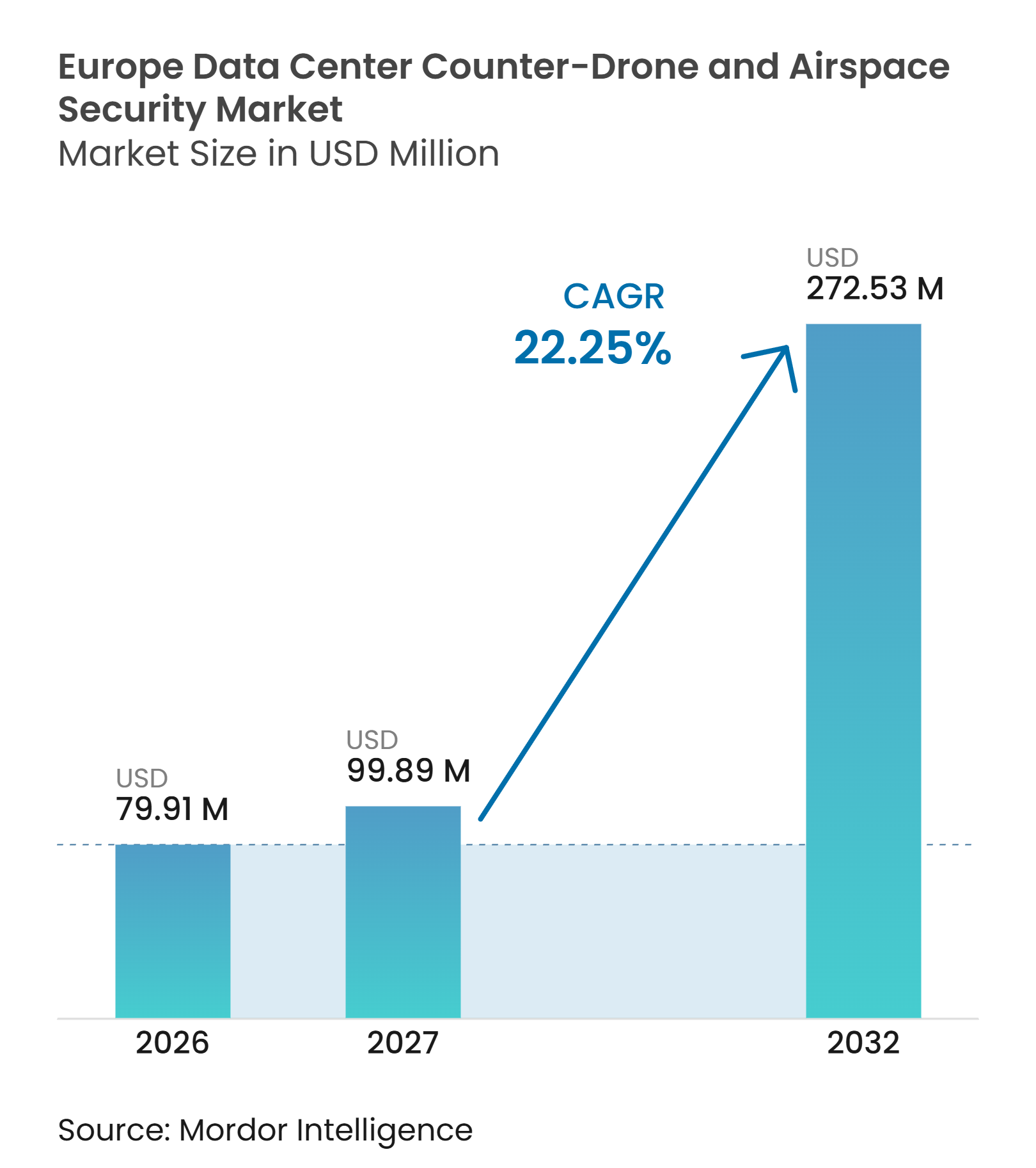
| Base Year Market Size (2026) | USD 79.91 Million |
| Market Size (2027) | USD 99.89 Million |
| Market Size (2032) | USD 272.53 Million |
| Growth Rate (2027 - 2032) | 22.25 % |
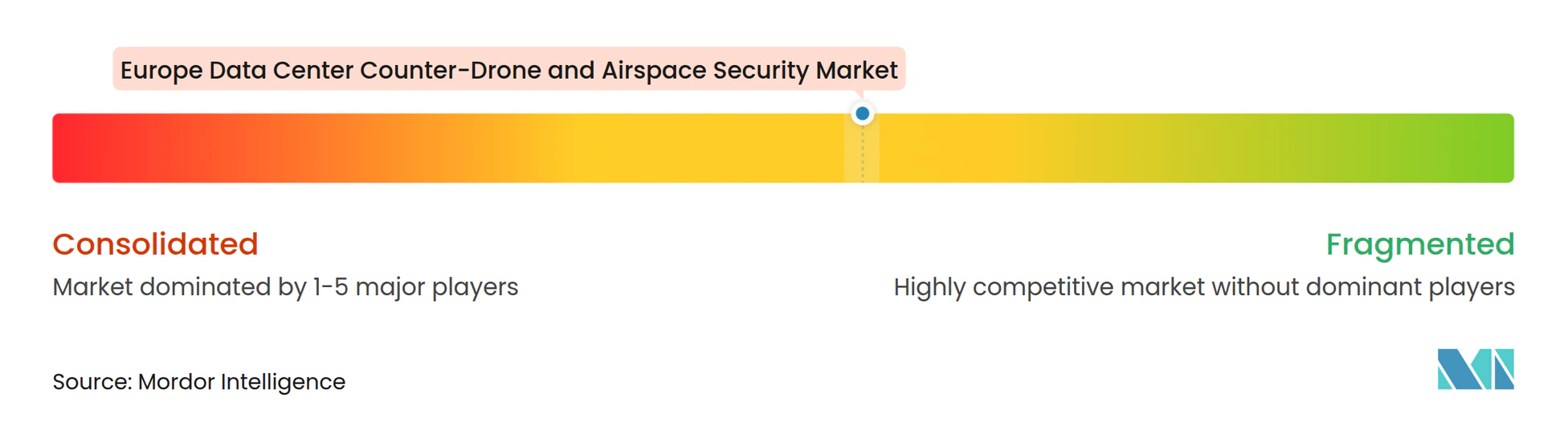
| Market Concentration | Medium |
Major Players *Disclaimer: Major Players sorted in no particular order Image © Mordor Intelligence. Reuse requires attribution under CC BY 4.0. | |
Europe Data Center Counter-Drone and Airspace Security Market Analysis by Mordor Intelligence
The Europe data center counter-drone and airspace security market size is projected to be USD 79.91 million in 2026, USD 99.89 million in 2027, and reach USD 272.53 million by 2032, growing at a CAGR of 22.25% from 2027 to 2032. The Europe data center counter-drone and airspace security market is shaped by the need to protect concentrated digital assets from aerial surveillance and physical disruption. Operators are treating the airspace above facilities as part of the security perimeter, particularly where cooling infrastructure, power systems, and fiber routes can be observed from above and used to identify vulnerabilities before an intrusion occurs. Demand also follows new data center construction, because newer sites in Southern Europe and the Nordics often build their physical security systems from the outset rather than adding aerial monitoring after operations have begun. Integrated detection and response systems are becoming more relevant as operators seek a single view across different sensor inputs. Regulation remains a limiting factor because many private operators can detect incursions but cannot independently take mitigation action.
Key Report Takeaways
- By component, hardware held 52.24% of the Europe data center counter-drone and airspace security market share in 2026, while software and analytics is projected to expand at a 23.45% CAGR through 2032.
- By technology, radio frequency detection and integrated multi-sensor systems each held 27.64% in 2026, while integrated multi-sensor systems are projected to expand at a 23.75% CAGR through 2032.
- By solution type, integrated counter-drone platforms accounted for 30.36% of the Europe data center counter-drone and airspace security market size in 2026 and are projected to expand at a 23.82% CAGR through 2032.
- By deployment type, fixed installations held 74.67% share in 2026, while mobile and portable systems are projected to expand at a 23.48% CAGR through 2032.
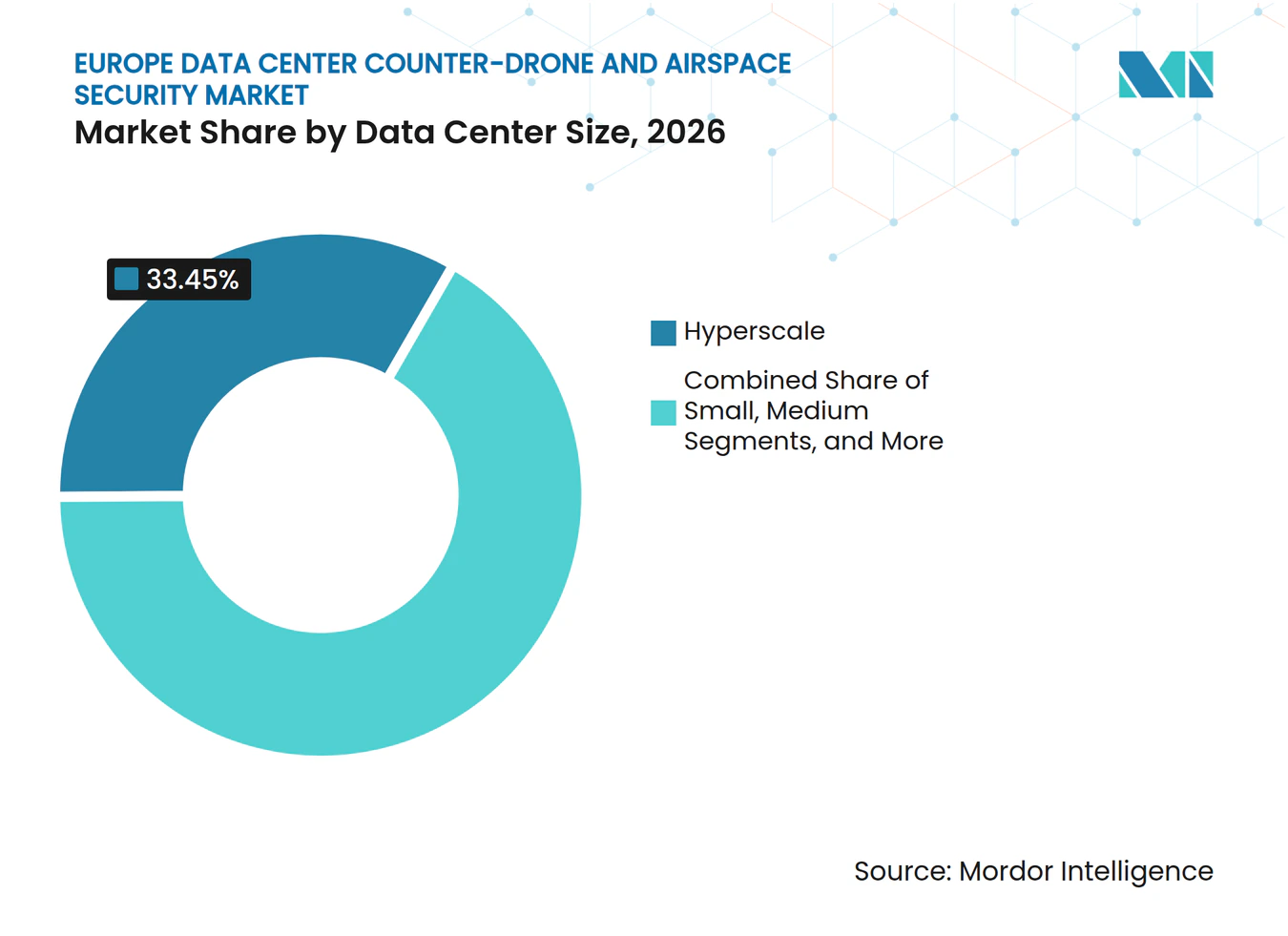
- By data center size, hyperscale facilities accounted for 33.45% share in 2026 and are projected to expand at a 23.66% CAGR through 2032.
- By data center type, colocation providers held 38.78% share in 2026, while cloud service providers are projected to expand at a 23.54% CAGR through 2032.
- By geography, the United Kingdom held 24.23% share in 2026, while Spain is projected to expand at a 23.83% CAGR through 2032.
Note: Market numbers in this report are based on Mordor Intelligence's proprietary estimation framework, which combines nine months of actuals with Q4 projections for base year 2026.
Market Trends and Insights
Drivers Impact Analysis of Europe Data Center Counter-Drone and Airspace Security Market*
| Driver | (~) % Impact on CAGR Forecast | Geographic Relevance | Impact Timeline |
|---|---|---|---|
| Expansion of Critical Infrastructure Counter-Drone Spending | +7.0% | Global, concentrated in the United Kingdom, Germany, and France | Short term (≤ 2 years) |
| Rising Protection Requirements for High-Value Data Center Assets | +5.5% | Global, concentrated in the FLAPD corridor | Medium term (2-4 years) |
| EU Counter-Drone Industrial and Regulatory Initiatives | +4.0% | European Union member states | Medium term (2-4 years) |
| Increasing Adoption of Integrated Multi-Sensor Detection | +3.0% | Global, concentrated in Western Europe | Medium term (2-4 years) |
| Data-Center SOC Integration and Offline Sovereign Processing | +1.5% | Global, with higher uptake in France and Germany | Long term (≥ 4 years) |
| Construction-Phase Aerial Reconnaissance Risk | +0.8% | Spain, the Nordics, and Eastern Europe | Short term (≤ 2 years) |
| Source: Mordor Intelligence | |||
Expansion of Critical Infrastructure Counter-Drone Spending
Government-led counter-drone spending is supporting demand across critical infrastructure, where data centers are increasingly treated as sensitive digital assets. Germany established a drone defense unit within the Federal Police and opened the Joint Drone Defense Center in December 2025 to coordinate federal and state capabilities.[1] The German government also set out measures to strengthen protection against drone threats through aviation security policy. These actions support procurement of sensors, command systems, and verified detection equipment for critical sites, while also making counter-drone planning more visible within national resilience and infrastructure-protection programs. The Europe data center counter-drone and airspace security market benefits when security requirements become part of site resilience planning. Data centers covered by essential-service obligations face a stronger case for documenting physical-security risks and maintaining visible protective controls.
Rising Protection Requirements for High-Value Data Center Assets
Data centers can be observed from the air without an intruder entering the site, which makes low-altitude surveillance a concern for facility managers. Drone flights can reveal cooling layouts, power distribution routes, fiber entrances, and construction activity. Dedrone reported a 4.3-times year-over-year increase in detections of do-it-yourself drone types during 2025, while 37.5% of detections occurred in low-visibility conditions.[2] Orange Business deployed its Drone Guardian solution at its Val-de-Reuil data center before offering the service to customers in March 2026.[3] This operating model places drone monitoring alongside continuity and perimeter-security processes, rather than treating it as a one-time purchase that sits outside everyday facility operations. The European Data Centre Association expects EUR 176 billion in cumulative European data center investment from 2026 to 2031, expanding the asset base that requires protection.
EU Counter-Drone Industrial and Regulatory Initiatives
The European Commission published its Action Plan on Drone and Counter Drone Security in February 2026. The plan includes a EUR 250 million call for land and maritime border surveillance, a Drone Security Package, and a proposed European Counter-Drone Centre of Excellence. It also identifies the need for clearer approaches to drone threats near critical infrastructure. This direction supports demand in the Europe data center counter-drone and airspace security market because digital infrastructure needs both detection capability and clear operating rules, especially when an operator must coordinate with police, aviation, and telecommunications authorities. The policy framework also places attention on testing, certification, and equipment supply chains. Operators may favor solutions that can meet future certification requirements without major system redesign, avoiding a later need to replace sensors, software, documentation processes, or approved equipment configurations over time.
Increasing Adoption of Integrated Multi-Sensor Detection
Single sensors do not provide reliable detection across every weather condition, operating environment, or drone-control method. Radio frequency tools can identify broadcasting aircraft, while radar can support detection of non-broadcasting targets. Optical, infrared, and acoustic tools add useful evidence but have operating limits linked to visibility, weather, distance, and surrounding noise. Dedrone identified the cost gap between a USD 20,000 threat drone and a USD 4 million response, which increases the value of accurate classification. Deutsche Telekom demonstrated a combined radio frequency, video, audio, and radar approach at Digital X in September 2026. The Europe data center counter-drone and airspace security market therefore favors platforms that bring varied sensor data into one operating picture.
Restraints Impact Analysis of Europe Data Center Counter-Drone and Airspace Security Market*
| Restraint | (~) % Impact on CAGR Forecast | Geographic Relevance | Impact Timeline |
|---|---|---|---|
| Regulatory Fragmentation for Detection and Mitigation Technologies | -2.0% | European Union member states, particularly cross-border operations | Medium term (2-4 years) |
| High Deployment and Lifecycle Costs for Layered Counter-Drone Systems | -1.5% | Global | Short term (≤ 2 years) |
| Air-Gapped Network Integration Complexity | -0.8% | Global, acute in Germany and the United Kingdom | Medium term (2-4 years) |
| Passive Remote ID Blind Spots Against Non-Broadcasting Drones | -0.5% | Global | Long term (≥ 4 years) |
| Source: Mordor Intelligence | |||
Regulatory Fragmentation for Detection and Mitigation Technologies
National rules continue to limit the ability of private site operators to act after detecting a drone. Active measures such as jamming, spoofing, and kinetic intervention are generally restricted because they affect radio spectrum use and aviation safety. A Royal Military Academy of Belgium study found that counter-UAS rules across European Union countries were often spread across aviation, police, defense, and telecommunications law. The result is a gap between detection and response for many civilian facilities. France and Austria have moved toward wider powers for eligible operators, but the regional approach remains uneven. The Europe data center counter-drone and airspace security market must therefore accommodate country-specific compliance requirements and escalation procedures.
High Deployment and Lifecycle Costs for Layered Counter-Drone Systems
Layered systems require radar, radio frequency detection, optical and infrared equipment, acoustic arrays, command software, and response tools where permitted. Initial equipment purchases are only one part of the expenditure. Sensor calibration, software subscriptions, threat-library updates, and operator training add recurring costs. Orange Drone Guardian uses a service model that moves detection and classification spending into an operating expense. This can lower the entry barrier for some operators but does not remove the need for a legally authorized response process, trained personnel, and practical coordination with public authorities. Smaller enterprise and edge facilities may find full perimeter coverage harder to justify than hyperscale campuses. Cost considerations can delay procurement in the Europe data center counter-drone and airspace security market, especially where funding for commercial sites is limited.
*Our forecasts treat driver/restraint impacts as directional, not additive. The impact forecasts reflect baseline growth, mix effects, and variable interactions.
Europe Data Center Counter-Drone and Airspace Security Market Segment Analysis
By Component:
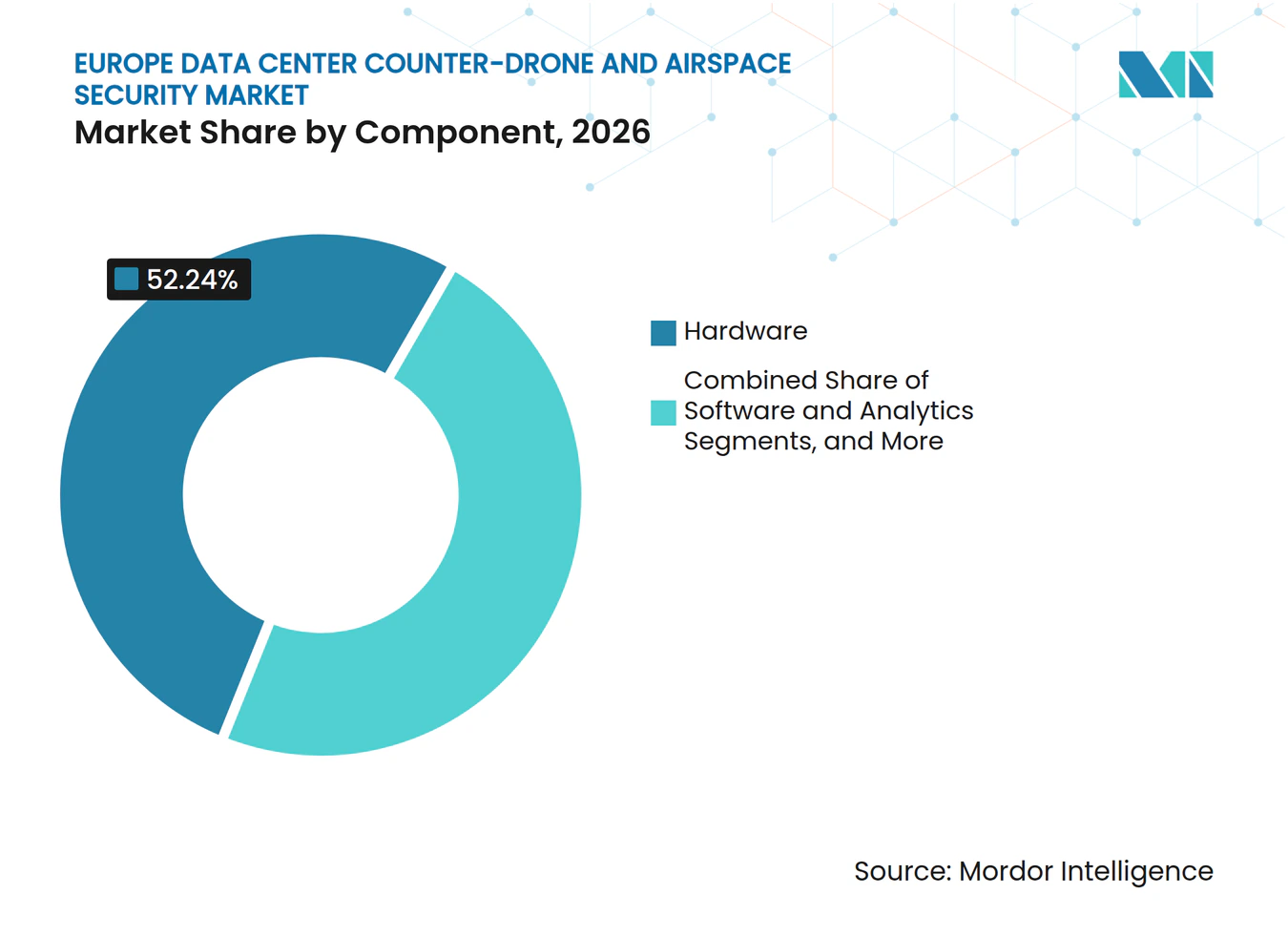
Hardware Anchors Revenue While Software and Analytics AccelerateHardware held 52.24% of the Europe data center counter-drone and airspace security market share in 2026 because a site needs physical sensing equipment before it can monitor its airspace. Radar units, radio frequency arrays, cameras, acoustic monitors, mounting structures, power connections, and communications links make up the core equipment layer. These items are often installed around rooftops, perimeter lines, and other locations with clear coverage. Hardware spending also includes the work needed to make those devices resilient in outdoor operating conditions, including their placement, communications links, power support, and connection to the protected site. Integration and support services occupy the middle of the component mix because site surveys, commissioning, and project coordination are necessary before equipment becomes operational.
Software and analytics is projected to expand at a 23.45% CAGR through 2032 in the Europe data center counter-drone and airspace security market size. Its role increases as operators connect multiple sensors and facilities through shared command-and-control environments. DroneShield launched DroneSentry-C2 Enterprise in October 2025 as a software platform for distributed counter-drone deployments across airports, energy facilities, and data centers. Software helps security teams combine alerts, evaluate classifications, manage operating records across sites, and reduce the need for personnel to interpret separate sensor feeds during a possible incident. Continued data center construction supports a hardware pipeline even as recurring analytics revenue gains importance. The European Data Centre Association's investment outlook indicates that the underlying infrastructure base will continue to expand through 2031.



By Technology:
Radio Frequency Detection and Integrated Multi-Sensor Systems Share LeadershipRadio frequency detection and integrated multi-sensor systems each accounted for 27.64% of the Europe data center counter-drone and airspace security market share in 2026. Radio frequency tools are relatively straightforward to deploy on existing rooftop and tower infrastructure. They can identify control and communication signals emitted by many low-altitude drones. Deutsche Telekom reported that its passive sensor approach could detect more than 90% of low-altitude drones in urban environments. This supports their use across broad industrial and infrastructure footprints, where passive coverage can provide early warning without requiring a separate sensor installation at every possible observation point.
Integrated multi-sensor systems are projected to expand at a 23.75% CAGR through 2032. The increase in do-it-yourself drones reported by Dedrone highlights a weakness in approaches that depend only on conventional control signals. Radar provides all-weather and low-light detection for targets that do not broadcast, while optical and infrared tools help verify the object. HENSOLDT upgraded Germany's ASUL system in May 2025 with improved sensor-effector integration and AI-supported classification. Acoustic tools add another input at close range, particularly where other sensors need confirmation. The Europe data center counter-drone and airspace security market is moving toward systems that prioritize classification quality rather than alert volume alone.
By Solution Type:
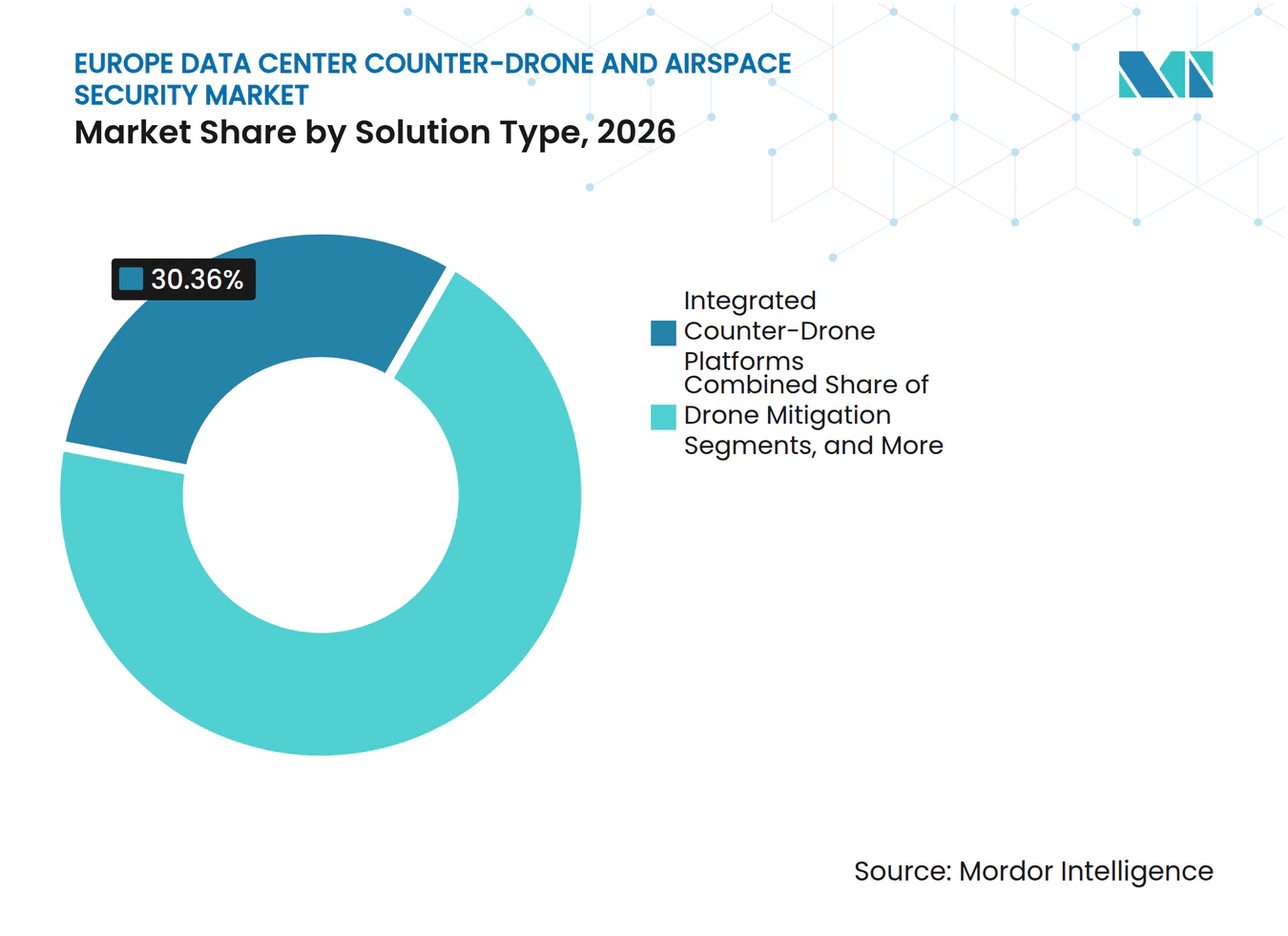
Integrated Platforms Lead Revenue and Forecast ExpansionIntegrated counter-drone platforms accounted for 30.36% of the Europe data center counter-drone and airspace security market size in 2026. These platforms combine sensing, tracking, classification, alerts, and system management within one operating environment. This approach suits data center security teams that need clear escalation workflows instead of separate alerts from unrelated devices, particularly when a security operations center must distinguish an authorized flight from a persistent surveillance event. Detection and identification solutions remain the entry point for first-time buyers. Tracking and classification functions then provide a clearer record of movement, route, and potential threat level.
Integrated counter-drone platforms are projected to expand at a 23.82% CAGR through 2032. Airspace monitoring and alerting tools provide automated notices to security staff and relevant authorities. Mitigation and response systems remain the most constrained solution category because civilian rules differ between countries. Safran's Skyjacker Advanced combines command-and-control with GNSS spoofing for swarm-drone neutralization, showing the technical availability of advanced response capability. The legal availability of those capabilities at commercial sites remains more limited, which keeps the current emphasis on detection, verification, documentation, and coordinated escalation. The Europe data center counter-drone and airspace security market is therefore likely to see detection-led platform purchases before wider response deployments.

By Deployment Type:
Fixed Installations Remain the Main ArchitectureFixed installations held 74.67% of the Europe data center counter-drone and airspace security market share in 2026. Data centers have stable locations, which makes permanent sensor placements practical over long operating periods. Operators can place sensors on rooftops, poles, and perimeter structures, then link them to the site's own security operations center. This model can be sized to cover known approaches and expanded when a campus adds buildings, which allows operators to match the equipment layout with a stable perimeter and an established operating plan. It is particularly suitable for large colocation and hyperscale facilities with established boundaries.
Mobile and portable systems are projected to expand at a 23.48% CAGR through 2032. They support construction-phase protection, temporary high-alert coverage, and coverage beyond the reach of fixed devices. They can also provide an accessible path for enterprise and edge sites that do not require permanent full-site coverage, including temporary activity during construction, maintenance work, and periods of elevated site risk. Blighter supplied B400 radars and BlighterNexus software for fixed and vehicle-mounted border surveillance in March 2026. That deployment shows how mobile equipment can connect with a common operating platform. The Europe data center counter-drone and airspace security market will use these systems as complements to fixed infrastructure rather than simple substitutes.
By Data Center Size:
Hyperscale Campuses Set Spending PrioritiesHyperscale facilities accounted for 33.45% of the Europe data center counter-drone and airspace security market share in 2026. These campuses concentrate large amounts of computing capacity, power infrastructure, and network equipment in one location. Their scale can make comprehensive detection coverage easier to justify in security planning because the potential consequences of detailed aerial reconnaissance can be disproportionate to the cost of extending sensor coverage. Large data centers follow the same logic because they have significant fixed assets and tenant obligations. Medium facilities are also potential buyers as sensor costs and managed-service options improve.
Hyperscale facilities are projected to expand at a 23.66% CAGR through 2032. Data4's Hanau campus illustrates the scale of projects that can support extensive airspace-security planning, with 25 hectares, capacity of up to 180 MW, and EUR 2 billion in investment, equivalent to USD 2.26 billion. Small data centers and edge nodes remain the most cost-sensitive sites. Portable solutions and subscription services are more suitable for these facilities than dense permanent sensor coverage. The Europe data center counter-drone and airspace security market will reflect the differing economics of each facility size. Coverage levels will depend on site value, operating footprint, and available response arrangements.
By Data Center Type:
Colocation Providers Lead Current SpendingColocation providers held 38.78% of the Europe data center counter-drone and airspace security market share in 2026. These facilities house multiple customers in shared physical infrastructure, which increases the impact of a perimeter-security failure. A drone-related incident may affect several tenant relationships at the same time. This shared exposure supports investment in broad detection and monitoring systems because reputational and contractual consequences can extend across every customer relationship in a shared facility, including customers with different audit, resilience, and physical-security expectations. Colocation operators also need to demonstrate consistent physical-security practices to customers with different compliance requirements.
Cloud service providers are projected to expand at a 23.54% CAGR through 2032. Their expansion into new European regions increases the number of facilities that need security planning from the construction stage. Enterprise and edge facilities represent a smaller part of spending but create dispersed locations that may need flexible protection models. SkeyDrone was selected by Elia for multi-site detection across Belgian electricity transmission infrastructure in September 2025. Such deployments establish a practical precedent for other critical-site operators. The Europe data center counter-drone and airspace security market benefits as monitoring becomes more common across adjacent infrastructure categories.
Geography Analysis
The United Kingdom held 24.23% of the Europe data center counter-drone and airspace security market share in 2026. London and South East England contain a high concentration of hyperscale campuses and financial-services infrastructure. These locations place substantial digital assets within dense urban and commercial areas. The United Kingdom also has a relatively advanced national-security focus on aerial threats. That environment supports early adoption of fixed detection and coordinated site-security procedures.
Germany is a major national market because Frankfurt is a leading European data center hub. The country's critical-infrastructure framework includes large data centers, creating a stronger basis for security obligations. Germany invested EUR 100 million, equivalent to USD 113 million, in a 130-person federal drone defense unit and opened the Joint Drone Defense Center in December 2025. The Federal Office for Information Security identifies drone threats as a risk area for organizations and infrastructure operators. France also contributes materially because approved critical-infrastructure operators have a clearer route toward active counter-drone measures. Orange Business used sovereign cloud infrastructure qualified by ANSSI for the Val-de-Reuil deployment.
Spain is projected to expand at a 23.83% CAGR through 2032 in the Europe data center counter-drone and airspace security market size. Hyperscale investment, renewable-energy availability, and subsea cable connections support its position as a developing data center location. The European Data Centre Association identified Spain, Italy, and Portugal among Europe's faster-expanding data center locations, where investment is supported by favorable climates and government incentives for digital infrastructure. Spain has more first-time security deployments than the more established markets of France and Germany. The Rest of Europe category includes the Nordics, Poland, and Baltic states, where new campuses, renewable power, regional-security concerns, and government directives support adoption. Denmark amended its air-traffic law in July 2025 to extend drone-neutralization rights to selected authorities and operators responsible for critical sites.
Competitive Landscape
Market Concentration
The Europe data center counter-drone and airspace security market includes defense primes, specialized counter-drone suppliers, and telecom-linked infrastructure operators. HENSOLDT, Rheinmetall, Thales, Safran, BAE Systems, Leonardo, and Saab bring established sensor, command-and-control, and public-sector procurement capabilities. Their products often originated in defense settings and are being adapted for fixed civilian sites. HENSOLDT's ASUL and Elysion Mission Core, Safran's Skyjacker Advanced, and Saab's Loke concept combine layers of radar, optical sensing, and electronic-warfare capability. These suppliers can offer established equipment portfolios to customers that need resilient multi-sensor architectures.
HENSOLDT signed a memorandum of understanding with TYTAN Technologies in January 2026 to integrate interceptor drones with its Elysion Mission Core software. Rheinmetall and Deutsche Telekom announced a collaboration in May 2026 to develop a civilian drone-defense approach for cities and critical infrastructure in Germany. Orange Business launched Drone Guardian in March 2026 as a subscription-based detection, identification, and classification service. These moves show the relevance of partnerships, managed services, and shared infrastructure. They also provide options for customers that do not want to build a complete system alone.
DroneShield, Dedrone, CERBAIR, SkeyDrone, and Senhive compete through specialization, rapid deployment, and software-led approaches. DroneShield reported additional European military contracts worth USD 23.2 million in July 2026 and continued development of a European manufacturing and assembly capability. Telecom providers can use tower networks for wide-area passive radio frequency detection and multi-tenant services, which gives them a channel that differs from a single-site defense-equipment sale. A future European certification approach could influence procurement where public policy affects buying decisions. The supplier base remains fragmented across defense contractors, specialized providers, and telecom-linked service companies. This structure leaves room for managed-service offers in mid-sized data centers.
Europe Data Center Counter-Drone and Airspace Security Industry Leaders
-
Dedrone Holdings, Inc.
-
Thales S.A.
-
DroneShield Limited
-
HENSOLDT AG
-
Leonardo S.p.a.
- *Disclaimer: Major Players sorted in no particular order
Europe Data Center Counter-Drone and Airspace Security Market Companies Covered in this Report
- Airbus SE
- Axon Enterprise, Inc.
- BAE Systems plc
- Blighter Surveillance Systems Limited
- CERBAIR SAS
- Drone Defense Limited
- DroneShield Limited
- HENSOLDT AG
- Indra Sistemas, S.A.
- Leonardo S.p.a.
- MBDA S.A.S.
- QinetiQ Group plc
- Rheinmetall AG
- Saab AB
- Safran S.A.
- Senhive NV
- SkeyDrone NV
- Thales S.A.
- Orange Business
- Dedrone Holdings, Inc.
Recent Industry Developments in Europe Data Center Counter-Drone and Airspace Security Market
- September 2026: Deutsche Telekom and T-Systems demonstrated live radio frequency drone detection publicly for the first time at Digital X in Cologne, using a multi-tenant passive RF sensor network capable of detecting more than 90% of low-altitude drones and pinpointing pilot locations. Customers include government agencies, airports, and industrial infrastructure operators.
- July 2026: DroneShield Limited received a package of contracts totaling USD 23.2 million from a European reseller for a European military end-customer, alongside the release of RfAI-3, its third-generation proprietary RF detection engine, which DroneShield described as a significant evolution in counter-drone doctrine.
- June 2026: Safran Electronics and Defense signed a contract with a European country for delivery of its Skyjacker Advanced counter-drone solution, which combines command-and-control with GNSS spoofing to neutralize swarm drones. The contract reinforces Safran's positioning as a provider of critical counter-drone equipment for national sovereign capability programs.
- May 2026: Rheinmetall AG and Deutsche Telekom announced a collaboration to develop a joint drone defense shield for cities and critical infrastructure across Germany, combining Rheinmetall's C-UAS hardware portfolio with Telekom's nationwide tower network and RF detection expertise, to be presented initially at the AFCEA security trade show in Bonn.
Europe Data Center Counter-Drone and Airspace Security Market Report Scope
The Europe Data Center Counter-Drone and Airspace Security Market refers to the ecosystem of technologies, solutions, and services designed to detect, identify, monitor, track, and mitigate unauthorized drones and other low-altitude aerial threats within and around data center facilities across Europe.
The Europe Data Center Counter-Drone and Airspace Security Market encompasses hardware, software, and services for detecting, identifying, tracking, monitoring, and mitigating unauthorized drones across data centers in the United Kingdom, Germany, France, Spain, and Rest of Europe. The market is Segmented by Component (Hardware, Software and Analytics, and Integration and Support Services), Technology (Radar-Based Detection, Radio Frequency Detection, Electro-Optical and Infrared Detection, Acoustic Detection, and Integrated Multi-Sensor Systems), Solution Type (Drone Detection and Identification, Drone Tracking and Classification, Airspace Monitoring and Alerting, Drone Mitigation and Response, and Integrated Counter-Drone Platforms), Deployment Type (Fixed Installations, and Mobile and Portable Systems), Data Center Size (Small, Medium, Large, and Hyperscale), Data Center Type (Colocation, Cloud Service Providers (CSPs), and Enterprise and Edge), Geography (United Kingdom, Germany, France, Spain, and Rest of Europe). The Market Forecasts are Provided in Terms of Value (USD).
Segmentation Overview
| Hardware |
| Software and Analytics |
| Integration and Support Services |
| Radar-Based Detection |
| Radio Frequency Detection |
| Electro-Optical and Infrared Detection |
| Acoustic Detection |
| Integrated Multi-Sensor Systems |
| Drone Detection and Identification |
| Drone Tracking and Classification |
| Airspace Monitoring and Alerting |
| Drone Mitigation and Response |
| Integrated Counter-Drone Platforms |
| Fixed Installations |
| Mobile and Portable Systems |
| Small |
| Medium |
| Large |
| Hyperscale |
| Colocation |
| Cloud Service Providers (CSPs) |
| Enterprise / Edge |
| United Kingdom |
| Germany |
| France |
| Spain |
| Rest of Europe |
| By Component | Hardware |
| Software and Analytics | |
| Integration and Support Services | |
| By Technology | Radar-Based Detection |
| Radio Frequency Detection | |
| Electro-Optical and Infrared Detection | |
| Acoustic Detection | |
| Integrated Multi-Sensor Systems | |
| By Solution Type | Drone Detection and Identification |
| Drone Tracking and Classification | |
| Airspace Monitoring and Alerting | |
| Drone Mitigation and Response | |
| Integrated Counter-Drone Platforms | |
| By Deployment Type | Fixed Installations |
| Mobile and Portable Systems | |
| By Data Center Size | Small |
| Medium | |
| Large | |
| Hyperscale | |
| By Data Center Type | Colocation |
| Cloud Service Providers (CSPs) | |
| Enterprise / Edge | |
| Market Size and Forecast by Geography | United Kingdom |
| Germany | |
| France | |
| Spain | |
| Rest of Europe |
Key Questions Answered in the Report
What is the size of the Europe data center counter-drone and airspace security market?
The Europe Data Center Counter-Drone and Airspace Security Market is projected at USD 79.91 million in 2026, USD 99.89 million in 2027, and USD 272.53 million by 2032, at a 22.25% CAGR from 2027 to 2032.
Why are data center operators adopting counter-drone systems?
Drone monitoring can help operators detect aerial observation of cooling systems, power infrastructure, fiber routes, and construction activity.
Which technology is expanding fastest across European sites?
Integrated multi-sensor systems are projected to expand at a 23.75% CAGR through 2032 because they combine several detection inputs.
Which data center facilities account for the largest share of spending?
Colocation providers held 38.78% share in 2026, while hyperscale facilities held 33.45% share by data center size.
Which country has the largest current presence?
The United Kingdom held 24.23% share in 2026, supported by major data center campuses and financial-services infrastructure.
What limits wider use of drone mitigation tools at data centers?
Civilian operators in many countries can detect drones but have limited authority to use jamming, spoofing, or other active countermeasures.