
Europe Bottling Line Cleaning Machinery Market Size and Share
Market Overview
| Study Period | 2021 - 2032 |
|---|---|
| Forecast Data Period | 2027 - 2032 |
| Base Year Market Size (2026) | USD 13.68 Million |
| Market Size (2027) | USD 14.44 Million |
| Market Size (2032) | USD 17.63 Million |
| Growth Rate (2027 - 2032) | 4.07 % |
| Market Concentration | Medium |
Major Players *Disclaimer: Major Players sorted in no particular order Image © Mordor Intelligence. Reuse requires attribution under CC BY 4.0. | |
Europe Bottling Line Cleaning Machinery Market Analysis by Mordor Intelligence
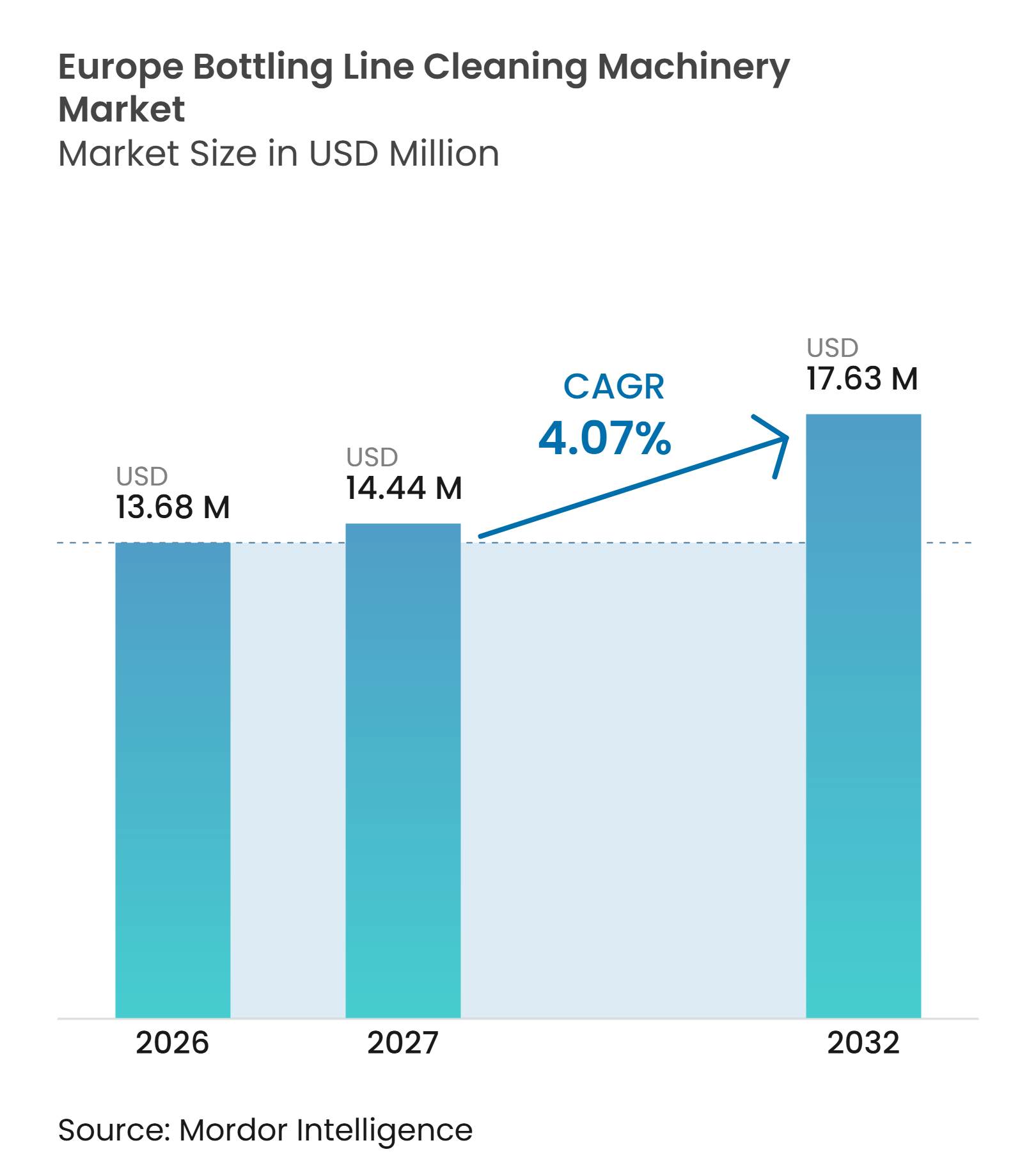
The Europe Bottling Line Cleaning Machinery Market size is expected to grow from USD 13.68 million in 2026 to USD 14.44 million in 2027 and is forecast to reach USD 17.63 million by 2032 at 4.07% CAGR over 2027-2032.
Regulation (EU) 2025/40 is bringing reusable beverage packaging and bottle reconditioning into the same investment cycle across Europe. The rule requires bottles in reuse systems to meet cleaning and performance requirements before they return to circulation. This makes washer performance a compliance consideration rather than only an operating choice. Producers are therefore reviewing returnable-glass capacity, water use, energy use, and digital control options together. The Europe bottling line cleaning machinery market also reflects a divide between large, specification-led projects and smaller retrofit programs for established sites.
Key Report Takeaways
- By machine type, rotary bottle washers held 34.08% of the Europe bottling line cleaning machinery market share in 2026, while combined washer-dryer systems are projected to expand at a 5.47% CAGR through 2032.
- By automation level, fully automatic systems held 65.58% of revenue in 2026 in the Europe bottling line cleaning machinery market, and the segment is expected to grow at a CAGR of 4.66% through 2032.
- By bottle material, glass bottles accounted for 68.59% of revenue in 2026, while plastic bottles are projected to grow at a 4.61% CAGR through 2032.
- By end user, breweries and soft-drink producers held 36.77% of revenue in 2026, while pharmaceutical manufacturers are projected to expand at a 5.22% CAGR through 2032.
- By geography, Germany held 27.19% of revenue in 2026, while the rest of Europe is projected to expand at a 5.03% CAGR through 2032.
Note: Market numbers in this report are based on Mordor Intelligence's proprietary estimation framework, which combines nine months of actuals with Q4 projections for base year 2026.
Market Trends and Insights
Drivers Impact Analysis of Europe Bottling Line Cleaning Machinery Market*
| Driver | (~) % Impact on CAGR Forecast | Geographic Relevance | Impact Timeline |
|---|---|---|---|
| Expansion of Reusable Beverage Packaging | +1.3% | Global, with early gains in Germany, France, and Belgium | Short term (≤ 2 years) |
| Replacement of Aging European Bottling Lines | +1.0% | Germany, Italy, and France | Medium term (2-4 years) |
| Demand for Water and Energy-Efficient Cleaning | +0.7% | Germany, France, and the Netherlands | Medium term (2-4 years) |
| Growth of High-Throughput Returnable Glass Bottling | +0.5% | Germany and Rest of Europe | Medium term (2-4 years) |
| Multi-Format Line Modernization for Glass and PET | +0.4% | Europe, with early gains across Western Europe | Long term (≥ 4 years) |
| Digital Monitoring and Predictive Maintenance Adoption | +0.3% | Europe, with strongest activity in Germany and the United Kingdom | Long term (≥ 4 years) |
| Source: Mordor Intelligence | |||
Expansion of Reusable Beverage Packaging
Regulation (EU) 2025/40 is the central policy driver for reusable beverage packaging in the Europe bottling line cleaning machinery market. The regulation entered into force on February 11, 2025, and sets reuse targets for beverage packaging placed on the European market.[1] It requires distributors to make at least 10% of alcoholic and nonalcoholic beverages available in reusable packaging within reuse systems by January 1, 2030. That requirement rises to 40% by 2040 under the regulation. Annex VI Part B also requires reusable packaging to pass cleaning and performance checks before it can reenter circulation. German and French producers are responding by reassessing installed washers against future reconditioning needs, which favors machines that can document consistent cleaning outcomes.
Replacement of Aging European Bottling Lines
A large installed base of older bottling equipment is supporting modernization work alongside new production-line investment. Many established washing lines have operated for 20 to 30 years, even where the frame remains usable. KHS stated in 2026 that control units and software can reach their operating limits before the mechanical structure does. Full replacement can interrupt production for weeks when a heavily integrated machine is difficult to remove from the building. In some sites, the work may require opening the facility roof to extract the equipment. In-situ conversions and targeted retrofits therefore offer operators a route to better hygiene control and line performance while avoiding a full shutdown, maintaining demand for both OEM equipment and service partners.
Demand for Water and Energy-Efficient Cleaning
Bottle washing uses heated caustic solution, fresh water, and spray-pump electricity, so lower resource use has become a material procurement issue. Krones introduced its Lavasonic HI system in September 2025 with ultrasonic pretreatment and high-pressure jetting designed to loosen dirt and labels. The company stated that the system can reduce thermal energy use by up to 30%, freshwater use by up to 20%, and carbon dioxide emissions by up to 35% compared with conventional double-end washers. KHS has also positioned its ECO carrier 2.0 and Liquid Efficiency Spraying System as ways to limit heat, liquid carryover, and spray-pump demand. These measures can improve the economics of a capital-intensive purchase because operating savings reduce the time required to recover the equipment cost. The Europe bottling line cleaning machinery market is consequently placing more value on documented resource performance as producers align line upgrades with environmental requirements.
Growth of High-Throughput Returnable Glass Bottling
Returnable-glass capacity projects are driving demand for cleaning systems that can keep pace with high filling-line speeds. Krones is supplying the full bottling technology for Bayreuther Brauhaus in Bavaria, including a returnable-glass line designed for 40,000 bottles per hour. Equipment delivery was scheduled for mid-2026, with production expected by the end of 2026. Coca-Cola Europacific Partners Deutschland also installed a returnable-glass line in Lüneburg that includes Krones' Parcival caustic filtration system. The system continuously filters up to 3 cubic meters of caustic solution per hour, returning it to the process cycle. Krombacher Brewery is separately modernizing 8 returnable-glass lines rated at 60,000 bottles per hour, which illustrates the scale of equipment renewal in established German breweries
Restraints Impact Analysis of Europe Bottling Line Cleaning Machinery Market*
| Restraint | (~) % Impact on CAGR Forecast | Geographic Relevance | Impact Timeline |
|---|---|---|---|
| High Capital Cost of Integrated Automatic Systems | -1.0% | Europe, with greatest pressure in Southern and Eastern Europe | Short term (≤ 2 years) |
| Skilled Maintenance Technician Shortages | -0.5% | Europe, with strongest pressure in Germany and the United Kingdom | Medium term (2-4 years) |
| Site-Specific Validation for Heterogeneous Returnable Bottles | -0.4% | Asia-Pacific core, with spillover to Rest of Europe | Long term (≥ 4 years) |
| Cybersecurity and Integration Exposure in Connected Equipment | -0.2% | Europe, with highest risk in Germany, the United Kingdom, and the Netherlands | Long term (≥ 4 years) |
| Source: Mordor Intelligence | |||
High Capital Cost of Integrated Automatic Systems
Fully automatic systems held 65.58% of 2026 revenue, but their purchase cost can be difficult for smaller producers and contract packagers to absorb. Combined washer-dryer systems add conveying, cleaning, drying, and inspection functions in one line. This configuration requires a longer payback commitment than a focused retrofit or a semi-automatic machine. The burden is strongest in smaller operations across Southern and Eastern Europe, where production volumes may not support a full-line replacement. Semi-automatic and retrofit programs can reduce the initial commitment, but they offer lower throughput and may provide less scope to meet stricter reconditioning requirements. EU circular-economy financing can partly offset costs, although smaller operators may still face administrative barriers when seeking support.
Skilled Maintenance Technician Shortages
Connected bottle washers depend on programmable controls, sensors, and cleaning programs that need qualified maintenance support. Their service needs include mechanical overhauls, chemical calibrations, sensor checks, and troubleshooting of digitally integrated systems. KHS has introduced tools including the ConnectApp Guide and augmented reality support to help maintenance teams manage scheduled tasks and obtain remote assistance. These tools can improve access to information and reduce reliance on paper procedures. They cannot replace the hands-on work needed for mechanical servicing or validation of critical cleaning parameters. As ultrasonic modules and adaptive cleaning programs become more common, a shortage of specialist maintenance capacity may limit the performance of installed equipment.
*Our forecasts treat driver/restraint impacts as directional, not additive. The impact forecasts reflect baseline growth, mix effects, and variable interactions.
Europe Bottling Line Cleaning Machinery Market Segment Analysis
By Machine Type:
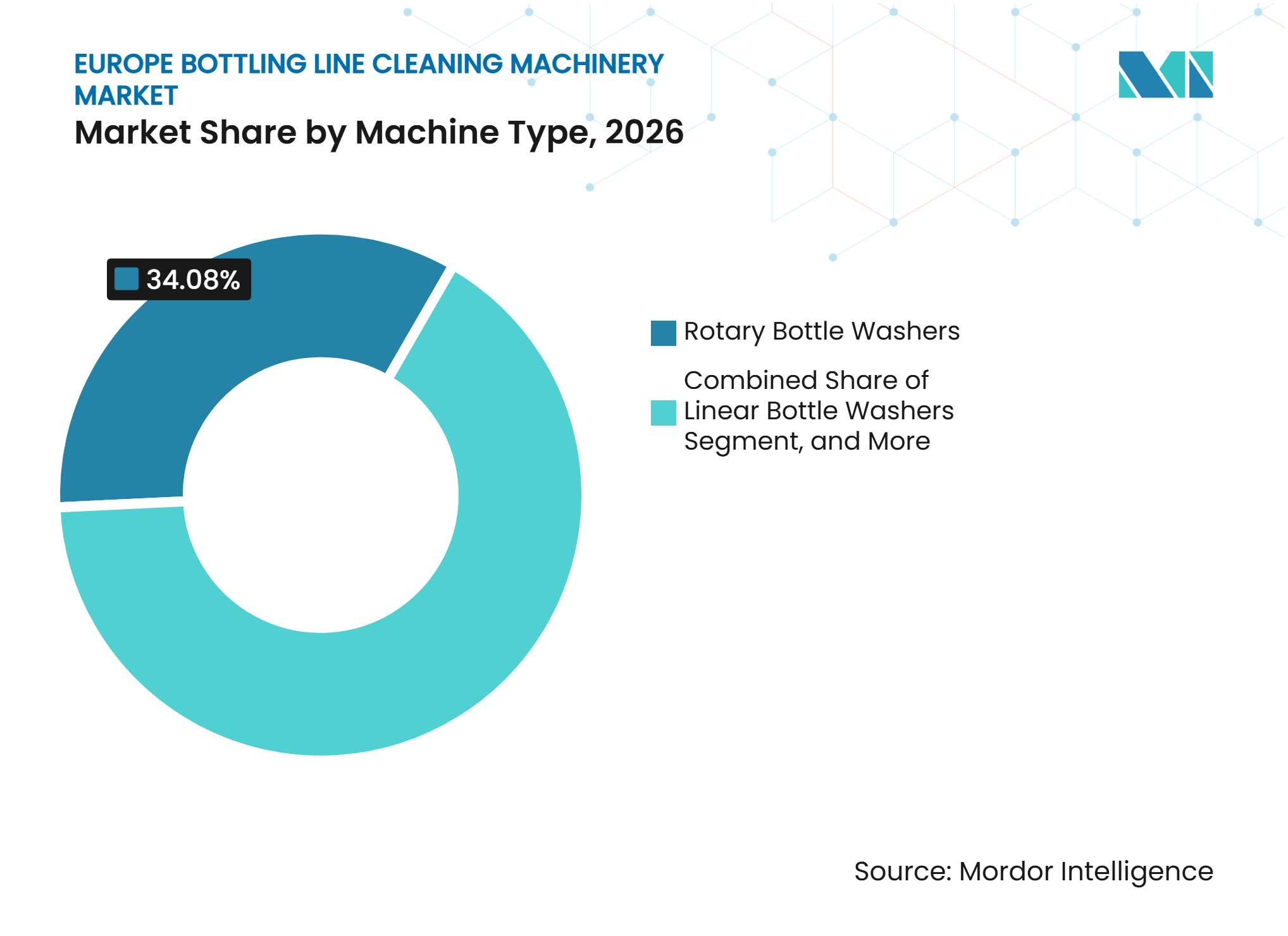
Combined Systems Support Compact New LinesRotary bottle washers held 34.08% of market revenue in 2026. Their position reflects proven carousel processing for high-throughput returnable-glass lines. These machines deliver consistent handling for breweries and beverage producers that require continuous operation. Krones launched the Lavasonic HI, a next-generation double-end washer, in September 2025. The system uses ultrasonic pretreatment before washing and was designed to process bottles with different levels of soiling. Krones stated that the technology can reduce treatment time by up to 40% and lower mechanical stress on bottles by up to 50%. That approach supports rotary equipment in returnable streams where labels, residues, and bottle condition can vary. The established base of high-speed glass lines therefore continues to underpin demand for rotary systems.
Combined washer-dryer systems are projected to expand at a 5.47% CAGR through 2032, the highest rate among machine types. Producers are selecting integrated configurations to consolidate the line footprint and reduce capital per unit of capacity. This is relevant in mid-volume pharmaceutical and food applications, where floor space and hygiene requirements must be addressed together. Linear washers remain relevant for lower-volume use cases. Tunnel washers continue to play a role in pharmaceutical applications that require controlled cleaning conditions. Immersion washers, rinsers, and blowers serve narrower needs in wine, spirits, and specialized bottling lines. Other machine types, including in-place caustic circulation systems, support supplementary cleaning in multi-product filling environments. The European bottling line cleaning machinery market is therefore retaining distinct machine roles rather than moving toward a single universal architecture. Buyers assess the production rate, bottle condition, cleaning chemistry, and available footprint before choosing between these layouts. Established beverage lines often retain proven rotary platforms, whereas new projects can evaluate combined arrangements at the planning stage. This preserves demand across separate machine families rather than concentrating purchases on a single format.



By Automation Level:
Fully Automatic Lines Remain the Core ConfigurationFully automatic systems accounted for 65.58% of market revenue in 2026. High-throughput returnable-glass operations use these systems because downtime and inconsistent hygiene can carry high operating costs. Automation also provides repeatable control over cleaning sequence, temperature, chemical use, and bottle movement. KHS presented the Innoclean Cascade D as a fully automatic double-end system with commercial availability planned from mid-2026. The machine has a 10% smaller footprint than its predecessor by increasing its height by 50 centimeters. This design responds to a frequent constraint at facilities that have limited floor space. It also shows why automation upgrades are not limited to throughput alone.
The shift from semi-automatic to fully automatic cleaning is continuing in bottling operations across Europe. Eastern European beverage sites and food and dairy producers still offer room for further automation. Their installed systems may have been designed for lower output or more direct operator involvement. Fully automatic equipment can improve process consistency when operators face more varied container streams and tighter hygiene expectations. Manual systems remain relevant for small wineries and distilleries in France, Italy, and Spain. Those businesses may run batches that cannot justify the investment in a fully integrated system. Semi-automatic equipment remains an intermediate option for contract packagers that need to control spending. This range of configurations keeps automation choice closely tied to volume, available space, and the complexity of the bottles handled. The choice also depends on whether a line handles a consistent returnable format or frequent changes between containers and products. Producers may sequence automation spending alongside broader filling-line work, rather than replacing every function at once. That purchasing pattern keeps manual and semi-automatic equipment relevant in select operations, while automatic systems remain the primary revenue driver.
By Bottle Material:
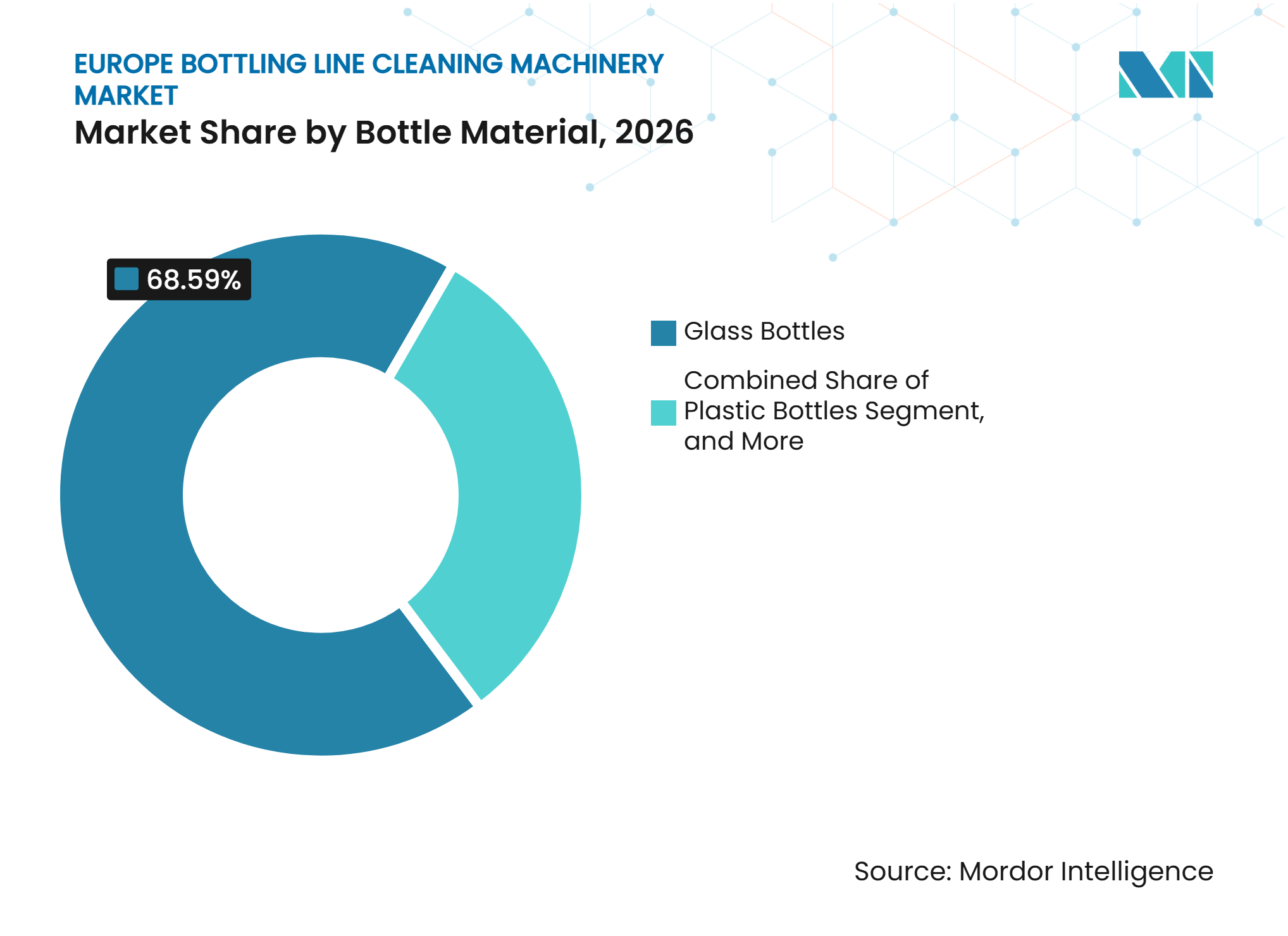
Glass Retains the Largest Installed BaseGlass bottles accounted for 68.59% of market revenue in 2026. This reflects the established returnable beverage systems used across European breweries and soft-drink operations. Germany's deposit-return system processes glass bottles and PET containers through organized collection and return channels. Repeated washing and refilling sustain demand for cleaning equipment across the installed base. Glass also suits multi-cycle use, which aligns with the direction of EU reuse policy. High-capital washer installations tend to have long operating lives, supporting recurring replacement and upgrade work. The Europe bottling line cleaning machinery market size linked to glass remains supported by this durable returnable infrastructure.
Plastic bottles are projected to expand at a 4.61% CAGR through 2032. EU recycled-content requirements for single-use PET bottles are increasing attention on handling, rinsing, and blow-cleaning needs within deposit-return streams. Post-consumer collection can introduce contamination that differs from controlled returnable-glass loops. Metal and aluminum containers represent a smaller application area that is relevant to energy drinks and premium carbonated beverages. In-line can washers and rinsers are increasingly included in automated production layouts. Glass, PET, and metal each require different temperature ranges, chemical compatibility, and handling approaches. Those differences limit direct substitution between cleaning systems and support specialist equipment offerings. Material choice therefore remains a practical factor in supplier selection and system design. Equipment providers must therefore match wash temperature, chemical exposure, handling pressure, and inspection needs to the bottle or container in use. This requirement is especially relevant where a plant operates both returnable and single-use formats across separate production runs. The result is a continuing need for specialized systems even as manufacturers seek common controls and lower operating costs.

By End User:
Beverage Producers Provide the Largest Revenue BaseBreweries and soft-drink producers held 36.77% of market revenue in 2026. Beer and carbonated beverage production support large investments in returnable glass in Germany, Belgium, the Czech Republic, and other established brewing markets. These operations commonly use continuous lines where equipment reliability and cycle efficiency are central to output. The operating model supports demand for both new equipment and ongoing service work. Bottled-water producers also contribute to demand across bottle-washing and rinsing applications. Wineries and distilleries require equipment that can accommodate different bottle shapes and more varied production schedules. Food and dairy producers are driving demand for hybrid lines that can handle glass and PET formats.
Pharmaceutical manufacturers are projected to expand at a 5.22% CAGR through 2032, the fastest end-user rate of growth. The rise in biologic drug filling is increasing the need for systems that meet stringent cleaning validation requirements in Western Europe. These applications require equipment capable of removing verified residues at very low levels. Regulatory requirements and pharmaceutical demand are supporting investment in cleaning-critical packaging equipment. Demand for GLP-1 drug filling, aseptic processes, isolator technologies, and freeze-drying systems reinforces this need. Contract packaging and bottling companies complete the demand base, particularly for modular lines with rapid changeovers. Their multi-client schedules can favor systems that are adaptable without compromising cleaning control. Their work requires predictable cleaning performance across different client products, bottle formats, and scheduled changeovers. A modular approach can allow service providers to adapt capacity without installing an entirely separate dedicated line for every customer. This makes flexibility and documented hygiene performance important procurement factors alongside purchase price.
Geography Analysis
Germany
Germany held 27.19% of the Europe bottling line cleaning machinery market share in 2026, supported by its role as both the leading demand center and a major manufacturing base for high-performance cleaning equipment. The country's deposit-return system creates recurring bottle collection, washing, and refilling activity across breweries, mineral-water producers, and soft-drink companies, while giving operators a large installed base that requires periodic service and modernization. Krones is supplying the Bayreuther Brauhaus project in Bavaria with a returnable-glass line designed for 40,000 bottles per hour, and Krombacher Brewery is conducting a phased modernization of 8 high-speed returnable-glass lines. Germany's machinery cluster links equipment development with use at nearby beverage sites, enabling earlier use of resource-efficient washers, digital service tools, and high-output configurations. PPWR compliance will keep reconditioning performance prominent in investment plans, as reusable packaging must meet cleaning and performance requirements before circulation
Nordic, Iberian, Italian, and United Kingdom Markets
Italy broadens the supply base of the Europe bottling line cleaning machinery market through producers of rinsers, blowers, and specialized washing systems that serve domestic users and export markets, particularly in glass-intensive wine and spirits production. Spain requires flexible, multi-format, single-end washers because wine and spirits producers use varied bottle shapes, while Nordic markets drive demand through established beverage operations that prioritize water and energy efficiency. The United Kingdom has demand associated with pharmaceutical and premium food and beverage production, and France's France 2030 plan has allocated EUR 400 million (USD 436 million) to health-product manufacturing modernization, including smart packaging and filling capabilities. Across these markets, regulatory compliance, bottle variety, resource use, and pharmaceutical cleanliness requirements shape equipment specifications differently from Germany's large returnable-glass base.
Rest of Europe
The rest of Europe is projected to expand at a 5.03% CAGR through 2032, as Eastern and Southern European markets develop reuse infrastructure and modernize older filling sites. Gaasch Packaging's Bring Back facility in Belgium provides industrial bottle washing and recertification for the Benelux area, allowing smaller beverage producers to participate in reuse systems without owning a washing plant.[2] Dedicated washing and visual inspection activities in France also extend the reuse model to wine and spirits, which have different bottle types and operating requirements from mainstream beer lines. Craiss commissioned a stationary container-washing system in Sibiu, Romania, in March 2025 that cleans up to 800 containers per hour across more than 400 packaging types and uses water recycling that can maintain circulation for up to 4 weeks. New capacity, outsourced reconditioning, and renovation of legacy lines give this geography its leading projected regional rate.
Competitive Landscape
Market Concentration
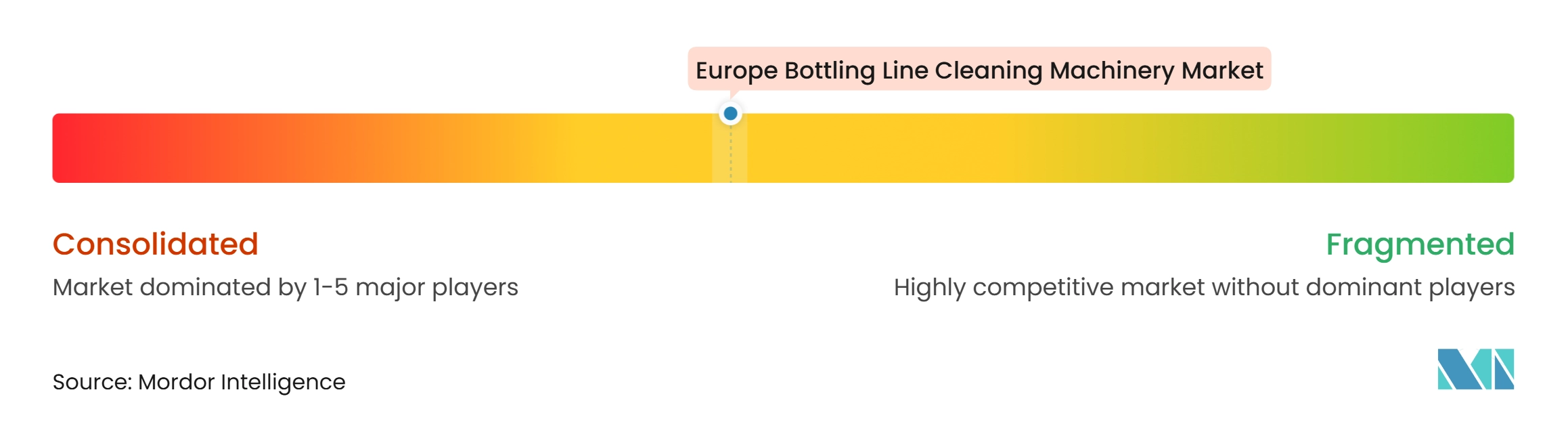
The Europe bottling line cleaning machinery market is moderately concentrated in premium projects but remains fragmented across smaller and specialized applications, with German companies setting the technical benchmark for high-throughput double-end washers and Italian suppliers holding visible positions in rinsers, blowers, and systems for wine, PET, and pharmaceutical applications. Krones and KHS each presented cleaning platforms at drinktec 2025: Lavasonic HI with ultrasonic pretreatment and Innoclean Cascade D with a smaller footprint and ECO carrier 2.0. Their product programs compete on cleaning results, resource use, floor-space requirements, and service support rather than on throughput alone. This structure leaves space for service specialists that can manage retrofit work, regional needs, and smaller production sites. It also reinforces a two-tier supplier field, with large firms serving specification-led contracts and specialists supporting niche applications.
Krones has emphasized energy, water, and cleaning-cycle performance with Lavasonic HI, reporting up to 30% lower thermal energy demand, 20% lower freshwater use, and 35% lower carbon dioxide emissions compared with conventional double-end washers. KHS has emphasized modernization services for installed returnable-glass lines and solutions that avoid full replacement of complex equipment. GEA introduced the AdaptAx modular orbital cleaner at BrauBeviale 2026, with market launch planned for early 2027, expanding its cleaning offer in brewing and beverage production.[3] This move raises competition where broader line-cleaning capability overlaps with bottle-specific equipment. It also demonstrates that innovation is extending beyond a single machine category.
Smaller suppliers, including GM Getränketechnik, Maschinenbau GmbH Gera, and R. Bardi, remain important to regional brewery and winery customers, where service response time and knowledge of existing equipment are valuable. Firms also compete through retrofit modules, predictive maintenance tools, and modular systems that reduce initial capital commitments while enabling improvements over time. Resource-efficiency data, remote diagnostics, and task-management tools can support both equipment selection and recurring service revenue. Adaptive multi-format systems and third-party reconditioning services remain relevant as reuse requirements draw closer, leaving a competitive field that brings together large engineering firms on major projects with specialized local providers.
Europe Bottling Line Cleaning Machinery Industry Leaders
-
Krones AG
-
KHS GmbH
-
Tetra Pak International S.A.
-
GEA Group AG
-
Serac Group
- *Disclaimer: Major Players sorted in no particular order
Europe Bottling Line Cleaning Machinery Market Companies Covered in this Report
- Krones AG
- KHS GmbH
- GEA Group AG
- Tetra Pak International S.A.
- Syntegon Technology GmbH
- IMA S.p.A.
- Serac Group
- SMI S.p.A.
- SIPA S.p.A.
- CFT S.p.A.
- G. Mondini S.p.A.
- R. Bardi S.r.l.
- GEA TDS GmbH
- Bausch+Ströbel SE + Co. KG
- OPTIMA packaging group GmbH
- Marchesini Group S.p.A.
- Colussi Ermes S.p.A.
- GM Getränketechnik & Maschinenbau GmbH Gera
- Krones AG subsidiary Kosme S.r.l.
Recent Industry Developments in Europe Bottling Line Cleaning Machinery Market
- November 2026: KHS GmbH presented its full range of returnable-glass-line retrofit and modernization services at BrauBeviale 2026, spotlighting the Innoclean ECO carrier and Liquid Efficiency Spraying System as the core offerings. The LESS system cut spray-pump energy consumption by up to 40% compared with conventional operation. KHS framed the program as an alternative to full-line replacement for heavily integrated machines that would otherwise require roof removal and several weeks of production downtime.
- November 2026: Krones AG showcased the Lavasonic HI high-intensity cleaning module at BrauBeviale 2026, targeting alcohol-free beer production that requires precise residue removal without heat damage to sensitive formulations. The presentation highlighted demand-oriented cleaning programs selectable by soiling level.
- November 2026: Krones AG's Lavasonic HI bottle washer received the German Sustainability Award 2027 for Products in the transformation field Climate. The recognition cited stated reductions of up to 30% in thermal energy, 20% in freshwater, and 35% in carbon dioxide emissions. This was the company's third consecutive DNP distinction.
- November 2025: GEA Group AG publicly unveiled the GEA AdaptAx at BrauBeviale 2026 in Nuremberg, November 10-12, a new generation of modular orbital cleaners for tank cleaning in brewing and beverage production, delivering up to 30% higher cleaning performance than GEA's previous generation with reduced pump energy, water circulation, chemical consumption, and maintenance costs. The market launch was planned for early 2027.
Europe Bottling Line Cleaning Machinery Market Report Scope
The Europe Bottling Line Cleaning Machinery Market encompasses industrial equipment and systems used to clean, wash, rinse, and prepare bottles and other containers before filling, sealing, and packaging in the beverage, food, dairy, pharmaceutical, and other manufacturing industries. These machines eliminate residual liquids, dust, dirt, microorganisms, and other contaminants from the internal and external surfaces of containers to support hygiene, product safety, and compliance with relevant quality and sanitation standards.
The Europe Bottling Line Cleaning Machinery Market Report is Segmented by Machine Type (Rotary Bottle Washers, Linear Bottle Washers, Tunnel Bottle Washers, Immersion Bottle Washers, Bottle Rinsers and Blowers, Combined Washer-Dryer Systems, ad Other Machine Types), Automation Level (Manual, Semi-Automatic, and Fully-Automatic), Bottle Material (Glass Bottles, Plastic Bottles, and Metal and Aluminum Containers), End User (Breweries and Soft-Drink Producers, Bottled Water Producers, Wineries and Distilleries, Food and Dairy Producers, Pharmaceutical Manufacturers, and Contract Packaging and Bottling Companies), and Geography (Germany, United Kingdom, France, Italy, Spain, and Rest of Europe). The Market Forecasts are Provided in Terms of Value (USD).
Segmentation Overview
| Rotary Bottle Washers |
| Linear Bottle Washers |
| Tunnel Bottle Washers |
| Immersion Bottle Washers |
| Bottle Rinsers and Blowers |
| Combined Washer-Dryer Systems |
| Other Machine Types |
| Manual |
| Semi-automatic |
| Fully-automatic |
| Glass Bottles |
| Plastic Bottles |
| Metal and Aluminum Containers |
| Breweries and Soft-Drink Producers |
| Bottled-Water Producers |
| Wineries and Distilleries |
| Food and Dairy Producers |
| Pharmaceutical Manufacturers |
| Contract Packaging and Bottling Companies |
| Germany |
| United Kingdom |
| France |
| Italy |
| Spain |
| Rest of Europe |
| By Machine Type | Rotary Bottle Washers |
| Linear Bottle Washers | |
| Tunnel Bottle Washers | |
| Immersion Bottle Washers | |
| Bottle Rinsers and Blowers | |
| Combined Washer-Dryer Systems | |
| Other Machine Types | |
| By Automation Level | Manual |
| Semi-automatic | |
| Fully-automatic | |
| By Bottle Material | Glass Bottles |
| Plastic Bottles | |
| Metal and Aluminum Containers | |
| By End User | Breweries and Soft-Drink Producers |
| Bottled-Water Producers | |
| Wineries and Distilleries | |
| Food and Dairy Producers | |
| Pharmaceutical Manufacturers | |
| Contract Packaging and Bottling Companies | |
| By Geography | Germany |
| United Kingdom | |
| France | |
| Italy | |
| Spain | |
| Rest of Europe |
Key Questions Answered in the Report
What is the Europe bottling line cleaning machinery market size?
The market is valued at USD 13.68 million in 2026 and is projected to reach USD 17.63 million by 2032 at a 4.07% CAGR. The 2027 estimate is USD 14.44 million. Reuse requirements, cleaning validation, and replacement activity shape the outlook. The outlook also reflects a premium segment for high-output systems and a separate retrofit opportunity among producers updating established lines.
What is driving demand for bottle-cleaning equipment in Europe?
Reusable packaging rules, returnable-glass capacity projects, installed-line upgrades, and lower water and energy use are supporting equipment demand. The policy direction makes cleaning performance relevant to packaging reconditioning. Large returnable-glass lines and retrofit projects support different parts of the supplier base. Water, energy, and digital monitoring requirements can be assessed at the same time as cleaning capacity when a line is upgraded.
Which machine type is expanding fastest?
Combined washer-dryer systems are projected to expand at a 5.47% CAGR through 2032 as producers seek more compact integrated line configurations. Their appeal is strongest where space, hygiene, conveying, drying, and cleaning needs must be considered together. Rotary bottle washers remain the largest machine type by 2026 revenue share. Linear, tunnel, immersion, rinsing, and blower systems continue to address lower-volume, pharmaceutical, and specialized production needs.
Which automation level accounts for the largest revenue share?
Fully automatic systems held 65.58% of 2026 revenue, supported by high-throughput returnable-glass operations. These systems help maintain consistent control over cleaning sequence, temperature, chemical use, and bottle handling. Manual and semi-automatic equipment remain relevant where batch sizes or capital budgets do not support full-line automation. The configuration chosen depends on line speed, floor space, bottle variety, and the degree of required process control.
Why do glass bottles remain important for equipment suppliers?
Glass bottles held 68.59% of 2026 revenue because returnable beverage systems require repeated industrial cleaning and refilling cycles. Long equipment life also supports future replacement and upgrade activity. Cleaning systems for glass, PET, and metal containers need different handling and chemical settings, which preserves the role of specialist equipment. Post-consumer collection can create different contamination conditions for PET than those seen in a controlled returnable-glass loop.
Which European geography is expanding fastest?
Rest of Europe is projected to expand at a 5.03% CAGR through 2032 as reuse systems and older filling infrastructure are modernized. Belgium, France, Romania, and other markets illustrate emerging investment in reconditioning, container washing, and legacy-line improvement. Germany remains the largest national market, supported by its extensive returnable bottle system. Its machinery cluster also gives operators access to equipment manufacturers and service partners close to important beverage-production locations. This supports capital expenditure planning across sites.