
Europe Bonsai Market Size and Share
Market Overview
| Study Period | 2021 - 2031 |
|---|---|
| Forecast Data Period | 2026 - 2031 |
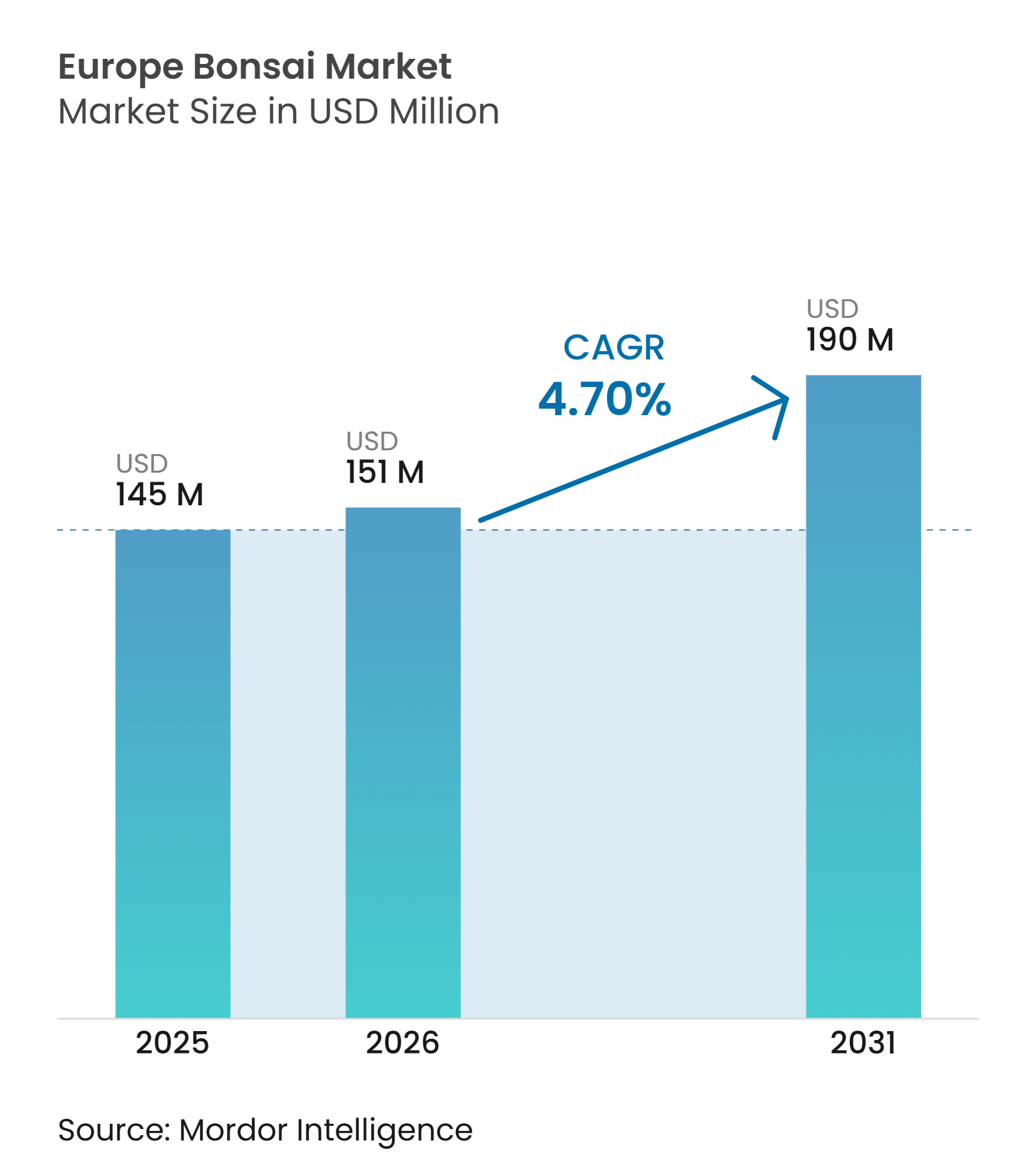
| Base Year Market Size (2025) | USD 145 Million |
| Market Size (2026) | USD 151 Million |
| Market Size (2031) | USD 190 Million |
| Growth Rate (2026 - 2031) | 4.70 % |
| Market Concentration | Low |
Major Players *Disclaimer: Major Players sorted in no particular order Image © Mordor Intelligence. Reuse requires attribution under CC BY 4.0. | |
Europe Bonsai Market Analysis by Mordor Intelligence
The Europe bonsai market size is projected to be USD 145 million in 2025, USD 151 million in 2026, and reach USD 190 million by 2031, growing at a CAGR of 4.7% from 2026 to 2031. Demand is centered on commercially sold live trees that serve home decoration, collecting, gifting, and long-term commercial display. Specialist nurseries can support higher-value sales when they combine reliable cultivation with clear plant-health records and careful delivery practices. Digital sales are widening access where local specialist retail is limited, while mature specimens retain a separate appeal for collectors and institutional buyers. The Europe bonsai market also faces practical limits from long production cycles, species-specific care needs, and plant-health requirements for cross-border trade. These conditions place added value on suppliers that can hold suitable stock and provide dependable guidance throughout the sale.
Key Report Takeaways
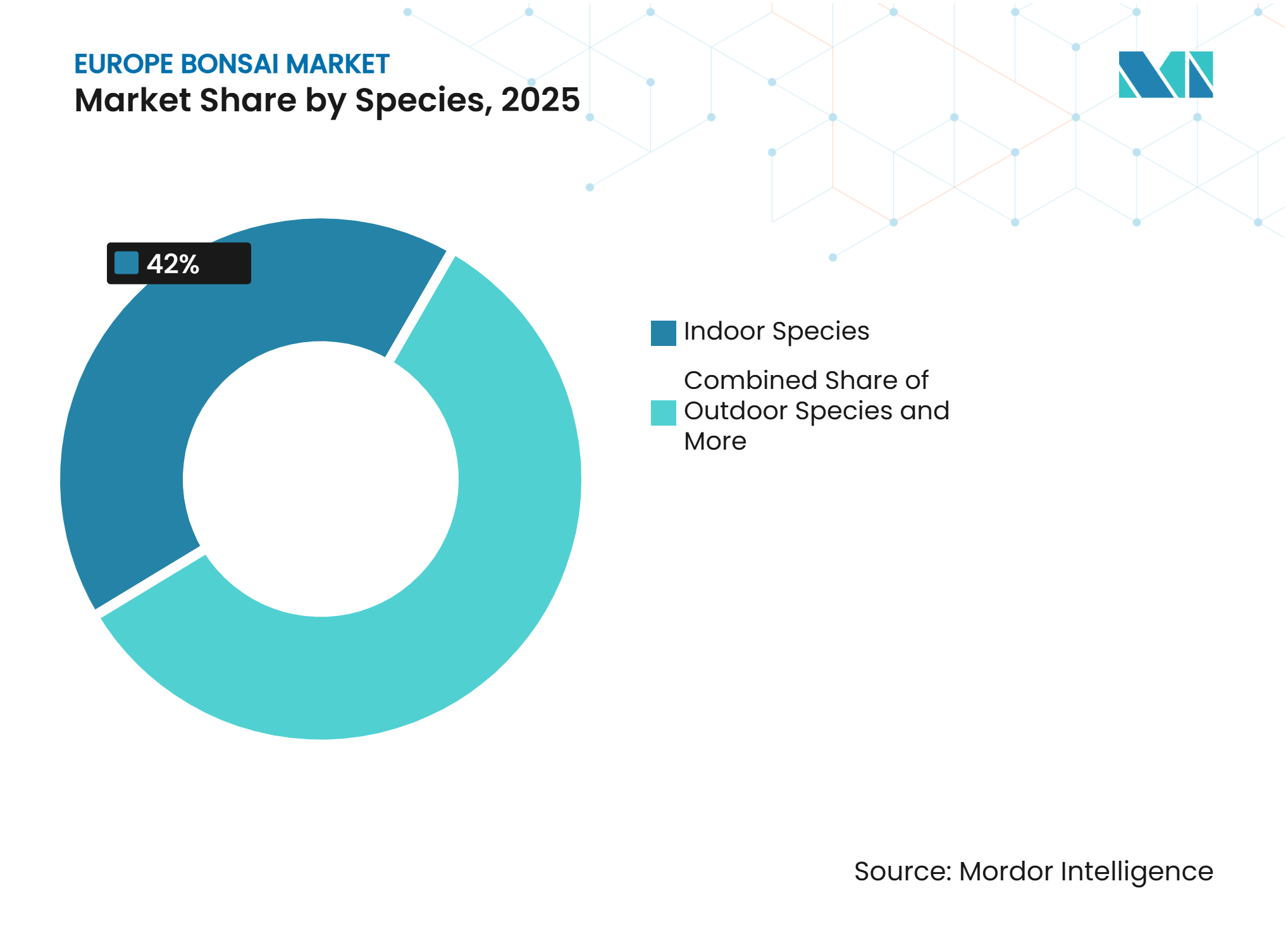
- By species, indoor species held the largest 42% Europe bonsai market share in 2025, while outdoor species is the fastest segment and is forecast to grow at a 5.5% CAGR during 2026–2031.
- By distribution channel, offline held the largest 61% share in 2025, while online is the fastest segment and is forecast to grow at a 7.2% CAGR during 2026–2031.
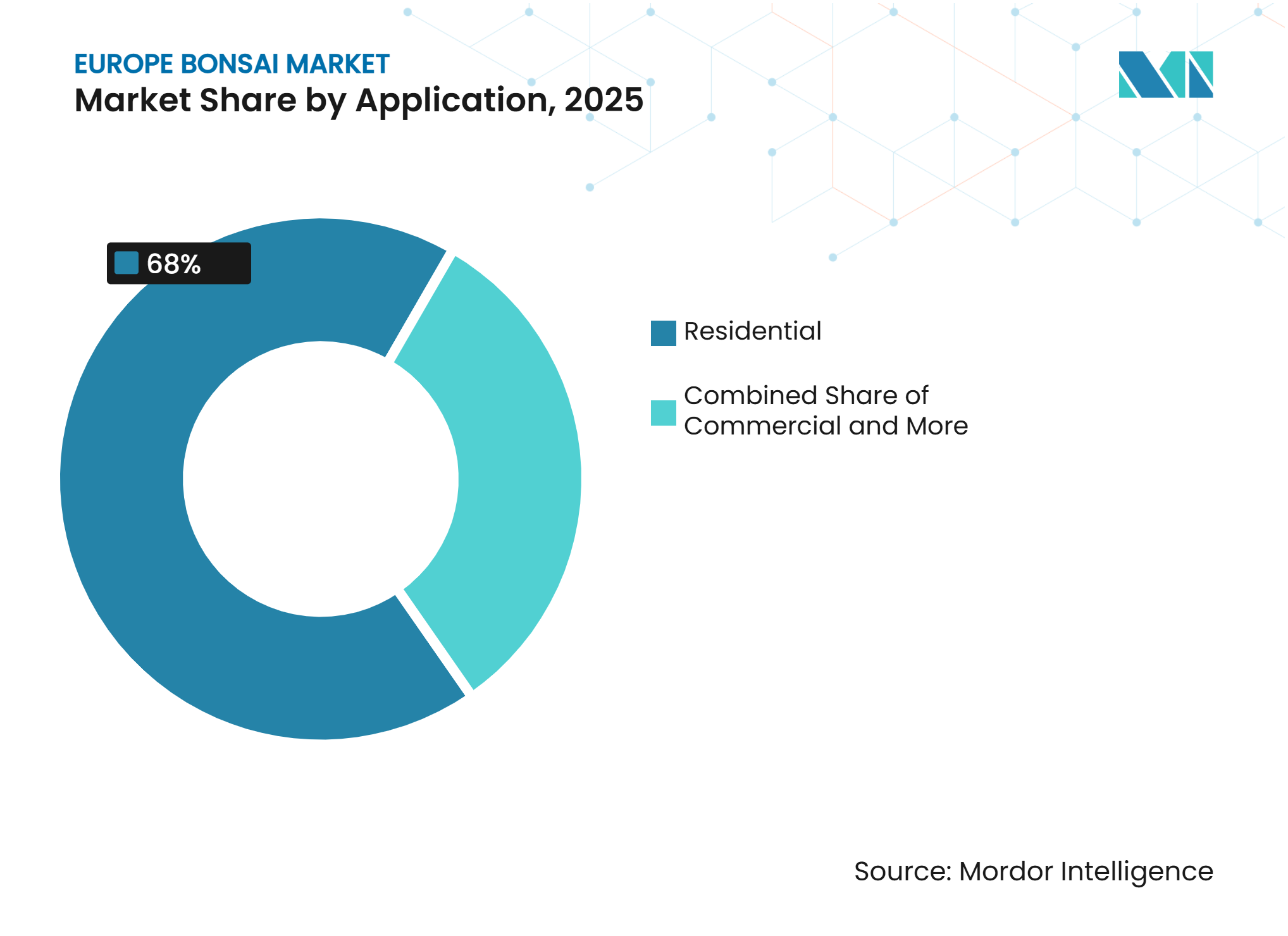
- By application, residential held the largest 68% share in 2025, while commercial is the fastest segment and is forecast to grow at a 5.8% CAGR during 2026–2031.
- By geography, Germany held the largest 24% share in 2025, while France is the fastest country segment and is forecast to grow at a 5.4% CAGR during 2026–2031.
Note: Market size and forecast figures in this report are generated using Mordor Intelligence’s proprietary estimation framework, updated with the latest available data and insights as of January 2026.
Market Trends and Insights
Drivers Impact Analysis of Europe Bonsai Market*
| Driver | (~) % Impact on CAGR Forecast | Geographic Relevance | Impact Timeline |
|---|---|---|---|
| Expansion of Online Bonsai Retail and Cross-Border Distribution | +1.10% | Europe, with higher relevance in Germany and Rest of Europe | Short term (≤ 2 years) |
| Growth in Bonsai Gifting and Premium Ornamental Purchases | +0.70% | Europe, with higher relevance in Germany | Medium term (2-4 years) |
| Rising Demand for Mature, Collectible, and High-Value Bonsai Trees | +0.60% | Europe, with higher relevance in Germany | Medium term (2-4 years) |
| Professionalization of Specialist Bonsai Nurseries and Retailers | +0.90% | Europe, with higher relevance in Germany | Long term (≥ 4 years) |
| Increasing Commercial Availability of Native and Mediterranean Bonsai Species | +0.50% | Europe, with higher relevance in Spain | Medium term (2-4 years) |
| Wider Adoption of Standardized Plant-Health Documentation Across European Trade Channels | +0.40% | Europe, with higher relevance in Rest of Europe | Medium term (2-4 years) |
| Source: Mordor Intelligence | |||
Expansion of Online Bonsai Retail and Cross-Border Distribution
The Europe bonsai market is benefiting from digital routes that connect specialist nurseries with buyers outside established retail areas. According to Ecommerce Europe and EuroCommerce, European B2C e-commerce turnover grew by 7% in 2025 to €911 billion (USD 1.04 trillion), with growth forecast at around 5% in 2026, providing a broader commercial environment for specialist online sales[1]. Bonsai can absorb delivery costs more readily than lower-value ornamental plants, as collectors and gift buyers often accept specialized handling. The Europe Packaging and Packaging Waste Regulation, which has been largely in force since August 2026, is prompting distributors to review packaging for live plants. In 2024, Smurfit Kappa (Smurfit Westrock) developed a dual-compartment corrugated format for House of Botanique that separates the pot and soil from the canopy during delivery. Digital sellers also need traceable consignments, and the EU plant passport framework provides the compliance basis for moving listed plants.
Growth in Bonsai Gifting and Premium Ornamental Purchases
Bonsai can be positioned as a durable gift rather than a short-life floral purchase, which supports its role in milestone, retirement, anniversary, and corporate recognition purchases. A Ficus ginseng specimen can remain in use for many years with suitable care, giving retailers a basis for explaining its longer lifespan. IPM Essen reported in January 2026 that self-gifting has become an important buying behavior for European flower and plant purchases[2]. This behavior gives specialist sellers another route to engage buyers who are selecting a lasting decorative object for themselves. The Europe bonsai market can therefore retain demand from buyers who value form, age, and care potential rather than immediate decorative use alone. This preference does not eliminate spending pressure, but it supports higher-value purchases when the product story and aftercare are clear. Retailers can use this preference to distinguish mature, well-presented stock from undifferentiated decorative-plant offerings.
Rising Demand for Mature, Collectible, and High-Value Bonsai Trees
Mature and exhibition-grade trees make up a small but commercially important part of the European bonsai market. Spanish nurseries supply Mediterranean-origin trees, including Olea europaea, to collectors and institutional buyers in France, Italy, and the United Kingdom. Mediflora states that it documents centennial bonsai-style olive trees with photographs and dimensional information, and supplies landscape designers, architects, and collectors. Such records help buyers assess a specimen's provenance and physical characteristics before arranging specialist transport. Limited availability can preserve the value of trees that have been conditioned over long periods. Nurseries with suitable land, stock, and training capability are better placed to serve this category than sellers focused on younger material. Their commercial approach must also account for specialist inspection, handling, and delivery before a sale is completed.
Professionalization of Specialist Bonsai Nurseries and Retailers
Commercial nurseries are placing more emphasis on consistent cultivation, formal trade processes, and documented distribution practices. Mistral Bonsai SL states that it operates 23 hectares of cultivation fields and 129,000 square meters of greenhouse space in Camarles, Spain. This scale supports a more regular supply of Mediterranean species than many smaller operators can maintain. Lodder Bonsai B.V. held its 25th annual open house on March 8 and 9, 2025, bringing together specialist buyers and practitioners in a commercial nursery setting. Formal import procedures, digital ordering, and reliable transport can help established nurseries serve customers across borders. The Europe bonsai market is likely to reward operators that align cultivation capacity with careful documentation and customer support. This approach can strengthen buyer confidence without requiring suppliers to compete only on the initial selling price.
Restraints Impact Analysis of Europe Bonsai Market*
| Restraint | (~) % Impact on CAGR Forecast | Geographic Relevance |
|---|---|---|
| High Mortality Risk During Live-Plant Transport and Cross-Border Delivery | -1.00% | Europe, with higher relevance in the United Kingdom |
| Long Production Cycles and Limited Availability of Mature Bonsai Trees | -0.90% | Europe, with higher relevance in Germany |
| Plant Health, Quarantine, and Import Compliance Requirements | -0.70% | Europe, with higher relevance in the United Kingdom |
| Limited Consumer Knowledge of Species-Specific Bonsai Care | -0.40% | Europe, with higher relevance in Rest of Europe |
| Source: Mordor Intelligence | ||
High Mortality Risk During Live-Plant Transport and Cross-Border Delivery
Live bonsai can be exposed to temperature changes, dehydration, physical shock, and poor ventilation while in transit. The risk increases on longer journeys because roots and foliage require species-appropriate handling during the delivery period. The European and Mediterranean Plant Protection Organization (EPPO) recorded quarantine-relevant pests on Pinus and Taxus bonsai imported from Japan into Germany, resulting in post-entry quarantine requirements[3]. Holding trees under quarantine adds time and handling requirements that do not apply to most durable retail goods. General logistics networks may not provide the species-specific packaging and care needed for mature or valuable trees. Retailers must manage this delivery risk carefully because damage can affect plant survival and the value of individual specimens. Packaging and dispatch choices are therefore part of the commercial proposition, not merely a logistics task.
Long Production Cycles and Limited Availability of Mature Bonsai Trees
Commercial bonsai production requires time for pruning, wiring, root management, and environmental conditioning. The European Food Safety Authority panel noted that certain Japanese bonsai, subject to a derogation process, required a minimum of 2 years of field-cage cultivation before export authorization. The time required to form saleable needle trees can extend well beyond a single propagation cycle. Controlled growing conditions can improve consistency, but they do not replace the long training period that gives mature bonsai their form. Supply cannot rise quickly when collector or institutional demand increases. This constraint favors nurseries that maintain long-term production programs and retain suitable mature stock. It also limits new entrants' ability to build a comparable offering in a short period.
*Our forecasts treat driver/restraint impacts as directional, not additive. The impact forecasts reflect baseline growth, mix effects, and variable interactions.
Europe Bonsai Market Segment Analysis
By Species:
Indoor Species Lead Commercial Sales by RevenueIndoor species accounted for 42% of the Europe bonsai market size in 2025, making them the largest species category. Ficus ginseng, Portulacaria afra, and Carmona retusa are familiar choices for buyers seeking trees for apartments, offices, and indoor displays. Their suitability for controlled interior conditions can make care requirements more accessible for first-time owners. Lower post-purchase attrition can strengthen customer confidence and support repeat sales through specialist retailers.
The outdoor species category is the fastest-growing and is forecast to grow at a 5.5% CAGR during 2026–2031. Collector interest includes climate-adapted Juniperus, Quercus, and Pinus trees supplied by specialist European nurseries. Outdoor settings can expand the use case beyond interior display, particularly for buyers seeking native or Mediterranean forms. Needle tree species face more complex sourcing conditions because imports of conifer bonsai require closer pest control and quarantine oversight. Deciduous tree species, including Zelkova and Malus, continue to see demand from retailers seeking visible seasonal change and distinctive garden displays.



By Distribution Channel:
Offline Channels Retain Commercial MajorityOffline accounted for 61% of the Europe bonsai market size in 2025, making it the largest distribution channel. Physical inspection remains important for collectors, trade buyers, garden centers, and institutional purchasers assessing trunk structure, roots, canopy form, and overall condition. Specialist nurseries and garden centers can manage local collection or delivery without exposing trees to lengthy transit. Established buyer relationships also matter when a purchase involves a larger or higher-value specimen. In-person advice can help customers select a species that matches their light, climate, and care conditions.
Online is the fastest distribution channel and is forecast to grow at a 7.2% CAGR during 2026–2031. Online stores can reach buyers where no local specialist retailer is available and can show stock through detailed photos and care information. DS Smith developed a fully recyclable fiber-based tree-gifting pack in 2026, featuring ventilation openings to protect live trees during e-commerce fulfillment. Plant passport traceability also provides professional buyers with a documented way to assess compliance before cross-border shipments. The channel will depend on careful packaging, reliable carriers, and transparent customer communication to manage delivery risk.
By Application:
Residential Demand Anchors the MarketResidential accounted for 68% of the Europe bonsai market size in 2025, making it the largest application segment. Home decoration, personal collections, and hobby cultivation remain the core uses for commercial live bonsai trees. IPM Essen cited a recent study by the Rheingold Institute for Qualitative Market and Media Analysis, in which 93% of German consumers said they are making their home a safe place of retreat, and 86% reported focusing on hobbies and leisure activities. These preferences support interest in durable items that can be displayed and cared for over time. Retailers serving residential buyers need to connect the species, pot size, and care requirements to the buyer's available space.
Commercial is the fastest application segment and is forecast to grow at a 5.8% CAGR during 2026–2031. Corporate offices, hotels, high-end restaurants, and corporate gifting programs use bonsai as a long-retention decorative element. These buyers may place greater weight on specimen quality, documented provenance, and dependable maintenance support. Other applications include institutional gifts, art fairs, and botanical procurement, where ceremonial or exhibition value can be important. The Europe bonsai market can serve these applications when suppliers combine distinctive stock with reliable handling and clear compliance records.

Geography Analysis
Germany held the largest 24% Europe bonsai market share in 2025. The country has specialist nurseries, established supply links with Asian and Spanish producers, and a consumer base with a strong interest in ornamental horticulture. Zentralverband Gartenbau, citing Agrarmarkt Informations-Gesellschaft, reported that Germany's flower and ornamental plant sales reached EUR 8.8 billion in 2024, equivalent to USD 9.5 billion. This wider retail setting gives specialist bonsai sellers an established base of plant-oriented consumers. The United Kingdom has a more complex import environment because its Border Target Operating Model applies phytosanitary controls to medium-risk plants from the European Union PLANTHEALTHPORTAL.DEFRA.GOV.UK.
France is the fastest growing country in the region and is forecast to grow at a 5.4% CAGR during 2026–2031. Valhor reported that 70% of French households bought at least 1 plant or flower product in 2024. This broad buying base gives specialty live-plant offers a route to reach households already active in plant purchasing. Spain plays a different role as a commercial production base for Mediterranean bonsai species. Producción Ornamental Mediterráneo in Almería lists bonsai-form olive trees for wholesale distribution, showing the supply role of Spanish growers.
Russia operates under geopolitical and logistics conditions that complicate its integration with standard European specialist nursery networks. Rest of Europe includes markets such as the Netherlands, Belgium, Poland, Austria, Italy, Portugal, and Scandinavia, where online sales and plant-passport-supported distribution can widen access to specialists. The Netherlands remains important as a routing point for European horticultural trade and digital business-to-business platforms. Portugal includes specialist suppliers such as Luso Bonsai and Jardim de Bonsai, while Scandinavian buyers contribute demand for premium ornamental trees. The Europe bonsai market in these countries depends on the availability of specialist advice, compliant distribution, and suitable species for local conditions.
Competitive Landscape
Market Concentration
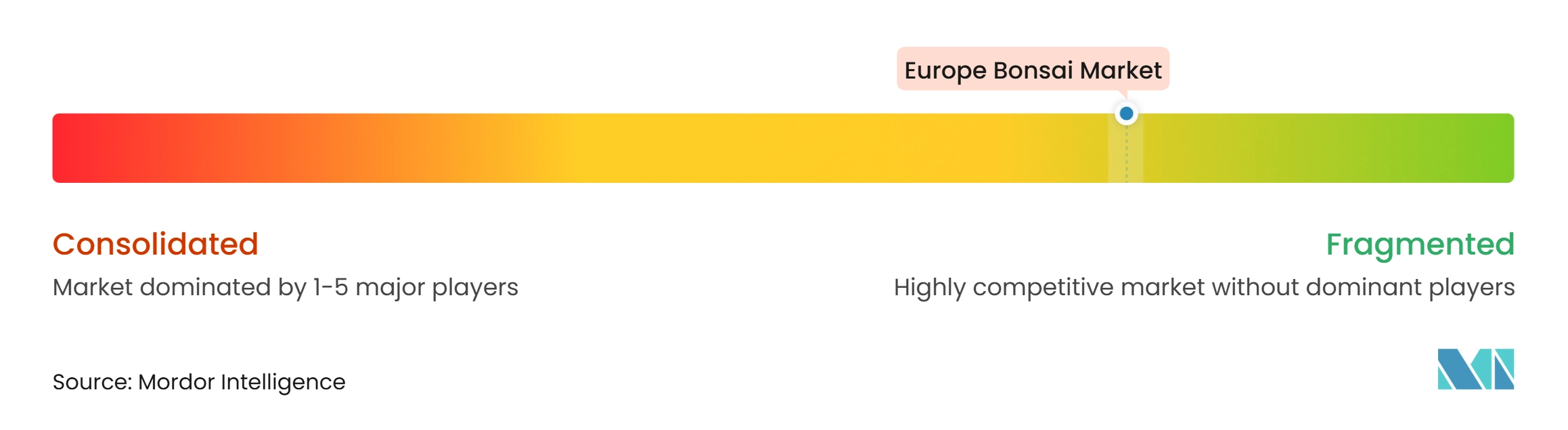
The Europe bonsai market is fragmented, with no single producer or distributor holding a dominant position across the continental commercial live-bonsai value chain. Key players such as Mistral Bonsai SL, Lodder Bonsai B.V., Green Express Società Semplice Agricola, Bonsaischule Wenddorf, and Herons Bonsai each operate through different geographic strengths or species niches. Competition is shaped by cultivation skill, import relationships, stock quality, and the ability to deliver trees without compromising their condition.
Regulatory compliance also plays a central role in how companies compete. Professional operators must maintain plant health documentation and register with the relevant national authorities when their activities fall within the European Union framework. As a result, compliance capability has become an important commercial requirement for companies serving cross-border buyers.
Leading suppliers are using digital trade systems and direct engagement to broaden access to professional buyers. According to its company website, Mistral Bonsai SL joined the BIORESILMED ecological restoration initiative in 2025, showing how a producer can incorporate environmental activities into its commercial identity while maintaining its core nursery operations. Lodder Bonsai BV's 2025 open house offers another example of a nursery using direct trade engagement with specialist buyers. Such initiatives can help suppliers stay connected with buyers who value direct inspection and specialist discussion.
Europe Bonsai Industry Leaders
-
Lodder Bonsai BV
-
Herons Bonsai
-
Green Express Società Semplice Agricola
-
Bonsaischule Wenddorf
-
Mistral Bonsai SL
- *Disclaimer: Major Players sorted in no particular order
Europe Bonsai Market Companies Covered in this Report
- Lodder Bonsai BV
- Luso Bonsai
- Green Express Società Semplice Agricola
- Mistral Bonsai SL
- IBUKI Ornamental Plant Nursery
- Bonsai Sturm
- EUROBONSAI Sevilla
- Genki Bonsai
- Garden One
- WeBonsai
- Herons Bonsai
- Bonsai Shop
- IkigaïBonsaï
- Treevaset
Recent Industry Developments in Europe Bonsai Market
- September 2025: The European Commission published Commission Implementing Regulation (EU) 2025/1953, amending Annexes VII, VIII, XI and XIII to Implementing Regulation (EU) 2019/2072, introducing strengthened measures against Anoplophora glabripennis and Anoplophora chinensis, 2 quarantine pests with documented association with bonsai and woody plant imports, directly tightening the import phytosanitary requirements for host plants moving into and within the European Union.
- May 2025: The United Kingdom Phytosanitary Conditions (Amendment) Regulations 2025 entered into force, clarified import requirements for plant entries including conifer-related commodities, and revised phytosanitary certificate requirements for third-country plant imports into Great Britain. Further provisions relating to Pinales reclassification entered into force on November 8, 2025.
- January 2025: Regulation (EU) 2024/3115 entered into force, amending Regulation (EU) 2016/2031 through provisions covering a Union Plant Health Emergency Team, digital plant-passport and post-import controls, and new market-access procedures for third-country plant exporters.
Europe Bonsai Market Report Scope
Bonsai are living woody plants intentionally trained to mimic mature trees, plus the pots, soils, and pruning inputs sold with them. The Europe Bonsai Market report segments the industry by Species (Indoor Species, Outdoor Species, Needle Tree Species, and Deciduous Tree Species), by Distribution Channel (Online and Offline), by Application (Residential, Commercial, and Other Applications (Institutional Gifts, Art Fairs)), and by Geography (Germany, United Kingdom, France, Russia, Spain, and Rest of Europe). The market forecasts are provided in terms of value (USD).
Segmentation Overview
| Indoor Species |
| Outdoor Species |
| Needle Tree Species |
| Deciduous Tree Species |
| Online |
| Offline |
| Residential |
| Commercial |
| Other Applications (Institutional Gifts, Art Fairs) |
| Germany |
| United Kingdom |
| France |
| Russia |
| Spain |
| Rest of Europe |
| By Species | Indoor Species |
| Outdoor Species | |
| Needle Tree Species | |
| Deciduous Tree Species | |
| By Distribution Channel | Online |
| Offline | |
| By Application | Residential |
| Commercial | |
| Other Applications (Institutional Gifts, Art Fairs) | |
| By Geography | Germany |
| United Kingdom | |
| France | |
| Russia | |
| Spain | |
| Rest of Europe |
Key Questions Answered in the Report
What is the forecast for the Europe bonsai market?
The Europe bonsai market is forecast to rise from USD 151 million in 2026 to USD 190 million by 2031, at a 4.7% CAGR during 2026–2031. The forecast reflects specialist retail, gifting, collection, and commercial display demand for live bonsai trees.
Which species category leads commercial bonsai sales in Europe?
Indoor species was the largest category with 42% of sales in 2025. Outdoor species is the fastest-growing category at a 5.5% CAGR during 2026–2031.
What is the main challenge in cross-border bonsai trade?
Plant-health documentation, phytosanitary requirements, and the risk of damage or dehydration during transit are major considerations for commercial shipments. These factors can raise the operating requirements for cross-border sellers, especially when a specimen is mature or valuable.
Which country has the largest bonsai sales base in Europe?
Germany was the largest national segment, with 24% of sales in 2025, supported by specialist nurseries, established plant-trade links, and an active ornamental horticulture buying base.