
Europe 5G Device Market Size and Share
Market Overview
| Study Period | 2020 - 2031 |
|---|---|
| Forecast Data Period | 2026 - 2031 |
| Base Year Market Size (2025) | 0.62 Billion units |
| Market Volume (2026) | 0.71 Billion units |
| Market Volume (2031) | 1.27 Billion units |
| Growth Rate (2026 - 2031) | 12.33 % |
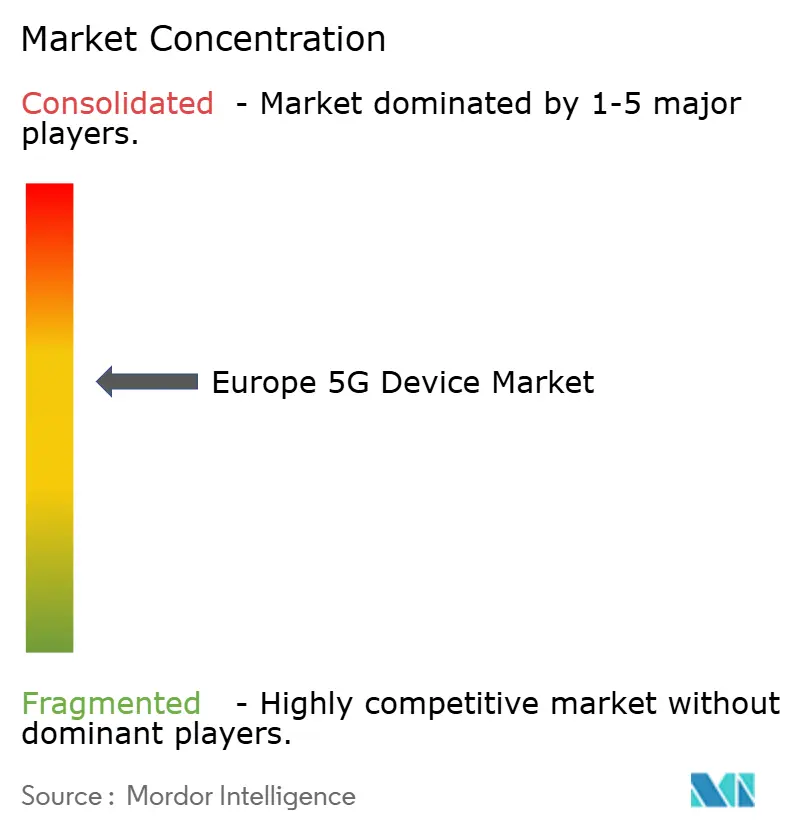
| Market Concentration | Medium |
Major Players *Disclaimer: Major Players sorted in no particular order Image © Mordor Intelligence. Reuse requires attribution under CC BY 4.0. | |
Europe 5G Device Market Analysis by Mordor Intelligence
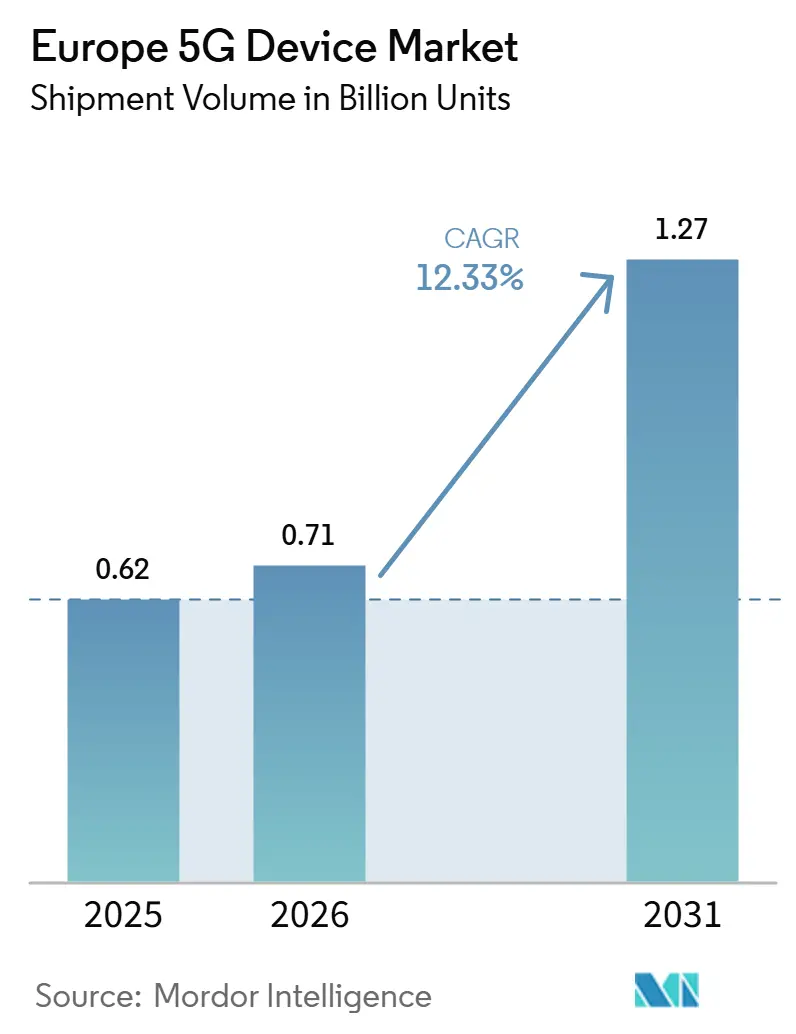
The Europe 5G Device Market size in terms of shipment volume was valued at 0.62 billion units in 2025 and is estimated to grow from 0.71 billion units in 2026 to reach 1.27 billion units by 2031, at a CAGR of 12.33% during the forecast period (2026-2031). The shift from 5G non-standalone architecture to standalone architecture is widening the commercial role of handsets, customer premises equipment, and enterprise devices. Standalone networks support network slicing, Voice over New Radio, and multi-operator services, enabling support for demand beyond mainstream smartphones. The limited standalone connection base in Europe suggests that replacement demand has not yet reached its full potential. Regulatory requirements are also reducing the useful commercial life of devices that do not meet cybersecurity and radio equipment rules. Component supply limits and dependence on Asia-Pacific assembly and chipset supply chains remain material risks for the Europe 5G device market.
Key Report Takeaways
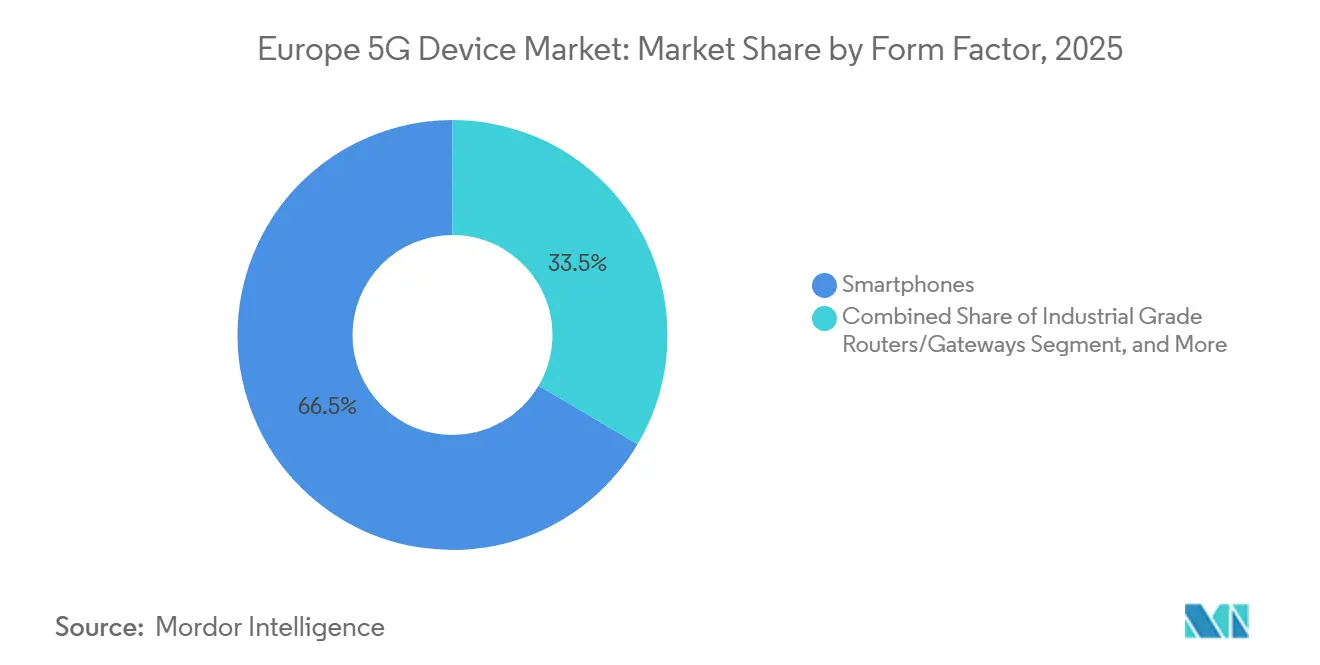
- By form factor, smartphones held 66.51% volume share of the Europe 5G device market in 2025, while wearables and XR devices are projected to expand at a 13.88% CAGR through 2031.
- By spectrum support, sub-6 GHz devices accounted for 63.10% of the European 5G device market volume in 2025, while mmWave devices are expected to grow at a 14.24% CAGR through 2031.
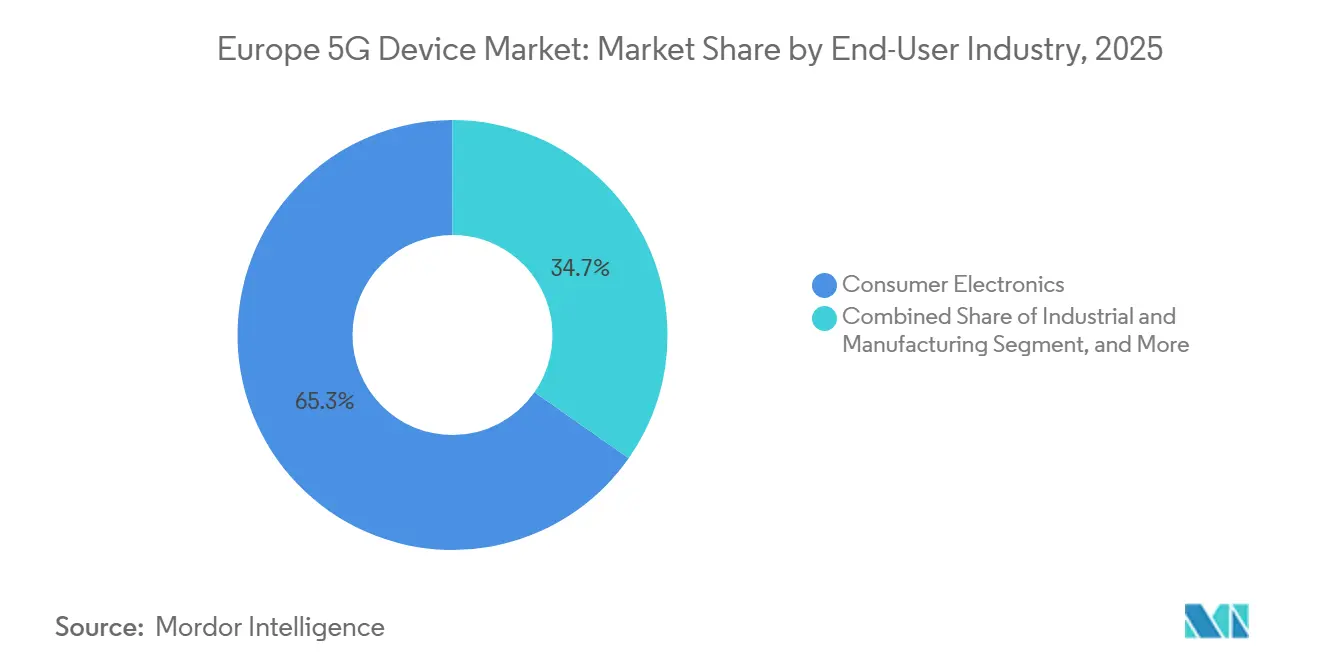
- By end-user industry, consumer electronics captured 65.29% volume share of the Europe 5G device market in 2025, while industrial and manufacturing is projected to record a 13.67% CAGR through 2031.
- By application, enhanced mobile broadband (eMBB) accounted for 58.55% volume share of the Europe 5G device market in 2025, while ultra-reliable low-latency communications is expected to expand at a 14.31% CAGR through 2031.
- By country, the rest of Europe held 35.80% volume share of the Europe 5G device market in 2025, while Spain is projected to grow at a 13.39% CAGR through 2031.
Note: Market size and forecast figures in this report are generated using Mordor Intelligence’s proprietary estimation framework, updated with the latest available data and insights as of January 2026.
Europe 5G Device Market Trends and Insights
Drivers Impact Analysis*
| Driver | (~) % Impact on CAGR Forecast | Geographic Relevance | Impact Timeline |
|---|---|---|---|
| 5G Standalone Rollout Expands Device Upgrade Demand | +2.5% | Pan-European, with leading gains in Spain, the United Kingdom, France, and Austria | Medium term (2-4 years) |
| Fixed Wireless Access Reaches Coverage Gaps | +2.0% | Rural Germany, France, Italy, and Eastern Europe | Medium term (2-4 years) |
| Private 5G Campus Networks Increase Enterprise Procurement | +1.5% | Germany, the United Kingdom, France, the Netherlands, Portugal, and Croatia | Medium term (2-4 years) |
| Operator Subsidies and Bundled Plans Support Premium Smartphones | +1.2% | Germany, the United Kingdom, France, and Spain | Short term (≤ 2 years) |
| RedCap Wearables and Low-Power Devices Create New Demand | +0.9% | Germany, followed by Western Europe | Long term (≥ 4 years) |
| Cyber Resilience and Radio Equipment Compliance Shorten Replacement Cycles | +0.6% | EU27 and EEA countries covered by Delegated Regulation (EU) 2022/30 | Short term (≤ 2 years) |
| Source: Mordor Intelligence | |||
5G Standalone Rollout Expands the Addressable Device Upgrade Cycle
The move to standalone 5G is a key driver of the Europe 5G device market. Standalone networks require compatible handsets and customer premises equipment for Voice over New Radio, network slicing, and improved latency. Movistar ranked third among European operators for standalone time on network in late 2025, with subscribers spending 35.4% of their 5G time on standalone connections. Only 2.8% of European 5G connections used a standalone architecture in April 2026, compared with 32% in North America. The Digital Networks Act seeks more consistent spectrum licensing, which could support wider launches and replacements of non-standalone devices. Battery performance can also give consumers a direct reason to replace older devices as standalone coverage expands.
Fixed Wireless Access Demand Replaces Fiber in Coverage Gaps
Fixed wireless access creates demand that is separate from the smartphone replacement cycle. FWA subscriptions across OECD members increased 17% from June 2023 to June 2024, while the UK recorded 30.4% growth.[1]Organisation for Economic Co-operation and Development, “Fibre and 5G Continue to Expand Their Footprint, While Fixed Wireless Access Gains Ground in OECD Countries,” OECD, oecd.org Europe had 108 commercially launched 5G FWA networks across EU member states. Every added subscriber requires at least 1 indoor or outdoor customer premises equipment unit. The Digital Decade objective recognizes FWA as a way to provide every household with at least 1 Gbps by 2030. Radio equipment and EN 18031 cybersecurity rules also make pre-August 2025 equipment less suitable for new procurement.
Private 5G Campus Networks Pull Enterprise Grade Devices into Commercial Procurement
Private 5G projects are moving from trials toward operating networks across Europe. Each operating site requires industrial routers, modules, sensors, gateways, and hardened handsets. Vodafone reported 173 commercial private 5G deployments across 119 contracts and 96 customers in nearly 20 markets in February 2026. Ericsson, Deutsche Telekom, and HHLA activated a private 5G network at Hamburg's Container Terminal Altenwerder in June 2026. CIMPOR's 3-plant Portuguese rollout supported drones, smart glasses, and predictive maintenance, with an annual impact of USD 10-15 million per plant. BEREC found that managed service contracts are replacing one-off installations, improving demand visibility for module and router vendors.[2]Body of European Regulators for Electronic Communications, “BEREC Report on the Evolution of Private 5G Networks and Interrelation with Public Networks in Europe,” BEREC, berec.europa.eu
Operator Subsidies and Bundled Device Plans Accelerate Premium Smartphone Penetration
Operators in Germany, the UK, France, and Spain use financing and bundles to reduce upfront handset costs. Vodafone Germany offered the iPhone 17 Pro with a EUR 1 (USD 1.13) co-payment in November 2025. Deutsche Telekom bundled the Samsung Galaxy S25 Ultra at an effective device cost of EUR 2 (USD 2.26) per month. These offers place consumers in 24-month contracts and favor devices with standalone-ready Qualcomm Snapdragon or MediaTek Dimensity modems. Orange France introduced a 5G+ offer with dedicated bandwidth, ChatGPT Plus, and Netflix in March 2026.[3]Orange, “Orange, the First Operator to Launch a 5G+ Offer With Dedicated Bandwidth for the Consumer Market,” Orange Newsroom, newsroom.orange.com Such bundles can add compatible devices to the installed base while supporting higher-value service tiers.
Restraints Impact Analysis*
| Restraint | (~) % Impact on CAGR Forecast | Geographic Relevance | Impact Timeline |
|---|---|---|---|
| RF Front-End Component Shortages Limit Premium and mmWave Supply | -2.0% | Global, with greatest effects on mmWave and standalone-ready premium devices | Short term (≤ 2 years) |
| Operator Certification and Field Testing Delay Launches | -1.5% | The United Kingdom, Germany, France, and Italy | Medium term (2-4 years) |
| Mature Replacement Cycles Slow Consumer Volumes | -1.0% | Western Europe, especially Germany, the United Kingdom, France, and Italy | Long term (≥ 4 years) |
| Asia-Pacific Assembly and Chipset Dependence Raises Cost and Lead-Time Risks | -0.7% | Pan-European, import-dependent EU27 consumer and enterprise markets | Medium term (2-4 years) |
| Source: Mordor Intelligence | |||
RF Front End Component Shortages Constrain Premium and mmWave Device Supply
Advanced standalone and mmWave designs rely on RF front-end components, including bulk-acoustic-wave and surface-acoustic-wave filters. The advanced filter supply base is concentrated among Qualcomm, Broadcom, Murata, and Skyworks. This exposes European assemblers to allocation decisions made outside the region. Gallium controls and specialized silicon-germanium bismuth complementary metal-oxide-semiconductor capacity add risk for power amplifiers, transceivers, and low-noise amplifiers. A shortage can delay flagship devices and restrict availability for venues, campuses, and FWA. The risk is most acute in high-performance, premium, and enterprise radio configurations.
Operator Certification and Field Testing Bottlenecks Delay Time To Market
Each new 5G model needs operator certification and field testing across different networks, bands, and countries. The process can add 3-6 months to launch timelines. Standalone devices must test radio performance, network slicing, Voice over New Radio, eSIM provisioning, and RedCap compatibility. ETSI interoperability processes do not remove the need for bilateral field trials with operators. This creates additional costs for small vendors and can reinforce the position of established brands in operator relationships. The bottleneck can delay the availability of affordable, standalone-ready devices even where the infrastructure is already active.
*Our forecasts treat driver/restraint impacts as directional, not additive. The impact forecasts reflect baseline growth, mix effects, and variable interactions.
Segment Analysis
By Form Factor: Smartphones Anchor Volume While Wearables Extend Demand
Smartphones held 66.51% of Europe's 5G device market share in 2025 and remained the primary connectivity endpoint for European mobile users. Their position reflects large subscriber bases and widespread use of mobile data services. Operator bundles are directing more buyers toward premium 5G models. They also give operators a way to place standalone-capable devices with subscribers over the life of a service contract. Samsung made the Galaxy S26 series available worldwide on March 11, 2026. The Galaxy S26 Ultra accounted for more than 70% of pre-orders. Customer premises equipment is becoming more important as operators extend FWA into rural areas.
Wearables and XR devices are projected to grow at a 13.88% CAGR from 2026 to 2031. Deutsche Telekom launched commercial RedCap services in Germany for Apple Watch Series 11, Apple Watch Ultra 3, and Apple Watch SE 3. GSA identified 6 RedCap chipsets, 17 modules, and 7 commercial end-user devices globally in September 2025. Huawei, Nokia, Samsung, TCL, and ZTE were expanding RedCap support. This technology gives wearables a connection option between LTE-M and full 5G NR. Industrial routers, automotive telematics modules, 5G laptops, tablets, and hotspots are procured through separate channels. Their demand is less exposed to consumer replacement intervals than smartphone demand.



By Spectrum Support: Sub-6 GHz Provides Coverage While mmWave Expands
Sub-6 GHz devices accounted for 63.10% of the volume share in 2025. The segment benefits from broad 3.5 GHz coverage across European markets. This spectrum supports both smartphones and FWA services. Deutsche Telekom operated more than 96,500 5G antennas in Germany, covering 98% of the population. Its network shows why sub-6 GHz is the standard choice for new users. EN 18031 cybersecurity requirements have added design review and testing work for internet-connected radio devices. High-volume sub-6 GHz lines can absorb these requirements more easily than specialized products.
mmWave devices are projected to expand at a 14.24% CAGR through 2031. Demand comes from urban venues, stadiums, enterprise campuses, and fixed wireless backhaul. Major European markets have 26 GHz licenses that provide 400 MHz blocks for gigabit-class services. This provides operators with a foundation for mmWave customer-premises equipment and small-cell devices. Hybrid devices support both sub-6 GHz and mmWave operation. They are gaining use in premium smartphones and enterprise routers because they can support future densification. RedCap in 3GPP Releases 17 and 18 also supports efficient industrial sensors, wearables, and surveillance cameras. These devices widen the addressable base even though mmWave remains focused on dense locations.
By End-User Industry: Consumer Electronics Leads While Industrial Deployments Scale
Consumer electronics accounted for 65.29% of the Europe 5G device market size in 2025. Smartphones, tablets, consumer customer premises equipment, and connected wearables formed the largest volume base. AI-integrated flagship phones and cellular wearables are adding additional reasons for replacement beyond voice services. Operator bundle incentives also support sales of compatible consumer equipment. The segment benefits from large consumer subscriber populations across the region. Its demand remains sensitive to handset pricing and replacement timing. The consumer electronics segment will continue to provide the largest unit volumes during the forecast period.
Industrial and manufacturing is projected to grow at a 13.67% CAGR through 2031. Private networks are moving from demonstrations toward scaled production applications. CIMPOR's 3-site Portuguese rollout showed how private 5G can support drones, smart glasses, and predictive maintenance. The project was expected to produce USD 10-15 million in annual economic impact per plant. BEREC observed a shift from one-off private network installations toward managed service agreements. Automotive and transportation are adopting 5G network access device modules for vehicles. Healthcare, energy, utilities, and commercial organizations are also adopting devices for monitoring, mobility, and campus connectivity.
By Application: eMBB Holds the Base While URLLC Gains Momentum
Enhanced mobile broadband accounted for 58.55% of application demand in 2025. Smartphones, consumer customer premises equipment, and high-bandwidth XR devices supported this volume. Unlimited plans and premium handset bundles also make eMBB important to operator revenue models. Those revenue models help justify standalone network investment in Germany, the UK, and France. eMBB will remain the largest application base because it serves mainstream consumer use. It also provides the data capacity needed for connected devices across daily activities. This broad installed base supports steady demand for compatible equipment.
Ultra-reliable low-latency communications is projected to grow at a 14.31% CAGR through 2031. Industrial automation, autonomous guided vehicles, and critical machine communication create the main use cases. 3GPP Release 16 URLLC can provide 1 millisecond one-way latency and reliability up to 99.999% in controlled factory conditions. Germany's Plattform Industrie 4.0 recognizes URLLC and time-sensitive networking as peer transport options for factory automation. Massive machine-type communications is growing through RedCap smartwatches, sensors, and cameras. FWA supports demand for customer premises equipment in rural and suburban areas. Vehicle-to-everything applications remain early stage, although Release 19 was frozen in December 2025 and supports future industrial IoT development.
Geography Analysis
The rest of Europe held 35.80% of the European 5G device market share in 2025. The group includes Nordic, Central, and Eastern European countries, where sub-6 GHz coverage supported smartphone adoption. Telia became the first Norwegian operator to launch nationwide commercial standalone 5G in 2025. Proximus launched Belgium's first commercial standalone 5G service in April 2026, with a 5G footprint covering 92% of the population. Digital Decade policy frameworks are supporting rollout progress across smaller Central and Eastern European countries.
Spain is projected to record a 13.39% CAGR from 2026 to 2031. The Ministry for Digital Transformation stated that standalone 5G coverage reached 98.1% of the Spanish population in 2025. The reported increase was 54 percentage points in 1 year. Germany, the UK, and France remain large country markets due to their populations, established operators, and enterprise procurement. Ofcom reported that at least 1 mobile operator provided a 5G signal across 62% of the UK landmass in spring 2025. These coverage conditions support a larger addressable market for Europe's 5G devices.
Italy's FWA subsidies in mountainous communities can drive demand for customer premises equipment beyond smartphones. Russia has a distinct profile because Western equipment vendors curtailed operations after the 2022 sanctions. Its device demand is centered on sub-6 GHz handsets from Chinese original equipment manufacturers. The EU27 is progressing toward the Digital Decade coverage goal, creating a common infrastructure base for demand across countries.
Competitive Landscape
The European 5G device market is moderately concentrated in premium smartphones and more fragmented across industrial devices. Apple and Samsung lead the EUR 600 (USD 678) and above handset tier. Samsung operates across entry-, mid-range-, premium-, and foldable categories. The Galaxy S26 Ultra represented more than 70% of the company's launch pre-orders. Xiaomi and Oppo add price and feature competition in the mid-range segment.
Apple, Samsung, Xiaomi, and Oppo compete through software, camera systems, and standalone certification with mobile operators. Fibocom, Telit Cinterion, u-blox, and Sierra Wireless compete in modules and customer premises equipment. Their differentiation rests on RedCap support, security compliance, industrial certifications, and field-test readiness. Telit Cinterion introduced 5G RedCap modules in 2024, ahead of wider European operator launches. Qualcomm and MediaTek influence wearables, industrial sensors, and mid-tier phones through their X35 RedCap and M60 platforms.
Schwarz Digits and Siemens announced a partnership in April 2026 to deploy physically isolated private 5G campus networks. Firecell and Accelleran combined their operations, with EUR 7.9 million (USD 8.93 million) in funding, to build a private 5G platform. Inseego also announced an intended acquisition of Nokia's global FWA device business for USD 200 million, expected to close in the fourth quarter of 2026. These moves indicate that the European 5G device market will reward both broad consumer portfolios and focused enterprise offerings.
Europe 5G Device Industry Leaders
Apple Inc.
Samsung Electronics Co., Ltd.
HONOR Device Co., Ltd.
Lenovo Group Ltd.
ZTE Corporation
- *Disclaimer: Major Players sorted in no particular order

Recent Industry Developments
- July 2026: Kontron secured a new European automotive OEM customer for its 5G Network Access Device (NAD) modules, manufactured in Düsseldorf, Germany. The initial supply volume stands at approximately 150,000 units, valued at a double-digit million EUR figure, with the potential to more than triple across additional vehicle platforms. The Düsseldorf facility officially began production on July 13, 2026, in the presence of federal and state government representatives.
- July 2026: Xavier Niel's Iliad acquired e&'s 17.13% voting stake in Vodafone for USD 5.9 billion, making Niel the operator's largest individual shareholder and intensifying pressure for cost rationalization and portfolio consolidation across Vodafone's European device bundling and private 5G managed services strategy.


Europe 5G Device Market Report Scope
The Europe 5G device market volume is measured by the annual shipment of 5G devices (in units), including smartphones, customer-premises equipment, routers, gateways, modules, laptops, tablets, hotspots, and wearables, across sub-6 GHz, mmWave, and hybrid spectrum configurations for applications such as enhanced mobile broadband (eMBB), ultra-reliable low-latency communications (URLLC), massive machine-type communications (mMTC), fixed wireless access (FWA), and vehicle-to-everything (V2X).
The Europe 5G device market report is segmented by form factor (smartphones, customer-premises equipment (indoor/outdoor), industrial grade routers/gateways, modules, laptops/tablets, hotspots, and wearables and XR devices), spectrum support (sub-6 GHz, mmWave, and hybrid (sub-6 GHz and mmWave)), end user industry (consumer electronics, industrial and manufacturing, automotive and transportation, healthcare, energy and utilities, and enterprise/commercial), application (enhanced mobile broadband (eMBB), ultra-reliable low-latency comms (URLLC), massive machine-type comms (mMTC), fixed wireless access, and vehicle-to-everything (V2X)), and country (Germany, United Kingdom, France, Italy, Spain, Russia, and rest of Europe). The market forecasts are provided in terms of volume (units).
| Smartphones |
| Customer-Premises Equipment (Indoor/Outdoor) |
| Industrial Grade Routers/Gateways |
| Modules |
| Laptops/Tablets |
| Hotspots |
| Wearables and XR Devices |
| Sub-6 GHz |
| mmWave |
| Hybrid (Sub-6 GHz and mmWave) |
| Consumer Electronics |
| Industrial and Manufacturing |
| Automotive and Transportation |
| Healthcare |
| Energy and Utilities |
| Enterprise/Commercial |
| Enhanced Mobile Broadband (eMBB) |
| Ultra-Reliable Low-Latency Comms (URLLC) |
| Massive Machine-Type Comms (mMTC) |
| Fixed Wireless Access |
| Vehicle-to-Everything (V2X) |
| Germany |
| United Kingdom |
| France |
| Italy |
| Spain |
| Russia |
| Rest of Europe |
| By Form Factor | Smartphones |
| Customer-Premises Equipment (Indoor/Outdoor) | |
| Industrial Grade Routers/Gateways | |
| Modules | |
| Laptops/Tablets | |
| Hotspots | |
| Wearables and XR Devices | |
| By Spectrum Support | Sub-6 GHz |
| mmWave | |
| Hybrid (Sub-6 GHz and mmWave) | |
| By End-User Industry | Consumer Electronics |
| Industrial and Manufacturing | |
| Automotive and Transportation | |
| Healthcare | |
| Energy and Utilities | |
| Enterprise/Commercial | |
| By Application | Enhanced Mobile Broadband (eMBB) |
| Ultra-Reliable Low-Latency Comms (URLLC) | |
| Massive Machine-Type Comms (mMTC) | |
| Fixed Wireless Access | |
| Vehicle-to-Everything (V2X) | |
| By Country | Germany |
| United Kingdom | |
| France | |
| Italy | |
| Spain | |
| Russia | |
| Rest of Europe |


Key Questions Answered in the Report
What is the Europe 5G device market size and forecast?
The Europe 5G device market is projected to grow from 0.71 billion units in 2026 to 1.27 billion units by 2031, at a 12.33% CAGR.
Which form factor has the largest demand in Europe?
Smartphones held 66.51% volume share in 2025, making them the largest form factor.
Which 5G device category is projected to grow fastest?
MmWave devices are projected to grow at a 14.24% CAGR through 2031, ahead of other spectrum categories.
Why are industrial 5G devices gaining adoption?
Private 5G networks are moving into production environments, which increases demand for routers, modules, sensors, and hardened devices.
Which application is expected to expand fastest through 2031?
Ultra-reliable low-latency communications is expected to expand at a 14.31% CAGR, supported by industrial automation and critical communications.
Which European country is projected to grow fastest for 5G devices?
Spain is projected to grow at a 13.39% CAGR through 2031, supported by extensive standalone 5G coverage.
Page last updated on:





