
Europe 3D Construction Market Size and Share
Market Overview
| Study Period | 2020 - 2031 |
|---|---|
| Forecast Data Period | 2026 - 2031 |
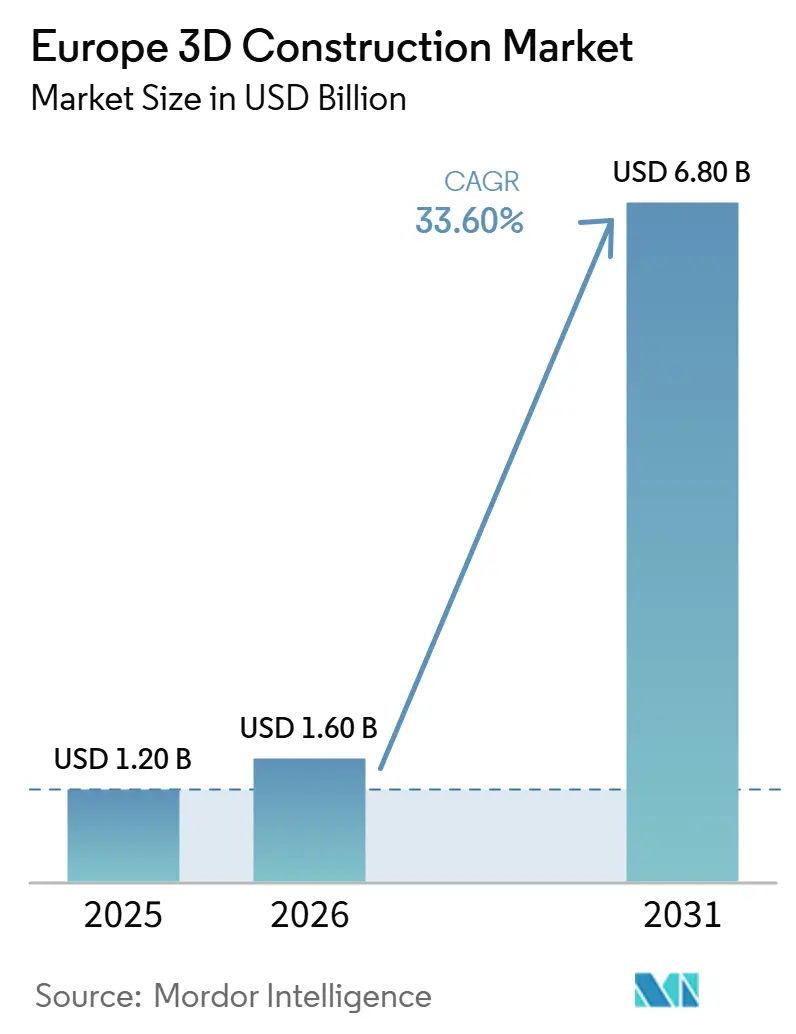
| Base Year Market Size (2025) | USD 1.20 Billion |
| Market Size (2026) | USD 1.60 Billion |
| Market Size (2031) | USD 6.80 Billion |
| Growth Rate (2026 - 2031) | 33.60 % |
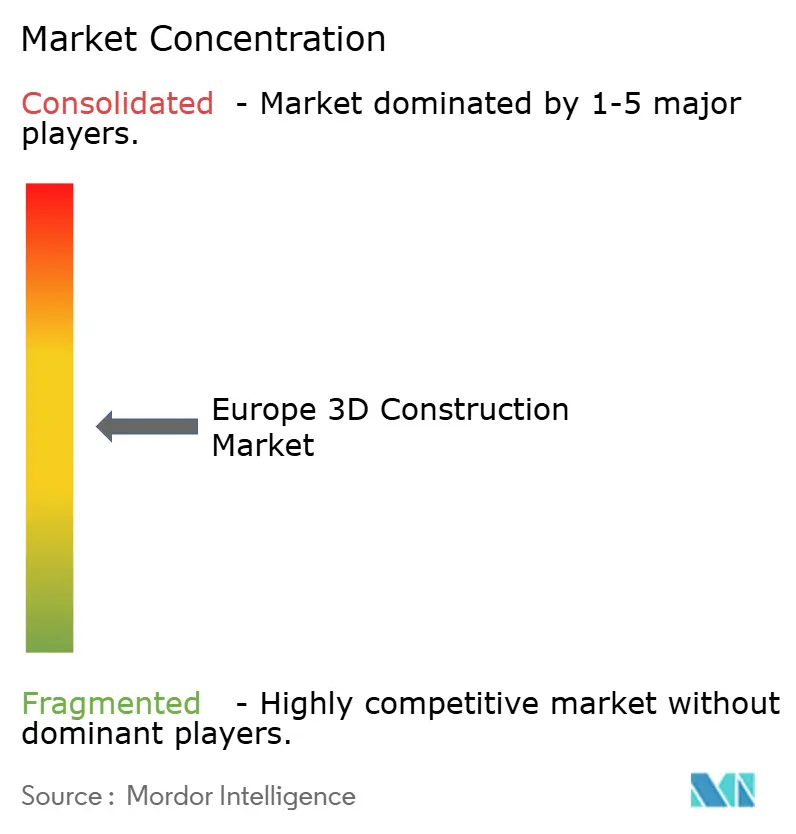
| Market Concentration | Medium |
Major Players *Disclaimer: Major Players sorted in no particular order Image © Mordor Intelligence. Reuse requires attribution under CC BY 4.0. | |
Europe 3D Construction Market Analysis by Mordor Intelligence
The Europe 3D Construction Market size is expected to grow from USD 1.20 billion in 2025 to USD 1.60 billion in 2026 and is forecast to reach USD 6.80 billion by 2031 at 33.60% CAGR over 2026-2031. The Europe 3D construction market is moving beyond pilot buildings because public housing demand, labor shortages, and low-carbon construction goals are now reinforcing one another in the same project pipelines. The European Union still needs more than 2 million new homes each year through 2035, and the additional requirement of 7.14 million units beyond current pipeline projections is keeping delivery pressure elevated across large metropolitan areas. That pressure is helping the Europe 3D construction market shift from experimental procurement toward repeat residential and infrastructure contracts where speed, labor efficiency, and material control matter more than novelty alone. Integrated suppliers are strengthening their positions by combining printer systems, printable materials, and site execution support into a single offer, while there is still room for off-site precast specialists and advanced materials developers. The Europe 3D construction market also retains clear headroom because fragmented approvals, uneven insurance acceptance, and heavy upfront equipment costs still prevent mid-sized contractors from scaling as quickly as large incumbents.
Key Report Takeaways
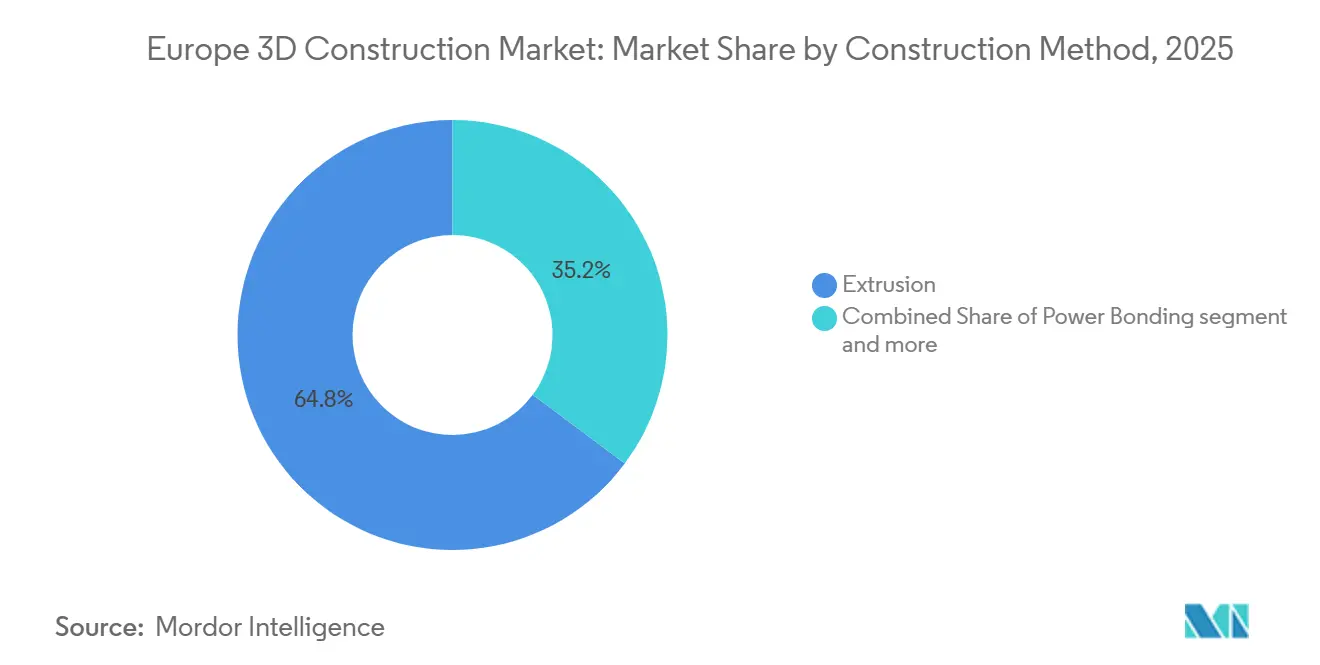
- By construction method, extrusion-based printing held 64.8% of the Europe 3D construction market share in 2025, while powder bonding is projected to expand at a 42.6% CAGR through 2031.
- By material type, concrete accounted for 58.2% of the Europe 3D construction market in 2025, while composite materials are forecast to grow at a 46.8% CAGR through 2031.
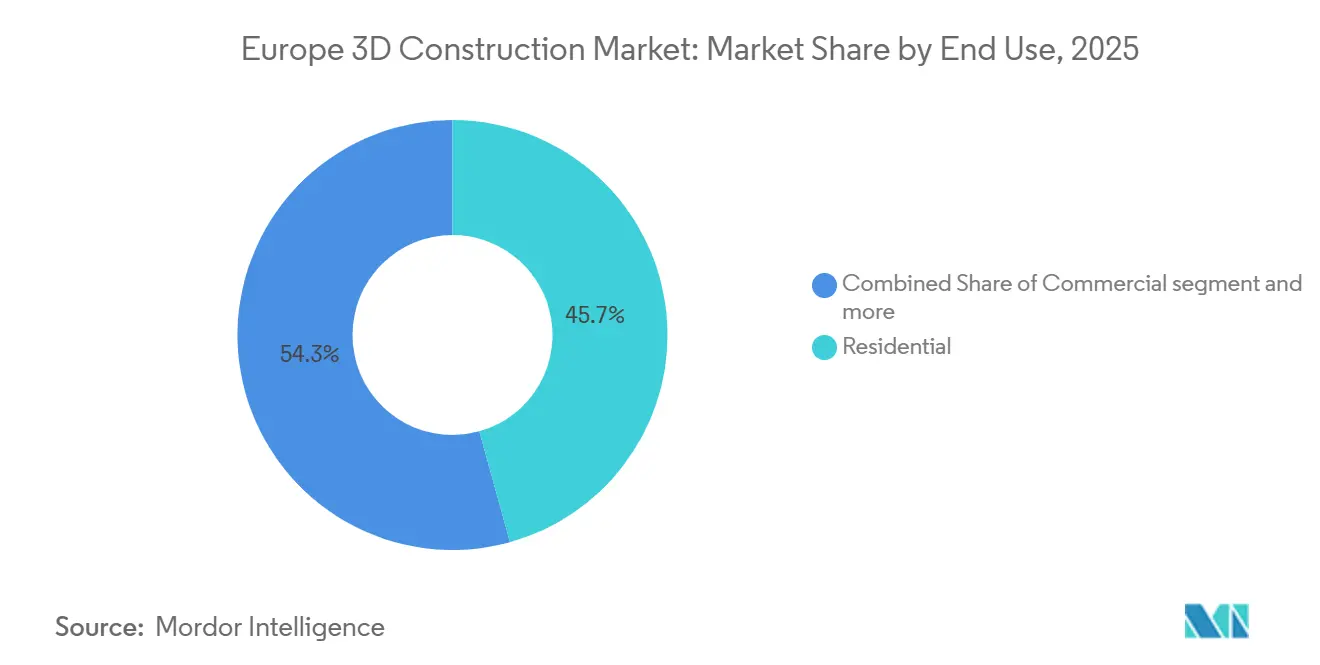
- By end use, residential construction held 45.7% of the Europe 3D construction market in 2025, while infrastructure is expected to record the fastest CAGR of 41.9% through 2031.
- By construction setting, on-site printing accounted for 63.5% of the Europe 3D construction market in 2025, while off-site printing is projected to grow at a 43.2% CAGR through 2031.
- By geography, Germany held 22.4% of the Europe 3D construction market share in 2025, while the Netherlands is forecast to register the fastest CAGR of 48.5% through 2031.
Note: Market size and forecast figures in this report are generated using Mordor Intelligence’s proprietary estimation framework, updated with the latest available data and insights as of January 2026.
Europe 3D Construction Market Trends and Insights
Drivers Impact Analysis*
| Drivers | (~) % Impact on CAGR Forecast | Geographic Relevance | Impact Timeline |
|---|---|---|---|
| Acute Social Housing Shortages in Major European Metropolitan Areas | +7.5% | Europe-wide, strongest in Germany, France, Spain, Netherlands | Short term (≤ 2 years) |
| EU Green Deal Embodied Carbon Targets Driving Low-Carbon Concrete Printing | +6.0% | EU-wide, strongest in Germany, France, Netherlands | Medium term (2-4 years) |
| Shorter Build Cycles and Lower Labor Intensity | +5.5% | Western and Northern Europe, with spillover across Europe | Short term (≤ 2 years) |
| Mix Design Advances Improving Structural Reliability | +4.0% | DACH, Benelux, Nordics, with early-stage adoption in Southern Europe | Medium term (2-4 years) |
| Carbon-Lowering Binder Systems and Waste Reduction | +3.5% | Germany, Netherlands, Nordic countries | Medium term (2-4 years) |
| Digital Quality Control and Rework Reduction | +3.0% | Broad relevance across European markets | Long term (≥ 4 years) |
| Source: Mordor Intelligence | |||
Acute Social Housing Shortages in Major European Metropolitan Areas
The Europe 3D construction market is well matched with social housing because public demand comes in repeatable project blocks rather than isolated private commissions. The European Union needs more than 2 million new homes each year through 2035, and the requirement for 7.14 million additional units above current pipelines is concentrated heavily in major urban areas where procurement schedules are difficult to defer. That kind of recurring demand helps justify printer utilization, as contractors can move from single-building demonstrations to continuous production runs. The Bezannes ViliaSprint² project in France provided the segment with a stronger reference point, as the building included 12 social housing units across 3 floors and was delivered 3 months faster than a comparable conventional project using a 3-person crew. Public developers are therefore not only testing a new process, but they are also using the process to answer delivery gaps that conventional labor-intensive methods are finding harder to close. This makes housing one of the clearest demand anchors for the Europe 3D construction market over the forecast period.
EU Green Deal Embodied Carbon Targets Driving Low-Carbon Concrete Printing
European construction policy is steadily moving toward stricter measurement of building-level environmental performance, and that is improving the commercial case for additive construction in public and regulated projects. Research published in 2025 showed that 3D concrete printing can reduce embodied carbon by 20% to 40% compared with conventional precast methods, providing buyers with a measurable reason to test the process in low-carbon building programs. That advantage matters more in Europe because procurement teams are under pressure to document environmental outcomes rather than only compare upfront cost. The benefit is also cumulative because each completed low-carbon project creates a better evidence base for repeat bids, better material qualification, and lower internal resistance inside public agencies. As a result, the Europe 3D construction market is benefiting from a policy setting that increasingly favors construction methods able to combine design freedom with cleaner material use.
Shorter Build Cycles and Lower Labor Intensity
Shorter construction timelines and lower crew requirements are strengthening the case for the Europe 3D construction market because recent projects now show measurable gains in speed and workforce efficiency under live operating conditions. COBOD reported that its BOD2 system can print 1 square meter of wall in 5 minutes with a 2 to 3-person crew, which is materially lower labor intensity than conventional structural wall construction methods. At Skovsporet in Holstebro, Denmark, printing productivity improved from multi-week cycles on the first building to a 5-day cycle for the sixth building, showing that throughput rises meaningfully as teams repeat the same workflow and gain operating familiarity. The same pattern appeared in Germany, where the DREIHAUS Heidelberg project delivered 21 residential units 30% faster and 10% more cost-efficiently than equivalent conventional builds using a 2 to 3-person operator team. These outcomes matter because developers and public housing agencies are looking for methods that can keep projects moving even when conventional site crews are harder to scale quickly across multiple builds. As more contractors shift from one-off demonstrations to repeat project execution, shorter build cycles and lower labor intensity are likely to remain one of the most practical growth supports for the Europe 3D construction market.
Mix Design Advances Improving Structural Reliability
Mix design advances are improving structural reliability in the Europe 3D construction market because newer printable formulations are becoming more consistent during pumping, deposition, and curing. Earlier printed concrete systems faced weaker interlayer bonding and uneven mechanical performance, so material development has become central to wider structural acceptance. The current shift is toward mixes that can balance printability with strength, durability, and fire performance, which is critical for load-bearing applications and formal project approvals. The BIO-UPTAKE project, concluded in May 2026, validated bio-based and recyclable composite construction products with natural flax fiber reinforcement and 80% bio-based content by weight, showing that advanced formulations are expanding the usable material base without losing technical intent. Better material consistency also reduces the risk of print defects and supports more predictable structural behavior, which helps contractors and regulators become more comfortable with repeat deployment. As these formulations mature, mix design advances should continue to support the Europe 3D construction market by making printed structural elements easier to qualify and more reliable in real construction settings.
Restraints Impact Analysis*
| Restraints | (~) % Impact on CAGR Forecast | Geographic Relevance | Impact Timeline |
|---|---|---|---|
| High Upfront Capex for Large-Format Printers | -4.0% | All markets, most acute in Southern and Eastern Europe | Short term (≤ 2 years) |
| Fragmented National Building Codes and CE Marking Complexity Across EU Member States | -3.5% | EU-wide, strongest in Germany, Italy, France | Medium term (2-4 years) |
| Insurance and Warranty Acceptance Gaps | -2.0% | UK improving, Germany, France, Italy lagging | Medium term (2-4 years) |
| Feedstock Quality and Additive Supply Constraints | -1.5% | EU admixture markets with supply-chain spillover effects | Long term (≥ 4 years) |
| Source: Mordor Intelligence | |||
High Upfront Capex for Large-Format Printers
Printer ownership still creates a sharp participation divide inside the Europe 3D construction market because large-format gantry systems usually cost USD 500,000 to more than USD 1.5 million before training, batching, maintenance, and material programs are added. A 2026 stochastic investment analysis found that material-saving potential explained 75% of the variance in unit production cost, while hardware upgrades showed weaker returns after an initial threshold, which means economics depend heavily on operating utilization and feedstock efficiency. Contractors without a steady flow of large projects, therefore, struggle to justify direct ownership even if they accept the technical case for the process. This keeps much of the learning curve inside large groups that already have public contracts, stronger balance sheets, and broader project pipelines. The Europe 3D construction market can still expand under this structure, but the pace of ecosystem widening remains slower than the demand picture alone would suggest.
Fragmented National Building Codes and CE Marking Complexity Across EU Member States
Fragmented national building codes and CE marking complexity continue to slow the Europe 3D construction market because contractors still face different approval paths across member states instead of a single structural route for printed construction products. The updated Construction Products Regulation has strengthened the policy framework for construction product safety and sustainability, but innovative printed systems still need clearer, harmonized technical pathways before regional-scale deployment can proceed smoothly. This means companies often have to prepare separate technical documentation, testing evidence, and compliance work for different countries, which raises cost and lengthens project timelines. Construction Fixings Europe noted that the new CPR environment can create financial risk when product development, hardware investment, and project commitments move ahead of formal certification progress or European Assessment Document timelines. The result is that contractors who have already proven a system in one national market may still need fresh validation work before entering another, which limits cross-border scaling and slows repeat deployment. Until more predictable approval routes are established, regulatory fragmentation is likely to remain one of the most persistent restraints on the Europe 3D construction market.
*Our forecasts treat driver/restraint impacts as directional, not additive. The impact forecasts reflect baseline growth, mix effects, and variable interactions.
Segment Analysis
By Construction Method: Extrusion Scales Residential Delivery, Powder Bonding Targets Precision Precast
Extrusion-based printing captured 64.8% of the Europe 3D construction market by construction method in 2025, which makes it the largest technology base in current commercial deployment. Its lead reflects practical maturity rather than concept appeal because contractors can point to several recent buildings where extrusion worked under real time, labor, and quality constraints. DREIHAUS in Heidelberg delivered 21 residential units 30% faster and 10% more cost-efficiently than equivalent conventional builds, using a 2 to 3-person operator team, which reinforced extrusion’s credibility for multi-unit projects. The same method also supported the ViliaSprint² project in France, where the full load-bearing structure and walls were printed on-site for a multi-family social housing building. This combination of site flexibility, labor efficiency, and growing reference depth keeps extrusion at the center of the Europe 3D construction market.
Extrusion also benefits from its fit with mobile gantry systems and established cement-based material handling, which lowers practical adoption friction compared with newer or more specialized methods. Contractors can deploy it directly on-site, adapt it to different building forms, and align it with public projects where shell speed matters most. The Europe 3D construction market share held by extrusion also reflects the fact that permitting bodies and clients can review a larger set of completed examples than they can for most competing methods. Productivity gains improve further as teams repeat the same print sequence, which was visible in Denmark where the final building at Skovsporet printed in 5 days after slower early cycles. In the Europe 3D construction industry, that growing bank of repeat examples is as important as the printer hardware itself because it reduces buyer hesitation in larger tenders. Powder bonding is the fastest-growing construction method with a 42.6% CAGR through 2031, which gives it a strong role in the next phase of Europe 3D construction market size. Its appeal is different from extrusion because it is strongest where geometric precision, surface quality, and complex element design matter more than field mobility. The method is particularly relevant for customized façade elements and optimized precast parts that benefit from fine deposition control in a factory setting. That production setting also reduces exposure to the on-site variability that still complicates broader approval of printed structural shells in some national markets. As the Europe 3D construction market develops further, powder bonding is likely to remain smaller in present volume than extrusion, yet more influential in precision precast and controlled-environment production.


By Material Type: Concrete Anchors Volume While Composites Define the Next Growth Phase
Concrete accounted for 58.2% of the Europe 3D construction market by material type in 2025, confirming that current revenue still depends mainly on cement-based printable systems. The reason is straightforward: concrete sits within familiar supply chains, established structural engineering practice, and a broader acceptance among contractors and public clients. The material also translates more easily into large structural wall systems, housing shells, and public infrastructure components than many alternative printable materials at current scale. That practical fit keeps concrete as the main volume engine of the Europe 3D construction market even as the surrounding material mix becomes more diverse. In commercial terms, concrete remains the material that most directly connects printer capability with real project delivery.
Fragmented national building codes and CE marking complexity remain a key restraint on the Europe 3D construction market because printed construction systems still do not have a uniform structural approval route across EU member states. The updated Construction Products Regulation has strengthened the broader policy framework, but companies still face separate documentation, testing, and compliance requirements in different countries, which raises cost and delays project execution. Construction Fixings Europe also noted that certification timelines can create financial risk when companies commit to product development and project delivery before formal approvals are completed. This limits cross-border scaling and keeps market expansion slower than demand conditions would otherwise support.
By End Use: Social Housing Drives Present Volume, Infrastructure Sets the Future Pace
Residential construction commanded 45.7% of the Europe 3D construction market in 2025, which makes housing the largest end-use category by current deployment. This lead is tied closely to social housing because state-backed procurement creates repeatable building programs that can support printer utilization and shorten the payback period for early adopters. The housing need identified by the European Union gives this segment a durable demand base, especially in large cities where shortages have become politically sensitive and operationally urgent. That matters for the Europe 3D construction market because project repetition is more valuable than one-off scale in the early commercialization phase. Residential demand, therefore, remains the segment where technology deployment can move most directly into repeat public procurement.
Commercial applications remain smaller than residential in the current Europe 3D construction market, but they are still relevant because they show that printed structures can support investor-grade use cases without relying only on state-backed housing programs. The input identifies serviced-apartment use in Heidelberg, which suggests that occupancy-based commercial formats are becoming more acceptable where developers can match the technology with a clear business model. This matters because broader commercial validation can diversify demand and reduce reliance on housing cycles alone. Even so, commercial growth is likely to remain secondary in the near term because public housing and infrastructure offer more urgent reasons to change established construction methods. The commercial segment therefore plays a supporting role in market development rather than leading present scale. Infrastructure is the fastest-growing end-use segment with a 41.9% CAGR through 2031, and that pace shows where future project economics may become strongest inside Europe 3D construction market size. The reason is that additive manufacturing performs well when components are standardized, repeated, geometrically complex, and material-sensitive at the same time. Bridge nodes, drainage structures, pipe supports, flood-defense elements, and other repeat civil components fit that profile better than many bespoke buildings. Infrastructure buyers also tend to evaluate total performance, durability, and carbon outcomes alongside cost, which can help new fabrication methods gain acceptance in targeted categories. For the Europe 3D construction market, infrastructure therefore offers a strong route toward scale where industrialized component production can support cleaner compliance and more consistent output.

By Construction Setting: On-Site Dominance Reflects Bespoke Design Needs, Off-Site Narrows the Gap on Economics
On-site printing accounted for 63.5% of the Europe 3D construction market in 2025, reflecting its dominance in the industry's early commercialization. Growth has been driven by bespoke housing, public demonstration projects, and project-specific designs where direct on-site printing was more practical than factory-produced components. The approach enables contractors to showcase 3D printing as a complete shell-construction method, making the technology more visible to developers and public authorities. Projects such as the Bezannes multi-family residential development demonstrated that on-site printing could be successfully integrated into real housing programs, while the ability to adapt to varying site geometries remains valuable for urban housing and mixed-use developments. However, productivity remains affected by equipment mobilization, weather conditions, and project-specific inspection requirements, suggesting that, although on-site printing currently leads the Europe 3D construction market, its share may gradually moderate as alternative production models mature.
Off-site printing is projected to expand at a 43.2% CAGR between 2026 and 2031, making it the fastest-growing deployment model within the Europe 3D construction market. Factory-based production offers greater control over temperature, humidity, dimensional accuracy, quality inspection, and repeatability, making it well suited for standardized housing components, infrastructure elements, and precision precast products. It also supports smoother regulatory compliance through established manufacturing and CE-marking processes, whereas on-site printed structures often require project-specific assessments. In addition, off-site production reduces repeated site mobilization costs and improves manufacturing efficiency through scalable, repeatable output. As the market shifts from demonstration projects toward higher-volume commercial deployment, these operational, regulatory, and economic advantages are expected to make off-site printing an increasingly important complement to the early success of on-site construction.
Geography Analysis
Germany accounted for 22.4% of the Europe 3D construction market in 2025, making it the region's largest national market due to its first-mover advantage, stronger institutional ecosystem, and consistent project execution. The country has demonstrated commercial scalability through projects such as Heidelberg's DREIHAUS development, which delivered 21 residential units across three buildings, proving that 3D printing can support repeatable multi-family housing rather than isolated pilot structures. Germany also benefits from close collaboration between construction firms, material suppliers, and technology providers, creating a larger base of domestic reference projects than most neighboring countries. Although project approvals and building authorizations remain a key bottleneck that slows wider deployment, Germany continues to lead the Europe 3D construction market through its combination of proven project delivery, industrial capability, and strong market visibility.
The Netherlands is projected to record the fastest CAGR of 48.5% between 2026 and 2031, driven by significant housing shortages and growing demand for standardized infrastructure solutions. Strong residential demand, combined with opportunities in public infrastructure and climate-resilient construction, aligns well with the advantages of additive manufacturing, particularly for repeatable building components and precast applications. France and the United Kingdom are also emerging as important growth markets. France has strengthened its position through successful social housing initiatives such as the ViliaSprint² project, demonstrating the viability of multi-family printed housing, while the UK has made progress in insurance and warranty acceptance, improving confidence among developers and investors and supporting broader commercial adoption.
The Nordic countries, particularly Denmark, Sweden, and Norway, are expanding adoption as high labor costs and public housing priorities improve the economic case for automated construction. Denmark's Skovsporet student housing project demonstrated significant productivity improvements through repetitive printing, highlighting the efficiency gains achievable in large-scale residential developments. Meanwhile, Spain and Italy remain at an earlier stage, with growing interest in circular construction and bio-based materials but slower commercialization due to certification challenges. The broader Rest of Europe, including countries such as Portugal and the Czech Republic, is witnessing increasing pilot activity, indicating that while revenue remains concentrated in leading markets, the Europe 3D construction market is steadily expanding across a wider geographic footprint.
Competitive Landscape
The Europe 3D construction market is moderately concentrated, with a limited number of technology integrators accounting for a significant share of commercial project activity. Companies such as COBOD, PERI 3D Construction, and leading material partners have established strong market positions by offering integrated solutions that combine printer hardware, deployment support, and certified printable materials. Their technologies have been deployed across high-profile residential and public housing projects in Germany, France, and Denmark, giving them a substantial portfolio of proven reference projects. As most developers and public authorities are still in the early stages of adopting additive construction, they often prefer established providers capable of delivering end-to-end solutions rather than standalone printing equipment.
A defining competitive trend is vertical integration, where suppliers differentiate themselves by combining hardware, materials, engineering expertise, project execution, and regulatory support into a single offering. Success increasingly depends on demonstrating reliable project delivery, construction quality, and compliance with local building standards rather than simply providing advanced printer technology. Once contractors or public agencies validate a particular workflow, switching to another technology provider introduces additional technical, operational, and approval risks, creating relatively high switching costs. This favors companies with proven deployment experience and comprehensive solution portfolios, reinforcing the competitive positions of established market leaders.
Competition is also expanding beyond printer manufacturers into printable materials, reinforcement technologies, and factory-based precast production. Advances in fiber-reinforced concrete, recyclable materials, and bio-based composites are creating new opportunities for material innovators, while the growing shift toward off-site manufacturing is opening the market to specialists focused on standardized precast components and infrastructure applications. These segments offer lower entry barriers than full-scale on-site building printing because factory production simplifies quality control, repeatability, and regulatory compliance. As the Europe 3D construction market matures, competitive advantage is expected to depend increasingly on integrated capabilities across hardware, materials, manufacturing efficiency, certification readiness, and the ability to consistently deliver commercial-scale projects.
Europe 3D Construction Industry Leaders
COBOD International A/S
CyBe Construction B.V.
XtreeE
Holcim Ltd.
PERI SE
- *Disclaimer: Major Players sorted in no particular order

Recent Industry Developments
- May 2026: PERI 3D Construction and COBOD completed ViliaSprint² in Bezannes, France, Europe’s largest 3D-printed multi-family residential building at the time, comprising 12 social housing units across 3 floors and approximately 800 m², delivered 3 months ahead of a comparable conventional construction timeline using a 3-person crew.
- May 2026: CIDETEC Surface Engineering concluded the European BIO-UPTAKE project with the development of bio-based and recyclable composites for the construction sector, including natural flax fiber reinforcement and 80% bio-based content by weight .
- October 2025: 3DCP Group completed the printing phase for Skovsporet in Holstebro, Denmark, Europe’s then-largest 3D-printed housing project, producing 36 student apartments across 6 buildings, 1,654 m², for NordVestBO using COBOD’s BOD3 printer, with printing productivity improving from multi-week cycles on the first building to 5 days on the final structure


Europe 3D Construction Market Report Scope
| Extrusion |
| Powder Bonding |
| Others |
| Concrete |
| Metal |
| Composite |
| Other Material Types |
| Residential |
| Commercial |
| Infrastructure |
| On-site (In-situ) Printing |
| Off-site (Factory / Precast) Printing |
| Germany |
| United Kingdom |
| France |
| Spain |
| Italy |
| Netherlands |
| Sweden |
| Denmark |
| Norway |
| Rest of Europe |
| By Construction Method | Extrusion |
| Powder Bonding | |
| Others | |
| By Material Type | Concrete |
| Metal | |
| Composite | |
| Other Material Types | |
| By End Use | Residential |
| Commercial | |
| Infrastructure | |
| By Construction Setting | On-site (In-situ) Printing |
| Off-site (Factory / Precast) Printing | |
| By Country | Germany |
| United Kingdom | |
| France | |
| Spain | |
| Italy | |
| Netherlands | |
| Sweden | |
| Denmark | |
| Norway | |
| Rest of Europe |


Key Questions Answered in the Report
What is the forecast for the Europe 3D construction market through 2031?
The Europe 3D Construction Market size is expected to grow from USD 1.20 billion in 2025 to USD 1.60 billion in 2026 and is forecast to reach USD 6.80 billion by 2031 at 33.60% CAGR over 2026-2031.
Why is social housing so important for Europe 3D construction demand?
Social housing creates repeatable multi-unit project blocks, and the EU still needs more than 2 million new homes each year through 2035.
Which construction method leads current adoption in Europe?
Extrusion leads with 64.8% share in 2025 because it has stronger site flexibility, better project references, and clearer productivity proof in housing programs.
Which material segment is growing the fastest in Europe 3D construction?
Composite materials are projected to grow at a 46.8% CAGR through 2031 as printable systems improve in strength, fire performance, and circularity.
Page last updated on:





