
Epoxy Hardeners Market Size and Share
Market Overview
| Study Period | 2021 - 2031 |
|---|---|
| Market Size (2026) | USD 4.52 Billion |
| Market Size (2031) | USD 5.99 Billion |
| Growth Rate (2026 - 2031) | 5.81 % |
| Fastest Growing Market | Asia-Pacific |
| Largest Market | Asia-Pacific |
| Market Concentration | Medium |
Major Players *Disclaimer: Major Players sorted in no particular order Image © Mordor Intelligence. Reuse requires attribution under CC BY 4.0. | |
Epoxy Hardeners Market Analysis by Mordor Intelligence
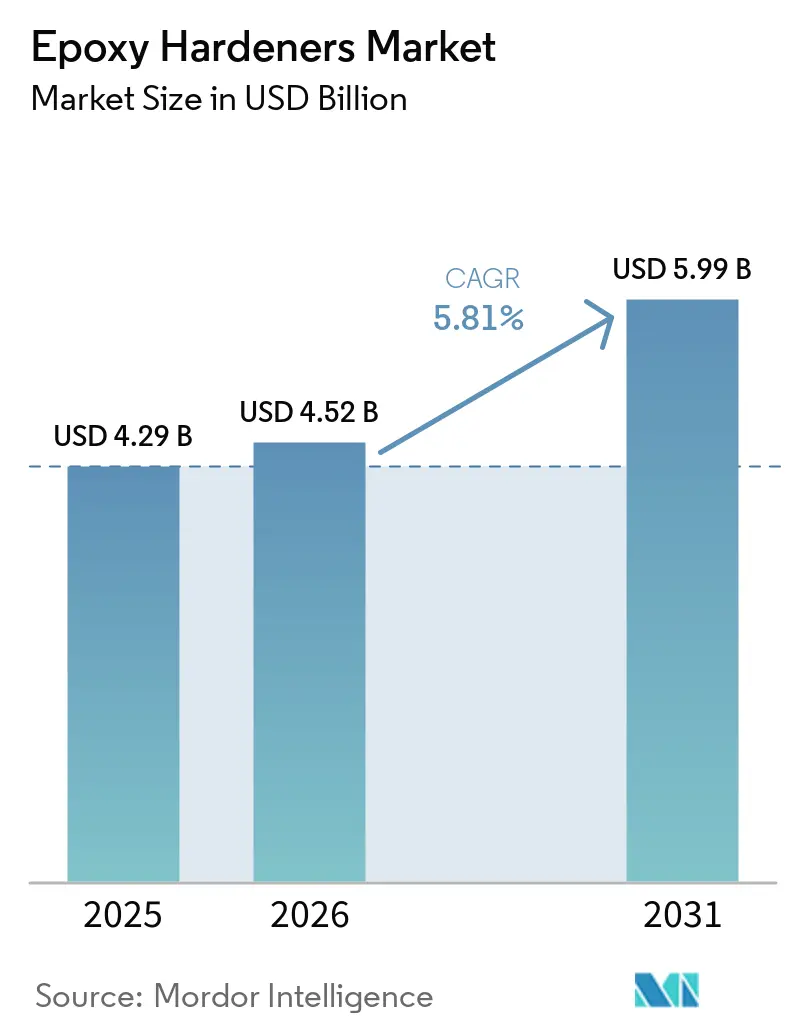
The global epoxy hardeners market size was valued at USD 4.29 billion in 2025 and is estimated to grow from USD 4.52 billion in 2026 to reach USD 5.99 billion by 2031, at a CAGR of 5.81% during the forecast period (2026-2031). Infrastructure activity in Asia and the Middle-East, wind blade production, and the shift toward lower-emission protective coatings support demand across the epoxy hardeners market. Suppliers must continue serving large construction and industrial customers while qualifying specialized grades for power electronics and composite structures. These specialist applications can deliver higher margins because they require tightly controlled cure behavior, purity, and product validation, and customers must often approve the entire material system before it can be used in a commercial component or operating asset. The market, therefore, combines recurring demand with smaller specification-led opportunities that carry higher value. Regulatory changes and raw material costs can slow growth, but they also favor suppliers with integrated production, formulation expertise, and established customer approvals, as these companies are better positioned to maintain supply while revising product labels, safety documentation, and formulation packages.
Key Report Takeaways
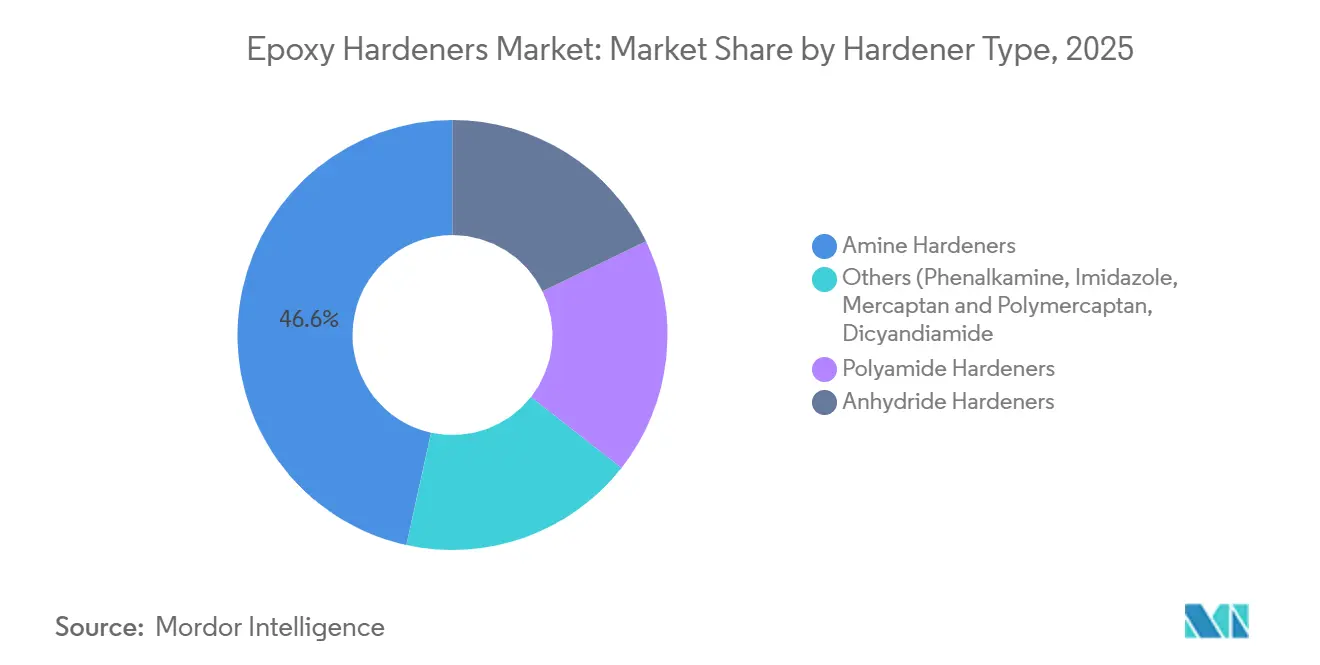
- By hardener type, amine hardeners held 46.56% of the epoxy hardeners market share in 2025, while anhydride hardeners are forecast to grow at a 6.45% CAGR through 2031.
- By application, protective coatings accounted for 38.18% of the epoxy hardeners market share in 2025, while composites are projected to expand at a 6.72% CAGR through 2031.
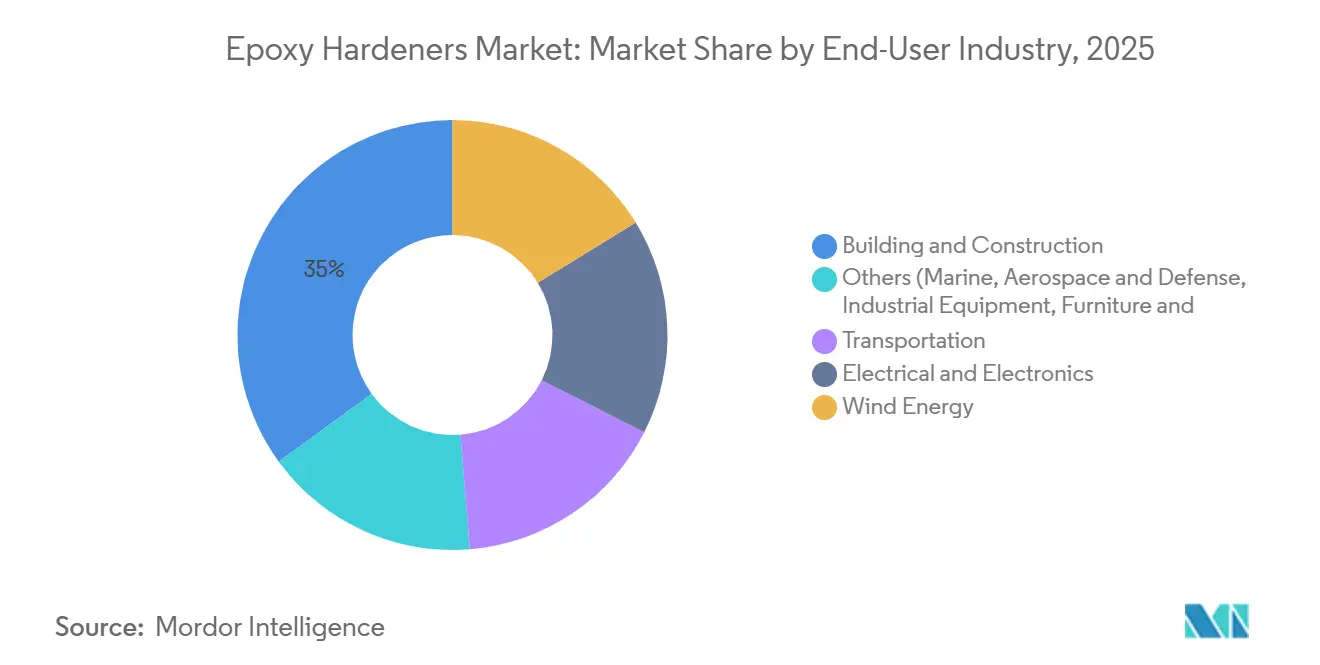
- By end-user industry, building and construction held 35.03% of the epoxy hardeners market share in 2025, while wind energy is expected to record a 7.13% CAGR through 2031.
- By geography, Asia-Pacific held 41.78% of the epoxy hardeners market share in 2025 and is projected to grow at a 6.94% CAGR through 2031.
Note: Market size and forecast figures in this report are generated using Mordor Intelligence’s proprietary estimation framework, updated with the latest available data and insights as of January 2026.
Market Trends and Insights
Drivers Impact Analysis of Epoxy Hardeners Market*
| Drivers | (~) % Impact on CAGR Forecast | Geographic Relevance | Impact Timeline |
|---|---|---|---|
| Construction, Infrastructure, and Industrial Flooring Demand | +1.6% | Global, with core gains in Asia-Pacific, the Middle-East, Africa, and North America | Short term (≤ 2 years) |
| Electronics Miniaturization and Encapsulation Requirements | +1.0% | Asia-Pacific core, with China, South Korea, and Japan, plus North America | Medium term (2-4 years) |
| Wind Blade and Renewable Infrastructure Build-Out | +1.0% | Asia-Pacific, Europe, and North America | Medium term (2-4 years) |
| Low-Volatile Organic Compound (VOC) and Waterborne Formulation Adoption | +0.7% | Europe and North America, with early gains in China and South Korea | Short term (≤ 2 years) |
| Low-Ion Hardener Qualification for Electric Vehicle (EV) Power Modules | +0.5% | China, Germany, the United States, and South Korea | Medium term (2-4 years) |
| Cashew Nut Shell Liquid (CNSL)-Based Phenalkamine Performance in Humid and Low-Temperature Applications | +0.4% | Southeast Asia, South America, the Middle-East, and Africa | Medium term (2-4 years) |
| Source: Mordor Intelligence | |||
Construction, Infrastructure, and Industrial Flooring Demand
Construction spending remains a key driver for the epoxy hardeners market, particularly in applications where reliable ambient curing is essential. China supports Asia-Pacific consumption through sustained civil engineering investment, large industrial facilities, and a regulatory-driven shift toward lower-VOC floor coatings, keeping epoxy use relevant in both new construction and maintenance work. Gulf Cooperation Council projects require amine systems with extended pot life and heat-tolerant curing, as application temperatures can exceed 40°C. In March 2025, BASF and Sika commercialized Baxxodur EC 151, which combines lower VOC emissions with reliable cure performance at 5-10°C for selected flooring and coating applications. Industrial floors also generate recurring demand, as recoating typically occurs every 5-10 years. This replacement cycle reduces the epoxy hardeners market's exposure to fluctuations in new construction activity and limits dependence on individual project starts.
Electronics Miniaturization and Encapsulation Requirements
Fan-out wafer-level packaging, 3D integration, and heterogeneous integration require hardeners with very low ionic contamination and controlled hydrolyzable chloride content. These applications often require sub-5 ppm alkali metal levels, restricting supply to high-purity cycloaliphatic amine and anhydride grades that meet narrow contamination limits without compromising cure behavior or electrical insulation. Low-ion hardeners for electric vehicle (EV) power modules face similar requirements, as thermal stability and electrical reliability affect module performance. Suppliers must balance purity with processability, controlled curing, and stable performance in high-voltage operating environments. Qualification periods can last 18-24 months per grade, creating meaningful switching costs once a formulation enters approved production. This makes continuity of supply, batch consistency, and technical support important considerations in purchasing. These dynamics give the epoxy hardeners market a path toward longer supply agreements in electronics, automotive power modules, and other applications where suppliers compete on performance rather than quantity.
Wind Blade and Renewable Infrastructure Build-Out
Longer wind blades and higher fatigue loads are increasing demand for infusion-grade hardeners with controlled viscosity and reactivity. At the end of 2025, Germany had 29,226 onshore turbines with 68,067 MW of installed capacity, and its wind policy requires 2% of national land to be designated for wind energy by 2032. Medium-reactivity systems combining fast and slow anhydride curing agents reduced blade pre-curing time from 3.0 hours to 2.3 hours in production settings. Recyclable epoxy systems are entering commercial blade-development programs, where structural certification can influence supplier qualification and future tender requirements. These developments support the epoxy hardeners market, as blade producers increasingly require both production efficiency and solutions that address end-of-life requirements, rather than treating curing speed, structural performance, and circularity as separate product decisions.
Low-VOC and Waterborne Formulation Adoption
Low-emission and waterborne systems are becoming compliance requirements in Europe and procurement criteria in North America and urban China. European VOC and REACH regulations are shaping formulation choices for coatings and hardeners used in construction products, affecting raw-material selection, emissions testing, safety documentation, and the continued availability of older solvent-borne systems. In July 2025, Evonik transitioned five epoxy curing-agent plants to renewable electricity, reporting a 30% annual reduction in Scope 1 and 2 emissions. In April 2026, Evonik introduced Ancamine 2873 for fast curing at temperatures as low as 5°C in protective and marine coatings. These developments make formulation capability increasingly important in the epoxy hardeners market. Phenalkamines derived from cashew nut shell liquid remain relevant in humid or low-temperature conditions that require dependable cure performance and where conventional synthetic amines may require further modification.
Restraints Impact Analysis of Epoxy Hardeners Market*
| Restraints | (~) % Impact on CAGR Forecast | Geographic Relevance | Impact Timeline |
|---|---|---|---|
| Hazardous Chemical Compliance and Reformulation Costs | -1.4% | Europe is primarily affected, with spillover to the United Kingdom, North America, and the Asia-Pacific through export controls | Short term (≤ 2 years) |
| Substitution by Polyurea, Polyaspartic, Vinyl Ester, and Polyester Systems | -1.1% | North America and Europe, especially in industrial flooring and bridge decks | Medium term (2-4 years) |
| Isophorone Diamine (IPDA) and Specialty Amine Precursor Price Volatility | -0.8% | Global, with particular exposure in Asia-Pacific and North America | Short term (≤ 2 years) |
| Long OEM Qualification Cycles for Specialty Grades | -0.5% | Automotive markets in Germany, the United States, and South Korea, plus aerospace in the United States and France | Long term (≥ 4 years) |
| Source: Mordor Intelligence | |||
Hazardous Chemical Compliance and Reformulation Costs
REACH and CLP requirements create direct costs for substance registration and reformulation, as well as indirect costs for customer requalification. Since January 2025, Dimethylaminopropylamine (DMAPA) and Diethylaminopropylamine (DEAPA) have been classified as reprotoxic Category 2 substances, while benzylated amines received new Specific Target Organ Toxicity Repeated Exposure (STOT RE) H373 labels in May 2025. Commission Regulation (EU) 2025/1731 introduced additional REACH Annex XVII restrictions for carcinogenic, mutagenic, and reprotoxic substances in August 2025[1]. Smaller suppliers may need to exit affected product lines or invest in reformulation without certainty that higher costs can be recovered through pricing, particularly when customers must separately qualify a revised finished coating, adhesive, or composite system. This dynamic can strengthen large, integrated suppliers in the epoxy hardeners market, as they are better positioned to maintain compliant portfolios and manage customer transitions with less disruption.
Substitution by Polyurea, Polyaspartic, Vinyl Ester, and Polyester Systems
Polyurea and polyaspartic systems compete with epoxy products for industrial floors and bridge decks by offering faster curing and greater humidity tolerance, reducing re-entry time in logistics facilities, parking structures, and maintenance projects where application downtime has a direct cost. Vinyl ester and polyester systems compete in tank lining and marine applications when their material costs are lower. Faster-curing alternatives can be particularly attractive in North America and Western Europe, where reduced downtime can lower labor and facility costs. Price volatility in isophorone diamine (IPDA) and other specialty amine precursors puts pressure on epoxy producers, particularly when input costs diverge from those in competing systems. Long original equipment manufacturer (OEM) approval cycles may also delay adoption of specialty grades in chemical containment and offshore coatings, even where their low-blush, high-reactivity, or corrosion-resistance performance remains competitive, as changes to a proven formulation can trigger new testing throughout the customer supply chain.
*Our forecasts treat driver/restraint impacts as directional, not additive. The impact forecasts reflect baseline growth, mix effects, and variable interactions.
Epoxy Hardeners Market Segment Analysis
By Hardener Type:
Amine Chemistry Leads, Anhydrides Gain Strategic GroundAmine hardeners accounted for 46.56% of the epoxy hardeners market share in 2025, supported by their use in protective coatings, industrial flooring, structural adhesives, and civil engineering repair. Their broad compatibility with waterborne formulations has helped suppliers adjust their portfolios without losing major application areas, particularly as construction and industrial customers replace solvent-borne systems to meet emissions requirements. Anhydride hardeners are expected to be the fastest-growing chemistry, with a CAGR of 6.45% from 2026 to 2031. Wind blade infusion and high-voltage electrical encapsulation support this growth, as low exotherm behavior and dielectric performance remain difficult to replace, and process stability becomes more important as component dimensions and electrical loads increase. The epoxy hardeners market size associated with anhydrides is also supported by production systems that reduce blade pre-curing time from 3.0 hours to 2.3 hours.
Polyamide hardeners are used in marine topcoats, civil engineering membranes, and joint sealants that require flexibility. In September 2024, Evonik Industries AG introduced Ancamide 2853 and Ancamide 2865, a nonylphenol-free polyamide curing agent with 20-40% bio-based content. Phenalkamines, imidazoles, mercaptans, dicyandiamide, and latent hardeners serve narrower applications with demanding performance requirements, allowing formulators to address low-temperature curing, one-component processing, moisture tolerance, or precise reaction control. Latent and imidazole grades are used in one-component prepreg systems, while Cashew Nut Shell Liquid (CNSL)-based phenalkamines are suited to humid and low-temperature marine or offshore conditions. China's GB/T 31293-2025 standard for vacuum-infused blade epoxy resins took effect on January 1, 2026, establishing a quality baseline that may favor certified anhydride and latent grades.

By Application:
Protective Coatings Lead by Output While Composites Record Fastest GrowthProtective coatings accounted for 38.18% of the epoxy hardeners market share in 2025, driven by anti-corrosion requirements across oil and gas assets, vessels, bridges, and industrial machinery. High recoating frequency makes this application more resilient than demand tied solely to new construction, as operators must maintain corrosion protection on existing bridges, vessels, industrial machinery, and energy infrastructure. Composites are expected to record the highest application CAGR at 6.72% through 2031. Offshore wind blade production, automotive lightweighting, and greater composite use in aerospace are increasing demand for high-purity, specification-specific grades, where a hardener is selected as part of a controlled resin system rather than as an interchangeable input. The epoxy hardeners market size for composites benefits from lower substitution risk, as suppliers must meet strict process and material requirements, including controlled resin flow, predictable curing, fatigue performance, and compatibility with the producer's established manufacturing cycle.
Commercial recyclable-blade programs indicate that circular material requirements may become part of composite-system selection in offshore wind projects, and this commercial deployment shows how recyclable epoxy systems can influence blade specifications in European offshore projects. Adhesives and sealants provide stable demand in automotive assembly, electronic bonding, and structural repair, although the balance of demand varies by required flexibility, operating temperature, cure speed, and long-term load-bearing performance. Polyurethane and silicone products limit growth in flexible-bonding applications, but epoxy systems retain important roles where structural strength is required. Electrical and electronics, industrial flooring, and civil engineering repair are also growing in importance as tunnel construction and power-electronics applications support demand for fast-setting, high-strength formulations.
By End-User Industry:
Wind Energy Resets the Growth CeilingBuilding and construction accounted for 35.03% of the epoxy hardeners market share in 2025, supported by infrastructure projects in Asia, renovation activity in Europe, and industrial facility development in the Americas. Wind energy is expected to be the fastest-growing end-user industry, with a CAGR of 7.13% from 2026 to 2031. Offshore deployment and larger blades require infusion-grade systems with closely controlled reactivity. Blade manufacturing is concentrated in China and India, where resin and labor costs support production economics, while wind projects across multiple regions create demand for grades that satisfy different local certification and operating conditions. European, North American, Southeast Asian, and South American projects create a broad deployment base for the epoxy hardeners market.
Commercial blade-development programs indicate that recyclable hardener chemistry is moving from product development toward supplier qualification. Transportation demand is shifting as EV platforms require low-ionic and thermally stable grades for power modules. Conventional automotive adhesive and coating demand remains stable, but power module requirements introduce distinct qualification standards for ionic cleanliness, thermal management, dielectric performance, and reliability over extended service life. Electrical and electronics demand includes printed circuit board (PCB) lamination and motor varnishing, while 5G deployments support base-station power module validation, reinforcing the importance of materials that protect components from heat, electrical stress, and moisture over long service periods. Marine, aerospace, and defense, industrial equipment, and consumer goods form the remaining end-user segments, with aerospace programs offering long production cycles once a hardener grade is qualified.
Geography Analysis
APAC Epoxy Hardeners Market
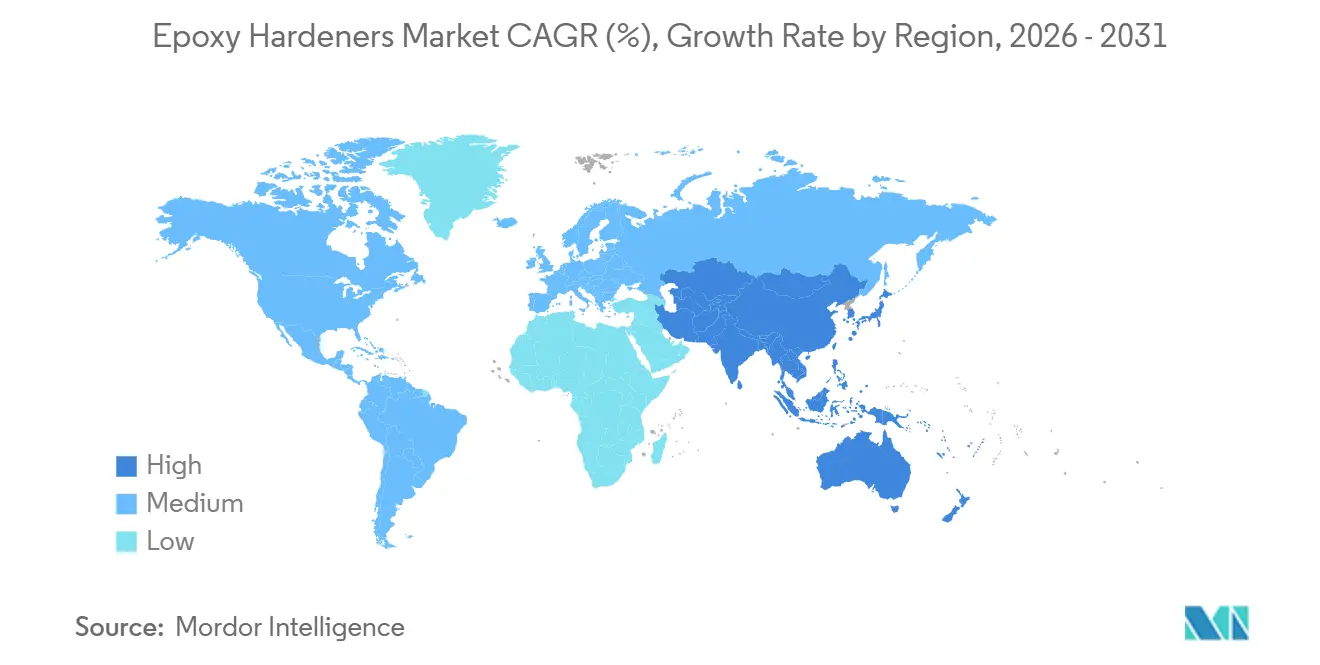
Asia-Pacific held 41.78% of the global epoxy hardeners market share in 2025 and is forecast to record the fastest regional CAGR of 6.94% through 2031. China combines major wind-blade production, semiconductor-packaging capacity, infrastructure investment, and a shift toward waterborne and lower-VOC systems. Domestic suppliers have expanded their amine and anhydride capabilities, reducing China's dependence on imported hardeners since 2020 and increasing competitive pressure in standard grades, while leaving room for higher-purity and certified specialty materials. India is emerging as a further demand center through industrial flooring, protective coatings for manufacturing plants, and renewable energy infrastructure. South Korea generates demand through electronics and shipbuilding, where coating and encapsulant specifications often require high performance and compliance with international volatile organic compound (VOC) regulations, reinforcing demand for products that combine production efficiency with reliable application properties.
North America Epoxy Hardeners Market
North America is the second-largest regional market for epoxy hardeners. Protective coatings for oil and gas infrastructure, industrial machinery, and transportation assets remain major sources of consumption. Demand for waterborne epoxy hardeners in the United States is supported by environmental compliance requirements in industrial painting operations, where suppliers must help users meet emissions standards without compromising corrosion protection, cure speed, or surface appearance. Mexico adds demand through automotive and electronics assembly linked to nearshoring, with adhesive and encapsulant grades serving manufacturing activity that increasingly supports regional supply chains. The proposed Olin and Huntsman transaction, announced in June 2026 and targeting a first-half 2027 close, would combine major chlor-alkali and epoxy raw-material operations with stated targeted synergies of USD 400 million[2].
EMEA and South America Epoxy Hardeners Market
Europe has a stable demand increasingly driven by reformulation requirements rather than output expansion, making regulatory compliance, lower emissions, and continued application performance the central commercial priorities for suppliers. Germany supports regional demand through automotive composites, North Sea wind-blade production, and building-renovation programs. Its land-use targets for wind energy create a multi-year need for blade-grade anhydride formulations, as turbine expansion requires reliable composite materials for both current manufacturing programs and subsequent maintenance demand. Nordic countries add offshore wind demand as regional manufacturers expand blade capacity. Brazil supports South American consumption through anti-corrosion coatings for offshore oil and gas assets. In the Middle-East and Africa, Gulf Cooperation Council (GCC) construction projects require amine hardeners that can cure at temperatures above 40°C, creating a meaningful qualification barrier for standard formulations.
Competitive Landscape
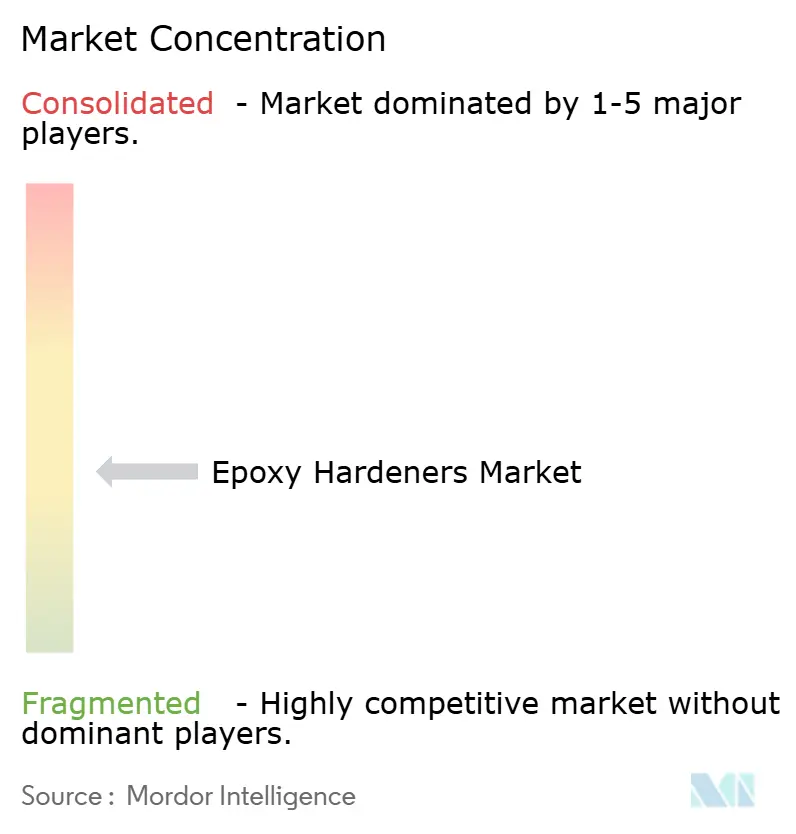
The epoxy hardeners market is moderately fragmented, with BASF, Evonik Industries, Huntsman, Allnex, Cardolite Corporation, and other specialty producers serving global and regional demand. Competition increasingly depends on regulatory readiness, application-specific approvals, and the ability to meet sustainability requirements. Customers face material risk when a supplier changes the chemistry already embedded in a validated formulation. Suppliers that build compliant portfolios before new regulations take effect can avoid product discontinuations and customer disruption, while those that respond later may face costly reformulation work, revised safety documentation, and extended customer requalification. Composite and electronics applications tend to support longer supply arrangements because material substitution requires extensive validation. Renewable electricity, bio-based feedstocks, and recyclable chemistries are also becoming points of differentiation in customer procurement decisions.
Evonik began expanding specialty amine production in Nanjing in April 2026 with a double-digit-million-euro investment, increasing capacity for reactive specialty amines used in polyurethane and epoxy applications. The Nanjing site operates on green electricity, aligning the project with the company's Scope 1 and 2 reduction targets. Evonik's 2025 shift to renewable electricity at five curing-agent plants gives it a production-carbon profile that is relevant in European procurement. BASF and Sika's 2025 commercialization of Baxxodur EC 151 demonstrates how lower-emission performance and wide-temperature curing can be combined for construction applications. These developments indicate that product development, capacity investment, and operational emissions are being addressed together in the epoxy hardeners market.
Cardolite holds a specialized position through cashew nutshell liquid (CNSL)-derived phenalkamines that perform in humid and low-temperature conditions, which is relevant when marine and infrastructure coatings must cure reliably outside controlled factory environments. Recyclable chemistries for wind blades remain an open opportunity, particularly where IEC 61400-23 certification is used in procurement and developers seek material systems that address future disposal challenges for large composite blades. Ultra-pure anhydride and cycloaliphatic amine grades also present opportunities in advanced semiconductor packaging, as qualification requirements narrow the supplier pool and make sustained quality control, technical support, and reliable availability essential to the customer relationship. China's GB/T 31293-2025 blade resin standard can serve as a quality filter for local suppliers and support demand for certified grades. The proposed Olin and Huntsman combination could intensify competition in commodity amine grades while expanding opportunities for vertically integrated supply.
Epoxy Hardeners Industry Leaders
-
Huntsman International LLC
-
Evonik Industries AG
-
Olin Corporation
-
Cardolite Corporation
-
BASF
- *Disclaimer: Major Players sorted in no particular order
Epoxy Hardeners Market Companies Covered in this Report
- Aditya Birla Chemicals (Thailand) Limited
- ALLNEX NETHERLANDS B.V.
- Atul Ltd.
- BASF
- Cardolite Corporation
- Cargill, Incorporated
- DIC CORPORATION
- Evonik Industries AG
- Hexion Inc.
- Huntsman International LLC
- KUKDO CHEMICAL CO., LTD.
- Mitsubishi Chemical Corporation
- Olin Corporation
- SHIKOKU CHEMICALS CORPORATION
- Westlake Corporation
Recent Industry Developments in Epoxy Hardeners Market
- April 2026: Evonik Industries inaugurated the expansion of its specialty amine production facility in Nanjing, China. The investment, valued in the double-digit-million-euro range, increased commercial-scale capacity for reactive specialty amines used in polyurethane and epoxy applications. The expanded facility operates entirely on green electricity, supporting Evonik's Scope 1 and 2 emission-reduction targets.
- December 2025: Kronospan completed the acquisition of Hexion's manufacturing facility in La Grande, Oregon, strengthening its North American production base and chemical supply chain in adhesives and performance materials.
Global Epoxy Hardeners Market Report Scope
Epoxy hardeners are reactive chemical compounds mixed with liquid epoxy resin to trigger a permanent hardening process. Through a chemical reaction called cross-linking, the hardener transforms the soft, sticky liquid into a rigid, durable, and strong solid plastic material.
The epoxy hardeners market is segmented by hardener type, application, end-user industry, and geography. By hardener type, the market is segmented into amine hardeners, polyamide hardeners, anhydride hardeners, and others (phenalkamine, imidazole, mercaptan and polymercaptan, dicyandiamide and latent hardeners). By application, the market is segmented into protective coatings, adhesives and sealants, composites, and others (electrical and electronics, industrial flooring, civil engineering and repair). By end-user industry, the market is segmented into building and construction, transportation, electrical and electronics, wind energy, and others (marine, aerospace and defense, industrial equipment, furniture and consumer goods). The report also covers market size and forecasts for epoxy hardeners across 16 countries in major regions. The market sizes and forecasts are provided in terms of value (USD).
Segmentation Overview
| Amine Hardeners |
| Polyamide Hardeners |
| Anhydride Hardeners |
| Others (Phenalkamine, Imidazole, Mercaptan and Polymercaptan, Dicyandiamide and Latent Hardeners) |
| Protective Coatings |
| Adhesives and Sealants |
| Composites |
| Others (Electrical and Electronics, Industrial Flooring, Civil Engineering and Repair) |
| Building and Construction |
| Transportation |
| Electrical and Electronics |
| Wind Energy |
| Others (Marine, Aerospace and Defense, Industrial Equipment, Furniture and Consumer Goods) |
| Asia-Pacific | China |
| India | |
| Japan | |
| South Korea | |
| ASEAN Countries | |
| Rest of Asia-Pacific | |
| North America | United States |
| Canada | |
| Mexico | |
| Europe | Germany |
| United Kingdom | |
| France | |
| Italy | |
| NORDIC Countries | |
| Russia | |
| Rest of Europe | |
| South America | Brazil |
| Argentina | |
| Rest of South America | |
| Middle-East and Africa | Saudi Arabia |
| South Africa | |
| Rest of Middle-East and Africa |
| By Hardener Type | Amine Hardeners | |
| Polyamide Hardeners | ||
| Anhydride Hardeners | ||
| Others (Phenalkamine, Imidazole, Mercaptan and Polymercaptan, Dicyandiamide and Latent Hardeners) | ||
| By Application | Protective Coatings | |
| Adhesives and Sealants | ||
| Composites | ||
| Others (Electrical and Electronics, Industrial Flooring, Civil Engineering and Repair) | ||
| By End-User Industry | Building and Construction | |
| Transportation | ||
| Electrical and Electronics | ||
| Wind Energy | ||
| Others (Marine, Aerospace and Defense, Industrial Equipment, Furniture and Consumer Goods) | ||
| By Geography | Asia-Pacific | China |
| India | ||
| Japan | ||
| South Korea | ||
| ASEAN Countries | ||
| Rest of Asia-Pacific | ||
| North America | United States | |
| Canada | ||
| Mexico | ||
| Europe | Germany | |
| United Kingdom | ||
| France | ||
| Italy | ||
| NORDIC Countries | ||
| Russia | ||
| Rest of Europe | ||
| South America | Brazil | |
| Argentina | ||
| Rest of South America | ||
| Middle-East and Africa | Saudi Arabia | |
| South Africa | ||
| Rest of Middle-East and Africa | ||
Key Questions Answered in the Report
What is current market size of Epoxy Hardeners Market?
The global epoxy hardeners market size was valued at USD 4.29 billion in 2025 and is estimated to grow from USD 4.52 billion in 2026 to reach USD 5.99 billion by 2031, at a CAGR of 5.81% during the forecast period (2026-2031).
Which hardener type leads global demand?
Amine hardeners led with a 46.56% share in 2025, owing to their use across coatings, flooring, adhesives, and civil engineering repairs.
Which epoxy hardener application is growing fastest?
Composites are forecast to grow at a 6.72% CAGR through 2031, supported by wind blades, automotive lightweighting, and aerospace applications.
Which end-user sector has the highest projected growth?
Wind energy is expected to grow at a 7.13% CAGR through 2031 as turbine blades require advanced infusion-grade systems.