
Enterprise AI Knowledge Operations Market Size and Share
Market Overview
| Study Period | 2020 - 2031 |
|---|---|
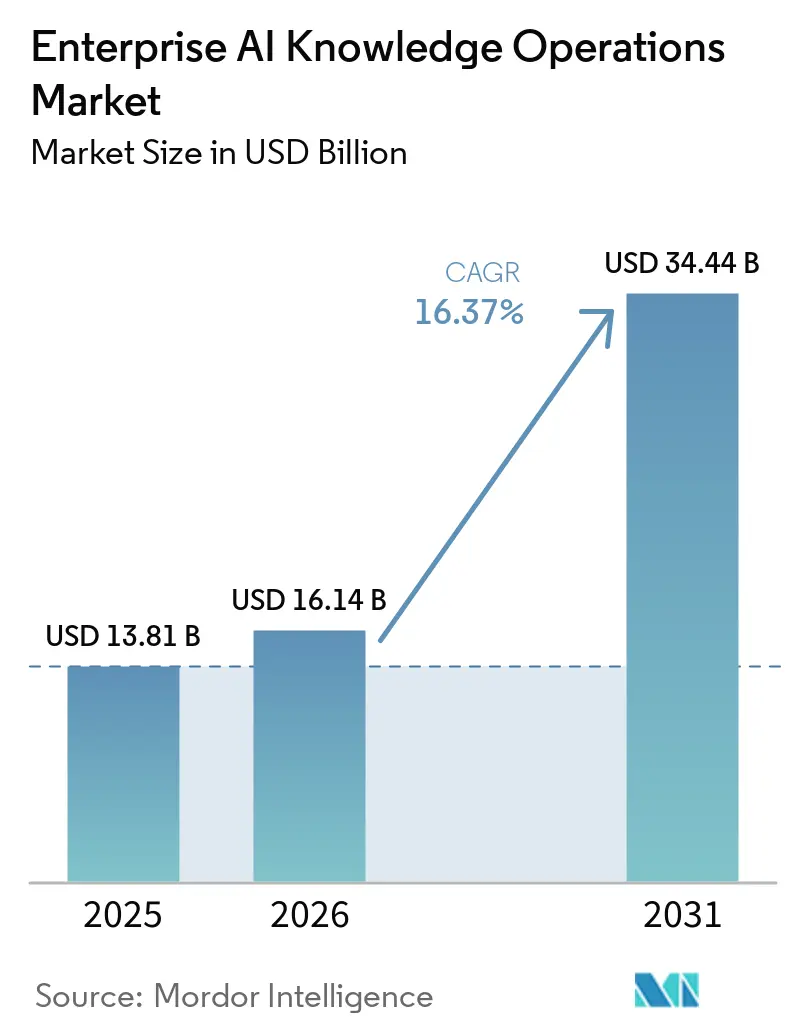
| Market Size (2026) | USD 16.14 Billion |
| Market Size (2031) | USD 34.44 Billion |
| Growth Rate (2026 - 2031) | 16.37 % |
| Fastest Growing Market | Asia-Pacific |
| Largest Market | North America |
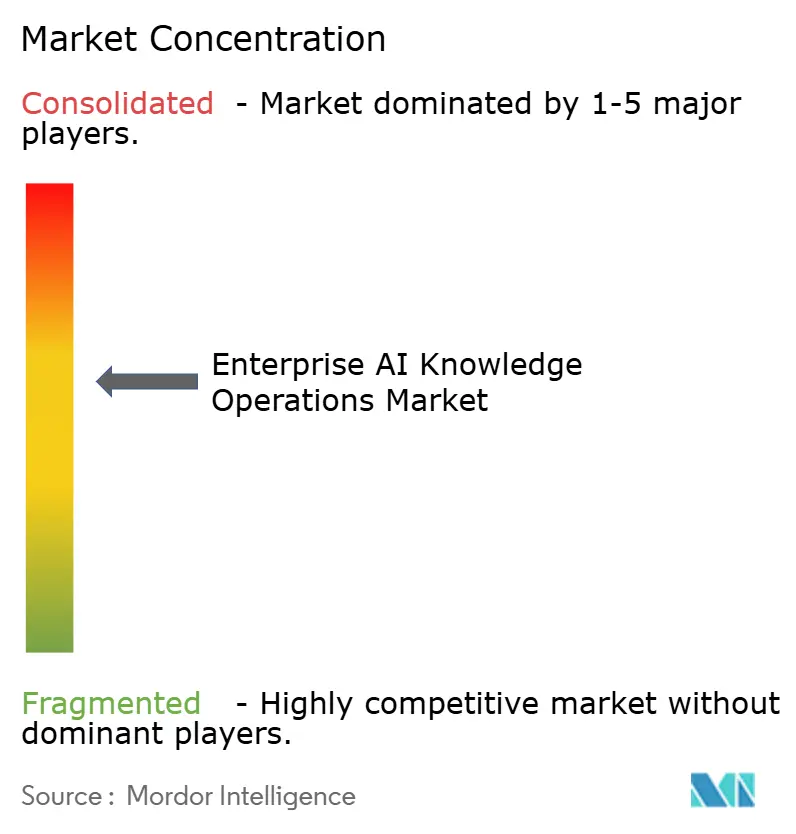
| Market Concentration | Medium |
Major Players *Disclaimer: Major Players sorted in no particular order Image © Mordor Intelligence. Reuse requires attribution under CC BY 4.0. | |
Enterprise AI Knowledge Operations Market Analysis by Mordor Intelligence
The enterprise AI knowledge operations market size is projected to expand from USD 13.81 billion in 2025 and USD 16.14 billion in 2026 to USD 34.44 billion by 2031, registering a CAGR of 16.37% between 2026 and 2031. Organizations are treating internal knowledge as operating infrastructure rather than as a passive document repository. Disconnected SaaS systems have fragmented information, which strengthens demand for unified retrieval that respects user permissions. Copilot deployment has also exposed the limits of keyword search because assistants can return outdated or ungoverned information. Therefore, data quality, reliable retrieval, and governance shape buying decisions in the enterprise AI knowledge operations market. The enterprise AI knowledge operations market is also favouring vendors that can integrate identity controls, current content, and audit requirements into a single platform.
Key Report Takeaways
- By offering, software platforms held 72.83% of the enterprise AI knowledge operations market share in 2025, while services are projected to expand at a 16.78% CAGR through 2031.
- By deployment mode, cloud accounted for 56.28% of the enterprise AI knowledge operations market size in 2025 and is projected to advance at a 17.25% CAGR through 2031.
- By application, enterprise search and knowledge discovery represented 24.19% of revenue in 2025, while employee copilots and productivity assistance are projected to expand at a 17.12% CAGR through 2031.
- By industry vertical, information technology and telecommunications held 25.19% of revenue in 2025, while healthcare and life sciences are projected to expand at a 17.55% CAGR through 2031.
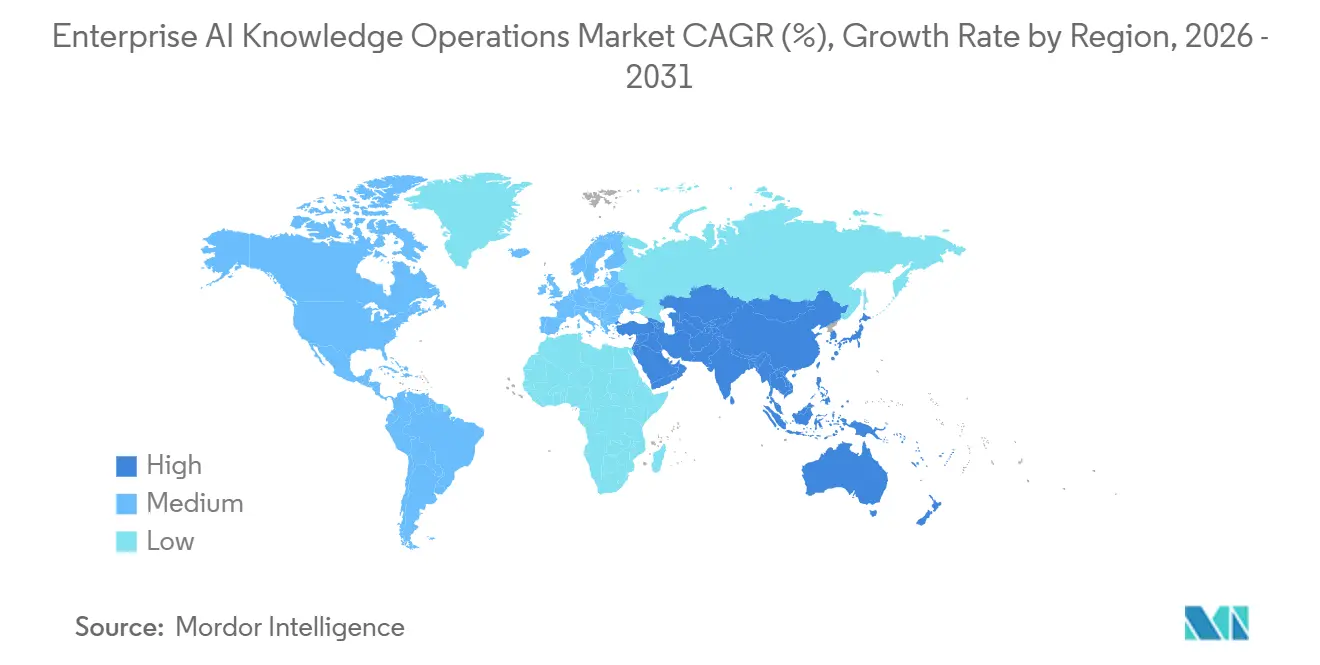
- By geography, North America held 44.12% of revenue in 2025, while Asia-Pacific is projected to expand at a 17.36% CAGR through 2031.
Note: Market size and forecast figures in this report are generated using Mordor Intelligence’s proprietary estimation framework, updated with the latest available data and insights as of January 2026.
Market Trends and Insights
Drivers Impact Analysis of Enterprise AI Knowledge Operations Market*
| Driver | (~) % Impact on CAGR Forecast | Geographic Relevance | Impact Timeline |
|---|---|---|---|
| Enterprise Knowledge Fragmentation Across SaaS Stacks | +3.5% | Global | Short term (≤ 2 years) |
| Permission-Aware Semantic Search and Grounded Answers | +2.8% | Global, core impact in North America and EU | Short term (≤ 2 years) |
| Copilot-Led Knowledge Workflows | +2.5% | North America and EU, spill-over to Asia-Pacific | Short term (≤ 2 years) |
| Retrieval of Tribal Knowledge for Distributed Teams | +1.8% | Global, pronounced in Asia-Pacific and EU | Medium term (2-4 years) |
| Agent-Ready Knowledge Graphs for Permissioned Autonomous Workflows | +1.5% | North America, EU, Asia-Pacific | Long term (≥ 4 years) |
| Multilingual Knowledge Retrieval for Cross-Border Operations | +1.2% | Asia-Pacific core, spill-over to MEA and EU | Medium term (2-4 years) |
| Source: Mordor Intelligence | |||
Enterprise Knowledge Fragmentation Across SaaS Stacks
Every added SaaS application can create another knowledge silo within an organization. Employees often need information from project trackers, document repositories, customer systems, internal messaging tools, and shared workspaces in the same task. A request that crosses these systems can otherwise require repeated searches, manual comparison, or help from colleagues who know where information is stored. This fragmentation increases the value of the enterprise AI knowledge operations market because it requires a shared retrieval layer rather than separate search tools. Glean stated that its platform supported more than 275 app connectors, reflecting the importance vendors place on broad enterprise coverage.[1] A centrally indexed system can improve access to information as organizations add tools, users, and content over time. Separate agents for each application can recreate the fragmentation they were intended to solve.
Permission-Aware Semantic Search and Grounded Answers
Semantic retrieval interprets the meaning of a request instead of relying only on keyword matches. Enterprises also require the retrieval process to enforce access rights before information reaches a user or agent. This requirement is raising the standard for the enterprise AI knowledge operations market, particularly in regulated settings where the consequences of disclosure can be material. Amazon Bedrock Managed Knowledge Base became generally available in June 2026 with document-level access control and real-time access-control-list checks.[2] Grounding responses in authorized, version-controlled material helps organizations assess the basis for an answer and identify the underlying source. It also makes permission enforcement central to platform design rather than a separate control applied after retrieval.
Copilot-Led Knowledge Workflows
Enterprise Copilot deployment is increasing the need for current and governed organizational knowledge. Microsoft 365 Copilot exceeded 30 million paid seats in July 2026, and customers deploying it to most information workers saw deployments increase nearly 75% quarter over quarter. Each deployed seat needs content that has been indexed, verified, permission-limited, and maintained as policies and documents change. This connection is driving increased demand across the enterprise AI knowledge operations market for dependable retrieval backends that operate across departments. Microsoft reported that S&P Global used Copilot Agent Builder to achieve 95% faster data extraction and 98% faster comparative analysis in its market research workflows.[3] Buyers are increasingly seeking evidence of operational results before extending these deployments to more teams and workflows.
Retrieval of Tribal Knowledge for Distributed Teams
Retirements and distributed work can make tacit organizational knowledge harder to retain and transfer. This issue becomes more significant when expert knowledge is held in individual files, conversations, or informal processes that are not consistently documented. The BMBF-funded KIWise project at the University of Bayreuth showed how AI-assisted semantic search could support intergenerational knowledge transfer in small and medium enterprises.[4] The enterprise AI knowledge operations market can benefit when organizations want to preserve internal expertise without imposing major workflow changes or exposing AI directly to customers. Internal knowledge management can offer a lower-risk starting point for companies that are cautious about customer-facing AI and need clearer governance. Tools that reduce the effort of finding and reusing existing expertise can be valuable across distributed teams, locations, and business functions.
Restraints Impact Analysis of Enterprise AI Knowledge Operations Market*
| Restraint | (~) % Impact on CAGR Forecast | Geographic Relevance | Impact Timeline |
|---|---|---|---|
| Hallucination Risk and Limited Trust in AI-Generated Answers | -2.0% | Global | Short term (≤ 2 years) |
| Legacy Repository and Identity-System Integration Complexity | -1.5% | Global, pronounced in EU and Asia-Pacific | Medium term (2-4 years) |
| Data Residency and Cross-Border Knowledge Replication Constraints | -1.0% | EU, Asia-Pacific | Medium term (2-4 years) |
| Stale Permissions and Unowned Enterprise Content | -0.8% | Global | Short term (≤ 2 years) |
| Source: Mordor Intelligence | |||
Hallucination Risk and Limited Trust in AI-Generated Answers
Hallucinations can produce plausible answers that are not supported by current or verified information. This risk makes enterprises cautious when knowledge tools are used in financial, legal, clinical, or operational processes where unsupported advice can affect a decision. The enterprise AI knowledge operations market must therefore address whether users can verify each answer, identify its source, and recognize uncertainty. Citation-based retrieval and confidence thresholds can help systems avoid presenting uncertain content as an established fact. Knowledge systems are increasingly assessed on traceability and auditability, not only on the number of results returned or the fluency of the response. These requirements can slow adoption where a platform cannot show how its answer was produced and whether the user was authorized to receive the source.
Legacy Repository and Identity-System Integration Complexity
Enterprise repositories often contain old file formats, separate access controls, and systems built before current application interfaces. Connecting these environments safely is not only a model integration task because the interface must also preserve security rules, content ownership, and access decisions. The enterprise AI knowledge operations market faces longer sales and implementation cycles when customers must connect ERP systems, file shares, customer records, and identity systems. This complexity can raise demand for professional services, managed operations, and repeated testing before the platform reaches production use. Vendors with mature connector libraries for systems such as SAP, Oracle, and Microsoft Dynamics may have an advantage when customers need to avoid custom development. Mid-sized organizations without dedicated integration resources can face a higher barrier to deployment and may adopt in phases.
*Our forecasts treat driver/restraint impacts as directional, not additive. The impact forecasts reflect baseline growth, mix effects, and variable interactions.
Enterprise AI Knowledge Operations Market Segment Analysis
By Offering:
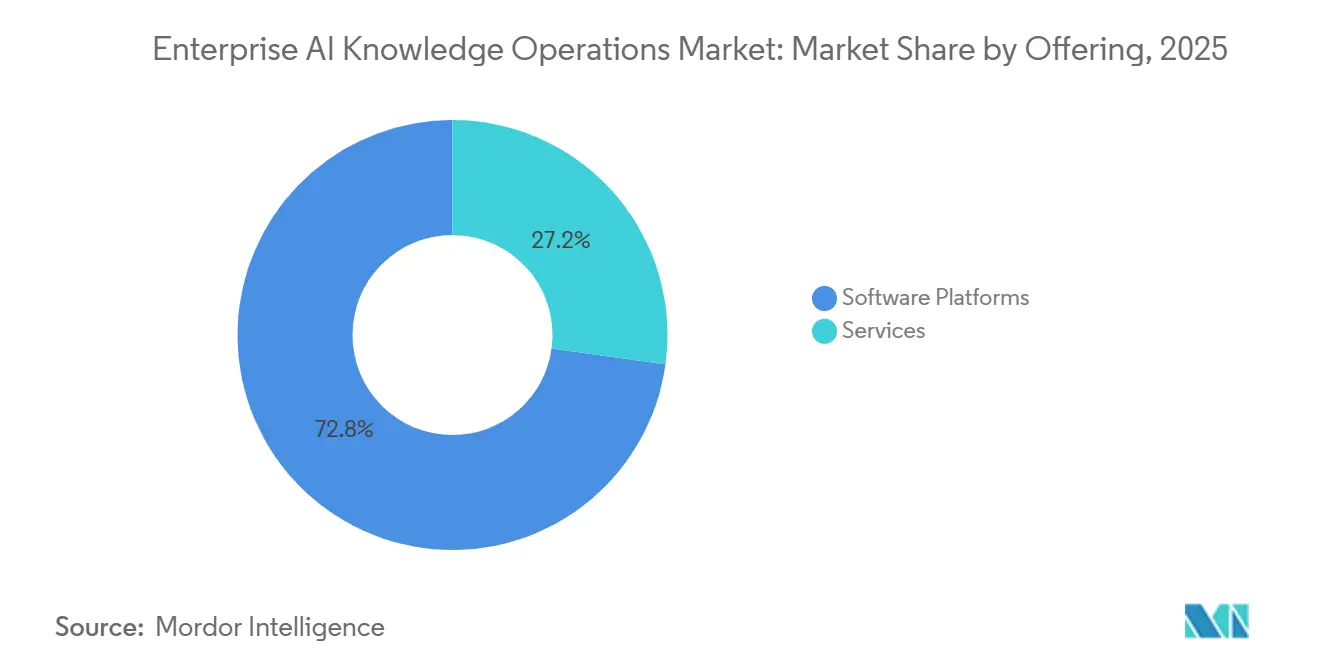
Software Platforms Anchor Revenue as Services Scale FastSoftware platforms held 72.83% of enterprise AI knowledge operations market revenue in 2025. Enterprises favour centralized, configurable retrieval systems that can serve several use cases through one governance layer, rather than requiring separate administration for every application. Each connected application can improve the usefulness of a shared index for more users and workflows because the system can bring relevant organizational context together. Atlassian reported that Rovo indexed more than 50 connected SaaS applications. The enterprise AI knowledge operations industry relies on this shared-index model because separate tools can duplicate administration, create inconsistent results, and leave users uncertain about which system contains the latest information.
Services are projected to expand at a 16.78% CAGR through 2031 within the enterprise AI knowledge operations market. Implementation work remains important because companies must connect legacy repositories, synchronize permissions across systems, and define practical ownership for ongoing content maintenance. Managed operations also support content refresh, index administration, governance review, and user support after the original deployment is complete. These needs make services a recurring part of many vendor relationships instead of a one-time technical setup. Vendors with partner delivery capacity can support broader deployments than those relying only on their internal consulting teams, particularly when customers operate across several business units or regions.
By Deployment Mode:
Cloud Leads While Hybrid Becomes Strategically ImportantCloud represented 56.28% of revenue in 2025 and is projected to expand at a 17.25% CAGR through 2031. Cloud platforms avoid customer-managed provisioning and can provide continuing updates to retrieval models, source connectors, and security features without major internal upgrade projects. Amazon Bedrock Managed Knowledge Base reached general availability in June 2026 with connectors for Amazon S3, SharePoint, Confluence, Google Drive, OneDrive, and web content. These capabilities can lower the initial deployment burden for the enterprise AI knowledge operations market, especially for organizations that want to connect common information sources quickly. They also support agentic retrieval and document-level access control within a managed service.
On-premises and hybrid options remain strategically relevant despite the cloud's larger share. Data sovereignty rules can require retrieval and storage to remain within defined infrastructure boundaries, even when organizations want access to cloud-based model capabilities. This condition creates a parallel opportunity for vendors that can support cloud and local deployment models without creating separate governance processes. Financial services, defense-adjacent organizations, and markets with local data mandates may place greater emphasis on hybrid deployment to keep sensitive data under defined controls. The enterprise AI knowledge operations industry can therefore favour providers that address governance requirements without limiting deployment choice or slowing access to updated tools.
By Application:
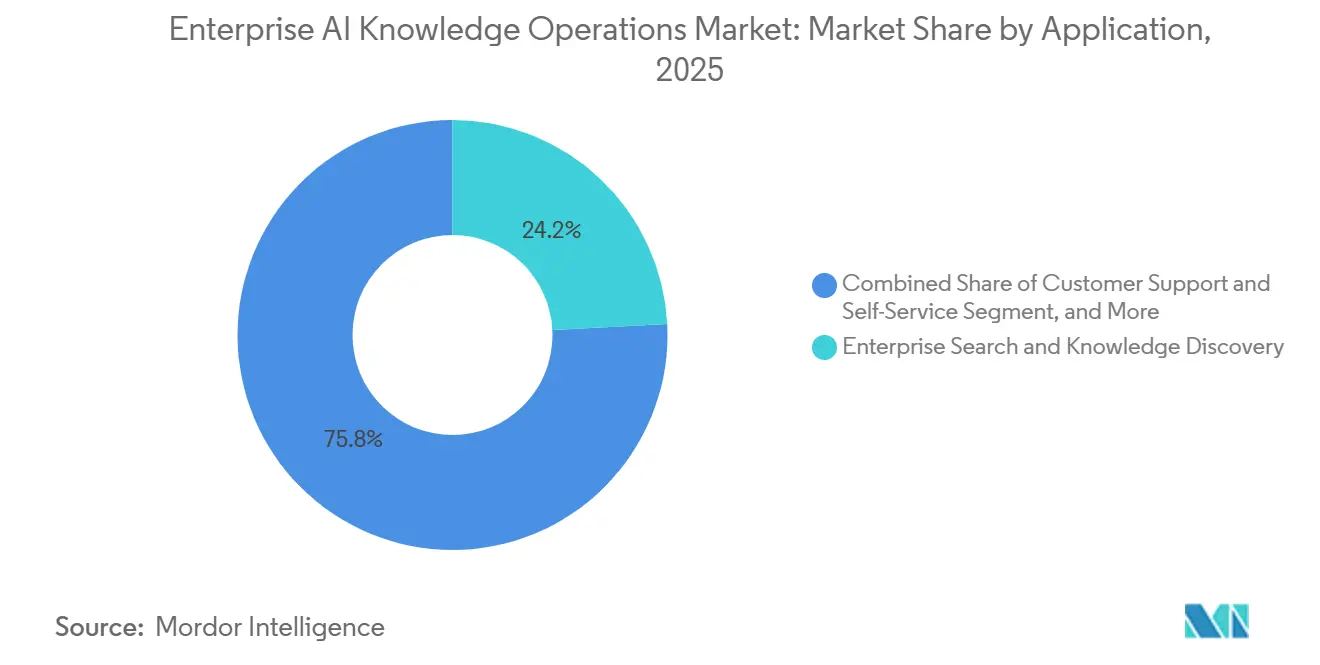
Knowledge Discovery Leads While Copilots AccelerateEnterprise search and knowledge discovery accounted for 24.19% of revenue in 2025. Retrieval remains the basic capability that supports the wider set of knowledge operations applications because users must be able to locate relevant and authorized source material first. Established enterprise search providers and AI-native entrants compete in this part of the enterprise AI knowledge operations market. The category supports access to distributed documentation, policies, operational information, internal expertise, and information needed to complete routine work. Its revenue position also supports the continued importance of software platforms as the underlying layer for other AI-enabled functions.
Employee copilots and productivity assistance are projected to expand at a 17.12% CAGR through 2031. Large enterprise copilot deployments increase the need for accurate, permissioned knowledge sources that can be refreshed as organizational information changes. Microsoft stated that customers with more than 50,000 Copilot seats increased more than 7 times year over year by July 2026. Customer support, legal and compliance, field service, and R&D each require retrieval that fits their evidence needs, operating vocabulary, and workflow responsibilities. These applications broaden the demand base for the enterprise AI knowledge operations market beyond general search and show why a common governed knowledge foundation is valuable.

By Industry Vertical:
IT and Telecom Leads While Healthcare and Life Sciences AccelerateInformation technology and telecommunications held 25.19% of revenue in 2025. These companies use knowledge platforms for their own operations and often manage large volumes of engineering, product, codebase, and incident documentation that must be available to distributed teams. Banking, financial services, and insurance also use governed retrieval for regulatory knowledge, credit policy, and client-facing compliance content where consistent access rules are necessary. Manufacturing, retail and e-commerce, and public-sector organizations have defined use cases in field documentation, product information, and citizen services. This broad adoption base supports the enterprise AI knowledge operations market across different operational settings and shows that the enterprise AI knowledge operations market reaches beyond technology companies.
Healthcare and life sciences are projected to expand at a 17.55% CAGR through 2031. The U.S. Food and Drug Administration released draft guidance in January 2025 on using artificial intelligence to support regulatory decision-making for drugs and biological products. Regulated workflows require traceable, version-controlled retrieval and documented human oversight because records must be available for review. Compliance expectations can shift spending from general search to governed knowledge operations that can support reliable documentation practices. This environment creates a clear role for the enterprise AI knowledge operations industry in clinical, regulatory, quality-related, and other controlled work.
Geography Analysis
North America Enterprise AI Knowledge Operations Market
North America accounted for 44.12% of the enterprise AI knowledge operations market in 2025. The region benefits from concentrated enterprise software spending and the presence of major platform vendors, while knowledge platforms are closely integrated with Microsoft, Google, and Salesforce environments across many organizations. Microsoft stated in March 2026 that 90% of the Fortune 500 used Microsoft 365 Copilot. The United States drives most regional demand, while Canada supports bilingual retrieval needs in English and French for government and enterprise settings.
APAC Enterprise AI Knowledge Operations Market
Asia-Pacific is projected to expand at a 17.36% CAGR through 2031. India has strong enterprise AI adoption, while China is developing locally adapted retrieval platforms designed for its data governance environment and domestic technology ecosystem. Japan is advancing more carefully, with internal knowledge management serving as an early use case for enterprise AI where organizations want controlled adoption. The enterprise AI knowledge operations market has room to develop differently across these markets because governance practices, language requirements, and deployment readiness vary. South Korea and Australia are at intermediate stages, with governance receiving attention before large-scale rollout across sensitive organizational information.
EMEA and South America Enterprise AI Knowledge Operations Market
Europe ranked third by share in 2025, led by Germany and the United Kingdom. Manufacturing, insurance, and financial-services organizations have deployed AI-assisted knowledge systems, and German research programs have provided models for small and medium enterprises. The EU AI Act and GDPR encourage demand for local and hybrid architectures that can support data residency requirements while maintaining useful AI-assisted retrieval. Middle Eastern adoption is linked to public-sector, energy, and financial-services digital programs in Saudi Arabia and the UAE. South America and Africa remain earlier-stage regions where enterprise digitalization is building the required data foundation, creating a longer-term opportunity as internal information becomes more structured and accessible.
Competitive Landscape
The enterprise AI knowledge operations market has moderate concentration at the platform level, with Microsoft, Google, Salesforce, and Amazon Web Services competing through suite integration and established enterprise ecosystems. Their bundled offerings can reduce buying friction for customers already using their productivity and cloud platforms because retrieval features can be introduced within familiar systems. Microsoft introduced Agent 365 in May 2026 at USD 15 per user per month as a management and governance control plane for AI agents. The move strengthened Microsoft's ability to link knowledge, governance, and agent management within an existing customer environment.
Specialist vendors focus on retrieval quality, vertical needs, and deployment flexibility where suite providers may not address every customer requirement. Glean has expanded its agentic AI platform around a broad connector base and tools for natural-language agent creation. Coveo introduced a Hosted Model Context Protocol Server in February 2026 to make its retrieval index available to compatible large language models without custom integrations. These moves position specialist providers as retrieval layers that can work alongside broader copilot suites and existing enterprise applications. They also target customers that need greater control over relevance, interoperability, source connections, and deployment configuration.
Highly regulated healthcare, financial services, and government deployments offer room for specialized providers because generic tools may not meet every documentation and control requirement. Multilingual knowledge retrieval and domain-specific semantic precision are other areas where generic platforms may have limitations. Academic work has examined knowledge graph integration as a way to improve reasoning across multi-step questions. The enterprise AI knowledge operations market is likely to reward platforms that combine accurate retrieval with permissions, auditability, integration depth, and clear administration for business users. Vendor strategies therefore center on increasing the number of connected sources while maintaining governance across those sources and avoiding inconsistent user access.
Enterprise AI Knowledge Operations Industry Leaders
-
Microsoft Corporation
-
ServiceNow, Inc.
-
Salesforce, Inc.
-
Atlassian Corporation Plc
-
Glean Technologies, Inc.
- *Disclaimer: Major Players sorted in no particular order
Enterprise AI Knowledge Operations Market Companies Covered in this Report
- Microsoft Corporation
- ServiceNow, Inc.
- Salesforce, Inc.
- Google LLC
- Atlassian Corporation Plc
- Glean Technologies, Inc.
- International Business Machines Corporation
- Amazon Web Services, Inc.
- Oracle Corporation
- SAP SE
- Elastic N.V.
- Coveo Solutions Inc.
- Open Text Corporation
- Lucidworks, Inc.
- Sinequa SAS
- Algolia SAS
- Guru Technologies, Inc.
- Notion Labs, Inc.
- Moveworks, Inc.
- Kore.ai, Inc.
- Vectara, Inc.
- KMS Lighthouse
- Knowmax AI Private Limited
- Shelf, Inc.
- Livepro, Inc.
Recent Industry Developments in Enterprise AI Knowledge Operations Market
- August 2026: ServiceNow announced its Autonomous Security offering, integrating six AI-native security solutions, including AI Agent Access Security and Non-Human Identity Remediation, into its AI Control Tower platform. The development positions ServiceNow's knowledge and workflow infrastructure as a governance and identity layer for AI agents, directly relevant to permissioned enterprise knowledge workflows.
- July 2026: Microsoft 365 Copilot surpassed 30 million paid seats globally, with enterprise customers deploying to the majority of their information workers, growing nearly 75% quarter over quarter. Microsoft's Copilot Cowork, a multi-model agentic product built with Anthropic, reached general availability and was adopted by half of the Fortune 500 within 6 months of its inception.
- June 2026: Amazon Web Services announced the general availability of Amazon Bedrock Managed Knowledge Base, a fully managed retrieval-augmented generation service with agentic retrieval, 6 native enterprise data connectors, hybrid search, document ranking, and document-level access control. The launch signals AWS's intent to commoditize the retrieval infrastructure layer for enterprise AI.
- May 2026: Microsoft launched Agent 365 at general availability on May 1, 2026, at USD 15 per user per month, serving as a governance and management control plane for AI agents. Simultaneously, Microsoft 365 E7, The Frontier Suite launched at USD 99 per user per month, bundling Microsoft 365 E5, Microsoft 365 Copilot, and Agent 365 powered by Work IQ.
Global Enterprise AI Knowledge Operations Market Report Scope
The Enterprise AI Knowledge Operations Market Report is Segmented by Offering (Software Platforms and Services), Deployment Mode (Cloud, On-Premises, and Hybrid), Application (Enterprise Search and Knowledge Discovery, Employee Copilots and Productivity Assistance, Customer Support and Self-Service, Document Management and Content Retrieval, Training, Learning, and Employee Onboarding, Legal, Risk, and Compliance Management, Market Intelligence and Competitive Analysis, Research and Development Knowledge Operations, and Field-Service and Technical Operations), Industry Vertical (Information Technology and Telecommunications, Banking, Financial Services, and Insurance, Healthcare and Life Sciences, Manufacturing, Retail and E-Commerce, Government and Public Sector, and Others), and Geography (North America, South America, Europe, Asia-Pacific, Middle East, and Africa). The Market Forecasts are Provided in Terms of Value (USD).
Segmentation Overview
| Software Platforms |
| Services |
| Cloud |
| On-Premises |
| Hybrid |
| Enterprise Search and Knowledge Discovery |
| Employee Copilots and Productivity Assistance |
| Customer Support and Self-Service |
| Document Management and Content Retrieval |
| Training, Learning, and Employee Onboarding |
| Legal, Risk, and Compliance Management |
| Market Intelligence and Competitive Analysis |
| Research and Development Knowledge Operations |
| Field-Service and Technical Operations |
| Information Technology and Telecommunications |
| Banking, Financial Services, and Insurance |
| Healthcare and Life Sciences |
| Manufacturing |
| Retail and E-Commerce |
| Government and Public Sector |
| Others Industry Vertical |
| North America | United States |
| Canada | |
| Mexico | |
| South America | Brazil |
| Argentina | |
| Rest of South America | |
| Europe | Germany |
| United Kingdom | |
| France | |
| Italy | |
| Spain | |
| Russia | |
| Rest of Europe | |
| Asia-Pacific | China |
| Japan | |
| India | |
| South Korea | |
| Australia | |
| Rest of Asia-Pacific | |
| Middle East | Saudi Arabia |
| United Arab Emirates | |
| Turkey | |
| Rest of Middle East | |
| Africa | South Africa |
| Egypt | |
| Rest of Africa |
| By Offering | Software Platforms | |
| Services | ||
| By Deployment Mode | Cloud | |
| On-Premises | ||
| Hybrid | ||
| By Application | Enterprise Search and Knowledge Discovery | |
| Employee Copilots and Productivity Assistance | ||
| Customer Support and Self-Service | ||
| Document Management and Content Retrieval | ||
| Training, Learning, and Employee Onboarding | ||
| Legal, Risk, and Compliance Management | ||
| Market Intelligence and Competitive Analysis | ||
| Research and Development Knowledge Operations | ||
| Field-Service and Technical Operations | ||
| By Industry Vertical | Information Technology and Telecommunications | |
| Banking, Financial Services, and Insurance | ||
| Healthcare and Life Sciences | ||
| Manufacturing | ||
| Retail and E-Commerce | ||
| Government and Public Sector | ||
| Others Industry Vertical | ||
| By Geography | North America | United States |
| Canada | ||
| Mexico | ||
| South America | Brazil | |
| Argentina | ||
| Rest of South America | ||
| Europe | Germany | |
| United Kingdom | ||
| France | ||
| Italy | ||
| Spain | ||
| Russia | ||
| Rest of Europe | ||
| Asia-Pacific | China | |
| Japan | ||
| India | ||
| South Korea | ||
| Australia | ||
| Rest of Asia-Pacific | ||
| Middle East | Saudi Arabia | |
| United Arab Emirates | ||
| Turkey | ||
| Rest of Middle East | ||
| Africa | South Africa | |
| Egypt | ||
| Rest of Africa | ||
Key Questions Answered in the Report
What is the enterprise AI knowledge operations market size?
The enterprise AI knowledge operations market size is USD 16.14 billion in 2026 and is projected to reach USD 34.4 billion by 2031 at a 16.40% CAGR.
What is driving demand for enterprise AI knowledge operations?
Organizations need to connect fragmented SaaS information, enforce permissions, and provide verified knowledge to copilots and AI agents.
Which offering has the largest share of enterprise AI knowledge operations revenue?
Software platforms held 72.83% of revenue in 2025 because companies favor centralized and configurable retrieval systems.
Which deployment model is expanding fastest?
Cloud is projected to expand at a 17.25% CAGR through 2031, supported by managed updates, connectors, and flexible provisioning.
Which application is expanding fastest in enterprise AI knowledge operations?
Employee copilots and productivity assistance are projected to expand at a 17.12% CAGR through 2031.
Which region is expanding fastest?
Asia-Pacific is projected to expand at a 17.36% CAGR through 2031, supported by varied enterprise AI adoption across major markets.