
Enterprise AI Coding Agent Market Size and Share
Market Overview
| Study Period | 2020 - 2031 |
|---|---|
| Market Size (2026) | USD 14.18 Billion |
| Market Size (2031) | USD 45.83 Billion |
| Growth Rate (2026 - 2031) | 26.44 % |
| Fastest Growing Market | Asia-Pacific |
| Largest Market | North America |
| Market Concentration | Medium |
Major Players *Disclaimer: Major Players sorted in no particular order Image © Mordor Intelligence. Reuse requires attribution under CC BY 4.0. | |
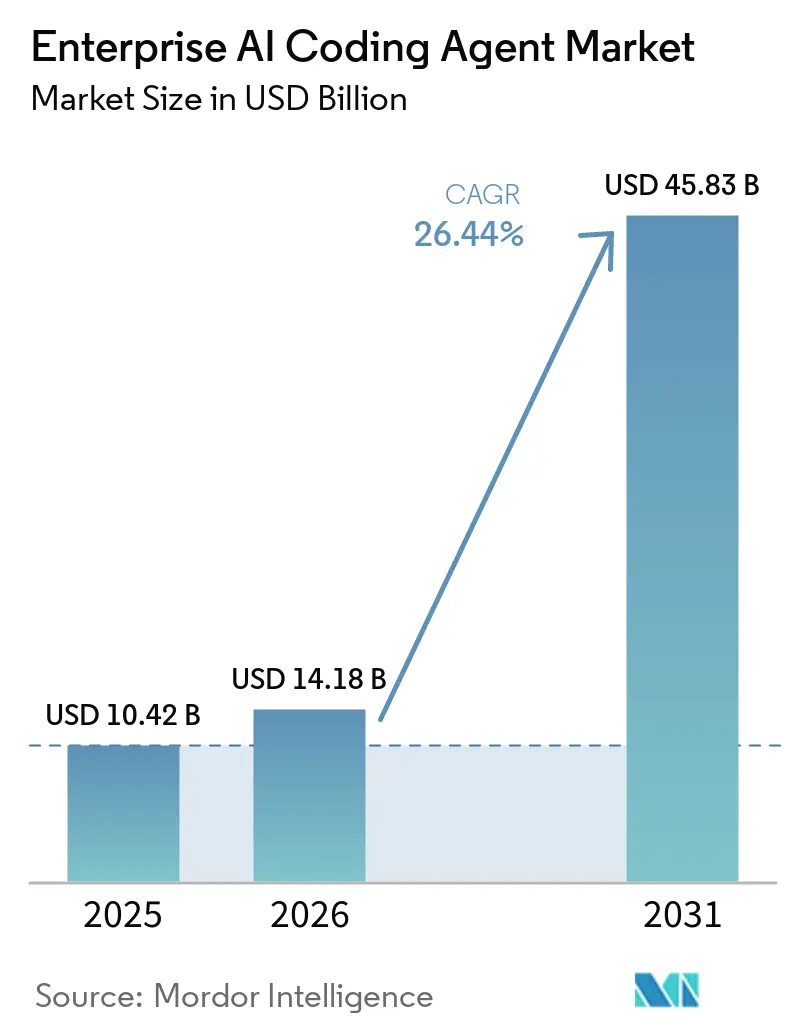
Enterprise AI Coding Agent Market Analysis by Mordor Intelligence
The enterprise AI coding agent market size is projected to expand from USD 10.42 billion in 2025 to USD 14.18 billion in 2026, and to USD 45.83 billion by 2031, registering a CAGR of 26.44% between 2026 and 2031. Demand reflects a change in how enterprises plan software capacity, because coding tools and engineering hiring now compete for the same budgets and are assessed against the same delivery objectives. New Relic reported that 2/3 of technology leaders said AI-generated or substantially refactored code accounted for 51%-75% of their organizations’ weekly code output in 2026, moving AI-assisted development beyond small pilot programs. Enterprise buyers are also evaluating platforms on governance, integration, and predictable operating costs rather than on code completion alone. The enterprise AI coding agent market is therefore moving toward tools that can support controlled, multi-step work across the software delivery process. Source-code confidentiality, code quality, and token spending remain material constraints for organizations that operate regulated or sensitive software environments, and the enterprise AI coding agent market must address these concerns before pilots can become broad operational deployments.
Key Report Takeaways
- By offering AI coding assistants, the segment held 43.92% of the enterprise AI coding agent market share in 2025, while autonomous software engineering agents are projected to expand at a 45.59% CAGR through 2031.
- By functionality, code completion held 36.78% of the enterprise AI coding agent market share in 2025, while automated testing and validation are projected to expand at a 45.52% CAGR through 2031.
- By deployment mode, cloud-based tools accounted for 72.43% of the deployment mode segment in 2025, while on-premises deployment is projected to expand at a 45.01% CAGR through 2031 in the enterprise AI coding agent market.
- By organization size, large enterprises accounted for 68.27% of the organization size segment in 2025, while small and medium-sized enterprises are projected to expand at a 44.96% CAGR through 2031.
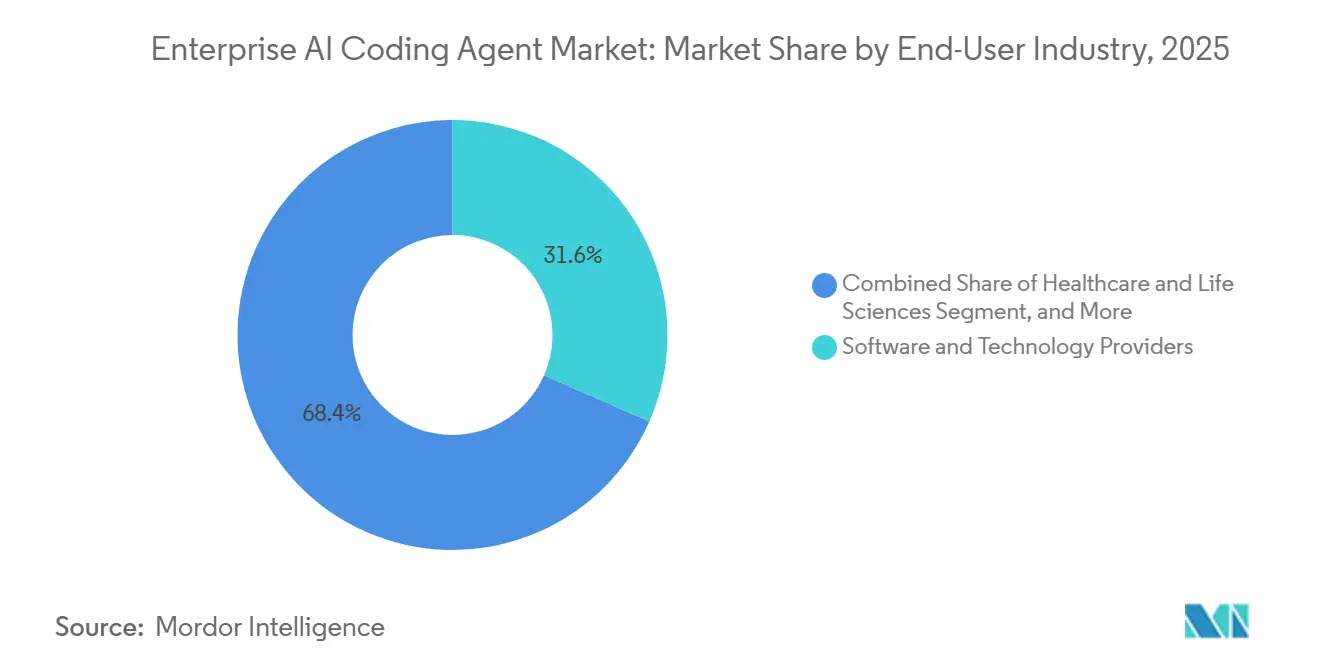
- By end-user industry, software and technology providers held 31.59% of the enterprise AI coding agent market size in 2025, while banking, financial services, and insurance are projected to expand at a 46.12% CAGR through 2031.
- By application, enterprise software development held a 36.57% share in 2025, while legacy modernization and refactoring are becoming a material area of demand and are expected to expand at a CAGR of 45.57% through 2031.
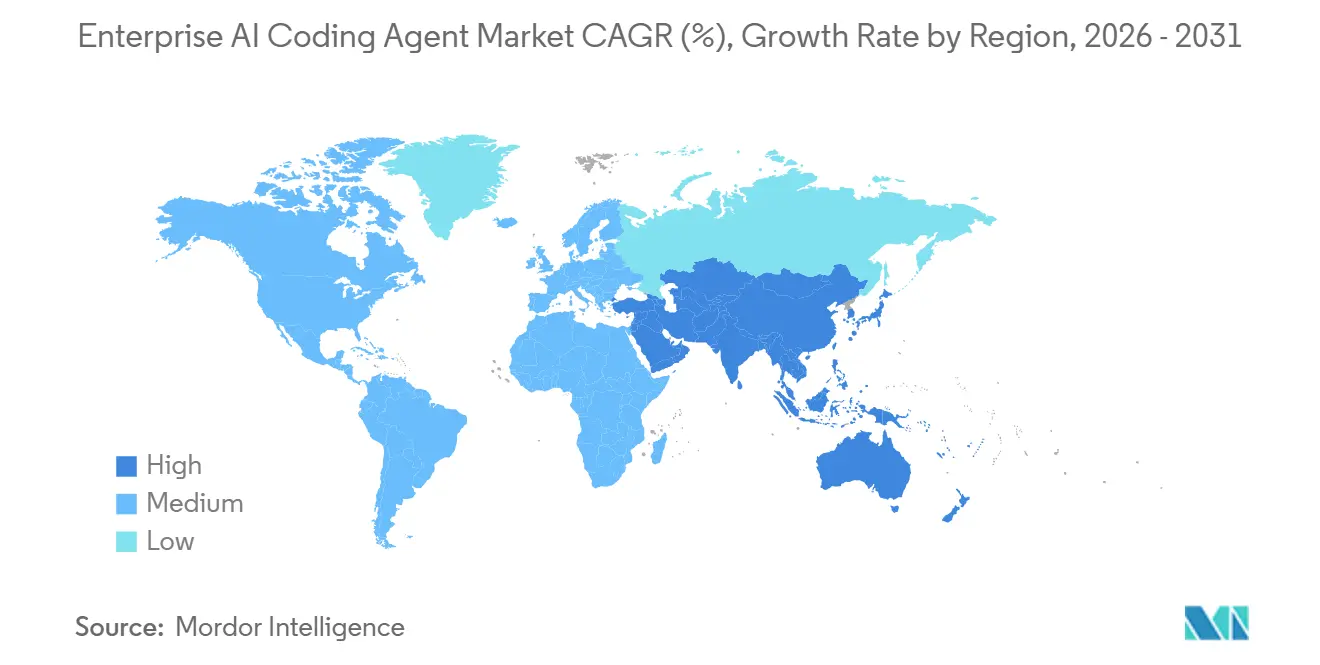
- By geography, North America held 38.12% share in 2025, while Asia-Pacific is projected to expand at a 45.57% CAGR through 2031.
Note: Market size and forecast figures in this report are generated using Mordor Intelligence’s proprietary estimation framework, updated with the latest available data and insights as of January 2026.
Market Trends and Insights
Drivers Impact Analysis of Enterprise AI Coding Agent Market*
| Driver | (~) % Impact on CAGR Forecast | Geographic Relevance | Impact Timeline |
|---|---|---|---|
| Enterprise Software Engineering Capacity Constraints | +8.2% | Global, concentrated in North America and Western Europe | Short term (≤ 2 years) |
| Expansion of Agentic SDLC Automation | +6.5% | Global, with early gains in North America and Asia-Pacific | Medium term (2-4 years) |
| Enterprise Demand for Legacy-System Modernization | +4.3% | North America, Europe, Asia-Pacific, Japan, and Australia | Medium term (2-4 years) |
| IDE and Developer-Workflow Distribution | +3.1% | Global, with strongest pull-through in North America | Short term (≤ 2 years) |
| Cloud Credits and Model-Platform Bundling | +2.4% | North America and Europe, with spillover to Asia-Pacific | Medium term (2-4 years) |
| AI-Assisted Security and Compliance Testing | +1.8% | North America, Europe, and core Asia-Pacific markets | Long term (≥ 4 years) |
| Source: Mordor Intelligence | |||
Enterprise Software Engineering Capacity Constraints
Engineering capacity has become a central operating constraint for software-intensive organizations, which is supporting adoption in the enterprise AI coding agent market. A 2025 field experiment across Microsoft, Accenture, and a Fortune 100 company found a 26.08% increase in completed tasks among 4,867 developers who used AI coding assistance. A Microsoft study released in 2026 found that engineers completed 40.5% more pull requests during their highest-usage weeks than during weeks with no use of these tools. Large engineering organizations still face rising software demand even when individual developer output improves. This makes autonomous task execution more relevant than a tool that only suggests code, especially when teams must address a series of related changes across files rather than resolve isolated coding questions. The enterprise AI coding agent market benefits where organizations need to increase delivery capacity without matching increases in technical headcount.
Expansion of Agentic SDLC Automation
The enterprise AI coding agent market is extending from code completion toward systems that perform connected work across the software development life cycle. Organizations are deploying agents for multi-stage workflows, and 91% of enterprises had moved AI coding agents into production code in 2026.[1] Agent workflows can divide a product requirement into separate tasks, coordinate specialized agents, and combine outputs into an integrated result. GitHub reported that organizations moving to multi-agent workflows recorded a 93.3% increase in pull request throughput. This operating model shifts the purchase case from individual developer assistance to broader delivery automation. It also raises the need for testing, review, and approval controls before code reaches production, since connected workflows can move work across requirements, implementation, validation, and release activities with less direct developer intervention.
Enterprise Demand for Legacy-System Modernization
Legacy system modernization is creating a direct use case for autonomous agents in financial services, insurance, government, and other regulated environments. IBM launched Bob Premium Packages for IBM Z, IBM i, and Java modernization in July 2026 with AI-native workflows for COBOL and PL/I modernization. Cognition described a migration of a 25,000-line COBOL customs workflow to AWS Lambda functions for a global automotive manufacturer. It also reported that Itaú Unibanco completed a refactoring migration 5-6 times faster than legacy manual methods. Such projects can reduce long modernization programs into shorter implementation cycles when the scope is well defined. The enterprise AI coding agent market presents an opportunity for vendors that combine autonomous workflows with programming-language- and sector-specific controls.
IDE and Developer-Workflow Distribution
The integrated development environment has become an important distribution point for the enterprise AI coding agent market. GitHub Copilot reached 4.7 million paid subscriptions by the end of Microsoft’s second fiscal quarter of 2026, supported by distribution through Microsoft’s developer and enterprise channels. Tools that sit within existing development workflows require fewer behavior changes from developers and can be purchased through familiar enterprise agreements. The selected coding environment can also influence the model ecosystem that organizations use in daily work. This creates switching costs once developers have established work patterns around a tool’s prompts, context, and code-review process. Vendors with workflow access can therefore combine deployment convenience with broader platform relationships.
Restraints Impact Analysis of Enterprise AI Coding Agent Market*
| Restraint | (~) % Impact on CAGR Forecast | Geographic Relevance | Impact Timeline |
|---|---|---|---|
| Source-Code Confidentiality and Data-Residency Risk | -3.2% | Global, strongest in Europe and regulated Asia-Pacific markets | Short term (≤ 2 years) |
| Hallucinated Code and Vulnerability Liability | -2.4% | Global | Medium term (2-4 years) |
| Inference Cost and GPU Capacity Volatility | -1.6% | Global, concentrated in markets with high agentic workflow intensity | Medium term (2-4 years) |
| Developer Trust, Accountability, and Skill Erosion | -0.8% | Global, with pronounced effects in organizations with senior-heavy teams | Long term (≥ 4 years) |
| Source: Mordor Intelligence | |||
Source-Code Confidentiality and Data-Residency Risk
Source-code confidentiality remains a major barrier when proprietary algorithms, customer information, or critical infrastructure code could be exposed to external inference systems. The European Commission’s guidance on the EU AI Act set out transparency requirements that became enforceable on August 2, 2026.[2] Legal and security teams must interpret how those requirements apply to code generation and high-risk uses. Organizations also face intellectual property risk if public code and reciprocal license obligations are added to proprietary repositories without detection. JFrog introduced AI-generated code validation to identify malicious or unsuitable code snippets during development workflows. Tabnine designed its Enterprise Context Engine to operate within a customer trust boundary unless configured otherwise. These requirements favor private-cloud, self-hosted, and air-gapped deployment options in regulated segments of the enterprise AI coding agent market, where control over how information is processed can be as important as implementation speed.
Hallucinated Code and Vulnerability Liability
AI-generated code can create defects that are syntactically valid but functionally incorrect or insecure, especially as agents receive greater autonomy. An ICSE 2026 study reported that 7.8% of patches that passed automated tests failed a developer’s own test suite. This result highlights the limits of relying only on automated checks for production-quality software. Responsibility is also less clear when an autonomous agent writes a change that later causes an incident. Enterprises are responding by adding independent review tools and formal approval gates between generated code and the main branch. Those controls can slow deployment, but they help retain accountable human review. The enterprise AI coding agent market will depend on vendors that can demonstrate secure generation, traceability, and reliable code validation.
*Our forecasts treat driver/restraint impacts as directional, not additive. The impact forecasts reflect baseline growth, mix effects, and variable interactions.
Enterprise AI Coding Agent Market Segment Analysis
By Offering:
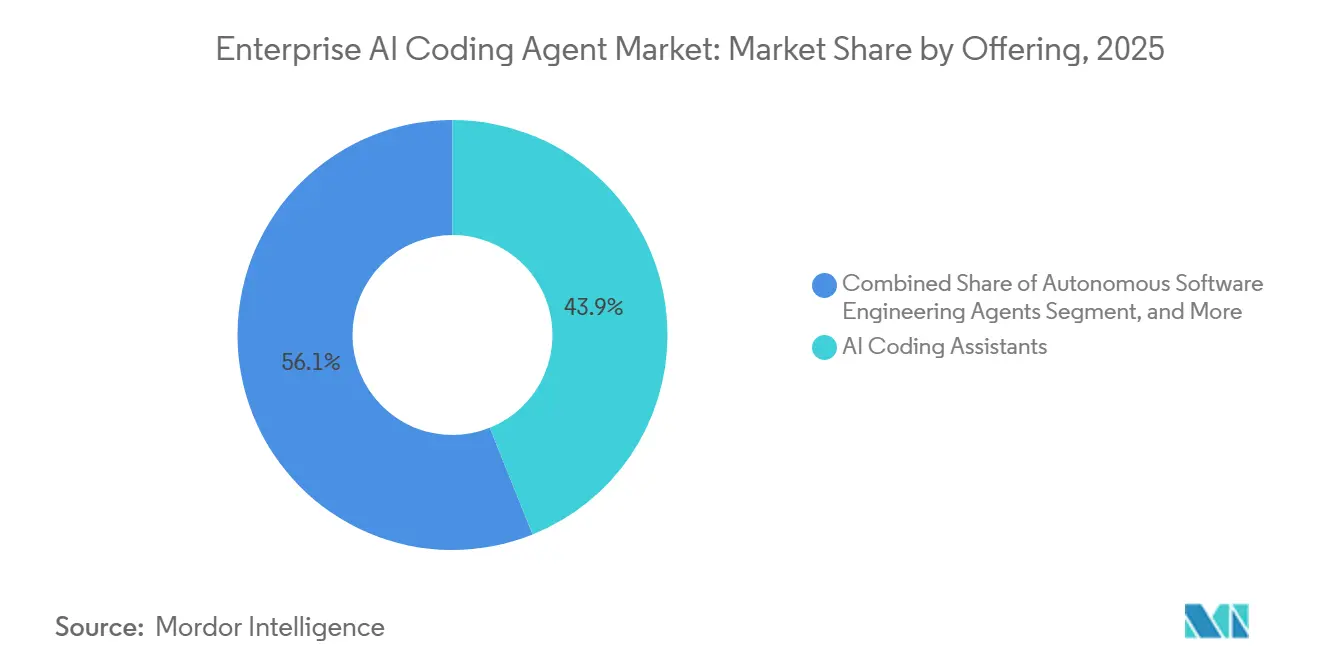
Assistants Lead Current Adoption While Agents Gain GroundAI coding assistants held 43.92% of the offering segment in 2025. Their position reflects early adoption within existing integrated development environment workflows and ease of use by individual developers before formal procurement processes expanded. The category includes embedded copilots and standalone coding chat interfaces. Many enterprises still classify these products as productivity tools, which affects both budget ownership and adoption speed while leaving procurement teams to define the required governance model. The enterprise AI coding agent market continues to use assistants as an accessible entry point for teams that need contextual suggestions and faster routine coding work, while allowing developers to retain familiar coding, testing, and approval practices.
Autonomous software engineering agents are projected to expand at a 45.59% CAGR from 2026 to 2031. These systems can perform multi-step, multi-file work with limited human intervention, making them relevant to a broader range of delivery tasks. Cognition reported USD 492 million in annualized enterprise revenue in 2026, with enterprise usage expanding by more than 50% month over month for 6 consecutive months. AI code review and governance platforms are also becoming increasingly important as the volume of generated code puts pressure on engineering review processes. The longer-term product direction combines generation, testing, review, and deployment governance in more integrated suites that can support handoffs between teams without separating each activity into a different tool. This broadening of capability changes the enterprise AI coding agent market from a narrow assistant category into a controlled software delivery platform.

By Functionality:
Automated Testing Supports Agentic DeliveryCode completion held 36.78% of the functionality segment in 2025. It is the most mature capability and remains widely deployed across enterprise development teams. Its position reflects sustained investment in next-token prediction and developer-facing interfaces, as well as familiarity among developers who already use completion features in their daily workflows. GitHub Copilot and Cursor helped establish the interaction model that many organizations use when beginning AI-assisted development. Code completion remains a practical starting point because developers retain direct control over whether to accept, edit, or reject suggested code.
Automated testing and validation are projected to expand at a 45.52% CAGR from 2026 to 2031. Together, code generation and transformation, code review and optimization, and testing support a broader automation model across the delivery cycle. Testing has often received less attention than feature work when development teams face release deadlines, even though incomplete coverage can increase the time required to investigate issues after a release. Agents can create test suites alongside code production rather than waiting until implementation is complete. Diffblue launched its Testing Agent in 2025 to treat test generation as a distinct engineering workflow. IBM Research found that enterprise teams using coding assistants were prioritizing automated testing coverage over code review in near-term automation plans
By Deployment Mode:
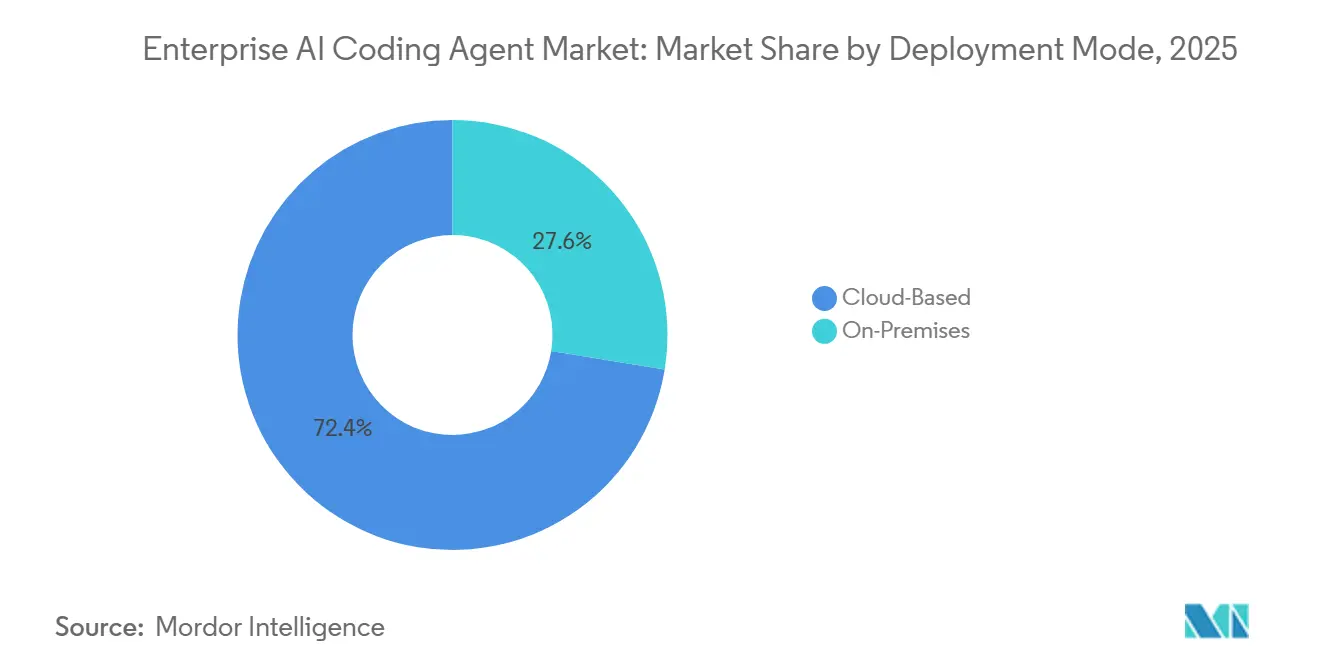
On-Premises Demand Reflects Data ControlsCloud-based deployment accounted for 72.43% of the deployment mode segment in 2025. Managed updates, elastic capacity, and simpler procurement support its leading position. Hyperscaler channels also make it easier to introduce coding tools alongside existing cloud spending and credit programs. The cloud model gives vendors a direct way to update models and services without local implementation work, which can be useful where development teams operate across multiple locations and need consistent access. These benefits continue to make cloud deployment the standard choice for organizations without strict data residency requirements.
On-premises deployment is projected to expand at a 45.01% CAGR from 2026 to 2031. The increase reflects demand from financial institutions, defense contractors, and other organizations that cannot route production code through an external environment. Tabnine made a fully self-hosted deployment stack generally available in May 2026. The stack runs the model, context engine, and governance layer within the customer’s trust boundary, allowing internal teams to apply their own access rules to repositories and development workflows. An empirical study from 2026 found that on-premises inference saved 40.1% of the total cost of ownership under shared GPU allocation, while requiring greater attention to defect repair. The enterprise AI coding agent market consequently supports both managed cloud tools and controlled, customer-operated environments, as deployment decisions are shaped by policy, technical capacity, and the sensitivity of the codebase.
By Organization Size:
Large Enterprises Lead While SMEs Adopt FasterLarge enterprises accounted for 68.27% of the organization size segment in 2025. They can negotiate enterprise agreements, establish governance policies, and manage the operational demands of linking agents to established CI/CD environments. Their scale also makes it easier to justify investment in single sign-on, audit records, role-based access, and intellectual-property protections. Many specialist vendors introduced enterprise-grade controls after first reaching individual developers, so procurement functions are now evaluating whether their security and administration features meet formal enterprise requirements. This timing has made large-company procurement an important source of current spending, because larger organizations are better placed to set common standards for access, security review, monitoring, and vendor management.
Small and medium-sized enterprises are projected to expand at a 44.96% CAGR from 2026 to 2031. Self-service enterprise offerings are reducing procurement friction for organizations without large software purchasing teams. Replit introduced self-service enterprise access in May 2026, allowing organizations to purchase enterprise security, configure single sign-on, and deploy without a sales engagement. A SonarSource survey found that small- and medium-sized business developers reported a 39% increase in personal productivity from AI coding tools, compared with 34% among enterprise developers. OECD analysis of 2,000 SMEs in 12 countries identified skills gaps and cost uncertainty as remaining barriers to broader AI deployment
By End-User Industry:
Financial Services Accelerates AdoptionSoftware and technology providers held 31.59% of the end-user industry segment in 2025. This leadership reflects their high concentration of developers and greater willingness to adopt emerging engineering tools early. Information technology and telecommunications organizations form another substantial demand group. These firms use coding agents to maintain delivery speed against cloud-native competitors. Their software-focused operating models also reduce the organizational friction of integrating new developer tools, because developers, platform teams, and technical leaders commonly work through established engineering processes.
Banking, financial services, and insurance are projected to expand at a 46.12% CAGR from 2026 to 2031. Legacy COBOL environments, engineering capacity needs, and competitive pressure from fintech firms are creating a substantial purchasing case. A Cambridge Judge Business School report found that 52% of financial services respondents were actively adopting agentic AI in 2026, and 71% expected to deploy it within 2 years. Citi introduced its Arc AI agent platform in 2026 to enable the development and scaling of agents for defined use cases across its functions. Healthcare and life sciences, retail and e-commerce, manufacturing and automotive, media and entertainment, government and public sector, and energy and utilities have differentiated demand based on developer density, internal software priorities, and legacy modernization needs.
By Application:
Enterprise Software Development Anchors DemandEnterprise software development held 36.57% of the application segment in 2025. Professional engineering teams in technology, financial services, and enterprise software organizations have the clearest opportunity to measure output from coding tools. Cloud services and DevOps, data science and machine learning, web development, mobile application development, and legacy modernization form the remainder of the application landscape. The enterprise AI coding agent industry is also expanding to support software operations and data pipelines. This broader use allows teams to apply agents beyond conventional application coding, while keeping software operations, data preparation, and deployment-related work within the same technology planning process across departments, systems, and recurring daily delivery activities.
The legacy modernization and refactoring segment is expected to generate the fastest CAGR of 45.57% through 2031 and is a strategically important application as organizations address technical debt accumulated over long periods. Fujitsu began operating its AI-Driven Software Development Platform in January 2026 for medical-fee revision software affecting 67 Japanese government and healthcare software products. Fujitsu reported that a defined 3-person-month task was completed in 4 hours through multi-agent collaboration. Microsoft’s Azure Legacy Modernization Agents framework provides a multi-agent approach for converting COBOL to Java, Quarkus, or C#. Data science and machine learning teams are also applying agents to pipeline development, experiment orchestration, and evaluation work. These uses expand the enterprise AI coding agent market beyond traditional software engineering functions, linking agent adoption to data preparation, application maintenance, operational work, and recurring modernization programs.
Geography Analysis
North America and Europe Enterprise AI Coding Agent Market
North America held 38.12% of the geographic segment in 2025. The region benefits from a mature enterprise software buyer base, a concentration of hyperscalers and foundation-model providers, and a large developer population. A Q1 2026 Digital Applied survey found that 71% of professional developers in North America used an AI coding agent daily. The United States accounted for the largest share of regional demand, with financial services and technology firms leading adoption. Canada and Mexico added demand through financial institutions and public-sector organizations. Europe was also a significant component of the enterprise AI coding agent market in 2026, with Germany, the United Kingdom, France, the Netherlands, and Russia leading. An Adesso survey of 500 German executives found that 59% of companies used agent-based systems for code generation and optimization, and that structured adopters reported a 21% increase in productivity. The same survey found that 1-third of companies with low AI maturity reported no measurable return, showing that deployment practices influence outcomes. EU transparency requirements also support European demand for governance and audit-trail tools.
APAC Enterprise AI Coding Agent Market
Asia-Pacific is projected to expand at a 45.57% CAGR from 2026 to 2031. Japan faces a shrinking engineering workforce and an aging legacy-code estate, making agents increasingly relevant in response to workforce constraints. Mizuho Securities began deploying Cognition’s Devin with 70 engineers in January 2026 and targeted full software life cycle automation in the second half of fiscal year 2026. In China, AI coding vendor revenue totaled CNY 399 million (USD 55 million) in 2025, and Alibaba’s Qoder held a 47.6% revenue share. The same source stated that 30% of Chinese developers used AI coding tools in 2025, compared with 91% in the United States. India recorded the highest concentration of expert agentic AI users among countries covered by the OutSystems survey. Australia and South Korea were building enterprise governance frameworks before wider deployments.
MEA and South America Enterprise AI Coding Agent Market
The Middle East, Africa, and South America held the smallest current shares of the enterprise AI coding agent market. The United Arab Emirates and Saudi Arabia are creating demand through sovereign AI programs and public-sector software modernization. A 2026 survey found a 16% production deployment rate for coding agents in the Middle East and Africa, concentrated in the United Arab Emirates and Saudi Arabia, with sovereign-linked projects. South America reported a 19% production deployment rate in the same survey. Brazil leads regional adoption through banking and fintech, including Itaú Unibanco’s codebase migration. Africa remains at an early stage, except for South Africa and Nigeria. Developer community development and cloud infrastructure investment are establishing conditions for later adoption, although adoption remains dependent on organizational skills, local procurement practices, and availability of suitable deployment models.
Competitive Landscape
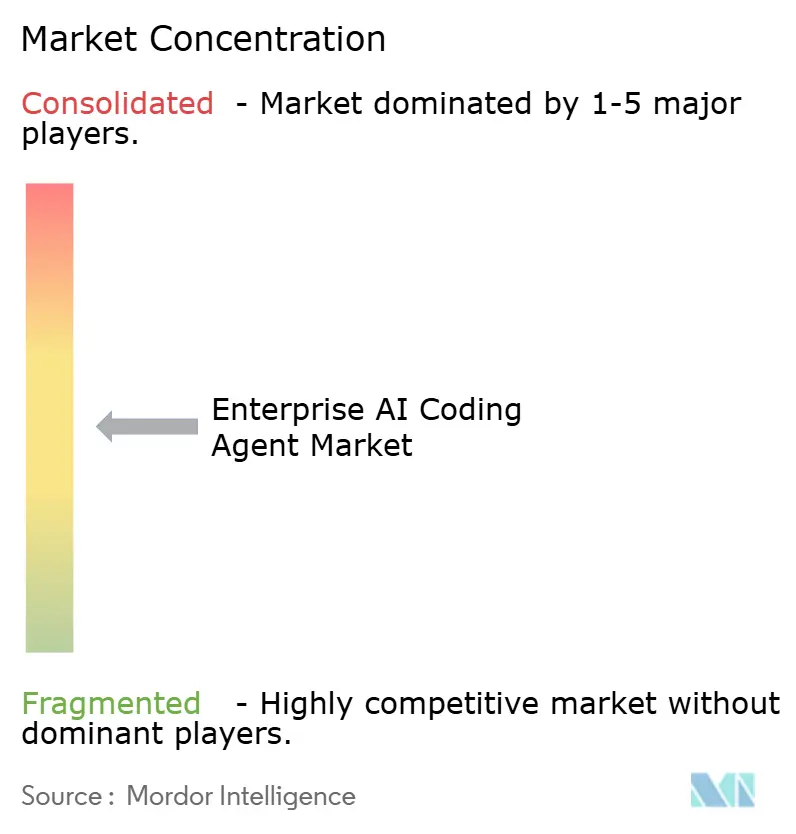
The enterprise AI coding agent market is moderately concentrated at the leading tier and fragmented below it. Cursor, GitHub Copilot, and Claude Code have substantial attention from enterprise developers, while smaller providers compete by offering specialized deployment, governance, or vertical features. Cursor reported USD 4 billion in annualized revenue in June 2026, with 75% of the run rate from enterprise business-to-business contracts, according to Dealroom. Cognition reported USD 492 million in annualized revenue alongside its 2026 funding announcement. These benchmarks show the scale to which leading independent vendors can grow. The enterprise AI coding agent market also includes foundation-model providers, hyperscalers, and established enterprise software companies. Competitive differences increasingly depend on the ability to fit into large development environments, including the capacity to manage repositories, identity controls, compliance expectations, and established development workflows.
Tabnine’s strategy centers on data-residency compliance and self-hosted deployment. Its Enterprise Context Engine provides a structured understanding of repositories, services, dependencies, and architectural relationships within a customer boundary. Sourcegraph launched Agentic Batch Changes in June 2026 for coordinated code changes across thousands of repositories.[3] This targets large monorepos and multi-repository environments that can be difficult for IDE-centered products to address. Foundation-model providers are moving into application-layer coding agents, while established firms are linking agentic coding to modernization services. IBM’s Bob packages demonstrate how incumbents can integrate coding agents into existing enterprise modernization relationships. NVIDIA also announced an Agent Toolkit with Siemens, Dassault Systèmes, Synopsys, and Flexcompute for industrial software development.
Opportunities remain in on-premises tools for regulated sectors, model-neutral governance platforms with audit capabilities, and vertical agents trained on specialized codebases. These areas require deployment controls and domain knowledge that general-purpose assistants may not provide. Poolside disclosed a USD 2 billion fundraising discussion at a USD 14 billion valuation in October 2025, with reported interest from NVIDIA. Its focus on reinforcement-learning-trained coding models illustrates continued investment in differentiated software engineering models. The enterprise AI coding agent market is also seeing providers connect generation with code review, testing, modernization, and operational governance. Buyers are likely to assess vendors on reliability, data controls, and integration alongside model capability, particularly when generated code is intended for production systems with internal audit and security requirements. The available information does not provide a combined top-player revenue share, so a numerical concentration score cannot be reliably assigned.
Enterprise AI Coding Agent Industry Leaders
-
Cognition AI, Inc.
-
Tabnine Ltd.
-
Sourcegraph, Inc.
-
Replit, Inc.
-
Cursor (Anysphere, Inc.)
- *Disclaimer: Major Players sorted in no particular order
Enterprise AI Coding Agent Market Companies Covered in this Report
- Anysphere, Inc.
- Cognition AI, Inc.
- Tabnine Ltd.
- Sourcegraph, Inc.
- Replit, Inc.
- Google LLC
- Augment Code, Inc.
- Factory AI, Inc.
- Qodo Ltd.
- CodeRabbit, Inc.
- Poolside AI, Inc.
- Magic AI, Inc.
- Blackbox AI, Inc.
- Mutable, Inc.
- Cosine Labs, Inc.
- Pythagora AI, Inc.
- Sweep AI, Inc.
- Codegen, Inc.
- Bito, Inc.
- Safurai, Inc.
- Refact AI, Inc.
- CodeStory, Inc.
Recent Industry Developments in Enterprise AI Coding Agent Market
- July 2026: IBM launched IBM Bob Premium Packages for IBM Z, IBM i, and Java Modernization, introducing opinionated AI-native COBOL and PL/I modernization workflows for mainframe enterprise environments. The packages target financial services, insurance, and government sectors where IBM Z systems anchor transaction processing at global scale, materially expanding the addressable market for autonomous software engineering agents in regulated infrastructure.
- June 2026: Cognition AI announced a USD 1 billion funding round at a USD 25 billion pre-money valuation, coinciding with disclosure that enterprise usage of its Devin autonomous software engineer expanded more than 10x since the start of 2026, with annualized revenue reaching USD 492 million. The company’s enterprise client base includes Citi, Mercedes-Benz, Goldman Sachs, Santander, and the US Army, positioning it as the leading pure-play autonomous software engineering vendor at enterprise scale.
- June 2026: NVIDIA announced its Agent Toolkit for enterprise AI agents at GTC Taipei, partnering with Siemens, Dassault Systèmes, Synopsys, and Flexcompute, among others, to build autonomous AI engineers for industrial software development. The announcement extends AI coding agent infrastructure into computer-aided design and engineering simulation workflows, opening a new category adjacent to traditional software development.
- June 2026: Sourcegraph launched Agentic Batch Changes, a frontier agent designed for coordinated code change execution across thousands of repositories simultaneously. Built on Batch Changes and Deep Search infrastructure, it targets enterprises managing large monorepos and multi-repository architectures, a use case underserved by IDE-centric coding assistants.
Global Enterprise AI Coding Agent Market Report Scope
The Enterprise AI Coding Agent Market encompasses AI-powered software development solutions designed to assist, augment, and increasingly automate coding and software engineering activities across enterprise environments. These solutions use artificial intelligence, machine learning, and generative AI technologies to understand software requirements and codebases, generate and transform code, complete code, identify and resolve coding issues, conduct code reviews, automate testing, and support other software engineering workflows. The market includes both AI-assisted development tools that work alongside software developers and more autonomous AI coding agents capable of executing multi-step software engineering tasks with limited human intervention.
The Enterprise AI Coding Agent Market Report is Segmented by Offering (AI Coding Assistants, Autonomous Software Engineering Agents, AI Code Review and Governance Platforms, and Other Offerings), Functionality (Code Completion, Code Generation and Transformation, Code Review and Optimization, Automated Testing and Validation, and Other Functionalities), Deployment Mode (Cloud-Based, and On-Premises), Organization Size (Large Enterprises, and Small and Medium-Sized Enterprises), End-User Industry (Software and Technology Providers, BFSI, Healthcare and Life Sciences, Retail and E-commerce, Manufacturing and Automotive, Media and Entertainment, Government and Public Sector, and Energy and Utilities), Application (Enterprise Software Development, Cloud Service and DevOps, Data Science and Machine Learning, Web Development, Mobile Application Development, Legacy Modernization and Refactoring, and Other Applications), and Geography (North America, Europe, Asia-Pacific, Middle East, Africa, and South America). Market Forecasts are Provided in Terms of Value (USD).
Segmentation Overview
| AI Coding Assistants |
| Autonomous Software Engineering Agents |
| AI Code Review and Governance Platforms |
| Other Offerings |
| Code Completion |
| Code Generation and Transformation |
| Code Review and Optimization |
| Automated Testing and Validation |
| Other Functionalities |
| Cloud-Based |
| On-Premises |
| Large Enterprises |
| Small and Medium-Sized Enterprises |
| Software and Technology Providers |
| Information Technology and Telecommunications |
| BFSI |
| Healthcare and Life Sciences |
| Retail and E-Commerce |
| Manufacturing and Automotive |
| Media and Entertainment |
| Government and Public Sector |
| Energy and Utilities |
| Enterprise Software Development |
| Cloud Services and DevOps |
| Data Science and Machine Learning |
| Web Development |
| Mobile Application Development |
| Legacy Modernization and Refactoring |
| Other Applications |
| North America | United States |
| Canada | |
| Mexico | |
| Europe | Germany |
| United Kingdom | |
| France | |
| Netherlands | |
| Russia | |
| Rest of Europe | |
| Asia-Pacific | China |
| Japan | |
| India | |
| South Korea | |
| Australia | |
| Rest of Asia-Pacific | |
| Middle East | United Arab Emirates |
| Saudi Arabia | |
| Turkey | |
| Rest of Middle East | |
| Africa | South Africa |
| Egypt | |
| Nigeria | |
| Rest of Africa | |
| South America | Brazil |
| Argentina | |
| Rest of South America |
| By Offering | AI Coding Assistants | |
| Autonomous Software Engineering Agents | ||
| AI Code Review and Governance Platforms | ||
| Other Offerings | ||
| By Functionality | Code Completion | |
| Code Generation and Transformation | ||
| Code Review and Optimization | ||
| Automated Testing and Validation | ||
| Other Functionalities | ||
| By Deployment Mode | Cloud-Based | |
| On-Premises | ||
| By Organization Size | Large Enterprises | |
| Small and Medium-Sized Enterprises | ||
| By End-User Industry | Software and Technology Providers | |
| Information Technology and Telecommunications | ||
| BFSI | ||
| Healthcare and Life Sciences | ||
| Retail and E-Commerce | ||
| Manufacturing and Automotive | ||
| Media and Entertainment | ||
| Government and Public Sector | ||
| Energy and Utilities | ||
| By Application | Enterprise Software Development | |
| Cloud Services and DevOps | ||
| Data Science and Machine Learning | ||
| Web Development | ||
| Mobile Application Development | ||
| Legacy Modernization and Refactoring | ||
| Other Applications | ||
| By Geography | North America | United States |
| Canada | ||
| Mexico | ||
| Europe | Germany | |
| United Kingdom | ||
| France | ||
| Netherlands | ||
| Russia | ||
| Rest of Europe | ||
| Asia-Pacific | China | |
| Japan | ||
| India | ||
| South Korea | ||
| Australia | ||
| Rest of Asia-Pacific | ||
| Middle East | United Arab Emirates | |
| Saudi Arabia | ||
| Turkey | ||
| Rest of Middle East | ||
| Africa | South Africa | |
| Egypt | ||
| Nigeria | ||
| Rest of Africa | ||
| South America | Brazil | |
| Argentina | ||
| Rest of South America | ||
Key Questions Answered in the Report
What is the enterprise AI coding agent market size?
The enterprise AI coding agent market size is projected to reach USD 45.83 billion by 2031 from USD 14.18 billion in 2026, at a 26.44% CAGR.
What is driving enterprise adoption of AI coding agents?
Engineering capacity constraints, broader software delivery automation, and legacy-system modernization are central factors.
Which offering is projected to expand fastest?
Autonomous software engineering agents are projected to expand at a 45.59% CAGR through 2031.
Why are on-premises coding agents gaining adoption?
Regulated organizations need stronger control over source-code confidentiality, data residency, and governance.
Which end-user group is projected to expand fastest?
Banking, financial services, and insurance is projected to expand at a 46.12% CAGR through 2031.
Which region is projected to expand fastest?
Asia-Pacific is projected to expand at a 45.57% CAGR from 2026 to 2031.