
ENT Chairs Market Size and Share
Market Overview
| Study Period | 2020 - 2031 |
|---|---|
| Market Size (2026) | USD 0.88 Billion |
| Market Size (2031) | USD 1.24 Billion |
| Growth Rate (2026 - 2031) | 7.12 % |
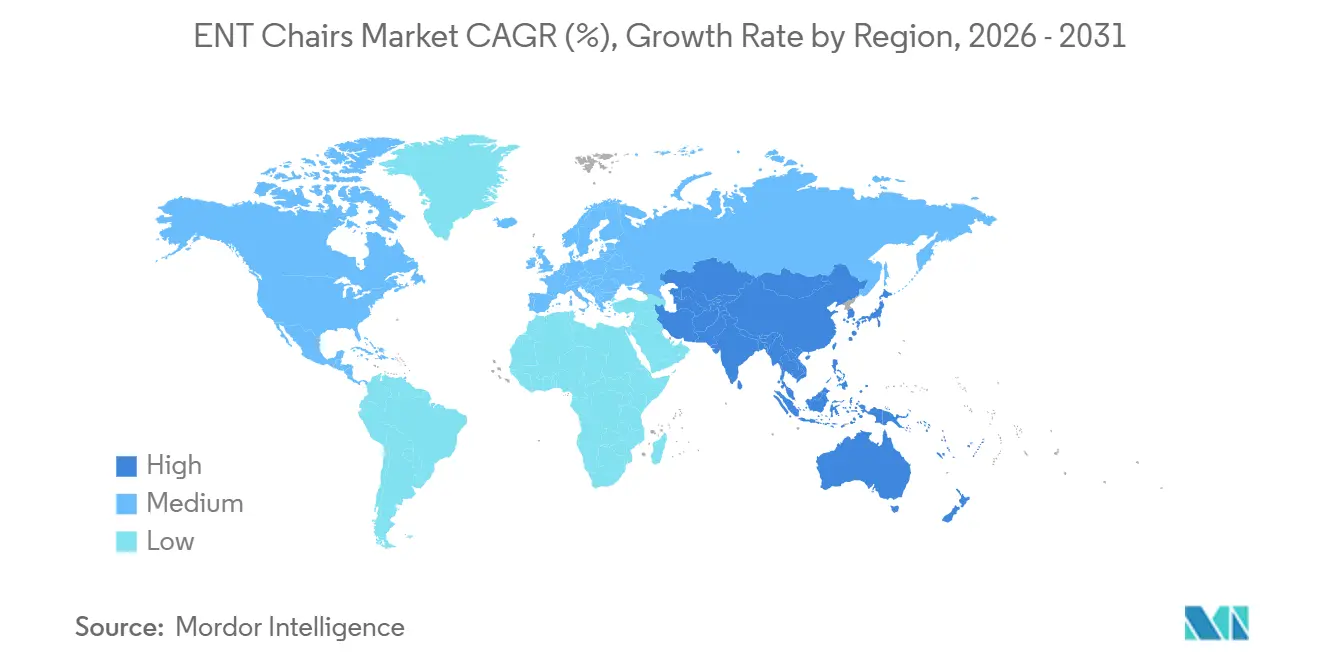
| Fastest Growing Market | Asia-Pacific |
| Largest Market | North America |
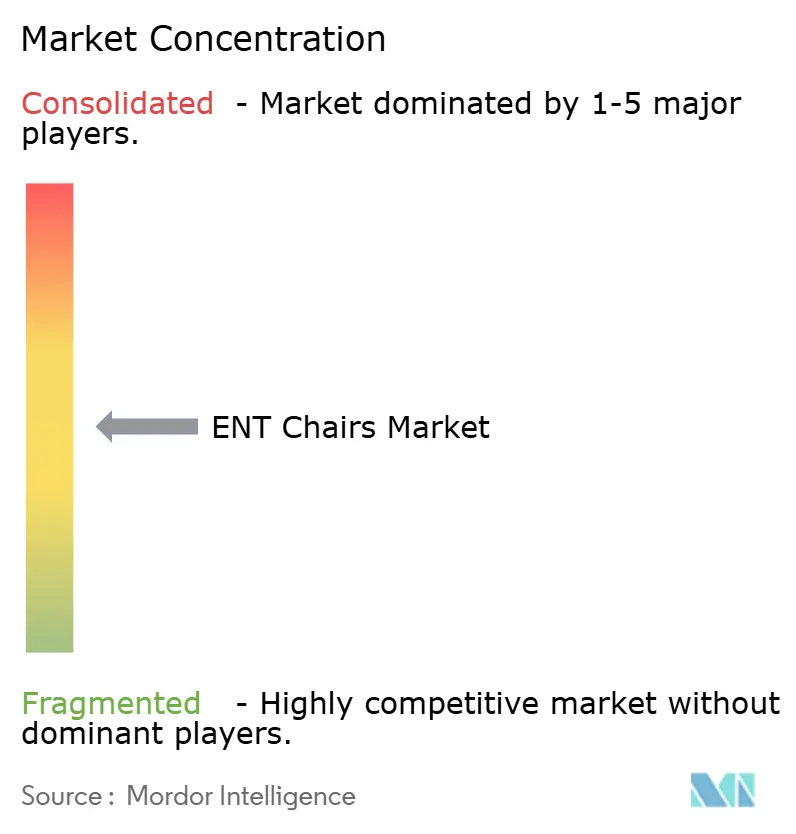
| Market Concentration | Medium |
Major Players *Disclaimer: Major Players sorted in no particular order Image © Mordor Intelligence. Reuse requires attribution under CC BY 4.0. | |
ENT Chairs Market Analysis by Mordor Intelligence
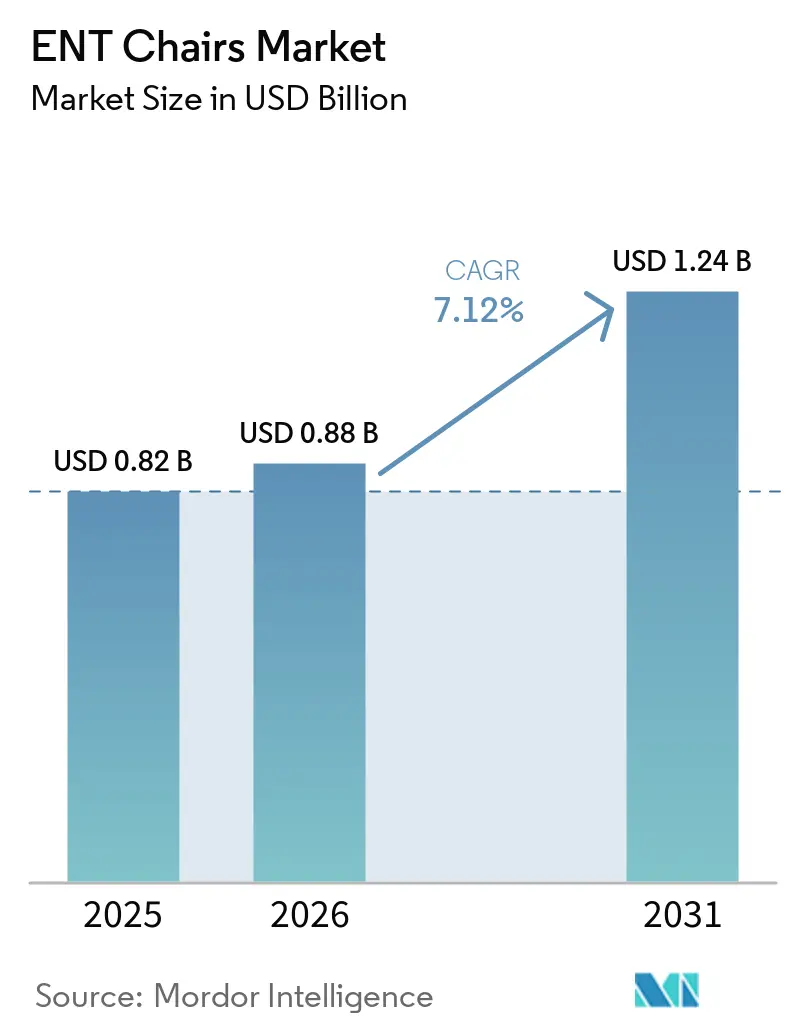
The ENT Chairs Market size is expected to increase from USD 0.82 billion in 2025 to USD 0.88 billion in 2026 and reach USD 1.24 billion by 2031, growing at a CAGR of 7.12% over 2026-2031.
Growth is tied to higher outpatient procedure volumes, the movement of care into ambulatory and office settings, and the need for equipment that supports repeatable clinical positioning. Medicare Part B otologic and neurotologic services rose from 1.85 million in 2012 to 2.15 million in 2024, and higher procedure volumes added USD 20 million in spending despite lower reimbursement per service. The service data indicate that demand for examination infrastructure is connected more closely to procedure volume than to reimbursement per service. Procurement teams increasingly view chair selection alongside endoscopy, diagnostic, accessibility, and cleaning requirements. The ENT chairs market is also shaped by replacement demand as facilities update equipment for lower transfer heights and infection-control needs. Long asset lives, constrained clinic budgets, and the higher cost of integrated systems continue to slow upgrades in smaller practices.
Key Report Takeaways
- By product type, manual ENT chairs held 53.31% of the ENT chairs market share in 2025, while programmed or powered chairs are forecast to grow at 8.58% CAGR through 2031.
- By chair configuration, examination chairs accounted for 56.24% of the ENT chairs market size in 2025, while minor-procedure and surgery chairs are forecast to expand at 8.22% CAGR through 2031.
- By technology and actuation, electric systems held 60.14% revenue share in 2025, and are expected to have 8.82% CAGR through 2031.
- By end user, hospitals held 54.65% revenue share in 2025, while ambulatory surgical centers are forecast to grow at 8.65% CAGR through 2031.
- By distribution channel, authorized medical-equipment distributors held 57.65% revenue share in 2025, while online medical equipment platforms are forecast to expand at 9.25% CAGR through 2031.
- By geography, North America held 38.61% of revenue in 2025, while Asia-Pacific is forecast to grow at a 8.75% CAGR through 2031.
Note: Market size and forecast figures in this report are generated using Mordor Intelligence’s proprietary estimation framework, updated with the latest available data and insights as of January 2026.
Market Trends and Insights
Drivers Impact Analysis of ENT Chairs Market*
| Driver | (~) % Impact on CAGR Forecast | Geographic Relevance | Impact Timeline |
|---|---|---|---|
| Rising ENT Outpatient Procedure Volumes | +2.2% | Global | Short term (≤ 2 years) |
| Aging-Linked Demand for Accessible Examination Positions | +1.8% | Global, concentrated in North America, Europe, and Japan | Long term (≥ 4 years) |
| Transition to Electric Multi-Position Chairs | +1.4% | North America and Europe | Medium term (2-4 years) |
| Integration With Endoscopy and Digital ENT Workflows | +1.0% | North America, Europe, and core Asia-Pacific markets | Medium term (2-4 years) |
| Replacement Demand From Infection-Control Upgrades | +0.7% | Global, concentrated in Europe and North America | Short term (≤ 2 years) |
| Low-Transfer-Height Procurement Requirements | +0.5% | North America, with spillover to Europe | Medium term (2-4 years) |
| Source: Mordor Intelligence | |||
Rising ENT Outpatient Procedure Volumes Drive Sustained Chair Utilization
Rising outpatient volume supports consistent use of examination and procedure rooms in the ENT chairs market. A fast-track ENT program at UCSF Benioff Children's Hospital used underused neurosurgery blocks for frequent ENT procedures in early 2024. The program increased total ENT case volume by 13% within 12 months and reduced the procedural backlog by 16%. This approach showed that workflow redesign can raise throughput without adding operating room capacity. Backlogs requiring 33,807 additional rhinology cases beyond new demand were projected to continue through 2027 and 2028 in several health systems. Higher utilization makes durable, procedure-ready chairs more relevant to outpatient facility investment.
Aging-Linked Demand for Accessible Examination Positions Creates Specification Pressure
An aging patient population is increasing ENT encounters and changing the chair features required for safe examinations. A 2025 Rotterdam Study found hearing loss above 35 dBHL in 31% of men and 30% of women aged 65 years and older. The prevalence rose to 62% of men and 57% of women older than 80 years. Chairs with lower transfer heights, wider seats, and higher weight capacity can better support patients with reduced mobility. India classified ENT chairs among 67 notified ENT medical devices that require registration under the Medical Devices Rules, 2017. These requirements gradually move accessible and bariatric configurations from optional features toward routine procurement specifications in the ENT chairs market.
Transition to Electric Multi-Position Chairs Reshapes Purchase Criteria
The transition from manual units to powered systems is changing purchase decisions in the ENT chairs market. Powered positioning can support more consistent patient placement through a busy clinical day and may reduce physical strain on caregivers. Midmark launched the 631 Procedure Chair in April 2025 with a 17-inch low transfer height. The company stated that it was the first procedure chair certified to meet U.S. Access Board accessible medical equipment standards. UMF Medical introduced its LibertyPRO Exam Chair in August 2025 with a 17-inch seat height and 650-pound capacity. These launches indicate that accessible design is becoming a more common requirement in North American institutional purchasing.
Integration With Endoscopy and Digital ENT Workflows Redefines Chair Specification
The ENT chairs market is increasingly influenced by the chair's role within a connected clinical setup. In June 2026, Medtronic and KARL STORZ announced a collaboration to align the AiBLE ENT ecosystem, including the FDA-cleared Stealth AXiS ENT surgical navigation system, with KARL STORZ endoscopy visualization platforms. The collaboration supports more integrated procurement for ENT operating rooms in the United States. Chair specifications can therefore include suction and irrigation access, compatible positioning ranges, and surfaces that are easy to clean. CMS interoperability requirements under the 21st Century Cures Act support broader use of connected clinical information systems[1]. Facilities investing in connected endoscopy workflows are less likely to pair those systems with legacy manual equipment.
Restraints Impact Analysis of ENT Chairs Market*
| Restraint | (~) % Impact on CAGR Forecast | Geographic Relevance | Impact Timeline |
|---|---|---|---|
| High Capital Cost of Powered and Integrated Systems | -0.8% | Global, concentrated in lower-income markets | Medium term (2-4 years) |
| Reimbursement and Budget Constraints in Small Clinics | -0.6% | North America, South America, the Middle East and Africa | Long term (≥ 4 years) |
| Long Service-Life and Refurbishment Delaying Replacement | -0.4% | Established European and North American markets | Medium term (2-4 years) |
| Compliance and After-Sales-Service Burden Across Markets | -0.3% | Asia-Pacific, the Middle East, and Africa | Long term (≥ 4 years) |
| Source: Mordor Intelligence | |||
High Capital Cost of Powered and Integrated Systems Limits Upgrade Adoption
Powered and integrated systems remain harder to purchase for independent practices and smaller specialty clinics. Chairs with programmable positions, integrated suction, and bariatric capacity cost several multiples of mid-range manual or hydraulic alternatives. The 2025 Medicare Physician Fee Schedule recalibrated RVUs, reducing reimbursement for routine sinus procedures while increasing payments for complex nasal reconstruction and voice treatments. Practices that depend on routine procedures face tighter margins for capital purchases. This challenge is stronger outside major metropolitan areas, where procedure volume may not support a short replacement cycle. Refurbishment of hydraulics, upholstery, and footpads can extend the use of installed chairs and delay new orders in the ENT chairs market.
Reimbursement and Budget Constraints in Small Clinics Suppress Mid-Market Demand
Small otolaryngology practices often derive a larger share of activity from examinations and diagnostic services with lower reimbursement. Medicare payment updates implemented in January 2025 affected payments for commonly used ENT procedure codes[2]. Lower retained cash flow limits facility investment in some affected practices. Public hospital purchases in South America, the Middle East, and import duties, approval processes, and limited local service networks can also delay Africa. These financing limits weigh most heavily on the sub-premium tier, where many small-clinic purchases would otherwise occur. The result is a clearer divide between better-funded institutional buyers and underinvested community settings in the ENT chairs market.
*Our forecasts treat driver/restraint impacts as directional, not additive. The impact forecasts reflect baseline growth, mix effects, and variable interactions.
ENT Chairs Market Segment Analysis
By Product Type:
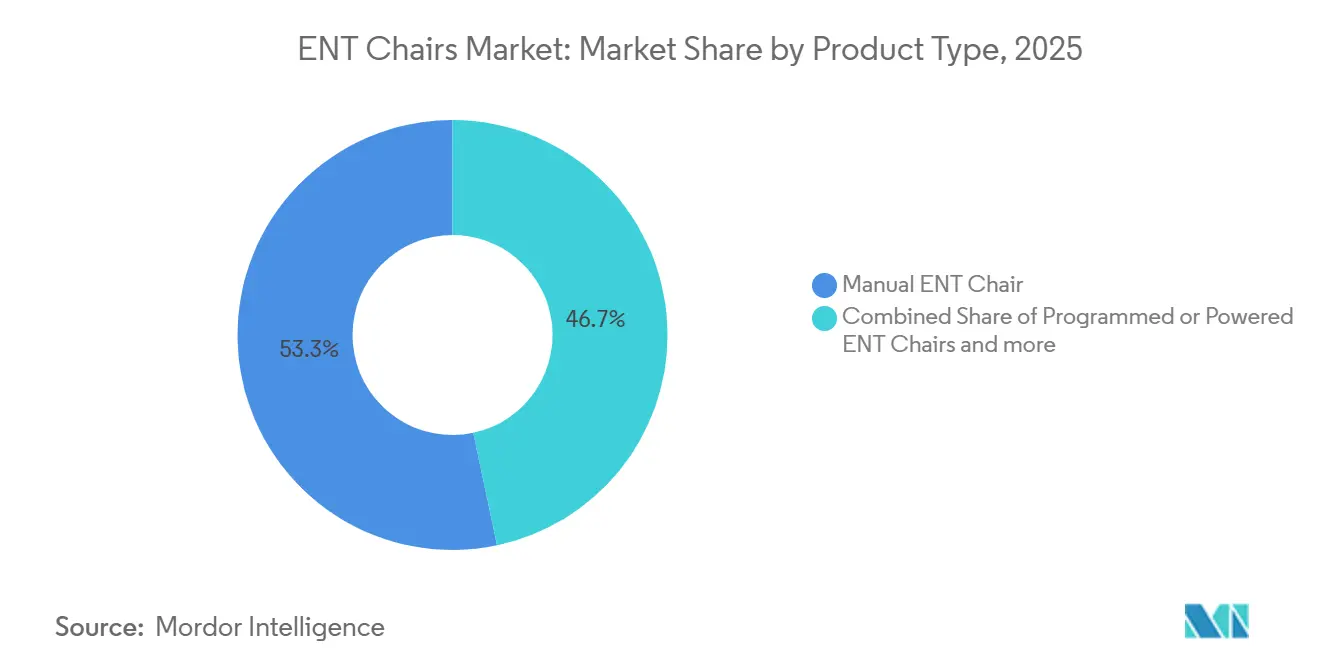
Powered Configurations Gaining Ground Against Manual DominanceManual ENT chairs held 53.31% of product-type revenue in 2025, representing the largest portion of the ENT chairs market share. Their position reflects lower purchase prices, straightforward maintenance, and compatibility with older cabinetry layouts. Programmed or powered chairs are forecast to grow at 8.58% CAGR through 2031. This faster rate reflects the rising need for more complex positioning in high-volume clinics and ambulatory surgery centers. Manual equipment still has a strong place in smaller practices and cost-sensitive regions. Hydraulic units offer height adjustment without the full complexity of electronic systems. The installed base continues to influence present manual demand. New procurement preferences are moving more clearly toward powered configurations in the ENT chairs market.
Convertible and hybrid products are gaining relevance where one room must support examination and minor procedures. These chairs can reduce the need for separate dedicated rooms in outpatient settings. The Midmark 631 Procedure Chair, launched in April 2025, used a 17-inch low transfer height to meet U.S. Access Board accessible medical equipment standards. This example shows how accessibility rules can affect product requirements. Manufacturers must maintain manual products for price-sensitive buyers. They must also develop powered systems that meet accessibility, infection-control, and digital workflow needs. This creates a two-part product development requirement across the ENT chairs industry. It also narrows the advantage for suppliers who delay accessible design updates.

By Chair Configuration:
Minor-Procedure Chairs Emerge as the Fastest-Growing CategoryExamination chairs accounted for 56.24% of configuration revenue in 2025, making them the largest configuration within the ENT chairs market. The routine diagnostic workload of hospital outpatient departments, specialty clinics, and physician offices supports their use. Minor-procedure and surgery chairs are forecast to expand at 8.22% CAGR through 2031. The higher growth rate follows the movement of procedures from hospital operating rooms to ambulatory and office-based locations. These settings require chairs with greater procedural capability. Treatment chairs also benefit from the same movement in care delivery. They can support recurring services such as balloon sinuplasty and in-office microlaryngoscopy. The configuration mix is therefore changing as more ENT work takes place outside traditional operating rooms.
There were 148 outpatient specialty transactions in 2025, including 7 in ENT. The deal activity supports continuing investment in ambulatory procedure capacity. Bariatric chairs remain a smaller but structurally growing configuration. They address the gap between standard weight limits and the needs of patients seen in ENT practices. ATMOS showed its S61 CORIAN treatment unit at DGHNO Congress 2026 in May 2026. The unit includes non-porous CORIAN surfaces, handle-free Servo-Drive drawers, and separate handling of clean and used instruments. This design places infection control within the chair configuration rather than treating it as an added feature. The ENT chairs market is consequently placing greater value on procedure capability and cleaning performance.
By Technology and Actuation:
Electric Actuation Consolidates as the Dominant PlatformElectric actuation held 60.14% of technology-and-actuation revenue in 2025. This leadership reflects demand for programmable multi-position adjustment and less manual repositioning during high-volume care. Electric platforms can support more repeatable positioning across examination and procedure workflows. The remaining demand spans mechanical, hydraulic, electro-hydraulic, and electromechanical designs. Each design serves different price points and clinical requirements. Electro-hydraulic systems retain a role in mid-range institutional use. They offer controlled movement while avoiding some of the complexity associated with fully solid-state systems. Electric actuation is now the baseline technology in developed areas of the ENT chairs market.
Electromechanical systems are gaining preference in procedure-heavy settings because of their smooth and low-noise operation. These systems can also work well alongside sensitive endoscopic documentation equipment. Mechanical chairs remain commercially relevant in Asia-Pacific, the Middle East, and Africa, where lower acquisition cost remains important. AKRUS developed the sc5010 ES series for ENT, ophthalmology, and maxillofacial use with IP65-rated protection and 24V DC actuation[3]. The battery-operated surgical chair category serves ambulatory and off-grid procedure environments. ISO 13485 certification is used as a quality signal in hospital procurement. European buyers also assess the technical documentation required under EU MDR for Class I medical devices. These requirements can strengthen the position of established suppliers in the ENT chairs industry.
By End User:
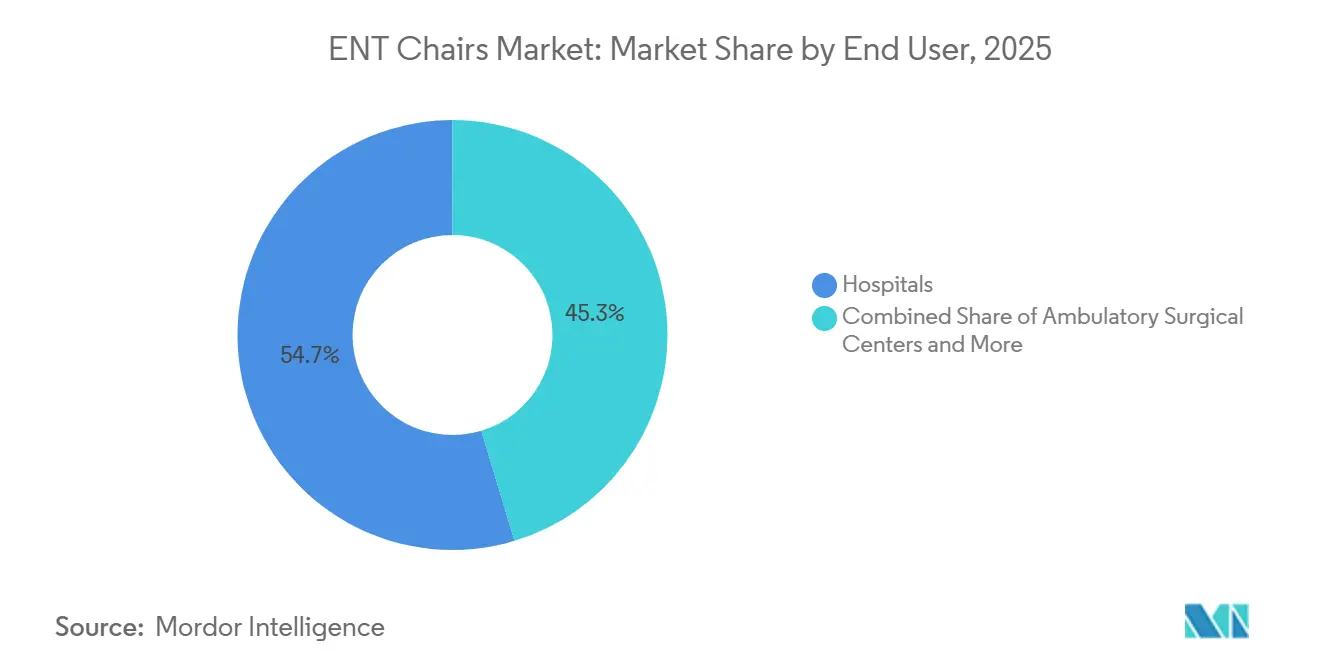
ASCs and Specialty Clinics Accelerate While Hospitals Retain ScaleHospitals held 54.65% of end-user revenue in 2025. Their scale comes from high procedure volumes, multi-department purchasing, and established group-purchasing organization relationships. Hospitals can use their purchasing scale to seek cost leverage across equipment categories. Ambulatory surgical centers are forecast to grow at 8.65% CAGR through 2031. This rate aligns with the wider move of ENT care toward outpatient delivery. It also reflects the consolidation of ENT practices around ambulatory surgery center models. Specialty clinics remain an important source of demand in the ENT chairs market. They often seek integrated diagnostic cabinetry, endoscopy-compatible positioning, and surfaces that support rapid disinfection.
Alliant Purchasing partnered with e3 Diagnostics in July 2025 to offer preferred pricing on audiology and balance equipment to ENT clinics and ambulatory surgery centers across more than 35,000 provider locations. The partnership shows how purchasing programs are extending beyond hospital networks. Academic medical centers, government facilities, and research institutions contribute to a steadier demand shaped by budget cycles. In August 2025, Universitätsklinikum Schleswig-Holstein awarded Happersberger otopront GmbH a contract for ENT treatment units. The contract value was EUR 139 thousand (USD 152 thousand) TED. This award indicates an active equipment refresh in European academic facilities. Large institutional contracts can support suppliers with service capacity and relevant product ranges. Smaller clinics continue to face more constrained upgrade decisions.
By Distribution Channel:
Online Platforms Grow Fastest as Digital Procurement ExpandsAuthorized medical-equipment distributors held 57.65% of channel revenue in 2025. Their role is supported by clinical demonstrations, service contract bundling, and established hospital group-purchasing relationships. These capabilities remain important for premium or complex systems that need installation and continuing maintenance. Online medical equipment platforms are forecast to grow at 9.25% CAGR through 2031. Their growth follows wider digital procurement activity in emerging markets. Direct manufacturer sales remain important for customized and premium chair systems. These sales are particularly relevant when hospital systems negotiate large multi-site contracts. Distribution is becoming more varied across the ENT chairs market as digital ordering expands.
Medikabazaar reported 57% year-on-year revenue growth in Q1 FY2025 across digital procurement volumes covering more than 2 lakh SKUs in 5 healthcare categories. The company targeted INR 3,000 crore (USD 360 million) in annual revenue by FY2027. Henry Schein completed a global e-commerce rollout to U.S. dental and Canadian customers in early 2026 and is rolling it out to U.S. medical customers during 2026. These actions show how established distributors are adapting to digital purchasing. A study in the Journal of Public Economics found that a 1-standard-deviation increase in group-purchasing organization scale reduced hospital supply expenses per discharge by 2.7%. This provides a commercial reason for manufacturers to pursue group-purchasing listings. Distributor service depth and online convenience will both influence channel choices in the ENT chairs market.
Geography Analysis
North America ENT Chairs Market
North America held 38.61% of the ENT chairs market share in 2025. The United States supports this position through a dense ENT specialist base and high per-capita procedure volumes. Consolidation of ENT practices into multi-site ambulatory platforms is centralizing procurement decisions. U.S. Access Board standards for 17-inch low transfer heights are appearing in hospital and ambulatory surgery center specifications. Canada provides steady institutional purchasing through its public health system. Mexico offers demand for mid-range electrical and hydraulic products as private hospital networks expand. Reimbursement pressure on routine ENT services remains a risk for independent-practice capital upgrades.
APAC ENT Chairs Market
Asia-Pacific is forecast to grow at 8.75% CAGR through 2031. Health infrastructure investment, aging populations, and increased awareness of ENT disorders support this rate. A 2025 study using the 2023 China National Health Survey reported high-frequency hearing loss among surveyed older adults in Jiangsu, Guangdong, and Jilin. India has brought ENT chairs within the 67 notified ENT medical devices under its Medical Devices Rules, 2017. Japan and South Korea maintain high equipment standards and domestic supplier bases. New hospitals and government-funded ENT screening programs support broader demand in Australia and other Asia-Pacific countries.
EMEA and South America ENT Chairs Market
Europe held a substantial share of the global ENT chairs market in 2025, with Germany serving as a key demand and manufacturing center. German outpatient procedure volumes and clinic refurbishment support recurring demand for premium configurations. The August 2025 UKSH contract awarded to Happersberger Otopront provides a visible example of university-hospital replacement purchasing. The United Kingdom, France, Italy, and Spain also have meaningful demand, although public procurement can lengthen replacement cycles. GCC hospital construction can create periodic high-volume purchases. Brazil and Argentina can face delayed orders because of budget limits and import duties. South America and Middle East and Africa remain smaller but strategically relevant parts of the ENT chairs market.
Competitive Landscape
The ENT chairs market is moderately fragmented. Suppliers compete through infection-control design, readiness for digital clinical workflows, and accessible-design compliance. European specialists, including ATMOS MedizinTechnik, Happersberger otopront, and NAMROL Medical, have positions in premium institutional channels. Their offerings emphasize hygiene engineering, ergonomic design, and proximity to ENT academic centers. North American companies, including Midmark and UMF Medical, compete through accessible designs, service coverage, and group-purchasing contracts. Chinese and South Korean suppliers are entering mid-market channels with electric and electro-hydraulic models. Their price positions add pressure in cost-sensitive procurements. Competition, therefore, differs across premium, institutional, and value-focused buying environments.
Bariatric-specific chairs for patients exceeding 300 kg remain a limited product category relative to stated clinical needs. Products that switch between examination and endoscopy-assisted minor-procedure positions without manual reconfiguration are also only partly addressed. ATMOS presented the S61 CORIAN unit in May 2026 with non-porous CORIAN surfaces, handle-free Servo-Drive drawers, and separation of clean and used instruments. The product move makes hygiene performance more visible in treatment-unit selection. Midmark launched the 631 Procedure Chair in April 2025 with a 17-inch transfer height and U.S. Access Board certification. UMF Medical then introduced the LibertyPRO chair in August 2025 with a 17-inch seat height and 650-pound capacity. These actions put accessibility alongside hygiene as a practical product differentiator.
ISO 13485 certification and EU MDR technical documentation can function as qualification requirements in European premium channels. Those requirements can slow entry for suppliers whose documentation is less developed than their product engineering. Manufacturers with established clinical service networks can also have an advantage when buyers require installation, maintenance, and staff support. The ENT chairs market, therefore, remains open to new suppliers but does not depend on price alone. Suppliers need products suited to local budget levels and care workflows. They also need to address accessibility, cleaning, and procedural integration requirements. The available evidence supports a moderately fragmented supplier environment rather than concentrated control by a small group.
ENT Chairs Industry Leaders
-
ATMOS MedizinTechnik GmbH & Co. KG
-
OPTOMIC ESPAÑA SA
-
Haag-Streit Group
-
NAMROL Medical S.L.
-
Global Surgical Corporation
- *Disclaimer: Major Players sorted in no particular order
ENT Chairs Market Companies Covered in this Report
- Arsimed Medical
- ATMOS MedizinTechnik
- Boyd Industries
- Chammed Co., Ltd.
- Entermed BV
- Euroclinic MediCare Solutions S.r.l.
- G. Heinemann Medizintechnik
- Global Surgical
- Happersberger otopront
- HAAG-Streit
- Innotech Medical Co., Ltd.
- Lemi MD
- Medstar Co., Ltd.
- Mega Medical Co., Ltd.
- Midmark
- MTI
- NAMROL Medical S.L.
- Olsen Industry
- OPTOMIC ESPANA SA
- UMF Medical
Recent Industry Developments in ENT Chairs Market
- May 2026: ATMOS MedizinTechnik showcased the S61 CORIAN ENT treatment unit at DGHNO Congress 2026, featuring non-porous CORIAN surfaces, handle-free Servo-Drive drawers, and structured instrument and secretion management. The product sets a benchmark for infection-control-compliant ENT workstation design in European clinical procurement and signals the direction of hygiene-specification evolution for the sector.
- August 2025: UMF Medical introduced the LibertyPRO Exam Chair with a 17-inch low seat height and 650-pound weight capacity, meeting U.S. Access Board accessible medical equipment standards. TruComfort+ Support Rails swing away for patient access, lock as bed rails, and enable accurate arm positioning for blood pressure monitoring, extending clinical utility well beyond ENT to general examination applications.
Global ENT Chairs Market Report Scope
As per the scope of the report, ENT chairs, also known as otolaryngology chairs or ENT examination chairs, are specialized medical chairs designed for ENT (ear, nose, and throat) examinations and procedures. They are essential equipment in ENT clinics and hospitals, providing comfort to patients and ease of access for healthcare providers.
The ENT chairs market is segmented by product type into manual ENT chairs, programmed or powered ENT chairs, hydraulic ENT chairs, and convertible and hybrid ENT chairs. By chair configuration, the market is segmented into examination chairs, treatment chairs, minor procedure and surgery chairs, and bariatric ENT chairs. By technology and actuation, the market is segmented into electric, mechanical, hydraulic, electro-hydraulic, electromechanical, and other chairs. By end user, the market is segmented into hospitals, otolaryngology specialty clinics, ambulatory surgical centers, and other end users. By distribution channel, the market is segmented into direct manufacturer sales, authorized medical equipment distributors, hospital groups and group purchasing contracts, and online medical equipment platforms. By geography, the market is segmented into North America, Europe, Asia-Pacific, the Middle East and Africa, and South America. The market report also covers the estimated market sizes and trends for 17 countries across major regions globally. For each segment, the market size and forecast are provided in terms of value (USD).
Segmentation Overview
| Manual ENT Chairs |
| Programmed or Powered ENT Chairs |
| Hydraulic ENT Chairs |
| Convertible and Hybrid ENT Chairs |
| Examination Chairs |
| Treatment Chairs |
| Minor-Procedure and Surgery Chairs |
| Bariatric ENT Chairs |
| Electric |
| Mechanical |
| Hydraulic |
| Electro-Hydraulic |
| Electromechanical |
| Others |
| Hospitals |
| Otolaryngology Specialty Clinics |
| Ambulatory Surgical Centers |
| Other End Users |
| Direct Manufacturer Sales |
| Authorized Medical-Equipment Distributors |
| Hospital Group and Group-Purchasing Contracts |
| Online Medical-Equipment Platforms |
| North America | United States |
| Canada | |
| Mexico | |
| Europe | Germany |
| United Kingdom | |
| France | |
| Italy | |
| Spain | |
| Rest of Europe | |
| Asia-Pacific | China |
| Japan | |
| India | |
| Australia | |
| South Korea | |
| Rest of Asia-Pacific | |
| Middle East and Africa | GCC |
| South Africa | |
| Rest of Middle East and Africa | |
| South America | Brazil |
| Argentina | |
| Rest of South America |
| By Product Type | Manual ENT Chairs | |
| Programmed or Powered ENT Chairs | ||
| Hydraulic ENT Chairs | ||
| Convertible and Hybrid ENT Chairs | ||
| By Chair Configuration | Examination Chairs | |
| Treatment Chairs | ||
| Minor-Procedure and Surgery Chairs | ||
| Bariatric ENT Chairs | ||
| By Technology and Actuation | Electric | |
| Mechanical | ||
| Hydraulic | ||
| Electro-Hydraulic | ||
| Electromechanical | ||
| Others | ||
| By End User | Hospitals | |
| Otolaryngology Specialty Clinics | ||
| Ambulatory Surgical Centers | ||
| Other End Users | ||
| By Distribution Channel | Direct Manufacturer Sales | |
| Authorized Medical-Equipment Distributors | ||
| Hospital Group and Group-Purchasing Contracts | ||
| Online Medical-Equipment Platforms | ||
| By Geography | North America | United States |
| Canada | ||
| Mexico | ||
| Europe | Germany | |
| United Kingdom | ||
| France | ||
| Italy | ||
| Spain | ||
| Rest of Europe | ||
| Asia-Pacific | China | |
| Japan | ||
| India | ||
| Australia | ||
| South Korea | ||
| Rest of Asia-Pacific | ||
| Middle East and Africa | GCC | |
| South Africa | ||
| Rest of Middle East and Africa | ||
| South America | Brazil | |
| Argentina | ||
| Rest of South America | ||
Key Questions Answered in the Report
What is the size of the ENT chairs market?
The ENT chairs market is projected to expand from USD 0.82 billion in 2025 and USD 0.88 billion in 2026 to USD 1.24 billion by 2031, registering a CAGR of 7.12% between 2026 and 2031.
What is driving demand for ENT chairs?
Higher outpatient procedure volumes, aging-related accessibility needs, electric positioning, and integrated endoscopy workflows are supporting demand. Replacement needs also arise when installed equipment does not meet lower transfer-height or infection-control requirements.
Which product type is growing fastest in ENT chairs?
Programmed or powered chairs are forecast to grow at 8.58% CAGR through 2031, while manual chairs held 53.31% share in 2025.
Which end user is growing fastest for ENT chairs?
Ambulatory surgical centers are forecast to grow at 8.65% CAGR through 2031, while hospitals held 54.65% share in 2025.
Which region is growing fastest for ENT chairs?
Asia-Pacific is forecast to expand at 8.75% CAGR through 2031, supported by health infrastructure investment, aging populations, awareness of hearing disorders, and evolving oversight of ENT medical devices.
Which distribution channel is expanding fastest?
Online medical equipment platforms are forecast to grow at 9.25% CAGR through 2031, although authorized distributors held 57.65% share in 2025.