
Endoprosthesis Market Size and Share
Market Overview
| Study Period | 2020 - 2031 |
|---|---|
| Market Size (2026) | USD 29.56 Billion |
| Market Size (2031) | USD 50.07 Billion |
| Growth Rate (2026 - 2031) | 11.12 % |
| Fastest Growing Market | Asia-Pacific |
| Largest Market | North America |
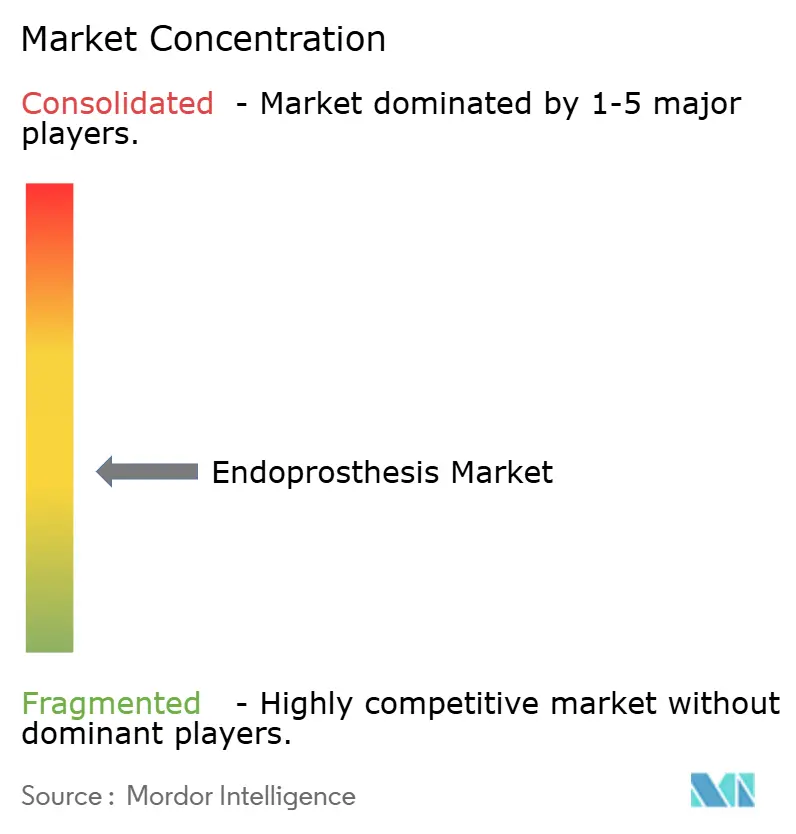
| Market Concentration | Medium |
Major Players *Disclaimer: Major Players sorted in no particular order Image © Mordor Intelligence. Reuse requires attribution under CC BY 4.0. | |
Endoprosthesis Market Analysis by Mordor Intelligence
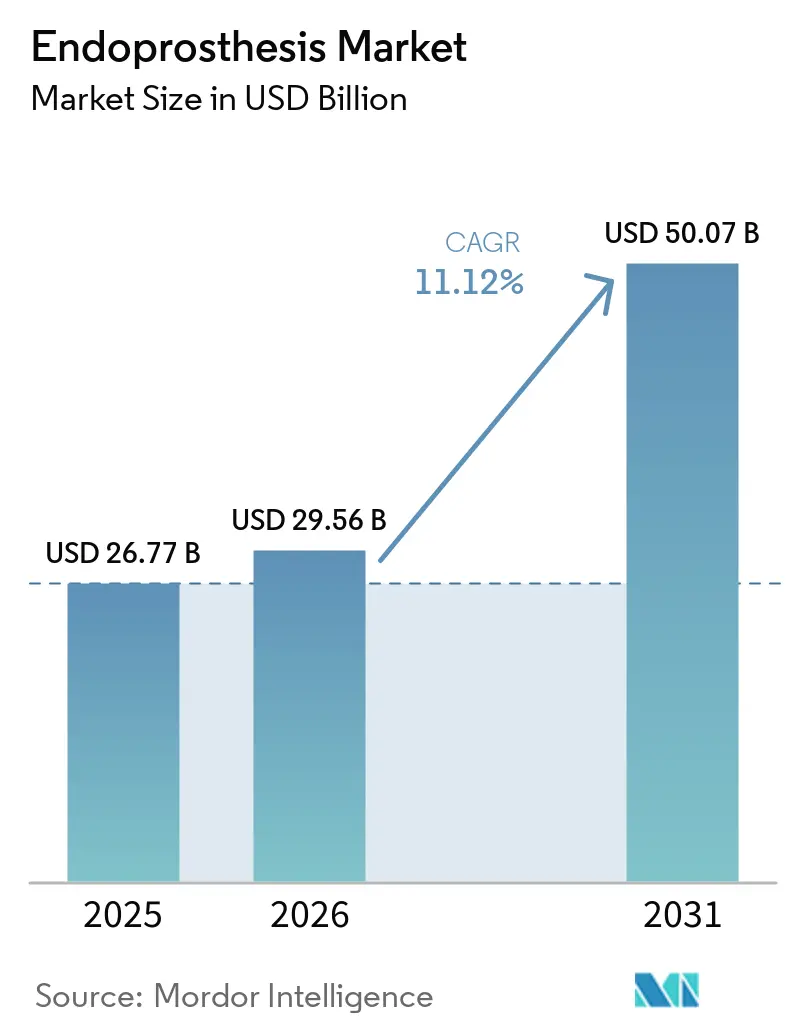
The endoprosthesis market is expected to grow from USD 26.77 billion in 2025 to USD 29.56 billion in 2026, and is forecasted to reach USD 50.07 billion by 2031, growing at a CAGR of 11.12% from 2026 to 2031. Aging populations and the rising burden of osteoarthritis support demand for joint replacement across established and developing health systems. Care delivery is moving from tertiary hospitals toward ambulatory surgical centers and specialized orthopedic practices. This change favors implant systems that reduce instrument needs, support standardized procedures, and work with robotic planning tools. Manufacturers are also placing greater weight on long-term clinical evidence because registries increasingly influence procurement and surgeon choice. The endoprosthesis market, therefore, combines broad volume growth with sharper competition around procedure efficiency, clinical outcomes, and price.
Key Report Takeaways
- By product type, knee endoprostheses held 38.26% of the endoprosthesis market share in 2025, while hip endoprostheses are forecasted to grow at 12.15% CAGR through 2031.
- By procedure, total replacement held 40.16% of the endoprosthesis market in 2025, while partial replacement is forecasted to grow at a 12.64% CAGR through 2031.
- By indication, osteoarthritis accounted for 39.16% of the endoprosthesis market share in 2025, while traumatic arthritis and fractures are forecasted to grow at a 13.47% CAGR through 2031.
- By end-user, hospitals and surgical centers held 42.23% revenue share in 2025, while orthopedic clinics are forecasted to grow at an 11.73% CAGR through 2031.
- By geography, North America held 47.34% revenue share in 2025, while Asia-Pacific is forecasted to grow at 14.21% CAGR through 2031.
Note: Market size and forecast figures in this report are generated using Mordor Intelligence’s proprietary estimation framework, updated with the latest available data and insights as of January 2026.
Market Trends and Insights
Drivers Impact Analysis of Endoprosthesis Market*
| Driver | (~) % Impact on CAGR Forecast | Geographic Relevance | Impact Timeline |
|---|---|---|---|
| Aging Populations and Rising Osteoarthritis Burden | +3.2% | Global, with the highest intensity in North America, Western Europe, and East Asia | Long term (≥ 4 years) |
| Rising Obesity, Sports Injury, and Post-Traumatic Joint Disease | +1.9% | Global, with the fastest demand growth in South and Southeast Asia and Latin America | Medium term (2-4 years) |
| Expansion of Robotic-Assisted and Minimally Invasive Arthroplasty | +2.3% | North America and Western Europe; accelerating in Japan, South Korea, Australia | Medium term (2–4 years) |
| Growth of Ambulatory Surgical Center and Same-Day Joint Replacement Pathways | +1.6% | North America (US-led); spill-over to Germany, UK, Australia | Short term (≤ 2 years) |
| Registry-Linked Evidence and Survivorship Transparency Increasing Implant Selection Confidence | +1.0% | North America, Western Europe | Medium term (2–4 years) |
| Modular, Patient-Specific, and Additively Manufactured Implants Expanding Treatment Eligibility | +2.4% | Global; strongest uptake in advanced surgical centers | Medium term (2–4 years) |
| Source: Mordor Intelligence | |||
Aging Populations and Rising Osteoarthritis Burden
The endoprosthesis market is supported by an aging population and a growing burden of osteoarthritis. A 2025 study projected continued growth in osteoarthritis prevalence and disability through 2050, with a heavier burden among women and people aged 55 years or older.[1] Hip and knee arthroplasty remains underrepresented in health planning despite its effect on mobility and disability. Demand is likely to become more durable in Japan, South Korea, China, and India as larger, older populations gain access to orthopedic services.
Rising Obesity, Sports Injury, and Post-Traumatic Joint Disease Prevalence
Post-traumatic joint disease adds a younger and more physically demanding patient group to the endoprosthesis market. Road traffic injuries caused 1.19 million deaths each year worldwide, and survivors may experience orthopedic trauma that creates later reconstructive needs. This exposure is important in India, Southeast Asia, and Latin America, where injury burdens are high, and trauma care capacity remains uneven. Greater sports participation also increases ligament and cartilage injuries among patients in their 30s and 40s. A 2025 engineering study found that an auxetic femoral stem design reduced stress shielding by 52.3% in a modeled hip replacement setting.[2] These patients can increase demand for cementless fixation, bone-conserving designs, and materials intended for long service life.
Expansion of Robotic-Assisted and Minimally Invasive Arthroplasty
Robotic arthroplasty is becoming a more established capability in high-volume centers in North America and Western Europe. A 2025 study projected that robotic-assisted total knee arthroplasty could approach 70% of U.S. total knee procedures by 2030.[3] Smith+Nephew completed its first clinical cases using the CORI XT Handheld Robotics Platform across knee and shoulder arthroplasty in June 2026. A 2026 review found that robotic-assisted total knee arthroplasty adoption rose globally from 2020 to 2025, while capital requirements and surgeon training remained adoption constraints. Platform ownership can strengthen supplier relationships because instruments, planning software, and compatible implants are often selected together.
Growth of Ambulatory Surgical Center and Same-Day Joint Replacement Pathways
Ambulatory surgical centers are changing the care setting for primary joint replacement in the endoprosthesis market. The share of primary total knee surgery completed on an outpatient basis reached 54% in the United States in 2024, compared with less than 5% in 2018. This transition moves greater attention toward predictable operating times, simplified instrument trays, and recovery pathways that do not require a prolonged inpatient stay. A 2025 study assessed 90-day outcomes across ambulatory surgery centers, hospital outpatient departments, and hospitals, reflecting the clinical importance of site-of-care selection. Specialized practices and surgical centers can negotiate directly with manufacturers, which changes purchasing discussions from broad hospital contracts toward cost per case. Implant suppliers need configurations that are suitable for short-stay procedures while maintaining support for complex cases that remain in hospital settings.
Restraints Impact Analysis of Endoprosthesis Market*
| Restraint | (~) % Impact on CAGR Forecast | Geographic Relevance | Impact Timeline |
|---|---|---|---|
| High Implant, Operating Room, and Rehabilitation Costs | -1.4% | Global, with acute pressure in the Middle East, Africa, South America, and Southeast Asia | Long term (≥ 4 years) |
| Implant Failure, Infection, Wear, and Revision Risk | -1.8% | Global; higher incidence in aging populations and resource-limited healthcare systems | Medium term (2–4 years) |
| Reimbursement Pressure, Procurement Consolidation, and Price Compression | -1.2% | North America, China, and Europe | Short term (≤ 2 years) |
| Robotics Fleet Lock-In, Capital Utilization Risk, and Surgeon Learning Curves | -1.2% | North America, Western Europe, Japan | Medium term (2–4 years) |
| Source: Mordor Intelligence | |||
High Implant, Operating Room, and Rehabilitation Costs
High costs remain a restraint on the endoprosthesis market, especially where public insurance coverage is limited. Total joint replacement includes the implant, operating room time, anesthesia, imaging, and rehabilitation. The World Health Organization has described arthroplasty as an essential surgery that remains insufficiently included in global health planning despite its role in treating disability. Custom, revision, and tumor reconstruction implants carry greater unit costs and may not be fully covered under diagnosis-related payment systems. Out-of-pocket costs in Sub-Saharan Africa and rural Southeast Asia can prevent clinically appropriate treatment. Manufacturers need lower-cost lines, government partnerships, and payment approaches that expand access without reducing standards of care.
Reimbursement Pressure, Hospital Procurement Consolidation, and Price Compression
Pricing pressure is increasing in several major markets for the endoprosthesis market. In China, centralized procurement reduced the average price of knee prostheses by 82% and increased the importance of lower-cost domestic alternatives. This development can extend access to surgery, but it also reduces margins for suppliers that depend on premium pricing. European group purchasing organizations can create similar pressure through multiyear contracts and larger purchasing pools. Registry evidence becomes more important when hospitals compare products with similar prices and specifications. Smaller manufacturers may face a higher evidence burden if they need to justify a price premium against larger suppliers.
*Our forecasts treat driver/restraint impacts as directional, not additive. The impact forecasts reflect baseline growth, mix effects, and variable interactions.
Endoprosthesis Market Segment Analysis
By Product Type:
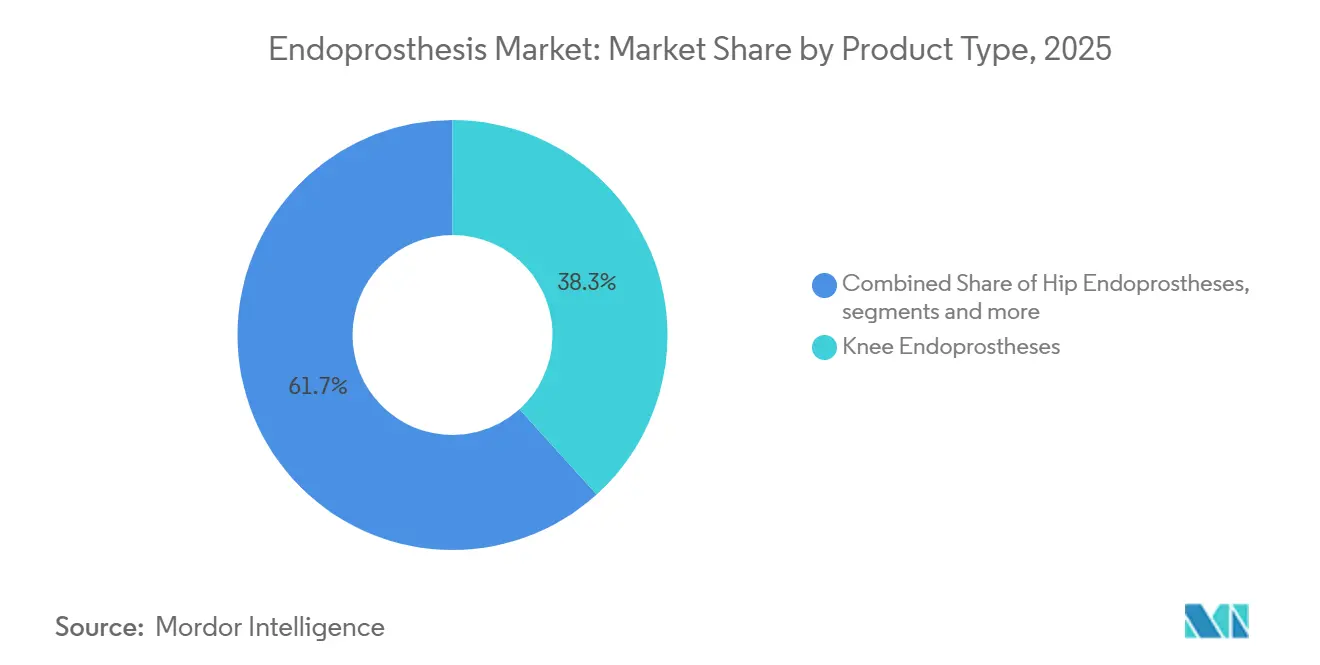
Knee Leads, Hip Gains Ground in Cementless InnovationKnee endoprostheses held 38.26% of the endoprosthesis market share in 2025. The category includes total, partial, revision, and tumor reconstruction options, which support its broad clinical use. Knee osteoarthritis affected 365 million people globally in 2019 and provides a large procedure base for the category. Demand is tied to a condition that often advances over time and can require replacement when nonoperative care is no longer effective. The category also benefits from extensive surgeon training and well-developed care pathways. Its scale makes it central to purchasing decisions at hospitals, orthopedic clinics, and ambulatory surgical centers.
Hip endoprostheses are forecasted to grow at 12.15% CAGR through 2031. Growth is linked to cementless fixation and bearing surface developments that address compromised bone and longer patient life expectancy. Shoulder replacement is also gaining attention as robotic platforms expand to upper-extremity procedures. Stryker placed Mako Shoulder into full commercial release in March 2026, combining planning software, robotic technology, and compatible reversed shoulder implants. Smaller joints remain lower-volume categories, but their complexity can support higher unit values and more specialized clinical requirements.

By Procedure:
Partial Replacement Gains Surgical MomentumTotal replacement procedures accounted for 40.16% of the endoprosthesis market in 2025. They remain the common choice for advanced hip and knee osteoarthritis because clinical practice, surgeon training, and reimbursement are well established. The procedure has a broad implant portfolio and a large installed base of experienced surgeons. Revision procedures account for less volume but require more complex implants and greater operating expertise. These cases are likely to remain concentrated in academic centers and specialized hospitals.
Partial replacement is forecasted to expand at 12.64% CAGR through 2031. Its growth reflects greater confidence in bone-conserving approaches for selected patients who may need future revision options. Such data gives surgeons and procurement teams a clearer basis for comparing revision risk across devices. Resurfacing remains more limited because registry findings have raised concerns about adverse tissue reactions associated with metal-on-metal bearings. Salvage and tumor reconstruction cases are increasingly using custom additive manufacturing when standard implants cannot match the patient’s anatomy.
By Indication:
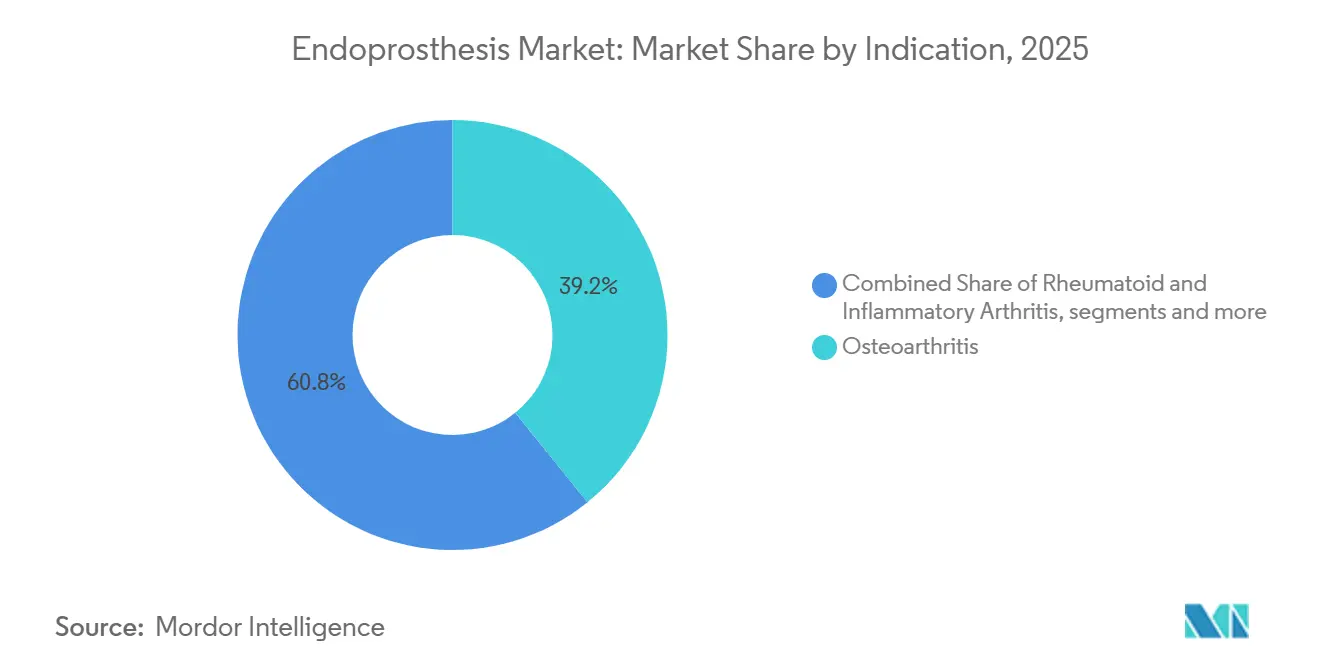
Osteoarthritis Anchors Volume, Trauma Shapes the Next Growth FrontierOsteoarthritis accounted for 39.16% of the endoprosthesis market share in 2025. It remains the leading reason for elective hip and knee replacement across regions. The World Health Organization states that osteoarthritis affects hundreds of millions of people and can cause pain, disability, and reduced mobility. This pattern provides a stable base for primary procedures, even as health systems alter where those procedures are performed. It also reinforces the value of reliable long-term implant data in populations that live longer after surgery.
Traumatic arthritis and fracture are the fastest-growing indications and are forecasted to expand at 13.47% CAGR through 2031. It is linked to younger, active patients and to regions where road injuries and occupational injuries are significant. Post-traumatic bone loss and congenital deformity represent smaller volumes, but they often require modular or patient-specific implants. Rheumatoid and inflammatory arthritis can require specialized designs because bone damage may be more severe, and patients may be younger.
By End-User:
Hospitals Lead, Orthopedic Clinics AccelerateHospitals and surgical centers held 42.23% of the endoprosthesis market in 2025. They remain essential for complex primary procedures, revisions, tumor reconstruction, and patients who need extensive post-operative support. Hospital procurement also remains important in markets where centralized purchasing determines product access. Larger institutions can use registry evidence and volume data to standardize implant choices.
Orthopedic clinics are forecasted to grow at an 11.73% CAGR through 2031. Specialization allows musculoskeletal practices to establish dedicated operating rooms and affiliations with ambulatory surgical centers. Outpatient recovery protocols also move more follow-up and rehabilitation coordination outside the hospital. The endoprosthetics industry is consequently serving a broader set of purchasers and care settings than it did when hospital inpatient care dominated joint replacement.
Geography Analysis
North America Endoprosthesis Market
North America held 47.34% of the endoprosthesis market share in 2025. The region is supported by high procedure volumes, broad premium implant adoption, and early use of robotic systems. Outpatient primary total knee procedures reached 54% of U.S. procedures in 2024, which shows how strongly site-of-care choices are changing purchasing requirements. The United States remains the largest source of regional volume, while Canada provides predictable demand through provincial systems with stricter price conditions. Mexico is expanding orthopedic capacity through private hospital networks in large cities. These differences require manufacturers to balance premium technology offerings with pricing and reimbursement realities across the region.
Europe Endoprosthesis Market
Europe is a major endoprosthesis market because Germany, the United Kingdom, France, Italy, and Spain have mature orthopedic systems. National joint registries have a strong influence on purchasing by linking implant selection to survivorship evidence. European Medical Device Regulation requirements increase the importance of post-market clinical follow-up for Class III orthopedic implants. The United Kingdom also has separate post-Brexit requirements, which add regulatory work for suppliers. These systems reward manufacturers that can provide consistent evidence across long follow-up periods.
APAC, MEA and South America Endoprosthesis Market
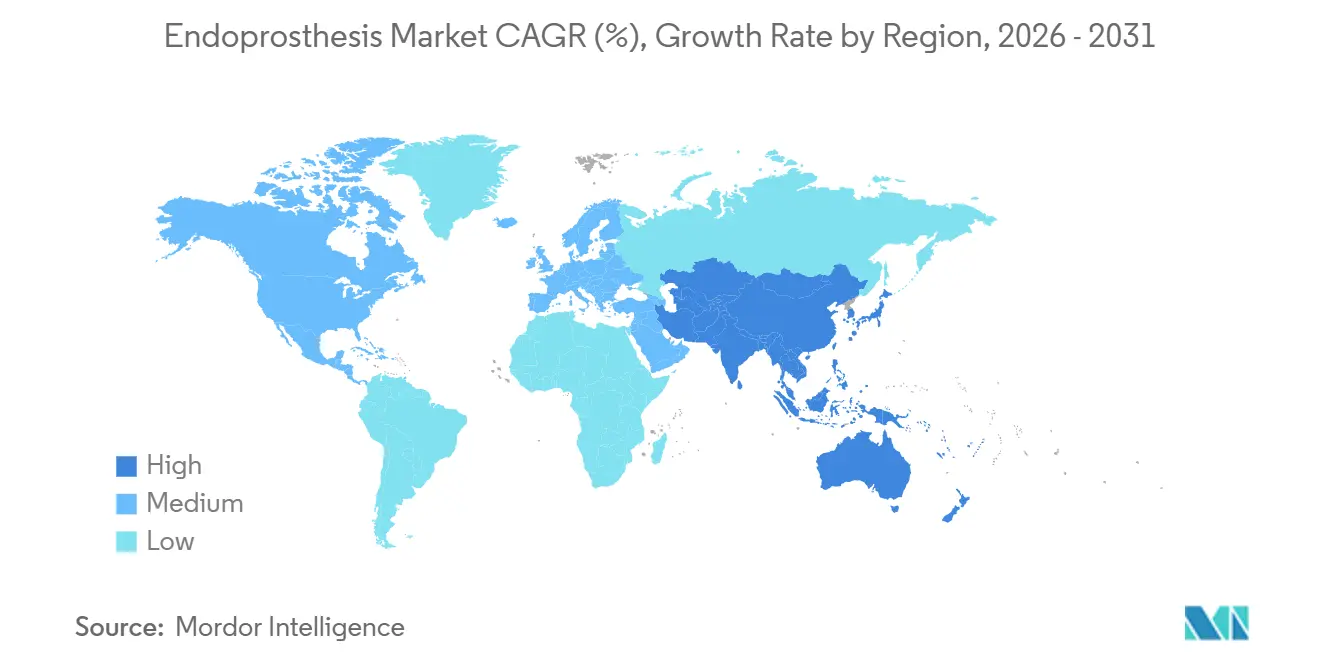
Asia-Pacific is projected to grow at a 14.21% CAGR through 2031, the fastest rate among geographic segments. China, Japan, India, South Korea, and Australia each contribute different demand conditions, from public procurement to premium registry-led selection. China’s centralized procurement policy reduced average knee prosthesis prices by 82% and strengthened domestic joint suppliers by volume. Japan, South Korea, and Australia offer a different opportunity because older populations and established clinical standards support advanced implant adoption. The Middle East, Africa, and South America remain smaller segments, but private hospital expansion, government health investment, road injury exposure, and lower competitive saturation create room for carefully priced offerings.
Competitive Landscape
The endoprosthesis market has moderate concentration, with Stryker, Zimmer Biomet, and Johnson & Johnson through DePuy Synthes as major competitors. Stryker recorded USD 9.5 billion in orthopedic revenue in 2025, including USD 2.7 billion from knees and USD 1.9 billion from hips. Its Mako platform links surgical planning, robotics, instruments, and implants, which helps maintain relationships with accounts that invest in the system. The endoprosthesis market is thus increasingly shaped by an ecosystem sale rather than a simple implant sale. Suppliers with integrated platforms can compete on workflow as well as implant design.
Zimmer Biomet reported USD 2.1 billion in net sales in the first quarter of 2026, which represented 9.3% year-over-year growth. Johnson & Johnson’s orthopedic segment reached USD 9.2 billion in 2025 but grew 1.1%, indicating greater pressure in its core franchise. Smith+Nephew, Medacta, LimaCorporate, Conformis, and Corin compete through precision fit, materials, and procedure-specific approaches. This creates room for focused suppliers, although broader platform leaders retain advantages in training and account coverage.
Patient-specific reconstruction remains an important area of competition for specialized suppliers. Custom 3D-printed reconstruction systems are intended for cases where standard implants cannot provide the needed anatomical fit. Long-term outcomes are also becoming a competitive tool, as shown by the 20-year survivorship evidence reported for OXINIUM technology. Domestic Chinese manufacturers add price competition in their home market following centralized procurement. Quality systems, FDA clearance, and European regulatory requirements remain meaningful barriers to entry in highly regulated markets.
Endoprosthesis Industry Leaders
-
Zimmer Biomet Holdings, Inc.
-
Stryker Corporation
-
Johnson & Johnson Services, Inc.
-
Smith+Nephew plc
-
Enovis Corporation
- *Disclaimer: Major Players sorted in no particular order
Endoprosthesis Market Companies Covered in this Report
- Acumed
- Aesculap
- Arthrex
- B. Braun
- Conformis, Inc.
- Corin Group
- DJO Global
- Enovis Corporation
- Enovis' DJO Surgical
- Exactech
- Globus Medical
- Johnson & Johnson
- LimaCorporate S.p.A.
- Medacta International SA
- MicroPort
- Orthofix
- Shoulder Innovations, Inc.
- Smith+Nephew plc
- Stryker
- Zimmer Biomet
Recent Industry Developments in Endoprosthesis Market
- July 2026: Stryker commercially launched Mako RPS (Robotic Power System) for total knee replacement, introducing a handheld robotics platform compatible with the Triathlon Total Knee System and specifically designed for use in ambulatory surgical centers, significantly expanding Mako's addressable customer base beyond large hospital systems. The launch marks the debut of the Mako Handheld Robotics platform and integrates intraoperative planning with a robotically enabled saw.
- June 2026: Smith+Nephew completed its first clinical cases with the CORI XT Handheld Robotics Platform across knee and shoulder arthroplasty in both hospital and ASC settings, marking the multi-specialty clinical introduction of its most advanced robotics system and establishing CORI XT as a single handheld platform intended to serve partial-to-revision knee, hip, and shoulder arthroplasty procedures.
- April 2026: Medacta extended its MyImplant platform to hip reconstruction, launching custom 3D-printed hip implants produced via its in-house 3D Metal additive manufacturing technology, targeting complex acetabular reconstruction cases with extensive bone loss and providing patient-specific screw configurations and trajectories designed to improve primary stability.
Global Endoprosthesis Market Report Scope
According to the report’s scope, the endoprosthesis market is for surgically implanted prosthetic devices that replace or support damaged body parts (e.g., hips, knees, shoulders, dental, or cardiovascular structures). It is driven by aging populations, chronic diseases, and advances in biomaterials.
The endoprosthesis market is segmented into product type, procedure, indication, end-user, and geography. By product type, the market is segmented into knee endoprostheses, hip endoprostheses, shoulder endoprostheses, ankle endoprostheses, elbow endoprostheses, and other product types. By procedure, the market is segmented into total replacement, partial replacement, revision replacement, resurfacing, and salvage and tumor reconstruction. By indication, the market is segmented into osteoarthritis, rheumatoid and inflammatory arthritis, traumatic arthritis and fracture, post-traumatic bone loss, congenital deformity, and other indications. By end-user, the market is segmented into hospitals and surgical centers, ambulatory surgical centers, orthopedic clinics, and specialty and rehabilitation clinics. By geography, the market is segmented into North America, Europe, Asia-Pacific, the Middle East and Africa, and South America. The report also covers the estimated market sizes and trends for 17 countries across major regions globally. The report offers values (USD) for all the above segments.
Segmentation Overview
| Knee Endoprostheses |
| Hip Endoprostheses |
| Shoulder Endoprostheses |
| Ankle Endoprostheses |
| Elbow Endoprostheses |
| Other Product Types |
| Total Replacement |
| Partial Replacement |
| Revision Replacement |
| Resurfacing |
| Salvage and Tumor Reconstruction |
| Osteoarthritis |
| Rheumatoid and Inflammatory Arthritis |
| Traumatic Arthritis and Fracture |
| Post-Traumatic Bone Loss |
| Congenital Deformity |
| Other Indications |
| Hospitals and Surgical Centers |
| Ambulatory Surgical Centers |
| Orthopedic Clinics |
| Specialty and Rehabilitation Clinics |
| North America | United States |
| Canada | |
| Mexico | |
| Europe | Germany |
| United Kingdom | |
| France | |
| Italy | |
| Spain | |
| Rest of Europe | |
| Asia-Pacific | China |
| Japan | |
| India | |
| Australia | |
| South Korea | |
| Rest of Asia-Pacific | |
| Middle East and Africa | GCC |
| South Africa | |
| Rest of Middle East and Africa | |
| South America | Brazil |
| Argentina | |
| Rest of South America |
| By Product Type | Knee Endoprostheses | |
| Hip Endoprostheses | ||
| Shoulder Endoprostheses | ||
| Ankle Endoprostheses | ||
| Elbow Endoprostheses | ||
| Other Product Types | ||
| By Procedure | Total Replacement | |
| Partial Replacement | ||
| Revision Replacement | ||
| Resurfacing | ||
| Salvage and Tumor Reconstruction | ||
| By Indication | Osteoarthritis | |
| Rheumatoid and Inflammatory Arthritis | ||
| Traumatic Arthritis and Fracture | ||
| Post-Traumatic Bone Loss | ||
| Congenital Deformity | ||
| Other Indications | ||
| By End-User | Hospitals and Surgical Centers | |
| Ambulatory Surgical Centers | ||
| Orthopedic Clinics | ||
| Specialty and Rehabilitation Clinics | ||
| By Geography | North America | United States |
| Canada | ||
| Mexico | ||
| Europe | Germany | |
| United Kingdom | ||
| France | ||
| Italy | ||
| Spain | ||
| Rest of Europe | ||
| Asia-Pacific | China | |
| Japan | ||
| India | ||
| Australia | ||
| South Korea | ||
| Rest of Asia-Pacific | ||
| Middle East and Africa | GCC | |
| South Africa | ||
| Rest of Middle East and Africa | ||
| South America | Brazil | |
| Argentina | ||
| Rest of South America | ||
Key Questions Answered in the Report
What is driving demand for endoprosthesis market?
Aging populations and rising osteoarthritis are the main demand factors. The market is forecasted to grow from USD 26.77 billion in 2025 to USD 29.56 billion in 2026 to reach USD 50.07 billion by 2031 at an 11.12% CAGR through 2031.
Which product category leads endoprosthesis sales?
Knee endoprostheses led with 38.26% share in 2025, supported by the high global burden of knee osteoarthritis.
Which procedure is growing fastest in joint replacement?
Partial replacement is forecasted to expand at 12.64% CAGR through 2031 as bone-conserving options gain clinical support.
Which region will grow fastest through 2031?
Asia-Pacific is forecasted to grow at a 14.21% CAGR, supported by demand in China, Japan, India, South Korea, and Australia.