
Employer Branding Services Market Size and Share
Market Overview
| Study Period | 2020 - 2031 |
|---|---|
| Market Size (2026) | USD 2.13 Billion |
| Market Size (2031) | USD 3.62 Billion |
| Growth Rate (2026 - 2031) | 11.19 % |
| Fastest Growing Market | Asia-Pacific |
| Largest Market | North America |
| Market Concentration | Medium |
Major Players *Disclaimer: Major Players sorted in no particular order Image © Mordor Intelligence. Reuse requires attribution under CC BY 4.0. | |
Employer Branding Services Market Analysis by Mordor Intelligence
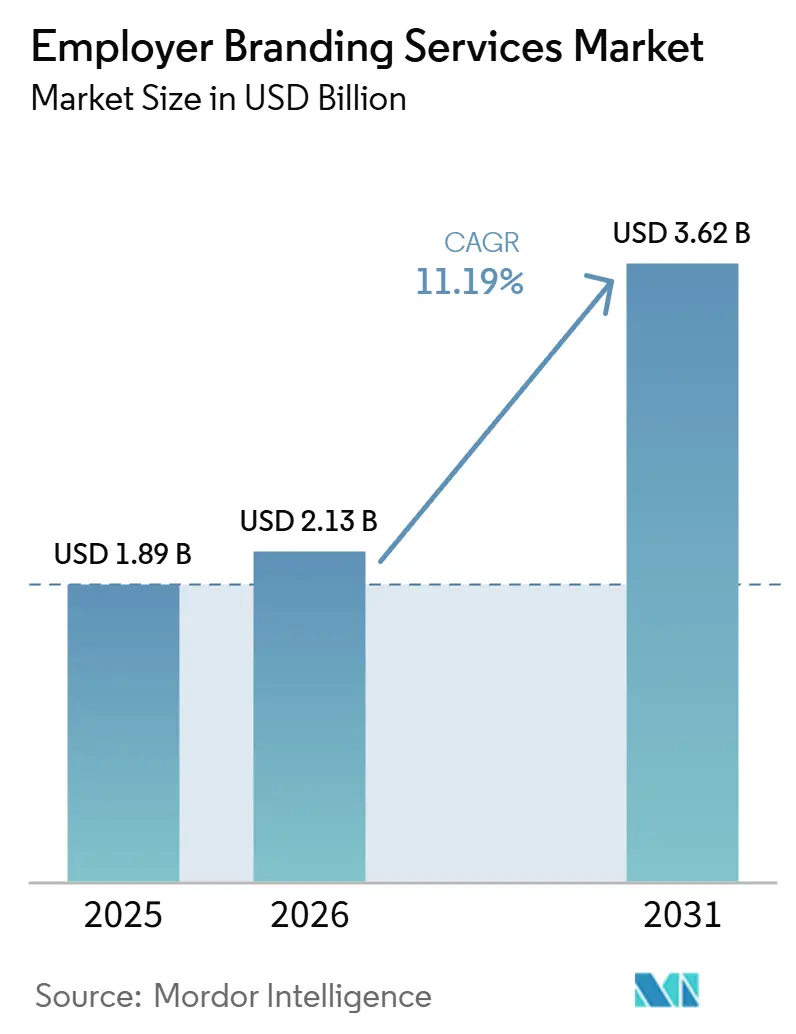
The Employer Branding Services Market size was valued at USD 1.89 billion in 2025 and estimated to grow from USD 2.1 billion in 2026 to reach USD 3.62 billion by 2031, at a CAGR of 11.19% during the forecast period (2026-2031). Talent shortages in AI, cloud, digital, and customer-facing roles are making employer reputation a more material part of recruitment planning. Candidates increasingly examine employers through AI tools, review platforms, and social channels before engaging with a job description. This has broadened the Employer Branding Services Market beyond campaign services and job advertising to include continuous reputation management, content, and measurement. Providers are responding with integrated tools that connect career-site performance, candidate experience, and recruitment outcomes. Budget scrutiny remains important because buyers need to demonstrate how brand activity contributes to applications, accepted offers, and retention.
Key Report Takeaways
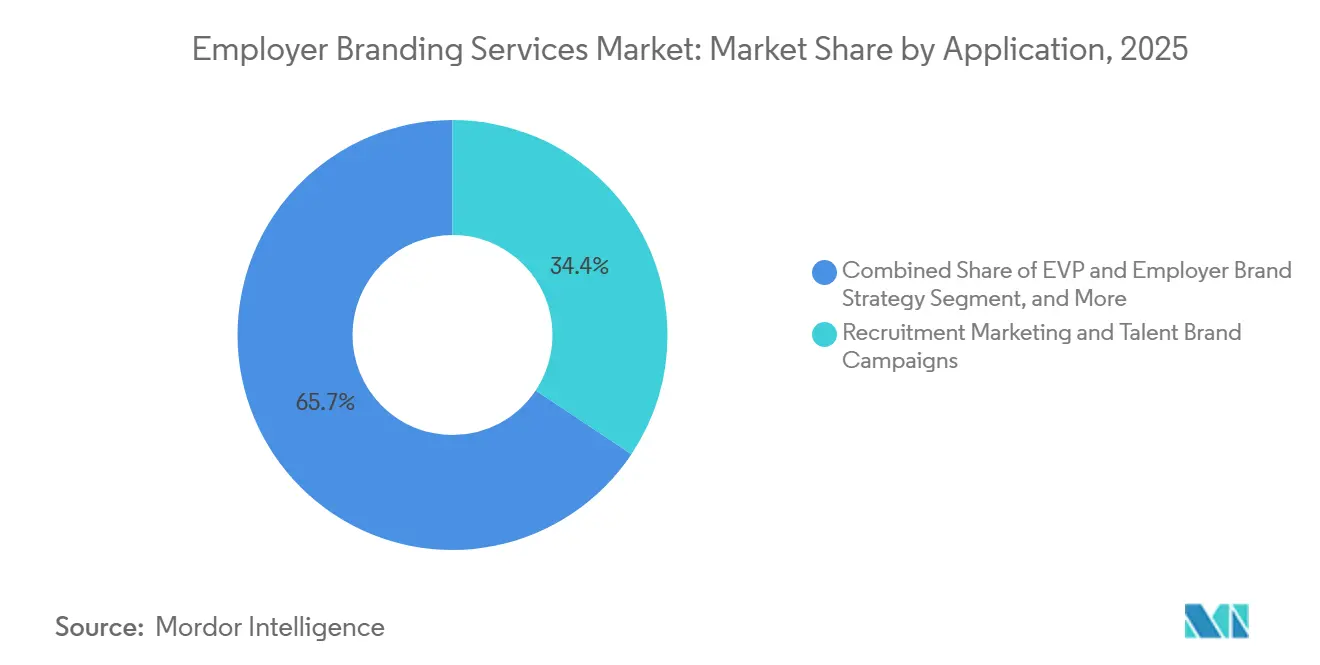
- By Application, Recruitment Marketing and Talent Brand Campaigns held 34.35% of the Employer Branding Services Market share in 2025, while Employer Reputation Monitoring and Analytics is projected to expand at an 11.98% CAGR through 2031.
- By organization size, Large Enterprises held 69.28% of revenue in 2025, while SMEs are projected to record the highest CAGR of 12.52% through 2031.
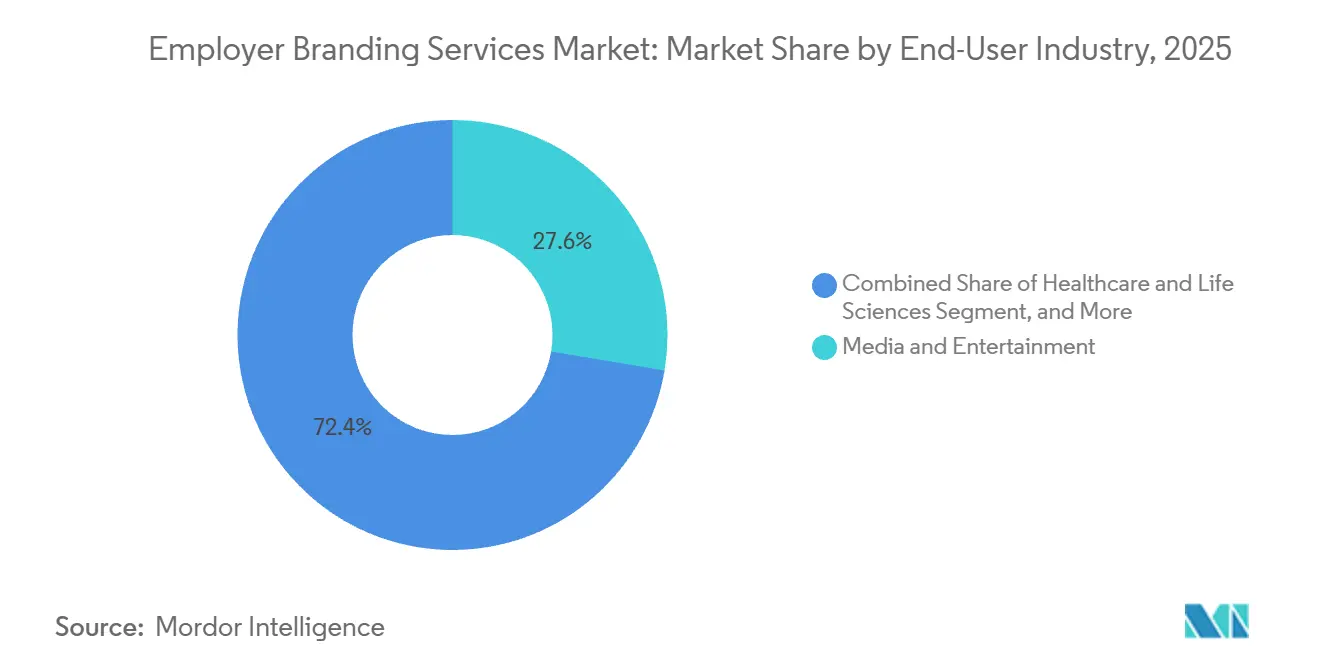
- By end-user industry, Media and Entertainment accounted for 27.64% of revenue in the Employer Branding Services Market 2025, while Healthcare and Life Sciences are projected to expand at a 12.34% CAGR through 2031.
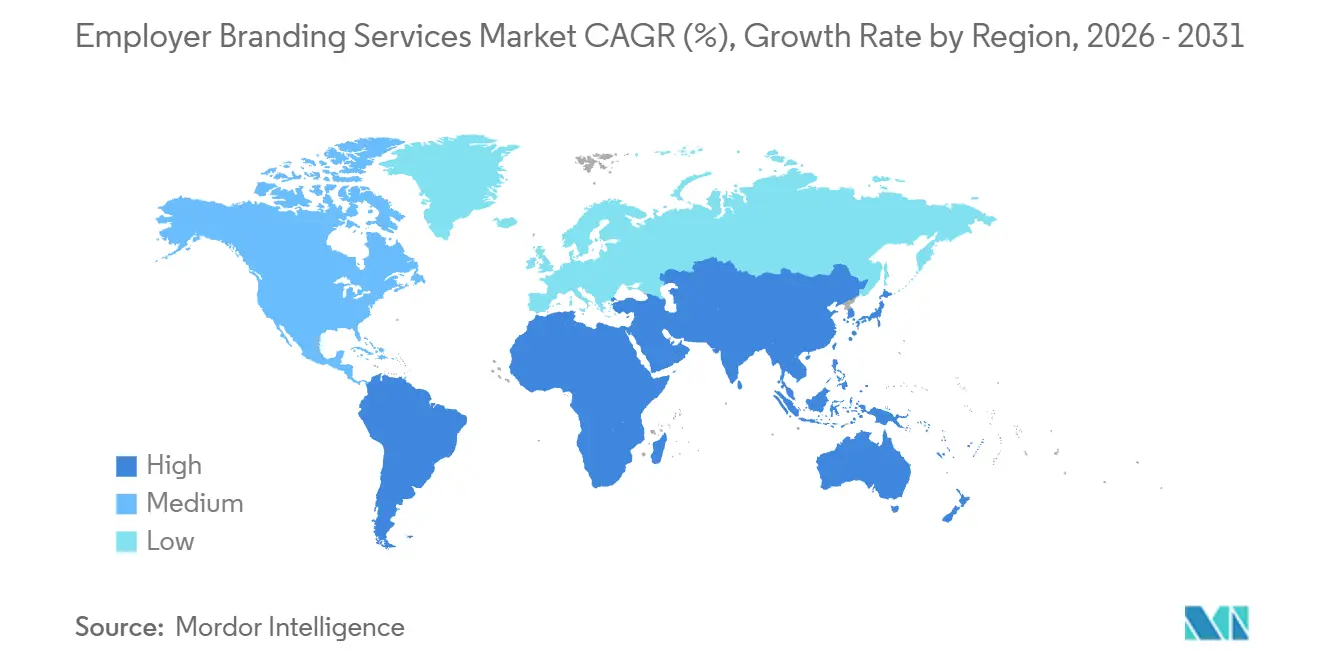
- By geography, North America held 41.42% of global revenue in 2025, while Asia-Pacific is projected to grow at a 12.31% CAGR through 2031.
Note: Market size and forecast figures in this report are generated using Mordor Intelligence’s proprietary estimation framework, updated with the latest available data and insights as of January 2026.
Global Employer Branding Services Market Trends and Insights
Drivers Impact Analysis*
| Driver | (~) % Impact on CAGR Forecast | Geographic Relevance | Impact Timeline |
|---|---|---|---|
| Intensifying Scarcity for AI, Digital, and Customer-Facing Talent | +3.2% | Global, with pronounced intensity in North America, Western Europe, and Asia-Pacific technology corridors | Long term (≥ 4 years) |
| Shift to Skills-Based Hiring and Internal Mobility Messaging | +2.0% | Global, with early acceleration in North America, Australia, and Northern Europe | Medium term (2-4 years) |
| Need to Prove Recruiting ROI and Lower Cost Per Hire | +1.5% | Global, with highest budget scrutiny in North America and Northern Europe | Medium term (2-4 years) |
| Expansion of Review-Led and Social-Led Candidate Research | +1.2% | North America, Europe, and digitally mature Asia-Pacific markets | Short term (≤ 2 years) |
| AI Search Visibility as an Employer Brand Battleground | +1.0% | Global, initially concentrated in English-language markets | Short term (≤ 2 years) |
| Leadership and Layoff Narrative Management | +0.8% | Global, with acute exposure in technology, media, and financial services | Short term (≤ 2 years) |
| Source: Mordor Intelligence | |||
Intensifying Scarcity for AI, Digital, and Customer-Facing Talent
A persistent gap between demand for specialized talent and the available workforce supports the Employer Branding Services Market. ManpowerGroup reported that 82% of employers in India struggled to find the skills they needed in 2026.[1]ManpowerGroup, “2026 Global Talent Shortage,” ManpowerGroup, manpowergroup.com The shortage is particularly visible in AI engineering, cloud architecture, and digital customer experience roles. In these roles, the quality of technical work, learning opportunities, and career development can influence the choice between similar job offers. Companies that maintain a credible employer proposition can develop talent relationships before an immediate vacancy arises. This creates a longer-term advantage that cannot be matched by higher pay alone or short recruitment campaigns.
Shift to Skills-Based Hiring and Internal Mobility Messaging
Skills-based hiring is changing the content employers use to explain roles and career opportunities. NACE data cited in the supplied material indicated that 85% of companies had adopted this approach by 2025, compared with 60% in 2024. The Employer Branding Services Market therefore benefits when employers need to explain skills pathways rather than present fixed job descriptions. LinkedIn research stated that skills-based hiring can expand the addressable talent pool by up to 6.1 times.[2]LinkedIn Talent Solutions, “Skills-Based Hiring and Talent Pool Expansion,” LinkedIn, mihcm.com Employer messages now need evidence on internal moves, reskilling programs, and career changes. Organizations with specific examples can make development claims more credible than those that rely on broad cultural statements.
Need to Prove Recruiting ROI and Lower Cost Per Hire
The Employer Branding Services Market is also shaped by pressure to show a clear return on recruitment spending. The supplied material stated that the average cost per hire was USD 4,700 before productivity losses and manager time. It also cited LinkedIn data showing that strong talent brands attracted 2.5 times more applicants and reduced cost per hire by 43%. Buyers need reporting that connects brand exposure with applications, offer acceptance, and retention. Without this connection, investment can be treated as a discretionary communications expense. Providers that integrate brand metrics with applicant tracking systems are better placed to address this requirement.
Expansion of Review-Led and Social-Led Candidate Research
Candidate research has shifted toward employee reviews, social media discussions, and other third-party sources. Glassdoor reported that 57% of its users had a better perception of an employer after seeing it respond to a review.[3]Glassdoor, “Your 2026 Employer Branding Roadmap,” Glassdoor, glassdoor.com The Employer Branding Services Market benefits from this change, as review engagement becomes part of routine reputation management. The supplied research also stated that 86% of French candidates researched an employer before applying in 2025. Reviews can expose a gap between public employer messages and employee experience. Employers, therefore, need responses and content that are specific, timely, and consistent with workplace practice.
Restraints Impact Analysis*
| Restraint | (~) % Impact on CAGR Forecast | Geographic Relevance | Impact Timeline |
|---|---|---|---|
| ROI Attribution and Budget Scrutiny | -1.0% | Global, most acute in North America and Northern Europe | Medium term (2-4 years) |
| Data Privacy, AI Governance, and Consent Complexity | -0.8% | Concentrated in Europe and spreading to Asia-Pacific through local requirements | Long term (≥ 4 years) |
| Employer Branding Ownership Within Talent Acquisition | -0.5% | Global, with acute exposure in mid-market and SME segments | Medium term (2-4 years) |
| Unmanaged Third-Party Content Volatility | -0.4% | Global, with highest severity in English-language digital markets | Short term (≤ 2 years) |
| Source: Mordor Intelligence | |||
ROI Attribution and Budget Scrutiny
ROI attribution limits the pace at which many programs can expand. The supplied Built In research found that 45% of talent acquisition leaders identified limited budgets as their leading barrier, while 41% considered their teams fully resourced. Employer branding affects several stages of the hiring process and may influence decisions over 18-24 months. Simple attribution methods can therefore understate their contribution. Mid-market organizations face the same measurement issue as large enterprises, but have fewer analytics resources. The Employer Branding Services Market will be constrained when providers cannot link employer activity to hiring and retention outcomes.
Data Privacy, AI Governance, and Consent Complexity
Privacy and AI governance requirements increase the complexity of technology-enabled employer branding. Employment and recruitment AI systems are classified as high risk under the EU AI Act, according to the research provided. This places greater emphasis on risk management, data governance, human oversight, and documented processes. The August 2, 2026, compliance deadline increased work for vendors and employers operating in Europe. Cross-border employers must also address local requirements governing candidate data and automated employment tools. These obligations can slow procurement, especially for organizations without dedicated legal and privacy teams.
*Our forecasts treat driver/restraint impacts as directional, not additive. The impact forecasts reflect baseline growth, mix effects, and variable interactions.
Segment Analysis
By Application: Reputation Intelligence Gains Ground as Campaign Spending Matures
Recruitment Marketing and Talent Brand Campaigns held 34.35% of the Employer Branding Services Market share in 2025. The category has visible operating metrics, including applications per dollar, cost per click, and offer acceptance rates, that align with established recruitment budgets and make campaign spending easier to review. EVP and Employer Brand Strategy is usually an upstream consulting activity that sets the proposition and message architecture before campaign delivery. Career Experience and Content Development supplies the employee stories, career-site material, advertising, and candidate communications used across recruitment channels. These connected activities explain why campaign services retain a leading position even as employers broaden their requirements.
Employer Reputation Monitoring and Analytics is projected to record the highest CAGR of 11.98% through 2031. This part of the Employer Branding Services Market addresses the growing importance of third-party reviews, social content, and AI-generated employer summaries that candidates may encounter before visiting a career site. The supplied Appcast release stated that 95% of job seekers who clicked a job advertisement did not complete an application. Monitoring tools can identify where candidates leave the process, which channels produce weaker engagement, and where employer messages differ from outside discussion. The 2026 launch of Caliber Talent 360 reflected a shift from periodic surveys toward continuous visibility to guide content, media allocation, and candidate-experience decisions.[4]Appcast, “Appcast Expands Its Recruitment Marketing Platform With Career Sites Built for the AI Era,” Appcast, prnewswire.com



By Organization Size: SME Adoption Narrows the Strategy Gap
Large Enterprises accounted for 69.28% of revenue in 2025. Their multinational hiring operations, dedicated employer brand teams, and larger budgets support full-service agency and platform relationships across several countries and role groups. High recruitment volumes spread platform costs across more open positions, while language, location, and candidate-persona requirements justify the use of sophisticated analytics and multilingual content. These organizations also need a consistent employer narrative across many hiring managers, business units, and candidate touchpoints. This makes an integrated service approach more practical than a series of unrelated campaigns.
SMEs are projected to grow at a 12.52% CAGR through 2031. The Employer Branding Services Market opportunity in this group comes from lower-cost software and the recognition that talent competition affects businesses of every size, even where dedicated brand teams are absent. The supplied material cited a 2026 benchmark in which 34% of small and medium-sized businesses had a formal employer branding strategy, compared with 78% of enterprises. A 2026 peer-reviewed study of Indian MSMEs found that development-oriented practices were the strongest predictor of employer brand strength, with β = 0.42. Services that emphasize training, skills development, and career progression can therefore be more relevant for these buyers than broad awareness campaigns.
By End-User Industry: Media Scale and Healthcare Urgency Shape Demand
Media and Entertainment held 27.64% of revenue in 2025, the largest share among end-user industries. The sector competes for creative, technical, and AI-skilled workers across streaming, gaming, animation, and digital advertising, so role content must explain both creative scope and technology exposure. A 2025 peer-reviewed study reported that 48% of Indian media and entertainment employers increased headcount in the first half of fiscal year 2025. Netflix launched INKubator, a generative AI-native animation studio, while JioHotstar pursued more than 75 AI roles in 2026, adding pressure to attract workers with overlapping capabilities. Retail and e-commerce, travel and hospitality, and consumer goods also create demand as digital commerce and service hiring continue to require clear employer differentiation.
Healthcare and Life Sciences are projected to grow at a 12.34% CAGR through 2031. The Employer Branding Services Market size for this segment is supported by clinical workforce shortages and high turnover costs, which make recruitment and retention communication more directly connected to operating performance. NSI Nursing Solutions reported a U.S. shortage of 158,600 registered nurses, an 8.6% RN vacancy rate, and a USD 60,090 turnover cost for each bedside RN in 2026. Magnet-recognized hospitals had a 7.3% RN vacancy rate, compared with the national 8.6% rate, and filled experienced RN positions in 68 days rather than 78 days. Career ladders, apprenticeships, and community partnerships require clear candidate communications that make workplace conditions and development opportunities understandable.
Geography Analysis
North America held 41.42% of global revenue in 2025. The region has extensive adoption of talent acquisition technology, a mature employer value proposition consulting base, and recruitment volumes that support full-suite platforms. The United States remains the largest national contributor, with New York, California, and Texas supporting spending across financial services, technology, and consumer businesses. Canada adds demand through multinational programs headquartered in the region. State-level rules for automated employment tools are also encouraging structured candidate communications and bias-audited content frameworks.
Europe is shaped by GDPR and the EU AI Act, which raise compliance costs but also create demand for services that integrate legal, privacy, and employer-communication requirements. Randstad found that salary and benefits, a pleasant work environment, and work-life balance were the leading factors in employer attractiveness in Belgium and France in 2026. The Employer Branding Services Market in the region consequently includes work on total rewards communication, flexibility messaging, and evidence that supports stated employee commitments. The supplied research stated that 36% of German companies could not fill open positions and that 96% reported recruitment difficulties. The United Kingdom, France, and Nordic countries contribute demand for employer value propositions tailored to local workforce expectations.
Asia-Pacific is projected to expand at a 12.31% CAGR through 2031. ANSR reported in July 2026 that India had more than 1,900 Global Capability Centers employing more than 2.1 million professionals, with over 50% of hiring coming from competing centers. This competition makes a credible employer proposition relevant to both retention and recruitment. A 2025 study covering India, Brazil, and Vietnam found that development practices were the strongest predictor of employer brand strength, with cultural collectivism affecting that relationship. China is increasing attention to privacy-compliant candidate data management under its Personal Information Protection Law audit regime. South America, the Middle East, and Africa are emerging opportunities as formal employer branding practices spread from multinationals to regional organizations.

Competitive Landscape
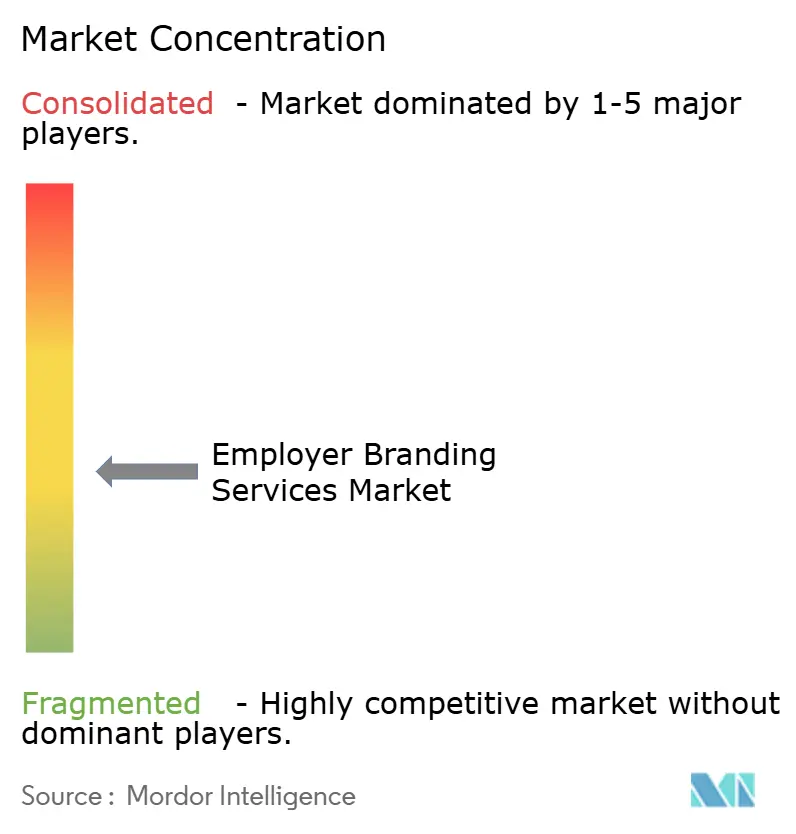
The Employer Branding Services Market is moderately fragmented. LinkedIn, iCIMS, and Radancy have integrated platforms that capture significant enterprise revenue through talent marketing, career sites, and analytics capabilities. Specialized providers compete through employer value proposition strategy, employee advocacy, job-description optimization, and reputation monitoring. Enterprise buyers may favor broader systems to reduce vendor count and achieve unified data across recruitment functions. Other buyers continue to use specialized providers for local, vertical, or specific functional needs.
Leading platforms are expanding AI's role across candidate interactions and employer content. Radancy integrated its services with SAP SuccessFactors using AI-supported orchestration across advertising, career sites, and personalized content in more than 40 languages, according to the supplied material. iCIMS embedded its Coalesce AI capabilities across sourcing, career site management, screening, and scheduling. In July 2026, iCIMS made High Volume Hiring generally available with embedded analytics and career-site content tools. This strategy extends measurable employer-branding capabilities to frontline hiring and places greater emphasis on the link between content, candidate experience, and workflow data.
The Employer Branding Services Market has opportunities in AI search visibility, SME-focused services, and cross-border analytics. The supplied research stated that 91% of talent leaders acknowledged AI's influence on candidate discovery. EveryoneSocial and Sociabble focus on employee advocacy, while Textio and Ongig focus on job-description optimization, and Universum provides employer brand benchmarking data. Great Place To Work uses survey-based certification to provide third-party workplace validation, while Caliber Talent 360 and PerceptionX monitor employer perceptions across ChatGPT, Gemini, and Perplexity. These offerings illustrate why campaign-only measures may be insufficient when third-party signals influence candidate perceptions.
Employer Branding Services Industry Leaders
Great Place To Work Institute, Inc.
Symphony Talent, LLC
Mercer LLC
Adecco Group AG
Universum Communications Sweden AB
- *Disclaimer: Major Players sorted in no particular order

Recent Industry Developments
- July 2026: iCIMS launched its Summer 2026 product release, making iCIMS High Volume Hiring generally available with embedded analytics that deliver visibility into high-volume hiring funnel performance. The release also added career-site content management tools and a broad set of enhancements across sourcing, screening, and scheduling. These changes extended the platform's measurable employer branding capabilities into the frontline workforce segment.
- July 2026: Appcast launched Appcast Career Sites, a performance-driven solution that transforms the career site into a measurable candidate acquisition engine. The solution combines employer brand content delivery with programmatic advertising integration. It directly addressed the finding that 95% of job seekers who click a job posting do not complete an application.
- July 2026: Phenom People was recognized as a Visionary in the 2026 Gartner Magic Quadrant for Talent Acquisition Suites. The company ranked among the top 4 vendors across every evaluated recruiting use case. The recognition cited its use of agentic AI to automate hiring workflows, improve candidate experience, and scale employer brand touchpoints across enterprise recruitment.
- May 2026: A Nucleus Research study found that iCIMS customers attracted 49% more applicants per open role and converted them at higher rates than market benchmarks. The study linked this performance to the company's integrated career site, CXM automation, and AI intelligence layer. It connected platform investment to measurable employer brand performance.


Global Employer Branding Services Market Report Scope
The employer branding services market refers to professional services that help organizations build, promote, and manage their reputation as an employer of choice. This includes developing employee value propositions (EVPs), executing recruitment marketing campaigns, creating career site content, and monitoring employer reputation and analytics. Catering to organizations of all sizes across industries such as retail, healthcare, and IT, these services enable businesses to attract top talent, enhance employee engagement, and reduce recruitment costs by establishing a compelling and authentic workplace brand.
The Employer Branding Services Market Report is Segmented by Application (EVP and Employer Brand Strategy, Recruitment Marketing and Talent Brand Campaigns, Career Experience and Content Development, Employer Reputation Monitoring and Analytics, and Others Applications), Organization Size (Large Enterprises, and Small and Medium-Sized Enterprises), End User Industry (Retail and E-commerce, Media and Entertainment, Healthcare and Life Sciences, Travel and Hospitality, Consumer Goods, and Other End User Industries (BFSI, Education, Automotive, and IT and Telecom amongst Others)), and Geography (North America, South America, Europe, Asia-Pacific, Middle East, and Africa). The Market Forecasts are Provided in Terms of Value (USD).
| EVP and Employer Brand Strategy |
| Recruitment Marketing and Talent Brand Campaigns |
| Career Experience and Content Development |
| Employer Reputation Monitoring and Analytics |
| Others Applications |
| Large Enterprises |
| Small and Medium-Sized Enterprises |
| Retail and E-commerce |
| Media and Entertainment |
| Healthcare and Life Sciences |
| Travel and Hospitality |
| Consumer Goods |
| Other End User Industries (BFSI, Education, Automotive, and IT and Telecom amongst Others) |
| North America | United States |
| Canada | |
| Mexico | |
| South America | Brazil |
| Argentina | |
| Chile | |
| Rest of South America | |
| Europe | Germany |
| United Kingdom | |
| France | |
| Italy | |
| Spain | |
| Rest of Europe | |
| Asia-Pacific | China |
| Japan | |
| India | |
| South Korea | |
| Australia | |
| Rest of Asia-Pacific | |
| Middle East | United Arab Emirates |
| Saudi Arabia | |
| Qatar | |
| Rest of Middle East | |
| Africa | South Africa |
| Egypt | |
| Nigeria | |
| Rest of Africa |
| By Application | EVP and Employer Brand Strategy | |
| Recruitment Marketing and Talent Brand Campaigns | ||
| Career Experience and Content Development | ||
| Employer Reputation Monitoring and Analytics | ||
| Others Applications | ||
| By Organization Size | Large Enterprises | |
| Small and Medium-Sized Enterprises | ||
| By End User Industry | Retail and E-commerce | |
| Media and Entertainment | ||
| Healthcare and Life Sciences | ||
| Travel and Hospitality | ||
| Consumer Goods | ||
| Other End User Industries (BFSI, Education, Automotive, and IT and Telecom amongst Others) | ||
| By Geography | North America | United States |
| Canada | ||
| Mexico | ||
| South America | Brazil | |
| Argentina | ||
| Chile | ||
| Rest of South America | ||
| Europe | Germany | |
| United Kingdom | ||
| France | ||
| Italy | ||
| Spain | ||
| Rest of Europe | ||
| Asia-Pacific | China | |
| Japan | ||
| India | ||
| South Korea | ||
| Australia | ||
| Rest of Asia-Pacific | ||
| Middle East | United Arab Emirates | |
| Saudi Arabia | ||
| Qatar | ||
| Rest of Middle East | ||
| Africa | South Africa | |
| Egypt | ||
| Nigeria | ||
| Rest of Africa | ||


Key Questions Answered in the Report
What is the size of the Employer Branding Services Market?
The Employer Branding Services Market was valued at USD 1.89 billion in 2025 and is estimated at USD 2.1 billion in 2026. It is forecast to reach USD 3.62 billion by 2031 at an 11.19% CAGR.
What is driving demand for employer branding services?
The Employer Branding Services Market is supported by shortages in specialized roles, skills-based hiring, review-led candidate research, and pressure to reduce recruitment costs. Employers also need credible evidence on development, workplace experience, and career progression because candidates often compare information from several sources before applying.
Which service type is growing fastest?
Employer Reputation Monitoring and Analytics is projected to grow at an 11.98% CAGR through 2031. The Employer Branding Services Market is using these services to manage reviews, social content, and AI-generated summaries, while identifying the points where candidate interest does not translate into an application.
Which organizations use these services most?
Large Enterprises held 69.28% of revenue in 2025, but SMEs are projected to grow faster at a 12.52% CAGR through 2031. For the Employer Branding Services Market, lower-cost software, modular services, and practical reporting are making adoption more attainable for smaller employers.
Which end-user sector is expanding fastest?
Healthcare and Life Sciences is projected to grow at a 12.34% CAGR through 2031 because of workforce shortages and the cost of clinical turnover. The Employer Branding Services Market serves this need through communications on career ladders, training, community partnerships, and working conditions.
Which region is expected to grow fastest?
Asia-Pacific is projected to grow at a 12.31% CAGR through 2031, supported by talent competition in India, China, Southeast Asia, and Australia. The Employer Branding Services Market benefits as Global Capability Centers and other employers compete for similar skilled workers and seek locally relevant employer messages.
Page last updated on:





